Showing posts with label Tutorial. Show all posts

Sunday, April 1, 2018

Fifth Anniversary - Waterproofing of quilled jhumkas - Tutorial and Review

Hello All,

Thank you so much for all the love you people have showered on us for past 5 years! It has been a roller coaster of a ride but what is life without some adventure thrown in!! Just like every year, we celebrate this anniversary with some love of sharing.........

All the crafters who make quilling jewellery groan (inwardly or otherwise) when their jewellery is compared with readymade, mass manufactured and impersonal alloy jewellery (most of it Made in China). We know the pain! Waterproofing of quilled jewellery has been its Achilles' Heel for a long time and most crafters struggle with answering the question: Will this jewellery get ruined when water falls on it?

We saw the problem for what it was. The customers want to make sure their money is worth it and the cost (of handmade jewellery) is justified too! So, we experimented with a host of resins and coating materials. The wall we kept hitting was: Importing the resin! Most resins available in India either had a short shelf like, or yellowed after some time! Since resin is susceptible to fire, it's transported via ships and that meant long waiting periods!

When Itsy Bitsy announced its line of resin (Lil Birdie: https://goo.gl/2EacL3 ), we seized the opportunity to try it on our quilled jhumkas..........we were a bit apprehensive as the reviews we had received so far said that the resin had a lot of bubbles upon mixing. We have worked around that problem and this video demonstrates how to use the resin on quilled jhumkas....

Happy Quilling Pritesh PS: If my posts inspire you to create something on similar lines, I feel highly flattered. But please, do respect the effort I take in conceptualizing and executing, please give a direct link to my work when you are inspired by mine. Thanks for understanding........:-)


Monday, October 31, 2016

Free tutorial - Adding ghunghroos to a quilled jhumka

Hello All,

HAPPY DIWALI!!!!!!!!!! And Happy Halloween to all those who are celebrating :)

Here comes the tutorial for addition of ghunghroos to a quilled jhumka


The video for the theory is here


For material related to ghunghroo addition, please contact A1 Craft Supplies or check out their Facebook Page

Important notes:

1. Finish all the processes (including waterproofing) before you add ghunghroos. After ghunghroos, it is virtually impossible to waterproof them later (you'll end up clumping ghunghroos). Ghunghroo addition should ideally be the last step, irrespective of the type of jewellery (quilled, layered paper or polymer clay)
2. You can use any ghunghroo beads sizes you like. We've used 4.5 mm beads. The bigger the beads, the smaller the number you'll need and vice versa.
3. Take a fine tip pliers, it'll help prevent loose ghunghroos.
4. This technique works for layered paper jewellery (including Chaand Baalis) and polymer clay too. Feel free to experiment.......

Happy Quilling

Pritesh

PS: If my posts inspire you to create something on similar lines, I feel highly flattered. But please, do respect the effort I take in conceptualizing and executing, please give a direct link to my work when you are inspired by mine. Thanks for understanding........:-)

Tuesday, June 7, 2016

Celebrations and a tutorial...........

Hello All,

It was in late 2012 that I picked up a 1/16 inch punch (I just can't remember why!!!) and was fiddling about with it. Something clicked somewhere in my brain and a jhumka resulted from it. I was very lucky that one of my friends was travelling from USA and she brought that punch for me, but I also knew that it was a speciality tool. By extension, it was expensive! I used it, I recommended it, but I knew it in the heart of my hearts that I was dependent. Dependent on a tool and dependent on my dependence.......

For almost 3.5 years, I've made jhumkas using that technique, but I never stopped wondering how to overcome this dependence. And sometimes, lack of sleep fires my brain up. Today was one such day! Having been thinking about this since Friday or so, the idea finally struck and I set about to work on it. It is an elegant (and cheap) solution, I wonder why it took me forever to come up with it!


So, over to the tutorial:

List of materials:

4 mm jump rings (kindly contact A1 Craft supply for the same)

I tried with smaller and bigger ones, but 4 mm works and looks best. 5 mm is too big to look at. And 3 mm too small to handle while working.

Fevicryl Fabric Glue

This works well enough and is cheaply (and easily) available across the country. I also did an experiment with B6000/E6000 (kindly contact A1 Craft supply for the same). The side effects of the super glue? Expensive, not very healthy to handle (SPECIAL NO NO to pregnant and lactating women and children) and takes time to set. Advantage: The glue is strong and dries transparent.

Prepared quilled dome (I've used a 5 mm strips dome, feel free to experiment)

Paint of your choice

Ghunghroo wire (A1 Craft Supply please)

Beads for ghunghroos (according to your colour scheme and preference)

The steps are illustrated in the series of images below:


The glue can take anything from 4-8 hours to dry completely, please let it dry before you handle the jump rings. Otherwise, they will come off (and they did when I made an attempt).......


Finished look of the dome. Now, go ahead, colour, embellish, paint................unleash your creativity


Paint the inside neatly


Do the waterproofing and Voila! You're DONE! [For waterproofing aids, please ping A1 Craft Supply, they'll help you out]


Add ghunghroos and you'll have a jhumka that looks almost like clay :)

A strong word of warning against people who want to walk away with the credit for a lot of things that began at Art'zire, a tweak or two in our technique is STILL derivative work. If you're a true crafter, you'd much rather think on your own. And certainly, won't come to us and blame us of copying your work (which you derived from ours, in the first place). We strongly condemn such underhanded tactics and would pray that God grants you some integrity!


On a lighter note: here is the evolution of the paper jhumka :)

October 25, 2012 :)


June 19, 2015


June 7, 2016


Happy Quilling

Pritesh

PS: If my posts inspire you to create something on similar lines, I feel highly flattered. But please, do respect the effort I take in conceptualizing and executing, please give a direct link to my work when you are inspired by mine. Thanks for understanding........:-)

Friday, April 1, 2016

Basic Earring making tutorial

Hello All,

Often we know how to make the 'rest of the ' quilling jewellery but stumble at making the final metal loops :)


And material for basic earrings........


Here is a guideline on how you can do that :)


Happy Quilling

Pritesh

PS: If my posts inspire you to create something on similar lines, I feel highly flattered. But please, do respect the effort I take in conceptualizing and executing, please give a direct link to my work when you are inspired by mine. Thanks for understanding........:-)

Sunday, July 26, 2015

Handling Casting Resin - A series of free tutorials

Hello All,

Here is a series of tutorials for using resin on paper jewellery. The resin is available with A1 Craft Supplies. You can contact them for purchasing the resin. I want to specially thank Richa Kapre of Rock, Paper and Scissor for her generous contribution to the knowledge in resin-handling.

My humble request to all users of resin: Resin handling is an exercise in patience. Hurrying the process with cause blotchy results. Please do read the instructions on your resin packaging carefully.

Part 1 - Preparation of surface for applying resin......

Very often, you are likely to encounter surfaces that have painted and drawn patterns on then. It is always better to cover the surface completely with a clear drying glue (like Fevicryl Fabric Glue, Camlin Crafty Glue or Faber Castell White Glue). Always allow for COMPLETE drying of the glue before you apply resin.


The base(s) can be prepared using the tutorial here.


Part 2 - Mixing Resin

Mixing the resin is the most crucial of all steps in the handling of resin. Unfortunately, very small things can be the make-or-break factors while handling resin. This video shows how one can mix resin. The key is to be patient and work slowly.


Part 3 - Applying resin on Enclosed Surfaces

Resin has most commonly been used for 'filling' up enclosed surfaces to create a "cabochon" like effect. This effect needs resin to be 'filled' in spaces. Though it may sound trivial, these very bubbles (in extreme cases, many small or large bubbles) can bring about "fogginess" to the resin coating and lead to bad finishing.


Part 4 - Popping the Bubbles

No amount of handling carefully can ensure zero bubbles. Mercifully, Richa has worked very hard at developing techniques to dispel these little jewellery spoilers :)


Part 5 - Coating a 3D surface (e.g. a jhumka)

One of the most common question I've been asked so far is, can resin be used to coat quilled jewellery. I'll answer it with a very reserved yes. I don't really know if it can be used on all types of quilling jewellery but it can be used on quilled jhumkas. How? Watch :) [Information courtesy: Richa]


Part 6 - Cleaning a resin coated brush

Since application of resin to a 3D surface needs a brush to be used and one wouldn't want to lose the brush, cleaning of that brush is imperative. Here is the video for how you can clean the brush after using it for coating the 3D surface(s)


Part 7 - Getting "Concave" effect on an enclosed surface


Such quilled outlines can be prepared using the quillography tutorial...........


Part 8 - Getting Concave effect on an unenclosed surface


The videos are property of Pritesh (Art'zire) and Richa (Rock, Paper and Scissor). Please do not report them as your own and whenever sharing, kindly give due credits.

Happy Quilling

 Pritesh

 PS: If my posts inspire you to create something on similar lines, I feel highly flattered. But please, do respect the effort I take in conceptualizing and executing, please give a direct link to my work when you are inspired by mine. Thanks for understanding........:-)

Wednesday, July 8, 2015

Antique finish jhumka - Free Tutorial

Hello All,

Here is a very quick tutorial for getting the antique effect on jhumkas (or any surface, for that matter).......


Step 1: Paint the dome (in any colour). It's painted yellow here, just for the sake of it. Now draw the pattern you wish with the "colour you wish to show above antique finish". For example, if you want antique golden, draw with golden outliner. For antique silver finish, draw with silver 3D outliner. We were targeting antique look with yellow as prominent colour, so yellow 3D outliner was used. In principle, any 3D outliner colour can be used, depending on your requirement. The denser the pattern, the better the antique finish looks.


Step 2: The pattern should be allowed to dry completely, before you do the following processes. You can also use half pearls, available with A1 Craft supply. The key is to allow the 3D outliner to dry completely.


Step 3: Paint the majority colour you wish to see among the antique sub-layer. We've used antique bronze (by Camlin). Make a complete layer above the 3D outliner pattern.


Step 4: Now, dab with pearl black to give an "old and rusted" look. Make only sporadic dabs.


Step 5: On top, make sporadic dabs with antique gold (by Camlin), if you wish, to give a partially antiquated look. 


Step 6: This is an important step. The key here is to use a piece of cloth (or tissue) that isn't too soft or coarse. For example, muslin is too soft but denim is too coarse. We've used an old cotton pant piece. Make the small patch above your index finger damp and scrape gently over the 3D outliner. Do not "wet" the tip, just make it damp enough to scrape off acrylic paint. You'll slowly see the 3D outliner colour emerge from underneath the "antique" colours.


(A video to help)


~~~~~~~~~~~~~~~~~~~~~~~~~~~~~~~~~~~~~~~~~~~~~~~~~~~~~~~~~~~~~~~~

And here is an antique yellow jhumka :) Proceed with waterproofing, as described in the tutorial. You may need to alter the steps to accommodate your specific design, so get experimenting!


The obvious question is: Why so much hassle when one can simply buy an antique looking jhumka? Answer: You can "choose" your antique tone, it's made of paper (ultra-light) AND that it's handmade (there is no parallel to THAT, is there?)........

Happy jhumka decorating :)


Happy Quilling Pritesh PS: If my posts inspire you to create something on similar lines, I feel highly flattered. But please, do respect the effort I take in conceptualizing and executing, please give a direct link to my work when you are inspired by mine. Thanks for understanding........:-)

Tuesday, February 24, 2015

Quilled jhumka, varnish application tutorial

Hello All,

A very quick and short tutorial for applying varnish on a quilled jhumka


So, go ahead, create jhumkas that you love creating :)


Happy Quilling

 Pritesh

PS: If my posts inspire you to create something on similar lines, I feel highly flattered. But please, do respect the effort I take in conceptualizing and executing, please give a direct link to my work when you are inspired by mine. Thanks for understanding........:-)

Saturday, October 25, 2014

Diwali special - Tutorial for attaching studs to quilled tight coils......

Hello All,

Wish you all a very happy (though belated) Diwali. Hope you all had a fun and safe Diwali......

Here's a little tutorial (in response to the queries) for attaching a stud base to a quilled tight coil (as seen in this creation).......


This is bare basics and the material is mentioned in the tutorial, Please use your own ingenuity to try variations, and even better, coming up with your own methods that surpass this.......


Hoping that the tutorial helped.............happy stud-attaching :)

Happy Quilling

Pritesh

PS: If my posts inspire you to create something on similar lines, I feel highly flattered. But please, do respect the effort I take in conceptualizing and executing, please give a direct link to my work when you are inspired by mine. Thanks for understanding........:-)

Friday, September 19, 2014

Inserting head/eye pins in a Quilled Pendant - Tutorial

Hello All,

I am back (only to disappear again, after a while) with a tutorial. I've taken the bold step of making a video against the tide of slow Internet! :D Let us see after how many hours of "Trying to upload" does it go online :)


Many people had this question about how to insert the head/eye pin into a quilled pendant. So, here is how I do it (and it truly is very simple). This is only a guideline video and you're free to devise your own methods, based on what is available with you :)


With this tutorial, I am nearly touching a MILLION views on my blog :)

After a mere 3 years and 1 month of being in existence, I am fortunate enough to see this landmark on my blog. Thank you! Every single one of you :)

Loads of love and keep crafting............

Happy Quilling

Pritesh

PS: If my posts inspire you to create something on similar lines, I feel highly flattered. But please, do respect the effort I take in conceptualizing and executing, please give a direct link to my work when you are inspired by mine. Thanks for understanding........:-)

Monday, May 12, 2014

Hobby Mela Tutorial Video

Hello Everyone,

When Avani called me for a video interview, it sounded too good to be true..........and when she did turn up on my doorstep, it was wonderful! :D Making tutorial videos is hard work, there is loads of planning that goes into it. Avani has worked very hard at editing this video and boy! Am I thankful or what :)

She has done a terrific job with the speeding up parts and the clipping as well......thank you from the bottom of my heart Avani :)

https://www.youtube.com/watch?v=o22KAGmQVx4

Some snapshots.............


Happy Quilling

Pritesh

PS: If my posts inspire you to create something on similar lines, I feel highly flattered. But please, do respect the effort I take in conceptualizing and executing, please give a direct link to my work when you are inspired by mine. Thanks for understanding........:-)

Thursday, April 24, 2014

Quick Video for Using a Mandrel

Hello All,

Here is a little video for using mandrels for making outlines/borders for quilling......


Happy Quilling

Pritesh

PS: If my posts inspire you to create something on similar lines, I feel highly flattered. But please, do respect the effort I take in conceptualizing and executing, please give a direct link to my work when you are inspired by mine. Thanks for understanding........:-)

Wednesday, February 26, 2014

Bead Soutache jewellery base tutorial

Hello All,

I am sure it has happened to many of us that we set out to make a quilled (or otherwise) jewellery but don't have the correct size base. I faced it many times and decided to solve it the punch-craft way. This is the kind of backing that went into this kind of a piece:


and it can be used like this:

 and this:


Following are the step-be-step images of the tutorial.....


These are the things you'll need: Glue, base paper (I've used 160 gsm black paper) punched in the shape of your choice (I've punched 1" circles using Martha Stewart circle punch), scissors, tweezers, a wire "blank" (to create a gap in the jewellery base) and elements to stick on top. It could be half pearls, beads, quilled elements etc.


Stick 4 layers on top of each other (increase or decrease the number depending on the thickness of the paper you're using) by applying glue throughout the surface.


Fold one circle in half


Cut a thin strip from the centre 


Make it as thin as possible, it only needs to be thick enough to accommodate a wire in the centre of the base.


Cut two circles in that manner, creating 4 semi-circles


Apply glue on the semi-circle and stick on the 4-paper-thick disc ready. Make it a point to align the edges properly.


Two layer thick semi-cricle stack will begin to look like this.


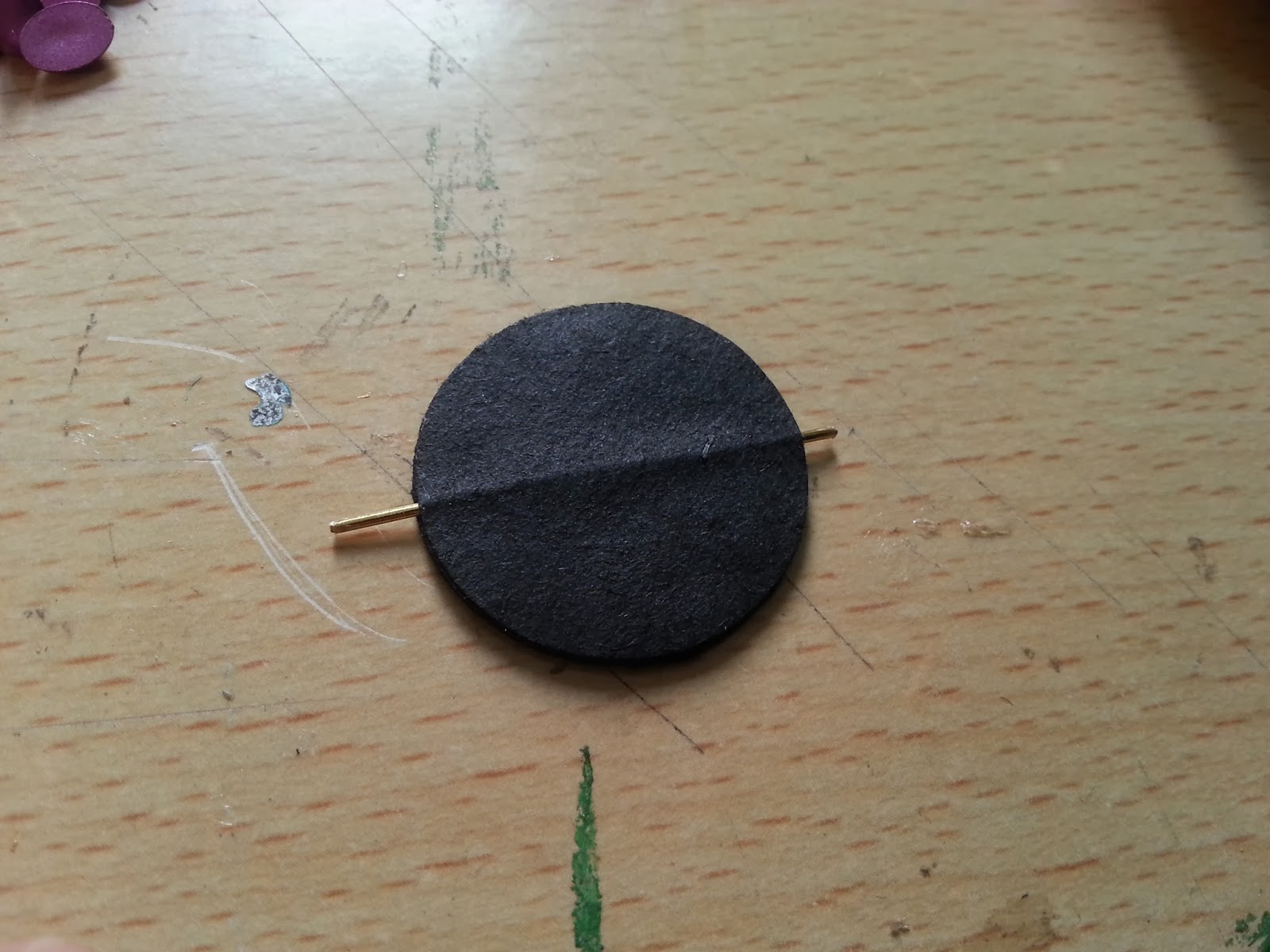
Do a similar step on the other side. Now, the 'groove' in the centre is ready for insertion of a wire.


The idea to insert the wire while making the base is to avoid the "weakness" brought about by sticking the wire to the back of the base. :)


Put glue on the ready base and stick the other 4 layers one by one (the total thickness of the base is 10 layers of 160 gsm paper)


Stick the "central piece" (I've used a 10 mm half pearl , bought from Craft Universe


Start sticking your elements in an "outside to inside" manner. 


And this is how it will end up looking :)


Happy Quilling

Pritesh

PS: If my posts inspire you to create something on similar lines, I feel highly flattered. But please, do respect the effort I take in conceptualizing and executing, please give a direct link to my work when you are inspired by mine. Thanks for understanding........:-)