
 |
| An almost-ripe common persimmon clings to the branch in the cool autumn air... |
 |
| ...beautiful autumn leaves and apricot-colored persimmons from October 13, 2012 at Greenbo Lake State Park in Kentucky. |
Persimmons, whether ripe or unripe contain tannins, which are naturally occurring chemicals that "bind and precipitate proteins" (click here for a detailed description of tannins by Cornell University). When persimmons are unripe, the tannins are diffused freely in the fruit, which means they are "unbound" and will react to to the proteins on our tongues and in our saliva by causing the proteins to coagulate (sucking all the moisture out of our mouths and causing the furry feel that accompanies the horrible drying). When the fruit is ripe, however, the tannins are "bound up" and cannot react or coagulate. Unripe bananas also have a lot of tannins, as well as red wine that has not been aged, and nuts too. Now I know why every now and then I get that dry feeling in my mouth after eating a walnut out of the shell.
If you want to teach your kids about astringency in fruits and plants, click here for an experiment that teaches how to "unpucker" the persimmon. This experiment is labeled easy and is good for grades 5th - 8th. Specifically, it teaches kids how tannins can be bound up (or "defanged") using an iron solution. (Holy cow. I did not know any of this, but even worse, it seems any 5th grader off the street does...)
 |
| When persimmons are ripe, they are wonderful and sweet, and taste a little like an apricot. Even better, though, they can be made into persimmon bread and other yummy things. |
 |
| The four-lobed sepal of a fallen fruit is still attached to the tree next to this persimmon. If the fruit separates easily from the sepal, it is probably ripe. |
 |
| ...persimmons are a favorite food source of raccoons, who seem to always know when the fruit is ripe. We found lots of raccoon scat piles with numerous persimmon seeds in them on our hikes. |
Folklore holds that persimmon seeds can predict the weather. Growing up in Cincinnati, we knew nothing about this amazing secret. We don't have a lot of persimmon trees here. Persimmons are mostly a southern and eastern species, and in all of my rambles, I've never come across one, so it's no wonder we were clueless to its power. It took my Aunt Pat and her family moving to Terre Haute, Indiana years ago to learn the folklore and pass it on to us, so I'm writing this post in her honor and memory. Here is the theory: when you slice open a persimmon seed, the embryo will be in the shape of a spoon, fork, or knife. Each has its own meaning:
Spoon - the winter will be rough with lots of snow. You need a spoon to shovel snow!
Fork - the winter will be light. You can't shovel much with a fork after all.
Knife - the winter will be icy, cutting and cold (yikes!).
 |
| ...a persimmon seed just bursting to let us know what to expect this winter. |
We were hoping for spoons because we love snow, so we were happy to see SPOONS...
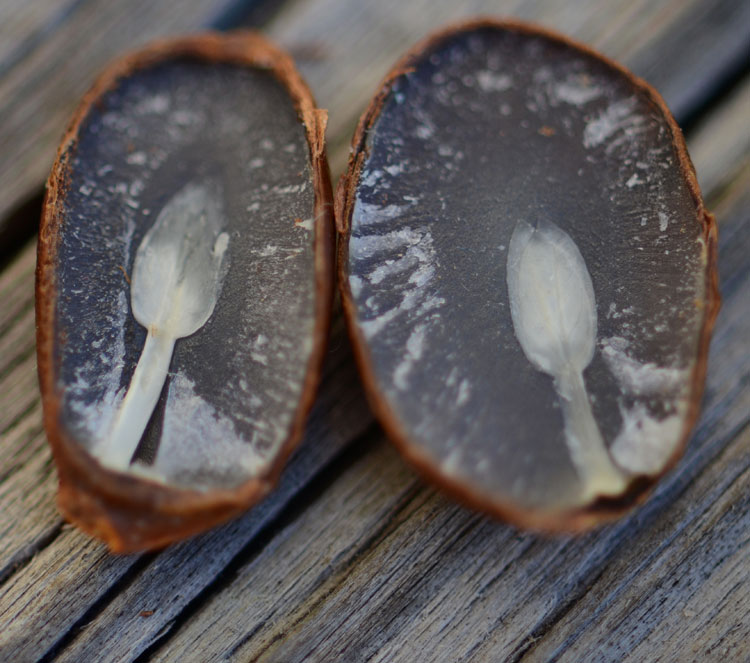 |
| ...the persimmon seeds say SNOW! The embryo on the left is definitely a spoon, which means heavy snow, get shoveling; however, the seed on the right looks suspiciously like a spork. Unfortunately, sporks haven't been accounted for in the folklore, so who knows what's up. Perhaps we will have bouts of heavy snow with days of mild weather thrown in between. We'll take that... |
If we're doing a complete post on persimmons, we can't leave out the bark. It's famous for its look of stacked cubes. You can spot a persimmon tree in the winter just by seeing the crazy bark (on older trees)...
 |
| The famous bark of a Persimmon Tree... |
 |
| ...little blocks of wood stacked up in a pleasing composition. |
 |
| The Cincinnati Champion Persimmon Tree at the Camargo Country Club in Indian Hill My friend, Paul, knew immediately where a champion persimmon tree was in our area. You can see it from the parking lot of the golf course. We walked out on the course to get a closer look. The grounds keeper didn't mind...this tree is famous, huge and old and has lots of visitors... |
 |
| ...the wires running up the sides are lighting rods. It's nice to know the grand old persimmon tree is well protected. |
...this is has been a long post...but there is just so much to say about the beautiful little persimmon. It's fitting the champion tree in Cincinnati is located on a golf course. The tree is part of the ebony family and its wood is very dense and hard. Its wood was a standard for "woods" golf clubs starting in the 1900s (and you can still have persimmon woods made today, source: click here).
Hope everyone had a wonderful Thanksgiving!


 Posts
Posts


