Statistics of Women of Colour Profiles at OkCupid

OkCupid statistically analyzed the profiles of their users and found the phrases that made each racial group distinct:

We selected 526,000 OkCupid users at random and divided them into groups by their (self-stated) race. We then took all these people’s profile essays (280 million words in total!) and isolated the words and phrases that made each racial group’s essays statistically distinct from the others’.

There is a lot of data at the link, but here are the phrases that make groups of women of colour—Asian women, Pacific Islander women, Indian women, Middle Eastern women, Black women, Latina women—distinct. (For some reason, all female groups except for White women and Indian women really like Alicia Keys.)
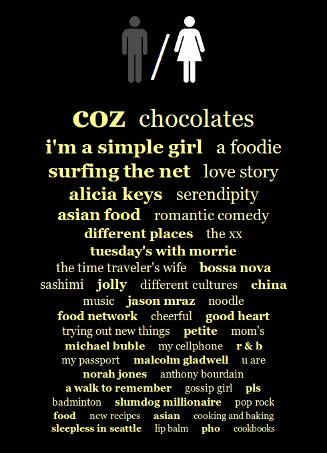
Asian women: coz

coz, chocolates, i'm a simple girl, a foodie, surfing the net, love story, alicia keys, serendipity, asian food, romantic comedy, different places, the xx, tuesday's with morrie, the time traveler's wife, bossa nova, sashimi, jolly, different cultures, china, music, jason mraz, noodle, food network, cheerful, good heart, trying out new things, petite, mom's, michael buble, my cellphone, r & b, my passport, malcolm gladwell, u are, norah jones, anthony bourdain, a walk to remember, gossip girl, pls, badminton, slumdog millionaire, pop rock, food, new recipes, asian, cooking and baking, sleepless in seattle, lip balm, pho, cookbooks
Read the rest of this entry »

Commercials conflate whiteness with modernity.

In Romanticizing Ancient Chinese Wisdom at Sociological Images, Lisa Wade writes:

This 40-second commercial for HSBC bank, sent in by Michelle F., is an excellent example of the way that non-white and non-Western people are often portrayed as more deeply cultural, connected to the past, and closer to nature than their white, Western counterparts. Sometimes this is done in order to demonize a culture as “barbaric,” other times it is used to infantilize them as “primitive.” In this case, it romanticizes.

[…]

Running on both English and Chinese language channels, the commercial contrasts the wise Chinese man with the young, white man. The music, the boats, their clothing and hats, and their fishing methods all suggest that the Chinese are more connected to their own long-standing (ancient?) cultural traditions, ones that offered them an intimate and cooperative relationship to nature. Simultaneously, it erases Chinese modernity, fixing China somewhere back in time.

Read the rest of this entry »

Unemployed? You fail at being Canadian.

Are you currently unemployed? According to the new Canadian citizenship guidebook for prospective immigrants, over 8.6% of unemployed Canadians are not fulfilling the Canadian responsibility of having a job, which now comes with the rights of having a Canadian citizenship.

The new Canadian citizenship guidebook was unveiled last week, redefining what it means to be Canadian. After all, new Canadian immigrants are more likely to be unemployed, which must mean—according to the authors of the guidebook—that their economic difficulties are a result of their failure adopt Canadian values. In addition, the new guidebook tells prospective immigrants, “Canada’s openness and generosity do not extend to barbaric cultural practices that tolerate spousal abuse, “honour killings,” female genital mutilation, or other gender-based violence.”

Read the rest of this entry »

Canadian resumés with English names are 40% more likely to secure a job interview, study finds

Resumes with English names more likely to be noticed (CTV News):

Canadians with English names have a greater chance of landing a job than those with Chinese, Indian or Pakistani names, says a new study.

In fact, after sending out thousands of resumés, the study found those with an English name like Jill Wilson and John Martin received 40 per cent more interview callbacks than the identical resumés with names like Sana Khan or Lei Li.

Read the rest of this entry »

People of colour are not born with racial identities.

Some white people appear to think that non-white people have a strong ethnic or racial identity by default. They may think that if a non-white person is unaware of her race or ethnicity, it is a result of white interference. However, ethnic and racial identities are socially constructed, not genetically inherited.

Infants of colour, for example, are born without knowing their race, their ethnicity, their culture, or their history. These things are learned. Learning culture may involve learning skills, learning history may involve learning knowledge, but learning racial and ethnic identity often involves the internalization of social categories of difference and otherness.

Perhaps white adults have a weak sense ethnic and racial identity—if they have any at all—because they have not had the same experiences with being othered and being different.

Read the rest of this entry »

Design a site like this with WordPress.com
Get started