
Gr. Ch. Palacegarden Malachy won this year's Westminster Kennel Club Dog Show. He is a testament to how flexible dog DNA actually is, but he also testament to how bizarrely cruel man actually is to animals he claims to love.
Malachy was the twelfth century Archbishop of Armagh, who had a vision in which he claimed to have seen the identity of the next 112 popes.
For that vision and from some miracles attributed to him, he was canonized as St. Malachy.
Ah but today we have a new Malachy who is ever bit as feted for his achievements at that Medieval Irish bishop.
Of course, I am talking about the 2012 Best in Show winner at the Westminster Kennel Club Dog Show.
Malachy’s registered name is Gr. Ch. Palacegarden Malachy, and to honest with you, I am more than somewhat dismayed at this dog’s success.
That’s because contrary to what everyone tells you. Malachy is not a good example of the breed at all– if you bother to read the actual breed standard.
This is what the AKC standard, which he was being judged against, says about coat:
It is a long, coarse-textured, straight, stand-off outer coat, with thick, soft undercoat. The coat forms a noticeable mane on the neck and shoulder area with the coat on the remainder of the body somewhat shorter in length. A long and profuse coat is desirable providing it does not obscure the shape of the body. Long feathering is found on toes, backs of the thighs and forelegs, with longer fringing on the ears and tail.
I guess the breed judges have been ignoring the line about the coat not obscuring the shape of the body for a long time now. I’ve watched a lot of dog shows, and nearly every peke in those shows has looked like something that a very large cat has hawked up.
But because they are judges and they all know better than us, it’s okay to ignore the breed standard when it’s convenient.
Of course, as a dog, he’s a terrible example of his species.
One merely has to watch him walk. Here he is at a dog show in Georgia:
Source.
You can tell by the way he uses his walk that he can’t walk.
He wobbles around.
That’s because pekingeses are extreme achondroplastic dwarfs, and unlike virtually every other dwarf breed in existence today, they are required to have a massive head and extremely heavy bone. In essence, they are bulldogs that are trying to be extremely long-haired dachshunds.
And in terms of brachycephaly, they totally surpass the bulldog for extremism.
I noticed that Malachy was carried to the ring last night. He walked very little, and the judge even made a special allowance for him so that he would go last and not have to walk as far as the other dogs when his gait was being judged.
And when he wond Best in Show, he was brought before the cameras panting heavily.
As I’ve noted time and again on this blog, brachycephaly– short muzzles– are extremely deleterious for dogs. The issue they have is that they have about the same amount of soft palate as a normally muzzled dog, but it’s so scrunched up in that short muzzle that the soft palate always obstructs the airways in some fashion. In the worst cases, vets pare back that soft palate under anesthesia to give the dog a relatively unobstructed breathing. This exact procedure was performed on the Best in Show winning peke from 2003. It was attacked as a facelift in the media, but it was actually a procedure to remove some soft palate tissue to open up his airways. A facelift would have been against Kennel Club rules, but this procedure is okay— even if breeding for such short muzzles is the cause for these problems in the first place!
Now, dogs don’t just breathe through their airways. Their airways are their cooling system. When a dog pants, it passes air over the mucus membranes, causing evaporation. This causes the moisture on the mucus membranes to evaporate, which cools the dog.
If you create a dog in which the airways are blocked in any way, its ability to cool itself will be hampered.
And it’s not just the soft palate issue that causes problems for these dogs. Their tracheas are scrunched up in the back of their throats and are often smaller than normal, and their nostrils are often smaller.
All of these issues hamper the dog’s breathing and cooling system.
These dogs cannot live normal lives. They can’t handle any heat, and I’ve actually read that the only time these dogs are as fully oxygenated as they should be is when they go under anesthesia and a breathing tube is placed down their tracheas.
Now, Malachy might have a nice life. He doesn’t have do much, and I’m sure he’s a well-socialized little dog who is loved and cherished.
But he has been bred to meet a breed standard that requires him to have a body that is totally dysfunctional.
If one were to put a collar on a dog that cause its airways to be as restricted as much as peke’s already are, one would likely be in violation of animal cruelty laws.
But because celebrated “ethical” breeders produce these dogs according to “the standard,” no one says a word.
There’s also a lot of cognitive dissonance in Pekingeses because they didn’t always look like this.
This breed was kept in the Forbidden City as the beloved family pets of Chinese royalty. The first of this breed ever to be seen in the West were stolen from the Imperial Summer Palace during the Second Opium War in 1860.
The dogs then were gradually smuggled out of China over the next 30 years.
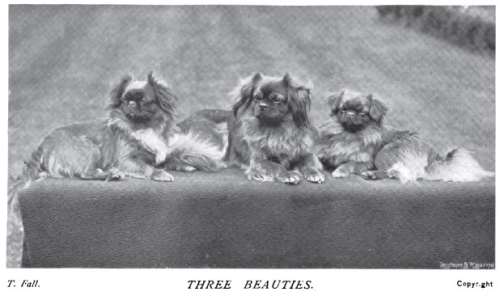
The dogs from the Second Opium War were the basis for the Goodwood line of Pekingeses in the West. Here are some Goodwood pekes from an 1899 edition of Country Life Illustrated. They don’t look anything like Malachy.
(Source for image)
One might find dogs like these in pet lines of Pekingeses, but you’ll never see one winning a major dog show.
These dogs certainly were short-muzzled, but they weren’t so extremely short in the muzzle that they couldn’t breathe or cool themselves effectively.
Now, some may call me to task for attacking established practices in the dog fancy.
I’ll be called an animal rights fanatic– PETA member, a communist, an asshole, whatever.
But I can tell you that celebrating dogs like Malachy in the show ring is doing nothing to stop the real animal rights radicals from totally destroying domestic dog ownership.
That’s because they do have a point here.
Facts are on their side.
Now, you can deny facts all you want, but if the facts show that breeding dogs like these does result in welfare and health problems, your denialism winds up giving the animal rights radicals more ammunition.
And if you are not careful, we will see the passage of laws that will change the breed standards for you.
You don’t want that.
Trust me.
Because Austria is in the process of implementing laws that prevent breeders from breeding certain phenotypes, and these laws don’t paint with a narrow brush at all. They go after any potential conformation issue that might cause even a minor health problem, including blue dilute alopecia. Yes, in Austria, it may soon be illegal to breed blue dobermans.
These laws are called Qualzucht laws. Qualzucht means “torture breeding” in German, and they were passed to prevent breeders from producing dogs with phenotypes that are associated with health and welfare issues.
If dog breeders continue to celebrate dogs like Malachy and deny that there are any problems with producing dogs like him, they will continue to feed the animal rights monster.
I don’t see Malachy as the winner of Westminster. I see Qualzucht as the real winner here.
And it’s a spectacle that should give everyone interested in dogs a certain amount of discomfort.
Because what we’re seeing before us is a great moral travesty, but more and more people are waking up to the very real problems that come from breeding for exaggerated conformation.
It will take much more than that before things really change.
But they will change– whether the fancy realizes it or not.
Read Full Post »


 Natural History