ROGUECLASSICIST’S BULLETIN ~ January 2, 2026

===========================================================
LEGENDA
===========================================================
Ancient Industrial Complex and Roman Necropolis Discovered in Egypt’s Western Nile Delta
https://greekcitytimes.com/2026/01/02/ancient-industrial-complex-and-roman-necropolis-discovered-in-egypts-western-nile-delta/?amp

Grace of Ancient Art Emerges in Laodikeia: Hermes Sculpture Head Discovered in Ongoing Excavations – Arkeonews
https://arkeonews.net/grace-of-ancient-art-emerges-in-laodikeia-hermes-sculpture-head-discovered-in-ongoing-excavations/

‘Unusual’ Roman-era discoveries unearthed in biblical city surprise archaeologists: ‘Completely unexpected’ | New York Post
https://nypost.com/2026/01/02/world-news/unusual-roman-era-discoveries-unearthed-in-biblical-city-surprise-archaeologists-completely-unexpected/

What were books like in ancient Greece and Rome?
https://theconversation.com/what-were-books-like-in-ancient-greece-and-rome-267872

Myth and Marble at Kimbell Art Museum by Patrick R. Crowley review
https://www.artforum.com/events/myth-and-marble-torlonia-kimbell-art-museum-review-1234741526/

Bedford Roman villa volunteers hoping to return after big find
https://www.bbc.com/news/articles/cq5qwpv3l6wo

Northumberland fort’s large Roman shoes to go on display
https://www.bbc.com/news/articles/c4gpnn090kko

Early Christian fresco depicting Jesus as the Good Shepherd discovered in Turkey
https://www.lemonde.fr/en/science/article/2026/01/01/early-christian-fresco-depicting-jesus-as-the-good-shepherd-discovered-in-turkey_6748985_10.html

How an Ancient Vase From Mykonos Redraws the Trojan War – GreekReporter.com
https://greekreporter.com/2026/01/02/vase-mykonos-redrew-trojan-war/

The Greek Myth of Demeter and Persephone Reinterpreted | Psychology Today United Kingdom
https://www.psychologytoday.com/gb/blog/maternal-ambivalence/202601/the-greek-myth-of-demeter-and-persephone-reinterpreted

Etruscans and Veneti: an exhibition in Venice on the fundamental role of water in the sacred and society
https://www.finestresullarte.info/en/exhibitions/etruscans-and-veneti-an-exhibition-in-venice-on-the-fundamental-role-of-water-in-the-sacred-and-society

The Mother Who Starved the Gods: The Fury of Demeter | History Hit

The Mother Who Starved the Gods: The Fury of Demeter

Return With Wisdom: An Ancient Principle for the New Year | Psychology Today
https://www.psychologytoday.com/us/blog/platonic-psychology/202512/return-with-wisdom-an-ancient-principle-for-the-new-year

New Research Questions the Origins of the Macedonian Kingdom and Alexander’s Dynasty: Was the True Founding in 575 B.C.?

New Research Questions the Origins of the Macedonian Kingdom and Alexander’s Dynasty: Was the True Founding in 575 B.C.?

‘Escape From Pompeii’ Review: Life After the Eruption – WSJ
https://www.wsj.com/arts-culture/books/escape-from-pompeii-review-life-after-the-eruption-c985f08f

Historie anime is officially greenlit – Everything you need to know
https://www.soapcentral.com/anime/news-historie-anime-is-officially-greenlit-everything-you-need-to-know

The Temple of Akhmim and Ancient Egyptian Pyramids as Chemical Plants – JASON COLAVITO
https://www.jasoncolavito.com/blog/the-temple-of-akhmim-and-ancient-egyptian-pyramids-as-chemical-plants

The Ancient Olympic Games And How Fighter Tournament Brackets Were Selected – The Historian’s Hut

The Ancient Olympic Games And How Fighter Tournament Brackets Were Selected

Sir James Frazer and New Year’s babies | Blog post | Mary Beard

Sir James Frazer and New Year’s babies

Spencer Alley: Ovidians – III
https://spenceralley.blogspot.com/2025/12/ovidians-iii.html

Jerome, Letter 154, to Donatus – online in English – Roger Pearse

Jerome, Letter 154, to Donatus – online in English

Jerome, Letter 153, to Pope Boniface I – online in English – Roger Pearse

Jerome, Letter 153, to Pope Boniface I – online in English

The Purpose of Speech? Dissent and Freedom of Speech in the Assembly of Iliad 9 – SENTENTIAE ANTIQUAE

The Purpose of Speech? Dissent and Freedom of Speech in the Assembly of Iliad 9

My 2025 in Books – Noodlings

My 2025 in Books

Laudator Temporis Acti: What’s Done Can’t Be Undone
https://laudatortemporisacti.blogspot.com/2026/01/whats-done-cant-be-undone.html

Voor-westerse geschiedenis (2): landschap – Mainzer Beobachter

Voor-westerse geschiedenis (2): landschap

Eerbewijzen voor Julius Caesar – Mainzer Beobachter

Eerbewijzen voor Julius Caesar

PaleoJudaica.com: Bible Archaeology Report 2025 top ten
https://paleojudaica.blogspot.com/2026/01/bible-archaeology-report-2025-top-ten.html

PaleoJudaica.com: ECT reviews Baker, Why a “New Testament?
https://paleojudaica.blogspot.com/2026/01/ect-reviews-baker-why-new-testament.html

PaleoJudaica.com: New bill proposes to extend Israeli authority over West Bank
https://paleojudaica.blogspot.com/2026/01/new-bill-proposes-to-extend-israeli.html

PaleoJudaica.com: Sifting Project unearths a siege slingstone
https://paleojudaica.blogspot.com/2026/01/sifting-project-unearths-siege.html

PaleoJudaica.com: Six lost cities that are still lost
https://paleojudaica.blogspot.com/2026/01/six-lost-cities-that-are-still-lost.html

PaleoJudaica.com: On the origin of Hanukkah
https://paleojudaica.blogspot.com/2026/01/on-origin-of-hanukkah.html

AWOL – The Ancient World Online: List of Open Access Journals in Ancient Studies
http://ancientworldonline.blogspot.com/2015/12/alphabetical-list-of-open-access.html

AWOL – The Ancient World Online: Alphabetical List of Open Access Monograph Series in Ancient Studies
http://ancientworldonline.blogspot.com/2014/06/alphabetical-list-of-open-access.html

AWOL – The Ancient World Online: Open Access Ancient Language Textbooks, OERs, and Primers
http://ancientworldonline.blogspot.com/2009/09/open-access-textbooks.html

AWOL – The Ancient World Online: Roundup of Resources on Ancient Geography
http://ancientworldonline.blogspot.com/2012/09/roundup-of-resources-on-ancient.html
===========================================================
AUDIENDA
===========================================================
Ancient History Podcast – Greek Mythology with Carolina López-Ruiz
https://www.karwansaraypublishers.com/en-ca/blogs/ancient-history-blog/ancient-history-podcast-greek-mythology-with-carolina-lopez-ruiz

How the ninety percent experienced the Roman economy, with Kim Bowes – Medievalists.net

How the ninety percent experienced the Roman economy, with Kim Bowes

Ancient Warfare Podcast: AWA390 – Roman Military Signalling
https://ancientwarfare.libsyn.com/awa390-roman-military-signalling

Anima Latina 01.01.2026 – Podcast – Radio Vaticana – Vatican News
https://www.vaticannews.va/it/podcast/rvi-programmi/anima-latina/2026/01/anima-latina-01-01-2026.html

How Did Ancient Romans become Christians? – Dan Snow’s History Hit | Acast

===========================================================
VIDENDA
===========================================================
(322) Sing, Muse, of A Complicated Man: Why the Narrative Structure of The Odyssey is VITAL. – YouTube

(322) Did Odysseus Really Exist? – YouTube

===========================================================
NOTANDA
===========================================================
SAM Newsletter January 2026
https://mailchi.mp/cd71a7d1e5ab/sam-newsletter-january-2026?e=875f90a671

Assessing the impact of Roman occupation on England through the Developmental Origins of Health and Disease (DOHaD) hypothesis | Antiquity | Cambridge Core
https://www.cambridge.org/core/journals/antiquity/article/assessing-the-impact-of-roman-occupation-on-england-through-the-developmental-origins-of-health-and-disease-dohad-hypothesis/921B8AB243C77B712498B9D56693EB72
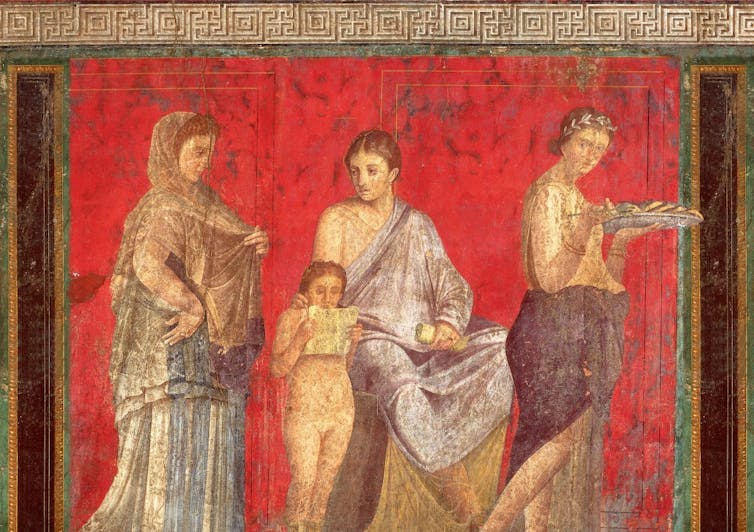
The Conveeersation:What were books like in ancient Greece and Rome?

Roman fresco, Pompeii.
Public domain, via Wikimedia Commons

Konstantine Panegyres, The University of Western Australia

If you were to visit a bookshop in the ancient world, what would it be like?

You don’t just have to imagine it. The ancient Roman writer Aulus Gellius, who lived in the 2nd century CE, gives us a number of descriptions of his adventures at bookstores. In one passage, he describes an encounter at one in Rome, which he was visiting with a poet friend:

I chanced to be sitting in a bookshop in the Sigillaria with the poet Julius Paulus […] There was on sale there the Annals of Quintus Fabius Pictor in a copy of good and undoubted age, which the dealer maintained was without errors.

Gellius then tells us that, while they are sitting there, another customer enters the shop. The new customer has a disagreement with the dealer. He complains that he “found in the book one error”. The dealer says that’s impossible. Then the customer brings out evidence to prove the dealer wrong.

In different passage, Aulus tells us about some bookstalls he came across when he arrived by ship at the port of Brundisium on the Adriatic coast. The books, he records, were “in Greek, filled with marvellous tales, things unheard of, incredible […] The writers were ancient and of no mean authority”.

The volumes themselves, however, were filthy from neglect, in bad condition and unsightly. Nevertheless, I drew near and asked their price; then, attracted by their extraordinary and unexpected cheapness, I bought a large number of them for a small sum.

Engraving of Aulus Gellius (1706).
Draughtsman: Jan Goeree. Engraver: Pieter Sluyter, Public domain, via Wikimedia Commons

Aulus goes on to describe in excited language all the weird facts he derived from these books – like how people in Africa can “work spells by voice and tongue” and through this witchcraft cause people, animals, trees and crops to die.

The origins of writing

These sorts of stories bring us close to how ordinary people in ancient Greek and Roman times obtained books and engaged with books. But if we read stories like this it might lead us to want to know more. How did books and writing come into existence? And how were books written and produced?

Many people in the ancient world thought that writing had been invented by gods or heroes. For example, the ancient Egyptians believed the god Thoth was the first to create signs to represent spoken sounds.

The origins of writing are certainly mysterious. It’s unclear when writing began and who invented it.

The earliest written text is a wooden tablet radiocarbon dated to before 5000 BCE. This is known as the Dispilio tablet, because it was discovered at a neolithic lakeside settlement at Dispilio in Greece. It is carved with strange linear markings. These have not been deciphered, but most scholars think they are a form of writing.

Model of the Dispilio Tablet.
Мико, via Wikimedia Commons, CC BY-SA

Evidence for writing appears early in different parts of the world. In Mesopotamia and Egypt, the oldest texts, such as the Kish limestone tablet at Uruk or the Narmer Palette at Hierakonpolis, date to before 3000 BCE. In the Indus Valley, the Harappan script, which remains undeciphered, appeared around the same time. In China, the earliest characters, the Dawenkou graphs, also date to around 3000 BCE.

One of the most interesting aspects of early writing is that there is such a variety of different scripts. For example, the earliest known texts in the Greek language are written in the Linear B script, which was used from around 1500-1200 BCE, and wasn’t deciphered until 1952. Linear B is not an alphabet, but a syllabary of more than 80 different signs. A syllabary is a kind of writing system where each sign represents a syllable.

By around the 8th century BCE, most Greeks had starting using an alphabet instead of a syllabary. Unlike a syllabary, in an alphabet each letter represents a vowel or consonant. The Greeks adapted their alphabet from the Phoenician alphabet, probably via interactions with Phoenician traders. The Phoenician alphabet had only 22 letters, making it much easier to learn than the 80-plus syllabary signs of Linear B.

Our English alphabet comes from the Romans, who in the 8th and 7th century BCE also got their alphabet from the Phoenicians, via the Greeks.

A papyrus document from ancient Egypt, written in hieratic script. The text describes anatomical observations and the examination, diagnosis, treatment and prognosis of numerous medical problems (c.1600 BCE)
Jeff Dahl, Public domain, via Wikimedia Commons

The origins of books

People in ancient times used many different things as writing materials.

The Roman writer Pliny the Elder (23-79 CE) tells us that the earliest people in the world

used to write on palm-leaves and then on the bark of certain trees, and afterwards folding sheets of lead began to be employed for official muniments, and then also sheets of linen or tablets of wax for private documents.

However, the most popular writing material in the ancient Mediterranean was papyrus, from which we get our word “paper”.

To make papyrus, you get the pith of the papyrus plant (Cyperus papyrus), cut it into slender strips, then press it together. Once dried, it forms a thin sheet that you can write on.

Papyrus sheets were usually glued together into rolls. These rolls could be very long. Some of the most lavish Egyptian papyrus rolls were more than 10 metres long, such as the recently discovered Waziri Papyrus containing parts of the Book of the Dead.

When papyri were rolled up they were stored in shelves or boxes. Labels were attached to the handles of the papyri so you could identify their contents. In his play Linus, Greek playwright Alexis (c. 375-275 BC) has one character tell another how to look through a bunch of rolls to find what he wants:

go over and pick any papyrus roll you like out of there and then read it… examining them quietly, and at your leisure, on the basis of the labels. Orpheus is in there, Hesiod, tragedies, Choerilus, Homer, Epicharmus, prose treatises of every type…

Papyrus seems flimsy to the eye, but it is a durable writing material, stronger than modern paper. Many papyri have survived for thousands of years stored in jars or sarcophagi or buried under the sand.

The oldest surviving papyrus text is the so-called Diary of Merer (which you can listen to here), the logbook of a man named Merer, who was an inspector during the construction of the Great Pyramid of Giza under Pharaoh Khufu. This papyrus, which dates to around 2600 BCE, gives a day-by-day account of how Merer and his team of about 200 men spent time hauling and transporting stone and doing other work.

Papyrus was susceptible to being eaten by insects or mice. But there were ways to prevent this. Pliny the Elder, for example, advises that sheets of papyrus soaked in citrus-oil won’t be eaten by moths.

How to write a book in antiquity

If you were living in ancient Greece or Rome and wanted to write a book, how would you do it?

First, you would buy sheets or rolls of papyrus to write on. If you couldn’t afford it, you’d have to write on the back or in the margins of papyri you already owned.

If you didn’t own any papyri already, then you would have to write on other materials. According to the Greek historian Diogenes Laertius (3rd century CE), the philosopher Cleanthes (c. 331-231 BCE) “wrote down lectures on oyster-shells and the blade-bones of oxen through lack of money to buy papyrus”.

Second, you would get your ink. In the ancient world, there were many varieties of ink. Normal black ink was made from the soot of burnt resin or pitch mixed with vegetable gum. When buying ink, it would come in powder form, and you would need to mix it with water before using it.

Third, you would get your pen. It would be made from reed, hence it was called the “calamus” by Greeks and Romans (“calamus” is the Greek word for reed). To sharpen your pen you would need a knife. If you made a mistake, you would erase it with a wet sponge.

Now you have all the materials you need. However, you don’t need to use the pen and papyrus yourself. If you want, you can get a scribe to write down your words for you.

The Greek orator Dio Chrysostom (c.40-110 CE) even advised writers not to use the pen themselves:

Writing I do not advise you to engage in with your own hand, or only very rarely, but rather to dictate to a secretary.

If you needed to consult other books while writing, you could get friends to send them to you or ask book dealers to make you a copy. In a papyrus from the 2nd century CE found at Oxyrhynchus, Egypt, and written in Greek, the writer asks his friend to find the books that he needs and make copies of them. Otherwise, you would go to a library, though the best libraries at Alexandria, Rome and Athens might be far away.

When you finished drafting your book you would need to revise and correct it. You could then publish it by having many copies made by scribes and delivering these copies to friends and booksellers.

When all this was done, your book would be out in public. Perhaps someone like Aulus Gellius would stumble across it in a busy Roman bookshop. Maybe he’d even buy it.The Conversation

Konstantine Panegyres, Lecturer in Classics and Ancient History, The University of Western Australia

This article is republished from The Conversation under a Creative Commons license. Read the original article.

This Day in Ancient History ~ ante diem iv nonas januarias

  • 43 B.C. — Octavian is granted propraetorian imperium and admitted to the senate
  • 17 A.D. — death of Publius Ovidius Naso … a.k.a. Ovid
  • 18 A.D. — death of Titus Livius … a.k.a. Livy
  • 69 A.D. — dies imperii of Vitellius
  • 1866 — birth of Gilbert Murray

Rogueclassicizing in the age of AI

As is possibly known, i”ve been spreading/sharing and commenting on Classics and Archaeology on the internet for more than a couple of decades and have long promoted assorted internet venues as essential for outreach purposes. For me, the two formats I became comfortable with are my Explorator newsletter and this blog..Both seem to me to be useful and unfortunately both were impacted by a couple of health issues the effects of which i have been contending with: Multiple Sclerosis and a stroke. Because of these, I am pretty much ‘bedridden’ and my day is regularly interrupted by visits os Personal Support Workers who do various tasks and transfer me from bed to wheelchair every four hours or so. As can hopefully be imagined, it’s not s scenario which lends itself easily to conventional blogging and/or newsletter production.

And so, I’ve had to adapt and create new routines. I think I have my Explorator production working pretty well and have long been trying to .’reboot’ this blog into something more useful. I had long envisioned presenting cumulative news coverage (i.e. with links to all the coverage of a particular find or event) in the hopes of presenting the ‘full’picture (if possible). I was thinking of point form summary followed by links., Just when I was thinking this, however, AI in various forms burst onto the scene and made me rethink bcause a lot of AI news items seem to begin with a point form summary and I genuinely feared I’d be accused of simply using AI myself. even though there are other signs something might be the product of AI (e.g. no author mentioned or something vague like ‘staff’, and a prose piece that seems to be ‘five paragraph essay’ format, usually with excessive use of headings which seem like modified question prompts).

Over the month of December it seemed like AI pieces were everywhere and what struck me as a tsunami of bot/AI driven ad farm type sites were filling my email box.. Perusing some of these i noticed another apparently common feature: the inline link citation of a news source. But what was clear was the source more often thann ot seemed to be just some random high circulation news source, and not necessarily a good one.

In the midst of this I had a eureka moment and realized this was where training in Classics fits into the world of AI news reporting..From the beginning of my training in Classics citation of sources was drilled into me. But simple citation wasn’t enough; the quality of those sources matters (I still remember a first year footnote comment criticizing (rightly) my use of Niebuhr as a source). but how does one judge news sources these days?

The answer, of course, was to establish a tier list. I first came across the concept of a tier list in my Yugioh Duellinks life where assorted sites (e.g. Duel links Meta) and duellists ranked assorted decks from a high of tier 0 (which Ive never seeen) a low of tier three or so . Then tier lists seemed to be showing up everywhere, especially in sports situations. And so it seemed like a useful exercisie to come up with a tier list for news items. This is what I came up with:

As can hopefully be seen among the small type and a few typos, the tiers are arranged primarily in terms of proximity to original sources and academic qualifications of the news correspondent.. I suggest this is something that AI hasn’t caught onto yet and i”m not sure it will for quite a while. And so I’ll soon be doing my cumulative bloggage which will incorporate these tiers in source citation. Stay tuned …

This Day in Ancient History ~ kalendae ianuariae

  • 291 B.C.– dedication of the temple to Aesculapius on the Tiber Island
  • 194 B.C. — dedication of the temple to Vediovis on the Tiber Island
  • 153 B.C.– beginning in this year (if not before) the Consuls would enter office on this date
  • 7 B.C. — the future emperor Tiberius (belatedly) celebrates a triumph for his victories over the Germans
  • 42 B.C. — Julius Caesar is posthumously deified by an act of the Senate
  • 14 A.D. — the future emperor Galba donned his toga virilis
  • 70 A.D. — the deceased emperor Galba is granted restitutio memoriae
  • 89 A.D. — L. Antonius Saturninus raises a revolt against Domitian at Moguntiacum
  • 112 A.D. — dedication of the Forum of Trajan and the Basilica Ulpia
  • 1847 — birth of Rodolfo Lanciani
  • 1854 — birth of Sir James Frazer (The Golden Bough)