





Power puff girls_Blossom, Bubbles and Buttercup


Kapaleeshwarar Temple, is located in chennai, Tamil nadu. The form of Shiva’s consort Parvati worshipped at this temple is called Karpagambal is from Tamil, (“Goddess of the Wish-Yielding Tree”). The temple was built around the 7th century CE in Dravidian architecture.
According to the Puranas, Shakti worshipped Shiva in the form of a peacock, giving the vernacular name Mylai (Mayilāi) to the area that developed around the temple – mayil is Tamil for “peacock”. Shiva is worshiped as Kapaleeswarar, and is represented by the lingam. His consort Parvati is depicted as Karpagambal.
The present masonry structure was built during the Vijayanagar rulers of the Tuluva Dynasty (1491–1570 CE)


Infobits:
1. Temple opens at 5.00am and closes at 12.00 p.m. and again opens at 4.00pm closes at 9.00pm
2. Direct buses to Mylapore are available from all parts of the city.
3. Local trains are available for every 15mins.
4. It is around 6kms from chennai railway station.


Bijapur now called as Vijaypuri city, is the district headquarters of Bijapur District of Karnataka state. Bijapur city is well known for its historical monuments of architectural importance built during the rule of the Adil Shahi dynasty. It is located 530 km northwest of Bangalore and about 550 km from Mumbai, and 384 km west of the city of Hyderabad.

In an introduction to an album of Bijapur published in 1866, Philip Meadows Taylor wrote: “Palaces, arches, tombs, cisterns, gateways, minarets, …all carved from the rich basalt rock of the locality, garlanded by creepers, broken and disjointed by peepul trees, each in its turn is a gem of art and the whole a treasury.
We had a big urge for visiting Badami-Aihole-Pattadakal-Dambal temples from a very long time. We plan every time and fail every time. Finally on 14th January 7:00pm, we’ve decided to fulfill our desire of visiting all the Chalukyan dynasty(Badami-Aihole-Pattadakal) temples via Bijapur. So we started to Bijapur which was 380kms away from Hyderabad(Via. Zaheerabad, Humnabad,Jevargi, Sindhagi etc.,) which seems to be better than Kodangal road. We reached around 2:00am and took a room in Navaratna international hotel which was 1100rs/room for 5members which was quite comfortable for 5 of us.
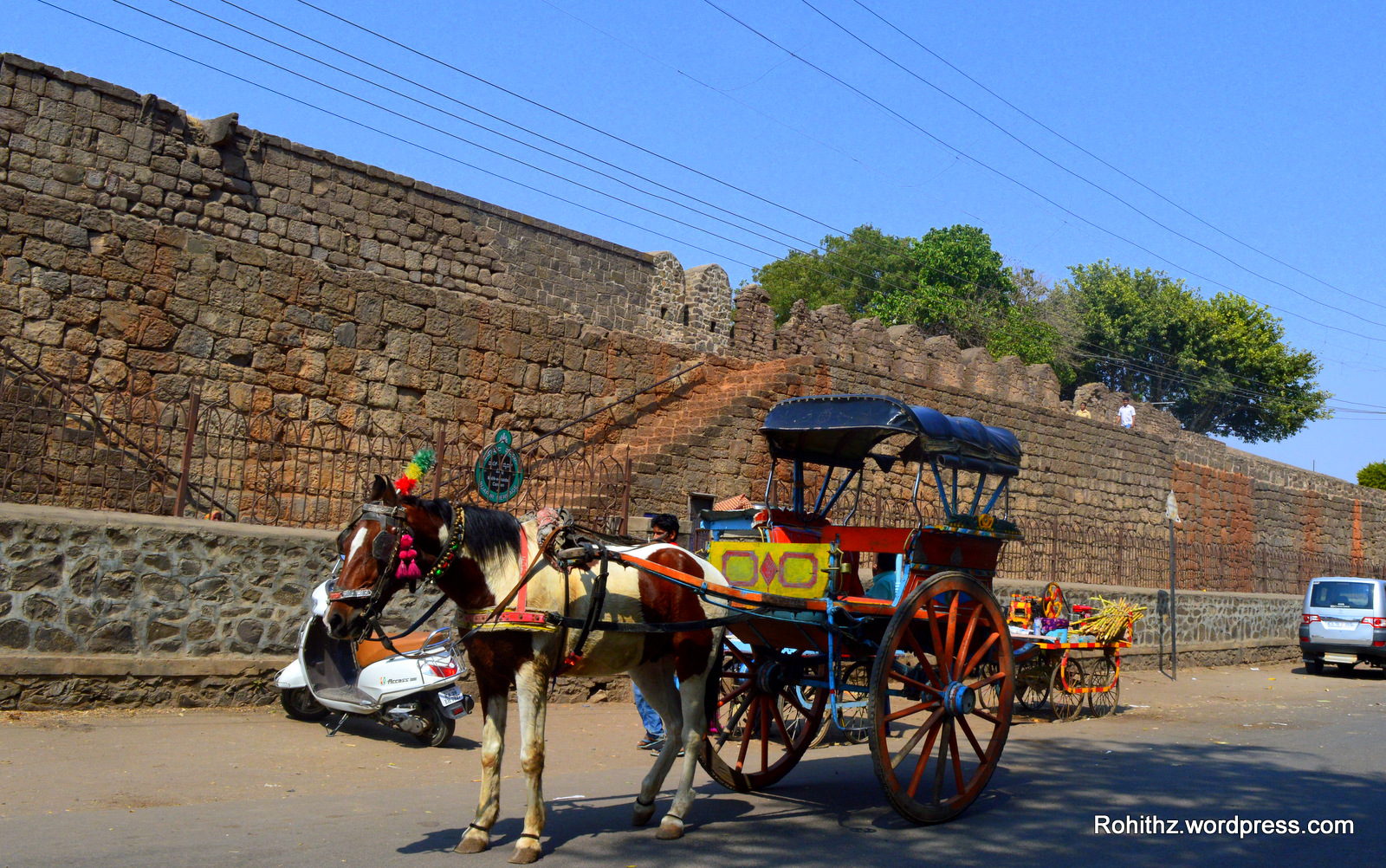
Tuk Tuk near Malik e Maidan, Bijapur.
After having breakfast, we started exploring Bijapur according to our planned itinerary which includes:
We started our trip from this place since it is quite near to our hotel. It is the largest and oldest mosque in the Deccan. Ali Adil Shah I, after his triumphant victory over Vijayanagara empire built this mosque. The most beautiful feature is the dome of this building which is highly proportionate. It is a big mosque with huge prayer hall. There is no charge to see this place. We spent a lot of time in this mosque by discussing about the architecture styles of Adilshah with a well knowledged old man. It seems that around 2500 members can pray at a stretch in this mosque. Then we headed to Golgumbaz.


This is the most famous monument in Bijapur. It is the tomb of Mohammed Adil Shah (ruled 1627-1657). It is the largest dome ever built in India, next in size only to St Peter’s Basilica in Rome. A particular attraction in this monument is the central chamber, where every sound is echoed seven times. We’ve never seen such incredible acoustics. Another attraction at the Gol Gumbaz is the Whispering Gallery, where even minute sounds can be heard clearly 37 metres away. The stairs are narrow but the management have been maintaining the place very well with separate steps to go up and down. But we were unable to tolerate the echo sounds inside the dome so we were there only for 10mins. Over all it is the best and most enjoyable touristic attraction in Bijapur.


This is the tomb of Ibrahim Adil Shah II (ruled 1580-1627), the fifth king of the dynasty.
It is one of the most prominent places to be visited in bijapur, It comprises two buildings, a magnificent tomb and a remarkable mosque enveloped by a garden. Facing each other, these twin buildings have a fountain in between them. This is the most ornate building in Bijapur. Cousins called the building as “The Taj Mahal of the Deccan”.It is said that the design for the Ibrahim Rauza served as an inspiration for that of the famous Taj Mahal.
The symmetry of the monuments was amazing, large well-maintained gardens, classic muslim architecture made my trip to bijapur more interesting than I’d originally thought. The Minarets and tomb are typical Muslim architecture, similar to the Taj Mahal and the Bibi ka Maqbarra. Though we visited this place in a wrong time, I loved clicking pictures of this marvel. Simply speaking it will be a delight to all those Photography enthusiasts, amateur photographers, and Professional photographers


The largest medieval cannon in the world. It was placed on the Sherza Burj (Lion Gate) on a platform especially built for it. The cannon’s nozzle is fashioned into the shape of a lion’s head with open jaws & between the carved fangs is depicted an elephant being crushed to death. It is said that after igniting the cannon, the gunner would remain underwater in a tank of water on the platform to avoid the deafening explosion. The cannon remains cool even in strong sunlight and if tapped, tinkles like a bell. This relic has been well preserved. One has to climb one of the twin staircases on the fortification wall to reach the canon, now protected by iron railings.
Built around 1584 by Hyder Khan, is an 80 ft. This is a spherical structure with stone steps winding round the outside. After climbing the circular stairs we’ve reached the top there are two large cannons placed on this tower. And the top of the tower offers a commanding 360 degree view of the Bijapur city.


My friends weren’t impressed by the maintenance of this place so they didn’t get down from the car. I went alone and captured some pictures. You can skip this place if you have a limited time.


A mausoleum of Ali Roza built in 1672. Bara Kaman got its name because it was the 12th monument during his reign. It has now seven arches and the tomb containing the graves of Ali, his queens and eleven other ladies possibly belonging to the Zenana of the queens.


At 12:30Pm, we started to Aihole which was 110kms from Bijapur(via Nh 133/SH66 road. Road till Ameengal was good and the last 10kms stretch to Aihole was not drive friendly.


1. Entrance Fee for Golgumbaz was 5rupees, 25 rupees for camera , 30 rupees for parking. Parking fees for Ibrahim Rauza is 30rs.
2. Get ready to take a very narrow stairs around 5 stories to the top of Golgumbaz. Don’t miss this is an acoustic wonder.
3. Golgumbaz and Ibrahim rauza are the main highlights of this trip to Bijapur.
4. I would suggest to add Bijapur to your itinerary if you are planning a trip to Badami-Aihole-Pattadakal.
5. My suggestion for all those Hyderabadies who are planning to go for a heritage tour. Follow this road map HyderabadBijapurAiholePattadakalBadamiMahadevi temple ,Itagi(It will make you the drive bit longer)Hampi then back to Hyderabad.
 My Life