Badami Cave temples: ‘A fine balance of versatility and restrain’

After visiting Aihole and Bijapur, we started our journey towards Pattadakal, which was just 10 kms from Aihole. Ever since I read ‘Temples of South India’ book I was very curious and excited about these UNESCO World Heritage Sites and added it to my bucket list. Since we are travelling on our own it was quite easy for us to cover Bijapur-Aihole-Pattadakal-Badami stretch.

Badami (26)

Boothnath temple on the green waters of the Agastya lake…

Badami (16)

Temples build by Western Chalukyas invoke a sense of peace and tranquility by their systematic and symmetrical approach..

Bagalkot District of Karnataka is blessed with some amazing historical sites of Ancient Indian like Badami, Pattadakal. These places were the most important centers of Chalukyan Empire. These three places are located in the close vicinity of each other and with a bit of planning can be covered in a single day.

Places to Visit in Badami:

Badami can be best experienced simply, by a walk through the ruins. All the major attractions of Badami are located around the Agasthya Lake and sandwiched between two high mountain cliffs on its North and South. It is about 1km walk from the bus stand.

Badami (15)

The fort on the Northern hill-top is visible from the main road itself.

Archaeological Museum of Badami:

There is a stone statue of Nandi, Lord Shiva’s bull, at the entrance of the museum. The museum mainly comprises of pre-historic stone implements and sculptures, inscriptions etc. datable from 6th to 16th century AD.

Walking further, we reached to a beautiful lake called Agasthya Lake. This lake is surrounded by the Badami Caves, Red sandstone hills, Bhootnath Temple, small houses of Badami and the beautiful flight of steps (the ghats). The water in this lake is believed to have some healing power too. The sandstone steps (ghats) from three side of the lake make it more beautiful.

Badami (25)

There we are…posing for a pic

Badami in Hindu Mythology:

Legend says that there were two demon siblings in the ancient times, one is Vatapi and another one is Ilvala. The older brother Ilvala converted Vatapi in red meat and offered that to the poor souls living in the area. Unaware of the tricks, people ate that meat happily. Then, Ilvala re-converted that meat back into Vatapi who then emerges by tearing through the person’s body causing death. One day they did the same trick to the great saint Agasthya. But, the saint was able to digest the meat, thus causing death of Vatapi. This put an end to the misery of local people. These two hills in Badami to its north and south are supposed to represent the demons Ilvala and Vatapi.

Badami (31)

The lake between these hills was named as Agasthya Lake or Agasthya Tirtha in honour of the great saint.

Bhootnath Temple :

This temple is located at the Eastern side of the lake and is believed to be built in 5th century. These temples are dedicated to Lord Shiva. Inside the temple, there are lot of carvings on the wall.

Badami Fort and Adjacent Area: Again walking along the Agasthya Tank, we moved towards the northern hill through an access road adjacent to the museum. This hill has an amazing package to unfold for its visitors. Top of the hills are almost flat, full of shrubs and thorns, many walkable trails and houses, small water reservoir, some small temples with excellent carvings and Badami Fort. After visiting the Northern Side of the lake, we moved towards the Southern Hill, that houses the famous cave temples.As one walks along the lake,the road leads to an 18th century mosque.

Badami Caves:

Badami is famous for its four cave temples  all cut out of a monolithic (single) rock of sand stone on the precipice of a hill. First three of these temples are dedicated to Hindu gods and goddesses and the last one is basically dedicated to JainTirthankars.

Badami (3)

monolithic (single) rock of sand stone on the precipice of a hill.

Badami (1)

The four cave temples represent the secular nature of the rulers then.

Badami (4)

Cave Temple 1 : Moving inside, a long flight of steps took us to the first cave. This cave is dedicated to Lord Shiva. This cave temple dates back to the 5th century CE and was built by Chalukyan King Pulkesin-I. There is a carving of the cosmic dance of Nataraja depicted with eighteen arms. With these 18 arms, Lord Shiva can make 81 dance poses or mudra of Natya Shastra.


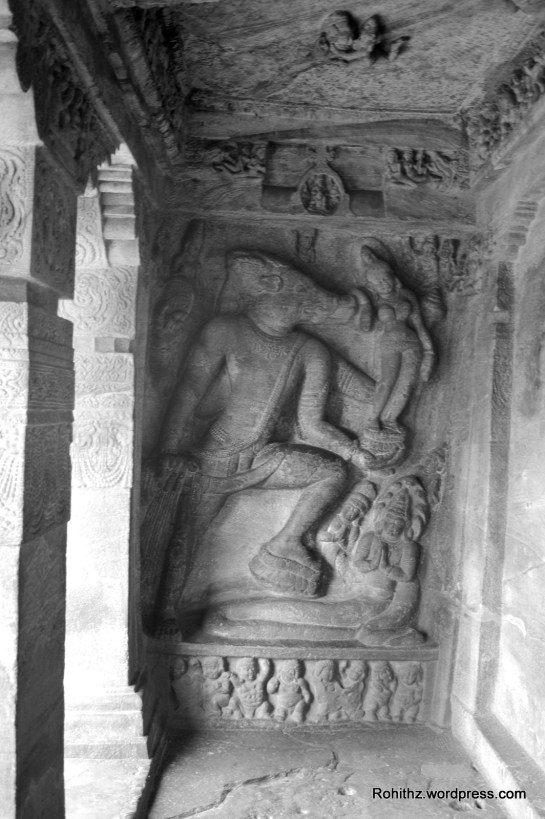
Cave Temple 2 : The second cave temple is dedicated to Lord Vishnu and his avatars (incarnations).
Badami cave temples, karnataka (3)

The best carving in this cave is the image of Lord Vishnu in his Varaha avatar (Varaha the pig-faced, human-bodied Lord, half human-half animal). In this avatar, he rescued the Goddess Bhudevi (The Earth) from the demon Hiranyaksha.

Cave Temple 3 :  The third cave is dedicated to Vishnu, and is the best and the biggest, and it has splendid giant figures of Paravasudeva, Bhuvaraha, Harihara and Narasimha.  An inscription found here records the creation of the shrine by Mangalesha in 578AD. There are some paintings on the ceiling and the style indicates maturity but has lost its original dazzling colour.

Badami cave temples, karnataka (2)

Lord Vishnu statue.. All the statues in this cave are engraved in a vigorous style.

Cave Temple 4 : The fourth cave is Jaina which lies a little east of cave III. The sanctum is adorned by the image of Mahavira.

Tips from my perspective:

  • It is approx. 420 kms away from Hyderabad and 500 kms away from Bengaluru.
  • Timings: Daily except Fridays through the year from 10:00 Hrs to 17:00 hrs.
  • Ticket Price: INR 5 for Indians and INR 100 for foreigners.

North Karnataka: A Heritage tour

This video is just an experimental video because it is mostly shot on Iphone5 and Xiaomi yi & Edited on Iphone. A Trip to some of the Heritage places in North Karnataka which includes Bijapur(Ibrahim Roza, Gol Gumbaz, Jamma Masjid, Barakaman etc), Aihole, Pattadakal, Badami, Dambal & Lakkundi.

The Quality of the video is bit compromised because we shot it in Harsh sunlight and scorching heat.

Aihole: The Cradle of the Ancient Hindu Temple Architecture

Aihoḷe is a small village in the Bagalkot district of Karnataka and located 400 kms from Hyderabad. It is known for Chalukyan architecture, with about 125 stone temples dating from 5th century CE. It was the cradle of ancient Hindu temple architecture. Experimentation with styles was undertaken by the artisans of Chalukyan Empire. The artisans worked on the rocks to create the earliest rock-cut shrines. The artisans graduated to the full-fledged Chalukya style of architecture. The early Chalukyas inherited architectural styles largely from their neighbors to the north and south of their kingdom.Iphone aihole (23)

After visiting all the must see places in Bijapur. We started to Aihole which was 110kms from Bijapur(via Nh 133/SH66) road till Ameengal was good and the last 10kms stretch was not drive friendly. Within an hour and so we’ve reached our first destination. We got surprised by seeing flocks of tourists. Then we realised that it was Sankranti/pongal (An Indian festival) Holiday season.Iphone aihole (16)

The prominent temple groups at Aihole are the Kontigudi group and the Galaganatha group of temples, although historians have divided all the temples into 22 groups. Three temples are referred to as the ‘Kontigudi group of temples’. One of these is the Lad Khan temple (the oldest at Aihole is the Lad khan temple dating back to the fifth century, named after a mendicant that lived in this temple in the 19th century, another the Huchiappayyagudi temple and the Huchiappayya math.

Durga temple: With a Curvilinear Shikhara

It is the best known of the Aihole temples and is just along the entrance to the temple complex. It is apsidal in plan, along the lines of a Buddhist chaitya, a high moulded adisthana and a tower – curvilinear shikhara. A pillared corridor runs around the temple, enveloping the shrine, the mukhamantapa and the sabhamantapa. All through the temple, there are beautiful carvings. The temple appears to be of the late 7th or early 8th century.

Lad Khan Temple consists of a shrine with two mantapas in front of it. The shrine bears a Shivalingam. The mukha mantapa in front of the sanctum has a set of 12 carved pillars. The sabhamantapa in front of the mukha mantapa has pillars arranged in such a manner as to form two concentric squares. There are also stone grids on the wall carrying floral designs. The temple was built by the Chalukya kings in the 5th century. Ladkhan Temple is to the south of the Durga temple are the temples of this group. The Ladkhan temple, so named, as a general of the name had lived here, consists of a square mantapa, a mukha mantapa and the sanctum, built against the backwall. The central square has a flat roof. In the centre Nandi is installed, and just above Nandi, there is a damaged nagara shikhara, appearing to be a later addition. The period of this structure is about 450 A.D.

We had a quick tour of all the other prominent temples of Aihole which includes Suryanarayana temple, Triyambakeshvara Group, Gowda temple, Huchimalli (gudi) temple,  Kontigudi group of temples, Rachi gudi, Gaudara gudi, Badigere, Huchappayya (gudi) temple & Museum. Because of a huge number of tourist we skipped some of the other prominent temples like Ravanaphudi temple and meguti jain temple. I made my mind at that moment that I am not done with Aihole yet. 😛

All the temple complexes have different style of construction that indeed indicates that Aihole was the place for early experiments in Chalukyan style of Architecture. This place simply took us back into the time. Aihole is not in the list of UNESCO World heritage places. It has a great potential to be included as a UNESCO World heritage site. Then we left to Pattadakal(Yet to post) which was 11kms from Aihole.

A Trip to Chalukyan Temples: An Experience to be felt

The Chalukya dynasty  was an Indian royal dynasty that ruled large parts of southern and central India between the 6th and the 12th centuries. During this period, they ruled as three related yet individual dynasties. The earliest dynasty, known as the “Badami Chalukyas”, ruled from Badami from the middle of the 6th century. The Badami Chalukyas began to assert their independence at the decline of the Kadamba kingdom of Banavasi and rapidly rose to prominence during the reign of Pulakeshin II. After the death of Pulakeshin II, the Eastern Chalukyas became an independent kingdom in the eastern Deccan. They ruled from Vengi until about the 11th century. In the western Deccan, the rise of the Rashtrakutas in the middle of the 8th century eclipsed the Chalukyas of Badami before being revived by their descendants, the Western Chalukyas, in the late 10th century. These Western Chalukyas ruled from Kalyani until the end of the 12th century.

The rule of the Chalukyas marks an important milestone in the history of South India and a golden age in the history of Karnataka. The political atmosphere in South India shifted from smaller kingdoms to large empires with the ascendancy of Badami Chalukyas. The rise of this empire saw the birth of efficient administration, overseas trade and commerce and the development of new style of architecture called “Chalukyan architecture”. Kannada literature, which had enjoyed royal support in the 9th century Rashtrakuta court found eager patronage from the Western Chalukyas in the Jain and Veerashaiva traditions.

Pattadakal Temples: A cluster of beautifully carved temples

 Badami:  Rock cut Cave Temples

Aihole: The Cradle of Indian temple Architecture

Mahadeva Temple, Itagi: Emperor among Temples

Chalukyan temples (6)

Doddabasappa Temple, Dambal: The dazzling templeDoddabasappa temple, Dambal (4)

Lakkundi: Most Ornate temples


P.S: This is just an introduction post of Chalukyas. Stay tuned to know more about the temple history, architecture, significance etc..

Source: Wikipedia.com