Mahadev Temple: ‘The Emperor of Temples’

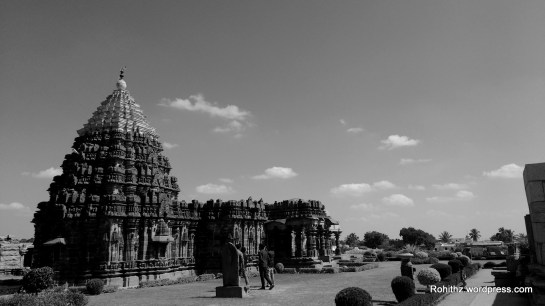
The 12th Century Mahadeva Temple at Itagi in Koppal District with splendid sculptures is said to be one of the finest examples in the country with respect to the magnificence and decorative details. The Mahadeva Temple at Itagi was built circa 1112 CE by Mahadeva, a commander (dandanayaka) in the army of the Western Chalukya King Vikramaditya VI.  Itagi is about 22 miles (35 km) east of Gadag and 40 miles (64 km) west of Hampi.

Mahadev temple, Itagi,koppal, karnataka (3)

Western Chalukyan art speaks volumes about the taste of the Chalukyan Artisans.

The well-executed sculptures, finely crafted carvings on walls, pillars and the tower make it a good example of complete Western Chalukyan art which speaks volumes about the taste of the Chalukyan artisans. An inscription dated 1112 CE in the temple calls it “Emperor among Temples” (Devalaya Chakravarti).The temple has a special place on the tourist map of Karnataka. The monument and sculptures that adorn the walls of the temple have a rich architectural value. This temple is dedicated to Hindu God Shiva.

Mahadev temple, Itagi,koppal, karnataka (7)

Aesthetic Sense is found in this beautiful temple..

Mahadev temple, Itagi,koppal, karnataka (6)

An inscription dated 1112 CE in the temple calls it “Emperor among Temples” (Devalaya Chakravarti)

One can have a glimpse of the high-towered Mahadeva Temple and a cluster of small temples around it while travelling on Koppal-Yelburga Road. It takes a few hours to watch the remnants of the temple and the architectural skill that glitter in daylight.

Mahadev temple, Itagi,koppal, karnataka (4)

Towards the north of the Shivalinga, there are five temples, of which two are dedicated to Murthinarayana and Chandraleshwari, parents of Mahadeva. There are 13 temples with Shivalingas around the main temple.

The east-faced main temple comprises a shrine with an antechamber, a closed hall with porches on either side of it towards north and south, and openings on either side with pillared halls. The temple roof is supported by 68 carved pillars. Of them, 26 are on the floor and the rest on the stone bench surrounding the hall and carrying the sloping eaves.

The carved columns are symmetrically arranged. The slabs on the central part of the ceiling have “Makaras” which spring from the jaws of “Kirtimuka” masks.
Mahadev temple, Itagi,koppal, karnataka (1)

Sojourn in time..

The walls of the inner hall are adorned with rich sculptures. The pentagon-shaped sanctum sanctorum and its outer walls have beautiful carvings. The 15-foot high main tower of the temple has carvings and projecting cornices.

Mahadev temple, Itagi,koppal, karnataka (9)

Beautifully carved…

The Mahadeva Temple is also known for its erotic sculptures. The temple has a “puskarani (teertha)” on its front side, which is still used by the villagers.

Mahadev temple, Itagi,koppal, karnataka (2)

Puskarini..

Mahadev temple, Itagi,koppal, karnataka (8)

The pillars in this hall bear similarities to the porch pillars at the Dodda Basappa Temple at Dambal and the lathe-turned pillars (whose rounded sections are lathe-turned) at the Kasivisvesvara Temple at Lakkundi.

The Mahadeva temple is officially protected as a national monument by the Archaeological Survey of India. This Temple has a history that is older than Hampi. The temple and its surroundings have been neglected for the past few centuries. The sculptures around the temple are in shambles. Hope Karnataka government takes proper care in protecting these Chalukyan architectural wonders.

Mahadev temple, Itagi,koppal, karnataka (10)

Art historian Henry Cousens called this monument the “finest in Kannada country after Halebidu”. These Western Chalukya monuments, regional variants of existing dravida (South Indian) temples, defined the Karnata dravida tradition. 

Aihole: The Cradle of the Ancient Hindu Temple Architecture

Aihoḷe is a small village in the Bagalkot district of Karnataka and located 400 kms from Hyderabad. It is known for Chalukyan architecture, with about 125 stone temples dating from 5th century CE. It was the cradle of ancient Hindu temple architecture. Experimentation with styles was undertaken by the artisans of Chalukyan Empire. The artisans worked on the rocks to create the earliest rock-cut shrines. The artisans graduated to the full-fledged Chalukya style of architecture. The early Chalukyas inherited architectural styles largely from their neighbors to the north and south of their kingdom.Iphone aihole (23)

After visiting all the must see places in Bijapur. We started to Aihole which was 110kms from Bijapur(via Nh 133/SH66) road till Ameengal was good and the last 10kms stretch was not drive friendly. Within an hour and so we’ve reached our first destination. We got surprised by seeing flocks of tourists. Then we realised that it was Sankranti/pongal (An Indian festival) Holiday season.Iphone aihole (16)

The prominent temple groups at Aihole are the Kontigudi group and the Galaganatha group of temples, although historians have divided all the temples into 22 groups. Three temples are referred to as the ‘Kontigudi group of temples’. One of these is the Lad Khan temple (the oldest at Aihole is the Lad khan temple dating back to the fifth century, named after a mendicant that lived in this temple in the 19th century, another the Huchiappayyagudi temple and the Huchiappayya math.

Durga temple: With a Curvilinear Shikhara

It is the best known of the Aihole temples and is just along the entrance to the temple complex. It is apsidal in plan, along the lines of a Buddhist chaitya, a high moulded adisthana and a tower – curvilinear shikhara. A pillared corridor runs around the temple, enveloping the shrine, the mukhamantapa and the sabhamantapa. All through the temple, there are beautiful carvings. The temple appears to be of the late 7th or early 8th century.

Lad Khan Temple consists of a shrine with two mantapas in front of it. The shrine bears a Shivalingam. The mukha mantapa in front of the sanctum has a set of 12 carved pillars. The sabhamantapa in front of the mukha mantapa has pillars arranged in such a manner as to form two concentric squares. There are also stone grids on the wall carrying floral designs. The temple was built by the Chalukya kings in the 5th century. Ladkhan Temple is to the south of the Durga temple are the temples of this group. The Ladkhan temple, so named, as a general of the name had lived here, consists of a square mantapa, a mukha mantapa and the sanctum, built against the backwall. The central square has a flat roof. In the centre Nandi is installed, and just above Nandi, there is a damaged nagara shikhara, appearing to be a later addition. The period of this structure is about 450 A.D.

We had a quick tour of all the other prominent temples of Aihole which includes Suryanarayana temple, Triyambakeshvara Group, Gowda temple, Huchimalli (gudi) temple,  Kontigudi group of temples, Rachi gudi, Gaudara gudi, Badigere, Huchappayya (gudi) temple & Museum. Because of a huge number of tourist we skipped some of the other prominent temples like Ravanaphudi temple and meguti jain temple. I made my mind at that moment that I am not done with Aihole yet. 😛

All the temple complexes have different style of construction that indeed indicates that Aihole was the place for early experiments in Chalukyan style of Architecture. This place simply took us back into the time. Aihole is not in the list of UNESCO World heritage places. It has a great potential to be included as a UNESCO World heritage site. Then we left to Pattadakal(Yet to post) which was 11kms from Aihole.

A Trip to Chalukyan Temples: An Experience to be felt

The Chalukya dynasty  was an Indian royal dynasty that ruled large parts of southern and central India between the 6th and the 12th centuries. During this period, they ruled as three related yet individual dynasties. The earliest dynasty, known as the “Badami Chalukyas”, ruled from Badami from the middle of the 6th century. The Badami Chalukyas began to assert their independence at the decline of the Kadamba kingdom of Banavasi and rapidly rose to prominence during the reign of Pulakeshin II. After the death of Pulakeshin II, the Eastern Chalukyas became an independent kingdom in the eastern Deccan. They ruled from Vengi until about the 11th century. In the western Deccan, the rise of the Rashtrakutas in the middle of the 8th century eclipsed the Chalukyas of Badami before being revived by their descendants, the Western Chalukyas, in the late 10th century. These Western Chalukyas ruled from Kalyani until the end of the 12th century.

The rule of the Chalukyas marks an important milestone in the history of South India and a golden age in the history of Karnataka. The political atmosphere in South India shifted from smaller kingdoms to large empires with the ascendancy of Badami Chalukyas. The rise of this empire saw the birth of efficient administration, overseas trade and commerce and the development of new style of architecture called “Chalukyan architecture”. Kannada literature, which had enjoyed royal support in the 9th century Rashtrakuta court found eager patronage from the Western Chalukyas in the Jain and Veerashaiva traditions.

Pattadakal Temples: A cluster of beautifully carved temples

 Badami:  Rock cut Cave Temples

Aihole: The Cradle of Indian temple Architecture

Mahadeva Temple, Itagi: Emperor among Temples

Chalukyan temples (6)

Doddabasappa Temple, Dambal: The dazzling templeDoddabasappa temple, Dambal (4)

Lakkundi: Most Ornate temples


P.S: This is just an introduction post of Chalukyas. Stay tuned to know more about the temple history, architecture, significance etc..

Source: Wikipedia.com