Feeds:
Posts
Comments

Archive for the ‘Uncategorized’ Category

Walking in Warsaw

We covered quite a few miles exploring Warsaw on foot and by tour bus over the past couple of days from the former Jewish ghetto in the north to the summer residence of the former king of Poland in the south, with many stops for good food in the Old City center.
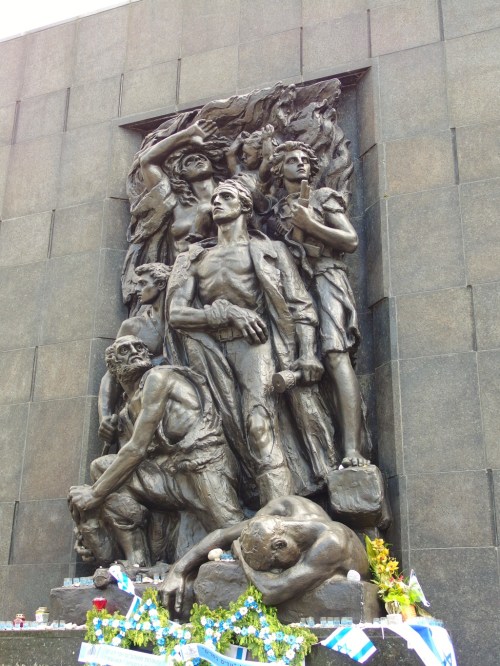
Memorial to the 1943 uprising in the Warsaw ghetto

Memorial to the 1943 uprising in the Warsaw ghetto, honoring young and old, mothers and fathers who fought bravely but were tremendously outnumbered by German troops.

Memorial for the 1944 uprising in the Warsaw ghetto

Memorial to the 1944 uprising in the Warsaw ghetto, the last stand before it was purged of all life.

The old walled city was completely demolished during the war, but was rebuilt in 11 years at the conclusion of the war to resemble its former elegance.

Broad boulevards lined with flowers, and no car traffic on Sundays.

Broad boulevards lined with flowers, and no car traffic on Sundays. The streets are litter-free!

Brick wall around the Old City of Warsaw rebuilt in the 1950s.

Brick wall around the Old City of Warsaw rebuilt in the 1950s.

Plaza in Old City of Warsaw overlooking the Vistula river

Plaza in Old City of Warsaw overlooking the Vistula river with the Royal Palace on the far right

Market square, Old City, Warsaw

Market square, Old City, Warsaw

Mermaid in market square, Old City, Warsaw

Mermaid in market square, Old City, Warsaw. The mermaid is key to the story of how Warsaw got its name:  a fisherman by the name of Wars accidentally caught a mermaid by the name of Sawa, they fell in love and together their names combined Wars-Sawa, or Warsaw.

The best pierogis can be found at Zapiecek's many locations in Warsaw.

The best pierogis can be found at Zapiecek’s many locations in Warsaw. Our fantastic guide, Art, and one of the serving ladies dressed in Polish costume.

Old City, Warsaw from across the Vistula River

Old City, Warsaw from across the Vistula River

Summer palace of the king, Warsaw

Summer palace of the king, Warsaw. Unlike other royals in other countries, the Polish king preferred to summer just 5 kilometers from his winter palace, within Warsaw city limits.

Chopin memorial, son of Warsaw, in the king's summer palace grounds.

Chopin memorial, son of Warsaw, in the king’s summer palace grounds.

Read Full Post »

Mangroves line the shorelines of Puerto Rico and its many island keys, where ever the wave action is limited.  The most noticeable are the red mangroves that grow from the shore into the salt water, supported by a tangle of prop roots.

Red Mangroves

The roots not only support the plants but catch debris, leaves, and sediment floating by which supports a community of organisms that feed on it.  This  is further enriched by droppings of the birds that roost in the mangrove branches at night.

While the mangrove forest above the water supports a terrestrial community of life,  the maze of roots below the water line offer protection for small fish and invertebrates that make up the underwater community.

While the mangrove forest above the water supports a terrestrial community of life, the maze of roots below the water line offer protection for small fish and invertebrates that make up the underwater community.

Red Mangroves are so dense you could never walk through them, but they make intriguing waterways for kayaking.

Red Mangroves grow together in such density that you could never walk through them, but they make intriguing island waterways for kayaking.

kayaking in mangrovesIt was a quiet on this particular day in the mangroves, no birds or fish to be seen.  But there was a pretty terrific sunset.

sunset in the mangrove swamp

Read Full Post »

The blowhole

The northwest coast of Puerto Rico has some flat, sand beautiful beaches but also features some rugged cliffs with pounding surf.  Not even the pelicans frequent these stretches, and surfers ride the waves much farther out.

Puerto Rico beach

Blowhole

Blowhole

Blowhole

Blowhole

Surfer in Puerto Rico

Read Full Post »

Brown Pelicans soar high above the ocean scoping out the site of their next dive, then fold their wings and drop headfirst like an arrow toward the surface.

This bird is circling to get into position for its dive, probably 100 feet above the school of fish it is following.

This bird is circling to get into position for its dive, probably 100 feet above the school of fish it is following.  Does greater height help them see the fish schools more clearly?

Brown Pelican

Brown Pelican diving

Brown Pelican diving

An Olympic 10 for little entry splash!

An Olympic 10 for little entry splash!

How do they keep from bashing their heads on the rocks?

How do they keep from bashing their heads on the rocks?

Brown Pelicans are one of the two pelican species that dive for their food — the other species hunt much closer to the water surface. Hitting the water surface continually from great height would seem to be injurious, but these pelicans buffer the impact with air sacs (part of their respiratory system) located between their neck and body that absorb the shock.

Brown Pelican

Read Full Post »

Old cars (actually very few of them left), even older trucks and tractors, horse carts, bicycle taxis, rubble and reconstruction, faded buildings, tin roof shacks next to one story stucco houses, palm trees loaded with coconuts, cowboys, street musicians, happy people– that’s Cuba.

Cuban cowboys

Cuban transportation

Cuban transportation

tractors in Cuba

music in the square in  Havana, Cuba

street entertainment, Cuba

Ernesto Reyes, bird guide in Cuba

Read Full Post »

Camaguey

The last stop on our Cuban adventure was the old colonial city of Camaguey with its distinctive narrow, winding streets, constructed that way on purpose to deter pirate attacks (?).  We drove around in circles looking for our restaurant at dinner time and finally ended up walking to it.  Outdoor dining in tropical air is wonderful, especially when serenaded not only by the trio hired to entertain, but by all the locals at nearby tables.  How is it that Cuban citizens know all the words to all the songs, but Americans can barely come up with all the words to “this land is your land”?

The historic center of the city was granted UNESCO status in 2008.  Art and music exhibit and performances, as well as cinema screenings, make this second-largest city in Cuba a popular destination.  The old city was established in 1514 on the site of an American Indian settlement, and grew because it was midway along a trade route between Spiritu Sanctu and Bayamo.

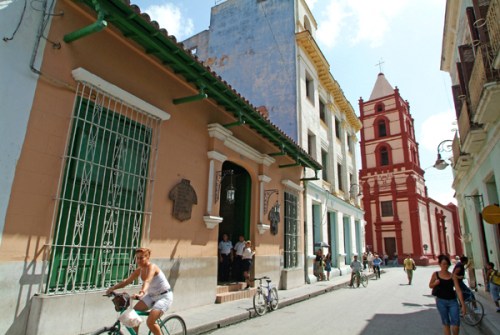
The old colonial buildings are nicely renovated with bright colors and lots of iron grillwork.  Fancy shops on pedestrian only streets, light (or no) car traffic, a relaxed pace — a pleasant place.

Ville historique de Camaguey (Cuba)

Rovirosa_house_camaguey

streets_of_camaguey

At the conclusion of our city walking tour, we drove to the airport for the 55 minute flight back to Miami

Read Full Post »

The plane ride from Miami was only 45 minutes, shorter than the wait in the airport for our luggage and getting through immigration.  Waiting for our group to clear customs in Havana with their luggage gave me a chance to look all the old cars in the airport parking lot.  What a treat to have a modern-equipped bus complete with A/C and DVD player for this trip.  We met our tour guides, Ernesto Reyes and Sole(dad).

20130425-070512.jpg
After a circuitous route through suburban Havana, our first stop was to the home of a noted Cuban ornithologist (and author of the bird guide we would be using while in Cuba) Orlando Garrido. He talked with us for over an hour in rapid-fire English about the 26 endemic bird species of Cuba, showing us his own preserved specimens and making a few comments about the habits and habitats of each.

20130425-070744.jpg
Homes in Havana are a mixture of old, crumbling estates, ramshackle wood structures with galvanized roof, and one-story stucco that looked like they were straight out of Southern California.  The streets are lined with many flowering trees, lots of bougainvillea, and hibiscus hedges.  Garrido’s home was being renovated and was one of the nicer ones oo the block.  His study was crammed with bird books and tennis trophies.  He pulled out 50 year old stuffed specimens of the 21 endemics he had collected and toll stories about each of them, where they could be found, etc.

Then it was off to our hotel (Hotel Santander overlooking the harbor new development area) for a conversation with the former Cuban ambassador to the European Union (Carlos Alzucaray) about the history of US-Cuban relations, held on the roof top terrace of our hotel. This sparked more than a few questions and was very informative but left us with many questions about how Cuba will prosper without a free market, non-state dominated economy.  Alzucarary thinks the socialist state will transform the country.

20130425-070949.jpg
Dinner was at the best restaurant in Havana on a little side street in Old Town.  The food was indeed excellent, and the dining space crowded with visitors. Strangely though, the cobbled streets leading from the plaza to the restaurant were completely empty– no evening strolls in this area of the city for some reason, quite unlike our experience in other Latin America or Caribbean towns.  There are beautiful old stone buildings of colonial architecture in Old Town, a huge cathedral and plaza, all deserted in the evening.

Read Full Post »

Older Posts »