Showing posts with label tutorial. Show all posts

Tuesday, November 16, 2010

富士山:ふじさん, Mount Fuji

Woah, a softie pattern? Really?

Yep! :D

I've been sitting on this "mountain" idea for a long time, trying to figure out how to make it more mountainous. The original small version looked like crap:

Pfft, first try.

Then I tried to make a really big, fluffy one out of some fleece material, like a wumphy-fumphy pillow, but it also ended up looking like crap:

...especially when compared to real mountains.

...and then I discovered that somebody else had already made a much nicer soft Fuji:

damnit

...so fark that. Here's an Eyjafjoell, or Merapi, if you prefer.

Okay, not quite as bad.

 平和な場所と見えるけど、実は、富士山も活火山です。Despite it's peaceful visage in modern times, it is important to note that Fuji-san is also still an active volcano.

(She could blow any minute - save the tea!!!)

And, if you're interested, the word for volcano in Japanese is kazan, written with two very basic kanji: "fire" and "mountain".
火 = fire
山 = mountain
火山 = volcano
Pretty easy, right? This is actually the way most Japanese words are formed. Even single kanji, since they began as ideograms (shorthand pictures meant to illustrate the thing they were describing), can be built out of simpler kanji stuck together:
木 = tree
森 = forest
日 = sun
月 = moon
明 = bright
Hey, you just learned some kanji. :D 楽しみしてね!

Saturday, October 30, 2010

Halloweeeeeeen~

~is my favorite holiday but I never seem to have time to prepare for it buuu~~ (´∩`。)

Today, besides finally buying candy (are there even any kids in our neighborhood? I've only seen maybe one), I took some junk and some other junk and put them together into decorative junk. I also took pictures, because I wanted to know exactly how serious the camera was when it said "battery low". Not very serious, apparently.

One nice part about this particular junk+junk=thing project is that it's impermanent. That is, you can get the glass forms back when you're done. Or, if you prefer, you can make them permanent with a simple trade of adhesives. 


Too Easy Halloween Lantern Tutorial
extremely, super, little-kid-doable easy


Materials
  orange tissue paper
  opaque black paper (or any dark color, really)
  glass jars, bowls, cups, or what have you
  scotch tape
  ponytail bands (or rubber bands)
  scissors
  spray adhesive (optional, only for permanent lanterns)


Cut up your black paper into jack-o-lantern eyes, moths, noses, or whatever Halloweeny shape you want. Consider the shape and size of your glass objects when you do this.


Tape your paper pieces to the surface of your glass objects. Most types of scotch tape can easily be peeled off of glass, but if you have to be sure that there won't be any stickiness left on your glass, use "magic" type tape. Don't worry that you can see the tape; when the lanterns are lit, taped areas become indistinguishable.


Now we wrap the glass forms in a sheet of tissue paper. If your form has straight, parallel sides, like a jar, you can just wrap it in a sheet...

...tape the bottom edges under the jar...

...and put a hairband around the rim to hold the sheet in place. 

Done.

If you're using a round shape, just set it in the center of a sheet of paper...

...wrap the paper up around it, gently, and stuff the loose ends into the top of the jar to hold them up...

...then secure with a hairband around the rim, trimming away extra paper from the opening. 

Done again.

Lastly, if your glass form is shaped such that it can't be banded at the top, you can either improvise with tape around the edges, or use the secret weapon of papercraft: adhesive spray.

 Boom.

Warning: Adhesive spray (spray mount, spray gum, aerosol glue, etc.) is very sticky and will make your paper-to-glass bond pretty damn near permanent. Re-positionable (impermanent) spray adhesive exists, but it is also awfully sticky, and does indeed become permanent on whatever surface it is originally applied to. As with all spray cans, use in a well-ventilated area.

Another Warning: Always protect work surfaces with scrap paper when using spray adhesive, unless you want a gummy table. No-one wants a gummy table, though. Gummy tables suck.


If using spray adhesive, first invert your glass form in the middle of a sheet of tissue paper. Then, spray the ever-loving hell out it. 


Okay, maybe not that much. Just get an even coat of spray on glass and tissue alike. 

Now, very carefully, turn your glass right-side up in the middle of the sheet, being careful not to let the gummy tissue touch the gummy glass, otherwise they'll fall in love IMMEDIATELY and stick like happy ever after. Guess what I did when trying to turn my glass over...  yeah.


Once your glass is right-side up, lift up the paper on all sides and wrap it around the glass. It'll stick real tight, real fast, and make a wrinkly effect. Pat it down to flatten it out.


Lastly, cut away the extra paper from the opening of the glass. Voila.

Add tea candles, display on Halloween night. Or be a dork and use them for mood lighting in the bathroom. Like me. :3
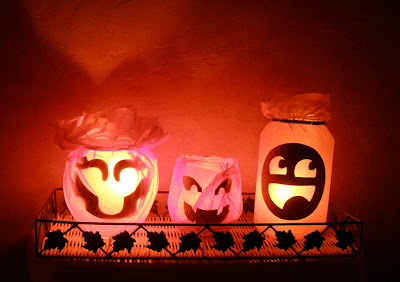
Guess where this picture was taken.
As always, have fun, and Happy Halloween! ハロウィーンおめでとう、たのしみして!

Monday, July 12, 2010

ゆびぬき:yubinuki, Japanese thimbles

Once again, I have been side-tracked into another J-craft. I officially cannot resist pretty things. Not even a little bit.

These are seriously awesome, though.


The word yubinuki simply means "thimble" in Japanese. It can refer to the bucket thimbles we're accustomed to in the west, leather cuff thimbles, metal pad thimbles, or any one of several "thing that goes on your finger when you are sewing" accessories.

 
the above images are all yubinuki,and all blatantly stolen from the Internet

What we've specifically got here are kaga yubinuki (加賀指ぬき). They are padded fabric rings decorated with silk thread. The origin of this style of thimble is credited to the Kaga region of old Japan, modern day Ishikawa prefecture, hence the term kaga yubinuki. When the term "yubinuki" is used in English, it is almost always in reference to this unique type of embroidered thimble.


I discovered yubinuki by way of a related craft called temari (てまり), a topic upon which I really, really hope to do a tutorial soon. The two are related in that they both apply colorful geometric patterns of silk thread to a padded, curved surface. Yubinuki, however, are easier in my humble opinion: there are fewer divisions to keep track of, only one stitch to remember, and they are generally much smaller.

The materials to make a yubinuki are fantastically simple. You need only a small piece of fabric, a needle, some thread in a few colors, some strips of paper, and a little padding. The Japanese use loose-fiber silk padding, but for those stitching in the west, I find that a bit of an unrolled cotton ball works just as well. (Polyfil does NOT work very well, as it is very springy and hard to wrap around the ring base without bits of it sticking out everywhere.)

もし日本語が読めれば、こちらには簡単な how-to があります。:D
If you can read Japanese, here is a simple tutorial all on one page. A more complete tutorial and the pattern to make the double yabane (arrow-tail) pattern can be found here. Even if you don't read Japanese, it's worth a look at just the pictures in each tutorial -- you'll quickly get the feel for what is being done.

Yubinuki instructions in English are a little harder to come by. Fortunately, there is Chloe Patricia and her blog, Ma Mercerie. Madam Patricia gives excellent tutorials for building a thimble base, stitching, making and using patterns, and more, all in English. パツリシア様、大変お世話になりました!

Once you're comfortable with building a ring base, all you need to do is learn the knot to start a new thread on the ring:


...and the single stitch used to make all the various patterns:


What allows for the variety of patterns is the number of divisions you mark on the ring (how many zig-zags of each thread), and in what order the different colors of threads reach across each other. After you get used to the basic stitch, you'll likely be able to mentally de-construct a finished yubinuki and understand the pattern used to make it. I'll be posting the basic ones as I finish graphing them out. :D

Until then:

Tutorials
Base-making tutorial: excellent pictures, Japanese text - also shows how to divide strips without measuring, using a line set or graph (from てんとう虫がやって来た)
Base and stitch tutorial: in Japanese (from Fujix Ltd. publishing)
Base and double yabane pattern tutorial: in Japanese, click each link in order from top to bottom to get a breakdown of materials, base making, divisions, stitch method, and pattern (from Thimble Japan)

Galleries
From 茶飲み話: works from 2006, 2007, 2008, and 2009 (all separate links)
From Zuccaさん: handmade yubinuki gallery
From Quilt-Yui: handmade yubinuki divided by design type (click the various links beneath the words 店主のギャラリー, the fourth menu item down in the left-hand frame)
From 人鳥官: yubinuki and quilting, link goes directly to yubinuki section

Blogs
Small pieces (category 加賀指ぬき)
Amerika tsukuri (full of yubinuki, temari, and miniatures of both)

...and there are a ton more. Try copy-pasting the Japanese term 加賀ゆびぬき (kaga yubinuki) into a GIS. Or, you know, just click here. :D

All actual pictures of kaga yubinuki in this post have been blatantly stolen from the Internet; I wanted to credit them, but I lost the links to the sites from which I saved them, 'cause I'm an idiot. -_-; すばらしい加賀指ぬきの写真は無断に盗まれてしまいました。もしかして、あなた様の写真がこちらに見つけて、おしえてください。大変申し訳ありません。

I'll be back soon with a step-by-step of some patterns~

Wednesday, March 17, 2010

St. Pancakes Day

I hope you are all full of corned beef and cabbage and potatoes... and beer, if you're of the proper age. ^w^ Here's something to be full of tomorrow morning: shamrock pancakes. (Not shamrock flavored, mind you, just shaped funny.) 四葉ホットケーキを作りましょう!

green pancake batter and strawberry pieces

Add some green food coloring to your favorite pancake batter. Also, cut up some fruit into smallish pieces. I'm using strawberries, but you can use almost anything. Bananas work really well because they're so sticky.

 (this is figure 2)

Prep your pan with oil/butter (you know how to make pancakes). Then, BEFORE you pour your pancake, put four of those little fruit pieces in the pan, as in figure 2.

*splut* is the Official Sound of Pancake Batter™

Now pour some green batter into the middle of the four fruit pieces. It should spread out between and around the fruit to make a shamrock-ish shape. You can tilt the pan a little to help form the right shape. (If your fruit pieces just get pushed out of the way, try stickier fruit or bigger pieces.)

wonky, but delicious

Ta-daa! Shamrocks, kinda! (I'm not the best at this.) With some poking and prodding, you can get much more appealing shamrocky shapes. Or, you could add more fruit pieces and make a daisy shape with 5 or 6 petals. It all depends upon how creative you can be in the early morning, before breakfast.

If you need a pancake recipe, this one's great:

Strawberry-Vanilla Pancakes
1 cup flour
0.5 cups oats (rolled, instant, steel cut, whatever)
2 tablespoons brown sugar
2 teaspoons baking powder
1 teaspoon salt

1 egg
0.75 cup milk
1 tablespoon vanilla extract

1 cup chopped strawberries
0.25 cup chopped almonds (optional)
In a large bowl, mix together flour, oats, brown sugar, baking powder, and salt. In a separate bowl, lightly beat together egg, milk, and vanilla. Add this mixture to the dry ingredients and stir it all together. Stir in the chopped strawberries (and almonds, if you want them).

...and if you need them:

Basic Pancake-Making Instructions

Oil or butter the bottom of a frying pan or griddle. Heat the pan over medium-high heat, or until the butter/oil starts to sizzle. Stir the batter up a little, and pour some into the pan to form a pool of your desired pancake size. Flip your pancake when bubbles appear in the middle. Repeat until all of your batter has turned into delicious pancakes. If your pancakes start sticking or burning to the pan, wipe it out and oil or butter the bottom again.

...and if you're out of maple:

Almondine Syrup
1 cup white sugar
1.25 cup brown sugar
1 cup water

1 teaspoon almond extract
Combine both sugars and water in a medium saucepan over medium-high heat. Stir and stir and stir, slowly but constantly, for about a minute as the pot heats up. There is too much sugar for the water to dissolve it all, so you’ll have a sugary sludge on the bottom and liquid on the top. Let the mixture heat up to the boiling point, giving it a slow but thorough stir about once a minute.

Once the mixture begins to boil, start stirring constantly. Boil the syrup (still stirring) for roughly 3 minutes, monitoring the temperature so that it doesn’t boil over or burn. The syrup should now be a transparent dark brown liquid.

Remove the saucepan from heat and immediately add the almond extract (it might puff or hiss when it hits the hot syrup; this is a good sign). Stir the pot about 20 times around to be sure everything is mixed together, then cover the syrup with plastic wrap and let it cool to room temperature (takes a few hours). Don’t put it in the fridge yet!

Once your syrup is cool, it’s ready to enjoy. Store extra syrup in an airtight container in the fridge. It might form a sugar crust on the top, but unless it grows something really strange, like fuzz or spots on the surface, it’s still okay to eat.

Saturday, March 6, 2010

もんきり:monkiri, family crest paper cutting

On the topic of kamon, here's something you can do with them. :D

click to download patterns in a PDF file

家紋:かもん、kamon, meaning "house" (家) + "crest" or "coat of arms" (紋)
切り:きり、kiri, meaning "cutting"; from the verb kiru, "to cut"
紋きり:monkiri, which translates roughly to "coat-of-arms cutting"

Monkiri (also called monkiri asobi) uses many folds and and brightly-colored paper to make paper cut-outs of popular family crests. The symmetrical and geometric nature of most kamon makes them perfect subjects for this craft. It's very similar to cutting out paper snowflakes. All you need to get started is some thin colored paper and sharp scissors.

click to visit the page I stole this graphic from: it's got a few patterns

It's popular to decorate blank uchiwa (団扇, paddle fans) and paper lanterns with monkiri.


They're nice on cards and wrapping, too. :3 楽しみして!

* Intending no offense to Canada... In fact, thank you, Canada! Your "eh" has helped me explain the sound of Japanese words ending in "e" in countless conversations. Also, I really like maple sugar candy and hockey. You guys are awesome.

Monday, February 15, 2010

Rawr. (a day late)

Okay, NOW it's 2010. Happy Chinese New Year of the Tiger. :D


Finally, a new pattern. I've been away from playing with felt for a while (largely because I still can't find where the movers packed it), but by the awesomeness of Nikki-the-Great, I had some special Japanese felt in reserve. (Just enough orange for a tiger -- Taihen doumo, Nikki!)

Also, process pictures. :3 Don't forget: right side of fabric means side that will be facing out when the whole thing is done; wrong side means the side that will be hidden facing the stuffing.

 
ONE: sew tummy and tail tips onto the right sides of fabric 


TWO: make the tail

This involves little more than putting the two tail panels right-sides-together and sewing around, remembering to leave the base of the tail open. Turn the tail right-side out, stuff it with fluff, and maybe add the applique stripes now, because it's harder to add them once the tail is attached to the body.


THREE: attach the tail

The "top" of the tail, that being the inside of the curve, should be facing the right side of the back panel. You can pin or baste it into place, whatever works for you.


FOUR: attach the bottom+sides piece

That long pointy piece provides both the bottom and the sides for this type of softie... it's built on the premise of a lunch bag "wedge" shape. Again, pin or baste it into place, making sure that it's relatively centered and even on both sides. (Ignore the seam in the middle of the piece I used here... I needed to improvise a longer piece from a tinier shape.)


FIVE: attach the front (face) piece

Just a reminder, all these pieces are facing wrong side out, right side in, with the tail hidden in the middle. Sew everything up, and remember to leave a hole of roughly 3cm unsewn somewhere, so you can invert your tiger and stuff it. (Ha, that sounds like a poorly-translated insult... "hey buddy, you can go invert your tiger and stuff it for all I care!")


SIX: invert and stuff

If you did everything right, you should now have this: white tummy on the front, tail attached at the bottom of the back. Now we get to stuff it up. If you want to make it more stable when it's sitting up (a good idea with this design, cause the bottom is so narrow), put something a little heavier in the bottom. I like to tape 10 pennies together and set them in as a weight, or make a little sack of rice out of some scrap fabric and put that in there. 


SEVEN: applique like crazy

I like this part... usually. Small pieces can be fussy sometimes. Using thread the same color as the piece you are attaching, applique the first layer of pieces onto the face and back of your form. I say the first layer because some of the pieces go on top of others. There is no special stitch to use: blanket stitch gives a nice edge if you have shiny thread or embroidery cotton, or you can just tack the pieces on with even stitches like I did. (Don't pull the thread too tight, else you'll get a wiggly scalloped edge on the applied pieces.)


EIGHT: back view

Once the stripes are on the back of your tiger, you're done there. (Note that the two stripes on either side go all the way around to the front.) As for the face...


NINE: 出来上がり - done!

Add the muzzle, eyebrows, and nose -- you now have a funny-looking Sack-o'-Tiger™ of your very own. おめでとう、congratulations! :D

So anyway, I hope to be around more often now. My sincere thanks to everyone who's been stopping by the blog, even while I wasn't posting anything new. You guys really cheer me up. m(-_-)m

Sunday, November 15, 2009

The End of Cake

タダイマカエリマシタ!!!>w< I'm back!

Grr, Google Ads, cut it out! This is not a cake blog! I know there have been some cake-related things in the past few months, but no! This is a blog about toys and sewing and paper and string and Japan!

See? A soft toy pattern! It's a plushie! ...of a cake. -_-;


This is the last cake-themed thing I'll post for a while. I promise. Really. 
Click to download the pattern as a PDF; instructions and pictures below.

I made this thing on the fly as a present for a former co-worker, the lovely Diana G., who knows everything there is to know about cake decorating and Wilton stuff. I wish I had some pictures of all the cakes she made and demo-decorated on Saturdays, 'cause damn, girl, were they ever awesome. And freaking sweet, too. Like the kind of sweet where you can feel the sugar crystallizing in your veins, but you still want more because it's just SOOOO good.

...eh-hem. ^^;

This is a pretty easy softie in theory; getting the edges of the frosting pieces to lay as you want and stitching them down with blanket stitch is a little bit of a challenge. Just go slow and it'll be fine. It helps if you make the whole cake form first, stuffing and all, and then sew the top frosting layer on to the finished form, so you're not fighting to get it pinned down on a limp, unstuffed model.

A Pictorial Walkthrough

1. Here are your pieces:


2. With a complementary color of perle cotton or embroidery floss, blanket stitch the frosting band to one of the layer side bands. (It helps to baste the pieces together first to keep them lined up while you stitch.)


blanket stitch, close up

3. This is what it should look like. Blanket stitch is a very easy and clean stitch that covers the raw edge of the felt and maintains that little bit of depth between the two pieces. If you have never done blanket stitch before, here's a lovely tutorial that shows it step-by-step


top layer, frosted bottom layer

4. Using regular thread, sew the other cake layer band to the top of the "frosted" one you just finished. 


"layer sammich", with finished seam along the top

NOTE: From here on, take care to remember which end is up, else things might get sewn to the wrong side of other things, which is a sucky mistake to make. :(

5. Sew your completed cake sides into a broad loop, wrong side (with all your seams) facing out.


...like this.

6. Sew on the bottom layer of the cake. It's really not hard to sew a circle onto the end of a tube; just line up the edge of the circle with the edge of the tube/cylinder of fabric, take a few stitches where the two are aligned, then turn the circle a bit and repeat. 


This is the top end, actually; notice the frosting on the bottom? I wasn't paying attention. -_-;

7. Sew on the top cake layer just as you did with the bottom, but remember to leave a gap of about 1.5 inches or so (3 cm+) to turn the form right side out. Stuff the finished form and sew the turning gap closed; it doesn't need to be pretty, because the top layer of frosting is going to hide it anyway.

Okay, so wait a second. Why did we just sew a top layer onto the cake if we're going to cover it up with the round frosting piece? Because it makes this last step much easier.


a blanket stitch in progress; going around the top frosting layer

8. Lay your frosting piece atop your finished, stuffed, stitched-closed cake form. Make sure it's centered. (Also, make sure it's on the right end.) Either pin on baste the piece into place so it doesn't get off-kilter while you're going around with the blanket stitch. Using the same embroidery cotton from before, blanket stitch all around the edge of the frosting top layer, laying each "ruffle" of frosting down over the edge of the cake as you go. Navigating the hills and valleys isn't really that hard if you just remember to keep your stitches evenly spaced and parallel to the closest tangent point of the edge.

For the strawberry on top, just make a tiny version of this softie. :D

Thanks for all the cake, Diana! (Especially for making the lemon ones, and letting me eat the extra frosting!) X3

楽しみして、ナハン〜!