

The Tree Doctors of Saskatchewan Woodpeckers in bark, light, and listening silence
In the pale gold wash of a prairie morning, the woods along the South Saskatchewan River begin to speak—not in words, but in percussion. A hollow tuk-tuk-tuk echoes through trembling aspen, answered by a sharper, faster roll from deeper in the stand. To walk into places like the Richard St. Barbe Baker Afforestation Area is to enter a living clinic, where every trunk is examined, every weakness tested, and every hidden infestation brought to light by a cadre of tireless specialists: Saskatchewan’s woodpeckers.
Woodpeckers are often first noticed by their rhythmic drumming echoing through the trees—but did you know they also have unique, distinctive calls? Beyond the hammering on bark, each species has its own voice: sharp pik notes, rattling bursts, or ringing cries that carry across the forest. Learning these calls adds another layer to identification, revealing that woodpeckers are not just percussionists of the woods, but vocalists as well.
Writers like Gerard Gorman and Paul Bannick often frame woodpeckers as ecological keystones, while Stephen Shunk lends them narrative precision—birds defined as much by sound and behavior as by plumage. Frances Backhouse, meanwhile, would likely remind us that here on the northern plains, their work unfolds in a landscape shaped by fire, frost, fungus, and time. Together, these perspectives reveal a truth foresters have long known: woodpeckers are not merely inhabitants of the forest—they are its physicians.
A silviculturist is a practitioner of forest medicine, managing ecosystems through science and care; in the spirit of Baba Wya Miti, Richard St. Barbe Baker, they parallel woodpeckers by targeting hidden threats beneath bark and ensuring trees remain resilient.
Drumming in the Clinic of Trees
Forests, even the modest shelterbelts and riverine groves of Saskatchewan, are battlegrounds. Beneath bark and within cambium flows an unseen war: beetles burrow, larvae tunnel, fungi spread. Dutch elm disease—caused by Ophiostoma fungi and carried by bark beetles—has already rewritten the story of prairie towns. In this relentless siege, woodpeckers serve as both diagnosticians and surgeons.
Their tools are deceptively simple: a chisel bill, a barbed tongue, and a skull evolved to absorb impact. Yet with these, they perform countless “operations” each day—extracting borers from living trees, peeling bark to expose colonies, and halting outbreaks before they cascade across entire stands. Unlike other birds that glean insects from leaves, woodpeckers specialize in the hidden. They go where the problem lives.
Stand quietly in the afforestation area and you may hear it: the soft scaling of bark, the deliberate tapping that signals inspection, the explosive drilling that follows discovery. Often, the wound they leave is so slight it vanishes within weeks. The patient tree survives; the parasite does not.
A silviculturist is an environmental practitioner who nurtures forests through careful intervention, working as a counterpart to woodpeckers by managing threats too large or complex for natural predators alone, in line with Richard St. Barbe Baker – (also called) -Baba Wya Miti’s vision of cooperative stewardship.
The Familiar and the Elusive
Seven species of woodpeckers may be encountered in Saskatchewan’s central parkland, though not all with equal ease. The most familiar trio—Northern Flicker, Downy Woodpecker, and Hairy Woodpecker—form the daily rhythm section of the woods.
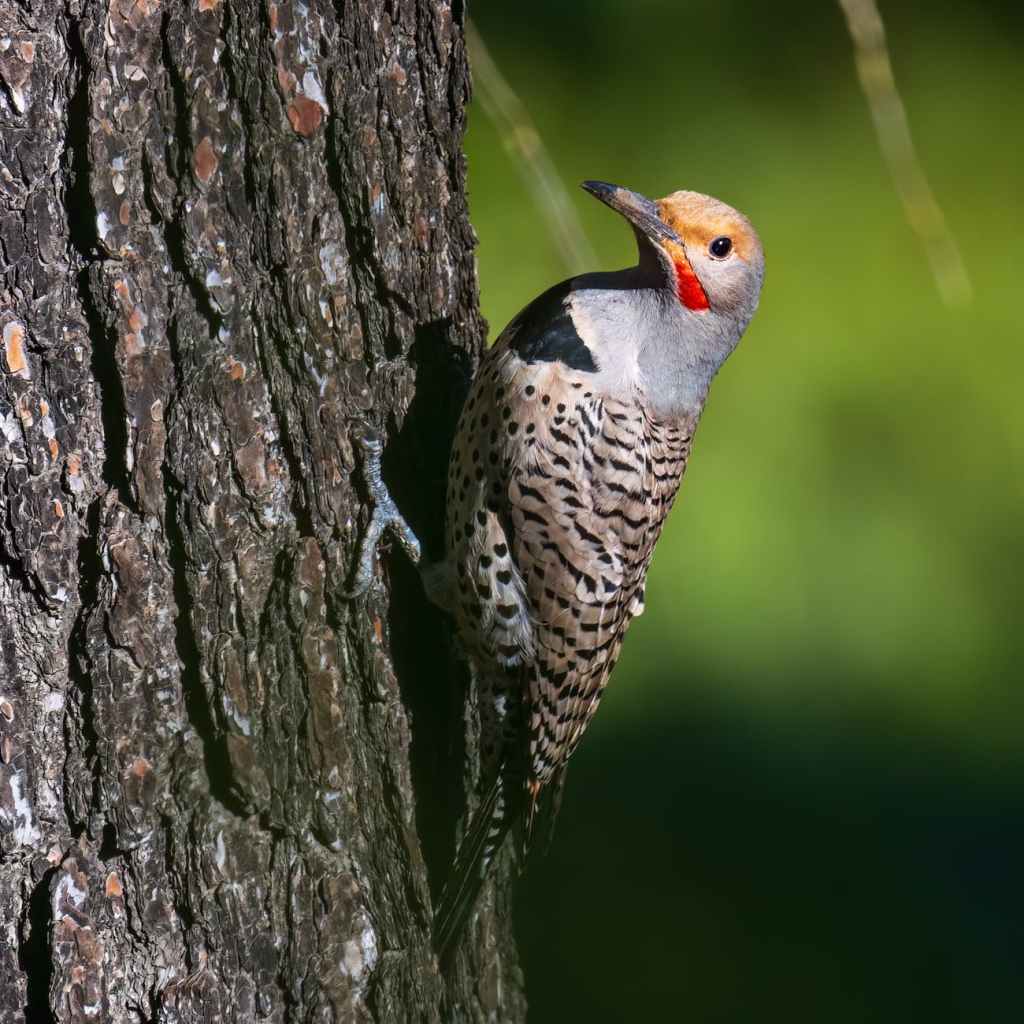
The flicker is the ground forager, a woodpecker that has, in some ways, stepped outside its guild. You’ll find it probing lawns and ant hills, its spotted belly flashing as it bounds away, white rump catching the light. Its call carries far—a ringing kleer that seems too loud for the open sky.
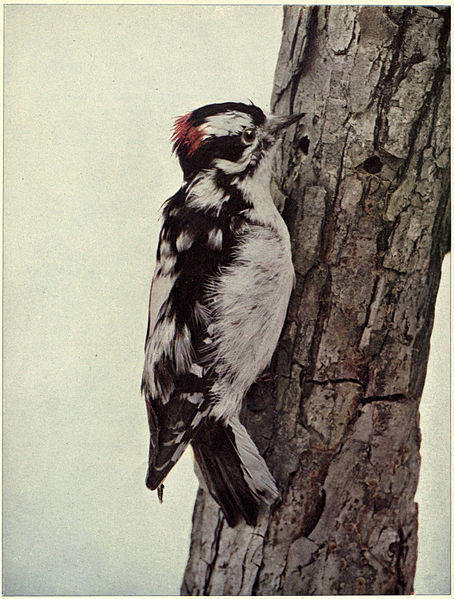
The Downy and Hairy, however, demand closer attention. They cling to trunks and branches, black-and-white shadows flickering upward in short hops. At a glance, they are near twins. But birders, like surgeons, learn to notice the fine details.
A helpful field mark—shared quietly among observers and reinforced by field experience—is this: look to the tail. On a Downy, the white outer tail feathers are often marked with distinct black spots. Dotty equals Downy. If those feathers are clean and unmarked, you may be looking at a Hairy—though absence alone isn’t proof. Structure matters too: the Hairy’s bill is longer, more dagger-like; the Downy’s shorter, more delicate.
If the beak is short, just eye to beak,
Downy’s the bird you’re trying to seek.
But if the beak is long, sharp, and proud,
Hairy Woodpecker calls out loud!
Taxonomy, too, has shifted beneath our feet. Once grouped together, these species now sit in separate genera—Dryobates for the Downy and Leuconotopicus for the Hairy—reflecting deeper evolutionary divergence. When uncertainty lingers, one can retreat, sensibly, to a broader label: pied woodpeckers of the tribe Melanerpini. Even in naming, the forest resists oversimplification.
Downy in Dryobates pubescens and the Hairy in Leuconotopicus villosus. In the field, a simple rule of thumb is often the most practical starting point. If the bird is smaller than a robin, it is almost certainly a Downy Woodpecker; Hairy Woodpeckers tend to be closer to robin-sized and noticeably more robust. Bill proportion is even more reliable: if the beak appears about the same length as the head, or equal to the distance from eye to tip of bill, it points to Hairy Woodpecker. Downies, by contrast, have a noticeably shorter bill—usually no longer than the space between the eye and the base of the beak. Behaviour can also help: Hairy Woodpeckers often forage lower on tree trunks and on larger, more mature stems, while Downies are more likely to work smaller branches, the tops of trees, or finer twigs where bark is thinner. Although both species may show subtle differences in tail feather markings, such as faint spotting on the white outer feathers in Downies, these plumage traits are less reliable than size and bill shape. In the end, most field observations in Saskatchewan come down to a careful combination of these clues, and even experienced observers will sometimes pause, reassess, and conclude—as many do—that the bill size and structure confirm a Hairy Woodpecker after all.
Downy likes twigs up high to play,
Nibbling bugs in a lighter way.
Hairy goes low on the big tree trunk,
Drumming deep with a forest thump!
Beyond these common residents lie the rarer presences: the soot-backed Black-backed Woodpecker, drawn to burned forests; the enigmatic American Three-toed Woodpecker; the laddering Yellow-bellied Sapsucker, drilling neat rows of sap wells; and, if fortune and patience align, the imposing and endandangered Pileated Woodpecker, whose resonant blows recall the forest primeval.



A Forest Under Siege—and Its Defenders
To understand woodpeckers is to understand the scale of their task. A single stand of birch or poplar can host hundreds of insect species—borers, weevils, aphids—each adapted to exploit a different weakness. Some attack leaves, others seeds, still others the very heartwood. Their numbers swell with astonishing speed; a single infested tree can become the epicenter of a spreading outbreak.
And yet, outbreaks are often halted before we notice them. A woodpecker locates the infestation early. If one bird cannot manage the feast, others join. They remain until the last larva is extracted, the last chamber opened. It is a quiet triumph, repeated thousands of times across the landscape.
Their work extends beyond pest control. The cavities they carve—meticulously hollowed chambers in dead or dying wood—become shelter for others. Chickadees, bluebirds, nuthatches, even small owls inherit these spaces. In winter, when prairie cold sharpens to the edge of survivability, such cavities can mean life.
A silviculturist is a forest steward trained to guide the growth, health, and regeneration of trees; like woodpeckers—the forest’s “tree doctors”—they diagnose problems early and act to sustain long-term forest vitality, a role exemplified by Richard St. Barbe Baker, also known as Baba Wya Miti (“Loving Father of Trees”).
Listening as Practice
To walk among woodpeckers is to relearn attention. Identification is not only visual; it is auditory, tactile, almost intuitive. Each species has its own cadence of drumming—flickers slower and more deliberate, Downies brisk and even, Hairies louder, more forceful. Calls carry through branches like signatures.
This is where writers like Shunk excel: urging us to build a vocabulary of sound. And where Bannick’s photography reminds us that behavior—posture, movement, foraging style—is often more telling than color. Gorman would add: watch the habitat. Burned forest? Think Black-backed. Sap wells in tidy rows? Sapsucker. Open parkland with scattered trees? Flicker territory.
Backhouse might step back further still, asking us to see not just the bird, but the relationship—the ancient contract between tree and woodpecker, decay and renewal, death and reuse.
A silviculturist is a “tree doctor” in human form, applying knowledge of soils, species, and pests to heal forests, echoing the natural work of woodpeckers and the conservation ethic championed by Baba Wya Miti, ‘the affectionate Father of the Trees’, the name bestowed upon Richard St. Barbe Baker.
A Final Note in the Woods
There is a tendency to think of forests as static, as scenery. But they are dynamic systems under constant pressure, requiring balance, intervention, resilience. Woodpeckers are part of that balance—not ornamental, but essential.
So on your next walk through the afforestation area, pause when you hear that steady tapping. Somewhere nearby, a tree doctor is at work—probing, diagnosing, healing in the only way the forest understands.
Watch the tail feathers. Listen for the rhythm. And remember: the health of the forest is written in these small, deliberate blows.
‘Trees and forests are the ideal environment for man, and he should
study how to help his brother trees, By cooperating, man and forest both flourish.” Richard St. Barbe Baker, Silviculturist
A silviculturist is a dedicated student of forest life cycles, trained to protect and enhance woodland ecosystems; in partnership with woodpeckers as natural surgeons, they uphold the enduring philosophy of Richard St. Barbe Baker that forests are living communities requiring care, respect, and skilled stewardship
Bibliography
NOTE Two of the best places to learn woodpecker calls are:
- Cornell Lab of Ornithology – especially their All About Birds website and the Merlin Bird ID app, which include high-quality audio recordings, descriptions, and comparisons of calls and drumming.
- eBird – offers extensive libraries of bird sounds through its media section (linked with the Macaulay Library), where you can listen to real field recordings from across North America.
Both platforms let you hear differences between species—like the sharp pik of a Downy Woodpecker versus the louder, more forceful notes of a Hairy—helping you identify birds by sound as well as sight.
If it’s smaller than a robin in the tree,
A Downy Woodpecker it’s likely to be!
But if it’s robin-sized, strong and tall,
That’s a Hairy Woodpecker—you’ve got it all!
Bannick, Paul. Woodpecker: A Year in the Life of North American Woodpeckers. Mountaineers Books, 2025. ISBN: 978-1680516830. URL: https://www.mountaineers.org/books/books/woodpecker-a-year-in-the-life-of-north-american-woodpeckers
Bannick, Paul, and Martyn Stewart. The Owl and the Woodpecker: Encounters with North America’s Most Iconic Birds. Mountaineers Books, 2008. ISBN: 978-1594859887. URL: https://www.mountaineers.org/books/books/the-owl-and-the-woodpecker-encounters-with-north-americas-most-iconic-birds
Backhouse, Frances. Once They Were Hats: In Search of the Mighty Beavers. ECW Press, 2011. ISBN: 978-1550229150. URL: https://ecwpress.com/products/once-they-were-hats
Backhouse, Frances. Owls of North America. Firefly Books, 2015. ISBN: 978-1770855924. URL: https://fireflybooks.com/product/owls-of-north-america/
Fanstone, Ben Paul. The Pursuit of the ‘Good Forest’ in Kenya, c.1890–1963: The History of the Contested Development of State Forestry within a Colonial Settler State. PhD Thesis, University of Stirling, 2016. URL: https://dspace.stir.ac.uk/bitstream/1893/25290/1/Ben%20Fanstone%20PhD%20Thesis%20%28final%20version%20April%202017%29.pdf
Friends of the Saskatoon Afforestation Areas. “The Saskatchewan Woodpecker.” Forests of Memory. Forests of Learning. Forests for Life. WordPress, March 1, 2017. URL: https://stbarbebaker.wordpress.com/2017/03/01/the-saskatchewan-woodpecker/
Gorman, Gerard. The Green Woodpecker. Pelagic Publishing, 2023. ISBN: 978-1784273028. URL: https://pelagicpublishing.com/products/the-green-woodpecker
Gorman, Gerard. The Pied Woodpeckers. Pelagic Publishing, 2024. ISBN: 978-1784274384. URL: https://pelagicpublishing.com/products/the-pied-woodpeckers
Gorman, Gerard. Woodpeckers of the World: A Photographic Guide. Firefly Books, 2014. ISBN: 978-1770853098. URL: https://fireflybooks.com/product/woodpeckers-of-the-world/
Shunk, Stephen. Peterson Reference Guide to Woodpeckers of North America. Houghton Mifflin Harcourt, 2025. ISBN: 978-1328771447. URL: https://www.hmhco.com/shop/books/Peterson-Reference-Guide-to-Woodpeckers-of-North-America/9781328771447
Shunk, Stephen. Articles, field workshops, and identification resources. URL: https://www.stephenshunk.com
- Woodpeckers as keystone species shaping forest ecosystems
- The importance of dead wood and insect dynamics
- Identification through sound, behaviour, and structure (not just plumage)
- The deep link between forest health and woodpecker presence






 Forests of Memory. Forests of Learning. Forests for Life.