

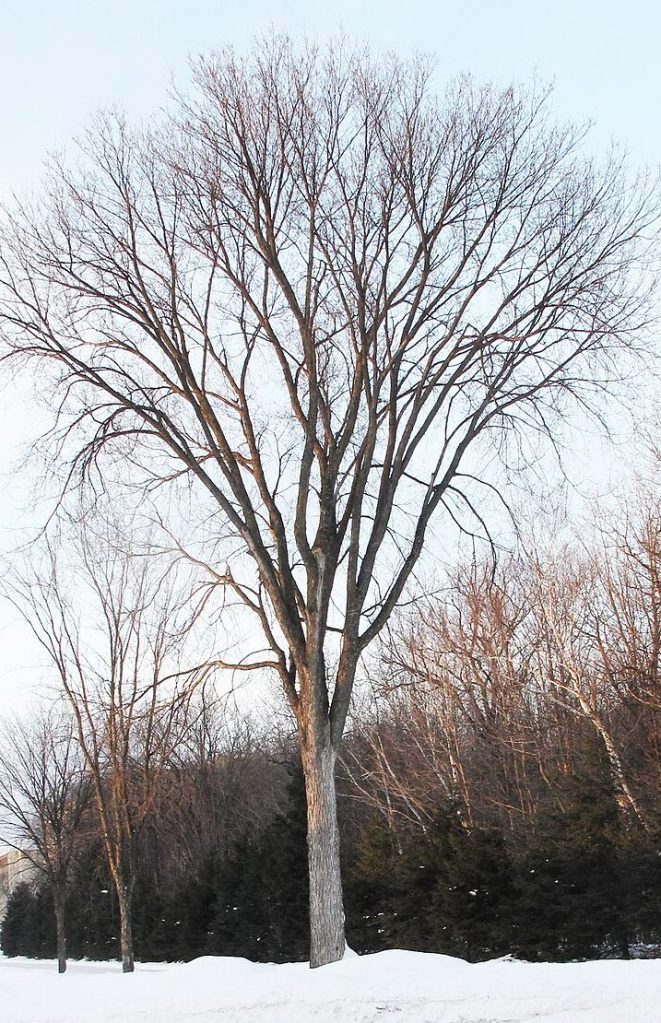
The elm, with its sweeping arch of green, has long been the cathedral tree of our northern cities. Its vaulted canopy shades our streets, cools our homes, and whispers to us of continuity with nature. In Saskatoon, nearly a quarter of the urban forest is elm—a treasure beyond measure. In the afforestation areas, too, Siberian Elms, and American Elms are a great portion of the canopy. Yet today, we face a dire crisis. The City has declared an ecological emergency as Dutch elm disease spreads with alarming speed. How to Identify an Elm. How to Spot Dutch Elm Disease Symptoms.
This is no ordinary ailment. Dutch elm disease (DED) is a ruthless invader, a fungus—Ophiostoma ulmi and its more virulent cousin Ophiostoma novo-ulmi—that enters the tree’s veins and clogs them, cutting off life itself. The carriers are small, inconspicuous elm bark beetles. On their wings, they bear spores like unwelcome cargo. Seeking places to lay their eggs, they search for damaged elm—pruned in the wrong season, broken by storm, or cut for careless firewood. From there, death marches through the canopy.
Richard St. Barbe Baker, silviculturist (forest doctor) has seen many forests suffer, but few plagues advance as swiftly as this. A tree that stood proudly in May may be yellowed and withered by August, its crown shriveling, its roots starving. So entire boulevards may fall silent, their green vaults gone, sunlight harsh and unbroken upon the pavement.


The Call to Action
The City has confirmed a record twelve cases this summer—more than ever before. Seven more trees show unmistakable signs and will be removed. Already, over 8,700 kilograms of elm wood have been gathered and destroyed, yet more remains.
Thai Hoang, Director of Parks, sounded the alarm plainly: “Do not store elm wood on your property. Do not burn it in your fire pit. About a quarter of our forest canopy is elm. This is not a minor issue—it is an ecological emergency.”
Indeed, the beetle thrives in neglected woodpiles. Every log, every stored branch, is a breeding ground. To keep elm wood is to endanger the very heart of our city.
Best Practices for Guardianship
We who love trees must become their guardians. There are simple yet essential practices:
- Never transport or store elm wood. Dispose of it only at the City landfill, where handling is safe and free.
- Obey the provincial pruning ban between April 1 and August 31. Fresh cuts draw the beetles like moths to a flame.
- Water wisely. From April until mid-August, water deeply. Then let the trees harden for winter, with one or two final soakings before freeze-up.
- Prune in very early spring. At that time, wounds heal quickly, and beetles are less active.
- Maintain soil and roots. Fertilize thoughtfully, protect roots from damage during construction, and mulch well to prevent mower injury.
The elm is resilient if cared for. But neglect is its undoing.
The Mystery of the Survivor Elms
Yet even in this dark time, there is hope. Researchers tell us of survivor elms—trees that, though surrounded by the dying, endure. These are not unlike people who endured the scourge of COVID-19. Those with co-morbidities fared worse, while the strong sometimes resisted. So it is with elms. Healthy, vigorous trees may overcome where weakened ones fail.
In Minnesota and elsewhere, researchers funded by the MITPPC are studying these survivor trees, seeking to propagate their resilience. Early-flushing clones, resistant hybrids, and cultivars like Valley Forge, Prairie Expedition, and Jefferson may offer us a new generation of elms. Some of these hybrids draw strength from Asian species, which co-evolved with the fungus and are far less susceptible.
This is the field of hope: not only to protect the present, but to plant a future forest of resistance.
A Plea for Stewardship
Let us remember: the elm is more than wood and leaves. It is a shelter for birds, a fortress against wind, a cooling balm in summer, a companion in our daily walk. To lose it is to lose part of ourselves.
As Richard St. Barbe Baker often said, “if a man loses one-third of his skin he dies; if a tree loses one third of its bark, it too dies. If the Earth is a ‘sentient being’, would it not be reasonable to expect that if it loses one third of its trees and vegetable covering, it will also die?” The elm has stood beside us for generations; now we must stand for it.
The emergency in Saskatoon is real, but it need not be the end. With vigilance, with science, with love, and with law, we can yet preserve these cathedral trees. And in time, with resistant cultivars and survivor elms, we may restore what is lost.
But only if we act—together, now.
“The minimum for safety is one third of the total land area. I think what is happening to the elms must be alerting the whole country to the necessity of trees, of the need for more trees. The elm has the largest leaf surface of any tree in Britain. If you …. put the leaves together edge to edge, they would cover ten acres. So naturally, the first tree to suffer from air pollution was the elm and, of course, when an elm is suffering from fatigue it is subject to attack by disease: the elm bark beetle, the carrier of the elm fungus, comes along and the tree succumbs.
I look at it this way. If a person is living a normal life and not abusing themselves – not smoking too much, not eating too much, not drinking too much – but living normally and eating the right food – they will be fit and well. It is only when they start abusing themselves that they are prone to attack by disease. It is the same with trees.
The next tree to go (the next tree with the largest leaf surface after the elm) is probably the beech: after that the sycamore: and so on. Finally it will be Man’s turn. We forget that we owe our existence to the presence of trees and as far as forest cover goes, we have never been in such a vulnerable position as we are today. The only answer is to plant more trees – to plant for our lives.
Richard St. Barbe Baker answers the first question above” Richard St. Barbe Baker.
Bibliography
- City of Saskatoon. (2025, August 29). Record Dutch elm disease cases identified; city urges action for ecological emergency. Retrieved from https://www.saskatoon.ca/news-releases/record-dutch-elm-disease-cases-identified-city-urges-action-ecological-emergency
- City of Saskatoon. (2025, August 18). New cases of Dutch elm disease identified in Saskatoon. Retrieved from https://www.saskatoon.ca/news-releases/new-cases-dutch-elm-disease-identified-saskatoon
- Minnesota Invasive Terrestrial Plants and Pests Center. (2025). Survivor elms. Retrieved from https://mitppc.umn.edu/news/survivor-elms
- CBC News. (2025, August 29). Saskatoon removes record number of trees infected with Dutch elm disease. Retrieved from https://www.cbc.ca/news/canada/saskatoon/saskatoon-removes-record-number-of-trees-infected-with-dutch-elm-disease-1.7621670
- CTV News. (2025, August 30). Saskatoon declares ecological emergency over Dutch elm disease. Retrieved from https://www.ctvnews.ca/saskatoon/saskatoon-declares-ecological-emergency-over-dutch-elm-disease-1.7621670
- CJME News. (2025, August 29). Saskatoon removes record number of trees infected with Dutch elm disease. Retrieved from https://www.cjme.com/2025/08/29/saskatoon-removes-record-number-of-trees-infected-with-dutch-elm-disease/
- CJWW Radio. (2025, August 29). Saskatoon removes record number of trees infected with Dutch elm disease. Retrieved from https://www.cjwwradio.com/2025/08/29/saskatoon-removes-record-number-of-trees-infected-with-dutch-elm-disease/
- Facebook. (2025, August 29). Saskatoon removes record number of trees infected with Dutch elm disease. Retrieved from https://www.facebook.com/watch/?v=2036431127184651
- YouTube. (2025, August 29). Saskatoon removes record number of trees infected with Dutch elm disease. Retrieved from https://www.youtube.com/watch?v=w3lXGZZTtgE
- YouTube. (2025, August 29). Saskatoon removes record number of trees infected with Dutch elm disease. Retrieved from https://www.youtube.com/watch?v=eM94W_XQpNM
Addresses:
Part SE 23-36-6 – Richard St. Barbe Baker Afforestation Area – 241 Township Road 362-A
Part SE 23-36-6 – SW Off-Leash Recreation Area (Richard St. Barbe Baker Afforestation Area ) – 355 Township Road 362-A
S ½ 22-36-6 Richard St. Barbe Baker Afforestation Area (West of SW OLRA) – 467 Township Road 362-A
NE 21-36-6 “George Genereux” Afforestation Area – 133 Range Road 3063
Wikimapia Map: type in Richard St. Barbe Baker Afforestation Area or
Google Maps South West Off Leash area location pin at parking lot
Web page: https://stbarbebaker.wordpress.com
Where is the Richard St. Barbe Baker Afforestation Area? with map
Where is the George Genereux Urban Regional Park (Afforestation Area)?with map
Blogger: FriendsAfforestation
Tumblr friendsafforestation.tumblr.comFacebook Group Page: Users of the George Genereux Urban Regional Park
Facebook: StBarbeBaker Afforestation Area
Facebook for the non profit Charity Friends of the Saskatoon Afforestation Areas Inc. FriendsAreas
Facebook group page : Users of the St Barbe Baker Afforestation Area
Support via Zeffy
Please help protect / enhance your afforestation areas, please contact the Friends of the Saskatoon Afforestation Areas Inc. (e-mail / e-transfers )
Donate your old vehicle, here’s how!
Support using Canada Helps
Support via a recycling bottle donation and Join the plastic-recycle challenge!
United Nations Decade on Ecosystem Restoration
- Use the UN Decade’s Visual Identity
- Make it your own
- Spread the word about the UN Decade
- Let’s Bring Back Forests
- Let’s Green Our Cities
““Be like a tree in pursuit of your cause. Stand firm, grip hard, thrust upward. Bend to the winds of heaven..”
Richard St. Barbe Baker




 Forests of Memory. Forests of Learning. Forests for Life.