Richard St. Barbe Baker Afforestation Area. George Genereux Urban Regional Park. Humboldt Broncos Memorial Forest. Come to Nature. Come to Life. Friends of the Saskatoon Afforestationk Areas Inc. friendsareas.ca
As the sun dips below the horizon on Monday, April 13, a quiet transformation begins. For most of the modern world, this is the hour when the “second sun”—the relentless, amber hum of high-pressure sodium and LED glare—flickers to life, erasing the universe from view. But as we usher in International Dark Sky Week, there remains a sanctuary on the peri-urban fringes of Saskatoon where the ancient contract between humanity and the stars is still honored.
To find it, one must travel southwest, away from the city’s light-choked core, to the sprawling shadows of the Richard St. Barbe Baker Afforestation Area and George Genereux Urban Regional Park. Here, the urban grid dissolves into a silhouette of trees, and the sky ceases to be a gray ceiling; it becomes an abyss of wonder.
The Wild Architecture of the West Swale
In the stillness of these afforestation areas, the night is far from empty. It is a bustling, hidden metropolis. As the light fades over the West Swale wetlands, the “wild Saskatchewan nightlife” takes center stage. This is not the clatter of commerce, but the rhythmic pulse of an ecosystem that evolved over eons to function in the dark.
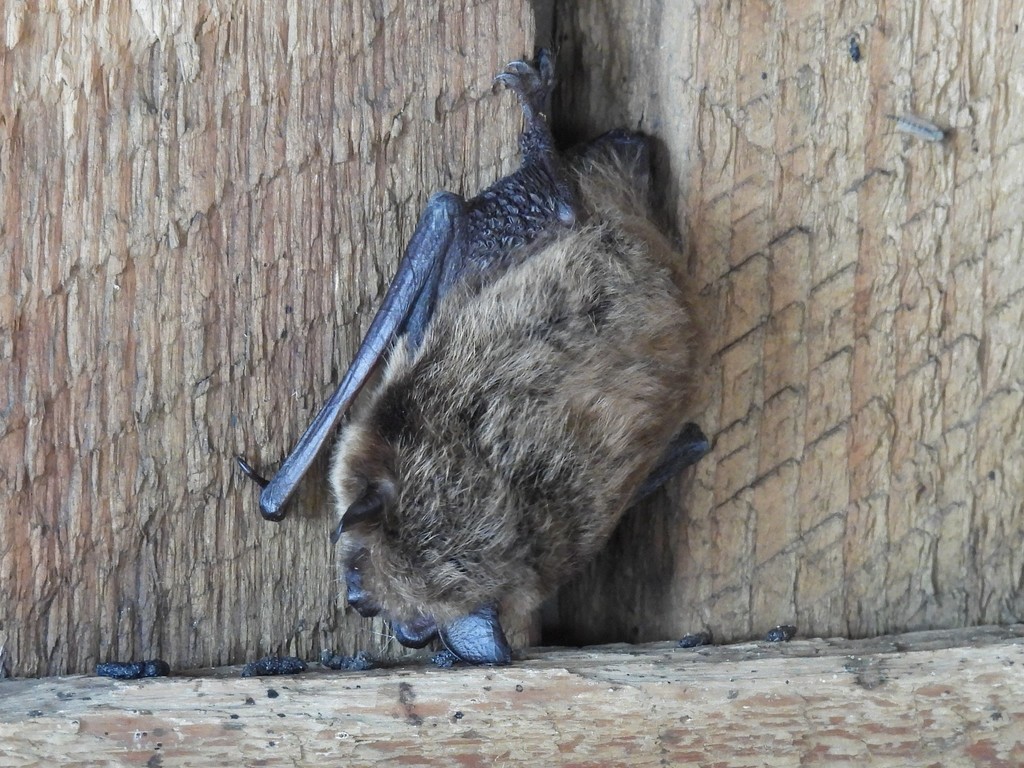
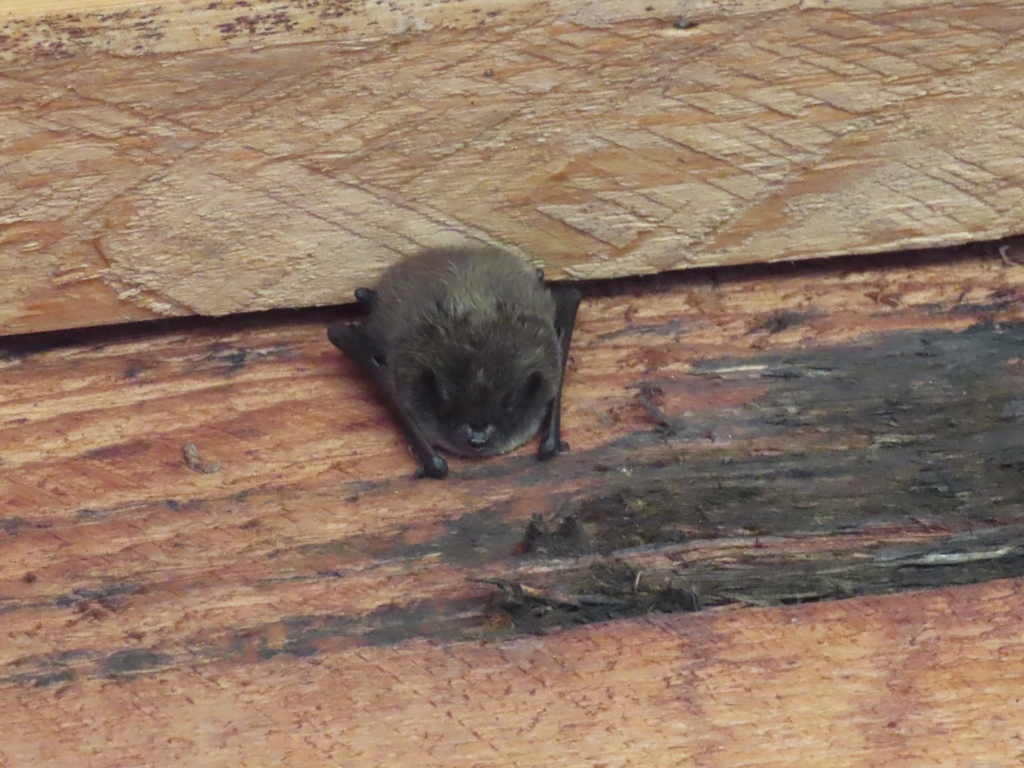
Out of the gallery of trees, the silhouettes of the night-fliers emerge. Among them are the Little Brown Myotis and the Northern Long-eared Bat, species now treading the precarious edge of the endangered list. These masters of echolocation are the sentinels of our night. To them, light pollution is not merely a nuisance; it is a barrier, a disruption of the predatory dance they have performed since the dawn of time. When we flood the night with artificial glare, we blind the nocturnal, turning their sanctuary into a gauntlet.
A Symphony in Shadow
The wetlands of the Swale act as a dark-mirror to the heavens. In the absence of city glow, the choir of the marsh reaches a crescendo, undisturbed by the biological confusion that artificial light brings to mating cycles and migration. This is the importance of International Dark Sky Week—it is a reminder that darkness is not the absence of life, but a requirement for it.
The Richard St. Barbe Baker and George Genereux lands are more than just parks; they are “star-grain” elevators, holding the precious resource of the cosmos for the next generation. Standing in the center of these woods, the Milky Way reveals itself not as a faint smudge, but as a frosted river of fire, casting soft shadows on the forest floor. It is a humbling reminder that we are citizens of a galaxy, not just residents of a municipality.
The Case for the Permanent Night
While April 13 marks the beginning of our celebration, the philosophy of the dark must be a year-round commitment. We have lived so long in the “electric cocoon” that we have forgotten the profound psychological and ecological necessity of a truly dark night. A dark sky preserves our health, guides the bird on its path, and grants the poet his muse.
As the wind whispers through the poplars of the southwest, let us recognize that darkness is an endangered species of its own. By shielding our lights and preserving the shadows of the West Swale, we aren’t just saving energy—we are reclaiming our place among the stars. This week, turn your eyes upward. The universe is waiting for you in the quiet, dark corners of Saskatoon.
“Darkness is as essential to our biological welfare, to our evolutionary heritage, as light itself.” — Inspired by the philosophy of the International Dark-Sky Association.
Part SE 23-36-6 – Richard St. Barbe Baker Afforestation Area – 241 Township Road 362-A
Part SE 23-36-6 – SW Off-Leash Recreation Area (Richard St. Barbe Baker Afforestation Area ) – 355 Township Road 362-A
S ½ 22-36-6 Richard St. Barbe Baker Afforestation Area (West of SW OLRA) – 467 Township Road 362-A
NE 21-36-6 “George Genereux” Afforestation Area – 133 Range Road 3063
Wikimapia Map: type in Richard St. Barbe Baker Afforestation Area or
Google Maps South West Off Leash area location pin at parking lot
I believe that water must be the basic consideration in all our national and earth- wide forest programmes. Streams and rivers must be returned to their natural motion. ~ Richard St. Barbe Baker
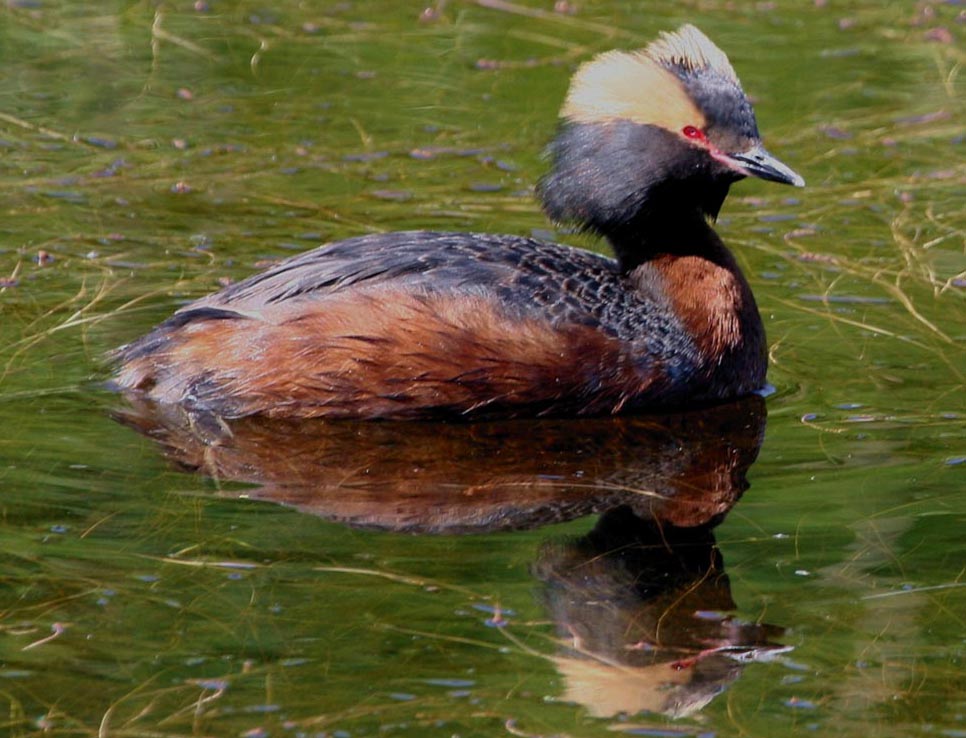
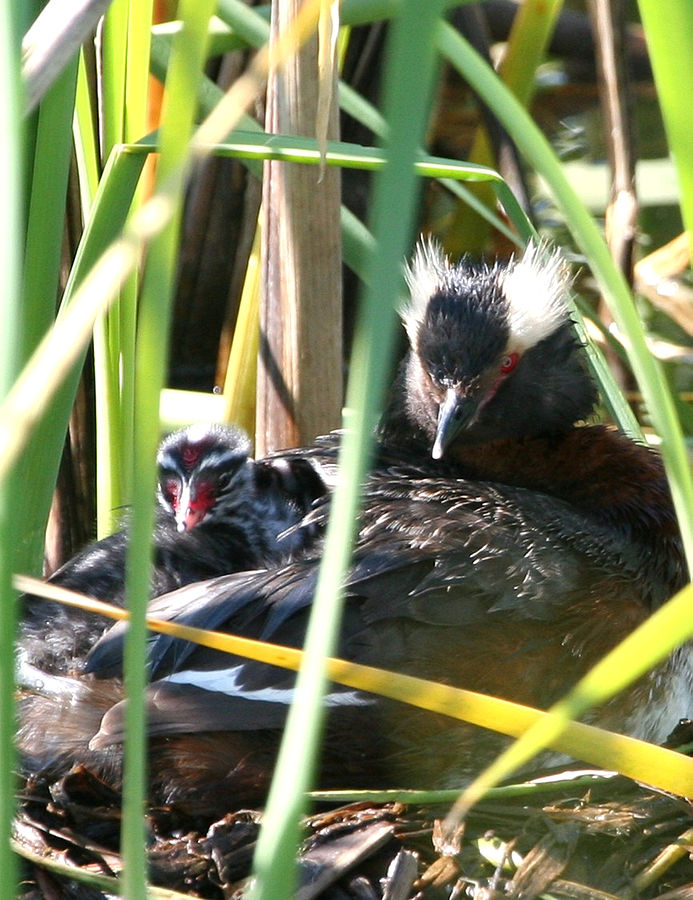
Podiceps Auritus is quite an amazing looking waterbird with yellow / white unique feathers behind its eyes tufted up to appear as “horns”, thus it name. This little bird is quite striking with black head, red eyes, and the white tufted ears bobbing along above a dark chestnut/black coloured body. These are the breeding colours when the Horned Grebe is all dressed up for show and courtship.
There are many books written nowadays which will tell you about birds as folk of the twentieth century see them. They describe carefully the singer’s house, his habits, the number of his little wife’s eggs, and the color of every tiny feather on her pretty wings. But these books tell you nothing at all about bird-history; about what birds have meant to all the generations of men, women, and children since the world began. You would think, to read the words of the bird-book men, that they were the very first folk to see any bird, and that what they think they have seen is the only matter worth the knowing.
Now the interesting facts about birds we have always with us. We can find them out for ourselves, which is a very pleasant thing to do, or we can take the word of others, of which there is no lack. But it is the quaint fancies about birds which are in danger of being lost. They show what the little feathered brothers have been to the children of men; how we have come to like some and to dislike others as we do; why the poets have called them by certain nicknames which we ought to know…~Abbie Farwell Brown
Nesting of the Horned Grebe will occur at a site in shallow water, most commonly amid wetlands flora alongside marshes. Breeding pairs most often choose sites in temperate zones of the Canadian prairies. The nests are made of wetlands plant material and anchored to the plants alongside freshwater marshes for concealment. Symbiosis played a major role in the co-evolution of the prairie marsh eco-system and the Horned Grebe.
Quite the jolliest season of the year, with the birds, is when they begin to require a home, either as a shelter from the weather, a defence against their enemies, or a place to rear and protect their young. May is not the only month in which they build their nests, some of our favorites, indeed, waiting till June, and even July; but as it is the time of the year when a general awakening to life and activity is felt in all nature, and the early migrants have come back, not to re-visit, but to re-establish their temporarily deserted homes, we naturally fix upon the first real spring month as the one in which their little hearts are filled with titillations of joy and anticipation.~C. C. Marble.
Horned Grebe Podiceps Auritus Nesting
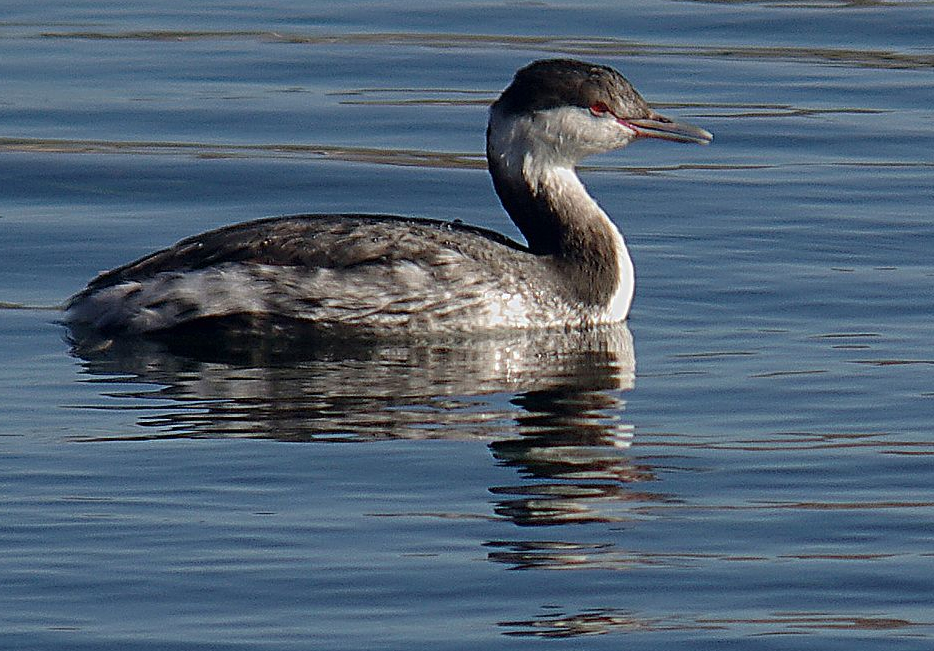
In winter, the Horned Grebe has a black crown, and a pale foreneck, cheeks and underparts, quite distinct from the showy breeding coloration. The Horned Grebe show up here in April, with the majority of sightings in May, June, and July. Sightings of the Horned Grebe continue on until November when they leave to the Aleutians and exposed shorelines of saltwater oceans to overwinter.
A grebe most resembles a small loon when it comes to waterbirds. Grebes in general are ducklike divers with lobed toes (not webbed feet) and sharp pointed bills. This little waterbird is quite fascinating to watch, at times diving down under the water as a loon, at other times just sinking down. The grebe will sit with its body much lower in the water than a duck.
The Horned Grebe needs to be on water to fly, and is not often seen on land. When not on the water, the Horned Grebe will maneuver awkwardly as a jumping and hopping motion, rushing across the surface of the water to gather up speed for flight.
Designated Special Concern by the Committee on the Status of Endangered Wildlife in Canada COSEWIC, “because over 90% of this bird’s breeding grounds are within Western Canadian wetlands, the continued destruction of marshes and waterways is a major threat to the survival of this species.”Nature Canada “Threats include degradation of wetland breeding habitat, droughts, increasing populations of nest predators (mostly in the Prairies), and oil spills on their wintering grounds in the Pacific and Atlantic Oceans. COSEWIC”
“The global population has been declined by 30% over the last three decades and by 79% within North America. Within 1985 and 2001, grassland and wetland drainage amounted to 5% global habitat loss. Due to global declines, the Horned Grebe has been unlisted from least concern to vulnerable resulting in conservation and research action plans.*”
According to the Ministry of the Environment, A breeding bird or breeding Grebe colony is protected May 15 through to July 15 of the year, foot traffic, and other low disturbances must maintain a distance of 100 meters. Medium disturbances such as vehicles and ATVs as well as high disturbances, roads, drilling both must maintain a distance of 200m from loons and any Colonial Nesting Grebes.
WHAT CAN YOU DO?
Nature Canada suggests:
“Tell elected officials that you support the protection of at least half of Canada’s Boreal forest.” “The eco-system of a forest is very fragile. It is very easily upset. This would be a fifth reason why tree cover should be maintained…It is not enough for a mayor to put on his chain and plant a tree but he must plant forest trees for our lives”~Richard St. Barbe Baker. The afforestation areas of Saskatoon are a vital heritage site, and a true testament to the Parks Department of Saskatoon.
Dan Kraus, Weston conservation scientist and senior director of conservation program development for the Nature Conservancy of Canada, writes about the temperate prairies, and the endangered grasslands ~ the World’s most endangered eco-system. So it certainly would not hurt to tell your elected officials that you support the protection as well, of the native grasslands of the West Swale, including those of the Afforestation area formerly known as George Genereux Urban Regional Park, and the native grasslands of the Richard St. Barbe Baker Afforestation Area.
“When viewed in the context of our climate and geological history, it is evident that prairie wetlands are integral and irreplaceable parts of the Saskatchewan landscape.The challenge is to find a place for these wetlands in our social, economic and land-use systems – a place where their protection and conservation is assured by their inherent value.Managing Saskatchewan’s Wetlands” Is there not truly a great symbiosis between woodlands, grasslands and wetlands?
“Advocate for greater protection of Important Bird Areas (IBA) in your community and across the country.” Do you consider Richard St. Barbe Baker Afforestation Area, the West Swale, and the many and several wetlands around Chappell Marsh an important bird area? Chappell Marsh is huge, extending from Chappell Marsh Conservation Area managed by Ducks Unlimited, into Richard St. Barbe Baker Afforestation Area managed by the City of Saskatoon and the Meewasin Valley Authority.
“Learn more about IBAs.”
“Stay informed about endangered birds and other species”
“Thousands of volunteers have helped conserve Important Bird Areas by surveying bird populations, building nest boxes, erecting signs, removing invasive species, planting native grasses, and promoting awareness of the value of wildlife.”
What will you do?
From the account above, can you recognize the Horned Grebe, now on your travels into the Richard St. Barbe Baker Afforestation Area, and around about the West Swale wetlands, the series of marshes alongside Chappell Marsh?
I believe, therefore, that water must be a basic consideration in all our national and earth wide forest programmes. Streams and rivers must be restored to their natural motion and thus floods and droughts must be eliminated. Forests and woodlands are intimately linked with biological, social and spiritual well-being. I believe that the minimum tree cover for safety is l/3rd of the total land area of every country. Every catchment area should have at least this proportion of tree cover made of mixed species including the broad leaved trees” ~Richard St. Barbe Baker
BIBLIOGRAPHY:
Collins, Henry Hill Editor. Harper and Row’s Complete Field Guide to North American Wildlife. Harper and Row Publishers. New York. 1981. ISBN 0-06-181163-7 page 12. Continuing Horned Grebe and Snow Buntings sullivancountybirder, Sullivan & Delaware County Birder’s Blog
COSEWIC Assessment and Status Report on the Horned Grebe Podiceps Auritus. Committee on the Status of Endangered Wildlife in Canada. COSEWIC. 2009. COSEWIC assessment and status report on the Horned Grebe Podiceps auritus Western population and Magdalen Islands population, in Canada. Committee on the Status of Endangered Wildlife in Canada. Ottawa. vii + 42 pp.
(www.sararegistry.gc.ca/
status/status_e.cfm)
Horned Grebe v.s. Highways. CBC.ca The Afternoon Edition. [Saskatchewan Highways and infrastructure have run into a different kind of roadblock at the site of one of their construction projects: the Horned Grebe.]
Horned Grebe. All About Birds Cornell Lab of Ornithology
Peterson, Roger Tory. A Field Guide to Western Birds. A completely new guide to Field Marks of All Species Found in North America West of the 100th Meridian and North of Mexico. Peterson Field Guides. Third Edition. Houghton Mifflin Company Boston. 1990. ISBN 0-395-51749-4. page 26
Richard St. Barbe Baker Afforestation Area is located in Saskatoon, Saskatchewan, Canada north of Cedar Villa Road, within city limits, in the furthest south west area of the city. 52° 06′ 106° 45′
Addresses:
Part SE 23-36-6 – Afforestation Area – 241 Township Road 362-A
Part SE 23-36-6 – SW Off-Leash Recreation Area (Richard St. Barbe Baker Afforestation Area ) – 355 Township Road 362-A
S ½ 22-36-6 Richard St. Barbe Baker Afforestation Area (West of SW OLRA) – 467 Township Road 362-A
NE 21-36-6 “George Genereux” Afforestation Area – 133 Range Road 3063
Wikimapia Map: type in Richard St. Barbe Baker Afforestation Area
Google Maps South West Off Leash area location pin at parking lot
““Be like a tree in pursuit of your cause. Stand firm, grip hard, thrust upward. Bend to the winds of heaven..”
Richard St. Barbe Baker
The trees and vegetation, which cover the land surface of the Earth and delight the eye, are performing vital tasks incumbent upon the vegetable world in nature. Its presence is essential to earth as an organism. It is the first condition of all life; it it the ‘skin’ of the earth, for without it there can be no water, and therefore, no life.~Richard St. Barbe Baker
Save
Save
I believe that water must be the basic consideration in all our national and earth- wide forest programmes. Streams and rivers must be returned to their natural motion. What is a natural motion? A river flowing in its natural course comes to a bend. This gives it a spiral motion. It comes to a marrow, this provides tension. It broadens out, here is relaxation. This is how blood circulates in our veins and the sap circulates in a tree. This is the natural motion. When you destroy this natural motion, the water goes on its way sick or cancerous. When water comes up against a dam, the natural motion is destroyed and the water becomes sick. This sickness spreads up to the tributary rivers and to the fields through which these rivers have come and the sickness will go to the fields bordering these rivers and will affect the grazing animals. They say that cancer is a disease of civilization. You will accept that, won’t you? It was unknown till we called ourselves civilized. ~Richard St. Barbe Baker




 Forests of Memory. Forests of Learning. Forests for Life.