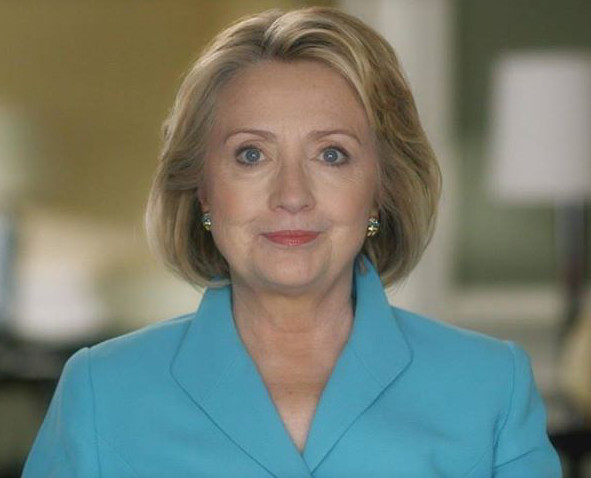
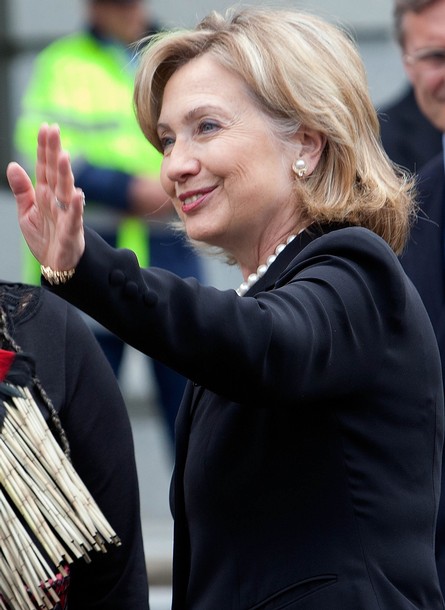
Tuesday evening, Hillary was honored with the Ripple of Hope Award at the Robert F. Kennedy Gala. Tony Bennett and Robert De Niro were also honored.. The event took place at the Hilton in New York City. Congratulations, Mme. Secretary!
On December 16th, 2014, Robert F. Kennedy Human Rights hosted its annual Ripple of Hope Awards Dinner in New York. Former First Lady, Senator from New York, and Secretary of State Hillary Rodham Clinton was among the night’s honorees. Below are her remarks from the evening.

Robert F. Kennedy Human Rights is not only an ongoing institution that represents a passion for justice and dignity, but it also continues to challenge us. Just look at the record of what has been done: from defending gay rights in Uganda to standing with the families of missing students in Mexico, reducing infant mortality in Kenya, advocating for the rights of farm workers here in the United States, this organization is showing us what Robert Kennedy meant when he spoke of those numberless diverse acts of courage and belief that send ripples of hope out across the world.
And on a personal note, no one has done more to advance this work than Ethel Kennedy. (Applause.) Last month, when President Obama awarded her the Presidential Medal of Freedom, he called Ethel an emblem of enduring faith and enduring hope. And the truth of those words is reflected in all the lives that Ethel has touched and all the children and grandchildren who have continued to make her proud.
She reminds us that, as Senator Ted Kennedy said – the senator who served in the United States Senate, not the senator who’s going to be serving in the Connecticut senate – (applause) – we’ll be looking for his accomplishments as well, along with other Kennedys who have served, and Representative Joe Kennedy, who I had the privilege of (inaudible) for in the House of Representatives – but as Ted Kennedy said, “The work goes on, the cause endures, the hope still lives, and the dream shall never die.” And so, Ethel, thank you for everything you have done to make that true. (Applause.)
I think it is obvious to us all that we are meeting here tonight at a time when the lessons of Robert Kennedy’s life and legacy are as urgent and relevant as ever. Like many of you, I wonder what would he think if he could see us now. I think he would celebrate the enormous progress we have made over the past half century; the advance of democracy and human rights in many parts of the world once locked in tyranny; the breakthroughs in health and science and productivity, delivered by American innovation; and the great strides we’ve made here at home to build a more just and inclusive society. So in many ways, we have moved forward toward that more perfect union that he dreamed of and worked for.
But what would Robert Kennedy say about the fact that still today more than 16 million children live in poverty in the richest nation on Earth? What would he say about the fact that such a large portion of economic gains have gone to such a small portion of our population? What would he say about the fact that the progress we’ve made has not closed the wealth gap between black and Hispanic families and white families, it’s actually grown wider?
Or what would he say about the cruel reality that African American men are still far more likely to be stopped and searched by police, charged with crimes, and sentenced to longer prison terms; that a third of all black men face the prospect of prison during their lifetimes; and by some estimates, young black men are more than 20 times more likely to be shot dead by a police officer than a young white man? What would Robert Kennedy say to the thousands of Americans marching in our streets, demanding justice for all, to the young people with their eyes open and their hands up, to the mothers who’ve lost their sons?
What would he say to all those who have lost trust in our government and our other institutions, who shutter at images of excessive force, who read reports about torture done in the name of our country, who see too many representatives in Washington quick to protect a big bank from regulation but slow to take action to help working families face an ever greater pressure? What would Robert Kennedy say to us?
I’d like to believe that he would remind us, as he did in that famous Ripple of Hope speech, that in American there have often been wide and tragic gaps between promise and performance, ideal and reality, and that the calling of our country is to extend and enlarge the meaning and practice of freedom to all of our people. That means dignity, that means justice, that means prosperity that gives a child born in the hills of Appalachia or the Mississippi Delta or the Rio Grande Valley the same opportunities in life as my baby granddaughter.
Robert Kennedy was a man of action and he would urge us to take hold of these challenges to organize, to legislate, and yes, to vote. For those of us who admire his legacy, that seems to be the charge: to narrow the gap between our ideals and our reality. We can stand up together and say, yes, black lives matter; yes, the government should serve and protect all of our people; yes, our country is strongest when everyone has a fair shot at the American dream, that inequality is not inevitable, that some of the social disparities we see today may stem from the legacy of segregation and discrimination, but we don’t have to perpetuate them, that some economic disparities may stem from long-term trends in globalization and automation, but we don’t have to give into them.
The choices we make matter. Policies, politics, priorities matter. But values matter even more. And it is possible. I believe Robert Kennedy would be telling us to restore a sense of security and potential of families struggling, worrying, disappointed, discouraged, revitalizing and re-stitching the frayed fabric of American life, possible to keep us safe from terrorism and reduce crime and violence without relying on torture abroad or unnecessary force or excessive incarceration at home.
Robert Kennedy was our nation’s chief law enforcement officer. He understood everyone in every community benefited when there is respect for the law and when everyone in every community is respected by the law. We know that there are so many police officers every day inspiring trust and confidence rather than fear and frustration, honorably doing their duty, putting themselves on the line to save lives, not take them. We can build on that. We can work to restore balance to our public life, our economy, our criminal justice system.
There’s no doubt that at home and abroad, America is at our best when our actions match our values. Yes, the threat of terrorism is real and urgent. Scores of children were just murdered in Pakistan; beheadings in the Middle East; a siege in Sydney – these tragedies not only break hearts, but should steel our resolve and underscore that our values are what set us apart from our adversaries.
I am proud to have been a part of the Obama administration that banned illegal renditions and brutal interrogation practices, including torture. (Applause.) Today we need to say again in a loud and clear voice that the United States should never condone or practice torture anywhere in the world, not under any future administration or in any future conflict. That should be absolutely clear as a matter of both policy and law, including our international treaty obligations. And if that requires new legislation, then Congress should work with President Obama to quickly enact it. And it should not be an issue of partisan politics. (Applause.)
We should never forget the extraordinary service and sacrifice of all those intelligence professionals who do keep us safe, including those patriots who question these practices from the inside. This is an opportunity to reaffirm the strength of the American character. For even when we must contend against opponents with no respect for human rights or life, remember what Senator McCain said the other day: The high standard to which we hold ourselves isn’t about our enemies. It’s about us. It’s about who we were, who we are, and who we aspire to be. (Applause.)
I have no illusions that this is easy. Americans are understandably frustrated by all the division and polarization that seems to block progress at every turn, and it is easy to get discouraged. It’s also easy to get angry, to lose sight of the common humanity that unites us all.
Robert Kennedy was the privileged heir to a famous name, but that never stopped him from finding humanity in everyone, from a single mom in Bed-Stuy, to a steel worker in Buffalo, to a student in South Africa. He had the great gift of seeing the world through their eyes, imagining what it was like to walk in their shows.
I was so honored to follow in Robert Kennedy’s footsteps in the United States Senate, and his example was often on my mind. New Yorkers took a chance on both of us, and I will always be grateful for that. (Applause.) And I followed in his footsteps again in the summer of 2012, when I went to South Africa. And of the places I went was the University of Cape Town to deliver a speech, just as he had decades earlier that continues to inspire today.
Before that speech, I stopped in for what turned out to be my final visit to my friend, Nelson Mandela, at his home in his ancestral village. We reminisced, and I thought about the extraordinary excitement of being at his inauguration in 1994. It was a time of political strife in our own country. I have to confess, my heart had been hardened by all the partisan combat. But then at lunch, the new president of the new South Africa, President Mandela, said something that shook me from my head to my toes. He welcomed all the VIPs who came from all over the world, that he was pleased they were there, and then said this: “The three most important people to me here in this vast assembly are three men who were my jailers on Robben Island.” Mandela called them by name, and three middle-aged white men stood up. He explained that despite everything that divided them, those men had seen him as a fellow human being. They treated him with dignity and respect. Mandela had later told me when he was finally released he knew he had a choice to make – he could carry the bitterness and hatred of what had been done to him in his heart forever and he would still be imprisoned, or he could open his heart to reconciliation and become free.
Robert Kennedy said much the same thing on that terrible night in 1968, when Dr. King was killed. He spoke of his own loss, and he urged Americans to reach for justice and compassion, rather than division and hatred, quoting Aeschylus on the wisdom that comes through the awful grace of God.
So at this moment in our country and, indeed, in the world, let us again turn to the wisdom and the example of Robert Kennedy. It is only in this spirit that we will be able to meet the perils and to seize the possibilities of the 21st century. So thank you. Thank you all for keeping the torch burning brightly and inspiring so many others to keep sending out those ripples of hope. Thank you.
# # #










 Still4Hill