Aquilops-ing intensifies
May 21, 2025

The second trailer for Jurassic World Rebirth is out today, and there’s my baby at 1:35!
I am completely certain that at some point the tide of Aquilops-themed merch will overwhelm my ability to keep up — not to mention your interest in keeping up with this blog — but for now I am happily in squee-land. Fortunately Mike is keeping the site turning over with some actual science content. Seriously, go read his new Diplodocus paper, it is fascinating and almost absurdly well-written throughout.

Spotted in the wild at my local grocery store.

I didn’t know that Blackberry Dr Pepper existed, and I’m still not 100% convinced that it should, but who am I to turn down sugary soda in such an attractive can? I’m particularly charmed by the silhouette with size facts near the bottom.

What else? There’s a plausibly “life-size” baby Aquilops puppet coming along sometime in June. Still no word on the surely-inevitable-pretty-please actually-life-size plush Aquilops of my dreams, but if it happens, you’ll see it here.
Back to counting the days until the Aquilops Lego sets drop on June 1….
Whatever happened to the Munich Diplodocus?
May 15, 2025
Everybody[1] knows that in the early years of the 20th Century, the Carnegie Museum in Pittsburgh sent casts of its iconic Diplodocus around the world. Ten casts, in fact: to London, Berlin, Paris, Vienna, Bologna, St. Petersburg, La Plata, Madrid, Mexico City and Munich. The first nine were all mounted, and most still stand in their original museums. (The London cast has moved around a lot and currently resides in Coventry; the Russian cast has a very strange history and is now in Moscow.)
But what happened to the Munich cast? The story is in Taylor et al. 2025:68 — our new paper! — and it’s strange enough that I’m just going to quote verbatim.
The remaining Diplodocus was completed, boxed, and shipped to Munich’s Bayerische Staatssammlung für Paläontologie und Geologie in November and December of 1934, completing an exchange for fossils received from Germany five years previously (Carnegie Institute 1934:40). On arrival, however, the cast was not mounted, but instead stored in the basement of the Alte Akademie, which also housed the rest of the paleontological collections. The replica was long assumed to have been destroyed during World War II, specifically during a British Royal Air Force bombing in April 1944, along with the Spinosaurus aegyptiacus holotype BSP 1912 VIII 19 and other dinosaur remains from Egypt. However, the cast had been removed from the building before the bombing raid, and while the elements themselves were not destroyed, the record of where they had been moved to was lost. It now seems the cast was taken to an abandoned convent on the outskirts of Munich. It is believed that a group of hippies, holding parties in the convent during the 1960s, found some cast bones, took them home, and attracted the attention of authorities who then discovered the crates (sources who wish to remain anonymous, pers. comm. 2022). At any rate, the cast was returned to the Munich museum in 1977 but has remained in storage ever since. Calls for it to be mounted as one of the attractions of a new museum at the Nymphenburg castle came to nothing, partly because the museum authorities favored a lighter and stronger resin cast over the maintenance-intensive plaster one.
In a perfect world, I would like to illustrate this post with photos of the Munich Diplodocus, still in its basement at the time of writing. I do have a few such photos; but the person who sent them to me said that the museum prefers that they not be made public, so I’m going to sit on them. Toss in the fact that much of what we found out for the paper was a personal communication from someone who doesn’t want to be named[2], and the whole thing feels rather mysterious.
I just hope that some day, Louise[3] Carnegie’s final gift will find a home worthy of it, on public display.
[1] Well, OK.Maybe not everyone, but probably most people who read this blog.
[2] I don’t even know myself who that person is: Ilja Nieuwland, one of the co-authors, made the relevant contact.
[3] Yes, Louise. The Munich donation was made in 1934, fifteen years after Andrew Carnegie’s death, and was made possible only by financial assistance from his widow Louise. It was in her honour that Apatosaurus louisae was named. What a great legacy.
References
- Carnegie Institute. 1934. Thirty-seventh annual report of the
Carnegie Museum. Carnegie Institute, Pittsburgh. - Taylor, Michael P., Amy C. Henrici, Linsly J. Church, Ilja Nieuwland and Matthew C. Lamanna. 2025. The history and composition of the Carnegie Diplodocus. Annals of the Carnegie Museum 91(1):55–91. doi:10.2992/007.091.0104
Everything you always wanted to know about the Carnegie Diplodocus (but were afraid to ask)
May 8, 2025
I’m really delighted today to announce the publication of my, and my co-authors’, new paper on the Carnegie Diplodocus:

Taylor et al. 2025: Figure 13. Skeletal atlas of the Carnegie mount of Diplodocus as originally erected in 1907, with bones color-coded according to the specimen they belonged to or were cast or sculpted from. Modified from a skeletal reconstruction by Scott Hartman, used with permission. Bones are colored as follows: CM 84 (most of the skeleton), yellow; CM 94 (right scapulocoracoid, lower right hindlimb, much of the tail and some chevrons), sculpted left tibia, red; CM 307 (the rest of the tail), not pictured; CM 662 (sculpted braincase, right humerus, radius and ulna), green; AMNH 965 (sculpted forefeet and carpus), purple; CM 21775 (left humerus, radius and ulna), cyan; CM 33985 (left fibula and lateral metatarsals), orange; USNM 2673 (sculpted remainder of skull), gold. White elements were sculpted, but the specimens on which these sculptures were based are not definitively known, though are most likely the corresponding CM 84 elements from the other side. Hyoids, clavicles, interclavicle, sternal ribs, and gastralia were all omitted from the mounted skeleton. Source of chevrons past the first seven is uncertain. See Table 2 and text for details.
“But Mike”, you say, “surely the Carnegie Diplodocus is the single best-known sauropod in the world? Didn’t Ilja Nieuwland (2019) write the definitive book about it only six years ago?”
And you’re not wrong. Lots has been written about the history of this specimen, not least my own paper on the concrete cast in Vernal, Utah (Taylor et al. 2013). And yet, surprisingly little has been written about the actual science of this keystone specimen: nothing very substantial, really, since Hatcher’s (1901) original monograph and Holland’s (1906) follow-up.
As I recounted in How the Concrete Diplodocus paper came to be, this new paper initially arose from one seemingly simple question which I wanted to be able to answer in the Concrete Diplodocus paper: what actual bones were the Carnegie casts taken from. And the answer turned out to be complicated. (That answer is summarised in the caption to Figure 13, above.)
As I started trying to figure this out, I got into correspondence with Matt Lamanna, the Carnegie’s very helpful curator of vertebrate palaeontology, and it quickly became apparent that Matt’s substantial contributions warranted co-authorship. Through Matt, I also got in touch with Amy Henrici, then the Carnegie’s collection manager for VP (now retired); and then with Linsly Church, a curatorial assistant in the same department. Both Amy and Linsly also went far beyond the call of duty, so joined the authorship. Meanwhile, as I was working on the brief historical introduction of the paper, I kept finding new rabbit-holes, and got so much help from Ilja Nieuwland that that section grew substantially and he, too, ended up as a co-author. So we ended up with five of us working on this thing, as it grew from a brief note to 27 deliciously detailed pages with 22 illustrations. (Lots of other people helped, too: see the acknowledgements.)
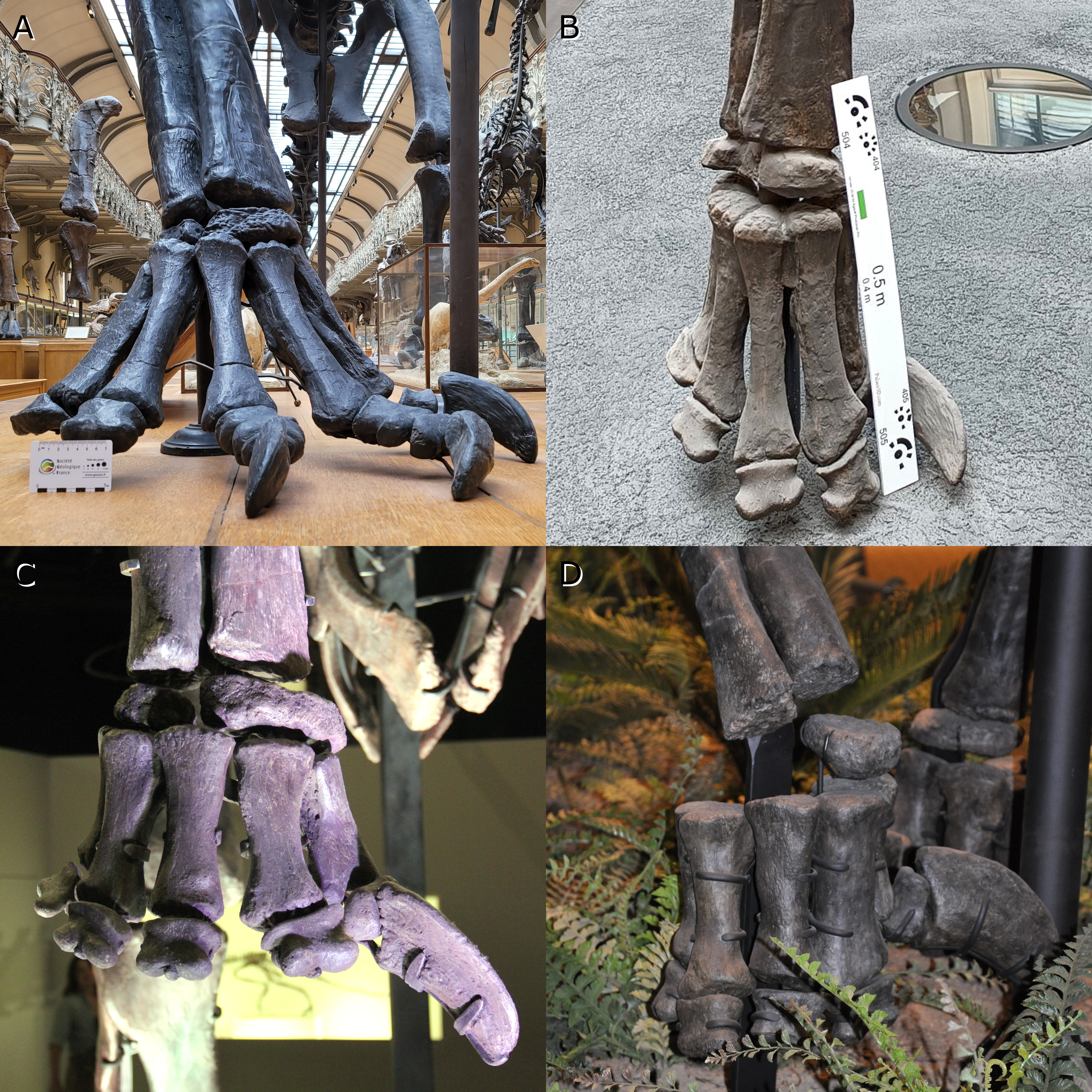
Taylor et al. 2015: Figure 16. Right forefeet of the Carnegie Diplodocus and its casts, all in approximately anterior view. A, the feet as originally mounted in 1905 (in the London cast), 1907 (in the first iteration of the Carnegie Museum original-material mount), and subsequent casts, as supervised by Hatcher and Holland and executed by Coggeshall. This photograph shows the right forefoot of the Paris mount, which is unchanged since its original mounting. This forefoot material, sculpted from the camarasaurid specimen AMNH 965, has elongate metacarpals splayed in a semi-plantigrade posture, with multiple phalanges on each of the three medial digit and large unguals on digits I, II, and III. Photograph by Vincent Reneleau (MNHN); B, the right forefoot of the Berlin mount, as remounted in 2006 by Research Casting International, supervised by Kristian Remes. This consists of the original casts mounted in 1908 by Holland and Coggeshall, reposed in a more modern digitigrade posture, with superfluous phalanges and unguals discarded (see text). Photograph by Verónica Díez Díaz (MfN); C, the forefeet of Galeamopus (= “Diplodocus”) hayi HMNS 175 (formerly CM 662), casts of which were used in the Carnegie mount between 1999 and 2007. Note the much shorter metacarpals, the fully digitigrade posture, the reduction in phalangeal count, and the single large manual ungual on digit I. Photograph by Jeremy Huff (TAMU); D, the present forefeet of the Carnegie mount, modelled in 2007 after those of WDC-FS001A, then thought to belong to Diplodocus carnegii (Bedell and Trexler 2005) but currently thought to belong to an as-yet unnamed basal diplodocine (Tschopp et al. 2015:229–230). Note the resemblance to the diplodocine forefoot in part C, with short metacarpals, digitigrade posture, reduced phalangeal count, and a single large manual ungual. Photograph by Matthew C. Lamanna.
It turns out there was still plenty of history to be uncovered, and that some well-known parts of the story aren’t quite right after all. Also, that the composition of the Carnegie mount has changed a lot through the years — something that has not been publicly documented until now. And no-one really knows even how long this dinosaur is.
We dug into all of this, with the hope that the new paper would become a one-stop-shop for anyone who needs to know anything about this keystone specimen. It’s been a joy to work on (and especially to work with Matt L., Amy, Linsly and Ilja), and I hope you will enjoy reading it.
(A note on the venue of publication: I went against my usual policy of open-access venues only because the museum’s in-house journal, Annals of the Carnegie Museum, seemed so historically appropriate for this work. I liked the idea of following the footsteps of Hatcher and Holland — even if their early-1900s monographs were in the now discontinued Memoirs rather than the Annals. In fact, the Annals is not even paywalled: there is no online version at all hosted by the publisher (which is the museum itself). It is a print-only journal. So you can consider the PDF on my own website to be the definitive electronic copy.)
Oh, and we have a sidebar page about the new paper, containing full-resolution copies of all 22 illustrations.
References
- Hatcher, John Bell. 1901. Diplodocus (Marsh): its osteology, taxonomy, and probable habits, with a restoration of the skeleton. Memoirs of the Carnegie Museum 1:1-63.
- Holland, W. J. 1906. Osteology of Diplodocus Marsh with special reference to the restoration of the skeleton of Diplodocus carnegiei Hatcher presented by Mr Andrew Carnegie to the British Museum, May 12 1905. Memoirs of the Carnegie Museum 2(6):225-278.
- Nieuwland, Ilja. 2019. American dinosaur abroad: a cultural history of Carnegie’s plaster Diplodocus. University of Pittsburgh Press. ISBN:978-0822945574. doi:10.2307/j.ctvh4zh5n
- Taylor, Michael P., Steven D. Sroka and Kenneth Carpenter. 2023. The Concrete Diplodocus of Vernal — a Cultural Icon of Utah. Geology of the Intermountain West 10:65-91. doi: 10.31711/giw.v10.pp65-91
- Taylor, Michael P., Amy C. Henrici, Linsly J. Church, Ilja Nieuwland and Matthew C. Lamanna. 2025. The history and composition of the Carnegie Diplodocus. Annals of the Carnegie Museum 91(1):55–91. doi: to follow.

I realize that the titular statement is open to misinterpretation so let me head that off at the pass:
I’m not saying this prescriptively, like you should learn anatomy to become a better person (you should learn anatomy because it’s accessible and it rules), or that knowing anatomy makes people better. I’m also not saying this distributively, like anatomists are better people than non-anatomists. I’m saying it in the narrowest, most literal, and most personal sense: I think I (and possibly no-one else ever) am now at least a slightly better person than I used to be because of my experience with human anatomy.
Here’s my thesis, which only occurred to me for the first time in my life yesterday: marinading in a job where I am forcibly confronted with the fact that humans are physically pretty darned variable under the hood, and thinking a lot about that fact and writing about it, has made it a lot easier for me to accept that humans are probably even more* variable in terms of their personalities and brain chemistries and psychological and emotional drives and preferences and tolerances, and I think that acceptance has made me a little more compassionate.** (Along with educating myself about the various spectra that people fall on, myself included, and finally taking stock of the Godzilla-sized footprints that ADHD has left all over my career and my personal and professional relationships — about which much more another time, probably.)
* More variable than we are physically because our brain chemistries and emotional states are changing all the time, faster than we’re remodeling our bones or making new capillaries.
** This is a relative statement and not a very strong one. I still have plenty of chunks of unexamined and un-remodeled stupidity inside. And plenty of people have upped their compassion without being prodded by data.
This dovetails productively with another of my favorite lines of thinking, which is pondering how little actual evidence we have for almost everything. Galileo’s telescopes had notoriously narrow fields of view. I’ve built replicas (you can get kits online 4 cheap) and such telescopes are pretty frustrating to use, like peering at the night sky through a drinking straw. There’s an obvious analogy with paleontology, where we often have only a handful of bones of one individual of a species that must have included billions or trillions of individuals across its entire temporal range — a particularly haunting thought for someone cursed with an interest in variation. But I think metaphorically that’s how almost all science is: peering at a universe that is effectively endless in its complexity through a series of drinking straws.
That narrowness-of-evidence is applicable to daily life, in terms of making assumptions about other people’s motives and intentions. Probably that person did not cut me off in traffic because they’re a selfish a-hole deliberately trying to show dominance or run me off the road, they were just occupied by thinking about their ailing parent or how they’re going to afford the next little stretch or whether they’ll have any time to spend with their kids by the time they get dinner on the table, and made an innocent mistake. (I’m not saying that excuses their incautiousness whilst directing two tons of steel and glass at 70mph; this is about the calculation going on in my head in the wake of the near miss.) And so on. I can talk with a close friend for hours, and neither of us will express ourselves perfectly, and each of us will interpret the conversation differently, and remember it differently, and that’s just how life is. Maybe the best we can do is become aware that we’re still — always — peering at the world and at each other through drinking straws.
So I think:
- People are not just different from each other, but surprisingly so, and probably in more directions than we even have words for yet; and
- Individually each of us has very few lines of evidence regarding other people’s internal lives, and the ones we do have are buggy and inaccurate.
…and mashing those two thoughts together makes me want to ask a lot more questions, listen more carefully to the answers, entertain more possibilities, jump to fewer conclusions, default more often to being patient, humble, and forgiving, and maybe above all, to commit fewer failures of kindness. Happily, those also seem like good traits to cultivate as an anatomist and paleontologist.
I’m not saying there aren’t unrepentant jerks in the world. There are plenty, and some of them are having a moment. But most of the folks I interact with aren’t unrepentant jerks, and it’s pretty cool that science gave me a couple of new ways of thinking about that, and of remembering that I probably look like an unrepentant jerk sometimes through other people’s straws.
The photo up top is of a bee in my garden. I don’t know what it was thinking, but I’m willing to venture that it was some variation of “Whoo-hooo, lavender baby!” And incidentally, at least here in southern California lavender is pretty bulletproof if you give it some level of water above ‘complete neglect’, and it’s fun to run your hands through because then they smell nice. So if you take nothing else away from this post, try growing yourself some lavender. Bees love it!
This seems to have gone under the radar: Accelerating Access to Research Results: New Implementation Date for the 2024 NIH Public Access Policy. It’s a memo from Jay Bhattacharya, director of the NIH (the United States’ National Institutes of Health):
The 2024 Public Access Policy, originally slated to go into effect on December 31, 2025, will now be effective as of July 1, 2025. […] While the 2008 Policy allowed for an up to 12-month delay before such articles were required to be made publicly available, in 2024, NIH revised the Public Access Policy to remove the embargo period so that researchers, students, and members of the public have rapid access to these findings.
Well, this is tremendous news. The NIH is the biggest single funder of health research in the USA, and making all the work that it funds immediately open access is a huge win. We could complain and say that this should have happened years ago — there has never been the slightest justification for Green OA embargoes — but instead let’s just rejoice that it’s happening now.
(Why now, I wonder, rather than the originally scheduled date six months later? Maybe they’re desperately trying to get it done before they’re abolished or defunded, or Bhattacharya is replaced by a “pro-business” Trump lackey. I mean, this one piece of very good news about the NIH could easily be blown away by forthcoming much worse news. But that’s for another day.)


 Sauropod Vertebra Picture of the Week