Get your name into the permanent scientific record!
September 27, 2025
Just a quick update on the crowd-funding effort to publish the new diplodocoid volume as open-access papers at Palaeontologia Electronica.

Van der Linden et al. 2024:Figure 6. Cervical vertebra 13 of Ardetosaurus viator MAB011899. CV13 is shown in A) ventral, B) dorsal, C) left lateral, D) right lateral, E) posterior, and F) anterior view. A close up of the white box in F is provided of the accessory laminae in the SPRF, shown in anterodorsal view. White shaded areas indicate reconstructed parts. The left cervical rib loop was obscured in ventral view for support and therefore roughly outlined here. White dotted lines in A indicate the remnants of the ventral keel. 1 indicates the triangular projections on the diapophysis. Abbreviations: al, accessory lamina; CPRL, centroprezygapophyseal lamina; epi, epipophysis; pap, parapophysis; PCDL, posterior centrodiapophyseal lamina; pre, pre-epipophysis; PRSL, prespinal lamina; pvf, posteroventral flange; SPOL, spinopostzygapophyseal lamina; SPRL, spinoprezygapophyseal lamina; TPOL, interpostzygapophyseal lamina.
The drive now contains an offer that maybe it should have included from the start: “We promise to mention the names of the backers in the acknowledgements of at least one upcoming paper, if this campaign is successful.”
I don’t know how big an incentive this will feel to different people. But I remember the thrill the first time my own name appeared in the scientific record, in the acknowledgements of the “Angloposeidon” paper (Naish et al. 2004), and I hope it will do the same for some of you.
So if you’d like to contribute, and become the envy of your friends and family by appearing in the scientific record as a sponsor of sauropod palaeontology, get yourself over to the crowdfunding page!
References
- Naish, Darren, David M. Martill, David Cooper and Kent A. Stevens. 2004. Europe’s largest dinosaur? A giant brachiosaurid cervical vertebra from the Wessex Formation (Early Cretaceous) of southern England. Cretaceous Research 25:787-795.
- Van der Linden, Tom T. P., Emanuel Tschopp, Roland B. Sookias, Jonathan J. W. Wallaard, Femke M. Holwerda and Anne S. Schulp. 2024. A new diplodocine sauropod from the Morrison Formation, Wyoming, USA [Ardetosaurus viator]. Palaeontologia Electronica 27.3.a50. doi:10.26879/1380
Midnight in the Museum
September 27, 2025

Midnight in the museum
In the yawning resonance
Of empty space
The great xylophone skeletons
Play the lonely strains of Time
Like cathedral organs
Heralding the ends of ages.

Time rushes on
The final predator
Implacable
Like Dinichthys
Cruising the crinoid beds
Sounding one note:
Everything dies.
Change hammers all
On the anvil of eons
Carnivores and civilizations
Long of tooth
Weak of spirit
Wracked by rot and riot
Collapse.
Their carcasses play host
To new generations
That strip the drying flesh
And flaunt their youth
Beneath the philistine stars
That warmed the nebulae
Before the phoenix-fusion birth
Of brash young Sol.

I feel a distant call
The silent whistle screaming
Of my genes
Seeking always
To jump this fragile ship of life
And flee down the generations
Until I am lost
Expended
Forgotten.
The tyrant kings smile knowingly:
“You too shall pass”
And continue their stately voyage
Into eternity.

The circle closes
The revolution complete
And morning spreads her wings
To the far horizon.
I do not fear the dawn
Or the age to come
For I have basked
On desert sands
Drinking life like heat
And felt the mighty Tethys
Washing over my feet.

Notes
In 1998-2001 I was a graduate student at the University of Oklahoma, with night-owl tendencies and all-hours keycard access to the old museum collections, a defunct WWII-era gymnasium where dinosaur skeletons were prepared and test-assembled, and the new building — now the Sam Noble Museum of Natural History — where they were being installed, ancient bones going up on skeletons of new steel. I wrote this in 1998 or 1999; perhaps fittingly, its precise origin is now lost in time. I’d no doubt say it all rather differently now, but 50-year-old me will yield the floor to the 20-something who penned this, not least because he wrote me into existence as well. Oh, and if I didn’t swipe the expression “xylophone skeletons” directly from Ray Bradbury’s Dinosaur Tales, it was at least heavily inspired by Bradbury.
Photos, top to bottom:
Diplodocus, Utah Field House of Natural History, Vernal, UT
Pteranodon, Rocky Mountain Dinosaur Resource Center, Woodland Park, CO
Something toothy, American Museum of Natural History, New York City, NY
Clouds over Mygatt-Moore Quarry, Rabbit Valley, CO
Ripple rock, Denver Museum of Nature and Science, Denver, CO
Anyone who’s been reading this blog for a while knows that Matt and I are both all in on open access. What is the point of “publishing” something that not everyone can read? We always want our work to be available to the widest possible audience, so it’s a no-brainer that we won’t let it moulder behind a paywall.
But the process of scholarly publication does cost money. Nowhere near as much as commercial publishers charge, sure, but there is an irreducible cost which has to be paid somehow.
And now, here comes Diplodocoidea (Dinosauria, Sauropoda): Systematics, Phylogeny, Biogeography!
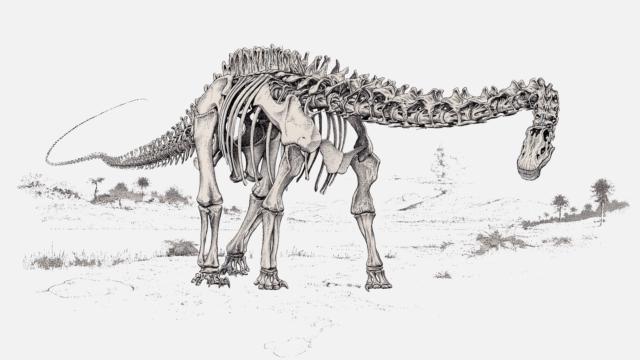
This is the snappy title of a “virtual edited volume” on Diplodocoids, which is being published a chapter at a time at the venerable open-access journal Palaeontologia Electronica (PE for short). Each chapter comes out as soon as it’s ready, and you’ve probably already seen the first two:
- A new diplodocine sauropod from the Morrison Formation, Wyoming, USA (Ardetosaurus viator)
- Introduction to Diplodocoidea (I was an author on this one: see the introduction to the introduction.)
Two more chapters have already been accepted and are in press; and a fifth is in review. There are plenty more in preparation, including at least one more new diplodocoid. A link to each paper will appear in the Table of Contents page, so that page will always be an index to all the available content.
To cover their costs for this volume, PE needs $3000. That comes out crazy cheap — we’re looking at a double-digit number of papers, so the cost to make each one freely available to the whole world in perpetuity is less than $300.
To raise this money, the group has kicked off a crowdfunding effort. It has a little under a month to raise the necessary $3000, and as I write this it’s 20% of the way to that goal. If you can afford to chip in, please do get yourself over there and make a contribution. You’ll have the satisfaction of knowing that you helped increase the world’s access to knowledge of diplodocoids.
My first palaeo paper is 20 years old today!
September 15, 2025
One of the things that comes up over and over — on this blog, at conferences like DinoCon, on Q&A websites — is how to become a palaeontologist. As I’ve said before (at some length) the way to become a published palaeontologist is to publish papers about palaeontology.
But that’s a very general, broad-stroke recipe, and some details might be interesting. Today is 20th anniversity of my own first published palaeontology paper, and I’m going to say a little bit about how it came about. Maybe there are broader lessons to be learned.

Taylor and Naish 2005: Figure 1. Relationships between sauropods showing successive outgroups to Diplodocus. Includes basal sauropodomorphs (represented by Plateosaurus), Macronaria (represented by Saltasaurus) and Diplodocoidea (represented by all other genera named in the figure). The numbers 1, 2 and 3 indicate possible positions for Haplocanthosaurus, discussed in the text. The letters A to L indicate nodes and stems in this phylogeny, the names and definitions of which are discussed in the text.
I started reading the old Dinosaur Mailing List (now the Dinosaur Mailing Group) around 2000, and that led me to the published literature.
By 2003 I’d read enough papers to have a sense of what was good and what was not. One day (on a transatlantic flight for my day-job, if memory serves), I read one particular paper that was so obviously flawed, I thought even I could do better. So it was in my mind that writing a paper might not be an unrealistic goal. But I had no particular topic in mind, so the idea just sat quietly in the back of my mind, percolating.
Then, on 6 October 2003, Matt Wedel asked me a fateful question in an email: “Do you know how dino diversity breaks down by clade, i.e. how many genera or spp. each of theropods, sauropodomorphs, and the various ornithischian groups?” I’m a computer programmer by trade, so my immediate impulse was to write a program to compute this. I replied: “the best I could do would be to download the raw XML data from Mike Keesey’s [now sadly defunct] Dinosauricon web-site and analyse that by clade”.
So I did. Having come that far, there were other obvious analyses to run on the data. That project grew into a paper with all those different analyses of the relevant data, and by the time I was ready to submit it I’d replaced the original data-set with one drawn from Don Glut’s Dinosaurs: The Encyclopaedia and its supplements. (Fiona read the relevant data out to me and I typed it in.) Confident that this paper was going to be my debut, and I sent three double-spaced printed copies off to Acta Palaeontologica Polonica on 24 October 2024. A couple of weeks later I got a letter back in the post telling me it had been rejected without review. (As of 2014, the manuscript of that paper is available as a “preprint”.)
So that crashed and burned. But once I’d got into the process of writing it, I started feeling like the kind of person who wrote papers, so I was open to starting other projects.
In May 2004, I’d started to feel a bit itchy about the way some papers used the name Diplodocoidea and other used Diplodocimorpha, and about the way these two names had several similar-but-not-identical definitions. At this point I had no intention of writing that up, I was just chasing down the definitions for my own interest. There’s an archived copy of the Dinosaur Mailing List thread for those who want the gritty detail.
Among those who weighed in on the thread was Darren Naish, and he and I somehow arrived at the idea that this little nomenclatural question was complex enough, and touched on enough other names, that it was worth writing up. I started a file just called “text” on 3 June, which got promoted to an OpenOffice document on 7 September, shortly before the Leicester SVPCA. On the train to Leicester, I met up with Darren and we went through the manuscript together, figuring out what needing moving around, what was missing, what was redundant, and so on.
When I got home after the conference (where I gave a talk on the diversity work that I thought was still alive), I revised the paper and Darren and I batted versions back and forth for a while. Darren also contributed the illustration above, as I’d not learned to use a graphics editor at this point.
On 10 October, we posted it to the Journal of Paleontology (again as hard copy). It came back in late January (yes, three and a half months later), rejected with, I thought, a couple of fairly harsh reviews.
In my memory, we turned it around pretty quickly for submission elsewhere, but my records show it was actually more than four months before we sent a somewhat revised version to PaleoBios — this time by email, proving that Modern Times began at some point between October 2004 and May 2005.
This time we lucked out on the reviewers[1]: we got Matt (who at that point of course had never published with either Darren or me, so there was no evident conflict of interests), and Jerry Harris (who is the best, most pedantic and constructive of reviewers). The paper was accepted on 5 July, subject to some small changes. We made these, received, read and corrected page proofs, and the paper was published on 15 September 2005 — twenty years ago to the day. You are welcome to read it (Taylor and Naish 2005): PaleoBios was then a print-only paper, but I put the PDF on my own website, as I do with all my papers.
[1] Yes, I do think it’s honest to say that who you get allocated as a reviewer makes a big difference. Neither Matt not Jerry is a pushover — they had their criticisms. But both of them approach the task of review with the primary attitude of, what would make this paper really good? Whereas certain other reviewers see their jobs much more as being gatekeepers.
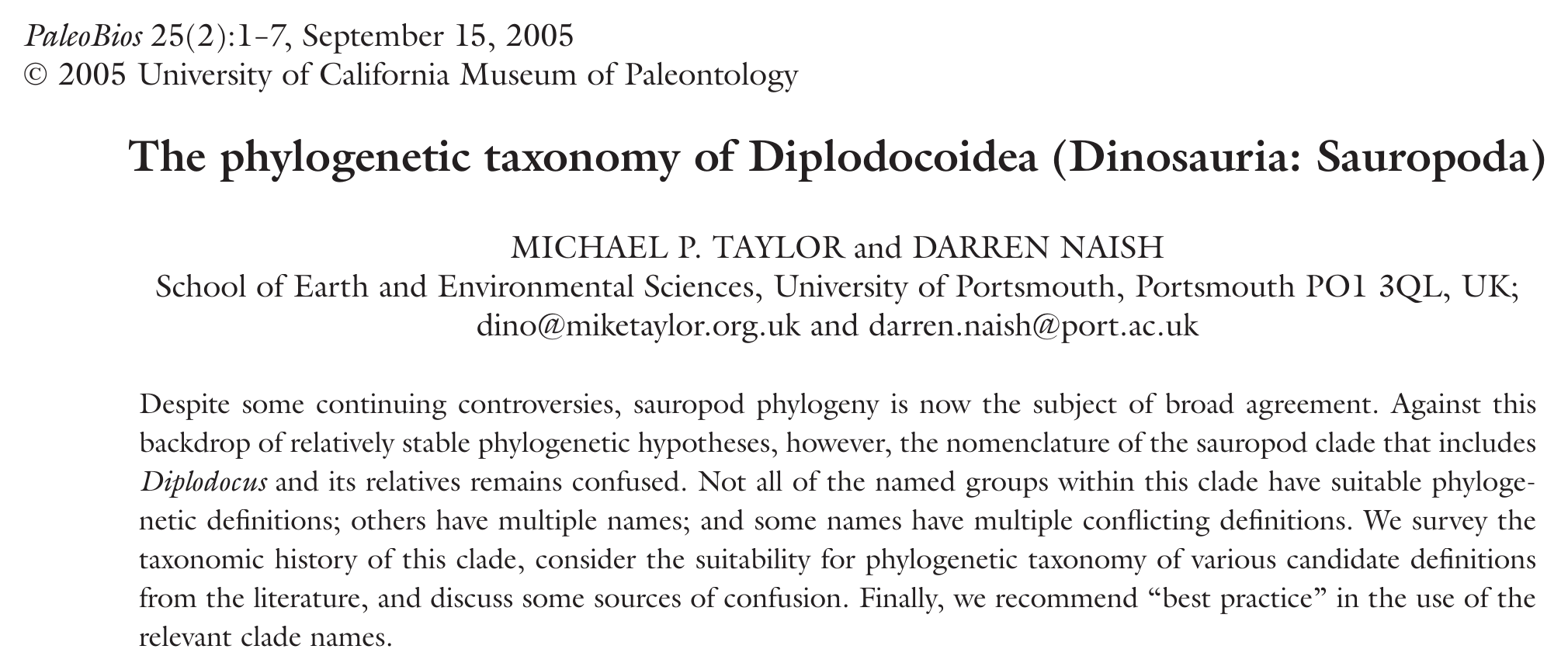
It’s a short paper — seven pages in total, including a half-page illustration, a full-page table and two pages of references. We didn’t expect it to set the world alight, just to be helpful to a few specialists who wanted certainty about the same nomenclatural issue that had bothered me at the outset. But I’ve been pleasantly surprised: according to Google Scholar it’s been cited 43 times, and it seems still to be slowly but surely racking up the citations. (It is just outside my top ten most-cited papers, by a single point.)
What have we learned?
By the time I came to write the early drafts of what became Taylor and Naish 2005, I had (I now realise) a lot of useful experience behind me:
- I’d learned to write good prose.
- I’d come roughly up to speed with the current state of dinosaur palaeontology, thanks to the Dinosaur Mailing List and the various books I’d read.
- I’d got used to reading the technical literature, and had a feel for what makes a good paper.
- I’d accumulated enough self-confidence to think, heck, why shouldn’t I make a contribution?
- I’d made contact with useful collaborators: not just Darren, who became my co-author, but Matt, who asked me the question that provoked my first submitted paper.
- I’d had the experience of submitting and being rejected, so that when it later happened with the paper in question it wasn’t crushing.
- I’d got interested in a specific, small problem, which I wanted to solve for myself.
- I was part of a community (the DML again) where I could spray questions around and get useful references to relevant literature.
These are all useful things to have on your side, and if you want to be a palaeontologist, I encourage you to find and develop analogous advantages. (Mostly: do a lot of reading, a lot of writing, and plant yourself in a community.)
Then in putting this particular paper together, two more things went my way:
- I got some in-person time with my principal collaborator at just the right time.
- On the second roll of the dice, we got sympathetic reviewers.
You could say I was lucky with these last two things; but then to some extent you make your own good-luck events by keeping on rolling the dice until they come up sixes. Keep rolling the dice.
As we come to the end of a longish post, I hope I’ve demystified the process a bit. What you should take away from all this is that there’s nothing particularly special about me. What I’ve done in the world of palaeontology, others can do. A surprising amount of it comes down to just keeping of doing the work.
References
- Taylor, Michael P., and Darren Naish. 2005. The Phylogenetic Taxonomy of Diplodocoidea (Dinosauria: Sauropoda). PaleoBios 25(2):1-7.
Alex Pritchard’s Aquilops and friends
September 12, 2025

Very nice photo of Alex Pritchard’s Aquilops skeleton from DinosaurSkeletons.co.uk.
I am often so far down the rabbit holes of my own work (and given that I work mostly on pneumaticity and weird stuff in neural canals, they are literally holes) that I do a very poor job of keeping up with what’s going on in the broader dinosphere. A timely example: I didn’t know that Alex Pritchard was out there making museum-quality dinosaur skulls and skeletons until I saw his work on the DinoCon Instagram feed in the run-up to the convention. Then I visited his website, DinosaurSkeletons.co.uk, and then I got very excited.

Here I am at Alex’s booth at DinoCon 2025, with his mounted Aquilops skeleton. If you’d like to see the skeleton without a big dumb mammal crowding the view, see the image at the top of the post, or visit the webpage.
That skeleton rocks on toast. Luggage constraints kept me from bringing a skeleton home, so I settled for one of Alex’s Aquilops skulls, only ‘settle’ isn’t the right verb because this is also extremely awesome.

I spent a *lot* of time reconstructing the skull of Aquilops for our descriptive paper (Farke et al. 2014), so it’s one of the few non-sauropod things I’m qualified to yap about (and have, here, here, and here). Alex’s Aquilops skull is so good it gave me flashbacks; it looked like my drawings had leapt off the page and into faux-fossilized-bone — and very shortly into my hand and then into my luggage.

I made a point to get to Alex’s table early on to scoop up one of his Aquilops skulls, which was a savvy move because he did later sell out — of Aquilops, and of darn near everything else, much of it gone by the end of the first day. I was also quite taken with his Psittacosaurus skull, which I got in two sizes, and an oviraptorosaur egg I picked up for the heck of it. I guess I should have nabbed a Velociraptor skull to complete the early ceratopsian/Djadochta Formation Venn diagram. Maybe next year.

I got to chat a little with Alex. He’s so easygoing and approachable that it would have been all too easy to overlook his passion and dedication, had the evidence of it not been covering a very long table and rearing around us on metal stands. I know how hard it is to execute these things faithfully in two dimensions; the sheer number of specimens that Alex has conjured into being in three dimensions — and not just accurately but convincingly — is pretty staggering.

Alex likes to show some love to the less-famous dinosaurs — on his Instagram feed you can see his reconstructed skeleton of the recently-named dromaeosaur Shri rapax. Aquilops turned out to be kind of a fluke — he’d already made the skull and skeleton before Jurassic World Rebirth‘s Dolores catapulted ‘my’ little weirdo from relative obscurity to global fame. That happy accident worked out pretty darned well for me, and I think for Alex as well — he had a whole raft of Aquilops skulls at the start of DinoCon, and none at all on day two. I assume he’s hard at work on more awesome critters; from now on I’ll be following his output a lot more closely.

So, if you want a faithful representation of the Aquilops holotype as it exists today, you can download and print the 3D model of OMNH 34557 that we published with the paper. But if you want a non-roadkilled Aquilops skull that looks like it might have come straight out of the Cloverly Formation, I can personally vouch for Alex’s — it’s the one I have sitting on my desk right now.
I got the impression that DinoCon 2025 punched a decent crater in Alex’s inventory, but he is accepting orders and I expect him to recover quickly, if he hasn’t already. So get on over to DinosaurSkeletons.co.uk and do the right thing.
Reference
Yapping about sauropods on Dave Hone’s Terrible Lizards podcast
September 3, 2025

Dave Hone and me with a Sinclair brontosaur somewhere in Utah, back in May of 2023.
I started my recent UK adventure in the city of London, where my son and I stayed for a couple of days with my friend and colleague Dave Hone and his partner Connie. Dave’s footprint in the dinosphere is vast, with his long-running blog, Archosaur Musings, what is now becoming a nice run of thought-provoking books, including the ever-popular Tyrannosaur Chronicles, and his Terrible Lizards podcast, now in its 11th season.

For an evolutionary biologist and a plant-lover, Dave’s back garden is pretty much the perfect place to sit, think, vegetate, and talk.
I always enjoy talking with Dave. In the same way that I come to dinosaurs through anatomy, he comes to them via wildlife biology, and his operating system seems to naturally be operating at the level of the ecosystem. He’s a solid anatomist as well, but most of his descriptive work has been on pterosaurs and theropods, which I think of as the other two branches of the “pneumatic triumvirate” with sauropods. So Dave and I have complementary but largely non-overlapping areas of expertise, which makes for fascinating conversations that tend to run at 90mph and spin off digressions recursively.
If you’re wondering what one of those conversations is like, we taped one for his podcast (link). I don’t know if Dave had any idea where all the conversation would lead — I certainly did not — but I had fun recording it and fun revisiting it as a listener. In 57 minutes we covered some sauropodomorph basics, the unlikely arc of my career, and some mysteries of dinosaur behavior and evolution. If you can stomach the prospect of an hour of excited, discursive yapping about that stuff, give it a listen and let us know what you think.

Yeesh, how have I not gotten round to blogging about these books before? Both interesting reads — check ’em out.
Gonna end with some book plugs. Of Dave’s books, my favorite is The Future of Dinosaurs: What We Don’t Know, What We Can, and What We’ll Never Know (2022; released in the US as How Fast Did T. rex Run? Unsolved Questions From the Frontiers of Dinosaur Science), with Uncovering Dinosaur Behavior: What They Did and How We Know (2024) coming in a close second (sorry/not sorry, tyrannosaurs). As we discuss in the podcast, just within my career there’s been an explosion of new paleobiological knowledge about dinosaurs. Both of these books sail right up to the line that divides the knowable from the as-yet-and-possibly-always mysterious and do some valuable reconnaissance of the frontier. Highly recommended.

And for you theropod enjoyers, you don’t have long to wait for Spinosaur Tales, Dave’s forthcoming book with Mark Witton. Should be landing in early November in the UK (link) and in late January in the US (link).

Also! Dave’s podcast host, Iszi Lawrence, had the latest installment of her Time Machine Next Door book series, subtitled Inventors and Dinosaurs, out just last week (UK, US). I hadn’t met Iszi before the podcast recording session, and it was only afterward that I discovered that she has a whole constellation of creative work, including a raft of historical fiction books for kids and some pretty impressive graphic work — her pencil sketch of Anthony Hopkins as Hannibal Lecter is an arresting example. She also got Dave and me to make silly sauropod noises at the end of the podcast, which I believe is a world first.
So, yeah, there’s 57 minutes of dinosaury goodness and about a zillion links. Go have fun!


 Sauropod Vertebra Picture of the Week