
One reason I was so happy to be invited to the Sam Noble Oklahoma Museum of Natural History to talk about horned dinosaurs is because the museum has two of the coolest ones on display: Aquilops, the smallest and earliest ceratopsian in North America, and Pentaceratops, one of the largest and latest. Naturally I had to check in on my baby, and its rather more imposing relative.

Here’s the Aquilops exhibit without any big hairy mammal heads mucking up the view.

The skull of Aquilops in three versions: the actual holotype fossil down below, a reconstruction of the distorted skull with the missing bits sculpted in by preparator and reptile-reconstructor extraordinaire Kyle Davies (see more of his work here), and a reconstruction of the skull as it might have looked before it went through the ravages of taphonomy.

And the holotype skull, OMNH 34557, by itself. If you’re wondering why I’m making with so many photos, it’s because my last attempt, 10 years ago, was not without criticism. I was still just rolling with an iPhone this time, but iPhones are a lot better these days, and I’m a less wretched photographer.

And just to the left of the Aquilops cabinet is the monster Pentaceratops with its 10.5-foot-long skull (3.2 meters).

The Pentaceratops is one of my favorite things in any museum. As a grad student back in the late 90s, I gave a lot of behind-the-scenes tours of the new museum as it was going up, and the Pentaceratops was a hit from the start. I actually preferred the view from the animal’s left side, now blocked by the wall behind it — the wide spread of the front and back legs made for a much more dynamic appearance. I should ask around and see if anyone has any photos of the skeleton from that side.

There was a plan kicking around back then to completely wall in the Pentaceratops except for a front viewing window, the idea being that it was the jewel of the collection and would be presented as if in a giant jewelry display case. That plan got nixed — correctly — because it would have precluded this head-on view, which lets you imagine your last moments before 7 tons of angry ceratopsian turns you into a Jackson Pollock painting. My only (and minor) unhappiness about this view is that darned spotlight to the left of the frill, which glares in photos.

You can scoot a smidge to the right and use the frill itself to block that light, but now you’re not quite looking at the animal head-on. Still, a heck of a nice view of a truly awesome critter. You can’t go wrong either way.
Unlike their cousins across the way in the “Bizarre Headgear” exhibit, who will only be on display until August 23, Aquilops and Pentaceratops are permanent fixtures at the museum. Check ’em out if you get the chance.
ALSO, since you had the impeccable good taste to click on a post about Aquilops:

The Aquilops merch train keeps rolling along, and coming down the pike is this life-size Dolores from Jurassic World Rebirth. I’ve seen fanboys online crying that the first life-size critter in the Hammond Collection line wasn’t a Compy or a baby Velociraptor. Ha ha, Aquilops FTW, theropods get back in line. Anyway, theoretically this thing will drop sometime this summer or fall. Chances are real good that its appearance on store shelves will not go unremarked here.
It’s now fairly well established that the remains of the Krayt Dragon that C-3PO and R2-D2 walk past in an early Tatooine scene of Star Wars (1977) were re-used from the knockabout Disney film One of Our Dinosaurs is Missing (1975).

I want to quote the Telegraph article I just linked, because it’s pretty amazing:
“The British view [on making the film] was definitely more tongue in cheek.”
That would be true from the very start of principal photography on A New Hope on March 22, 1976. Arriving in Tozeur, Tunisia, producer Gary Kurtz opened the Lockheed Hercules aircraft that he’d chartered to ferry equipment over from London, and was surprised to find… a dinosaur skeleton. And not just any dinosaur, but the diplodocus from Disney’s One of Our Dinosaurs Is Missing.
His new British crew had found the prop at Elstree, where it had been filmed a couple of years earlier, and had gleefully hidden it on the plane for a laugh. But no matter: it then became the skeleton we see when C3PO and R2D2 crash-land on Tatooine.
It’s hard to credit that a film crew would load an entire sauropod skeleton (or at least a substantial part of one) onto a cargo plan as a prank. But since this is the only story we have, I guess we need to accept it unless something else emerges.

The best image I have seen of the Tatooine skeleton, from this Kickstarter page (which I found in the Matt Lamanna article discussed below).
But the real question — and one that has not been properly investigated, as far as I can see — is how did the One of Our Dinosaurs crew source the dinosaur in the first place?
The only place I’ve seen this addressed at all as in Matt Lamanna’s article Dippy in Star Wars?. Here’s what Matt has to say:
Assuming this was indeed the case (i.e., that the krayt dragon skeleton is the same sauropod prop that was used in One of Our Dinosaurs is Missing), and that (as Matt Wedel had already demonstrated), that sauropod was almost certainly based on Diplodocus, I then tried to determine where the Disney Diplodocus could have come from; in other words, what real Diplodocus specimen(s) it might have been cast or sculpted from. Sadly, I was unable to do so. But the only Diplodocus skeleton (or the only substantial portion of one, anyway) at London’s Natural History Museum during the 1970s was the cast of CMNH’s very own Diplodocus carnegii that was presented to England by Andrew Carnegie himself in 1905.
So, in a nutshell, although I can’t absolutely, definitively prove it (yet?), I think there’s an excellent chance that the krayt dragon in Episode IV was ultimately based on Diplodocus carnegii. Specifically, the evidence suggests that it was inspired by the cast of D. carnegii in London, either a sculpted replica of that cast or even potentially a second-generation cast of that cast.
(For much, much more on the Carnegie Diplodocus and its many casts, see Taylor et al. 2025.)
Looking at the Journey to Tataouine (sic) image above, clicking through and looking closely at the vertebrae, it’s clear that there are specific details of lamination and pneumaticity that I would not expect a prop sculptor to have bothered with, which makes me think this was likely a cast rather than a sculpt. Do others agree?
And if it was a cast, where from? One possibility is, as Matt suggests above, it’s a second-generation cast made from moulds taken from the London cast. But that doesn’t seem probable: I’ve never heard of moulds being taken from that cast, and one would think that if this laborious and potentially damaging task was undertaken, there would have been more casts made from molds, turning up in other museums in the UK.
At one point, I thought another possibility is that the One of Our Dinosaurs crew simply bought a cast from Dinolab Inc. in the USA. As extensively documented in Taylor et al. (2023), Dinolab took moulds from the Concrete cast, and made and sold several second-generation casts around the world. But I’d got my chronology all mixed up: they made the moulds in 1989 and started selling casts in 1990 (Taylor et al. 2023:80), long after One of Our Dinosaurs was made.
Another possibility is that second-generation moulds were taken from one of the other Carnegie casts — but again, it doesn’t seem likely that this would have been done only for the sake of a film prop, and I’ve never heard of other second-generation casts than those made by Dinolab.
Which I think leaves only one final possibility, which I only thought of as I was writing the post: that the original Carnegie casts — which had made their way to Rocky Mount, NC, by the 1960s, but which we’d lost track of as of the publication of the 2013 paper — found their way into the hands of the film crew.
Since the 2013 paper, I have discovered that the original molds were not bulldozed in Avalon Airport some time after 1968, as we pessimisticaly concluded (Taylor et al. 2013:74). We now know that early in 1969 they were acquired by Arthur Pugh, of the eponymous museum consultancy firm in Houston, who planned to make a cast for the Rocky Mount museum. (That never happened, sadly.)

Photograph of Arthur Pugh, printed in the Houston Chronicle on Sunday 19 January 1969. The headline of the short article accompanying was “THE HEAD BONE CONNECTED TO …”. The text of the article read: Arthur Pugh of the Houston museum consultant form bearing his name holds the first cast of a dinosaur head made from the molds he has acquired. The molds, made from a dinosaur skeleton found in 1903, will be used to cast a skeleton replica for the Houston Museum of Natural Science. Also to be used in the reconstruction are 65 bones now owned by the museum. The whole skeleton contains 627 bones. Pugh estimates it will take 18 months to two years to complete the project. He first plans to cast a skeleton for the Rocky Mount, N.C., museum.
It’s likely that elements cast from these molds were indeed used to complete the “Diplodocus” (now Galeamopus) hayi skeleton HMNS 175 (formerly CMNH 10670, formerly CM 662), which HMNS acquired from the Cleveland Museum of Natural History in 1963. The completed skeleton was mounted in 1975, and it’s likely that elements cast by Pugh still form part of the rearing mount that we featured less than a week ago. But what happened after that, we still don’t know. I’m now entertaining the idea that the old moulds’ final job was to provide the One of Our Dinosaurs prop. The chronology works out, as this film would have been in production within a year or two of Pugh acquiring the moulds.
So can anyone shed any light on this supposition? All thoughts, and especially all actual information, is very welcome!
References
- Taylor, Michael P., Steven D. Sroka and Kenneth Carpenter. 2023. The Concrete Diplodocus of Vernal — a Cultural Icon of Utah. Geology of the Intermountain West 10:65-91. doi: 10.31711/giw.v10.pp65-91
- Taylor, Michael P., Amy C. Henrici, Linsly J. Church, Ilja Nieuwland and Matthew C. Lamanna. 2025. The history and composition of the Carnegie Diplodocus. Annals of the Carnegie Museum 91(1):55–91. doi:10.2992/007.091.0104

Last Friday night I was at the Sam Noble Oklahoma Museum of Natural History to talk about horned dinosaurs, for the launch of the “Bizarre Headgear” exhibit. But last Saturday I was there for “Curiousiday”, to talk about Sauroposeidon.

I was set up at the south end of the museum’s main hall, with a table and some specimens to show off. On the left here is a 1/8 scale 3D print of OMNH 53062, the holotype cervical vertebrae of Sauroposeidon. On the right is OMNH 1094, a cervical vertebra of Apatosaurus (or the giant Oklahoma apatosaurine) that was the first thing that Kent Sanders and I CT scanned back in the spring of 1998 after the vertebrae of what would become Sauroposeidon. And on the far right is a monitor showing the three best slices, a version of an image that I’ve used in many papers and blog posts, going all the way back to Tutorial 3 in the fall of 2007. Good old OMNH 1094 must surely rival OMNH 53062 as my most-figured specimen. I should tally up the occurrences and see who’s ahead.

Anyway: back to Sauroposeidon! Just outside the frame of the previous photo, the two larger jackets were on display, holding what I thought back when were cervicals 6, 7, and 8. That was based on a brachiosaurid identification, and a conservative estimate of 13 cervicals. Now it seems much more likely that Sauroposeidon is some kind of somphospondyl, and possibly a basal titanosaur. If so, it could have had anywhere from 13 to 17 cervicals, and there’s really no telling which four we have, other than they are probably from near the middle of the neck.
I believe that this is the first time that the original fossil material of Sauroposeidon has been on public display. Pretty darned cool! I got to show them off to a lot of visitors, and point out all kinds of neat anatomical details, like the numerous pneumatic fossae and subfossae and the overlapping cervical ribs.

And here I am yapping about Sauroposeidon, in a photo by curator Jacqueline Lungmus. Sauroposeidon-philes will recognize the slide as the quarry map, which appeared as figure 7 in Wedel & Cifelli (2005).

I love the composition of this photo, also by Jac Lungmus, in which the reconstructed neck and skull of Sauroposeidon loom overhead while I talk about the discovery of Sauroposeidon next to the actual fossils of Sauroposeidon and a 3D print of the Sauroposeidon vertebrae. More Sauroposeidon, anyone?

No? Okay, here’s a bunch of Aquilops stuff at the vertebrate paleontology table, including a cast of the actual fossil and a reconstructed skull, alongside the by-now-classic Brian Engh art and a couple of stills from Jurassic World Rebirth. There were many more goodies on display on the VP table, including casts of bones from Allosaurus anax (formerly Saurophaganax) and the Oklahoma Deinonychus.
I have skipped a ton of stuff that happened at Curiousiday. I believe every department in the museum had a table set up, except maybe genomics. The place was packed with cool stuff and interested visitors. Many thanks to Jac Lungmus, Jen Larsen, Kyle Davies, Greg Wilbert, Anne Seagren, and everyone else who made my fun day possible!

In a comment on the previous post, llewelly asked about a dinoceratan on display in the Bizarre Headgear exhibit. Here you go. Unfortunately I didn’t get a pic of the signage, so I’m not sure which taxon this is (Uintatherium? Eobasileus?), or which artist made the sculpture. Most of the sculptures in the exhibit are by Shane Foulkes. If anyone knows, sing out in the comments and I’ll update the post accordingly.

Finally, for the first time in nearly a decade, Giant Irish Matt has been spotted in its natural habitat (= inside a museum, natch). This pathetic freak is clearly bound for extinction.

An imposing view of a juvenile Utahceratops.
As threatened, I was in Oklahoma at the tail end of last week and over the weekend, mostly to give talks. My Friday evening public lecture was on horned dinosaurs, and it was tied in with the launch of a temporary exhibit called “Bizarre Headgear: Ceratopsians and the Evolution of Extraordinary Skulls”. I’ll cover the talks in another post; this one is about that exhibit.

From the museum’s central atrium, there are a couple of passages into the special exhibition gallery that houses “Bizarre Headgear”. My preferred way in is the second doorway, farther from the front of the museum, which puts you face-to-face with pterosaurs and hell pigs. This sets up the basic division of the room: mostly Mesozoic and mostly dinos to the left, mostly Cenozoic and mostly mammals to the right (with a few exceptions, like the Synthetoceras visible on the back wall).

From there, turn left and you’ll see horned dinosaurs and many other interesting critters. A lot of them.

Turn right and you’ll see a lot more non-dinosaurs, mostly extinct and extant mammals with a smattering of non-mammals.

I was there to yap about horned dinos, and the exhibit does not slack in this department, starting with this charming side-by-side skeletal reconstruction and lift restoration of Psittacosaurus. The sculpture is by Shane Foulkes, and it looks like a real animal.

A highlight of the exhibit for me is this case of early ceratopsians. From right to left (far to near in this photo) are cast skulls of Liaoceratops, Auroraceratops, Archaeoceratops, and Protoceratops. These are little Aquilops-alikes from Asia. Back in 2014, Farke et al. got this topology:
Psittacosaurus (Liaoceratops (Aquilops (Auroraceratops (Archaeoceratops + all more derived ceratopsians))))
and in 2024, Tanaka recovered these relationships for those same taxa (I’m dropping many others here):
Psittacosaurus (Liaoceratops (Archaeoceratops ((Aquilops + Auroraceratops) + (all more derived ceratopsians))))
I’d never seen so many of these adorable little weirdos in one place. Heck, I’d never even seen casts of Liaoceratops and Auroraceratops in person. So it was nice to get acquainted with the aunts and cousins of Aquilops.

The ceratopsian show continues with a pair of Protoceratops skeletons, followed by skulls of Zuniceratops, Diabloceratops, Kosmoceratops, and a cool Utahceratops with some soft tissue reconstructed. There’s also a mounted skeleton of Torosaurus, and the juvenile Utahceratops shown at the top of the post. This diversity of critters from across the ceratopsian tree was clutch when I helped lead a student tour on Monday. And it was nice to see a lot of animals that weren’t described when I was growing up, and that the average museum-goer might be less familiar with — Diabloceratops instead of Centrosaurus or Styracosaurus, Kosmoceratops and Utahceratops in place of Triceratops and Chasmosaurus.

The exhibit has a lot more than just skulls and skeletons. There are loads of sculptures, both life-sized fleshed-out heads and miniatures showing the whole animal, like this Pachyrhinosaurus. And lots of wall art. I believe all of the sculptures are by Shane Foulkes (and apologies if I missed anyone else). Most of the paintings are by Andrey Atuchin, but there is at least one Mark Hallett piece in the exhibit: Synthetoceras being menaced by an amphicyonid ‘bear-dog’.

The mostly-mammals, mostly-extant side of the exhibit is equally impressive. I’m including fewer photos from that side, because this is already a long post, but I counted at least 65 skulls of non-dinosaurs, including 3 proboscideans and 5 cetaceans. Invertebrates even get a look in, with some of the more baroquely-horned beetles. I nipped into the exhibit while it was still being set up to get some photos for my talk, like this awesome array of African bovids. All of these non-ceratopsians are there to put the evolution of bizarre headgear in dinosaurs into context, and to show that dinos were not incomprehensible monsters, but animals whose anatomy and ecology we can understand, or at least make pretty good inferences about. The signage is uniformly excellent — discreet, informative, and attractively laid out, with a consistent arrangement and color palette.
As long as we’re keeping score, I counted 5 mounted dinosaur skeletons, and 16 other dinosaur skulls. This exhibit is stacked. Every single person I talked to about it, including other paleontologists, staff, security guards, and museum visitors, volunteered something along the lines of “Holy cow, that is a lot of amazing stuff.” The sheer density and diversity of material on display has a qualitative impact, which gave me the feeling of walking through a cabinet of curiosities the size of a basketball court. I think it’s the most impressive temporary exhibit I’ve ever seen, and by far my favorite.

Here’s another thing I’d never seen in person: a cast skull of a hammerhead shark. Just incredible. As the artist and author Ricardo Delgado, creator of the Age of Reptiles comics, often says, “Nature is the best creature designer.”

The “Bizarre Headgear” exhibit is the brainchild of Rob Gaston, shown here with some bespectacled doofus for scale. Rob and the crew at Gaston Design do great work — I’ve got a couple of their casts right here in my home office as I type. Because I got to go behind the scenes while they were setting up, I got to say hi to Rob and congratulate him on such a fantastic exhibit. If you’re within striking distance of Norman, Oklahoma, between now and late August, go see it. It’s included with the extremely reasonable museum admission (max $12 for non-senior adults, even less expensive for everyone else), and hey, you get to see the whole rest of the museum, too. See the museum website for details.

Parting shot: some utter genius in the museum gift shop got into the spirit of things by putting a Triceratops mask on this stuffed polar bear. I love this unreasonably and it’s only because of carry-on luggage limitations that I didn’t bring it home with me. Maybe you will succeed where I fell short.
I’ll have more to say about my trip in another post (Sauroposeidon!), so here I’ll just say a quick thanks to the museum director, Dr. Janet Braun, for the kind invitation to come speak; to Assistant Director Laura Moon and all the staff for making my visit successful and enjoyable; and to vert paleo curator Dr. Jacqueline Lungmus and the VP staff and volunteers for letting me come play in their sandbox. It was a heck of a trip, and you’ll be able to read more about it real soon.
References
- Farke, A.A., Maxwell, W.D., Cifelli, R.L., and Wedel, M.J. 2014. A ceratopsian dinosaur from the Lower Cretaceous of Western North America, and the biogeography of Neoceratopsia. PLoS ONE 9(12): e112055. doi:10.1371/journal.pone.0112055
- Tanaka, Tomonori; Chiba, Kentaro; Ikeda, Tadahiro; Ryan, Michael J. 2024. A new neoceratopsian (Ornithischia, Ceratopsia) from the Lower Cretaceous Ohyamashimo Formation (Albian), southwestern Japan. Papers in Palaeontology, 10 (5).
Way back in 2014, John Hutchinson posted some photos from the Museum of Paleontology Egidio Feruglio in Trelew city, Patagonia, Argentina. John’s original tweets are long gone (quite rightly), but happily we reposted the photos on SV-POW!, so they live on.
John’s first photo showed what we now known to be Epachthosaurus. But the second photo is more interesting for our present purposes:

John R. Hutchinson @JohnRHutchinson
@MikeTaylor Here’s the wide view of that exhibit, with about-to-be-squished abelisaur and sulking Amargasaurus.
This also prominently features the Epachthosaurus mount. But as you can see, the foreground also shows another, smaller, sauropod — also in a rearing pose. But we don’t know what it is. (In a comment, Nima suggested “The smaller one may be a Neuquensaurus with a very wrong Giraffatitan-based skull model” but gave no reason for this ID.)
So I went to look for other photos of the same exhibit. Wikimedia, which is often the best source, has 145 photos of the museum, and I hoped one of them would show the smaller rearing sauropod and give an ID. But no: it seems that a short time after John’s visit, the display was reworked to replace that sauropod with (admittedly very impressive) forelimb material of Patagotitan:

Caption from Wikimedia: Fósiles del titanosauria del Chubut en el Museo Egidio Feruglio de Trelew, Chubut, Argentina. Descubiertos en 2013 y presentados en 2014, supuestamente se trata del animal terrestre más grande de la historia de la Tierra. Pesaría 4 toneladas más que el Argentinosaurus y su fémur mide más de dos metros. Translation: Fossils of the Chubut titanosaur at the Egidio Feruglio Museum in Trelew, Chubut, Argentina. Discovered in 2013 and presented in 2014, it is supposedly the largest land animal in Earth’s history. It would have weighed 4 tons more than Argentinosaurus and its femur measures more than two meters.
(Because that photo, like John’s, is from 2014, I briefly wondered whether it was the other way around, and the giant forelimb was replaced by the small rearing sauropod: but no, later photos also show the giant forelimb.)
So it seems that John’s photo is the only one available that shows the old, small, rearing sauropod. (Unless any of you happen to have other such photos?)
So what is it? Wikimedia has a newer photo of a Neuquensaurus mount at the museum, and it looks like it could well be the rearer from the older photo, based on the short cervical ribs, low dorsal neural spines, oddly shaped scapula and hourglass humeri. But it’s hardly a slam-dunk.
Can anyone confirm? Is anyone in touch with someone at the museum? And, most of all: does anyone have a good photo of this rearing mount from before it was taken down?
Sound the clarion! It’s time to help SV-POW! once more!
I’m working on a paper about mounted rearing skeletons of sauropods, and I want to include figures that show various examples. To be included in a CC By open-access paper, it’s simplest if the photos are also CC By. But for some of the mounts I know about, I’ve not been able to find CC By images, or contact the owners of otherly-licenced images to ask for an exception.
So I am asking our loyal readers to help out by sending their own photos of the relevant mounts and licensing them CC By (taking new photos if necessary!). Obviously I will mention all contributors in the acknowledgements. You can comment here with links, or email dino@miketaylor.org.uk
Here are the ones I need (there may be more in future):
The Smithsonian’s subadult Camarasaurus
The smaller of the two skeletons in this photo:

This photo is by Ben Miller of Extinct Monsters, who I’m sure would be happy to licence it, but it’s … well, it’s not very good. It has the mount in question as a bit-player, and it’s from an angle that doesn’t do a great job of capturing the rearing. Can anyone do better?
The Houston Museum’s Galeamopus

This photo is from Facebook with no license specified — posted by the museum itself, but in my experience I’ve not been able to establish good communication with its staff. If anyone in and around Houston has a good photo, that would be great!
The Australian Museum’s Jobaria
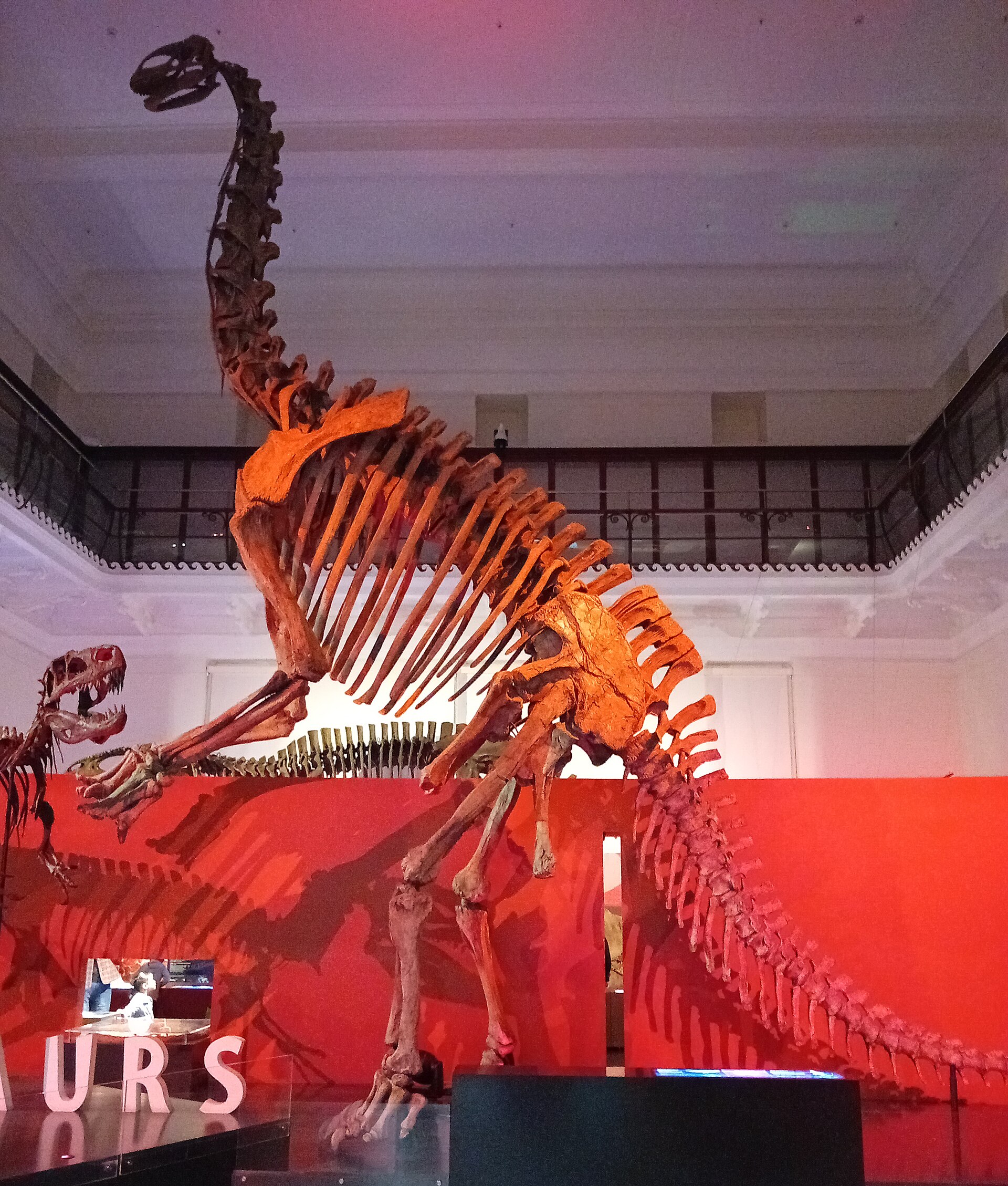
This is in Sydney. The photo is from Wikimedia, but it’s CC By-SA, and I can’t find a way to contact the uploader or photographer.
The University of Zurich’s “Diplodocus“

This one is an oddity. The photo I have here seems to be the only one of the exhibit on the whole Internet. It’s from a Reddit post by a user (EmptySpaceForAHeart) who has been banned, and is consequently uncontactable. So if anyone has, or can find, or can take, another photo of this skeleton, that would be great!
That’s it for now! Thank you, all!
Update (12 May 2026)
Thanks to everyone who’s contributed! I now have decent CC By photos of the Smithsonian juvenile Camarasaurus (from Matt Wedel) and the Houston Galeamopus (from Ben Miller). I have a promise of photos of the Zurich baby diplodocid (from Tom van der Linden) when he visits there shortly. And the photographer of the Australian Museum Jobaria has replied to my comment on the Flickr page. So it looks like I’m all set!
Thank you all.
Very belatedly, I come to an email from Joe Parish, who on 8 March — a full month ago — emailed me to draw my attention to a life reconstruction of Camarasaurus that was published in 1885: one year earlier than the 1886 “atlantosaur” by Jules Blanadet that we thought was the oldest.
The new record-holder appeared in both the New York edition and the London edition of Holder (1885:plate XVIII), and here it is:

I’ve not been able to figure out who the artist is — can anyone help? Unfortunately, Holder had very little to say about this illustration: here’s the whole of the relevant text (Holder 1885:107):
Even more remarkable than the above [mosasaurs including Clidastes] were the Amphicoelias and Camarasaurus (Plate XVIII.), the former attaining a length of one hundred feet, and the latter seventy-five — gigantic serpentine reptiles that floated in shallow waters, anchored by their ponderous tail and legs.
It’s a shame there’s no more discussion, because this is a fascinating piece. The neck, tail and limbs are all shockingly slender by modern standards of what we’d expect to in a Camarasaurus. But really, even in 1885, there’s no excuse for this. I think of Tom Holtz’s rule of dinosaur restorations: if you can’t fit the skeleton inside the model, the model is wrong. And there’s no way to get Cam cevicals into that flamingo-like neck.
(Pedantic note: the neck is not really flamingo-like. It’s flamingo-neck-like. It resembles a flamingo’s neck, not an entire flamingo.)
Surely the strangest part of the restoration is the small trunk protruding from the front of the head. I thought that the idea of trunks in sauropods originated with Coombs (1975), but evidently it’s ninety years older than that! I wonder what strange line of evidence led the anonymous artist to restore the head that way?
Anyway: if anyone can find a yet older sauropod restoration, I want to know about it! Leave a comment.
My thanks to Joe Parish for pointing me at this, and my apologies for taking so long to blog about it (or even reply to his email)!
References
- Coombs, W. P. 1975. Sauropod habits and habitats. Palaeogeography, Palaeoclimatology, Palaeoecology 17:1-33.
- Holder, Charles Frederick. 1885. Marvels of Animal Life. London : Sampson Low, Marston, Searle, and Rivington Collection.
For my birthday this year, my wife bought me the newish Lego kit Natural History Museum 10326. (Well: actually she bought me a Chinese knock-off for 1/3 the price, but that’s not the point.) It’s a lovely kit and I had a great time building it.
One of the exhibits that you build for the museum is a sauropod skeleton — recognizably a brachiosaur. But as previously documented on this blog, I also have a much larger Lego brachiosaur, built from the piece of the kit Dinosaur Fossils 21320. (That one was also a present from Fiona!)
Here they are, side by side.

So which brachiosaur is more accurately to scale?
Lego is often considered to be in 42:1 scale, based on minifigure height of about 4 cm relative to a typical adult human height of about 1.68 m. (5 feet 6 inches).
I measured the big brachiosaur at 37 cm high from the top of its plinth to the top of the head. At 42:1 scale, that’s 15.54 m. The smaller one is 15 cm tall from plinth to head, which at 42:1 scale is 6.30 m.
The real Giraffatitan mount in the Museum für Naturkunde Berlin is 13.27 m tall (Taylor and Wedel 2013: caption to figure 1). That means that the larger of the two Lego models is much closer to being the right size, relative to the minifigs, than the small one is.
But wait: famously, the Giraffatitan fibula HMN XV2 is 134 cm long compared with 119 cm for the fibula of HMN SII (= MB.R.2181, the mounted specimen) (Janensch 1961: table 16). That’s 1.126 times as long, which indicates it belonged to an animal that stood 13.27 x 1.126 = 14.94 m tall.
That’s 96% the scaled size of the Lego Giraffatitan — which, given the hand-waving involved in the various scalings here, is as near to identical as makes no difference.
In conclusion, m’lud, the large Lego Giraffatitan in the photo above is almost exactly the right size for the largest known individual of that genus, relative to the minifigs and indeed the actual museum.
References
- Janensch, Werner. 1961. Die Gliedmaszen und Gliedmaszengurtel der Sauropoden der Tendaguru-Schichten. Palaeontographica, suppl. 7(3):177-235.
- Taylor, Michael P., and Mathew J. Wedel. 2013c. The effect of intervertebral cartilage on neutral posture and range of motion in the necks of sauropod dinosaurs. PLOS ONE 8(10):e78214. 17 pages. doi: 10.1371/journal.pone.0078214


 Sauropod Vertebra Picture of the Week


