My adventures with Tri-bear-atops
June 7, 2026

One month ago this weekend, I was at the Sam Noble Oklahoma Museum of Natural History to yap about horned dinosaurs, a tie-in to the new Bizarre Headgear exhibit. Some utter genius in the gift shop had set up what you see above: a Triceratops mask on a stuffed polar bear. This charmed me immensely, in part because it reminded me of one of my favorite memes:

That image lives rent-free in my head forever.

Tri-bear-atops also reminded me of Natalie Metzger’s squirrel wearing an Aquilops skull, a signed print of which lives rent-free in my office. (BTW this print and many other awesome things are available in Natalie’s shop at The Fuzzy Slug. Incidentally, I got to meet Natalie at NorWesCon 2018 and she is just as awesome and hilarious in person as you’d expect from her art. I myself am just as forgetful and procrastinatory as you’d expect from an 8-year-overdue endorsement.)
I loved Tri-bear-atops so much I put it in my talk, at the end when I was encouraging folks to see the whole museum and patronize the gift shop. I said in the talk — truthfully! — that I would have bought it but it wouldn’t fit in my carry-on, so someone else should do the right thing.

That advice landed closer than I expected — my brother Ryan and his family surprised me with it for my birthday! Not a recreation, not “inspired by”, they just went back to the museum and bought the OG Tri-bear-atops and socked it away for a month. A special shout-out to my nephew Eli, who bought the Triceratops mask with his own money, and who (in classic older brother fashion) assures me that his siblings Jewel and Isaac had nothing to do with it.
I feel like the genre of dinosaur-masks-on-things-that-aren’t-dinosaurs has legs. Chances are good that you’ll see more here in time.

Last Friday night I was at the Sam Noble Oklahoma Museum of Natural History to talk about horned dinosaurs, for the launch of the “Bizarre Headgear” exhibit. But last Saturday I was there for “Curiousiday”, to talk about Sauroposeidon.

I was set up at the south end of the museum’s main hall, with a table and some specimens to show off. On the left here is a 1/8 scale 3D print of OMNH 53062, the holotype cervical vertebrae of Sauroposeidon. On the right is OMNH 1094, a cervical vertebra of Apatosaurus (or the giant Oklahoma apatosaurine) that was the first thing that Kent Sanders and I CT scanned back in the spring of 1998 after the vertebrae of what would become Sauroposeidon. And on the far right is a monitor showing the three best slices, a version of an image that I’ve used in many papers and blog posts, going all the way back to Tutorial 3 in the fall of 2007. Good old OMNH 1094 must surely rival OMNH 53062 as my most-figured specimen. I should tally up the occurrences and see who’s ahead.

Anyway: back to Sauroposeidon! Just outside the frame of the previous photo, the two larger jackets were on display, holding what I thought back when were cervicals 6, 7, and 8. That was based on a brachiosaurid identification, and a conservative estimate of 13 cervicals. Now it seems much more likely that Sauroposeidon is some kind of somphospondyl, and possibly a basal titanosaur. If so, it could have had anywhere from 13 to 17 cervicals, and there’s really no telling which four we have, other than they are probably from near the middle of the neck.
I believe that this is the first time that the original fossil material of Sauroposeidon has been on public display. Pretty darned cool! I got to show them off to a lot of visitors, and point out all kinds of neat anatomical details, like the numerous pneumatic fossae and subfossae and the overlapping cervical ribs.

And here I am yapping about Sauroposeidon, in a photo by curator Jacqueline Lungmus. Sauroposeidon-philes will recognize the slide as the quarry map, which appeared as figure 7 in Wedel & Cifelli (2005).

I love the composition of this photo, also by Jac Lungmus, in which the reconstructed neck and skull of Sauroposeidon loom overhead while I talk about the discovery of Sauroposeidon next to the actual fossils of Sauroposeidon and a 3D print of the Sauroposeidon vertebrae. More Sauroposeidon, anyone?

No? Okay, here’s a bunch of Aquilops stuff at the vertebrate paleontology table, including a cast of the actual fossil and a reconstructed skull, alongside the by-now-classic Brian Engh art and a couple of stills from Jurassic World Rebirth. There were many more goodies on display on the VP table, including casts of bones from Allosaurus anax (formerly Saurophaganax) and the Oklahoma Deinonychus.
I have skipped a ton of stuff that happened at Curiousiday. I believe every department in the museum had a table set up, except maybe genomics. The place was packed with cool stuff and interested visitors. Many thanks to Jac Lungmus, Jen Larsen, Kyle Davies, Greg Wilbert, Anne Seagren, and everyone else who made my fun day possible!

In a comment on the previous post, llewelly asked about a dinoceratan on display in the Bizarre Headgear exhibit. Here you go. Unfortunately I didn’t get a pic of the signage, so I’m not sure which taxon this is (Uintatherium? Eobasileus?), or which artist made the sculpture. Most of the sculptures in the exhibit are by Shane Foulkes. If anyone knows, sing out in the comments and I’ll update the post accordingly.

Finally, for the first time in nearly a decade, Giant Irish Matt has been spotted in its natural habitat (= inside a museum, natch). This pathetic freak is clearly bound for extinction.
Very belatedly, I come to an email from Joe Parish, who on 8 March — a full month ago — emailed me to draw my attention to a life reconstruction of Camarasaurus that was published in 1885: one year earlier than the 1886 “atlantosaur” by Jules Blanadet that we thought was the oldest.
The new record-holder appeared in both the New York edition and the London edition of Holder (1885:plate XVIII), and here it is:

I’ve not been able to figure out who the artist is — can anyone help? Unfortunately, Holder had very little to say about this illustration: here’s the whole of the relevant text (Holder 1885:107):
Even more remarkable than the above [mosasaurs including Clidastes] were the Amphicoelias and Camarasaurus (Plate XVIII.), the former attaining a length of one hundred feet, and the latter seventy-five — gigantic serpentine reptiles that floated in shallow waters, anchored by their ponderous tail and legs.
It’s a shame there’s no more discussion, because this is a fascinating piece. The neck, tail and limbs are all shockingly slender by modern standards of what we’d expect to in a Camarasaurus. But really, even in 1885, there’s no excuse for this. I think of Tom Holtz’s rule of dinosaur restorations: if you can’t fit the skeleton inside the model, the model is wrong. And there’s no way to get Cam cevicals into that flamingo-like neck.
(Pedantic note: the neck is not really flamingo-like. It’s flamingo-neck-like. It resembles a flamingo’s neck, not an entire flamingo.)
Surely the strangest part of the restoration is the small trunk protruding from the front of the head. I thought that the idea of trunks in sauropods originated with Coombs (1975), but evidently it’s ninety years older than that! I wonder what strange line of evidence led the anonymous artist to restore the head that way?
Anyway: if anyone can find a yet older sauropod restoration, I want to know about it! Leave a comment.
My thanks to Joe Parish for pointing me at this, and my apologies for taking so long to blog about it (or even reply to his email)!
References
- Coombs, W. P. 1975. Sauropod habits and habitats. Palaeogeography, Palaeoclimatology, Palaeoecology 17:1-33.
- Holder, Charles Frederick. 1885. Marvels of Animal Life. London : Sampson Low, Marston, Searle, and Rivington Collection.
What was the first life restoration of a sauropod?
February 2, 2026
Way back in 2010, when I was young and stupid, I wrote as follows in my History Of Sauropod Studies book-chapter (Taylor 2010:368–370):
Ballou (1897) included, as one of his six figures, the first published life restoration of a sauropod, executed by Knight under the direction of Cope (Fig. 5a). This illustration, subsequently republished by Osborn & Mook (1921, fig. 127), depicted four Amphicoelias individuals in a lake, two of them entirely submerged and two with only their heads above the water. The skins were shown with a bold mottled pattern like that of some lizards, which would not be seen again in a sauropod restoration for the best part of a century
And here is that illustration:

Taylor 2010:Fig. 5. Snorkelling sauropods. Left: the first-ever life restoration of a sauropod, Knight’s drawing of Amphicoelias, published by Ballou (1897), modified from Osborn & Mook (1921, fig. 127). Right: a similar scene with ‘Helopus’ (now Euhelopus), modified from Wiman (1929, fig. 5).
I blithely repeated this assertion on the in-progress Barosaurus-mount manuscript. When I mentioned this manuscript in a Dinosaur Mailing Group thread, Tyler Greenfield helpfully pointed out that I’d missed something!
Two publications in 1892 included life restorations of sauropods.
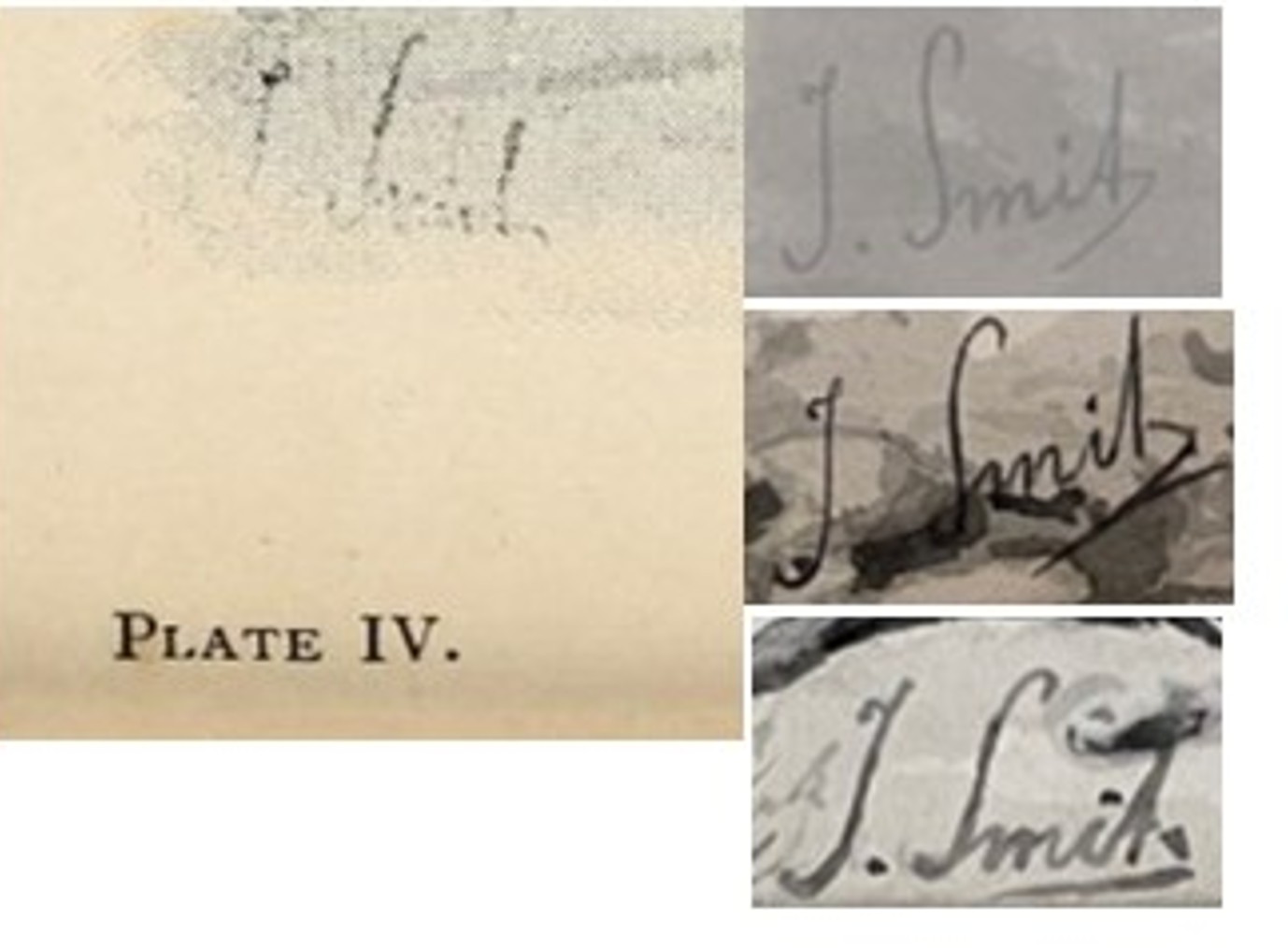
One is Henry Neville Hutchinson’s book Extinct monsters: A popular account of some of the larger forms of ancient animal life, first published in September 1892. His Plate IV (between pages 68 and 69) shows a Brontosaurus:

My initial thought that this may be by Joseph Smit, since the book’s title page says “With illustrations by J. Smit and others”, but that the poorly preserved signature at bottom left doesn’t look like it spells his name. However, Mary Kirkaldy sent me a helpful comparison of this poorly reproduced signature with several others which are definitely Smit’s, and it checks out:
The other 1892 publication with a sauropod life-restoration is James Erwin Culver’s seven-page article “Some Extinct Giants” from issue 1(5) of The Californian Illustrated Magazine. This must have been published before Hutchinson’s book, because the date-range for Volume 1 of this magazine is October 1891 to May 1892.
I’ll quote from page 505 because it’s just so cute:
If men lived in those days, they were cave dwellers living in the rocks,, garbed in skins, defending themselves,, if necessary, with stone clubs and hammers. But what could their weapons, avail against the giant Amphicoelias that crawled slowly and heavily out of the water in the direction of their homes, a mountain of flesh, weighing possibly twenty tons, four or five feet taller than the tallest elephant, and dragging along sixty or seventy feet of flesh?
And on page 506 we see this — note the cavemen on the ledge to the right!

(Tyler says this artwork is by Carl Dahlgren, but I’ve not been able to find the attribution. Can anyone point me to it? He also notes that this piece was clearly an inspiration for Knight’s rendition, especially the patterning.)
But both of these 1892 works were predated by Camille Flammarion’s 1886 book Le Monde Avant la Création de l’Homme (The World before the Creation of Man). On page 561, as figure 297, Flammarion included this restoration by Jules Blanadet:

Translation: Shape and probable size of the atlantosaur, the biggest animal that ever existed (length: 35 meters).
As things stand, this is the oldest life restoration of a sauropod that I know of. But I’ve been wrong about this before, and very possibly there are yet older ones that I don’t yet know about. Can anyone point us to something older than 1886?
References
- Culver, James Erwin (1892, April). Some Extinct Giants. The Californian Illustrated Magazine 1(5):501–507.
- Flammarion, Camille. (1886). Le Monde Avant la Création de l’Homme. Origines de la Terre. Origines de la Vie. Origines de l’Humanité. C. Marpon et E. Flammarion (eds.). 847 pages.
- Hutchinson, Rev. Henry Neville (1892). Extinct Monsters: A Popular Account of some of the Larger Forms of Ancient Animal Life. Chapman & Hall, London. [This links to the more widely-circulated 3rd edition from 1893.]
- Taylor, Michael P. 2010. Sauropod dinosaur research: a historical review. pp. 361-386 in: Richard T. J. Moody, Eric Buffetaut, Darren Naish and David M. Martill (eds.), Dinosaurs and Other Extinct Saurians: a Historical Perspective. Geological Society of London, Special Publication 343. doi: 10.1144/SP343.22
Book Week 2025, Day 6: The Laws Guide to Nature Drawing and Journaling, by John Muir Laws
December 3, 2025

Drawing is how I understand things best, and it’s one of the ways I teach myself new subjects. My top advice for anyone wanting to be a paleontologist is “learn how to write” and “learn how to draw”, which really boil down to, “practice writing and drawing”. You only get better by doing. There’s a great saying, that everyone is born with 1000 bad drawings inside them. You get to the good drawings — you get to be good at drawing — by exorcising the 1000 bad drawings. “I can’t draw” is just a shorter way of saying, “I’m unwilling to practice drawing.” (That probably sounds pretty strident. If you don’t want to be good at drawing, that’s fine. The world is big, full, and busy, and not everyone has to be interested in every possible thing. Just don’t mistake “I can’t draw” for a good reason not to try.)
Drawing forces me to be a better observer. If I have to trace every line and contour of a fossil, I have to push my pen along those paths, and that compels me to notice them in the first place, and wonder about them. Why this shape, and not some other? Is this an omnipresent feature, or a variable one? Where have I seen this before? Have I seen this before? Has anyone ever noticed this at all? (Answer: surprisingly often, no.) I think anyone who wants to be a better morphologist could improve their observational skills and anatomical understand through drawing; indeed, I can hardly imagine how it could be otherwise.

A slide from my introduction to anatomy lecture, from the section on how to study.
John Muir Laws is all about the practice of observing nature through drawing and writing notes, but the principles he teaches have much broader applications. Here are a couple of my favorite quotes of his:
“The first pancakes off the griddle are always funky, but you need to make them to get to the good pancakes. So too with drawing or journaling. Do not judge yourself by your first lines on paper on any given day.”
– from “Sacrificial Pancakes”
When I first read that, I wrote to Mike, “Holy cow, did I need to read these lines, not just about drawing or writing but about LIFE.”
Mike responded, “Whether X is blog-posts, specimen drawings, novels, narrative songs or landscape paintings, the best _and quickest_ way to produce a good X is to produce a lot of bad Xs. Also: “sacrificial pancake” is a good term for the sequence of Bad Xs.”
The thing is, it’s not about the bad Xs, or even the good Xs. It’s about the willingness to keep making Xs at all. To wit:
“Drawing with the goal of the drawing itself makes a fetish of the product. […] Each drawing is not an end in itself. It is a vehicle to help you focus your attention.”
– from “Quantity, not Quality”
The Laws Guide to Nature Drawing and Journaling is about doing that — learning to focus your attention by drawing and taking notes. I particularly like Laws’s 3-part structure to taking notes on something, be it a landscape, an organism, or a phenomenon. His guiding prompts are:
- “I notice…” What do you notice about the thing? Draw those things, write them down, annotate them — capture them somehow. The more you capture, the more you will likely notice.
- “I wonder…” Ask questions. They can be dumb questions, or unanswerable ones. The goal in the moment is not to filter, not to judge, just to let the ideas flow. As with pancakes, you may have to off-gas some dumb ideas into your notebook to get to the good ones.
- “It reminds me of…” Make connections. Again, without judgement. They can be far-fetched or goofy. You’ll have the rest of your life to sort the good from the bad — but only if you cast a broad enough net to catch the good ideas in the first place. Which is just another way of saying, lower your inner defenses to looking or feeling stupid. A lot of great ideas looked dumb at first blush.
That second quote resonates with me for another reason. I have the odd privilege of being friends with some of the world’s most accomplished paleoartists. If I started comparing my drawings to theirs, I’d never pick up a pen or pencil again. I’m like a goldfish watching a team of brain surgeons. But I’m not drawing for the same reasons they are. I basically only need to be able to do two things: take notes for my own personal use, and — occasionally — hand-draw something for publication. My first draft of the previous sentence included the formulation, “draw well enough to learn something”, but I realized that’s a nonsensical arrangement of words. I think that anyone at any level of skill or experience can draw well enough to learn something; indeed, a beginner may learn more from their first 10 drawings than a master will learn from their next 50.
And to circle back to the opening of the post, I don’t think aspiring paleontologists need to learn how to draw so that they can draw better. I think aspiring paleontologists need to learn how to draw so that they can see better. As Laws wrote, drawing is a vehicle for focusing attention. But the process of drawing has the handy corollary that it gives off archivable notes as waste.

A still from one of Laws’s videos on sketching.
Laws’s chosen field is natural history, but you could apply his ideas on noticing things, asking questions, making connections, and creating iteratively to all kinds of things: baking techniques, physical exercises, lawn mower engines, you name it. So a book with a seemingly specific remit, observing nature, actually is about becoming a better observer, and a better learner, in general. UPDATE: I should have thought to include this the first time around — Laws has just tons of great resources on his website, including a lot of freely-downloadable inserts and templates in the store to help with observation and drawing. One of them, the ruler sticker, is where I got the idea for affixing IKEA paper tapes to the cover of my research notebook.
Of all the books I’ve covered in this book week, if there’s one I could inflict on aspiring scientists — or active ones — and beg them to read and engage with, it would be this one. Not from any position of superiority! I am climbing the mountain myself, always, one day and one step at a time. This book is one of my hiking poles. I think you will find it useful as well.
Book Week 2025, Day 3: Dungeon delvers delight in Dr Dhrohlin’s Dictionary of Dinosaurs
November 29, 2025

This book is squarely at the intersection of being an objectively great thing to have in the world, and a subjectively great thing to have on my gaming shelf. I’ve been playing tabletop RPGs since I was 16, and running Dungeons & Dragons for over a decade, including an elaborate “Dinosaur Island” campaign for my son when he was younger. Just this year my current party has had to deal with an Octyrannopus — one of my homebrew monsters:

— as well as a gigantic, very aquatic, possibly-somewhat-undead Spinosaurus. In game, that horror was summoned on the shore of the Sunless Sea by a gnoll necromancer. But I summoned it from the pages of Dr Dhrolin’s Dictionary of Dinosaurs, which is packed with so much good stuff that it’s hard to know where to begin.

First off, as it says on the tin, the book has a bunch of dinosaurs, which go waaay beyond the standard half-dozen or so from the official D&D Monster Manual. It’s nice to see some love for some of the more recently-described, not-yet-famous taxa like the titanosaur Mnyamawamtuka.

But it’s not just dinosaurs sensu stricto — the book also has a healthy leavening of pterosaurs, marine reptiles, and non-dinosaurian critters to round out your random encounter tables and fictional ecosystems.

And speaking of ecosystems, the book covers four in some depth: the Yixian, Bahariya, and Crato Formations, and Hateg Island, including flora, landscape, climate, and so on, so dungeon masters can give their players some you-are-there verisimilitude, or use the covered ecosystems as guides for fleshing out their own homebrew worlds. I believe that every single organism in the book — dinosaur, pterosaur, fish, or plant — comes with optional magical rules, so dungeon masters can dial in the high-to-low magic level of their game worlds. There’s just so much in here, to use as written or mine for inspiration.

Note that each critter gets at least one two-page spread (a few prominent taxa get two or more spreads), and, crucially, all the game-relevant info is usually available on a single spread. Why is this important? I’ve heard it may be largely fixed for the new 2024 Monster Manual, which I’ve not yet acquired, but all three of the 2014 D&D core rulebooks, and most of the official campaign books that followed, are UI disasters when it comes to consistently putting the info that people will need at the table (i.e., at speed) where it will be immediately accessible — which is the One Job that an RPG book really needs to do well. RPG books are sort of like a combo of emergency manual and cookbook in requiring good, reader-focused structure and graphic design for usability on the fly. If you can’t find what you need quickly, and ideally get all the info for a given thing without turning the page, the book has failed as a game reference, no matter how great the ideas and writing are. Why Wizards of the Coast can’t figure this out for most of the official D&D books is quite beyond me (possibly because they keep firing the whole D&D creative crew and then replacing them with newcomers, so neither institutional memory nor game-creation expertise accumulate as they should). But like a lot of 3rd-party products, Dr Dhrolin’s gets it right, and runs circles around WOTC books in terms of usability at the table.

When a critter gets more than one spread, it’s either for a splash page of art, or more options, or both. There are a handful of custom dinos chosen as high-level pledge rewards by backers when the book was crowdfunded. For example, You-Know-Who here, which struck me as a neat linkage between Mark Witton’s scientific thoughts on what a max-size tyrannosaur would have been like, as explored in his new book, King Tyrant, and a truly awesome challenge to throw at a D&D party. The big, weird spinosaur my party recently faced is another of these special purpose, beyond-the-ordinary, truly monstrous foes. As a dungeon master, it’s nice to have a selection of boss dinos locked and loaded.

For people new to dinosaurs and paleontology, there’s a really lovely, concise introduction that would not be out of place in almost any popular science book about dinosaurs. The book is built in two versions, for D&D 5E and Pathfinder 2E, but there’s such a wealth of good ideas and great art inside that I think it would be worth picking up for anyone interested, no matter what system they run (it’s an article of faith with me that dungeon masters should freely adapt or homebrew stats as needed).

I’m especially impressed by Dr Dhrolin’s as a sort of global and all-encompassing guide to bringing paleontology into tabletop games. It includes ideas on how this might happen at all — lost worlds, time travel, necromancy, and more — NPCs to hook parties into paleo-themed adventures, and new subclasses and other options, for newly-generated characters or pre-existing ones encountering dinosaurian realms for the first time.

Want to ride a dinosaur? The book has you covered, with taming and domestication rules.

Want to play a dinosaur, or a pterosaur? You can do that, too, with six new playable species, complete with notes on their societies.

Just like great paleoart? The visuals alone are worth the price of admission, with Mark Witton providing art for the critters and Jules Kiely on plants, items, and some of the new playable species and character options. The book is a shade over 300 pages long, illustrated in full color throughout, and with pretty pictures on almost every spread. It’s a staggering amount of art.
Finally, a word on professionalism. Considered broadly, RPG products tend to be very hit-and-miss. It’s a genre where new authors can sometimes bring new ideas to the table pretty quickly, and without having all the interesting bits sanded off by corporate focus groups, but also one where a certain level of amateurish production is almost endemic. Even the official WOTC books, pretty as they are, rarely seem to have been designed and assembled by anyone who actually plays D&D regularly, or understands how books get used mid-game. Dr Dhrolin’s is one of the most professionally — and considerately — produced products ever put out for 5E. The creative team — Drs. Nathan Barling and Michael O’Sullivan on writing, Mark Witton and Jules Kiely on art, and a host of others (nicely detailed and credited on page 8) — had the ambition to make it wide-ranging, the closest thing that’s ever existed to one-stop-shopping for dinosaurs in RPGs, while also understanding the brief to make it useable at speed at the gaming table, and while also delivering an attractive, high quality, solidly-constructed book that feels good in the hand and is a joy to just flip through. If you like dinosaurs and paleontology, it’s great — every critter even gets a small section of references! If you like D&D, it’s jam-packed with ideas, well-organized, and actually useful in prep and in play. If, like me, you’re into both things, it’s basically aersolized, weaponized crack, and you probably already own a copy.
If you need more convincing, professional dungeon master and RPG creator Ginny Di has a great video review.
Dr Dhrolin’s Dictionary of Dinosaurs has been out for a year now, so this is yet again something I could have and should have covered a lot sooner. But this entry is still timely. Right now, and for about 59 hours after I hit the “publish” button (= until sometime on Dec. 1), PalaeoGames has big discounts on Dr Dhrolin’s and lots of other associated goodies, including tokens, battle maps, a fillable character sheet, and 3D-printable digital models (delivered as STLs), through their current crowdfunding campaign, Dr Dhrolin’s Festive Party 2025. You can also pre-order the follow-up volume, Professor Primula’s Portfolio of Palaeontology, which is being developed as I type. This is a hoard of good stuff, just in time for holiday shopping. Go do the right thing.
Book Week 2025, Day 1: Speed Thief Vol 1, by Sean Hennessy
November 27, 2025

I would like this book just for being funny.

I would like this book just for being well-illustrated.

I would like this book just for covering lots of different dinosaurs and other Mesozoic critters, some familiar and many others only recently described, from more dinosaur-bearing formations than I was previously familiar with.

The fact that Sean Hennessy manages all of this at once is pretty astounding. I can laugh at the animals’ sometimes very modern, sometimes Mesozoic-specific, and sometimes universal predicaments, while learning about new-to-me critters, while enjoying pretty darned great paleoart. Each comic is accompanied by a title, a list of featured genera, and the geologic unit, time, and country or continent. There’s even a taxonomic index in the back of the book!

This post is doing multiple duties. Having followed his comics online, and loved them, I promised Sean that I’d buy his book and blog about it…back in 2024. Finally acquired my copy at DinoCon 2025, and got it personalized by the very personable author. So here’s your long overdue shout-out, Sean, and a visible reminder, to myself and to the world, that I still have more DinoCon stuff to blog.

Sean Hennessy’s contribution to the noble theme of sauropods stomping theropods.
New Speed Thief comics are going up regularly on Instagram, and you can get them early as a Patreon backer. You can get the book, prints of comics, t-shirts, pins, stickers, and more from Sean’s Etsy store. Go have fun! And stay tuned for the rest of Book Week 2025, in which I will continue belatedly singing the praises of books that aren’t necessarily new, but are fully awesome.
Finally, happy Thanksgiving! Go eat a dinosaur.
Midnight in the Museum
September 27, 2025

Midnight in the museum
In the yawning resonance
Of empty space
The great xylophone skeletons
Play the lonely strains of Time
Like cathedral organs
Heralding the ends of ages.

Time rushes on
The final predator
Implacable
Like Dinichthys
Cruising the crinoid beds
Sounding one note:
Everything dies.
Change hammers all
On the anvil of eons
Carnivores and civilizations
Long of tooth
Weak of spirit
Wracked by rot and riot
Collapse.
Their carcasses play host
To new generations
That strip the drying flesh
And flaunt their youth
Beneath the philistine stars
That warmed the nebulae
Before the phoenix-fusion birth
Of brash young Sol.

I feel a distant call
The silent whistle screaming
Of my genes
Seeking always
To jump this fragile ship of life
And flee down the generations
Until I am lost
Expended
Forgotten.
The tyrant kings smile knowingly:
“You too shall pass”
And continue their stately voyage
Into eternity.

The circle closes
The revolution complete
And morning spreads her wings
To the far horizon.
I do not fear the dawn
Or the age to come
For I have basked
On desert sands
Drinking life like heat
And felt the mighty Tethys
Washing over my feet.

Notes
In 1998-2001 I was a graduate student at the University of Oklahoma, with night-owl tendencies and all-hours keycard access to the old museum collections, a defunct WWII-era gymnasium where dinosaur skeletons were prepared and test-assembled, and the new building — now the Sam Noble Museum of Natural History — where they were being installed, ancient bones going up on skeletons of new steel. I wrote this in 1998 or 1999; perhaps fittingly, its precise origin is now lost in time. I’d no doubt say it all rather differently now, but 50-year-old me will yield the floor to the 20-something who penned this, not least because he wrote me into existence as well. Oh, and if I didn’t swipe the expression “xylophone skeletons” directly from Ray Bradbury’s Dinosaur Tales, it was at least heavily inspired by Bradbury.
Photos, top to bottom:
Diplodocus, Utah Field House of Natural History, Vernal, UT
Pteranodon, Rocky Mountain Dinosaur Resource Center, Woodland Park, CO
Something toothy, American Museum of Natural History, New York City, NY
Clouds over Mygatt-Moore Quarry, Rabbit Valley, CO
Ripple rock, Denver Museum of Nature and Science, Denver, CO
Alex Pritchard’s Aquilops and friends
September 12, 2025

Very nice photo of Alex Pritchard’s Aquilops skeleton from DinosaurSkeletons.co.uk.
I am often so far down the rabbit holes of my own work (and given that I work mostly on pneumaticity and weird stuff in neural canals, they are literally holes) that I do a very poor job of keeping up with what’s going on in the broader dinosphere. A timely example: I didn’t know that Alex Pritchard was out there making museum-quality dinosaur skulls and skeletons until I saw his work on the DinoCon Instagram feed in the run-up to the convention. Then I visited his website, DinosaurSkeletons.co.uk, and then I got very excited.

Here I am at Alex’s booth at DinoCon 2025, with his mounted Aquilops skeleton. If you’d like to see the skeleton without a big dumb mammal crowding the view, see the image at the top of the post, or visit the webpage.
That skeleton rocks on toast. Luggage constraints kept me from bringing a skeleton home, so I settled for one of Alex’s Aquilops skulls, only ‘settle’ isn’t the right verb because this is also extremely awesome.

I spent a *lot* of time reconstructing the skull of Aquilops for our descriptive paper (Farke et al. 2014), so it’s one of the few non-sauropod things I’m qualified to yap about (and have, here, here, and here). Alex’s Aquilops skull is so good it gave me flashbacks; it looked like my drawings had leapt off the page and into faux-fossilized-bone — and very shortly into my hand and then into my luggage.

I made a point to get to Alex’s table early on to scoop up one of his Aquilops skulls, which was a savvy move because he did later sell out — of Aquilops, and of darn near everything else, much of it gone by the end of the first day. I was also quite taken with his Psittacosaurus skull, which I got in two sizes, and an oviraptorosaur egg I picked up for the heck of it. I guess I should have nabbed a Velociraptor skull to complete the early ceratopsian/Djadochta Formation Venn diagram. Maybe next year.

I got to chat a little with Alex. He’s so easygoing and approachable that it would have been all too easy to overlook his passion and dedication, had the evidence of it not been covering a very long table and rearing around us on metal stands. I know how hard it is to execute these things faithfully in two dimensions; the sheer number of specimens that Alex has conjured into being in three dimensions — and not just accurately but convincingly — is pretty staggering.

Alex likes to show some love to the less-famous dinosaurs — on his Instagram feed you can see his reconstructed skeleton of the recently-named dromaeosaur Shri rapax. Aquilops turned out to be kind of a fluke — he’d already made the skull and skeleton before Jurassic World Rebirth‘s Dolores catapulted ‘my’ little weirdo from relative obscurity to global fame. That happy accident worked out pretty darned well for me, and I think for Alex as well — he had a whole raft of Aquilops skulls at the start of DinoCon, and none at all on day two. I assume he’s hard at work on more awesome critters; from now on I’ll be following his output a lot more closely.

So, if you want a faithful representation of the Aquilops holotype as it exists today, you can download and print the 3D model of OMNH 34557 that we published with the paper. But if you want a non-roadkilled Aquilops skull that looks like it might have come straight out of the Cloverly Formation, I can personally vouch for Alex’s — it’s the one I have sitting on my desk right now.
I got the impression that DinoCon 2025 punched a decent crater in Alex’s inventory, but he is accepting orders and I expect him to recover quickly, if he hasn’t already. So get on over to DinosaurSkeletons.co.uk and do the right thing.
Reference
Matt’s DinoCon 2025 adventure
August 27, 2025

Where all discerning paleontologists buy road trip junk food. This one is in Santa Rosa, New Mexico.
I just got back home after a solid four weeks on the road, an epic peregrination from SoCal to Oklahoma to England to Oklahoma to SoCal. DinoCon 2025 was embedded mid-trip, which is why I haven’t gotten anything about it posted before now.

I love driving across the American West. Give me a thousand miles of interstate and a couple of days to myself and you’ll rarely see me happier or more well-adjusted.
My brain is still buzzing, from DinoCon and from the rest of the trip, but here are some of my personal highlights in no particular order:
1. Venue generally — all the conference areas on the University of Exeter campus were very walkable, and the Great Hall had tons of space and lots of doorways, which made it easy to get in and out of from multiple directions, quietly, even during talks. The vendor space was nice, and having dorms and a pub on site was excellent.

Kieran Satchell fixin’ to hold court. Past Matt did not know that he was about to get his face rocked off.
2. Speakers — great, diverse set, appreciated seeing so many women and early-career folks, and people that have had different pathways into paleontology (researchers, educators, artists, people in entertainment, students, etc.). Hillary Maclean’s talk was the absolutely perfect way to kick off the conference, and set a really wonderful tone for everything that followed (irritatingly, I got no photos). I’ll have more to say on a couple of standout talks in a future post.

I’ve been admiring Dougal Dixon and his work for four decades, so getting to meet this kind, gracious, curious, enthusiastic, wonderful person was a lifetime dream come true.
3. Vendors — freakin’ amazing. Highlights for me were getting to meet Dougal Dixon, Andy Frazer (Dragons of Wales, Novosaurs, etc.), Sean Hennessey (Speed Thief), Alex Pritchard (DinosaurSkeletons.co.uk), and Katrina van Grouw (Unfeathered Bird, Unnatural Selection), in addition to catching up with old friends like Mark Witton, Georgia Witton-Maclean, Bob Nicholls, and Toni Naish. I’d corresponded with Natee Himmapaan and David Krentz but not met them in person, so it was nice to finally close those loops. And Nathan Barling — I’ve been meaning to blog about Dr. Dhrolin’s Dictionary of Dinosaurs for ages, and I got to gush at Nathan for a few minutes over how rad that book is. I got books signed by Dixon, Frazer, Hennessey, Naish, and Witton, but I was a lightweight compared to some in that department. The evening art exhibition was fantastic; Mike and I wandered around taking it all in, and it gave us a lot to think and talk about. If you were there and I didn’t meet you — and I know I missed a few folks from busyness, brain fog, general overwhelmedness, etc. — I’m sorry, and I hope we can catch up next year.

Lots of official DinoCon stuff, some of it personalized by me. No-AI pin by Andy Frazer is available in his shop.
4. Brochure — all the swag was great, including the badges and lanyards, but the brochure was a real high point for me, for these specific reasons: I love the A5 size and form factor, so much more convenient than anything larger or smaller; print quality and paper quality were excellent, so it felt good in the hand and like a high-quality artifact; layout with schedule on the middle fold and maps at the back (and on the back) was super convenient, especially for one-handing when carrying an armload of books and art; and finally having room for notes. This is peak conference guidebook design; no need to rethink, just keep making them like this, and other conferences take notice.

Still a few spaces left, but laptop real estate is getting tight. Blue Lias sticker was another DinoCon acquisition, courtesy of Kieran Satchell.
5. Official themed art for the conference — I like that this existed, and I thought that Natalia Jagielska‘s art hit the right note for the type of event this was, so well done all around. I was particularly taken with what I can’t help seeing as her Union Jack azhdarchid; that piece adorns the laptop I’m typing this on, courtesy of the official DinoCon 2025 sticker pack. Speaking of: loved the stickers and pins and so on, I’m a helpless victim for all of that, as Mike can attest.

As the self-nominated Aquilops Ambassador, I left a few Aquilops Funko Pops with various parties in the UK, and put one in the auction.
6. Auction and Quiz — turns out Darren Naish is really good at working a room, and keeping the tone light, even when he was (mock) exasperated by this or that. Both events were enjoyable and hilarious. My plea for the future: don’t find a more professional or even competent auctioneer, just keep making Darren do it. It’s unarguably the right move.

What the kids refer to as a grip of Mark Witton’s art.
Needless to say, I enjoyed myself tremendously. I did have one minor problem that I’d never had the opportunity to experience before: sheer exhaustion from all the dinosaurian awesomeness. At most conferences the dinosaur bits get one day, maybe a day and a half max, and although many of the vendors will be catering to the dinosaurati, it’s not all dinosaurs all the time. DinoCon was just that, and although it was exhilarating, I collapsed into bed each night on the thinnest of fumes (and thinnest of wallets).

Mike and Fiona kindly let me disgorge my DinoCon loot onto their dining room table. I did manage to get it all safely home to SoCal, with only a little necromancy and some slight warping of the spacetime continuum.
But heck, I’ve got in the neighborhood of 50 weeks to recover. By the time DinoCon 2026 rolls around, I’ll be more than ready to do it all again.

The SV-POW!sketeers cracking each other up, as is our wont. This photo was taken just before the one at the top of Mike’s recent post.
One of the major highlights of the trip was just getting to hang out with Mike and Darren. I hadn’t been to the UK since SVPCA 2019, so it was well overdue. I’ve known them both as pen pals for a quarter-century now, and as good friends and colleagues for over 20 years, and looking back I can see the Godzilla-sized footprints their scholarship and companionship have left in my life and my career. That’s a humbling amount of good fortune.

Probably my favorite photo from the trip. Fiona, Mike, me, and Jenny watching the sunset from the trampoline in the Taylors’ back garden.
Also perfectly lovely: getting to stay with Mike and Fiona before and after the conference. Their place is my home away from home. Rivers of English tea flow invisibly beneath the surface of many of my papers, courtesy of the Taylors, and it’s past time I publicly acknowledged that.
I have more to say about the trip — about Mike’s talk, book signings and art acquisitions, not one but two close encounters with Aquilops, and more — but science is calling so those posts will have to wait a bit. Stay tuned.


 Sauropod Vertebra Picture of the Week