Five questions from Tom Redd
October 24, 2024
Three years ago, Tom Redd made a very generous commitment to the SV-POW! Patreon, and he remains our most generous donor in total. When I wrote to thank him his reply included “I have thousands of questions about apatosaurus that I would like to ask you some day.”
It seemed only fair to invite him to ask some of those questions, so we asked him to give us five and said we’d try to answer them. When the questions came through, some of them were hard — not really in our area of expertise. But I promised we’d take a crack, and that we’d invite commenters to chip in where we get something wrong or leave something out.
Then a bit more than three years slipped past. Now, finally: here we go!
Question #1:
Do you think sauropods could have evolved long necks as a defensive strategy? (Better to see your enemies from a long way off). The sigmoid curve and the neutral position is another issue!
I recently read a couple of research papers where the researcher used “radiological imaging” to determine the neutral position of the cervical vertebrae. The result was a gently downward curving neck beginning at the pectoral girdle, with the skull only 2 meters off the ground. (I agree with Matt that this would be an ambush predator’s delight!)
Also, could compressive or tensional forces of cartilage and ligaments affect the neutral position of the cervical vertebra? (I believe Matt also alluded to this condition.)
This is the longest question, but maybe the one I’m best positioned to comment on.
First of all, the perennial question of what sauropods’ long necks were for. There are a few candidate explanations out there. The obvious one is that they enabled high browsing, and on the whole we feel that’s the strongest single explanation. Another candidate factor is sexual selection — that sauropods were particularly attracted to long-necked individuals of the opposite sex — but we don’t feel that is a strong explanation for reasons explained in our 2011 paper (Taylor et al. 2011). Predator avoidance would certainly have been aided by the long visual distances allowed by elevated heads, and we are confident that at least some sauropods used their necks in combat — primarily in intraspecific combat (Taylor 2015) but no doubt also against predators when the occasion arose. And we may well have missed other good uses for long necks.
In reality of course all these factors likely played a role: structures do not always, or even often, evolve for a single reason. When people who know much more about ceratopsians tell me “The horns of Triceratops were for intraspecific display and combat”, I don’t doubt them. But I also don’t doubt that, whatever the primary purpose of the horns, a Triceratops confronted by a Tyrannosaurus would do its damnedest to stick its horns into it. In the same way, while high feeding seems like the strongest driver of sauropod neck elongation, the other factors will surely have played in, too.
I’m not sure what radiological imaging papers you have come across, but the one I know about is Berman and Rothschild (2005) in the Thunder Lizards edited volume. This paper rather questionably partitions all sauropod cervicals into two bins, “robust” and “gracile”, and concludes, based on functional stress analysis, that “the robust-type centrum supported a neck held in a vertical, or near-vertical, pose, whereas the gracile-type centrum supported a neck held in a horizontal, or near-horizontal, pose”. If this is right, and their categorization holds, then Camarasaurus and an unidentified titanosaur had vertical necks; and Diplodocus, Apatosaurus, Haplocanthosaurus, Barosaurus and Brachiosaurus all had horizontal necks. We find every part of this unconvincing. At some point we should explain why in detail; but it is not this day.
Finally, yes, compressive and tensile forces in cartilage and ligaments definitely did affect neutral posture. My 2014 paper (Taylor 2014) shows this rather dramatically.

What we’re seeing here is what the neutral posture would be if cartilage is added to a neck that is otherwise articulated in horizonzal pose. The importance of intervertebral cartilage has often been overlooked, but can make a dramatic difference to neck posture.
Question #2
I recently read a report that indicated Apatosaurus survived at the species level for a period of approximately 8 million years ! So is this a success, average, or a short run?
I’m not sure where you read that, but the problem here is that no-one really knows what Apatosaurus means. We have the type species Apatosaurus ajax, sure, and the referred species Apatosaurus louisae, and the genus Brontosaurus based on the species Brontosaurus excelsus which is sometimes but not always synonymised with the genus Apatosaurus yielding the combination Apatosaurus excelsus, and don’t even get me started on Apatosaurus parvus, Apatosaurus laticollis, Atlantosaurus and whatever the heck AMNH 460 is.
So if we say that Apatosaurus survived for 8 million years, what exactly are we saying? That Apatosaurus ajax is known from sediments that differ in age by 8 million years? That would be interesting if true, but it’s very hard to establish because the referral of any given individual to a particular sauropod species tends to be very uncertain — largely because most specimen are so fragmentary and distorted. And if all we mean is that 8 million years separate the oldest and youngest specimens that have been referred to the genus Apatosaurus — well, that statement is all but meaningless, given the huge uncertainty about what is and is not part of that genus, if indeed genera even really mean anything.
Putting it all together, I’m not confident that there is any reason to think that Apatosaurus was particularly longer lived than other sauropods. Probably Camarasaurus outlasted it if you include all the taxa that have been referred to Camarasaurus. But then I’m far from convinced that that’s the right thing to do, too.
Question #3
Why so many heavy predators during the age of apatosaurs? Predator to prey ratios were in the 6 to 8% range as compared to modern ratios of 2 to 3%!
I’m not sure I can say much about this without knowing the source of the figures, but I assume that what’s being counted here is the number of individuals represented in the fossil record, and the ratio of a predator species to prey species. The problem is that there is a huge amount of vagueness in these numbers, but it’s not obvious that the apatosaur-age figures are comparable to the modern ones.
Consider first the modern ratio. Which animals are counted in each category? In the Serengeti, lions prey on zebras. So far, so simple, but there are also dwarf moongooses, which are predators — but they don’t hunt zebras. So do we count them in the numbers? If so, do we count their prey animals, too? Including invertebrates? And if not, then where do we draw the line between predators that we consider do and do not hunt the prey animals that we’ve decided we’re interested in?
Then there’s the matter of which animals get counted. If you do your Serengeti counts on dead animals, you might find disproportionately many predators because prey animals tend to be consumed. Or you might find disproportionately many prey animals because they tend to die in areas where the corpses are more easily found and counted. You might be able to do better by counting live animals, but then you might easily undercount secretive predators, or perhaps overcount predators because they stand fearlessly around to be counted.
Now consider trying to measure the predator/prey ratio in the Morrison formation. You have all the problems I already mentioned, plus a bunch of others. If you only count complete-ish articulated skeletons then your sample size is too small to be meaningful. If you count isolated elements, you’re at risk of registering multiple instances of the same individual. Counting individuals represented in bonebeds is difficult because of these problems. Assigning an element to a taxon is error-prone (though should generally be OK at the high level of sauropod vs. theropod — or are you?). Bones of different taxa may survive taphonomy better or worse than others. Life history differences will mean that the fossils of long-lived taxa under-represent their live populations. And so on, and on, and on.
Putting it all together, I would tend to be very sceptical that a difference in ratios of 6–8% to 2–3% is necessarily telling us anything.
With all that said, it’s perfectly possible that the average predator:prey body-size ratio was closer in the Morrison than in modern ecosystems. But we’d do better trying to measure that directly from body-fossils than to infer it from population densities.
Question #4
Are all apatosaur tracks on emergent surfaces? (Some depth of water over the prints)
This I don’t know. But then I wouldn’t know how to pick out apatosaur tracks from those of other diplodocids, and I bet no-one else does, either. Tracks are notoriously variable in shape, and can very wildly from the that of the feet that made them. Given that diplodocid feet were mostly pretty similar anyway, I would not be easily persuaded that any track can be confidently identified down to the genus level.
One other thing to be aware of is that there is often not agreement on the conditions under which a given track is made. One palaeontologist may think a given a track is a direct print, another will think it’s an underprint. I don’t mean to say that it’s hopeless and all we can do is throw our hands up in despair — good work is being done on interpreting tracks, but we have a long way to go. And this is not an area that I’m at all expert in.
Question #5
I read recently that in order for a skin impression to be made the Dermal tissue must undergo a type of chemical alteration! Do you think this is what allows the impression to be made?
That doesn’t sound right to me. The first thing that has to happen for an animal to be fossilized is that it needs to be buried in sediment really fast after it dies — before it’s eaten by scavengers. For something as fine as skin impressions to be preserved, that sediment needs to be very fine — which sadly tends to conflict with the first condition, since course sediments can be deposited more quickly than fine ones. It’s really hard for enough fine sediment to be laid down quickly enough to cover an animal of the size of a sauropod, which is why we don’t have sauropod specimens like those gloriously preserved theropods from the Yixian Formation in China(*). So sauropod skin impressions are pretty rare.
(*) Alternatively: there are spectacularly preserved partial sauropod specimens in the Yixian, but Chinese researchers can’t be bothered to write them up because they’d rather spend their time getting a slam-dunk Nature paper out of yet another little feathered theropod. Unduly cynical? Maybe. But I continue to live in hope.
Well, that about wraps up the five questions — to the best of my ability at least. But I’d love to hear from people who know more than I about these topics: leave a comment, and fame and glory could be yours!
And finally … if you, too, would like to have us answer five questions on the sauropod-related topic of your choice, quite possibly in the less than three years, you should consider getting yourself across the The SV-POW! Patreon and making an unreasonably extravagant financial commitment.
References
- Berman David S., and Bruce M. Rothschild. 2005. Neck posture of sauropods determined using radiological imaging to reveal three-dimensional structure of cervical vertebrae. pp. 233–247 in: Virgina Tidwell and Ken Carpenter, Thunder-lizards: the sauropodomorph dinosaurs. Bloomington: Indiana University Press.
- Taylor, Michael P. 2014. Quantifying the effect of intervertebral cartilage on neutral posture in the necks of sauropod dinosaurs. PeerJ 2:e712. doi: 10.7717/peerj.712
- Taylor, Michael P., David W. E. Hone, Mathew J. Wedel and Darren Naish. 2011. The long necks of sauropods did not evolve primarily through sexual selection. Journal of Zoology 285:150-161. doi: 10.1111/j.1469-7998.2011.00824.x
- Taylor, Michael P., Mathew J. Wedel, Darren Naish and Brian Engh. 2015. Were the necks of Apatosaurus and Brontosaurus adapted for combat?. p. 71 in Mark Young (ed.), Abstracts, 63rd Symposium for Vertebrate Palaeontology and Comparative Anatomy, Southampton. 115 pp.

I floated this idea on Fist Full of Podcasts, and Andrew Stuck gave it a shout-out in the comments, so I’m promoting it to a post.
The idea, briefly, is that sauropods grew fast and had enormous energy demands and even though horsetails and pine needles are surprisingly nutritious (Hummel et al. 2008), they probably suck to eat all the time. Extant herbivores are notoriously carnivorous when no-one is looking, and it’s silly to assume that extinct ones were any different. It seems likely that a big, hungry sauropod, gifted by natural selection with more selfish opportunism than compassion, would probably have viewed a turtle as a quick shot of protein and calcium, and a welcome hors d’oeuvre before stripping yet another conifer or tree fern. Furthermore, said sauropod would have been well-equipped to render the unfortunate chelonian into bite-size chunks, as shown above. The first time might even have been accidental. (Yeah, sure, Shunosaurus, I believe you. [rolls eyes])
Given that sauropods and turtles coexisted over most of the globe for most of the Mesozoic, I’ll bet this happened all the time. I don’t know how to falsify that,* but how could it not have? You’d have to assume that sauropods didn’t run into turtles, or that their mercy outweighed their curiosity and hunger. That’s even more bonkers than turtle nachos.** As Sherlock Holmes almost said, “When you have eliminated the impossible, whatever remains – no matter how stupid/awesome – was probably done by sauropods.”
* “Oh, you found a boatload of turtle shell pieces at your fossil site? How tantalizingly unprecedented – please tell me more!” said no-one ever. Seriously, everyone who works on stuff younger than the Early Jurassic seems to bitch about all of the turtle frags they find, whether they’re looking for Apatosaurus or Australopithecus.
** Not to be all navel-gazey, but that is conservatively the greatest sentence I have ever written.
In conclusion, sauropods stomped on turtles and ate them, because duh. Fight me.
Further Reading
For more sauropods stomping, see:
- Genesis of an instant palaeo-art classic
- Sauropods stomping theropods: a much neglected theme in palaeo-art
- Sauropods stomping theropods, redux
- Greatest. Palaeoart. Ever.
- Brian Engh: Stomp time!
- Sauropods stomping theropods: Bryan Riolo’s Chaos Gigantes
- Greatest. Video. Ever. Starring sauropod-on-theropod violence!
And for sauropods not eating, but gettin’ et:
- Oblivious sauropods being eaten
- Oblivious sauropods being eaten, part 2: Bakker’s snoozing brontosaur
Reference
What should we do now Beall’s List has gone?
January 26, 2017
It’s now been widely discussed that Jeffrey Beall’s list of predatory and questionable open-access publishers — Beall’s List for short — has suddenly and abruptly gone away. No-one really knows why, but there are rumblings that he has been hit with a legal threat that he doesn’t want to defend.
To get this out of the way: it’s always a bad thing when legal threats make information quietly disappear; to that extent, at least, Beall has my sympathy.
That said — over all, I think making Beall’s List was probably not a good thing to do in the first place, being an essentially negative approach, as opposed to DOAJ’s more constructive whitelisting approach. But under Beall’s sole stewardship it was a disaster, due to his well-known ideological opposition to all open access. So I think it’s a net win that the list is gone.
But, more than that, I would prefer that it not be replaced.
Researchers need to learn the very very basic research skills required to tell a real journal from a fake one. Giving them a blacklist or a whitelist only conceals the real issue, which is that you need those skills if you’re going to be a researcher.
Finally, and I’m sorry if this is harsh, I have very little sympathy with anyone who is caught by a predatory journal. Why would you be so stupid? How can you expect to have a future as a researcher if your critical thinking skills are that lame? Think Check Submit is all the guidance that anyone needs; and frankly much more than people really need.
Here is the only thing you need to know, in order to avoid predatory journals, whether open-access or subscription-based: if you are not already familiar with a journal — because it’s published research you respect, or colleagues who you respect have published in it or are on the editorial board — then do not submit your work to that journal.
It really is that simple.
So what should we do now Beall’s List has gone? Nothing. Don’t replace it. Just teach researchers how to do research. (And supervisors who are not doing that already are not doing their jobs.)
Vertebrates and invertebrates of Nova Scotia
June 16, 2015
Last week I went to Halifax, Nova Scotia, for the twice-yearly meet-up with my Index Data colleagues. On the last day, four of us took a day-trip out to Peggy’s Cove to eat lunch at Ryer Lobsters.
We stopped off at the Peggy’s Cove lighthouse on the way, and spotted a vertebrate, which I am pleased to present:
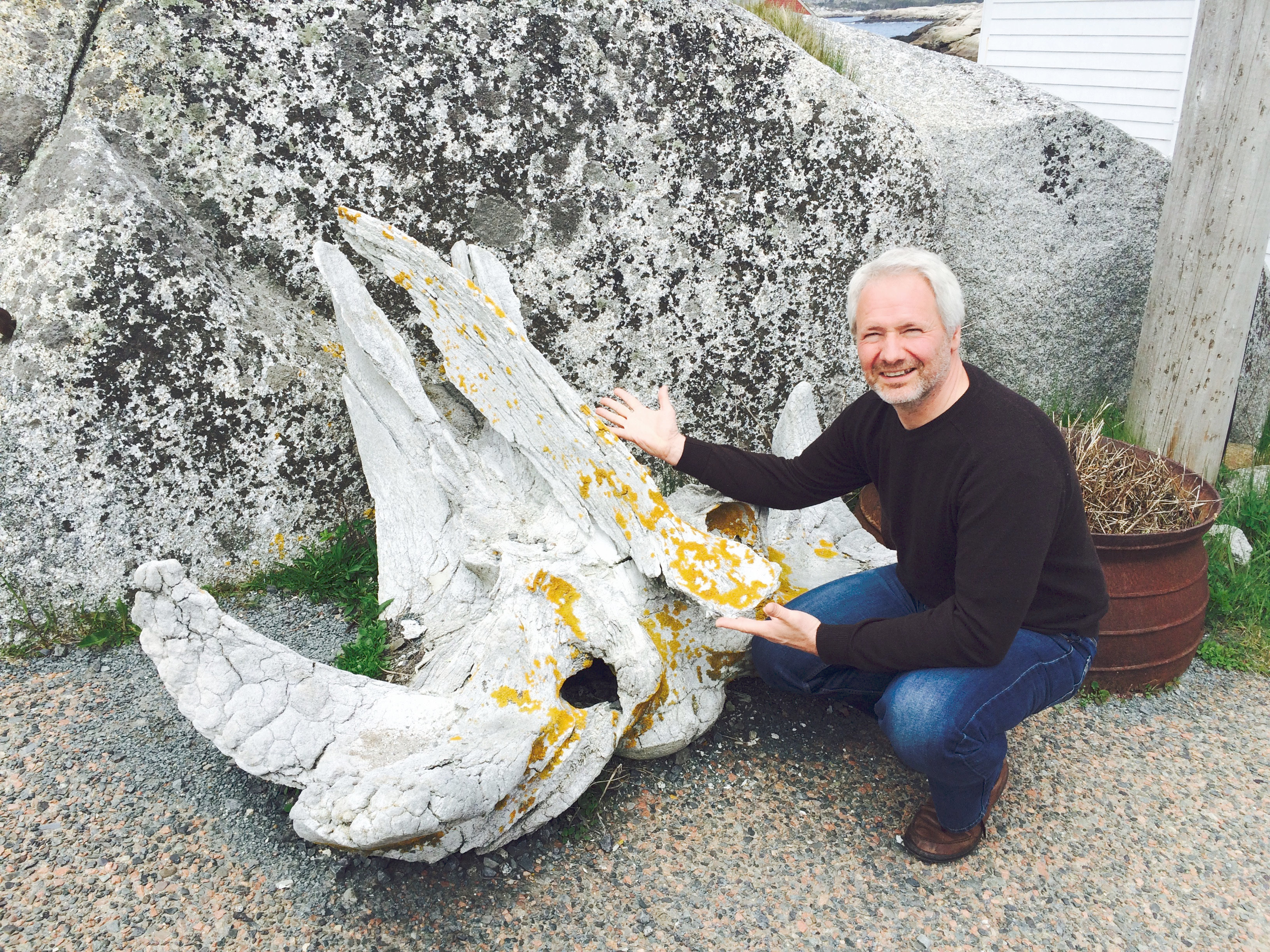
It’s a whale skull, but I have no idea what kind. Can anyone help out?
So much for vertebrates — it was really all about the inverts. Here are six of them:

I have a 2lb lobster here; my colleague Jakub went for two 1lb lobsters, as did Jason and Wolfram (not pictured). That’s Wolfram’s lobster closest to the camera, giving a better impression of just what awesome beasts these were.
Peggy’s Cove: recommended. For vertebrates and inverts.
(Thanks to Wolfram Schneider for these photos.)
Copyright from the lens of reality
May 7, 2015
This post is a response to Copyright from the lens of a lawyer (and poet), posted a couple of days ago by Elsevier’s General Counsel, Mark Seeley. Yes, I am a slave to SIWOTI syndrome. No, I shouldn’t be wasting my time responding to this. Yes, I ought to be working on that exciting new manuscript that we SV-POW!er Rangers have up and running. But but but … I can’t just let this go.

Copyright from the lens of a lawyer (and poet) is a defence of Elsevier’s practice of having copyright encumber scientific publishing. I tried to read it in the name of fairness. It didn’t go well. The very first sentence is wrong:
It is often said that copyright law is about a balance of interests and communities, creators and users, and ultimately society as a whole.
No. Copyright is not a balance between competing interests; it’s a bargain that society makes. We, the people, give up some rights in exchange for incentivising creative people to make new work, because that new work is of value to society. To quote the US constitution’s helpful clause, copyrights exist “To promote the Progress of Science and useful Arts” — not for authors, but for wider society. And certainly not of publishers who coerce authors to donate copyright!
(To be fair to Seeley, he did hedge by writing “It is often said that copyright law is about a balance”. That is technically true. It is often said; it’s just wrong.)
Well, that’s three paragraphs on the first sentence of Elsevier’s defence of copyright. I suppose I’d better move on.
The STM journal publishing sector is constantly adjusting to find the right balance between researcher needs and the journal business model, as refracted through copyright.
Wrong wrong wrong. We don’t look for a balance between researchers needs (i.e. science) and the journal business model. Journals are there to serve science. That’s what they’re for.
Then we have the quote from Mark Fischer:
I submit that society benefits when the best creative spirits can be full-time creators and not part-timers doing whatever else (other than writing, composing, painting, etc.) they have to do to pay the rent.
This may be true. But it is totally irrelevant to scholarly copyright. That should hardly need pointing out, but here it is for those hard of thinking. Scholars make no money from the copyright in the work they do, because (under the Elsevier model) they hand that copyright over to the publisher. Their living comes in the form of grants and salaries, not royalties.
Ready for the next one?
The alternatives to a copyright-based market for published works and other creative works are based on near-medieval concepts of patronage, government subsidy […]
Woah! Governments subsidising research and publication is “near-medieval”? And there we were thinking it was by far the most widespread model. Silly us. We were all near-medieval all this time.
Someone please tell me this is a joke.
Moving swiftly on …
Loud advocates for “copyright reform” suggest that the copyright industries have too much power […] My comparatively contrarian view is that this ignores the enormous creative efforts and societal benefits that arise from authoring and producing the original creative work in the first place: works that identify and enable key scientific discoveries, medical treatments, profound insights, and emotionally powerful narratives and musical experiences.
Wait, wait. Are we now saying that … uh, the only reason we get scientific discoveries and medical treatment because … er … because of copyright? Is that it? That can’t be it. Can it?
Copyright has no role in enabling this. None.
In fact, it’s worse than that. The only role of copyright in modern scholarly publishing is to prevent societal benefits arising from scientific and medical research.
The article then wanders off into an (admittedly interesting) history of Seeley’s background as a poet, and as a publisher of literary magazines. The conclusion of this section is:
Of course creators and scientists want visibility […] At the very least, they’d like to see some benefit and support from their work. Copyright law is a way of helping make that happen.
This article continues to baffle. The argument, if you want to dignify it with that name, seems to be:
- poets like copyright
- => we copyright other people’s science
- => … profit!
Well, that was incoherent. But never mind: finally we come to part of the article that makes sense:
- There is the “idea-expression” dichotomy — that copyright protects expression but not the fundamental ideas expressed in a copyright work.
This is correct, of course. That shouldn’t be cause for comment, coming from a copyright lawyer, but the point needs to be made because the last time an Elsevier lawyer blogged, she confused plagiarism with copyright violation. So in that respect, this new blog is a step forward.
But then the article takes a sudden left turn:
The question of the appropriateness of copyright, or “authors’ rights,” in the academic field, particularly with respect to research journal articles, is sometimes controversial. In a way quite similar to poets, avant-garde literary writers and, for that matter, legal scholars, research academics do not rely directly on income from their journal article publishing.
Er, wait, what? So you admit that scholarly authors do not benefit from copyright in their articles? We all agree, then, do we? Then … what was the first half of the article supposed to be about?
And in light of this, what on earth are we to make of this:
There is sometimes a simplistic “repugnance” about the core publishing concept that journal publishers request rights from authors and in return sell or license those rights to journal subscribers or article purchasers.
Seeley got that much right! (Apart from the mystifyingly snide use of “simplistic” and the inexplicable scare-quotes.) The question is why he considers this remotely surprising. Why would anyone not find such a system repugnant? (That was a rhetorical question, but here’s the answer anyway: because they make a massive profit from it. That is the only reason.)
Well, we’re into the final stretch. The last paragraph
Some of the criticism of the involvement of commercial publishing and academic research is simply prejudice, in my view;
Yes. Some of us are irrationally prejudiced against a system where, having laboriously created new knowledge, it’s then locked up behind a paywall. It’s like the irrational prejudice some coal-miners have against the idea of the coal they dig up being immediately buried again.
And finally, this:
Some members of the academic community […] base their criticism on idealism.
Isn’t that odd? I have never understood why some people consider “idealism” to be a criticism. I accept it as high praise. People who are not idealists have nothing to base their pragmatism on. They are pragmatic, sure, but to what end?
So what are we left with? What is Seeley’s article actually about? It’s very hard to pick out a coherent thread. If there is one, it seems to be this: copyright is helpful for some artists, so it follows that scholarly authors should donate their copyright to for-profit publishers. That is a consequence that, to my mind, does not follow particularly naturally from the hypothesis.
Defensive use of the tail in monitors – and also sauropods?
February 22, 2015

Murphy and Mitchell (1974: fig. 1)
One thing that I’ve never understood is why some people are skeptical about sauropods using their tails defensively, when lizards do this all the time. I’ve been digging through the literature on this for a current project, and there are some really great accounts out there, and by ‘great’ I mean ‘scary’.
Here’s a key passage from Murphy and Mitchell (1974: p. 95):
V. salvator uses the tail to strike repeatedly in combination with biting for defense…Captive Varanus (varius, spenceri, mertensi, and salvadorii) use the tail for defense, but only salvadorii appears to aim directly for a handler’s eye. An adult male V. salvadorii accurately struck the senior author’s eye with the tip of the tail as he was attempting to maneuver the lizard. On many subsequent occasions, the monitor tried to strike the eye of the handler with accuracy.
Not being a monitor expert, I was initially thrown by the V. salvator/V. salvadorii issue. V. salvator is the water monitor, V. salvadorii is the crocodile monitor. Both get pretty darned big; Wikipedia lists 3.21 m (10.5 ft) for V. salvator and 2.44-3.23 m (8.0-10.6 ft) for V. salvadorii.
Anyway, I’d heard of lots of anecdotal reports of lizards from many clades using their tails to lash at rivals, predators, or handlers, but I’d never read about a lizard aiming directly for the target’s eyes. It immediately made me think about (1) sauropod tails, especially the whip-lash tails of flagellicaudan diplodocoids and at least some titanosaurs (Wilson et al. 1999), and (2) the supraorbital crests and ridges in many theropods, especially big Morrison forms like Allosaurus and Ceratosaurus. Of course, supraorbital crests in theropods could serve many functions, including shading the eyes and social and sexual display, but it’s interesting to speculate that they might have had a defensive function as well. Has anyone ever proposed that in print?

Diplodocus longus USNM 10865, from Gilmore (1932: plate 6)
Most of the papers that pooh-pooh the use of whiplash tails in defense (e.g., Myhrvold and Currie 1997) argue that the tail-tip would be too small to do any serious damage to a multi-ton attacker, and too fragile to survive an impact. This seems wrong-headed to me, like arguing that unless you find putative animal weapons broken and caked in their adversaries’ blood, they aren’t used as weapons. A structure doesn’t have to do lethal damage or any damage at all to serve as a weapon, as long as it dissuades a predator from attacking. I’d think that getting hit in the eye by a 35-foot bullwhip might convince an allosaur to go have a look at Camptosaurus instead.
Now, one could argue that if the whip-lash doesn’t do any serious damage, predators will learn to blow them off as dishonest signals (we’re assuming here that having your eye possibly knocked out doesn’t count as ‘serious damage’ to an allosaur). But it’s not like the whiplash was the only weapon a diplodocid could bring to bear: the proximal tail could probably deliver a respectable clobberin’, and then there’s the zero fun of being stomped on by an adversary massing a dozen tons or more. In that sense, the whip-lash is writing checks the rest of the body can certainly cash. It’s saying, “Getting hit with this will be no fun, and if that isn’t enough, there’s plenty more coming.”
All of this is leaving aside more obvious defensive adaptations of the tail in Shunosaurus, maybe Omeisaurus and Mamenchisaurus, and probably Spinophorosaurus (although I’d feel better about Spinophorosaurus if the association of the spikes and the tail was more secure). I suspect that all sauropod tails were useful in defense, but only some sauropod taxa used that behavior enough for a morphological enhancement (club, spikes, whiplash) to have evolved. Similarly, common snapping turtles, Chelydra serpentina, will wiggle their unspecialized tongues to attract fish (I’ve witnessed this myself in captive specimens) but lack the worm-shaped tongue lure found in the more ambush-specialized alligator snappers, Macrochelys temminckii. On reflection, there are probably few morphological changes in evolution that aren’t preceded by behavior. Not in a Lamarckian sense, just that certain variations aren’t useful unless the organism is already (suboptimally) performing the relevant function.
Bonus observation: Mike noted back when that Shunosaurus and Varanus retain complex caudal vertebrae all the way out to the end. Since in this case ‘complex’ means ‘having processes that muscles can attach to’, maybe that has something to do with keeping up relatively fine motor control in your bad-guy-whomping organ. Would be interesting to compare caudal morphology between tail-whomping lizards and committed caudal pacifists (assuming we can find any of the latter that we’re certain about – maybe tail-whomping just doesn’t get used very often in some taxa, like those that have caudal autotomy). Anyone know anything about that?
References
- Murphy, J. B., & Mitchell, L. A. (1974). Ritualized combat behavior of the pygmy mulga monitor lizard, Varanus gilleni (Sauria: Varanidae). Herpetologica, 90-97.
- Myhrvold, N. P., & Currie, P. J. (1997). Supersonic sauropods? Tail dynamics in the diplodocids. Paleobiology, 23(4), 393-409.
- Wilson, J. A., Martinez, R. N., & Alcober, O. (1999). Distal tail segment of a titanosaur (Dinosauria: Sauropoda) from the Upper Cretaceous of Mendoza, Argentina. Journal of Vertebrate Paleontology, 19(3), 591-594.
On Monday we visited the Prehistoric Museum in Price, Utah, the Cleveland-Lloyed dinosaur quarry, and sites in the Mussentuchit member of the Cedar Mountain Formation. Many thanks to Marc Jones for the photos.

In 2010, the College of Eastern Utah became Utah State University – Eastern, and the CEU Prehistoric Museum in Price is now officially the USU Eastern Prehistoric Museum. The dinosaurs in the center of exhibit hall are being remounted. These include Allosaurus, Stegosaurus, Camptosaurus (mounted, toward top of photo), and Camarasaurus (dismounted, on floor). Most of the mounts are either real material or casts of real material from the nearby Cleveland-Lloyd quarry.
The museum has many other exhibits besides the one shown above. The paleo wing alone covers two floors, and upstairs there are great displays on Cretaceous dinosaurs from the area, including Jurassic and Cretaceous ankylosaurs, a ceratopsian, and numerous tracks.

After leaving Price we went to the Cleveland-Lloyd dinosaur quarry, which has produced over 20,000 separate elements, including the remains of something like 50-60 allosaurs. The smallest ones are hatchlings–several elements from literally cat-sized baby allosaurs are known from the quarry.

Mark Loewen (right) talked to us about how the quarry might have formed, and what it’s like to work there. On the left in the above photo you can see a bunch of disarticulated Allosaurus bones suspended above the floor on wires. These are placed to give an idea of the three-dimensional jumbling of the bones in the matrix. It is almost impossible to jacket one bone or even several without hitting others. I remember how that goes from working at the OMNH sauropod bonebed in the Cloverly–it’s almost impossible to avoid blowing through some bones just to get others out of the ground.

Here’s one of a handful of bones from the quarry with bite marks. This is the pelvis of a Camarasaurus, lying upside down, anterior toward the wall. The back end of the right ilium is heavily tooth-marked.
After Cleveland-Lloyd we stopped at a couple of sites in the Mussentuchit. I’m not going to blog about those because they are active sites that are still producing fossils. Unfortunately it is not uncommon for fossil localities on public land to be looted and vandalized by unscrupulous private collectors. I don’t want to give those a-holes any help, so I’ve deliberately not shown any photos of about half a dozen of the most interesting sites that we visited during the conference. It sucks to know cool things and not be able to tell people about them, but if I blab then I put those cool things at risk. Happily there is a lot of active research going on, including one or two projects that got hatched at this conference, so hopefully I will be able to tell some of these stories soon.

Instead, I will close this series (for now) with a shout-out to the people who convened and ran the field conference: Jim Kirkland (left) and ReBecca Hunt-Foster (middle). John Foster (right) also contributed a lot of time, energy, effort, and expertise.
Jim Kirkland is amazing. If you know him, you know that his heart is as big and outgoing as his booming voice. His knowledge of and enthusiasm for the mid-Mesozoic sites in western Colorado and eastern Utah have driven a lot of science over the past quarter century, and he shared that knowledge and enthusiasm compulsively on this trip. My head is so full of new stuff, it’s honestly hard to think. I wish I had a solid week to just digest everything I learned at the conference.
My highest praise and thanks go to ReBecca. Thanks to her hard work and organization, the whole field conference ran about as much like clockwork as something this complicated can–and when it didn’t run smoothly, like that flat tire on Saturday, she took charge and got us back on track. She was basically den mom to about 60 folks, from teenagers to retirees, from at least ten countries and four continents, and somehow she did it all with unflagging grace and good humor. The fact that she had her appendix out just two or three days before the start of the conference only cements my admiration for what she pulled off here.
I had a fantastic time. I hope they do another one.
Actually we had the Jurassic talks today, but I can’t show you any of the slides*, so instead you’re getting some brief, sauropod-centric highlighs from the museum.
* I had originally written that the technical content of the talks is embargoed, but that’s not true–as ReBecca Hunt-Foster pointed out in a comment, the conference guidebook with all of the abstracts is freely available online here.

Like this Camarasaurus that greets visitors at the entrance.

And this Apatosaurus ilium ischium with bite marks on the distal end, indicating that a big Morrison theropod literally ate the butt of this dead apatosaur. Gnaw, dude, just gnaw.

And the shrine to Elmer S. Riggs.

One of Elmer’s field assistants apparently napping next to the humerus of the Brachiosaurus alithorax holotype. This may be the earliest photographic evidence of someone “pulling a Jensen“.

Here’s the reconstructed forelimb of B. altithorax, with Cary Woodruff and me for scale. The humerus and coracoid (and maybe the sternal?) are cast from the B.a. holotype, the rest of the bits are either sculpted or filled in from Giraffatitan. The scap is very obviously Giraffatitan.
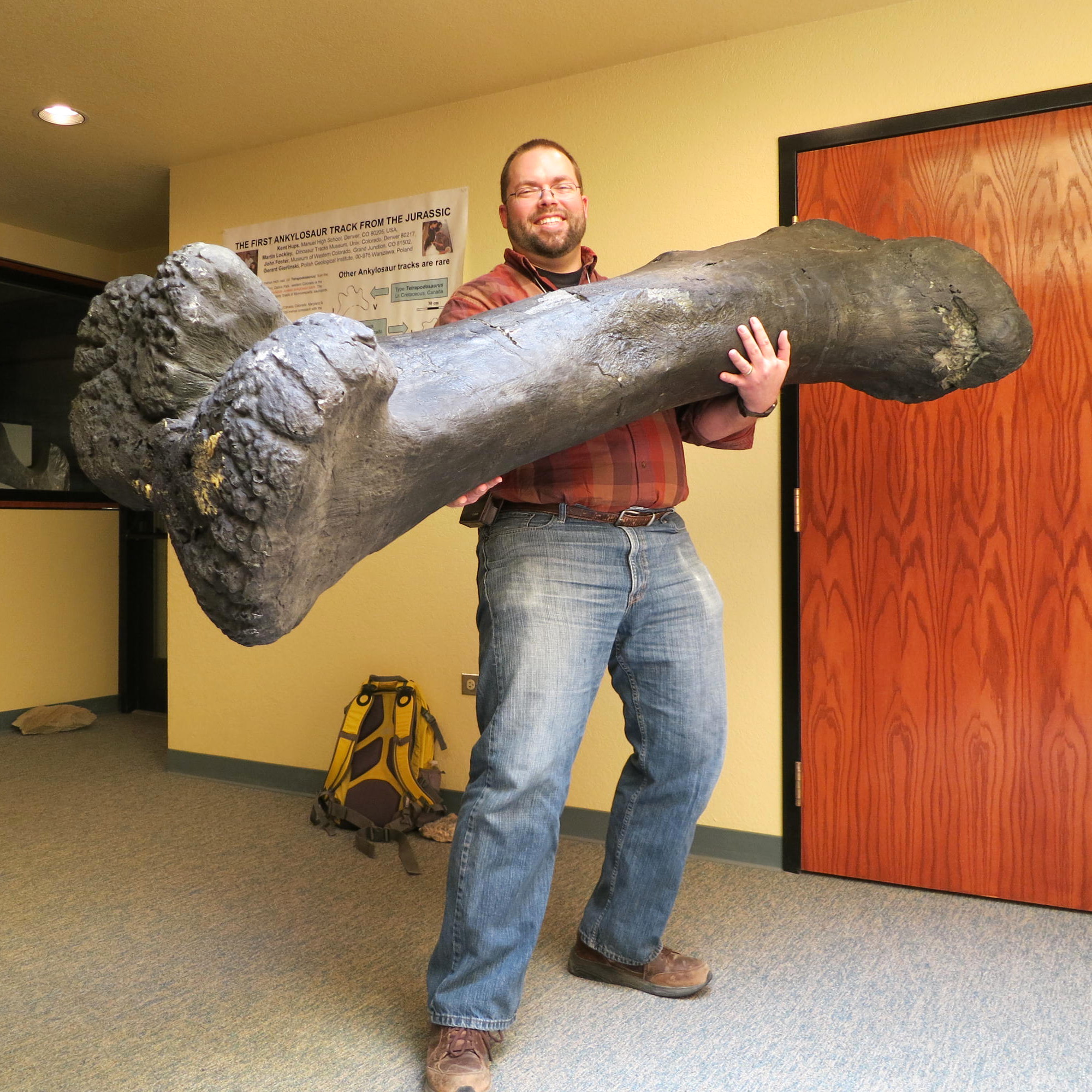
Cary took this photo of me playing with a fiberglass 100% original bone Apatosaurus femur upstairs in the museum office, and he totally passed up the opportunity to push me down the stairs afterward. I kid, I kid–actually Cary and I get along just fine. It’s no secret that we disagree about some things, but we do so respectfully. Each of us expects to be vindicated by better data in the future, but there’s no reason we can’t hang out and jaw about sauropods in the meantime.
Finally, in the museum gift shop (which is quite lovely), I found this:
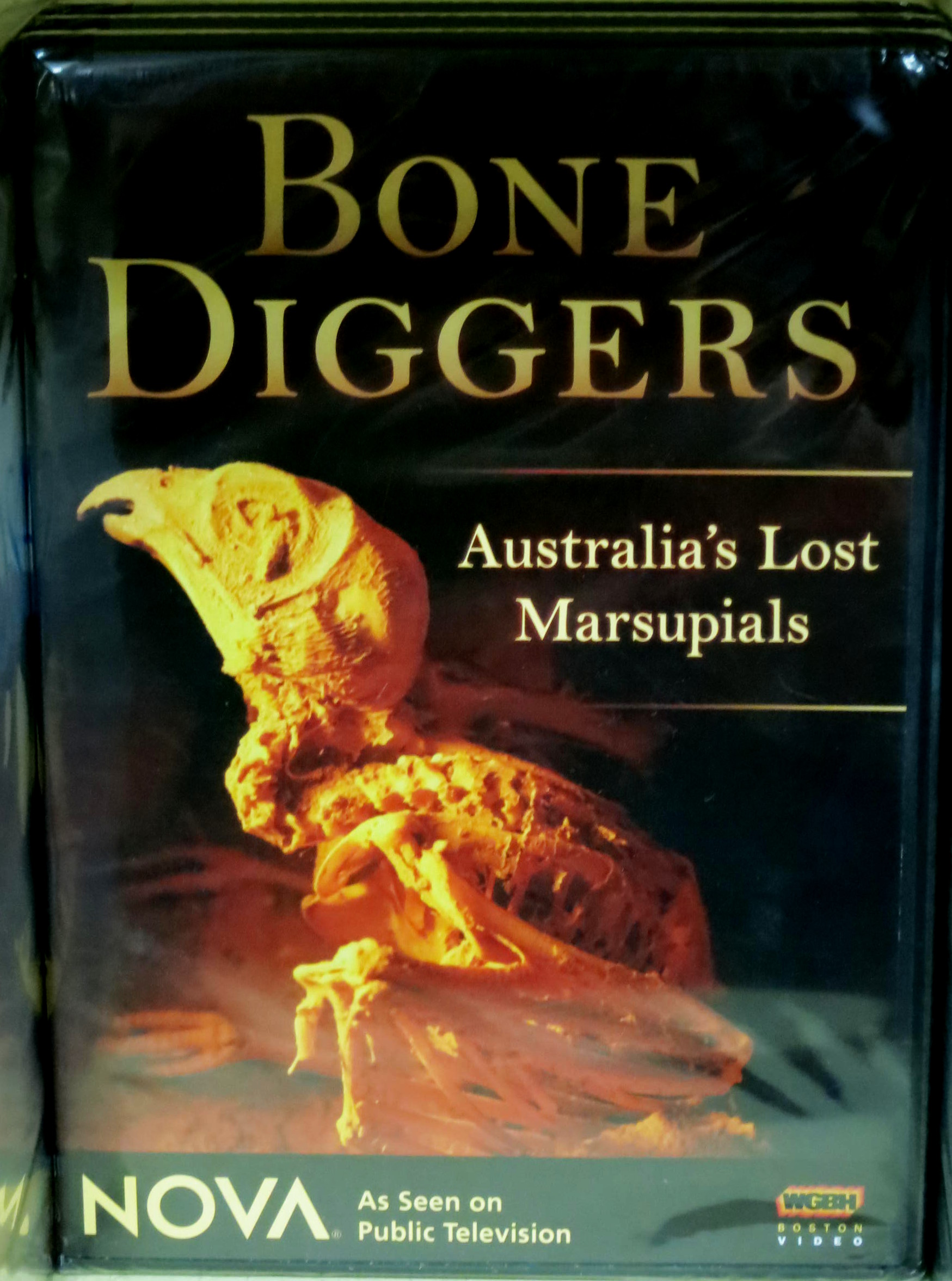
You had one job, Nova. ONE JOB!
So, this is a grossly inadequate post that barely scratches the surface of the flarkjillion or so cool exhibits at the museum. I only got about halfway through the sauropods, fer cryin’ out loud. If you ever get a chance to come, do it–you won’t be disappointed.
If Harry Potter was an academic work
February 3, 2014
From the files of J. K. Rowling.
Publisher #1
Dear Ms. Rowling,
Thank you for submitting your manuscript Harry Potter and the Half-Blood Prince. We will be happy to consider it for publication. However we have some concerns about the excessive length of this manuscript. We usually handle works of 5-20 pages, sometimes as much as 30 pages. Your 1337-page manuscript exceeds these limits, and requires some trimming.
We suggest that this rather wide-ranging work could usefully be split into a number of smaller, more tightly focussed, papers. In particular, we feel that the “magic” theme is not appropriate for our venue, and should be excised from the current submission.
Assuming you are happy to make these changes, we will be pleased to work with you on this project.
Correspondence ends.
Publisher #2
Esteemed Joenne Kay Rowling,
We are delightful to recieve your manuscript Harry Potter and the Half-Blood Prince and we look forword to publish it in our highly prestigious International Journal of Story Peer Reviewed which in 2013 is awarded an impact factor of 0.024.
Before we can progression this mutually benefit work, we require you to send a cheque for $5,000 US Dollars to the above address.
Correspondence ends.
Publisher #3
Dear J.R.R. Rowling,
We are in receipt of your manuscript Harry Potter and the Half-Blood Prince. Unfortunately, after a discussion with the editorial board, we concluded that it is insufficiently novel to warrant publication in our journal, which is one of the leading venues in its field. Although your work is well executed, it does not represent a significant advance in scholarship.
That is not to say that minor studies such as yours are of no value, however! Have you considered one of the smaller society journals?
Correspondence ends.
Publisher #4
Dear Dr. Rowling
Your submission Harry Potter and the Half-Blood Prince has passed initial editorial checks and will now be sent to two peer-reviewers. We will contact you when we have their reports and are able to make a decision.
Dear Dr. Rowling
Re: Harry Potter and the Half-Blood Prince.
We agree that eighteen months is too long for a manuscript to spend in review. On making inquiries, we find that we are unfortunately no longer able to contact the editor who was handling your submission.
We have appointed a new handling editor, who will send your submission to two new reviewers. We will contact you as soon as the new editor has made a decision.
Dear Dr. Rowling
Re: Harry Potter and the Half-Blood Prince.
Your complaint is quite justified. We will chase the reviewers.
Dear Dr. Rowling
I am pleased to say that the reviewers have returned their reports on your submission Harry Potter and the Half-Blood Prince and we are able to make an editiorial decision, which is ACCEPT WITH MAJOR REVISION.
Reviewer 1 felt that the core point of your contribution could be made much more succinctly, and recommended that you remove the characters of Ron, Hermione, Draco, Hagrid and Snape. I concur with his assessment that the final version will be tighter and stronger for these cuts, and am confident that you can make them in a way that does not compromise the plot.
Reviewer 2 was positive over all, but did not like being surprised by the ending, and felt that it should have been outlined in the abstract. She also felt that citation of earlier works including Lewis (1950, 1951, 1952, 1953, 1954, 1955, 1956) and Pullman (1995, 1997, 2000) would be appropriate, and noted an over-use of constructions such as “… said Hermione, warningly”.
Dear Dr. Rowling
Thank you for your revised manuscript of Harry Potter and the Half-Blood Prince, which it is our pleasure to accept. We now ask you to sign the attached copyright transfer form, so we can proceed with publication.
Dear Dr. Rowling
I am sorry that you are unhappy about this, but transfer of copyright is our standard procedure, and we must insist on it as a prerequisite for publication. None of our other authors have complained.
Dear Dr. Rowling
Thank you for the signed copyright transfer form.
In answer to your query, no, we do not pay royalties.
Dear Dr. Rowling
Sadly, no, we are unable to make an exception in the matter of royalties.
Dear Dr. Rowling
Your book has now been formatted. We attach a proof PDF. Please read this very carefully as this is the last chance to spot errors.
You will readily appreciate that publishing is an expensive business. In order to remain competitive we have had to reduce costs, and as a result we are no longer able to offer proof-reading or copy-editing. Therefore you are responsible for ensuring the copy is clean.
At this stage, changes should be kept as small as possible, otherwise a charge may be incurred for re-typesetting.
Dear Dr. Rowling
Many thanks for returning the corrected proofs of Harry Potter and the Half-Blood Prince. We will proceed with publication.
Now that the final length of your contribution is known, we are able to assess page charges. At 607 pages, this work exceeds our standard twenty free pages by 587. At $140 US per page, this comes to $82,180. We would be grateful if you would forward us a cheque for this amount at your convenience.
Dear Dr. Rowling
Thank you for you prompt payment of the page charges. We agree that these are regrettable, but sadly they are part of the reality of the publishing business.
We are delighted to inform you that Harry Potter and the Half-Blood Prince is now published online, and has been assigned the DOI 10.123.45678.
We thank you for working on this fine contribution with us, and hope you will consider us for your future publications.
Dear Dr. Rowling
You are correct, your book is not freely downloadable. As we explained earlier in this correspondence, publishing is an expensive business. We recover our substantial costs by means of subscriptions and paid downloads.
In our experience, those with the most need to read your book will probably have institutional access. As for those who do not: if your readers are as keen as you say, they will no doubt find the customary download fee of $37.95 more than reasonable. Alternatively, readers can rent online access at the convenient price of $9.95 per 24 hours.
Dear Dr. Rowling
I am sorry that you feel the need to take that tone. I must reiterate, as already stated, that the revenues from download charges are not sufficient for us to be able to pay royalties. The $37.95 goes to cover our own costs.
If you wish for your book to be available as “open access”, then you may take advantage of our Freedom Through Slavery option. This will attract a further charge of $3,000, which can be paid by cheque as previously.
Dr. Rowling
Your attitude is really quite difficult to understand. All of this was quite clearly set out on our web-site, and should have been understood by you before you made your submission.
As stated in the copyright transfer form that you signed, you do not retain the right to post freely downloadable copies of your work, since you are no longer the copyright holder.
Dr. Rowling
We must ask you not to contact your handling editor directly. He was quite shaken by your latest outburst. If you feel you must write to us again, we must ask you to moderate your language, which is quite unsuitable for a lady. Meanwhile, we remind you that our publishing agreement follows industry best practice. It’s too late to complain about it now.
Correspondence ends.
IP Lawyer #1
Dear Pyramid Web-Hosting,
Copyright claim
We write on behalf of our client, Ancient Monolith Scholarly Publishing, who we assert are the copyright holders of Harry Potter and the Half-Blood Prince. It has come to our attention that a copy of this copyrighted work has been posted on a site hosted by you at the URL below.
This letter is official notification under the provisions of Section 512(c) of the Digital Millennium Copyright Act (“DMCA”) to effect removal of the above-reported infringement. We request that you immediately issue a cancellation message as specified in RFC 1036 for the specified posting and prevent the infringer, Ms. J. K. Rowling, from posting the infringing material to your servers in the future. Please be advised that law requires you, as a service provider, to “expeditiously remove or disable access to” the infringing material upon receiving this notice. Noncompliance may result in a loss of immunity for liability under the DMCA.
Please send us at the address above a prompt response indicating the actions you have taken to resolve this matter.
Correspondence ends.
Historical Note
Examination of Ms. Rowling’s personal effects established that she had written most of a seventh book, Harry Potter and the Deathly Hallows. However, Rowling never sought to publish this final book in the series.


 Sauropod Vertebra Picture of the Week