New paper: Hart et al. 2025 on neural canal ridges in crocs
December 12, 2025

The dawn of a new era: AMNH FR 34089, a caudal vertebra of the giant extinct croc Thecachampsa, backlit to show the neural canal ridges. This is not just my favorite specimen with NCRs, it’s one of my favorite images of any fossil ever. Photo by William Jude Hart.
New paper out:
This one started last autumn. On October 2, 2024, I got an email from William Jude Hart, then an undergraduate at Hofstra University. At the time he was preparing to present a poster at the upcoming 2024 SVP meeting, on a caudal vertebra of a large extinct croc, Thecachampsa. Thecachampsa was a tomistomine gavialoid, closely related to the extant False Gharial, Tomistoma, which in turn is a member of Gavialidae and therefore a lot less “false” than we used to think. Thecachampsa lived on the east coast of North America in the Miocene, and it was bigger and scarier than any croc alive today. William had seen Atterholt et al. (2024), my paper with Jessie and a gang of other folks on neural canal ridges (NCRs) in non-avian dinosaurs — which we interpreted as bony spinal cord supports, following Skutschas and Baleeva (2012; see this post and this one). He had noted similar structures in his Thecachampsa caudal, and he offered to send photos.

OMNH RE 0215, a third dorsal vertebra of an alligator in anterior view showing the bilobed neural canal. Also used in Atterholt et al. (2024: fig. 9).
I was interested to see photos of the Thecachampsa vert, but I was trying to moderate my excitement. A lot of crocs have bilobed neural canals, shaped like a snowman or a numeral 8, with a larger lower passage for the spinal cord and its associated meninges, and a smaller upper passage for the large supraspinal vein (a character shared with many birds — see Atterholt et al. 2025 and this post). The two passages are often divided by longitudinal bony ridges, and these can mimic bony spinal cord supports. Criteria exist to distinguish the two, as we discussed in Atterholt et al. (2024), but it’s not always super clear-cut. I wondered if the structures in the Thecachampsa vert would just be elaborate ridges between the neural and vascular compartments.

Thecachampsa caudal AMNH FR 34089, close-up of the right NCR. Photo by William Jude Hart.
As the photo at the top of the post demonstrates, I should have had more faith in William’s perspicacity as a morphologist. When he sent the photos, my jaw hit the floor. These are the thinnest, spikiest, least ambiguous bony spinal cord supports I’ve seen in any amniote, extinct or extant. They’re up there with the rose-thorn-esque bony spikes in tuna vertebrae (see photos in this post).

Close-up of the right NCR in AMNH FR 34089. The morphology here is complex — there is a longitudinal ridgeline for the NCR itself (red highlight), but it doesn’t extend vert far at all. More interesting to me is the subtle ridge running dorsoventrally on the lateral wall of the canal (blue highlights).
I’m pretty confident that these have nothing to do with separating the supraspinal vein from the spinal cord. For one thing, this Thecachampsa vert does not have a bilobed neural canal. On the contrary, rather than having a longitudinal ridge on the side of the canal, the Thecachampsa caudal has a very subtle transverse ridge running up each side of the canal — highlighted in blue in the photo above — on which the neural canal ridge sits like a fairly abrupt summit. The photos above are closeups of the right NCR, but the same is true on the left, as you can see in the photo at the top of the post. That morphology looks a lot more consistent with bony spinal cord supports than with physically demarcating the canal into upper and lower halves.

My favorite sauropod NCRs, in MWC 10613, a Diplodocus caudal from Bone Cabin Quarry in Wyoming. Nice sharp little ridges about midway along the canal, visible to the naked eye, in CT slices (left), and in a hemisectioned digital model (right).
Also, the Thecachampsa spikes are at about the midpoint of the neural canal, where we tended to find the NCRs in sauropods and other dinosaurs. That makes perfect sense if the bony spinal cord supports are remnants of embryonic myosepta, as hypothesized by Skutschas and Baleeva (2012; see this post for more discussion). The neural arch pedicles form within those myosepta, so if the bony spinal cord supports are also myoseptal remnants, they should be located near the craniocaudal midpoint of each neural arch pedicle, which is just another way of saying “about halfway down the neural canal”. Et voila, so they are, in both Thecachampsa and non-avian dinosaurs.
(Why not just check in extant crocs and see what soft tissues are tethered to these things? We’re working on that. Even if we’re wrong about NCRs being bony spinal cord supports, they’re bony somethings, presumably related to interesting soft tissues, and with anatomical and phylogenetic distributions that are very far from being fully mapped.)

Deinosuchus caudal WSC 285.8 in anterior view. The left NCR is the lower of the two prominences visible on the right side of the canal (the upper is taphonomic damage, the edge of a crack).
Armed with the knowledge that NCRs were present in crocs, I drove out to Hemet to visit the Western Science Center. Andrew McDonald has been digging in the Menefee Formation of New Mexico for years, unearthing cool critters like the tyrannosaur Dynamoterror, the armored Invictarx, the hadrosaur Ornatops (which you’ve seen here before), some turtles (McDonald and Wolfe 2018, McDonald et al. 2018, 2021, Adrian et al. 2025) — and, oh yeah, the gigantic and terrifying Cretaceous croc Deinosuchus (Mohler et al. 2021). Thanks to the kind offices of Andrew and Alton Dooley, a good friend and Haplocanthosaurus partner in crime, I got my mitts on the Menefee Deinosuchus caudals. Two of the three vertebrae that I examined had an NCR preserved on at least one side. The third vertebra, by far the most complete externally, ironically had the worst-preserved neural canal. But the others were enough.
We had all the ammo for this paper about a year ago. William had the original discovery, the nicer specimen, and everything he needed to publish on his own, but he kindly invited me to contribute. We put together — well, William put together, with about 95% of the work — a presentation for the 5th Palaeontological Virtual Congress this spring. We looped in Jessie Atterholt for the paper, and she made a lot of improvements. And here we are.

Where will these things turn up next? Maybe you will be the one to find out. Modified from Hart et al. (2025: fig. 1).
(Incidentally, I created the silhouettes for Figure 1 myself, mostly tracing public domain images but drawing a few on my own. Why not use PhyloPic? Partly my own cussed persnickettiness, and partly because properly crediting 17 people was going to be cumbersome in such a short paper. I should make the originals available for everyone else — watch this space.)
Why do we find NCRs in some taxa but not others? Some animals are prevented from developing them: sharks don’t have a way to ossify their ligament attachments, and the denticulate ligaments of mammals don’t anchor to bone (see this post for more). Also, I suspect that NCRs are like the ossified traces of most muscle, tendon, and ligament attachments, in that they can be present but are not always present, even when the muscle, tendon, or ligament is. But that’s just kicking the can down the road — why do we see prominent NCRs in certain groups, and in certain regions of the vertebral column? We advance a hypothesis in the new paper (p. 752):
NCRs are prevalent in clades with laterally undulating locomotion (e.g., Teleosti; Skutchas and Baleev 2012), tail-driven femur retraction (e.g., Dinosauria; Atterholt et al. 2024), or both (e.g., Urodela; Wake and Lawson 1972), and absent in clades that have more rigid torsos, an absence of tail-driven femur retraction, or both, such as Anura, Aves, and Mammalia (Fig. 1A). This apparent distribution is consistent with the hypothesis that NCRs anchor the spinal cord against lateral undulatory motion.
That’s our best guess right now, but a LOT of work remains to be done. We hint at three fronts in the paper:
1. Discovery
NCRs are turning up all over the place. When we published the first NCR paper last year, they were known in salamanders but not in other lissamphibians. Now they’ve been documented in caecilians, by Santos et al. (2025), which we were able to cite in the new paper. The pace of discovery is rapid, but there is a lot of ground not yet covered. At this point, the number of non-sauropod archosaurs with published NCRs is very small — one individual each of Thecachampsa, Deinosuchus, Allosaurus, Ceratosaurus, Stegosaurus, and an indeterminate hadrosaur — but very suggestive, because Archosauria is a big, diverse clade. Not to mention all the other vertebrates. Someone is going to the be the first to document NCRs in, gosh, all the other things. Tyrannosaurs, anyone?
In particular, you may be thinking that it’s all very well for NCRs to be present in these giant extinct crocs, but what about mortal extant crocs? Stay tuned — we’re working on that, with William leading the charge. He’s a grad student now, pursuing his Master’s at East Tennessee State, and I’m confident you’ll be hearing a lot more about his work in the future.

Thecachampsa caudal AMNH FR 34089 in ventral view. This vert is just shy of four inches long, which if you know crocs, is up in *gulp* territory.
2. Investigating soft tissues
We think the NCRs in crocs and dinos are bony spinal cord supports, but it would be very nice to have that confirmed via dissection. Also, where do the denticulate ligaments attach in vertebrae with bilobed neural canals? Could some of the longitudinal ridges in croc verts be doing double duty, dividing the vascular and neural compartments and anchoring denticulate ligaments at the same time? These are open questions, which are about one dead alligator away from being answered.
Also, as mentioned above, if the NCRs of crocs aren’t bony spinal cord supports, what the heck are they?
3. Biomechanical testing
Assuming NCRs are bony spinal cord supports, is lateral movement of the vertebral column the primary driver in their formation, just one factor among many, or a complete red herring? This is the kind of thing that could easily lend itself to logistically intensive approaches like 3D scanning and modeling, but might also get solved by just, like, pulling on things to see what happens (e.g., Baumel 1985).
Conclusion
If you want to get in on this, it’s a pretty straightforward gig: find some vertebrae, peer in the neural canals, document what you find, tell the world. If you don’t find NCRs you might find pneumatic cavities or blood vessel tracks or some totally new thing to add to the neural canal zoo. There are whole big clades of vertebrates about which we know basically nothing, neural-canal-wise, and opportunities for new discoveries abound — as our new paper shows. Come play.
References
- Adrian, B., Smith, H.F. and McDonald, A.T. 2025. A revised turtle assemblage from the Upper Cretaceous Menefee Formation (New Mexico, North America) with evolutionary and paleobiostratigraphic implications. PeerJ 13: e19340.
- Atterholt, J., Wedel, M.J., Tykoski, R., Fiorillo, A.R., Holwerda, F., Nalley, T.K., Lepore, T., and Yasmer, J. 2024. Neural canal ridges: a novel osteological correlate of postcranial neuroanatomy in dinosaurs. The Anatomical Record, 1-20. https://doi.org/10.1002/ar.25558
- Atterholt, Jessie; Burton, M. Grace; Wedel, Mathew J.; Benito, Juan; Fricano, Ellen; and Field, Daniel J. 2025. Osteological correlates of the respiratory and vascular systems in the neural canals of Mesozoic ornithurines Ichthyornis and Janavis. The Anatomical Record. http://doi.org/10.1002/ar.70070.
- Baumel, J.J. 1985. Suspensory ligaments of nerves: an adaptation for protection of the avian spinal cord. Anatomia, Histologia, Embryologia 14(1): 1-5.
- Hart, W.J., Atterholt, J., and Wedel, M.J. 2025. First occurrences of neural canal ridges in Crocodylia. Acta Palaeontologica Polonica 70(4): 749–753.
- McDonald, A.T. and Wolfe, D.G. 2018. A new nodosaurid ankylosaur (Dinosauria: Thyreophora) from the Upper Cretaceous Menefee Formation of New Mexico. PeerJ 6: e5435.
- McDonald, A.T., Wolfe, D.G. and Dooley Jr, A.C. 2018. A new tyrannosaurid (Dinosauria: Theropoda) from the Upper Cretaceous Menefee Formation of New Mexico. PeerJ 6: e5749.
- McDonald, A.T., Wolfe, D.G., Fowler, E.A.F. and Gates, T.A., 2021. A new brachylophosaurin (Dinosauria: Hadrosauridae) from the Upper Cretaceous Menefee Formation of New Mexico. PeerJ, 9, p.e11084.
- Mohler, B.F., McDonald, A.T. and Wolfe, D.G. 2021. First remains of the enormous alligatoroid Deinosuchus from the Upper Cretaceous Menefee formation, New Mexico. PeerJ 9: e11302.
- Santos, R.O., Wilkinson, M., and Zaher, H. 2025. An overview of the postcranial osteology of caecilians (Gymnophiona, Lissamphibia). The Anatomical Record, 1–26, https://doi.org/10.1002/ar.70000.
- Skutschas, P. P., & Baleeva, N. V. 2012. The spinal cord supports of vertebrae in the crown-group salamanders (Caudata, Urodela). Journal of Morphology 273(9): 1031–1041.
- Wake, D. B., & Lawson, R. 1973. Developmental and adult morphology of the vertebral column in the plethodontid salamander Eurycea bislineata, with comments on vertebral evolution in the Amphibia. Journal of Morphology 139(3): 251–299.
Tutorial 48: my museum collections kit
November 26, 2025

I was on the road for most of August, September, and October, and in particular I made a ton of museum collections visits. When I visit a museum collection, I bring a specific set of gear that helps me get the photos, notes, and measurements that I want. All of this is YMMV — I’m not trying to predict what will work best for you, but to explain what has worked for me, and why. I’m reasonably happy with my current setup, but even after 28 years of museum visits, I’m still finding ways to improve it. Hence this post, which will hopefully serve as a vehicle for sharing tips and tricks.
A word about my program when I visit a collection, because not everyone needs or wants to do things my way. The closest museums with extensive sauropod collections are states away from where I live and work. If I’m in those collections at all, I’m traveling, and therefore on the clock. Time in collections is a zero-sum game: if I have the time to take 20 pages of notes, that could be 4 pages of notes of each of 5 specimens, 2 pages on 10, 1 page on 20, half a page on 40, etc. In practice, I usually make expansive notes early in the visit, one or two spreads per specimen with detailed sketches and exhaustive measurements of the most publication-worthy elements. I grade toward brevity over the course of the visit, and end with a mad desperate rush, throwing in crude sketches and rudimentary notes on as many newly-discovered (by me) specimens as possible. My collections visits are Discovery Time and Gathering Time, trying to get all the measurements and photographs I’ll want for the next year, or five, or forever. And, to the extent that I can suppress them, not Analysis Time or Graphing Time or Writing Time — I can do those things after hours and in my office back home, IF and only if I’ve spent my collections time efficiently gathering all the information I’ll need later.
The very first thing I do in any collection is a walking survey, to make sure I know roughly what specimens the collection contains and where to find them. For a sufficiently large collection — or even a single cabinet with 10 drawers of good stuff — I may draw a map in my notebook, on which I can note things I want to come back and document, and add new things as I find them.
Enough preamble, on to the gear. The first two or three entries here are in strict priority order, and after that things get very fuzzy and approximate.

1. Research Notebook
Seems obvious, right? Write stuff down, make sketches, capture the info that will be difficult or impossible to recapture later from photos. I have encountered people who don’t take a physical notebook, just a laptop or tablet, and take all their notes digitally. If that works for you, may a thousand gardens grow. For me, sketching is a fundamental activity — for fixing morphology in my mind, disciplining myself to see the whole object and its parts, creating a template on which to take further explanatory notes, and capturing the caveats, stray ideas, and odd connections that surround each specimen in a quantum fuzz in my mind (temporarily in my mind, hence the need for external capture). I also write priority lists in advance of specimens to document each day, and then cross them off, add new ones, and strike out duds with wild abandon in the heat of data collection.

I do a few specific things to increase the usefulness of my notebooks:
– Label the spines and covers with the notebook titles and years. These things live on the shelf directly over my desk, and I pull them down and rifle through them constantly. I also have notebooks for university service (committees, student advising, and so on), astronomical observations, and personal journaling, so “Research” is a useful tag for me.
– Number the pages, if they’re not already numbered, use the books chronologically from front to back, and create the table of contents retrospectively as I go — a tip I got from the Bullet Journal method.

– Paste a small envelope inside the back cover, if a pouch is not already built in, to hold all kinds of ephemera — index cards, scale bars, a bandage (just in case), stickers I acquire along the way, etc.

– Affix a section of measuring tape to the outer edge of the front or back cover. I got this tip from the naturalist John Muir Laws, whose Laws Guide to Nature Drawing and Journaling is wonderfully useful and inspiring (UPDATE: that book is now covered in its own post, here). The scale-bar-permanently-affixed-to-research-notebook has been a game-changer for me. Do you know how many times I’ve accidentally left a scale bar on a museum shelf, and then gotten to my next stop and had to borrow or fabricate one? I myself lost count long ago. But never again. If I’m in a hurry, small specimens go straight onto the notebook to be photographed, like the baby apatosaurine tibia above, and the notebook itself goes into the frame with large specimens. (This comes up again — if possible, and it’s almost always possible, put the specimen label in the photo with the specimen. No reason not to, and sometimes a lifesaver later on.)

Behold the thinness of the eminently pocketable IKEA paper tape. Folding instructions, because this seems to bedevil some folks: hold up one end, fold in half by grabbing the other end and bring it up in front, then do that three more times. Finished product is 65mm long, 25.4mm wide, and about 1mm thick when folded crisply and left under a heavy book overnight.
2. Measuring tapes
I find the flexible kind much more convenient and useful than retractable metal tape measures. I like the 1-2mm thick plastic type used by tailors and fabric sellers, because they have just enough inertia to stay where I put them, or drop in a predictable fashion when draped over something sufficiently large, as when measuring midshaft circumference of a long bone.
I LOVE the little plasticized paper tapes that hang on racks, free for the taking, near the entrances of IKEA stores. I tear them off by the dozen when I go to IKEA, cram them in my pockets, fold them flat when I get home, and stash them everywhere, including in my wallet. A few specific reasons they’re great:
– Folded flat, they’re about the thickness of a credit card, so there’s just no reason to be without one. I usually have one in my wallet, another in the envelope at the back of my research notebook, a couple more stashed in my luggage, a couple more stashed in my car, desk, tookbox, nightstand, etc.
– I can write on them. Especially handy if:
– I’ve torn off a section to serve as an impromptu scale bar. Which I never hesitate to do, because they’re free and I have dozens waiting in my toolbox and desk drawers at any one time. Torn off bits also make good bookmarks, classier, more cerebral, and less implicitly gross than the traditional folded square of toilet paper.
– I give them away to folks I’m traveling with, or that I meet in my travels, and they’re usually well-received.

I would NOT have figured out all these laminae if I hadn’t had a way to make them stand out.
3. Writing instruments in various colors
Up until about 2018 my notebooks were always monochrome pen or pencil. Then I realized that color is an extremely helpful differentiator for Future Matt, so now I highlight and color-annotate willy-nilly.
4. Calipers
I borrowed the digital calipers from Colin Boisvert to get the photo up top, having forgotten my own at home. As a sauropod worker, I don’t need sub-millimeter accuracy all the time. But digital calipers have three exceedingly useful functions: measuring the thickness of very thin laminae and bony septa; measuring the internal dimensions of small fossae and foramina; and measuring the depth of fossae and of concave articular surfaces. I also have a little titanium caliper on a lanyard that goes with me most places.
5. Small brush on a carabiner
This is the newest addition to the kit. I got the idea from Matthew Mossbrucker at the Morrison Museum in Morrison, Colorado. Colin and I visited him in September, immediately before our week-long stint in the collections at Dinosaur Journey. Matthew keeps a little brush carabinered to his belt at all times, and the utility was so instantly obvious that when Colin and I rolled into Fruita later that same day, I went to the hardware store and got my own. Cheap, weighs nothing, clips to anything, compact enough to cram in a pocket, good for lab and field alike. Genius!
6. Scale bar
Yes, I have my scale-bar-enhanced research notebook and my hoarder stash of IKEA paper tapes, but good old-fashioned scale bars are still useful, and I use them constantly. And lose them constantly, hence my multiple redundant backup mechanisms.
(Aside: I can’t explain why I hold onto some objects like grim death, but let others fall through my fingers like sand grains. I’ve only lost one notebook of any kind in my entire life — set it on top of the car while packing and then drove off [grrrr] — so I have no problem investing in nice notebooks and treating them like permanent fixtures. But I can’t hang onto pens and scale bars to save my life, hence my having gravitated to Bic sticks and IKEA paper tapes.)
7. Index cards
I try to get as much information into each photograph as possible. Ideally alongside the specimen I will have:
– a scale bar at the appropriate depth of field;
– the specimen tag with the number, locality, and other pertinent info;
– my notebook open to my sketch of the specimen, for easy correlation later (I don’t do this for every single view, just the ones that I think are particularly publication-worthy, or have info I’m likely to forget later);
– anything else I might want — serial position, anatomical directions, whether the photo is part of an anaglyph pair, and so on — written on an index card, which being a standard size will itself serve as an alternate/backup scale bar.
8. Pencil case
To hold all the smaller fiddly bits you see in the photo up top. I can’t now fathom why, but I resisted getting one of these for a loooong time. I was young and foolish then. Pretty useful all the time, absolutely clutch when it’s 4:58 pm and I’m throwing stuff in bags, caught between the Scylla of working as late as possible and the Charybdis of wanting to be polite to whatever kind, patient person is facilitating my visit. That is also when the pocket in the back of the notebook comes in especially handy.

Headlamp in action, casting low-angle light on a pneumatic fossa on the tuberculum of this sauropod rib. Note also the scale bar, elevated on a specimen box to be the same depth of field, and the notebook open to my sketch of the specimen.
9. Artificial lighting
This was another very late discovery for me — I don’t think I was regularly bringing my own lights prior to 2018. For me, portable, rechargeable lighting is useful in many circumstances and absolutely critical in two: casting low-angle light to pick out subtle pneumatic features, as in the photo above, and lighting up big specimens that I don’t have the time, energy, or space to pull off the shelves, as in the photo below.

I’m particularly taken with the big orange fan/light combo. It charges using a USB-C cable, has four settings for fan speed (handy when it’s hot, humid, or just oppressively still) and three for light intensity, a rotating hook that folds flat, and a USB power-out socket for charging phones, headlamps, fitness trackers, and what have you. I use it practically every day whether I’m on the road or not.

Magnetic flashlight hanging from steel shelving to illuminate Camarasaurus cervical vertebrae in the Utah Field House collections.
Whether it’s a hook or a magnet, some kind of mechanism for suspending a light at odd heights and angles is super useful. I usually have a strong flashlight with an integral seat-belt cutter and window-smasher in the door pocket of my car, and its magnetic base makes it omnidirectionally functional in collections spaces, which are usually liberally supplied with steel in the form of shelving and cabinets.

Haplocanthosaurus CM 879 caudal 2 in left lateral view, with rolled-up paper neural canal visualizer and scale-bar-stuck-to-flashlight.
Sometimes I use a bit of blue tack to stick a scale bar to a flashlight, to create a free-standing, truly vertical scale bar that I can rapidly place at different distances from the camera. Beats leaning the scale bar against a stack of empty specimen boxes or a block of ethofoam (which in turn beats nothing at all).
What else?
USUALLY — Laptop
Not for recording notes or measurements — all of that goes into the notebook, which I scan and upload new stuff from every evening. Mostly for displaying PDFs of descriptive monographs, and hugely useful in that regard.

MAYBE — Monographs
When I have the freedom (= baggage allowance) to do so, I find it handy to bring hardcopies of descriptive monographs, both for quick reference and so I can photograph specimens alongside the illustrations. Doesn’t even have to be the same specimens, just comparable elements. In the photo above, MWC 7257, a partial sacral centrum of Allosaurus from the Mygatt-Moore Quarry, is sitting next to a plate from Madsen (1976), illustrating the same vertebra in a specimen from Cleveland Lloyd Dinosaur Quarry. Thanks to Colin Boisvert for bringing the specimen to my attention — I’ve got a longstanding thing for sacrals — and for loaning me his copy of Madsen (1976) for this photo.
OUT — Camera and tripod
I suspect that some folks will shake their heads in mute horror, but after a couple of decades of lugging dedicated cameras and tripods everywhere, I stopped. For the past few years I’ve been rolling with just my phone, which is objectively better than any dedicated camera I owned for the first half of my career. Sometimes I brace it in an ad hoc fashion against a chair or shelf or cabinet, but mostly I just shoot freehand. For my purposes, it does fine, and any minor improvements in field curvature or whatever that I’d get from a dedicated camera don’t outweigh the logistical hassle. Again: YMMV!
Over to you
So, that’s what I roll with right now. It was different six months ago, and will almost certainly be a little different six months hence, hopefully as a result of people responding to this post. With all that said: what’s in your kit?
P.S. Many thanks to Matthew Mossbrucker and Julia McHugh for their hospitality and assistance in their collections, and to Colin Boisvert for being such a great travel companion, research sounding board, and generous loaner-of-things-I’d-forgotten. The Wedel-Boisvert Morrisonpocalypse 2025 deserves more blogging.

More on that “Ultrasaurus” scap photo
November 13, 2025
Three weeks ago, I posted three colour photos of the “Ultrasaurus” excavation at the Dry Mesa Quarry, provided by Tyler Holmes from an old dinosaur encyclopedia. Here’s the third one again:

The scapula of Ultrasaurus being excavated.
[caption from original book.]
I wrote:
This can’t be right. In [another photo], which definitely is the “Ultrasauros” scap, the glenoid is facing clockwise if you think of the whole bone as being able to rotate about its midpoint; but in this photo it must be facing anticlockwise at top left. So I conclude it’s one of the Supersaurus scaps — either the left in lateral view or the right in medial.
Several people (Llewelly, Adam Yates, Matt) disagreed, and thought this was indeed the “Ultrasaurus” scap, but that the photo had been left-right reversed.
Brian Curtice weighed in by email, which I will quote.
Hola!
I was asked to identify which specimen is in those color photos. The scap is BYU 9462, the brach scapulocoracoid that Jensen referred to Ultrasauros.
I suspect the area added around the scapula in the left photo was an attempt to preserve the sides. BYU 9462, as shown in the picture of the original, is quite fractured and delicate.
The purple lines are the same bars, the yellow one shows the straightness, the orange circle shows the part sticking past that isn’t visible in the photo on the left because of the perspective, the red shows a similar angle, and the green shows the narrow waist.

The big block on chains is likely He-Hum-1, aka BYU 16776, a Diplodocus (?) humerus nearly 80 cm long. I suspect the jacket had “He-Misc-,” likely BYU 20173, a sternal plate as well as “cdl-1,” which should be BYU 12996, a diplodocid mid-caudal. Perhaps a few other bits were in the block; that area was a bone salad.
Neat pics! Hope that helps!!!
I’m happy to bow to Brian’s expertise on this: he knows those bones much better than I do, maybe better than anyone does.
Why anyone would left-right reverse a photo for a book, I can’t imagine, but it does seem that’s what happened.
Colour photos of the “Ultrasaurus” quarry
October 24, 2025
Long-time SV-POW! reader Tyler Holmes came across a book with the very un-searchable title “Encyclopedia of Dinosaurs” — I tried to find it in the Internet Archive, but there are waaay too many books of that name. He emailed me about it because it contains three colour photos of the excavation of our old friend “Ultrasaurus“.
Here they are, with their captions as they appear in the book.
First, a very familiar image — a similar but not identical one is reproduced in Jensen (1985:figure 4A) and Jensen (1987:fig 6A) — but here it appears for the first time in colour.

Jim Jensen lays alongside the nine-foot-long scapula (shoulder blade) of Ultrasaurus.
(No: Jim Jensen lies alongside the scapula. Also, it’s not just a scapula, it’s a scapulocoracoid, i.e. the coracoid is fused to the scapula. Also, it’s not nine feet long, it’s 2500 mm (Curtice et al. 1995:88), which is eight feet 2.5 inches. Otherwise, this caption is fine.)
Next, a photo that is completely new to me:

Half of a scapula (shoulder blade) of Ultrasaurus is lifted by a crane.
Is this the scapula? Maaaybe, but the shape of the jacket, and the cross-section of bone shown in the end of the jacket closest to us, doesn’t seem right. This looks more like part of a long bone — femur or humerus, or maybe radius/ulna or tibia/fibula. But I’m not aware of any femur or humerus having come out of the Dry Mesa quarry, so who knows?
Finally, this:
The scapula of Ultrasaurus being excavated.
This can’t be right. In the photo above, which definitely is the “Ultrasauros” scap, the glenoid is facing clockwise if you think of the whole bone as being able to rotate about its midpoint; but in this photo it must be facing anticlockwise at top left. So I conclude it’s one of the Supersaurus scaps — either the left in lateral view or the right in medial.
I wonder where the originals of these photos are, and whether there are more? I suppose I ought to ask the people at BYU.
References
- Curtice, Brian D., Kenneth L. Stadtman and Linda J. Curtice. 1996. A reassessment of Ultrasauros macintoshi (Jensen, 1985). The continental Jurassic M. Morales (Ed.) Museum of Northern Arizona Bulleti. 60:87-95.
- Jensen, James A. 1985. Three new sauropod dinosaurs from the Upper Jurassic of Colorado. Great Basin Naturalist 45(4):697-709.
- Jensen, James A. 1987. New brachiosaur material from the Late Jurassic of Utah and Colorado. Great Basin Naturalist 47(4):592-608.
Alex Pritchard’s Aquilops and friends
September 12, 2025

Very nice photo of Alex Pritchard’s Aquilops skeleton from DinosaurSkeletons.co.uk.
I am often so far down the rabbit holes of my own work (and given that I work mostly on pneumaticity and weird stuff in neural canals, they are literally holes) that I do a very poor job of keeping up with what’s going on in the broader dinosphere. A timely example: I didn’t know that Alex Pritchard was out there making museum-quality dinosaur skulls and skeletons until I saw his work on the DinoCon Instagram feed in the run-up to the convention. Then I visited his website, DinosaurSkeletons.co.uk, and then I got very excited.

Here I am at Alex’s booth at DinoCon 2025, with his mounted Aquilops skeleton. If you’d like to see the skeleton without a big dumb mammal crowding the view, see the image at the top of the post, or visit the webpage.
That skeleton rocks on toast. Luggage constraints kept me from bringing a skeleton home, so I settled for one of Alex’s Aquilops skulls, only ‘settle’ isn’t the right verb because this is also extremely awesome.

I spent a *lot* of time reconstructing the skull of Aquilops for our descriptive paper (Farke et al. 2014), so it’s one of the few non-sauropod things I’m qualified to yap about (and have, here, here, and here). Alex’s Aquilops skull is so good it gave me flashbacks; it looked like my drawings had leapt off the page and into faux-fossilized-bone — and very shortly into my hand and then into my luggage.

I made a point to get to Alex’s table early on to scoop up one of his Aquilops skulls, which was a savvy move because he did later sell out — of Aquilops, and of darn near everything else, much of it gone by the end of the first day. I was also quite taken with his Psittacosaurus skull, which I got in two sizes, and an oviraptorosaur egg I picked up for the heck of it. I guess I should have nabbed a Velociraptor skull to complete the early ceratopsian/Djadochta Formation Venn diagram. Maybe next year.

I got to chat a little with Alex. He’s so easygoing and approachable that it would have been all too easy to overlook his passion and dedication, had the evidence of it not been covering a very long table and rearing around us on metal stands. I know how hard it is to execute these things faithfully in two dimensions; the sheer number of specimens that Alex has conjured into being in three dimensions — and not just accurately but convincingly — is pretty staggering.

Alex likes to show some love to the less-famous dinosaurs — on his Instagram feed you can see his reconstructed skeleton of the recently-named dromaeosaur Shri rapax. Aquilops turned out to be kind of a fluke — he’d already made the skull and skeleton before Jurassic World Rebirth‘s Dolores catapulted ‘my’ little weirdo from relative obscurity to global fame. That happy accident worked out pretty darned well for me, and I think for Alex as well — he had a whole raft of Aquilops skulls at the start of DinoCon, and none at all on day two. I assume he’s hard at work on more awesome critters; from now on I’ll be following his output a lot more closely.

So, if you want a faithful representation of the Aquilops holotype as it exists today, you can download and print the 3D model of OMNH 34557 that we published with the paper. But if you want a non-roadkilled Aquilops skull that looks like it might have come straight out of the Cloverly Formation, I can personally vouch for Alex’s — it’s the one I have sitting on my desk right now.
I got the impression that DinoCon 2025 punched a decent crater in Alex’s inventory, but he is accepting orders and I expect him to recover quickly, if he hasn’t already. So get on over to DinosaurSkeletons.co.uk and do the right thing.
Reference
Things: The Surprising Power of Stuff That Exists
July 27, 2025
In the past decade or two, I’ve seen a LOT of popular science books of this form:
[NOUN]
Learn how this amazing [whatsit] allowed the rise of civilization, informs every aspect of our daily lives, and may hold the key to our future.
where the noun in question might be salt or wood or math or clouds or daydreaming or whatever. It’s not enough to write an engaging book on Topic X without somehow, by tortuously overreaching, making it the underpinning of life itself.
If we ever do an SV-POW! book, I’ll be sorely tempted to put on the back cover: “Could understanding diapophyseal laminae improve the health of your spleen? Open this book to find out!”

This cast of a juvenile apatosaur femur really does hold the key to your future: get your eyes back on the dang road!
I say, I say, I say! How many palaeontologists does it take to write a paper? Twenty-four (if it’s in Nature)!
July 16, 2025
Today sees the publication of what is, OK, an interesting paper on how the serrated trailing edge of the flippers of the ichthyosaur Temnodontosaurus may have enabled it to generate less turbulence, enhancing its abilities as a stealth predator:
- Lindgren, Johan, Dean R. Lomax, Robert-Zoltán Szász, Miguel Marx, Johan Revstedt, Georg Göltz, Sven Sachs, Randolph G. De La Garza, Miriam Heingård, Martin Jarenmark, Kristina Ydström, Peter Sjövall, Frank Osbæck, Stephen A. Hall, Michiel Op de Beeck, Mats E. Eriksson, Carl Alwmark, Federica Marone, Alexander Liptak, Robert Atwood, Genoveva Burca, Per Uvdal, Per Persson and Dan-Eric Nilsson. 2025. Adaptations for stealth in the wing-like flippers of a large ichthyosaur. Nature, published online 16 July 2025. doi:10.1038/s41586-025-09271-w

Lindgren et al. 2025: figure 1. a–c, Photographs of the part section of SSN8DOR11 under polarized (a) and ultraviolet (longpass cut-off 455 nm) (b) light, respectively, together with a diagrammatic representation of the forelimb in planform view (c). Note that the individual blocks have been re-assembled in their original position (the stippled line delineates the end of sediment that has been digitally removed to show underlying bones). Arrow indicates anterior. Extended Data Figs. 1 and 2 depict the counterpart section.
Now this is good interdisciplinary work which would have legitimately required the involvement of several scientists with different specialisms, including morphology, exotic photography techniques, biomechanics and maybe fluid dynamics. I can easily see how it would have four authors, or five or even maybe six.
But, cards on the table, I find it very hard to believe that twenty-four people all made substantial contributions to this paper — substantial enough to be listed as authors.
So what are they all doing there? I can only surmise that the four or five legitimate authors all invited their friends along for the ride, on the basis that “he needs a Nature paper for his postdoc applications”.
And the tragedy of it is, they’re not wrong.
Many universities — most? Maybe even all? — do indeed recruit people to postdocs and permanent positions in part on whether they have a paper in Nature or Science. Even if their role is as seventeenth or eighteenth of twenty-four, and they actually did little or nothing towards the science. I have been told flatly by people in positions of influence that candidates without the Nature or Science stamp are likely to be filtered out of the recruitment process at Step Zero, and never even have their papers read, let alone make it to interview.
And for as long as that is true, it would be negligent of lab leaders not to slip their own grad-students, and any other students they know and like, into the authorship of such a paper if it happens to come their way.
What does this mean for the aspiring palaeontologist? It means that his or her most rational strategy for landing a job is to socially cultivate as many lab leaders as possible, especially those who work in strata likely to turn up preserved soft tissue, and hope to get in on a Nature or Science paper — so that their job applications get through to the stage where their actual work might get some scrutiny.
Can we all agree that this is idiotic?
The Dread Olecranon of Kentrosaurus
July 4, 2025
(This was buried in Part 5 of my 2011 review of the Sideshow Apatosaurus maquette, but it’s long deserved to be a post of its own, and now it is. I’m not adding anything new here, just extracting and reposting the relevant bits, for reasons that will become clear in a future post. — MJW)
The Dread Olecranon of Kentrosaurus is something Heinrich Mallison pointed out in the second of his excellent Plateosaurus papers (Mallison 2010: fig. 3).

Heinrich’s thoughts on articular cartilage in dinosaurs are well worth reading, so once again I’m going to quote extensively (Mallison 2010: p. 439):
Cartilaginous tissues are rarely preserved on fossils, so the thickness of cartilage caps in dinosaurs is unclear. Often, it is claimed that even large dinosaurs had only thin layers of articular cartilage, as seen in extant large mammals, because layers proportional to extant birds would have been too thick to be effectively supplied with nutrients from the synovial fluid. This argument is fallacious, because it assumes that a thick cartilage cap on a dinosaur long bone would have the same internal composition as the thin cap on a mammalian long bone. Mammals have a thin layer of hyaline cartilage only, but in birds the structure is more complex, with the hyaline cartilage underlain by thicker fibrous cartilage pervaded by numerous blood vessels (Graf et al. 1993: 114, fig. 2), so that nutrient transport is effected through blood vessels, not diffusion. This tissue can be scaled up to a thickness of several centimeters without problems.
An impressive example for the size of cartilaginous structures in dinosaurs is the olecranon process in the stegosaur Kentrosaurus aethiopicus Hennig, 1915. In the original description a left ulna (MB.R.4800.33, field number St 461) is figured (Hennig 1915: fig. 5) that shows a large proximal process. However, other ulnae of the same species lack this process, and are thus far less distinct from other dinosaurian ulnae (Fig. 3B, C). The process on MB.R.4800.33 and other parts of its surface have a surface texture that can also be found on other bones of the same individual, and may indicate some form of hyperostosis or another condition that leads to ossification of cartilaginous tissues. Fig. 3B–D compares MB.R.4800.33 and two other ulnae of K. aethiopicus from the IFGT skeletal mount. It is immediately obvious that the normally not fossilized cartilaginous process has a significant influence on the ability to hyperextend the elbow, because it forms a stop to extension. Similarly large cartilaginous structures may have been present on a plethora of bones in any number of dinosaur taxa, so that range of motion analyses like the one presented here are at best cautious approximations.
One of the crucial points to take away from all of this is that thick cartilage caps did not only expand or only limit the ranges of motions of different joints. The mistake is to think that soft tissues always do one or the other. The big olecranon in Kentrosaurus probably limited the ROM of the elbow, by banging into the humerus in extension. In contrast, thick articular cartilage at the wrists [of sauropods] probably expanded the ROM and may have allowed the strong wrist flexion that some artists have restored for sauropods. I’m not arguing that it must have done so, just that I don’t think we can rule out the possibility that it may have.
– – – – – – – – – – – – – – – – – – – –
To see that chunk in context and read more about cartilage in dinosaurs, see the original post — here’s that link again. Throwing in the references to Bonnan et al. (2010) and Holliday et al. (2010) because they’re still relevant, foundational studies.
References
- Bonnan, M.F., Sandrik, J.L., Nishiwaki, T., Wilhite, D.R., Elsey, R.M., and Vittore, C. 2010. Calcified cartilage shape in archosaur long bones reflects overlying joint shape in stress-bearing elements: Implications for nonavian dinosaur locomotion. The Anatomical Record 293: 2044-2055.
- Holliday, C.M., R.C. Ridgely, J.C. Sedlmayr and L.M. Witmer. 2010. Cartilaginous epiphyses in extant archosaurs and their implications for reconstructing limb function in dinosaurs. PLoS ONE 5(9): e13120. doi:10.1371/journal.pone.0013120
- Mallison, H. 2010. The digital Plateosaurus II: An assessment of the range of motion of the limbs and vertebral column and of previous reconstructions using a digital skeletal mount. Acta Palaeontologica Polonica 55 (3): 433–458.
Aquilops-ing intensifies
May 21, 2025

The second trailer for Jurassic World Rebirth is out today, and there’s my baby at 1:35!
I am completely certain that at some point the tide of Aquilops-themed merch will overwhelm my ability to keep up — not to mention your interest in keeping up with this blog — but for now I am happily in squee-land. Fortunately Mike is keeping the site turning over with some actual science content. Seriously, go read his new Diplodocus paper, it is fascinating and almost absurdly well-written throughout.

Spotted in the wild at my local grocery store.

I didn’t know that Blackberry Dr Pepper existed, and I’m still not 100% convinced that it should, but who am I to turn down sugary soda in such an attractive can? I’m particularly charmed by the silhouette with size facts near the bottom.

What else? There’s a plausibly “life-size” baby Aquilops puppet coming along sometime in June. Still no word on the surely-inevitable-pretty-please actually-life-size plush Aquilops of my dreams, but if it happens, you’ll see it here.
Back to counting the days until the Aquilops Lego sets drop on June 1….
Everything you always wanted to know about the Carnegie Diplodocus (but were afraid to ask)
May 8, 2025
I’m really delighted today to announce the publication of my, and my co-authors’, new paper on the Carnegie Diplodocus:

Taylor et al. 2025: Figure 13. Skeletal atlas of the Carnegie mount of Diplodocus as originally erected in 1907, with bones color-coded according to the specimen they belonged to or were cast or sculpted from. Modified from a skeletal reconstruction by Scott Hartman, used with permission. Bones are colored as follows: CM 84 (most of the skeleton), yellow; CM 94 (right scapulocoracoid, lower right hindlimb, much of the tail and some chevrons), sculpted left tibia, red; CM 307 (the rest of the tail), not pictured; CM 662 (sculpted braincase, right humerus, radius and ulna), green; AMNH 965 (sculpted forefeet and carpus), purple; CM 21775 (left humerus, radius and ulna), cyan; CM 33985 (left fibula and lateral metatarsals), orange; USNM 2673 (sculpted remainder of skull), gold. White elements were sculpted, but the specimens on which these sculptures were based are not definitively known, though are most likely the corresponding CM 84 elements from the other side. Hyoids, clavicles, interclavicle, sternal ribs, and gastralia were all omitted from the mounted skeleton. Source of chevrons past the first seven is uncertain. See Table 2 and text for details.
“But Mike”, you say, “surely the Carnegie Diplodocus is the single best-known sauropod in the world? Didn’t Ilja Nieuwland (2019) write the definitive book about it only six years ago?”
And you’re not wrong. Lots has been written about the history of this specimen, not least my own paper on the concrete cast in Vernal, Utah (Taylor et al. 2013). And yet, surprisingly little has been written about the actual science of this keystone specimen: nothing very substantial, really, since Hatcher’s (1901) original monograph and Holland’s (1906) follow-up.
As I recounted in How the Concrete Diplodocus paper came to be, this new paper initially arose from one seemingly simple question which I wanted to be able to answer in the Concrete Diplodocus paper: what actual bones were the Carnegie casts taken from. And the answer turned out to be complicated. (That answer is summarised in the caption to Figure 13, above.)
As I started trying to figure this out, I got into correspondence with Matt Lamanna, the Carnegie’s very helpful curator of vertebrate palaeontology, and it quickly became apparent that Matt’s substantial contributions warranted co-authorship. Through Matt, I also got in touch with Amy Henrici, then the Carnegie’s collection manager for VP (now retired); and then with Linsly Church, a curatorial assistant in the same department. Both Amy and Linsly also went far beyond the call of duty, so joined the authorship. Meanwhile, as I was working on the brief historical introduction of the paper, I kept finding new rabbit-holes, and got so much help from Ilja Nieuwland that that section grew substantially and he, too, ended up as a co-author. So we ended up with five of us working on this thing, as it grew from a brief note to 27 deliciously detailed pages with 22 illustrations. (Lots of other people helped, too: see the acknowledgements.)
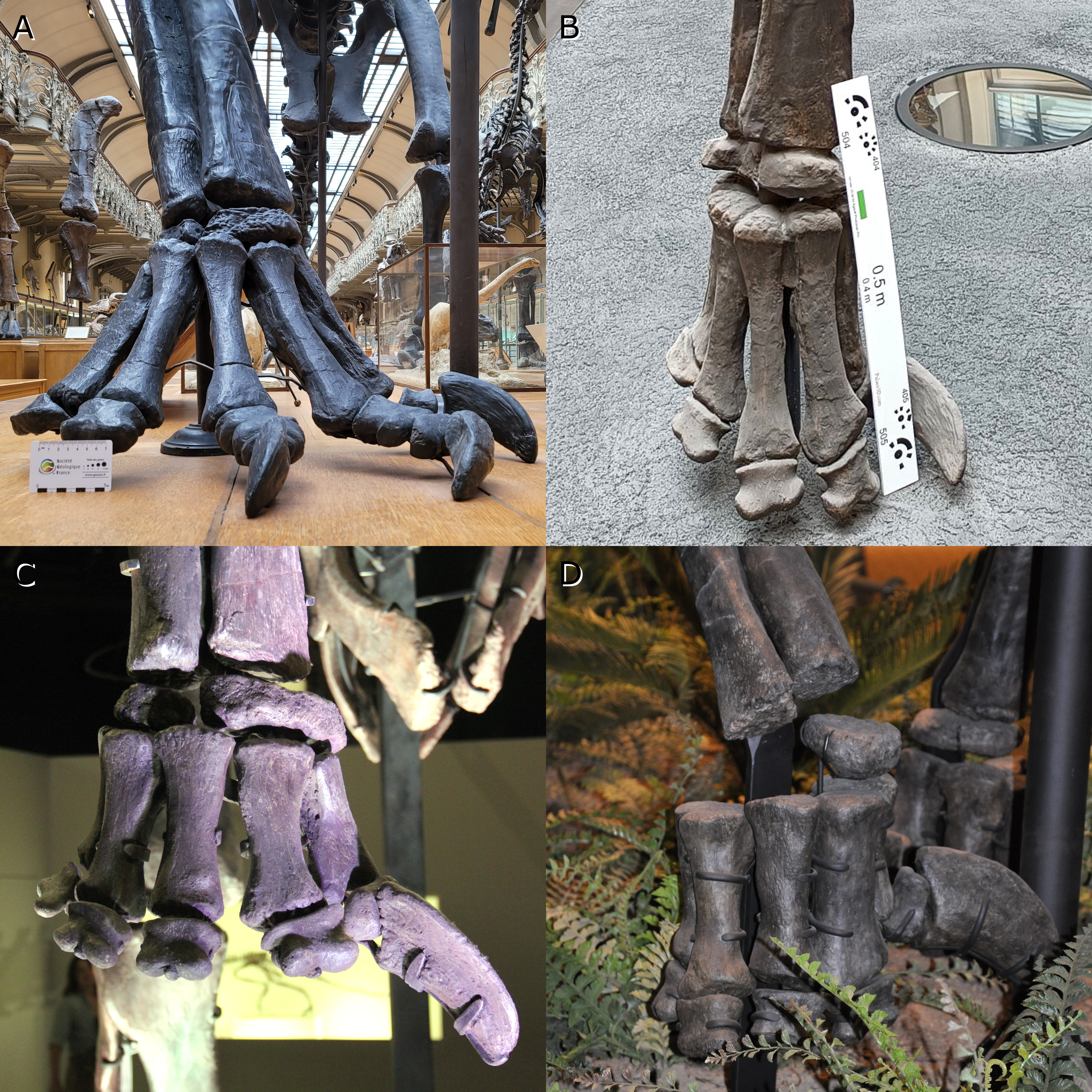
Taylor et al. 2015: Figure 16. Right forefeet of the Carnegie Diplodocus and its casts, all in approximately anterior view. A, the feet as originally mounted in 1905 (in the London cast), 1907 (in the first iteration of the Carnegie Museum original-material mount), and subsequent casts, as supervised by Hatcher and Holland and executed by Coggeshall. This photograph shows the right forefoot of the Paris mount, which is unchanged since its original mounting. This forefoot material, sculpted from the camarasaurid specimen AMNH 965, has elongate metacarpals splayed in a semi-plantigrade posture, with multiple phalanges on each of the three medial digit and large unguals on digits I, II, and III. Photograph by Vincent Reneleau (MNHN); B, the right forefoot of the Berlin mount, as remounted in 2006 by Research Casting International, supervised by Kristian Remes. This consists of the original casts mounted in 1908 by Holland and Coggeshall, reposed in a more modern digitigrade posture, with superfluous phalanges and unguals discarded (see text). Photograph by Verónica Díez Díaz (MfN); C, the forefeet of Galeamopus (= “Diplodocus”) hayi HMNS 175 (formerly CM 662), casts of which were used in the Carnegie mount between 1999 and 2007. Note the much shorter metacarpals, the fully digitigrade posture, the reduction in phalangeal count, and the single large manual ungual on digit I. Photograph by Jeremy Huff (TAMU); D, the present forefeet of the Carnegie mount, modelled in 2007 after those of WDC-FS001A, then thought to belong to Diplodocus carnegii (Bedell and Trexler 2005) but currently thought to belong to an as-yet unnamed basal diplodocine (Tschopp et al. 2015:229–230). Note the resemblance to the diplodocine forefoot in part C, with short metacarpals, digitigrade posture, reduced phalangeal count, and a single large manual ungual. Photograph by Matthew C. Lamanna.
It turns out there was still plenty of history to be uncovered, and that some well-known parts of the story aren’t quite right after all. Also, that the composition of the Carnegie mount has changed a lot through the years — something that has not been publicly documented until now. And no-one really knows even how long this dinosaur is.
We dug into all of this, with the hope that the new paper would become a one-stop-shop for anyone who needs to know anything about this keystone specimen. It’s been a joy to work on (and especially to work with Matt L., Amy, Linsly and Ilja), and I hope you will enjoy reading it.
(A note on the venue of publication: I went against my usual policy of open-access venues only because the museum’s in-house journal, Annals of the Carnegie Museum, seemed so historically appropriate for this work. I liked the idea of following the footsteps of Hatcher and Holland — even if their early-1900s monographs were in the now discontinued Memoirs rather than the Annals. In fact, the Annals is not even paywalled: there is no online version at all hosted by the publisher (which is the museum itself). It is a print-only journal. So you can consider the PDF on my own website to be the definitive electronic copy.)
Oh, and we have a sidebar page about the new paper, containing full-resolution copies of all 22 illustrations.
References
- Hatcher, John Bell. 1901. Diplodocus (Marsh): its osteology, taxonomy, and probable habits, with a restoration of the skeleton. Memoirs of the Carnegie Museum 1:1-63.
- Holland, W. J. 1906. Osteology of Diplodocus Marsh with special reference to the restoration of the skeleton of Diplodocus carnegiei Hatcher presented by Mr Andrew Carnegie to the British Museum, May 12 1905. Memoirs of the Carnegie Museum 2(6):225-278.
- Nieuwland, Ilja. 2019. American dinosaur abroad: a cultural history of Carnegie’s plaster Diplodocus. University of Pittsburgh Press. ISBN:978-0822945574. doi:10.2307/j.ctvh4zh5n
- Taylor, Michael P., Steven D. Sroka and Kenneth Carpenter. 2023. The Concrete Diplodocus of Vernal — a Cultural Icon of Utah. Geology of the Intermountain West 10:65-91. doi: 10.31711/giw.v10.pp65-91
- Taylor, Michael P., Amy C. Henrici, Linsly J. Church, Ilja Nieuwland and Matthew C. Lamanna. 2025. The history and composition of the Carnegie Diplodocus. Annals of the Carnegie Museum 91(1):55–91. doi: to follow.


 Sauropod Vertebra Picture of the Week