Five questions from Tom Redd
October 24, 2024
Three years ago, Tom Redd made a very generous commitment to the SV-POW! Patreon, and he remains our most generous donor in total. When I wrote to thank him his reply included “I have thousands of questions about apatosaurus that I would like to ask you some day.”
It seemed only fair to invite him to ask some of those questions, so we asked him to give us five and said we’d try to answer them. When the questions came through, some of them were hard — not really in our area of expertise. But I promised we’d take a crack, and that we’d invite commenters to chip in where we get something wrong or leave something out.
Then a bit more than three years slipped past. Now, finally: here we go!
Question #1:
Do you think sauropods could have evolved long necks as a defensive strategy? (Better to see your enemies from a long way off). The sigmoid curve and the neutral position is another issue!
I recently read a couple of research papers where the researcher used “radiological imaging” to determine the neutral position of the cervical vertebrae. The result was a gently downward curving neck beginning at the pectoral girdle, with the skull only 2 meters off the ground. (I agree with Matt that this would be an ambush predator’s delight!)
Also, could compressive or tensional forces of cartilage and ligaments affect the neutral position of the cervical vertebra? (I believe Matt also alluded to this condition.)
This is the longest question, but maybe the one I’m best positioned to comment on.
First of all, the perennial question of what sauropods’ long necks were for. There are a few candidate explanations out there. The obvious one is that they enabled high browsing, and on the whole we feel that’s the strongest single explanation. Another candidate factor is sexual selection — that sauropods were particularly attracted to long-necked individuals of the opposite sex — but we don’t feel that is a strong explanation for reasons explained in our 2011 paper (Taylor et al. 2011). Predator avoidance would certainly have been aided by the long visual distances allowed by elevated heads, and we are confident that at least some sauropods used their necks in combat — primarily in intraspecific combat (Taylor 2015) but no doubt also against predators when the occasion arose. And we may well have missed other good uses for long necks.
In reality of course all these factors likely played a role: structures do not always, or even often, evolve for a single reason. When people who know much more about ceratopsians tell me “The horns of Triceratops were for intraspecific display and combat”, I don’t doubt them. But I also don’t doubt that, whatever the primary purpose of the horns, a Triceratops confronted by a Tyrannosaurus would do its damnedest to stick its horns into it. In the same way, while high feeding seems like the strongest driver of sauropod neck elongation, the other factors will surely have played in, too.
I’m not sure what radiological imaging papers you have come across, but the one I know about is Berman and Rothschild (2005) in the Thunder Lizards edited volume. This paper rather questionably partitions all sauropod cervicals into two bins, “robust” and “gracile”, and concludes, based on functional stress analysis, that “the robust-type centrum supported a neck held in a vertical, or near-vertical, pose, whereas the gracile-type centrum supported a neck held in a horizontal, or near-horizontal, pose”. If this is right, and their categorization holds, then Camarasaurus and an unidentified titanosaur had vertical necks; and Diplodocus, Apatosaurus, Haplocanthosaurus, Barosaurus and Brachiosaurus all had horizontal necks. We find every part of this unconvincing. At some point we should explain why in detail; but it is not this day.
Finally, yes, compressive and tensile forces in cartilage and ligaments definitely did affect neutral posture. My 2014 paper (Taylor 2014) shows this rather dramatically.

What we’re seeing here is what the neutral posture would be if cartilage is added to a neck that is otherwise articulated in horizonzal pose. The importance of intervertebral cartilage has often been overlooked, but can make a dramatic difference to neck posture.
Question #2
I recently read a report that indicated Apatosaurus survived at the species level for a period of approximately 8 million years ! So is this a success, average, or a short run?
I’m not sure where you read that, but the problem here is that no-one really knows what Apatosaurus means. We have the type species Apatosaurus ajax, sure, and the referred species Apatosaurus louisae, and the genus Brontosaurus based on the species Brontosaurus excelsus which is sometimes but not always synonymised with the genus Apatosaurus yielding the combination Apatosaurus excelsus, and don’t even get me started on Apatosaurus parvus, Apatosaurus laticollis, Atlantosaurus and whatever the heck AMNH 460 is.
So if we say that Apatosaurus survived for 8 million years, what exactly are we saying? That Apatosaurus ajax is known from sediments that differ in age by 8 million years? That would be interesting if true, but it’s very hard to establish because the referral of any given individual to a particular sauropod species tends to be very uncertain — largely because most specimen are so fragmentary and distorted. And if all we mean is that 8 million years separate the oldest and youngest specimens that have been referred to the genus Apatosaurus — well, that statement is all but meaningless, given the huge uncertainty about what is and is not part of that genus, if indeed genera even really mean anything.
Putting it all together, I’m not confident that there is any reason to think that Apatosaurus was particularly longer lived than other sauropods. Probably Camarasaurus outlasted it if you include all the taxa that have been referred to Camarasaurus. But then I’m far from convinced that that’s the right thing to do, too.
Question #3
Why so many heavy predators during the age of apatosaurs? Predator to prey ratios were in the 6 to 8% range as compared to modern ratios of 2 to 3%!
I’m not sure I can say much about this without knowing the source of the figures, but I assume that what’s being counted here is the number of individuals represented in the fossil record, and the ratio of a predator species to prey species. The problem is that there is a huge amount of vagueness in these numbers, but it’s not obvious that the apatosaur-age figures are comparable to the modern ones.
Consider first the modern ratio. Which animals are counted in each category? In the Serengeti, lions prey on zebras. So far, so simple, but there are also dwarf moongooses, which are predators — but they don’t hunt zebras. So do we count them in the numbers? If so, do we count their prey animals, too? Including invertebrates? And if not, then where do we draw the line between predators that we consider do and do not hunt the prey animals that we’ve decided we’re interested in?
Then there’s the matter of which animals get counted. If you do your Serengeti counts on dead animals, you might find disproportionately many predators because prey animals tend to be consumed. Or you might find disproportionately many prey animals because they tend to die in areas where the corpses are more easily found and counted. You might be able to do better by counting live animals, but then you might easily undercount secretive predators, or perhaps overcount predators because they stand fearlessly around to be counted.
Now consider trying to measure the predator/prey ratio in the Morrison formation. You have all the problems I already mentioned, plus a bunch of others. If you only count complete-ish articulated skeletons then your sample size is too small to be meaningful. If you count isolated elements, you’re at risk of registering multiple instances of the same individual. Counting individuals represented in bonebeds is difficult because of these problems. Assigning an element to a taxon is error-prone (though should generally be OK at the high level of sauropod vs. theropod — or are you?). Bones of different taxa may survive taphonomy better or worse than others. Life history differences will mean that the fossils of long-lived taxa under-represent their live populations. And so on, and on, and on.
Putting it all together, I would tend to be very sceptical that a difference in ratios of 6–8% to 2–3% is necessarily telling us anything.
With all that said, it’s perfectly possible that the average predator:prey body-size ratio was closer in the Morrison than in modern ecosystems. But we’d do better trying to measure that directly from body-fossils than to infer it from population densities.
Question #4
Are all apatosaur tracks on emergent surfaces? (Some depth of water over the prints)
This I don’t know. But then I wouldn’t know how to pick out apatosaur tracks from those of other diplodocids, and I bet no-one else does, either. Tracks are notoriously variable in shape, and can very wildly from the that of the feet that made them. Given that diplodocid feet were mostly pretty similar anyway, I would not be easily persuaded that any track can be confidently identified down to the genus level.
One other thing to be aware of is that there is often not agreement on the conditions under which a given track is made. One palaeontologist may think a given a track is a direct print, another will think it’s an underprint. I don’t mean to say that it’s hopeless and all we can do is throw our hands up in despair — good work is being done on interpreting tracks, but we have a long way to go. And this is not an area that I’m at all expert in.
Question #5
I read recently that in order for a skin impression to be made the Dermal tissue must undergo a type of chemical alteration! Do you think this is what allows the impression to be made?
That doesn’t sound right to me. The first thing that has to happen for an animal to be fossilized is that it needs to be buried in sediment really fast after it dies — before it’s eaten by scavengers. For something as fine as skin impressions to be preserved, that sediment needs to be very fine — which sadly tends to conflict with the first condition, since course sediments can be deposited more quickly than fine ones. It’s really hard for enough fine sediment to be laid down quickly enough to cover an animal of the size of a sauropod, which is why we don’t have sauropod specimens like those gloriously preserved theropods from the Yixian Formation in China(*). So sauropod skin impressions are pretty rare.
(*) Alternatively: there are spectacularly preserved partial sauropod specimens in the Yixian, but Chinese researchers can’t be bothered to write them up because they’d rather spend their time getting a slam-dunk Nature paper out of yet another little feathered theropod. Unduly cynical? Maybe. But I continue to live in hope.
Well, that about wraps up the five questions — to the best of my ability at least. But I’d love to hear from people who know more than I about these topics: leave a comment, and fame and glory could be yours!
And finally … if you, too, would like to have us answer five questions on the sauropod-related topic of your choice, quite possibly in the less than three years, you should consider getting yourself across the The SV-POW! Patreon and making an unreasonably extravagant financial commitment.
References
- Berman David S., and Bruce M. Rothschild. 2005. Neck posture of sauropods determined using radiological imaging to reveal three-dimensional structure of cervical vertebrae. pp. 233–247 in: Virgina Tidwell and Ken Carpenter, Thunder-lizards: the sauropodomorph dinosaurs. Bloomington: Indiana University Press.
- Taylor, Michael P. 2014. Quantifying the effect of intervertebral cartilage on neutral posture in the necks of sauropod dinosaurs. PeerJ 2:e712. doi: 10.7717/peerj.712
- Taylor, Michael P., David W. E. Hone, Mathew J. Wedel and Darren Naish. 2011. The long necks of sauropods did not evolve primarily through sexual selection. Journal of Zoology 285:150-161. doi: 10.1111/j.1469-7998.2011.00824.x
- Taylor, Michael P., Mathew J. Wedel, Darren Naish and Brian Engh. 2015. Were the necks of Apatosaurus and Brontosaurus adapted for combat?. p. 71 in Mark Young (ed.), Abstracts, 63rd Symposium for Vertebrate Palaeontology and Comparative Anatomy, Southampton. 115 pp.
Afield in Oklahoma
June 25, 2018

Clouds over Black Mesa.

Baby spadefoot toad, with my index finger for scale.

Someone was here before us. Even though Black Mesa is best known for its Morrison exposures and giant Jurassic dinosaurs, there are Triassic rocks here, too, which have produced both body fossils and tracks, including these.
Seen but not photographed today:
- a group of pronghorn by the side of the road, with two babies;
- a deer that ran across the road right in front of our vehicle;
- a wild turkey foraging in the ditch next to the road;
- a few jackrabbits, and more cottontails than you can shake a stick at;
- loads of prairie dogs.
Now if you’ll excuse me, I have to go watch a thunderstorm.
Walking with sauropods at Copper Ridge (video)
December 14, 2016
In the summer of 2015, Brian Engh and I stopped at the Copper Ridge dinosaur trackway on our way back from the field. The Copper Ridge site is 23 miles north of Moab, off US Highway 191. You can find a map, directions, and some basic information about the site in this brochure. The BLM has done a great job of making this and other Moab-area dinosaur trackways accessible to the public, with well-tended trails and nice interpretive signage. Brian has gotten to do the art for interp signs at several sites now, including Copper Ridge, and he put together this video to explain a bit about the site, what we know about the trackmaker, and the lines of evidence he used in making his life restoration. I’m in there, too, yammering a bit about which sauropod might have been responsible. We weren’t sure what, if anything, we would end up doing with the footage at the time, so I’m basically thinking out loud. But that’s mostly what I do here anyway, so I reckon you’ll live.
Stay tuned (to Brian’s paleoart channel) for Part 2, which will be about the Copper Ridge theropod trackway. And the next time you’re in the Moab area, go see some dinosaur tracks. This is our heritage, and it’s cool.
A short post this time, partly because it’s late, partly because the hotel internet is sucking bigtime–probably as the hotels fill up for the weekend. I simply don’t have the bandwidth to post more, and in fact I had to downsize these few photos to get them to upload in polynomial time.
Today we left Fruita, Colorado, and hit several Lower Cretaceous sites in eastern Utah on our way to Green River, Utah. Highlights were the Copper Ridge and Mill Canyon dinosaur tracksites.
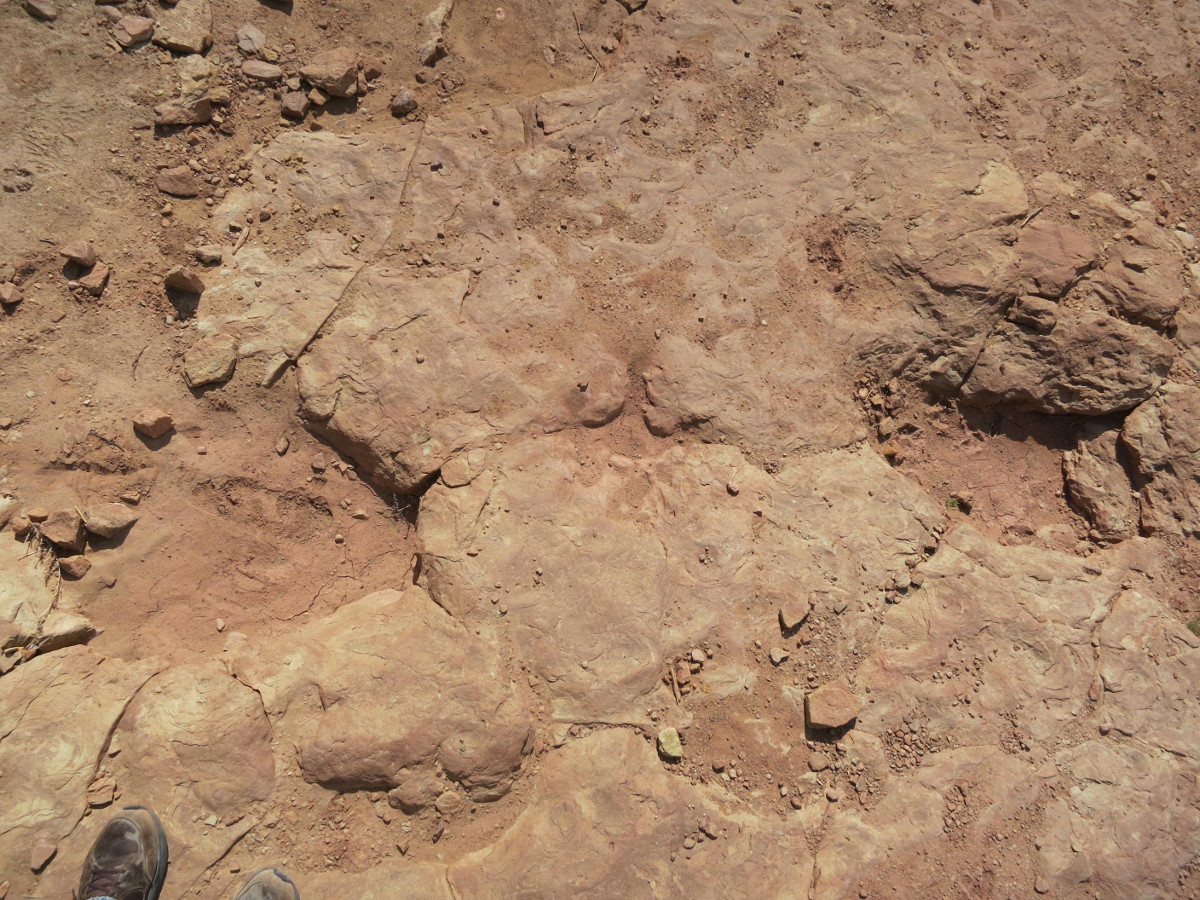
Here’s a tridactyl theropod track between two sauropod pes prints at Copper Ridge.

Here’s a little theropod track at Mill Canyon…

…a big one…

…and one that I had never seen before in person: Dromaeosauripus, the two-toed ichnogenus left by dromaeosaurs. Utahraptor or a close relative is a likely culprit for the Mill Canyon Dromaeosauripus.

How big were the biggest sauropod trackmakers?
October 13, 2009
UPDATE December 3, 2009
I screwed up, seriously. Tony Thulborn writes in a comment below to correct several gross errors I made in the original post. He’s right on every count. I have no defense, and I am terribly sorry, both to Tony and to everyone who ever has or ever will read this post.
He is correct that the paper in question (Thulborn et al 1994) does discuss track length, not diameter, so my ranting about that below is not just immoderate, it’s completely undeserved. I don’t know what I was thinking. I did reread the paper before I wrote the post, but I got the two switched in my mind, and I assigned blame where none existed. In particular, it was grossly unfair of me to tar Tony’s careful work with the same brush I used to lament the confused hodgepodge of measurements reported in the media (not by scientists) for the Plagne tracks.
I am also sorry that I criticized the 1994 paper and implied that the work was incomplete. I was way out of line.
I regard this post as the most serious mistake in my professional career. I want very badly to somehow unmake it. I am adding corrections to the post below and striking out but not erasing my mistakes; they will stand as a reminder of my fallibility and a warning against being so high-handed and unfair in the future.
I’m sorry. I beg forgiveness from Tony, from all of our readers, and from the broader vertebrate paleontology community. Please forgive me.
–Mathew Wedel

You might have seen a story last week about some huge sauropod tracks discovered in Upper Jurassic deposits from the Jura plateau in France, near the town of Plagne. According to the news reports, the tracks are the largest ever discovered. Well, let’s see.
The Guardian (from which I stole the image above) says the prints are “up to 2 metres (6ft 6 in) in diameter”, but ScienceDaily says “up to 1.5 m in total diameter”. Not sure how ‘total diameter’ is different from regular diameter, but that’s science reporting for you. The BBC clarifies that, “the depressions are about 1.5m (4.9ft) wide”, which might be the key here (see below), but then mysteriously continues, “corresponding to animals that were more than 25m long and weighed about 30 tonnes.” I find it rather unlikely that a pes track 1.5 m wide indicates an animal only as big as Giraffatitan (hence this post).
So there’s some uncertainty with respect to the diameter of the tracks–half a meter of uncertainty, to be precise. But sauropod pes tracks are usually longer than wide, and a print 1.5 m wide might actually be 2 m long.
Not incidentally, Thulborn (1994) described some big sauropod tracks from the Broome Sandstone in Australia, with pes prints up to 1.5 m. Although the photos of the tracks are not as clear as one might wish, they do appear to show digit impressions and are probably not underprints. [See Tony Thulborn’s comment below regarding footprints vs underprints.]
I’ll feel a lot better about the Plagne tracks when the confusion about their dimensions is cleared up and when some evidence is presented that they also are not underprints. In any case, the only dimension with any orientation cited for the Plagne tracks is the 1.5 m width reported by the BBC, so we’ll go with that. So the Plagne tracks might only tie, but not beat, Thulborn’s tracks.
…Then again, Thulborn only said that the biggest tracks were up to 150 cm in diameter. What does that mean–length? Width? Are the tracks perfect circles? Does no one who works on giant sauropod tracks know how to report measurements? These questions will have to wait, because despite the passing of a decade and a half, the world’s (possibly second-) biggest footprints–from anything! ever!–have not yet merited a follow-up paper. [Absolutely wrong and unfair; please see the apology at top and Tony Thulborn’s comment below.]
Nevertheless, for the remainder of this post we’ll accept that at least some sauropods were leaving pes prints a meter and a half wide. Naturally, it occurs to me to wonder how big those sauropods were. I don’t know of any studies that attempt to rigorously estimate the size of a sauropod from its tracks or vice versa, so in the finest tradition of the internet in general and blogging in particular, I’m going to wing it.
How Big?
First we need some actual measurements of sauropod feet. When Mike and I were in Berlin last fall (gosh, almost a year ago!), we measured the feet (pedes) of the mounted Giraffatitan and Diplodocus for this very purpose. The Diplodocus feet were both 59 cm wide, and the Giraffatitan feet were 68 and 73 cm wide. The Diplodocus feet are trustworthy, the Giraffatitan bits less so. Unfortunately, the pes is the second part of the skeleton of Giraffatitan that is less well known than I would like (after the cervico-dorsal neural spines). The reconstructed feet look believable, but “believability” is hard to calibrate and probably a poor predictor of reality when working with sauropods.
One thing I won’t go into is that Giraffatitan (HM SII) probably massed more than twice what Diplodocus (CM 84/94) did, but on the other hand G. bore more of its weight on its forelimbs. It would be interesting to calculate whether the shifted center of mass would be enough to even out the pressure exerted by the hindfeet of the two animals; Don Henderson may have done this already.
Anyway, let’s say for the sake of argument that the hindfeet of the mounted Giraffatitan are sized about right. The next problem is figuring out how much soft tissue surrounded the bones. In other words, how much wider was the fleshy foot–deformed under load!–than the articulated pes skeleton? I am of two minds on this. On one hand, sauropods probaby had a big heel pad like that of elephants, and it seems reasonable that the heel pad plus the normal skin, fat, and muscle might have expanded the fleshy foot considerably beyond the edges of the bones. On the other hand, the pedal skeleton is widest across the distal ends of the phalanges, and in well-preserved tracks like the one below the fleshy foot is clearly not much wider than that (thanks, Brian, for the photo!).
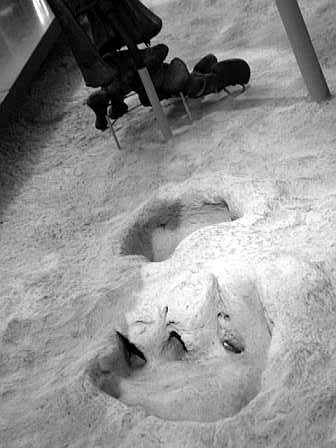
Bear in mind that a liberal estimate of soft tissue will give a conservative estimate of the animal’s size, and vice versa. Looking at the AMNH track pictured above, it seems that the width added by soft tissue could possibly be as little as 5% of the width of the pes skeleton. Skewing hard in the opposite direction, an additional 20% or more does not seem unreasonable for other animals (keep in mind this would only be 10% on either side of the foot). Using those numbers, Diplodocus (CM 84/94) would have left tracks as narrow as 62 cm or as wide as 71 cm. For Giraffatitan (HM SII) I’ll use the wider of the two pes measurements, because the foot is expected to deform under load and the 73 cm wide foot looked just as believable as the 68 cm foot (for whatever that’s worth). Applying the same scale factors (1.05 and 1.20) yields a pes track width of 77-88 cm.
These numbers are like pieces of legislation, or sausages: the results are more pleasant to contemplate than the process that produced them. They’re ugly, and possibly wrong. But they give us someplace to start from in considering the possible sizes of the biggest sauropod trackmakers. Something with a hindfoot track 1.5 meters wide would be, using these numbers, conservatively more than twice as big as (2.11x) the mounted Carnegie Diplodocus or 170% the size of the mounted Berlin Giraffatitan. That’s right into Amphicoelias fragillimus/Bruhathkayosaurus territory. The diplo-Diplodocus would have been 150 feet long, and even assuming a very conservative 10 tons for Vanilla Dippy (14,000L x 0.7 kg/L = 9800 kg), would have had a mass of 94 metric tons (104 short tons). The monster Giraffatitan-like critter would have been “only” 130 feet long, but with a 14.5 meter neck and a mass of 113 metric tons (125 short tons; starting from a conservative 23 metric tons for HM SII).
Keep in mind that these are conservative estimates, for both the size of the trackmakers and the masses of the “known” critters. If we use the conservative soft tissue/liberal animal size numbers, the makers of the 1.5 meter tracks were 2.4 times as big as the mounted Diplodocus or almost twice as big as the mounted Giraffatitan, in which case masses in the blue whale range of 150-200 tons become not just probable but inevitable.

Mike measuring Giraffatitan's naughty bits. Check out the hindfeet. Also note the sauropod vertebrae in the background--titular obligation fulfilled!
Too Big?
Going the other way, I can think of only a handful of ways that the “conservative” trackmaker estimates might still be too big:
First, the pes of Giraffatitan might have been bigger than reconstructed in the mounted skeleton. Looking at the photo above, I can image a pes 10% wider that wouldn’t do any violence to the “believability” of the mount. That would make the estimated track of HM SII 10% wider and the estimated size of the HM-SII-on-steroids correspondingly smaller. But that wouldn’t affect the scaled up Diplodocus estimate, and the feet of Giraffatitan would have to be a LOT bigger than reconstructed to avoid the reality of an animal at least half again as big as HM SII.
Second, the amount of soft tissue might have been greater than even the liberal soft tissue/conservative size estimate allows. But I think that piling on 20% more soft tissue than bone is already beyond what most well-preserved tracks would justify, so I’m not worried on that score. (What scares me more is the thought that the conservative estimates are too conservative, and the real trackmakers even bigger.)
Third, I suppose it is possible that sauropod feet scaled allometrically with size and that big sauropods left disproportionately big tracks. I’m also not worried about this. For one thing, when they’ve been measured sauropod appendicular elements tend to scale isometrically, and it would be weird if feet were the undiscovered exception. For another, the allometric oversizing of the feet would have to be pronounced to make much of a dent in the estimated size of the trackmakers. I find the idea of 100-ton sauropods more palatable than the idea of 70-ton sauropods with clown shoes.
Fourth, the meta-point, what if the Broome and Plagne tracks are underprints? [Please see Tony Thulborn’s comment below regarding footprints and underprints.] I’ve seen some tracks-with-undertracks where the magnification of the apparent track size in the undertracks was just staggering. The Broom tracks have gotten one brief note and The Plagne tracks have not been formally described at all, so all of this noodling around about trackmaker size could go right out the window. Mind you, I don’t have any evidence that the either set are underprints, and at least for the Broome tracks the evidence seems to go the other way, I’m just trying to cover all possible bases.
Conclusions
So. Sauropods got big. As usual, we can’t tell exactly how big. Any one individual can leave many tracks but only one skeleton, so we might expect the track record to sample the gigapods more effectively than the skeletal record. Interestingly, the largest fragmentary skeletal remains (i.e., Amphicoelias and Bruhathkayosaurus, assuming they’re legit) and the largest tracks (i.e., Plagne and Broome) point to animals of roughly the same size.
It’s also weird that some of the biggest contenders in both categories have been so little published. I mean, if I had access to Bruhathkayosaurus or a track 1.5 m wide, you can bet that I’d be dropping everything else like a bad habit until I had the gigapod evidence properly written up. What gives? [The implication that the Broome tracks were not properly written up is both wrong and unfair; please see the apology at top.]
Finally, IF the biggest fragmentary gigapods and the biggest tracks are faithful indicators of body size, they suggest that gigapods were broadly distributed in space and time (and probably phylogeny). I wonder if these were representatives of giga-taxa, or just extremely large individuals of otherwise vanilla sauropods. Your thoughts are welcome.
Epilogue: What About Breviparopus?
It’s past time someone set the record straight about damn Breviparopus. The oft-quoted track length of 115 cm is (A) much smaller than either the Broome or Plagne tracks, and (B) the combined length of the manus and pes prints together; I know, I looked it up (Dutuit and Ouazzou 1980). Why anyone would report track “length” that way is beyond me, but what is more mysterious is why anyone was taken in by it, since the width of 50 cm (pathetic!) is usually quoted along with the 115 cm “length”, indicating an animal smaller than Vanilla Diplodocus (track length is much more likely than width to get distorted by foot motions during locomotion) [This part is wrong; see the update below.]. But people keep stumbling on crap (thanks, Guiness book!) about how at 157 feet long (determined how, exactly?) Breviparopus was possibly the largest critter to walk the planet. Puh-leeze. If there’s one fact that everyone ought to know about Breviparopus, it’s that it was smaller than the big mounted sauropods at museums worldwide. The only thing super-sized about it is the cloud of ignorance, confusion, and hype that clings to the name like cheap perfume. Here’s the Wikipedia article if you want to do some much-needed revising.
UPDATE (Nov 17 2009): The width of the Breviparopus pes tracks is 90 cm, not 50 cm. The story of the 50 cm number is typically convoluted. Many thanks to Nima Sassani for doing the detective work. Rather than steal his thunder, I’ll point you to his explanation here. Point A above is still valid: Breviparopus was dinky compared to the Broome and Plagne trackmakers.
Parting Shot
You know I ain’t gonna raise the specter of a beast 1.7 times the size of HM SII without throwing in a photoshopped giant cervical. So here you go: me with C8 of Giraffatitan blown up to 170% (the vert, not me). Compare to unmodified original here.

References
- Dutuit, J.M., and A. Ouazzou. 1980. Découverte d’une piste de Dinosaure sauropode sur le site d’empreintes de Demnat (Haut-Atlas marocain). Mémoires de la Société Géologique de France, Nouvelle Série 139:95-102.
- Thulborn, R.A., T.Hamley and P.Foulkes. 1994. Preliminary report on sauropod dinosaur tracks in the Broome Sandstone (Lower Cretaceous) of Western Australia. Gaia 10:85-96.


 Sauropod Vertebra Picture of the Week