Showing posts with label productivity. Show all posts

Friday, February 27, 2026

Can You Afford a Slow Internet Connection?

By: John Shepler

Time is money. In business, that’s almost always true. Your expenses for labor, facilities and services keep draining the cash register. You need to refill it faster than it is draining or you’ll be out of the game at some point. Things need to keep moving at a steady clip just to make your nut each month. On top of that, customer satisfaction often depends on how fast you can service them. What’s the last thing you need? A process that slows you down!

Where are the Bottlenecks?
Most businesses have at least some online presence and many have their business processes inextricably connected with software running on remote or cloud servers. That means that no matter how much you scurry about in the office or shop, you may be inherently limited by computer processing a thousand miles away and the connections to them.

Let’s assume for the moment that your data center has all the resources needed to process any requests instantly. With elastic computing you don’t even have to worry about peaks and dips in traffic. The system automatically assigns whatever computing hardware and software are required to keep up with the necessary tasks. Let’s also assume that the data center has as much Internet bandwidth as needed to handle all the incoming and outgoing traffic. That's more than likely as major carriers tend to have points of presence with massive bandwidth located within key data centers.

So, where might things slow down? The Internet itself is vulnerable. It is designed to work around traffic jams to keep things moving. Even so, there are times when too many things go wrong and the entire network drags. Far more often, the problem is not within the backbone of the Internet but with your connection to it. This is referred to as the last-mile connection.

Unclogging the Last Mile
Last mile problems tend to be caused by limited bandwidth, congestion from too many users needing that bandwidth at the same time, latency from long paths and repeated transmissions to get the packets through intermittent connections.

Bandwidth is the easiest to address. If you are still stuck with aging T1 lines or DSL you likely don’t have near enough bandwidth to handle modern Web traffic. In the dial-up days, a Megabit per second was considered broadband. Today that’s more like a Gigabit per second. Smaller users may get by with fractional Gbps, but large operations may be needing 10 Gbps or even 100 Gbps to keep traffic streams from interfering with each other.

Fortunately, fiber optic bandwidth is more the norm than the exception now. If you have a 1 Gbps or 10 Gbps port installed, you should have the bandwidth you need unless your requirements are extraordinary.

Fiber bandwidth also tends to be low in latency. That’s important to responsiveness because when you have enough bandwidth latency will make communication sluggish and adding more bandwidth won’t help. Low latency is especially important in real-time processes including phone calls and video conferencing. You want those communications channels to be full duplex or instantly two-way all the time.

A fiber connection is the gold standard in the office, but you may also need high performance while portable or mobile. That’s where 5G rises to meet the challenge. You likely have this on your smartphone. Other devices can also have built-in 5G or connect through a portable hotspot that is essentially a 5G phone without the user interfaces or apps. It simply converts 5G bandwidth to WiFi. Any WiFi compatible device can then access the Internet.

Private Lines offer Superior Performance
One limitation to the most readily available Internet connections, such as cable and 5G broadband, is that they are a shared resource. The price is kept low by sharing the cable or radio channels with many users at the same time. When things are going well, you don’t even know there is anybody else on the line. But when everybody wants to send huge files are download video simultaneously, you’ll definitely feel the speed bumps.

If the loss in productivity due to varying congestion is a problem, consider a direct private line from your location to your cloud service provider. This bypasses the Internet completely and is available only to your organization. This service is sometimes called “direct access.” You may also want private lines among your facilities and even key suppliers and customers. In essence, you create your own private Internet.

An alternative that can enhance performance and improve reliability of your connection is called SD-WAN. This involves having two or more Internet connections with a special router that prioritizes traffic and selects which path offers the best performance at the time. The SD means software defined, which is the intelligence in the router that monitors your connections and makes instant decisions on how to best route traffic.

Is your business struggling to keep up because your Internet connection isn’t responsive enough? Look into better alternatives for faster, more reliable connectivity to boost productivity and ensure customer satisfaction.


Click to check pricing and features or get support from an expert technology specialist.


Follow Telexplainer on Twitter


Thursday, December 11, 2025

Can CPaaS Make Your Job Easier?

Are you getting a bit overwhelmed with a myriad of business applications that kinda, sorta work together but just don’t seem to give you the seamless communications that you really wish you had? Perhaps something new could help. It’s called CPaaS or Communications Platform as a Service.

Find out what CPaaS can do for your businessWhat is CPaaS and Why Should I Want It?
CPaaS doesn’t replace what you have now. It extends your capabilities without having to rip out your current systems or buy new expensive hardware. CPaaS is focused on communications. It a suite of tools that plug into your existing systems to add capabilities you don’t have now or find awkward to use. Best of all, you don’t need extensive technical support to make CPaaS work. These are developer friendly APIs hosted in the cloud and available as needed.

What Can CPaaS Do?
Which API’s you elect to use may depend on the industry you are in. For instance, in healthcare you may want the ability to have video consultations for Telehealth, send appointment reminders and have secure HIPAA-compliant messaging. Financial businesses may desire 2FA authentication for secure login and chatbots to handle FAQs. Other businesses may want interactive telephone response, email updates, SMS alerts, virtual meetings and contact analytics.

Note that all of these applications are related to enchanting communications with customers, clients, supplies or team members. They are designed to fit into what you are using now without a lot of muss and fuss. You can customize your workflows and automate interactions without having to purchase, install and train on whole new systems.

The Cloud Makes It Painless
The mere thought of having to take the time and effort to dig into the systems you use every day or hire the expertise needed to do this is cringeworthy. It’s way more complexity than most companies want to deal with. Plus, once you start creating ad-hoc custom solutions, you are stuck with ongoing maintenance and upgrades and tracking who has what throughout the company.

The cloud aspect of CPaaS greatly simplifies things. All the hardware and software that makes the internals of these application interfaces function is handled by the CPaaS vendor. You are just dealing with inserting the APIs and easily customizing the user features as you desire. There are low code and no code solutions including pre-built templates to make it easy on your tech team.

What’s the Cost of CPaaS?
As a service, CPaaS is available on a pay-as-you-go basis. You decide what apps you want to deploy and to what extent. You only pay for what you use. As business conditions change, you can increase or decrease your usage as needed. There is no need for an upfront capital outlay in hardware or software.

Does Communications Platform as a Service sound like it might be something that would make your business more productive? If so, you are invited to talk with a technical expert and see what CPaaS offerings make the most sense for your situation.

Click to check pricing and features or get support from an expert technology specialist.


Follow Telexplainer on Twitter


Wednesday, June 25, 2025

Goodbye Employees, Hello Bandwidth

By: John Shepler

Office employment has been undergoing a major shift since the rise of the Covid Pandemic in 2020 and it’s likely to accelerate rather than return to “normal.” Office buildings nationwide have been emptying out, some being converted to residential units or commercial malls. Even with employees being ordered to return to the office or be replaced, things aren’t really going to go back to mass commutes five days a week, as we’ll soon see. This also has major ramifications for the bandwidth you’ll need and where you’ll need it.

Bandwidth to support the changing business officeReluctant Office Workers Offer Opportunities
How do you get ‘em back in the office after they’ve seen work from home?

That might be the title of a song for the 2020’s. The abrupt culture shock from everyone being sent home, with most expected to keep on working, did indeed break the expected paradigm of where you are supposed to be all day. Once appropriate computers and Internet connections got settled, quite a few customer service reps, programmers, and other information workers found they could work just as well from a spare bedroom or dining room table as in the corporate cubicle. Their productivity even improved without the distractions of office chatter or pro-forma meetings.

Employees might have picked up an hour or two of extra personal time not spent commuting and some could drop the expense of outside daycare for children. Meanwhile, companies that continued this arrangement after the pandemic threat had passed found they could reduce office space expense, including real estate and utilities.

One demand that might have increased is the need for fast highly reliable bandwidth to connect now far-flung individuals. Residential Internet connections have improved greatly during this millennium. High speed cable broadband, fiber to the home and 5G fixed wireless access have made most connections nearly transparent. For more demanding applications, SD-WAN and dedicated point to point private lines can reduce latency and congestion.

Not All of Us Are Coming Back to the Office
Remote work may be a boon for some employees and their employers, but many other companies, including some of the largest ones, want the old culture of co-located teams back for camaraderie and supervision. In fact the managers are insisting on it. To some extent this coalescence will occur, but there is another force at work that is going to disrupt it again.

Artificial Intelligence is heralded to be the next dramatic productivity improvement. There is a mad scramble on to build data centers and secure baseload power to support the coming tsunami of AI applications. These promise to be far more sophisticated than the inane chatbots on many sites that can’t seem to answer the simplest questions. Expect these to get a lot smarter. A lot of the coming AI will not be customer facing. It will handle back office paperwork, data entry, report writing, proposal generation, language translation, code generation, graphic arts, network monitoring & troubleshooting, quality control, financial analysis, legal research and medical image diagnosis just to name a few.

In other words, the century long migration from farm to factory to office is about to hit a brick wall of automation. There is already concern that new hires in white collar professions will be facing an increasingly tough job market, followed by job eliminations right up the ladder.

What Network Technology Will You Need?
If office automation is soon taking over, what do you need to plan for to support this transition? In addition to remote worker systems and bandwidth, you’ll need robust connectivity to the AI data centers where many of these applications will reside. Any apps that deal with the customer directly will require substantial Internet connections, likely right from the data center. Your office team will also need solid connections to those same data centers. The Internet may not be adequate for high bandwidth, low latency, jitter, packet loss and general congestion. A dedicated fiber optic private line, also called a cloud on-ramp, can make this connection transparent and help maximize productivity.

A lot of your communications may be in the form of video conferences, including a mobile workforce and well as the office staff. Don’t forget to include enough mobile bandwidth so that the people in the field are as well connected as those in the office.

Finally, you may be looking at whole new systems of computers, phones, pads and other devices that integrate your staff, management, suppliers and customers along with the AI applications that make it all work seamlessly.

Are your business needs in a state of change? Yesterday’s solutions might not support your future. Let an experienced technology advisor help you acquire the networking services you need to stay at the top of your markets.

Click to check pricing and features or get support from a Telarus product specialist.


Follow Telexplainer on Twitter


Thursday, July 18, 2024

How Fiber Future-Proofs Your Business

By: John Shepler

Chances are that connectivity is not just another expense item in your business. It is critical to your being in business and for your employee productivity. What you need is solid, reliable, fast, low latency and uncongested network connections to the Internet, cloud services, and your other business locations. This is the time to ensure you have it now and in the future.

Fiber optic bandwidth for your business.What You Are Looking For Is Fiber
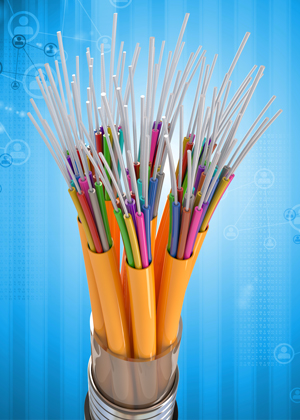
Telecommunications, the genesis of computer to computer connections, was historically built on twisted pair copper wiring. That era is essentially over. The remaining T1 lines and DS3 coax are relics of an earlier day and will soon be moved to the recycling bin. Not only have they been eclipsed in bandwidth, but the infrastructure buildouts now are based on multi-strand fiber optic cables.

Fiber historically has been expensive and rare. That changed with the introduction of Ethernet over Fiber or EOF services directly compatible with today’s most popular computer networks. Fiber optic Ethernet has the widest availability of bandwidths and the lowest cost per Mbps or Gbps. In many areas, fiber is available to just about every business location and in others it soon will be. As you drive down the road you can see crews installing underground fiber conduits in both business and residential areas.

Where Do You Want to Connect?
The most popular connections are to the public Internet. This is a must if you are going to communicate with customers and suppliers. You can also use the Internet to connect to cloud services and link multiple business locations. The beauty of the Internet is that it is already built-out to connect just about everyone, everywhere. This makes worldwide connections fast and inexpensive.

While the Internet itself is a shared network that doesn’t favor one user over another, you can improve your company’s connection by using dedicated instead of shared access. A DIA or Dedicated Internet Access line is a private connection between your business and your Internet Service Provider. It lets you avoid the congestion that can occur when you are sharing access locally with many other business and consumer users.

Dedicated Cloud On-Ramps
Productivity is key to any business. If a key element to your productivity is provided by cloud services, you may be plagued with varying slowdowns and even dropouts caused by a congested Internet not able to keep up with the massive flow of data between you and your cloud provider. The solution is a direct line between your network and your cloud service provider. This is called a cloud connection or cloud on-ramp. It shields you from competition for bandwidth from other users. Such a dedicated leased line can make the cloud server perform like it is right down the hall.

Multiple Locations on the Same Network
Within your building, you have complete control of your LAN that connects terminals, PCs, printers, storage and so on. With multiple locations, you need some way to connect their networks, since they can’t all be on the same LAN… or can they? Dedicated fiber optic bandwidth can go a long way to creating the perception that all of your users, and perhaps some customers and suppliers, are on the same network with the same performance. This is usually done with a central hub and separate links to each location. For vastly separated locations, you can also achieve similar performance with a dedicated link to a MPLS or Multi-Protocol Label Switching network that provides regional, national or international coverage.

How Fast is Fast?
While single Megabits per second was once considered speedy, It doesn’t cut it for most uses today. Even consumers are demanding 300 Mbps, 600 Mbps or even 1 Gbps or more for their Web access and video streaming. Businesses, especially those with cloud services, must have at least this much. Entry level connections of 1 Gbps are now common. As demands increase or business size expands, 10 Gbps is a readily available and affordable service level. Once core network speeds of 100 Gbps are now being offered to businesses in metro areas and will soon be universally available.

How is this possible? Fiber optic strands have nearly unlimited bandwidth capacity. The limitation is often defined by the equipment powering, switching and terminating the strands. Wavelength division multiplexing divides one strand into a dozen or a hundred separate high bandwidth connections. Each cable may have a dozen to a hundred separate fiber strands.

How much low latency high performance bandwidth do you need? You may be surprised to find how much costs have come down the last few years. See now the availability and pricing for fiber optic connections that can grow with your business.

Click to check pricing and features or get support from a Telarus product specialist.


Follow Telexplainer on Twitter


Tuesday, August 02, 2011

As Travel Becomes Costlier, Online Meetings Look Better

In these economically challenged times, the cost of travel hasn’t improved one bit. In fact, it’s just getting more expensive and often less convenient to travel across the country for team coordination, client presentations and other face to face activities. Some of this is critical to the business, but is all of it? Couldn’t you do a better job if you could collaborate more often without the time and expense of business travel?

GoToMeeting - Online Meetings Made EasyMany companies have found online meetings to be both a money saver and productivity improver. It works especially well if you can just call a meeting anytime you feel the need to get together, without having to worry about the cost involved. You can do that with GoToMeeting. You pay one low monthly fee. You have as many meetings as you like, anytime you like. No need to coordinate with a service provider. This is a service that makes calling meetings about as simple as sending out emails.

How easy is GoToMeeting? You can set up instant meetings with a single click. You also have the option to have one-time scheduled meetings or recurring meetings. It’s just like setting up a weekly review in the conference room except that the participants can be anywhere, even traveling. Those participants can join your meeting from a Mac, PC, iPad or iPhone. The cost to them is nothing. Even the apps for their devices are free.

All someone has to do to participate is click on the meeting link you provide them via email, instant message, or even over the phone. You’ll need to give them a meeting ID verbally if you invite them by phone. Each attendee chooses whether to pick up the audio portion of the meeting by phone or by using the microphone and speakers built into their computer. Use your own toll free service or purchase integrated audio conferencing from Citrix Online Audio.

What can you do in your online meeting? It’s both an audio and visual experience. The audio conferencing allows everyone to talk and listen. While you are presenting, you can mute the participant's mics to prevent background noise. You can also record your meeting sessions for future review and reuse.

The visual portion uses your computer screen. You can chose to share your entire desktop or a specific application. There are drawing tools, multiple monitor support and the ability to transfer keyboard and mouse control and instantly change presenters. You can have a chat feature enabled for discussion while someone is presenting.

After the meeting is over, you can post it to a website or third-party video host to share with others. Review the attendance report and schedule future meetings.

The basic GoToMeeting service lets you hold as many meetings as you want with up to 15 attendees each. Need more than that? Consider GoToWebinar that also includes GoToMeeting and supports from 100 to 1,000 users, depending on the plan you buy.

Are you intrigued by GoToMeeting as a way to have more meetings for less cost, but not sure if it will do everything you have in mind? No problem. Try GoToMeeting FREE for 30 days before you buy. Chances are, you’ll consider this the best business deal you get all year.


Follow Telexplainer on Twitter

Tuesday, November 30, 2010

Bonded T1 Solution Increases Bandwidth

T1 bandwidth at 1.5 Mbps has been a staple for smaller business applications. For many businesses, a solid 1.5 Mbps download and 1.5 Mbps upload is more than adequate. Some businesses can even use an Integrated T1 solution to deliver both telephone and Internet service on the same line. But other businesses are finding that T1 bandwidth is becoming a bottleneck to productivity. They need and want more bandwidth.

A bonded T1 solution increases line bandwidth for business applications.So, what is the easiest and most cost effective solution? A straightforward approach is to add another T1 line. This doubles your bandwidth from 1.5 Mbps to 3 Mbps. But don’t just run out and order a second T1 line just anywhere. If you want to two T1 lines to work as if they were one larger line, then you’ll need to get them from the same supplier and request a bonded T1 solution. Bonding is a technical process that combines the bandwidth of the otherwise independent T1 lines.

Why would you not want your lines bonded? One reason is redundancy. If the two lines are bonded and from the same source, chances are that a fault that takes out one line might well take out the other as well. You’ll be left with no bandwidth at all until repairs are completed. Fortunately, this is usually a matter of hours at most for top tier T1 line service providers. Even so, by keeping the lines separate and from totally different carriers coming in on different wire bundles from different directions, you stand a good chance of an outage being limited to one line or the other.

Redundant lines are easiest to implement when they feed different networks. Say, half your users are on one line and half on the other. Or, you can use a device called a TRUFFLE from Mushroom Networks to combine two or more broadband lines to create one larger bandwidth. If you lose one input to the TRUFFLE, the others keep feeding the network.

Another situation where a bonded T1 solution makes sense is delivering larger amounts of bandwidth to locations where fiber optic service isn’t available or is way too expensive to bring in. You can bond 3 T1 lines to get 4.5 Mbps, 4 T1 lines to get 6 Mbps, 5 T1 lines for 7.5 Mbps, 6 lines get you 9 Mbps, and bonding 7 T1 lines will deliver 10.5 Mbps. That’s equivalent to basic Ethernet network speeds and is more than enough for applications like video conferencing and broadband Internet access for medium size companies.

Bonding this many lines often makes a lot of sense for companies located in rural areas or just far enough from Metro Ethernet service that fiber isn’t practical. That includes WISPs (Wireless Internet Service Providers) and rural medical centers, as well as office buildings of all types. T1 line service is available just about anywhere you can get telephone service and is provisioned on the same type of twisted pair cable that brings in analog or digital phone lines.

Finally, a bonded T1 solution can provide short term connectivity while fiber optic service is under construction. In most cases, the copper wiring to support bonded T1 bandwidth is already in place. A service provider only needs to install customer premises termination equipment and provision the service. Once fiber has been brought in and turned up, you can discontinue the bonded T1 connection or keep it as a backup service that will be unaffected by faults in the fiber optic network.

Can you business benefit from a fast, reliable T1 based bandwidth service? Check prices and availability for a bonded T1 solution now. If you have an older T1 line contract, you may find that you can get more bandwidth for the same money today.

Click to check pricing and features or get support from a Telarus product specialist.


Follow Telexplainer on Twitter

Monday, November 08, 2010

How Bandwidth Can Affect Productivity

Many companies are finding themselves in a decision process about how much bandwidth to order. For the most part, it’s so many dollars per Megabit per second throughput. There are ways to actually get more Mbps for your bandwidth dollar, and I’ll tell you about that in a second. First, though, let’s see if there is a relationship between your network bandwidth and employee productivity.

Bandwidth vs Productivity. Click for options.If your only bandwidth connection is a broadband Internet service that employees use to sell personal items on eBay or play Farmville when the boss isn’t looking, you might argue that less bandwidth would be a productivity enhancer. In fact, you’d be better off disconnecting from the Internet completely. But most companies can’t do that anymore. They are completely dependent on both internal data transfers and connections to the Internet in order to conduct business. Still, what is the right level of bandwidth to install?

Let’s use an analogy to see if we can figure this out. Suppose you have a office full of sales agents. This is certainly true of insurance firms and real estate brokers. It’s also the case with many other types of business. Now, let's install one wall telephone for every two dozen agents. How much sales volume would you expect to be generated?

In such a case, you’d probably find that the telephone set would never get cold. There’d be a line of agents urging whoever was on the phone to wrap up the conversation and give others a chance. If these were salaried sales people, you’d be losing money in buckets. If they were commissioned sales people, the ranks would soon thin out from a steady stream of resignations.

Obviously you want to manage the productivity of your scarce resource, which is the skilled sales agent. You’d give them each a phone and perhaps both a desk phone and a cell phone. How about the number of outgoing phone lines? You’d install enough lines that there would rarely, if ever, be a busy signal.

This is an easy example because there is a clear connection between sales agents being able to make phone calls and the amount of revenue the company generates. It’s also generally acknowledged that high producing agents are far more expensive than telephones and phone lines. But what about other employees? Does this analogy translate to other activities?

Of course it does. It’s just when you have dozens or hundreds of employees doing all sorts of tasks, it’s harder to nail down the cost of lost productivity. You should try, though, because the loss is there just the same. Any time someone has to wait for a file transfer or access to a Web site they need to do their job, you have minutes of productivity vaporizing.

Multitask, you say? Sure, people do that all the time. If they know that it takes 15 minutes to download a particularly large image file, they might do something else while they wait. But what if it takes 15 seconds? Chances are they’ll sit back and relax or converse with someone at the next desk. Worst of all, what if your network performance is so variable that you have no idea if you’ll get that file in 15 seconds or 15 minutes? Do you start another task only to be immediately interrupted or cool your heels only to find that you’re doing nothing for the better part of most hours?

The problem is probably more insidious because these are extreme examples. In most cases, the wasted time is probably more like seconds than minutes per task. But multiply that lost time by the number of employees every day for a month and you might be surprised by how much it costs. Now, compare that cost to what you are spending on bandwidth per month and see if your telecom bill still looks outrageous.

To go a step further, consider how much more you might accomplish as an organization with more sophisticated tools that are also more dependent on Internet or cloud network connectivity. It’s a tradeoff between the cost of automation plus ongoing bandwidth & maintenance charges versus the cost of bodies in seats to accomplish the same thing. It makes no difference if your bandwidth costs are a few hundred dollars a month, a few thousand or tens of thousands. It’s what you are accomplishing for the money spent that counts.

Now, as promised, I’ll let you in on a little secret about the cost of bandwidth. It’s not the same for everyone. Pick out 10 companies, each with a T1 line or an OC3 fiber optic service, and you’ll find they’re paying 10 different lease prices. Why? Partly this due to the fact that the price of bandwidth is always changing but line leases are for a fixed time period. You also pay less if you sign a 3 year lease than if you hedge your bets and only commit to a 1 year lease. But the biggest cost differences come from what type of bandwidth service you order and who you buy it from. This can result in a factor of 2x or more in the cost of the same Mbps from one company to another.

How can you be sure you are getting the best rate on your voice or data bandwidth services? More competition is better, so using a broker who has relationships with dozens of service providers helps insure that you didn’t miss a big price break because you only got quotes from one or two carriers.

Also be sure that you compare all means of connectivity appropriate to your business. Did you know that you can get twice the bandwidth for the same money if you order Ethernet over Copper versus T1? They’re both professional grade telecom services, but one is cheaper than the other if it’s available for your location. There are copper, fiber and wireless options available for most businesses. Some services offer broadband and telephone on the same connection for a cost savings.

If you are losing money because your systems are bandwidth limited or you suspect you are paying more that you should for a particular level of service, then by all means get current competitive bandwidth quotes and see what’s available. You can do this quickly and easily through the Telarus telecom brokerage service and get complementary consulting help as well.

Click to check pricing and features or get support from a Telarus product specialist.


Follow Telexplainer on Twitter

Friday, June 25, 2010

What Is Lowering Gigabit Ethernet Bandwidth Pricing?

If you have recently gone out for quotes on Gigabit Ethernet bandwidth, you may have been surprised by how much prices have dropped the last few years. That’s one pleasant surprise for organizations that need higher levels of business bandwidth for cloud computing access, e-commerce, medical image transmission, video distribution and the like. But is this for real and what is driving these prices lower?

Gigabit Ethernet Bandwidth prices have been reduced. Check pricing and availability now.Yes, it’s for real alright. In fact, bandwidth services across the board can be had for a fraction of what you may have paid when you signed your last service contract. That applies to everything from T1 lines to DS3 connections and on up through OCx SONET/SDH fiber optic bandwidth. It also includes competing services like Ethernet, Fast Ethernet, Gigabit Ethernet and 10 Gig E. Plus multi-location cloud networks like MPLS. They’ve all dropped in price. But the cost per Mbps is often most dramatic for Ethernet services.

What’s behind the lowered prices? Two factors can be credited. First is the move from traditional switched circuit transport technologies to packet switched IP networks and services. Second is new levels of competition.

Both legacy service providers, the telephone companies, and new competitive carriers have built-out extensive networks based on IP or a networking technology that embraces IP, such as MPLS or Multi-Protocol Label Switching. You can thank the Internet for that. The enormous volume of equipment and services to support near-universal demand access to the Internet has decreased the price of Ethernet and IP networking to a fraction of what it costs for competing technologies. The entire world is going to packet switched networks based on Internet Protocol.

When every LAN is running Ethernet, it just makes sense that the most efficient way to connect all those local area networks is with an Ethernet connection. Ethernet over Copper lets you do this from typically 3 Mbps on up to around 50 Mbps. Ethernet over Fiber is good for 100 Mbps Fast Ethernet, Gigabit Ethernet, and even 10 Gigabit Ethernet. Gigabit Ethernet is becoming a requirement for medium and large companies depending heavily on high productivity enterprise software or distributing media content, such as video. At the very highest levels, even 10 GigE is no longer out of the question.

The move from legacy telco technologies to IP based fiber optic networks has brought new players into the marketplace for WAN networking services. These competitive carriers have built their own regional or national fiber optic networks and established colocation facilities and points of presence in most major cities, even some mid-size cities. They can often bring their own fiber into business locations and bypass the telephone companies completely. Now instead of one option for service, you may have several or more even at the Gigabit Ethernet level. That spells competition and competition leads to lowered prices.

Could your organization benefit from the recent cost reductions in high bandwidth networks services? Don’t shake your head no until you check current prices and availability for Gigabit Ethernet bandwidth services and other bandwidth offerings. At the very least, your next service lease could cost you less than the one you have now.

Click to check pricing and features or get support from a Telarus product specialist.


Follow Telexplainer on Twitter

Thursday, July 09, 2009

Rural Broadband Stimulus Hopes To One-Up Dial-up

Just before the 4th of July holiday, the long-anticipated rural broadband stimulus funding was launched with release of the official government "Notice of Funds Availability (NOFA) and solicitation of applications."

If you want to get in on the action, you best get a move on. Applications are only being accepted between July 14 and August 14 of this year, 2009.

As a potential user rather than a provider of broadband services, you'll have to wait awhile longer before you can expect a nearby on-ramp to drive your buggy onto the information superhighway. Yes, buggy not sports car. If you've been eagerly anticipating FTTF (Fiber to the Farmstead), you may find the definition of broadband a bit disheartening. The bar has been set at a breathtaking speed of 768 Kbps download and 200 Kbps upload to meet the criteria of "broadband" Internet service.

Why such a poky broadband standard when AT&T and Verizon are slugging it out to see who can deliver 50 & 100 Mbps to the most residential users where their U-verse and FiOS services, respectively, are in a feverish construction phase? Simply because some people way-out-there are lucky to get 56 Kbps dial-up modem service on their telephone line. The idea is to get universal digital service in the same way that we've finally gotten universal telephone service and rural electrification.

The one difference is that electricity and telephone service standards are the same everywhere. There isn't one set of standards for city dwellers and another for those in the boonies. But broadband is a different animal. It's always been tiered service, with those who live in denser populated areas and willing to pay more getting to go first class.

Perhaps this is the natural difference between mandated universal service and the workings of the competitive marketplace. I've argued before that broadband should be treated like a utility. Even more than that, it should be considered a strategic infrastructure for the country. Broadband is a lot more than the amusement value of YouTube and Twitter. It's about the commercial value of online shopping, working remotely, and creating value with new Web services. It's about the educational importance of having an immense library at your fingertips that would have stunned Andrew Carnegie, as valuable as the bricks and mortar libraries he donated were to earlier generations. It's about the democracy of collaboration to advocate for a cause or support a political candidate on the other side of the state or the country.

The commercial marketplace will never be all-inclusive. It's profit driven. Where the numbers look good, the infrastructure will be built and the head-to-head competition will be brutal. Areas where the population is too thin to recover capital costs in a timely manner are simply passed over. You can see this today even with cellular phone service. In the city there may be a carrier branded cell phone store on nearly every corner. But drive out where the highway turns into a cow path and you'll find gaping holes in the service footprint. No bars in these places unless they're country taverns.

The opportunity that may be missed here is the chance to lift the entire population to a new plateau. That may sound a bit fanciful, but consider the downward slope we've been on as a society from our post-WWII productivity and world dominance high. The national debt is through the roof. The auto industry nearly died this summer. The banking system had to be brought back from death's door this spring. Anyone looking to "upgrade" their house or job this year? Hanging-on is the new moving up.

We've been told repeatedly by industry and government officials that we're competing in a new world marketplace. Just what tools do we have to compete with? If this is the long anticipated information age, many of us are going to miss it. We going to miss the knowledge jobs. We're going to miss the massive productivity multiplier that instantaneous collaboration offers. We're going to miss the opportunity to live where it's beautiful and still participate in the 21st century economy. We're going to miss the next leg up in technological progress that will be based on video instead of text. We're going to miss it because 768 Kbps is a pittance, not a stimulus.

Hopefully, the minimum will not become the standard and the builders of the rural broadband initiative will exceed expectations, giving us something of real value for our $7.2 billion. Perhaps your company will be one of those that wins a grant to trench fiber or put up a WiMAX tower. If so, I hope you'll think big and set the performance standard high. As a society on the edge, we truly need the best you can possibly do.


Follow Telexplainer on Twitter

Thursday, January 15, 2009

Fiber Is The New Infrastructure

Infrastructure rebuilding dominates the news these days, as roads, bridges, water and power systems creak and fail with age. Major investments by both the private and public sector will be required for decades to modernize the national infrastructure. But along with simply refurbishing the facilities already in place and adding new capital, such as green energy, there is another infrastructure component that needs to be put in place. That's fiber optic broadband.

Fiber optic transport for voice, data and video is no longer an elite service for carrier backbones and specialized applications. It should be treated as a basic necessity for the business of the twenty first century. Wireline was adequate for the last century. This century needs telecommunication pipes that are transparent for the high bandwidth applications that will be in demand by both businesses and consumers. A few Mbps won't do it. What is considered fast today is going to seem as archaic as dial-up Internet access in a decade or two. There's really only one technology that has the potential to meet any need we can throw at it. That's fiber optic.

But infrastructure? How can you justify something like high speed Internet service as infrastructure? Easy. Business is more and more electronic in nature. It's also more and more interconnected than ever before. Do you still send contracts and drawings through the mail? How about purchase orders? Do customers still write letters to your customer service department starting with "Dear Sir or Madam"? I didn't think so.

It's happened gradually over the last 20 years or so. First came email, then Websites, then online shopping, electronic data interchange, CAD/CAM, and WAN networks as extensions of internal LAN computer networks. Now there's increasing pressure to implement electronic medical records and electronic every other record. That doesn't mean scanning-in paper records, storing them on disk and then printing them off when you need to review or mail a copy. It means electronic from inception through the entire life cycle of use and storage. With the right tools we may soon see the long heralded arrival of the paperless office as well as the paperless hospital, factory, warehouse, school and government agency.

There is tremendous productivity to be gained by making our business systems more electronic and more interactive. But you can't do that with a creaky old wireline telecom infrastructure. No more than a modern factory can run on line shafts powered by water wheels or steam engines. Electricity made the Twentieth Century. Fiber will make the Twenty First.

There is a lot of room for government support in building out a truly universal fiber optic communications infrastructure that will reach out into rural areas and permeate every building the way twisted pair copper wiring has become ubiquitous over the last hundred years. But private industry can make a certain amount of this happen on its own. The opportunity is obvious for greenfield projects such as new industrial parks or office buildings. In fact, it is almost irresponsible not to wire these projects with fiber optic cabling throughout, along with high bandwidth connections to the Internet and competitive telephone service carriers.

Savvy developers know this now and recognize the competitive advantage of offering their clients fiber optic broadband services as well as power, light, water, gas, sewer and roads. Fiber broadband can even be a profit center if the facilities manager contracts for the service and then resells it by the Mbps or Gbps. The higher the bandwidth, the lower the price per Mbps. Buying in bulk and then reselling at competitive rates can easily net a handsome profit on monthly lease rates. To explore this possibility, all you need to do is ask a friendly telecom consultant. You'll find a toll free number and online pricing engine available at GigaPackets.com.

Click to check pricing and features or get support from a Telarus product specialist.


Follow Telexplainer on Twitter

Tuesday, December 02, 2008

More Bandwidth, Less Money

What does every business want employees to provide? Higher productivity. The usual quip is "do more with less." Well, how would you like to really get more for less? You can do that with bandwidth. You get more Mbps from your WAN connection and pay less. Sound interesting?

I'll limit this discussion to WAN or Wide Area Network bandwidth, although it can easily apply to LAN or local networks as well. If you want to explore possible cost savings for your in-house networks, take advantage of the VAR Network to locate contractors in your area that have this expertise.

So, how is it possible to get more bandwidth for less money? Conventional wisdom is that the more Mbps you use, the more you pay. That's still true as a rule. But what makes you think you have the optimum solution now? Chances are you are paying more than you need to under your current contracts. Once you see what you may be missing out on, you'll have a tough decision to make. Either pay less for your current bandwidth usage or pay the same and get a higher bandwidth level.

The first thing that you may be missing out on is a true competitive marketplace for your communications services business. Many companies simply call the local telco or check the Yellow Pages to find somebody that can hook them up for voice and data line service. That will get you up and running, but the chances that you are getting the optimum pricing are unlikely.

What's a better way? Use a telecommunications broker like Telarus, Inc. to research the available options for your location and get you the best deal. You can access this service by calling a toll free number or using the GeoQuote (tm) online search tool available at T1 Rex. This service is available at no cost for companies with a valid business address and telephone number in the United States. What will Telarus do that you can't? They'll access a dozen or more competitive carries and get you an list of competitive quotes prioritized by lease price. They'll also work with you to better define your requirements if need be.

You know yourself that having a dozen offers to choose from is better than having just one place to shop - especially when that provider knows they are the only game in town. Well, they may not be the only carrier that services an area but perhaps the easiest one to find.

Here's another thing you may be missing out on. There are newer bandwidth services available that might not have been offered in your area even a year ago. Two that come to mind are Wireless Fixed Internet access and Metro Ethernet. The Wireless offering is an alternative to DSL for smaller businesses and is available in most business locations. Metro Ethernet offers high bandwidths for less cost per Mbps that competing services such as DS3 or SONET fiber optic. If your requirements are under 50 Mbps, you may be able to get EoC or Ethernet over Copper transport that doesn't require the expense of new fiber installation.

So how do you find out whether these new options or others may save you a bundle? Once again, just use the GeoQuote (tm) online search tool. Some types of services will give you an instant price online. Others need a little more investigation, but you'll soon get a reply from a friendly Telarus consultant. Chances are, you'll soon be enjoying more bandwidth for less money.

Click to check pricing and features or get support from a Telarus product specialist.


Follow Telexplainer on Twitter

Thursday, July 24, 2008

Don't Layoff Employees, Evict Them

The life of an employee today is one of feast and famine at best. In good times you have way too much work to do and fear for your job if you complain. In lean times you have way too much work to do and fear for your job regardless of what you say. Layoffs are always looming like a dark shadow over the organization. But what if you could be evicted rather than laid off? Wouldn't that be better?

I know what you're thinking: "This is nuts." Getting kicked out of your home is certainly no better than getting kicked out of your job. But that's not what I'm talking about. The idea gaining popularity among managers is to evict employees not from their homes, but from their offices. You stay on the payroll. You just don't set foot on the premises. Oh, and you have to get your job done too.

The popular term for this is telecommuting. The idea is that many, if not most, employees of today's information intensive companies can work just as well from home. In some cases their productivity soars because the opportunities to socialize with other employees disappears and they aren't trying to remotely manage a myriad of personal concerns, such as child care.

Think about it. How much of your workday do you spend sequestered in a cubicle staring at a video display and pecking away at a keyboard? Or, how much of your time is spent on the telephone while perhaps also using a computer? Is there really something sacred about the hallowed ground of the corporate center that makes it imperative that you sit there and only there to do the job? Probably not.

But what about meetings? You have to have meetings or you're not a team. Yeah, right. How much of those meetings are a complete waste of time, as you wait for all the members to saunter in and quiet down. The rest is also a waste of time or could be handled via email, Webcast, teleconference or video conference.

But what about supervision? Everybody knows employees work harder when the boss is breathing down their neck. Yeah, right. If a job can be measured and status objectively tracked and reported, there is no longer a need for the long arm of intimidating management. There is still a need for training, coaching and evaluation. Some of that is still best done face to face and can be scheduled for office visits.

By having employees visit the office when needed instead of squatting there in dedicated personal space, the need for expensive real estate is dramatically reduced. With less floor space required, there is a proportional reduction in heating, cooling, plumbing and lighting expenses. What replaces those is a telecommunication expense that's just a fraction of the expense eliminated.

Telecommuting has been used as a "perk" for trusted employees to give them more flexibility in their schedule and hopefully keep their critical skills on staff. But now it's becoming a cost saving strategy for the many rather than only the chosen few.

The company sets up telephone communications and broadband Internet, often with VPN software to maintain security. An MPLS network can provide many to many connections with a higher degree of performance and reliability than your typical residential broadband services. Some employers also provide computing and telephone equipment just like they would if you were on premises.

Other businesses are organized as "virtual companies" from the get-go. There is no corporate center. Instead, all of the team members are on a virtual PBX telephone system that works just like a business phone system with users scattered around the country. Customers and suppliers have no idea the operation is distributed because they still dial a central number and even have "virtual" operator service.

Click to check pricing and features or get support from a Telarus product specialist.


Follow Telexplainer on Twitter

Wednesday, April 23, 2008

Telepresence as a Service

Just as telephone means sending your voice at a distance and television means pictures at a distance, telepresence means projecting yourself at a distance. It's not quite the Star Trek technology of beaming yourself physically from one place to another, but it might be close enough for business purposes. Now that Cisco and AT&T are teaming up to offer telepresence as a managed service rather than a capital expense, could the floodgates be opening for the virtual business call?

Telepresence has its roots in video conferencing. I remember using video conferencing in a large enterprise a decade ago. It wasn't pretty. The system was telephone based with a conference phone on long table and a video projector showing the feed from the far end on a pull-down screen. Images were fuzzy. To get everyone in the picture you had to widen the camera angle so far that it was hard to see facial expressions. Movement? Ha! I think we saw better full motion video from the Moon landings.

The real problem with telephone based video teleconferencing is that there's really not enough bandwidth to get the job done right. Even with 128 Kbps available through ISDN BRI phone service, video looks a long way from realistic. But now that broadband connectivity is ubiquitous, the door is open to high quality voice, video and data sharing. Cisco has been the big player in capitalizing on this new capability and at just the time it is needed most.

The best friend telepresence has is $100+ per barrel oil. High fuel prices are already stifling consumer travel. How much longer before they kill business travel? Not completely, of course. There are some situations where you positively have to meet in person to close the deal. But can you really afford to keep sending teams of a dozen participants to present a business case or attend a professional seminar? How about when you'd like to get together and hammer out some engineering details or contract clauses, but you're in New York and they're in Los Angeles and you'd really like to have things wrapped up by 5 PM? When it's now 2 PM?

What telepresence does is bridge the gap between physical locations for most needs. Cisco's approach has been to emulate the conference room table by dividing it half. Your half, on either end, is still a physical wood table. Their half, also on either end, is one or more high definition video screens with wide band audio. The scene is designed to fool the eye and ear into believing that your colleagues 3,000 miles away are right there on the other side of that conference table. As long as you don't try to pass a pot of coffee or plate of cookies over there, you might just be able to maintain that illusion indefinitely.

The beauty of a telepresence system is that goes beyond just shaving the cost of business travel. The additional leverage of being able to meet virtually at any time with participants from almost anywhere can more than offset the disappointment of not being able to get out of the office and go visiting, depending on how you feel about business travel. Another bonus you gain is all that downtime riding on buses and getting your shoes screened at the airport is recovered. If time is money, the value of additional productive hours may even exceed the bottom line on the expense report.

Up until now, there have been two giant hurdles to improved teleconferencing. One has been the inherent bandwidth limitations of trying to feed anything but phone calls down a phone line. That's been solved by broadband connections, either dedicated Internet VPN service or point to point private networking. Cisco estimates you need 1 to 5 Mbps to support their TelePresence system. Most larger companies have that now with T1 lines (1.5 Mbps) and DS3 connections (45 Mbps). Carrier Ethernet at 10, 100 and 1,000 Mbps makes the high definition conferencing option even more compelling.

The other hurdle has been cost. With specially designed and outfitted conference rooms needed to get the real value from Cisco's TelePresence, the capital expense has been appropriate only for the largest of corporations. Perhaps that barrier is also going to fall. Cisco's partner AT&T has the worldwide IP networking capability to provide the bandwidth. Cisco can provide the dedicated hardware. Companies can pay as they go using this managed service without having to risk huge amounts of construction capital when they're not so sure how much they'll really use it.

On a smaller scale, desktop and small meeting teleconferencing is proving popular for virtual workgroups, online enterprises, and sales training. Many of these are Web conferences with audio teleconferences supporting the slide shows and computer presentations. The cost is low enough that even the smallest companies can afford a service such as GoToMeeting or GoToWebinar.

Do you need help upgrading your audio and video conferencing equipment? How about improving your network WAN bandwidth to support communications with your employees, customers and suppliers? Being agile with your electronic conferencing capabilities offers the potential for faster response time, travel cost savings, and a greener approach to running your business.


Follow Telexplainer on Twitter