Desktop BSD

It seems to me now that all the BSDs are server OSes that some really smart people are adapting to the desktop. Perhaps years ago all the existing Linux OSes were the same way until some smart people started making desktop OSes out of them.

Linux has had years to make the adaptations, while in the BSDs the process is still pretty recent, and perhaps just hasn’t had the time to truly become a desktop OS. GhostBSD comes closest of all, and is free of corporate BS, systemd, Xorg,and other corruption. But in order to make it work on the desktop, they’ve had to add “Linuxulator” (a dev’s name for the Linux Compatibility Layer) – complete with some systemd elements!

I sure wish them well in their efforts and I still donate to the project, but too many things don’t work as they should on my hardware. Perhaps if I had a super-razoo machine with all the cool resources and special requirements, I could run it as a desktop reliably and fearlessly. Dangit. I really wanted it to work reliably because of it’s “ethical purity” for lack of a better way to put it, but so very much depends on hardware compatibility for now.

My quest for a fully-“ethical” Linux distro so far has always landed me in trouble of some sort or another, breaking stuff and fixing it, keeping a journal of what I did and what resulted, but alas, that journal was destroyed in the last GhostBSD eff-up. I didn’t think a full back-up was needed since I was only making minor little changes to the UI, but there it is.

My trouble is I care too much about the “ethical purity” of an OS to actually make good use of it yet.

Void Linux intrigues me but I think I’d only get in trouble again playing around with it.

It Wasn’t Broke, So They Fixed It

We ‘nixers like to pretend that we’re all about software freedom and that we somehow hold the high moral ground because we’re on about Free and Open-Source Software (FOSS). But we’re on shaky ground to make such claims to begin with unless we employ no multimedia codecs, no proprietary firmware, and use only the libre Linux kernel (having no “non-free blobs” in it’s code). Very few of us do. Because if we did, our computers wouldn’t boot, we couldn’t watch videos, play games, or listen to music. There’s no small hypocrisy in our boasting about our higher morality and greater “freedom.”

I’m not sure what compels Linux distribution developers to keep fixing what ain’t broke, but until last month I always recommended Linux Mint to beginners because it “just works out of the box” and the design made sense and the OS stayed out of your way so you could get stuff done. I can’t recommend any of the old favorites: Ubuntu, Linux Lite, or Linux Mint any more. Every time they fix stuff that ain’t broke, they add new complications and new unintended consequences. If there were TV commercials for these Linux distributions, they’d have to include disclaimers like:

Side effects may include sudden breakage because some package upgraded but one of it’s many dependencies depreciated … your hard disk drive may become choked for storage space because the journaling init/supervisory software keeps detailed logs of absolutely everything that happens on your computer … we may suddenly and completely change our way of doing things, like abandoning the long-standing, time-tested, proven and reliable APT system in favor of a completely new and experimental way of managing packages which may include Appimages, Flatpaks that take up a zillion gigs of storage space, and more. We know you’re a beginner, so we figure you won’t even know that you’re an unwitting lab rat while we beta test software in a distro intended for beginners. Ask your IT guy if Linux Mint is right for you!

It’s new and shiny so it must be awesome! Most of the time it doesn’t turn out that way. Linux Mint has replaced APT and Gdebi with something they call “captain.” It sounds a lot like what systemd is aiming for: To replace APT and other time-honored package management tools with something else and make all applications “distro-agnostic,” as they say. This would make software repositories obsolete and we’ll all do it like Windows users have to: Download apps from some web site and install using this universal software standard. Big money saver for the developers, but chaos for users.

This shows one of the biggest reasons to have a serious look at the BSDs instead of Linux, besides the fact that Linux – right down to the kernel itself – has become corrupted and compromised by big corporate money and government interference. More and more Linux distros have “gone woke” like Mozilla and now Debian. That almost always results in decline and disaster for a project, when the skin color, political persuasion, and/or the sexual identities and orientations of the coders and maintainers matters more than the code itself.

But besides that: Linux is “just the kernel” and a distribution is the kernel with a bunch of third-party applications tied on and held together with duct tape or something. The BSDs are fully integrated, designed to operate not as a hodgepodge of independent daemons, applications, libraries, desktop environments, and process-managers, but as a single, efficient operating system without conflicts between independent parts with separate requirements and processes of their own. That must be the reason that GhostBSD was so unbelievably fast and nimble on this old hardware. Faster than any Linux distro on this machine.

What Linux needs is a DOGE audit and some Executive Orders (better yet, legislation) making “wokeness” irrelevant. Focus on the friggin’ code, y’all, and forget what color and gender the coder might be.

Your First Non-Microsoft, Non-Apple OS

In spite of my moderate-to-severe technophobia (to quote all the TV commercials), I have come a very long way from what we call “beginner’s” operating systems other than Microsoft Windows and iOS (Mac). Lately I have ventured even out of the Linux world into one of the BSDs. But I’m still every bit as paranoid of the terminal as I was the day I started this journey years ago. I want to point and click as much as possible, not type commands. And I want to run applications, not the operating system! I’m really not the computer hobbyist people suppose, even though I blog about this stuff regularly.

I still get asked what operating system I recommend for beginners, and until pretty recently I would recommend either Linux Lite, Linux Mint, or MX-Linux hands down without question. The only reason I hesitate to whole-heartedly recommend them now – and I’m going to catch some flak for this I’m sure – is because these great OSes have strayed so far off from the ideals and ways of doing things that made them great to begin with. Where once upon a time it mattered how they put together a great product, now the means have changed – which inevitably changes the ends. The old adage remains true: The end does not justify the means.

Non-free software and proprietary “blobs” (a tech term) get thrown into a product that is billed as “free and open-source.” Perfectly good and truly free and open-source software is replaced by the quick and easy solutions offered by Big Tech companies whose software becomes a dependency for just about everything else in the whole operating system to work. “This won’t work without systemd,” is what the developers say, but it isn’t true. Consolekit worked as well as elogind (a component of systemd), but it’s “old.” Old doesn’t mean obsolete, however. Old usually, in this context, means it did it’s one job and did it well. But Big Tech’s goal is dependency. One software to do multiple jobs instead of “do one job and do it well.” Big Tech owns Linux now. Billions of dollars flow into the Linux Foundation from Microsoft, IBM, Oracle, and other giants. They sit on the Linux Foundation’s Board of Directors and pay Linux Torvalds a million dollar salary. Put two and two together, y’all.

A handful of Linux distributions actively resist the DEPENDENCY game that Big Tech / Linux Foundation is playing upstream. And among that handful of Linux distributions, the best for beginners, by far, is PCLinuxOS. It still follows the old ways. The UNIX way. The pure and bold and time-honored way.

For some reason they call this”the Boomer Distro.” Maybe it’s because they follow the “old” ways. Boomers are supposedly old, but dangit, these guys work hard and make and maintain a superb “beginner-friendly” operating system that has all kinds of advantages.

It’s “rolling release:” Which means it doesn’t have to be re-installed every 2-5 years like Linux Lite, Linux Mint, the ‘buntus, Debian and it’s derivatives like MX-Linux.
It’s systemd-free: Not even a hint of that evil, intrusive, One-Ring-to-Rule-Them-All DEPENDENCY imposed by the Big Tech / Linux Alliance of Evil.
It’s well supported. The documentation for this OS is second to none, and the folks in the Forums are friendly, knowledgeable, and helpful. Just like most boomers.

While GhostBSD is my daily driver these days, I keep PCLinuxOS (Xfce edition, naturally) on a separate hard drive just for the cool tools that rival anything MX-Linux and the others have to offer. Cool tools that are simply not available in FreeBSD / GhostBSD yet. Also, since even GhostBSD doesn’t play nice on some hardware (compared to Linux, that is), your first non-Windows, non-Apple operating system should be PCLinuxOS! Find it here!

Robin’s New Favorite

It’s Christmas morning here, and more than presents or just about anything not having to do with the real meaning of Christmas, I looked first at my new favorite operating system to check for updates and new posts in the forums. And it occured to me out of the blue, that I haven’t even booted into my former favorite OS since I first started testing GhostBSD about a month ago!

Instead I have been busy doing things that used to scare the heck out of me, and now I find that I’m doing them with utmost confidence and speed because I don’t worry that I’m going to permanently and irretrievably bork my computer with experimentation, trial and error (and fixing them), and never-before-tried tweaks that can be done simply, effortlessly, and effectively.

I’m still as scared of technology as I ever was! But because this is GhostBSD, I’m not so scared to try these new things because:

  • They follow “the UNIX Way.” The philosophy of UNIX includes such simple but profound things as “do one thing and do it well.”
  • The developers frequently visit the forums and are happy to offer detailed solutions without the snobbery, arrogance, and elitism found in many Linux forums.
  • All the software is vetted like crazy before being released to the users. Quite opposite of “the Ubuntu Way,” where even newbies are unwitting beta testers.
  • No bloatware! Which I define as software for the OS to use rather than for the user.
  • There’s much less chance of a universe-ending disaster from an OS that follows “the UNIX way” than for the hodgepodge, scattererd approach of a Linux OS.
  • It’s even more secure than any Linux OS.
  • It’s simpler than any of the “beginner-friendly” Linux OSes I have used (Mint, Lite, PCLOS, etc)

It has been so trouble-free that I don’t even feel like I’m learning much as I go along, but in fact I am. This is the way to learn about UNIX! Not even know that you’re learning, but gaining a lot and able, hopefully someday, to help others do the same.

A Review of GhostBSD

GhostBSD is now the official operating system of Robin’s corner of the batcave. After adjustments, it is free of Microsoft, free of Google, free of systemd, free of the corrupted Linux kernel, and free of Mozilla’s woke malware. It is a kinda-sorta rolling release operating system (upgrading is super easy when the next FreeBSD RELEASE version comes out next year). Only minimal adjustments were needed to cleanse it from all evil, by simply replacing the evil-leaning Google and Mozilla stuff with pure, simple, beautiful alternatives.

Before GhostBSD

After GhostBSD

I didn’t get the credit I should have for keeping track of evil-creep in our choices of software. It’s understandable since I’m still scared of technology. But that is exactly the reason I keep such a close eye on software! It is because tech is so scary and powerful that someone has to keep an eye on it!

The switch from MX-Linux to GhostBSD was as easy as “distro hopping” is to Linux hobbyists. Download an iso file, write it to a USB stick (notice I said write it, not copy it! Use a software program like Ventoy that makes a bootable USB “image” on a USB stick). Boot into it and bingo, up pops a “live” functioning Xfce desktop (or you can choose the MATE version if you prefer). Kick the tires like our grandparents used to do, drive it around, try it all out. It’s FreeBSD, but nice and graphical, point-and-click simple. It’s not a “persistent” portable OS like NomadBSD, meaning that any changes you make in a Live session won’t be saved to the USB stick as they would in a “persistant” one like NomadBSD. One reason I chose GhostBSD is that NomadBSD is not intended for installation to a desktop computer’s hard drive or SSD.

Security has always been a big deal to my foster dad. That’s why we switched from Microsoft to Linux to begin with. But that wasn’t near enough, as it turns out. I’m happy to report that he is delighted with this new operating system, and after he drove it around for bit and read all the research I had done to select GhostBSD, he finally agreed to make it official. He likes the name, too. It kinda goes with the whole Bat thing, striking terror in the hearts of the bad guys and stuff. Anyway:

If you like it after you’ve driven it around, made sure eveything works (sound, printer, peripherals, etc), there’s an “Install GhostBSD” icon on the desktop to launch the installer. Select a username and password, time zone, keyboard, and some preferences and off it goes. It will create it’s own swap partition and all that stuff, but partitioning the drive, while possible, is not a nice easy graphical thing in GhostBSD. I skipped all that and gave GhostBSD the whole drive. For me it installed in mere minutes and I rebooted into the familiar desktop, updated it (graphically, with Update Station), installed Plank, Geary, ungoogled-chromium (from the Software Station), and removed Firefox and Thunderbird). Plank replaced the bottom panel which I only use for launching frequently-used apps, and it has a much cooler analog clock widget than the one that goes ordinarily on an Xfce panel. The upper panel just has a calender, HPLIP (from Software Station), network stuff, clipboard thingy, PulseAudio sound controller, Whisker Menu, and notification bell. Very minimal and out of the way. Other than HPLIP and Inkscape, GhostBSD comes with all the software most people expect from a ready-out-the-box operating system.

Backups are the only thing that I found confusing, but they too are point-and-click simple once you get BSD’s terminology and such, GhostBSD’s forums are very helpful and support is usually quick and thorough. Bumps along the way before I wiped away MX-Linux were matters of just reading up on things a little bit, and FreeBSD (from which GhostBSD is built) has the very best Handbook in the universe for learning about this OS. It’s NOT LINUX! But it is UNIX-like, so it has all the advantages of it’s UNIX base including the “UNIX way” of doing things: Simple and done well.
There’s no one-ring-to-rule-them-all Overseer software journaling and reporting every little thing (systemd). No invasive spyware (once Mozilla’s crap is removed), and more than 30,000 mostly up-to-date softwares in GhostBSD’s vast repositories!

I’m a happy Boy Wonder again, and Batman and I are in complete agreement now.

My Ideologically-driven Tech Choice

In my previous post I described that my tech decisions are largely ideology-driven. I switched to Linux because Microsoft turned to the dark side and it was becoming a chore to use anyway. I switched to Startpage because Google went over to the dark side, with data mining and spyware and all kindsa evil stuff. I switched from Firefox to Brave because Mozilla went woke, partnered with Google, and took their famous browser down an ever-darkening path. ISPs, cellphone companies, all the same story – switching whenever possible for ethical reasons. My most recent post describes how Linux – right down to the very kernel itself – has also turned to the dark side. Do I still have a choice now? Microsoft is over-the-top evil, Apple is crazy expensive and also ethically challenged at points. So now that Linux has been twisted into a Microshit/IBM/Politically-correct mess, what else is there?

Glad you asked. Lookie here:
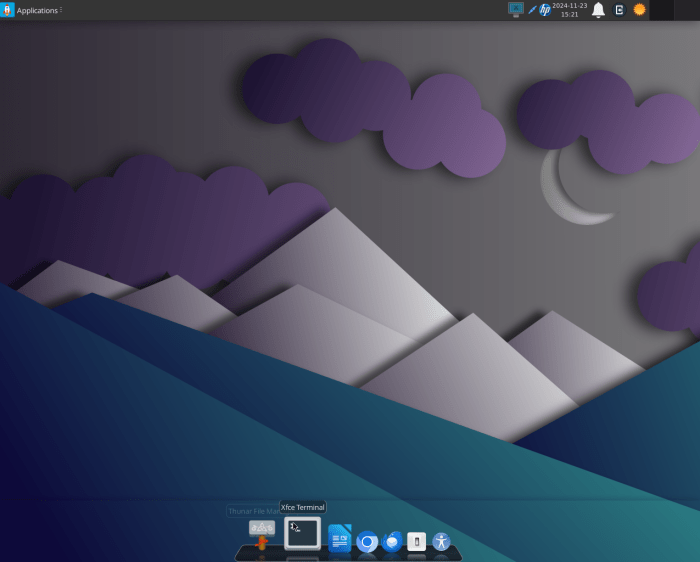
This here is GhostBSD, with the Xfce desktop and Cairo-dock tied on just for some fun eye candy. You can use whatever desktop you like in any of the BSDs, but my readers know what a Xfce fanboy I’ve become after trying most of the others. I may experiment with Openbox again, since I grew to love it so much in Crunchbang Linux years ago.

Like Debian Linux with it’s Stable and Testing branches, BSD offers Stable and Current. I always stick with Stable, being the techno-phobic boy I am, still scared that pushing the wrong button on my computer might ignite the atmosphere and annihilate all life on Earth. How did such a tech-scared user end up on BSD for cry’n out loud?

Because just like Ubuntu – before it turned crazy – made Debian Linux usable by us ordinary mortals, GhostBSD is doing the same thing for FreeBSD! It ain’t quite as simple as Ubuntu, Mint, or MX-Linux, but I’m not exactly a total novice at this stuff anymore, and merely using it one can’t help but learn a little. It’s important that we do! You wouldn’t just take off in a new car without reading the owner’s manual or at least be familiar with it’s basic features. Responsible computing means you do a little reading and research before diving in. I did that – but not much – and I still got it right the first time as if I knew what I was doing!

GhostBSD is built on FreeBSD Stable, with cool tools and GUI (Graphical User Interface, pronounced “gooey”) apps to make it simple for us point-and-click users who are taking our first steps into the BSDs. Perhaps many users move on to the other BSDs, and many – like Linux Mint users, perhaps – just stay put. I love learning, but I’m slow at it. But let me tell you what’s to love about the BSDs besides the simplicity and utility of GhostBSD:

The BSDs are faithful to “the UNIX way” of doing things. There’s no “one ring to rule them all” big-brother-like supervisory software watching and logging and evaluating every little freaking process like systemd on most Linux distributions. There’s no corporate sponsors shoveling money into the projects in an effort to buy influence or assert control – also unlike Linux, whose lead developer is paid a huge, exorbitant salary by the Linux Foundation which has been effectively bought my Microsoft and IBM. Has that money influenced the Linux kernel? How could it not?! BSD is free of that happy horse hockey. Apples IOS and Sony’s Playstation software are both built from the BSDs, didjya know that? Yeah! But they didn’t try to take over the project. At least no one’s doing it yet.

BSD is FAST on even modest hardware. I mean, zoom, zing, whoosh fast. Blazing, mind-bending speed, and it doesn’t “eat all your RAM” the way Linux does. It really is different from Linux even though they’re both built from UNIX. Linux doesn’t love it’s mother the way BSD does. It’s not what Mom hoped it would grow up to be. It forsook it’s noble heritage and embraced the dark side, lured by big bucks from big corporate players. Little does Linux know, even though it’s been warned over and over again, that EMBRACE –> EXTEND –> EXTINGUISH is and always has been Microsoft’s strategy. Linux will be assimilated, and resistance – now that it has accepted Microsoft’s money and influence – is futile.

Enjoy your glamor and fame while you may, Linux, but it comes at a great price. BSD hasn’t got the nanoprobes and can still resist the Borg. Even though there are four or five BSDs, they all share that faithfulness to UNIX and the freedom and openness it provides. The BSDs operate under a different license as well, rather than GNU, which also provides a measure of resistance to the Borg. Yet it’s still free in every sense.

Yup, it’s still all about ethics for this boy, and yes, there are still alternatives to compromising with evil.

Ideologically-Driven Tech Choices

Most of my readers know how ideologically-driven I am, even down to my choices of software, operating systems, every. Little. Thing.

  • Mozilla – makers of the most popular web browser in the history of ever – went “woke” to the point of firing their CEO for daring to express an opinion (personally, not as a representative of the company) that wasn’t “politically correct” and conflicted with the toxic “wokeism” that has infected the country. When they did this (and a bunch of other stupid things they’ve done to Firefox since then), I dumped Firefox and switched to Brave browser.
  • Goya food brands was raked over the coals for daring to support Israel against the terrorists who have always sought to destroy them. When the media did that, I dumped a favorite (and ideologically left-leaning) food brand and switched to Goya.
  • Fox News – previously a reliable source of unbiased news – decided to compromise their own credibility and neutrality and start appealing to the far left. When Fox News did that, I switched to Newsmax.

I have a long and distinguished history of making choices based almost entirely on ideology as of first importance. I won’t settle for or do business with unethical companies like Google or Microshit. Not when there are viable alternatives! And if and when there are no viable alternatives, I’d rather do without than pay anything to an unethical business. Is that weird? Excessive? Obsessive? Maybe so, but I don’t care.

Now I’m talking about more than just some little bit of software, like a single web browser among hundreds to choose from. This time it’s an entire ecosystem which is supposed to a free, open-source, globally cooperative effort to produce and maintain the Linux kernel itself. It, too, has now sold out, gone woke, and abandoned the ideals that made it great. Right down to the very core – the Linux kernel itself – it’s ideologically unsupportable for me. Here is why:

https://arstechnica.com/information-technology/2024/10/russian-coders-removed-from-linux-maintainers-list-due-to-sanction-concerns/

Linux kicked out all of it’s Russian maintainers – because they’re Russians. How dare they! And since that wasn’t enough,

https://www.youtube.com/watch?v=1Sf0epTxkTE

They have changed the Code of Conduct to preclude “politically incorrect” contributors from working on the Linux kernel.

It’s official, folks: Linux has gone woke.

I’ve been a ‘nixer for years and years! Can I actually walk away from my beloved Linux family after all these years over “mere” ideology? You bet your booty I can. There are still alternatives to choose from. And I’ve already made the switch! More about that in my next post.

My First BSD – Just for Giggles and Grins

Hi readers and fellow technophobes,

I must be crazy to even try this, but maybe I just want to be able to say I’ve done it, y’know, for bragging rights or something. For those who don’t know what a BSD is, it’s related to Linux. Actually they are siblings, whose daddy is UNIX. There are approximately one zillion and twelve Linux distributions and less than a dozen BSD distributions, unless you count the amazing MacOS, Apple’s own operating system, which is derived from BSD!

BSD is less popular and doesn’t yet offer all the popular bells and whistles available to most Linux users, but it does have some advantages over it’s sibling: The kernel is not built and maintained just by one guy trying to herd cats like Linux is. It also doesn’t have systemd, which has grown so huge that it’s actually bigger than the kernel, and has so much “feature creep” that it’s a little scary to a lot of users, who avoid it by running to Slackware or other Linux distros that don’t have it (or don’t use it even though it’s “there,” as in MX-Linux). What got to me is the Systemd head guy saying that eventually systemd will eventually “phone home” to report on how the computers it’s installed on are used. I’m not running away from systemd, not really afraid to use it (or I wouldn’t be running Xubuntu and recommending Linux Mint for newbies! But systemd may become more of a privacy concern as it continues to expand and intrude itself upon more and more subsystems in Linux. I’m kinda hoping that Debian will drop it, and the changes will filter downstream to Ubuntu and Mint, Linux Lite, and hundreds of other Debian-based distros downstream.  Now that Microsoft is jumping into Linux with both feet as well (basically buying GitHub and “taking over” the Linux Foundation, I might want to put some more distance between myself and Microsoft as well.  That is more bothersome to me than systemd, frankly.

So, anyway: TrueOS is a BSD that used to PC-BSD. It was aimed at the desktop at first, but grew to a server-side kind of OS. Rather than try to be all things to all users, some sort of one-size-fits-all thing like Ubuntu and it’s derivatives and offspring, it kinda-sorta forked into two: TrueOS for servers and Trident for the desktop. Trident will be what I’ll test-drive this week if I have time, and report on later. In the meantime if you’re curious, have a look for yourself here.

Cheers!