
The Lost, 1965. L to R: Walter Powers III, Kyle Garrahan, Ted Myers, Lee Mason, Willie Alexander
Many thanks to Mike Stax, editor and publisher of Ugly Things magazine for the excellent and insightful review of my book in Issue #45. Here it is:
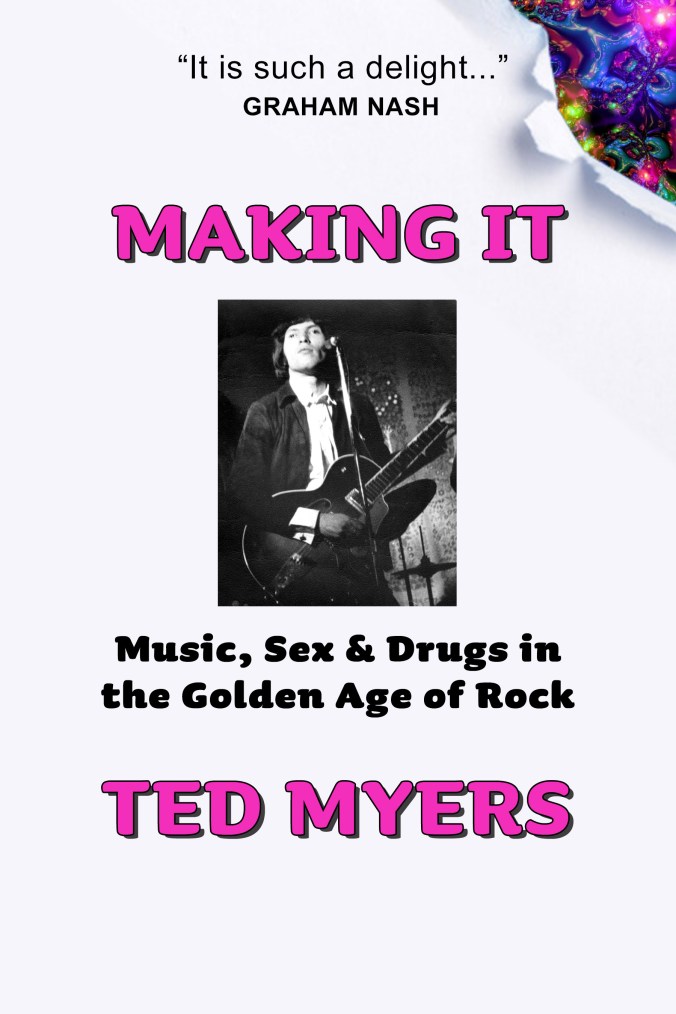
“Making music, like all art, is a crap shoot,” reflects Ted Myers. “If you don’t ‘make it,’ it’s not necessarily your fault.” “Making It” in the music industry had been Myers’ goal since the dawn of the ‘60s when he began playing folk music in the coffee houses of Greenwich Village. That quest continued in Boston in the mid-60s with the Lost, and into the psychedelic era with Chamaeleon Church (with a young Chevy Chase on drums) and the waning days of Ultimate Spinach (Myers was drafted in for the third album, after the band’s mercurial leader, Ian Bruce-Douglas was canned. It rolled on into the 1979s with a move to Los Angeles, where he attempted to find a foothold as a singer-songwriter before forming Glider, a melodic commercial rock group who had an album on United Artists in 1977, and then, in 1980, Incognito, the band he considered his last stab at “making it.”
That final stab turned out to be more like a self-inflicted wound. Incognito—who had a sound “somewhere between the Cars and Tom Petty & the Heartbreakers” (which sounds more like a warning than a recommendation)—were part of an artistically crippled Hollywood rock scene that by the early ‘80s was fueled almost entirely by cocaine. While his band struggled to attract interest, Myers was making a lucrative living. “My music career was starting to interfere with my partying,” he confesses. Over the course of the ‘80s his goal of “making it” as a songwriter and musician sputtered and died. Fortunately, he was able to break free of that lifestyle, and start a new life in the business side of the music industry, going on to work for more than a decade at Rhino Records (he was nominated for a Grammy for the 2001 box set, Washington Square Memoirs: The Great Urban Folk Boom, 1950-1970, which he compiled) and subsequently at the Concord Music Group.
Myers may not have “made it” in terms of fame and fortune, but he made it through what the book’s tagline calls “the Golden Age of Rock” with his sanity and his sense of humor intact, creating some great music along the way—especially the songs he wrote and recorded with the Lost—and with numerous memorable stories to tell. The section covering the 1960s, which will be of most interest to Ugly Things readers, and includes plenty of detail on the Lost, who Myers reflects “had the most potential to break through to the big time of any of my bands,” as well as Chamaeleon Church, the underrated pop-psych outfit that followed. Along with the music, Myers doesn’t hold back when it comes to dishing the dirt on the sex and drugs. In fact, he has something of a compulsion to over-share when it comes to tales of his sexual exploits, giving the book an occasional tinge of locker room braggadocio that I found unnecessary and repetitive. But that’s a minor distraction to what is a hugely enjoyable biography, one that proves once again that the stories of those who never “made it” are every bit as interesting and compelling as the lives of the rich and famous—and more often than not more so. —Mike Stax
 Ted Myers