Posts Tagged ‘war’

h1

§334 Is your ipod fueling mass rape in Congo?

April 16, 2009

Me – There’s a deadly conflict in Congo DRC. Deadliest since WWII they say. One of the weapons used by the rebel forces is mass rape to innocent civilians.

You – Well, what can I do?

Me – Great! That’s the spirit! What can we do, what can we do…?

The electronic things you use all the time. Ipods, cell phones, computers – where do their minerals come from? Any idea? If not, make sure they’re not from Congo. The mines there are controlled by the very forces that do these mass rapes.

Urge you Electronics Companies to Sign the Congo Conflict Minerals Pledge

I know I will.

More information about this on Michael Kleinman’s blog post of today

h1

§288 IDF Didn’t Hit School. Sri Lanka did. And Nkunda has been arrested

February 2, 2009


UN Admits: IDF Didn’t Hit School

 
by Maayana Miskin

(IsraelNN.com) During the Cast Lead operation in Gaza, IDF tank fire near a United Nations school in Gaza was blamed for the deaths of dozens of civilians who had taken refuge in the building. The incident became one of the most highly publicized attacks in the war, and led to heavy international criticism.

Recent reports suggest that the incident was not accurately portrayed by senior U.N. officials. John Ging, the director of the U.N. Relief and Works Agency (UNRWA) in Gaza, spoke to the Toronto Globe and Mail last week and agreed that no shell had actually struck the school building. Ging said he had never claimed that the school itself was hit, and he blamed Israel for confusion over where the strike took place.

Shortly after the alleged attack, Ging harshly criticized Israel for firing near the school, saying he had given the exact coordinates of the compound to the IDF. He charged that the IDF had failed to avoid hitting the building.

While admitting that Israeli fire had not hit the school compound, Ging insisted it made little difference. “Forty-one innocent people were killed in the street… The State of Israel still has to answer for that,” he said.

While many Israel news outlets reported that the strike had taken place near the school, several international media networks reported that the UN school building itself was hit. The U.N. Office for the Coordination of Humanitarian Affairs may have added to the confusion by releasing a report stating that Israeli fire “directly hit two UNRWA schools.”

Almost all reports said that the victims were primarily civilians who had fled to the school for shelter – a version of events cast into suspicion by the Globe and Mail report.

A teacher who was in the school at the time of the shelling reported that several people within the compound were injured, but that none were killed. Those killed were all outside in the street as the shells were fired, he said. Only three of those killed were students at the school, he added.

The teacher did not give his name, explaining that U.N .officials had told staff not to talk to the media.

The IDF responded to criticism over the attack by explaining that soldiers were simply responding to terrorist fire and did not mean to hit a civilian area.


Source: http://www.israelnationalnews.com/News/News.aspx/129696


You know, I made a google news search for “shell hits school”. Out of the 10 first items, 7 are about the israelis hitting the school, one (admitting, the first one – apaprently the most recent) is about that they did not hit the school.

But when UN staff in a school are exposed to military fire in Sri Lanka, that’s not top news, is it? Why is no one condemning the Sri Lankan army for this? Because they can’t prove since journalists are banned there? That happened in Gaza too. Because the Tamil tigers are crazy and evil terrorists and suicide bombers that use children soldiers and civilians as shields? That can be said about Hamas too.

http://www.nytimes.com/2009/01/28/world/asia/28lanka.html?ref=world

If you compare the conflict in Sri Lanka between the Sinhalic government and the terrorists that claim to represent the Tamil minority, with the one in Israel, the resemblance is actually quite striking. Three major differences though:
1 – The Tamil terrorists are much more well equipped than Hamas or PLO ever were. They even have planes and boats and control areas that they have conquered by force. No palestinian force has ever conquered areas from Israel. It has all been agreements (except one stupid disengagement decision in 2005 – and that unilateral withdrawal was an israeli initiative). Hamas conquered the Gaza strip by force from Fatah-PLO, not from Israel.
2 – Sri Lanka has been much less successful in protecting its civilians than Israel. Many suicide attacks in Colombo during the past few years have claimed a much higher body count than in Israel.
3 – Sri Lankan army is ruthlessly killing civilians with the terrorists, not really doing much efforts to save as many civilians as possible. Bombing schools, hospitals, whatever.

Vellupillai Prabhakaran - terrorist leader of LTTE

Velupillai Prabhakaran - terrorist leader of the LTTE

Sri Lanka seems to be in deeper problems than we. I lean towards being more pro-government, as I know that they are fighting terrorists. Still, they’re not doing it very well when they’re bombing schools and hospitals like that. I hope they take control of the area soon, capture that terrorist leader Vellupillai Prabhakaran, put an end to terrorism and LTTE and give the Tamil people democratic rights. I also hope that’s what’s going to happen in Congo now that Nkunda has been arrested in Rwanda:

http://www.zimdaily.com/news/nkunda27.6814.html

http://www.timesonline.co.uk/tol/news/world/africa/article5058019.ece

Laurent Nkunda - crazy terrorist killer or peaceful christian preacher?

Laurent Nkunda - crazy terrorist killer or peaceful christian preacher?

But I know, it’s just wishful thinking. I just don’t get this fighting between the Hutu and the Tutsi. They look exactly the same, they believe in the same religions, they talk the same languages… still the Hutu killed thousands of Tutsis in Rwanda in the genocide 1994, and the Tutsi killed lots of Hutus in Burundi in the 70’s… it just goes back and forth with new generations growing up with war and wishes to revenge for what they’ve gone through. Basically, from what I can see most african conflicts are like this:
One group wants to kill another ethnic group (Sudan government the Darfuris, Rwanda Hutu the Tutsis, Darfur rebels the government, etc). There’s a genocide, people are thrown from their homes and they flee to neighbouring countries. The neighbouring countries (whether the government or other military units around – government affiliated or rebels) either kill the refugees creating more genocide, or protect them by wagin war against the neighbour. Or protect them by killing all civilians around that belong to other ethnic groups.

If I understand Congo correctly, the killers are claiming to protect the victims of the 1994 genocide by killing the wive’s and kids of the people associated with the ones commiting that genocide? Won’t that happen again in a few years, but back again the other way around?

It’s good we have UN peace keeping troops, isn’t it? We now we can always trust them, right?

http://humanitarianrelief.change.org/blog/view/relief_from_relief_sexual_exploitation_by_peacekeepers


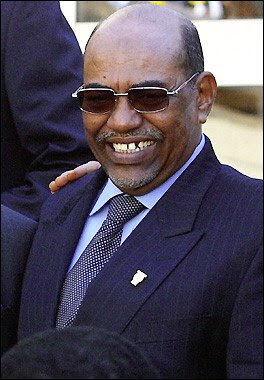
One thing that strikes me regarding the above pictures is that no crazy terrorist looks like a crazy terrorist. Let’s take a look at a few others:

Omar el-Bashir - President of Sudan and mass murderer

Omar el-Bashir - President of Sudan and mass murderer

Mugabe - Zimbabwe dictator and serial killer

Mugabe - Zimbabwe dictator and serial killer


Khaled Meshal - Leader of extremist terror organization Hamas, cowardly hiding in Damascus

Khaled Meshal - Leader of extremist terror organization Hamas, cowardly hiding in Damascus


Except Mugabe maybe, they all look pretty normal, don’t they? They could all be happy fathers with a beautiful wife, a few children and a villa (which is probably true regarding most of them). Now picture them watching and smiling as their troops slaughter a few families with children, ripping the kids from the mothers, shooting them in the head as the parents watch. These are people who would actually watch this and smile. As long as the right people are killed.

The scary thing is that they are not detained in prisons or in mental hospitals. They’re adored as leaders and freedom fighters by thousands. People actually listen to them and act on it.

h1

§282 Co-existence. An idea

January 20, 2009

I was just thinking of something – an idea if you like. I think it could be done as a private initiative, but you would need to somehow fundraise all the millions of dollars it would take.

Wouldn’t it be great to found the first ever “co-existence-settlement” in the West Bank? A town with Palestinians and Israelis living together in co-existence under one municipality, showing Israel and the world that it’s possible? I’d move tomorrow!

h1

§278 Song boycott, Darfur, Water scams and Peace initiatives

January 15, 2009

First of all, this article in a Swedish newspaper calls for boycotting Israel in the Eurovision song contest. Apparently, people from war areas can’t sing. They get sore throats from screaming slogans at the enemy. The fact that it’s a duett of one jew and one arab that will represent Israel doesn’t change that fact.
The scary thing is that there’s a poll for readers, and apparently two thirds of the Swedes who have read that article are in favour of mixing entertainment and politics like this, and thinks it’s fine to discriminate Israel as much as possible (and how did you like the Beijing olympics…?)
Sweden is going downhill… my only hope now is that the normal people didn’t see the article.

Second of all today is last day to vote in change.org before the inauguration. Hurry up and vote! Darfur was 40-something place last time I posted, and it’s up to 16th place now! That’s great, but there’s only one day left, and it needs to make the top ten in order to be presented to Obama.

Third of all, watch out for water scams. Scott Adams has tried to identify the next financial bubble that is likely to form and that will screw us over completely. It’s water.

Fourth of all, this article gives, in a very informative and non-propaganda way a good picture of how Israelis see this war, and why it’s different from the two previous Lebanon wars: “Israelis united on Gaza war as censure rises abroad“.

Fifth of all, Sri Lanka army says it’s best in the world at avoiding civilian casualties, even better than Israel, and that they’re the first country to defeat terrorism completely since Malaysia in the 50’s. The LTTE apparently disagrees. Then again, the LTTE leader is wanted by interpol for terrorism, so maybe they’re unreliable. On the other hand the army could be exagerrating. It’s hard to know in a country that journalists don’t really care about.

Sixth of all, people are still killed in Congo. Known as the deadliest conflict since WWII, the humanitarian need there is great. To all you people donating to Gaza – instead of donating to a good cause, where Hamas seizes your aid and gives it to whoever pays most, why don’t donate there, where other terrorists… well… will probably do the same.

Seventh of all, Jerusalemgypsy copied this article in her blog, and I’ll copy it to mine. It’s too good to be unread:


Gaza needs a peace stimulus

History shows the power of people-to-people contact.

By Daniel Noah Moses and Aaron Shneyer
from the January 14, 2009 edition (Christian Science Monitor – http://www.csmonitor.com/2009/0114/p09s02-coop.html )

Jerusalem – “We have failed, haven’t we?” our colleague from Gaza said over the phone, amid the sound of explosions.

For those of us engaged in “people to people” peace building, the latest violent chapter in the Israeli-Palestinian conflict is both tragic and surreal. All around us, people remain convinced that the solution to the conflict depends on military fatigues, armored tanks, Qassam rockets, suicide bombers, stones, and F-16s. But violence will only prolong the conflict and inflict deeper wounds.

Israelis and Palestinians have a choice. They can continue business as usual: violence, separation, hatred, and fear. Or they can recognize that they must look for mutually beneficial ways to share their small corner of the world.

People-to-people diplomacy works on the assumption that if Israelis and Palestinians connect at a human level, they will build compassion and trust. They will change public opinion. Painfully, slowly, they will create cross-border movements to transform the cultural and political reality on the ground.

Many question the impact of people-to-people diplomacy. But it has hardly been tried. Researchers estimate that perhaps 5 percent of the Palestinian and Israeli populations have engaged in an organized “dialogue” or “encounter” program of any kind. Since the beginning of the second intifada in 2000, an estimated 1 percent or less of Palestinian and Israeli youth have had such an opportunity. It’s unreasonable to dismiss people-to-people programs based on such a meager attempt.

When the conflict between Israel and Hamas took its latest ugly turn, Israeli and Palestinian graduates of the Seeds of Peace summer camp in Maine were at a citywide interfaith celebration in Haifa. While Hamas and the Israeli government communicated through violence, the “Seeds” communicated with words and affirmed their commitment to finding nonviolent ways to build a better future.

Participants of all ages in reconciliation programs such as Seeds of Peace go through profound personal transformations. They do not melt into soft consensus and sing “Kumbaya.” They struggle – intensely. They disagree radically about fundamental issues.

At the same time, they come to terms with the existence and the perspectives of the “other side.” They form deep, life-long relationships. They build trust.
But it is difficult for seeds to flourish when the ground is toxic. To cultivate a culture of peace, we need a critical mass. Leading up to the Good Friday agreements in Northern Ireland in 1998, at least $650 million in mostly government funds was spent over five years to bring Catholics and Protestants together. This people-to-people diplomacy touched at least one-sixth of the population (250,000 people).

There are nearly 12 million people within the borders of Israel and the Palestinian territories. To reach roughly the same proportion of people there as in Northern Ireland, let’s assume we need to spend at least the same amount per capita. This would be about $5 billion over the course of five years – $1 billion a year.

This is pocket change. The war in Iraq has cost the American government almost $600 billion so far. The United States gives more than $2 billion annually to Israel for military aid. Why not invest close to that amount in peace – $2 billion a year over the course of five years, just $10 billion for the first phase of a peace-building initiative worth its salt.

For such a “peace stimulus” to succeed:

1. The United States must lead an international campaign to bring together millions of Israelis and Palestinians for sustained people-to-people diplomacy.

2. The Israeli and Palestinian governments must make people-to-people diplomacy a public and vocal priority.

3. Programs need to be flexible. They must provide space for local initiative and local needs.

4. Resources must be devoted to programs that focus on community building, on dialogue within communities – on getting one’s own house in order.

5. Programs must be coordinated and sustained: Follow-up is essential. Individual organizations need to work together, to share resources, to have maximum impact. The Alliance For Middle East Peace is taking critical steps in this direction.

First, we have to navigate the geography of conflict: the enforced separation, through military and legal means; the emotional and psychological barriers, just as strong. We urge the international community to construct a chain of secure centers, safe havens, at the separation barriers, where Israelis, Palestinians and internationals can meet safely and interact as equals.

With war raging, with people dying, with pain, anger, and hatred intensifying, world citizens of conscience must take responsibility and realize our power to help transform this conflict. A well-coordinated people-to-people initiative would do more than perhaps anything to ease the tensions in the greater Middle East and on the world scene.

h1

§277 Daddy, why is there war?

January 14, 2009

Today the alarms sounded in Jerusalem. It was just me, the boss and a volunteer in the office. We went downstairs, then back up. Tried to check the internet, tried to call municipality (busy). Turned on the radio. What’s going on? The war can’t have reached here, right? It must be some sort of drill… but no one notified us. A quick check with my wife confirmed that it’s the same home in Ma’ale Adumim. She was just on her way to pick up the kids. She wrote about her experience here

Turned out it was a mistake. A pretty severe mistake.
http://www.israelnationalnews.com/News/Flash.aspx/159279

On the bus on the way home I heard other passengers discussing it. Apparently  all schools and kindergartens brought the kids to the bomb shelters. No risks taken, responding immediately to an unexpected situation. Hats off to all teachers. A quick check with my wife confirmed that our kindergarten teacher had done the same.

I checked with the kids. Yes, there had been a sound in the air, and they all went to the “store room” (which is what they use the bomb shelter for). I explained that it was just pretend, but that in the areas near Gaza where there is war, they have to do that all the time. Now here’s the trick. How do you explain the very existance of war to a child, and how do you explain this complicated situation? I grew up in Sweden, I learned about it when I was around 10 (and then I was still convinced that “all arabs are terrorists”).

I explained to him a simply as I could that there are countries that are dangerous to Israel because they don’t like us. They think that there shouldn’t be any Israel. And sometimes they even shoot at us. My son expressed an opinion that all those people should be thrown in the sea… that’s where it came in handy to explain about “forgive them, because they know not what they are doing”. I explained to him that Yeshua teaches us to love and pray for those who hate us. If we don’t do that, and we are angry back at them, then we become just as dangerous for them as they are to us.

Not an easy thing to explain to a child. But I think he has to know. Who knows if we might need to run to the bomb shelters one day. If Hamas conquers Ramallah, or if they get missiles with further length, or if Syria or Iran attacks – anything could happen.

Design a site like this with WordPress.com
Get started