Tag Archives: nonfiction

Light and Thread by Han Kang. Translated by Maya West, e. yaewon, and Paige Aniyah Morris

It is fascinating to read of an author’s mind at work. How they write, what they think, what they feel about their work, their surroundings, their emotions, and how it feels when the work has ended, and a new book is about to begin.

Han Kang’s latest offering, “Light and Thread”, her first since she won The Nobel Prize in Literature is an intimate book of thoughts, of how life works, of how we are as humans (to some extent), and in all of this, the role nature plays, and the thread that connects us all, even if we choose to ignore it: “the gold thread that connects our hearts” – what an eight-year old Han Kang wrote in her diary: Love.

She speaks of her books, of “Human Acts”, “Greek Lessons”, “The Vegetarian”, and “We Do Not Part” – the ones we have enjoyed, been tortured about, and felt so strongly about – she speaks of her state of mind and heart while writing them. Of how violence has seeped in our lives, and yet there is so much hope left in humans, in love, in holding on to it, and spreading that love.

She speaks of her little north-facing courtyard garden in her home that she tends to with mirrors for sunlight and water and deep love, and how things grow, and how people have the same capability in them.

I read this book at a time when I needed it the most. To believe in kindness and goodness and love, despite the violence in the world, despite the hate in people’s hearts, in spite it being there like a large, dark shadow.

Han Kang’s writing is simple, it is simple so we understand, so we feel, so we know that flowers will bloom no matter what. We need to just understand how it all works – how love and kindness works – and how we then survive in a world like this.
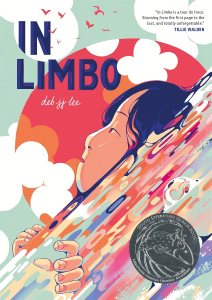
In Limbo: A Graphic Memoir by Deb JJ Lee

Title: In Limbo
Author: Deb JJ Lee
Publisher: First Second
ISBN: 9781250252661
Genre: Graphic Memoir 
Pages: 348
Source: Publisher
Rating: 4/5 

For anyone who has ever felt out of place, struggling with who they are, and trying very hard to fit in, “In Limbo” is the graphic memoir for you to read. Deb JJ Lee charts their journey from high school to being an adult in a world that doesn’t celebrate your differences.

And it isn’t just about this – it is about family and the love or lack of it that you have to sometimes live with, it is about seeking one’s identity no matter the time taken to do that, and above all just making sense of the world, with being self-aware of your flaws and shortcomings.

Deb has charted their life from high school to finally becoming an adult, almost being comfortable in their own skin. Sure, the end will leave you wanting more, but I thought it was just perfect – with no definite tying up of anything, because that’s what life is – transient in nature.

In Limbo struck a chord because I just empathize with Deb’s experience growing up in a New Jersey suburb as a Korean American child of immigrants with so much weight of expectations. They write about what it is to be the Other and what does racism do to you – especially when it is not evident and on the surface. It is about mental health and at the same time it is also about the burden of it – of what you are going through, and whose responsibility is the fixing.

It is never easy writing a memoir – you struggle to include and exclude – how much of your story should be read by the world, and how much it shouldn’t. Deb does a great job of that, and so much more. The drawings are raw and hit you hard. I will for sure go back to this graphic memoir later this year. Read it!

The Art of Not Eating : A Doubtful History of Appetite and Desire by Jessica Hamel-Akré.

Title : The Art of Not Eating : A Doubtful History of Appetite and Desire
Author : Jessica Hamel-Akré
Publisher : Atlantic Books
ISBN : 9781838957049
Genre : Nonfiction
Pages : 281
Source : Publisher
Rating : 4/5

My relationship with food is a tricky one. In the last couple of years, it has taken a different turn. I eat to fill a void – an emotional longing – dents are made by people or by me – I eat to repair, I eat thinking I will come out whole – but I do not. I haven’t for a while now. It is a pity because all the eating just makes me hate the way I look and talk and feel about myself.

I have been asked to lose weight – been told by family, friends, and sometimes even strangers as if I don’t know what I am “supposed” to do. I am not trying to play victim here. Just laying facts.

In all of this, I came across this read: The Art of Not Eating by Jessica Hamel-Akré. The title certainly hit a nerve. The subtitle of this book is “A Doubtful History of Appetite and Desire”. As a fat, gay man, I was drawn to it like moth to a flame. It is more than just the history of diet culture and how it shapes our relationship with hunger. It is also about how Hamel-Akré dealt with desire and food and how the world sees people with desire.

To top this, she delves in the life and times of George Cheyne, an eighteenth-century polymath known as “Dr. Diet”, and how it all connects to the diet fads we follow today. Hamel-Akré writes about the body from such a personal space that it is more than just compelling – you stay with it, and it stays with you. You identify and see yourself in its pages because you know you’ve been shamed too – not just for eating but also to want another body close.

You feel understood once you are done reading this book. You feel someone gets you. It is personal, raw, emotional but not sentimental in its approach, also funny in a way, and quite liberating. I will most certainly go back to this one.

This House of Grief by Helen Garner.

Title : This House of Grief
Author : Helen Garner
Publisher : Weindenfeld & Nicholson Essentials, Hachette Book Group
ISBN : 978-1399606806
Genre : True Crime, Nonfiction
Pages : 320
Source : Publisher
Rating : 5/5

What happens to a father who on the surface of it seems to have crashed his car with his children in it, into a dam, reaching for safety, but leading to the deaths of both his sons? Is he remorseful? Was there more to this since he had separated from his wife a couple of months before this incident? What goes on with the bereaved and the community when such an incident takes place?

Helen Garner explored these questions, emotions, and more in this glorious, emotional, and often scathing nonfiction work of true crime. This House of Grief is her account of what she witnessed at this man’s trial, the past she pieced through interviews with family and friends, and ultimately what was the outcome of it all.

And to think all of this happened on the Father’s Day weekend – the 4th of September 2005 adds another layer of irony, grief, and sorrow. The story is so heartbreaking that at times I forgot it was real. Garner writes with such intensity, without of course clouding it with her bias or opinions – just presenting what she saw, and what was said. So, there could be an element of dryness to the writing but that’s what kept me going – I loved Garner’s sentimentality not overpowering her writing.

This House of Grief is about ordinary lives and what happens in the wake of an accident or crime and its consequence. A book that is right up there with In Cold Blood and other true crime works. Highly recommended.

Art Monsters : Unruly Bodies in Feminist Art by Lauren Elkin

Title : Art Monsters : Unruly Bodies in Feminist Art
Author : Lauren Elkin
Publisher : Picador
ISBN : 9781250338013
Genre : Nonfiction
Pages : 368
Source : Publisher
Rating : 5/5

Who gets to be a monster? Growing up gay in a world that often feels judgmental, I’ve grappled with the word “monster.” Sometimes it came from others, other times from within myself—a whisper of not belonging. Lauren Elkin’s Art Monsters takes that label and flips it, showing how monstrosity can be a refusal to conform, a creative force that reshapes the world.

Elkin’s “art monsters” aren’t villains—they’re visionaries. These women, like Vanessa Bell and Carolee Schneemann, refuse to apologize for being bold, strange, or different. Elkin’s writing is disjointed, almost lyrical, weaving together memoir, art criticism, and provocative questions. It feels alive, like the art she’s describing—vital, messy, and unapologetic.

Reading it made me reflect on my own journey to find space in a world that can be unkind to those who don’t fit in. Bell’s fearless paintings felt like defiance itself, while Schneemann’s Fuses—a film of her and her partner having sex—wasn’t shocking but liberating. It was about taking control of her body, her pleasure, her story. After finishing the book, I even watched it, curious and inspired by the freedom it represented.

What struck me most was how Elkin threads her own life into the book. She shares how certain art unsettled her, how pregnancy reshaped her creativity, and how her views evolved over time. She also confronts privilege and race, tackling controversies like Dana Schutz’s painting of Emmett Till and celebrating the work of artists like Kara Walker and Lubaina Himid.

By the end, I wasn’t just thinking about Elkin’s artists—I was thinking about my own “monsters.” What would it mean to embrace the parts of me that feel too much? Elkin shows us that monstrosity isn’t a flaw—it’s where the magic lives. For anyone who’s ever felt othered, this book is a rallying cry.