Feeds:
Posts
Comments

Posts Tagged ‘homeschooling’

I started homeschooling when the oldest boy was eight, after three years of trying to fit him into a school system that wasn’t designed for the way he learns. He’s ferociously bright, in a way that was obvious from the time he was born. I’ve been dragged along by this child, forced to research everything ever written about giftedness and gifted education, driven from morning till night by his relentless quest for challenge.

He taught himself to read when he was 18 months old, he was asking about fractions by the time he was two.  I saw him devouring the non-fiction section of the library while he was still in diapers, and I worried about how he would adapt to kindergarten. He was thrilled at the idea of school, where he imagined himself sitting at a desk being taught algebra. When he was four, he found a book called “101 ways to do better on tests” and read it from cover to cover in anticipation. He was four-and-a-half when he started kindergarten, and I did everything I could to prepare the school in advance, but what could they really do with a child who was immersed in the Lord of the Rings trilogy when the classroom was set up for learning the alphabet? He was okay in kindergarten because it was mostly play and it was only half a day, leaving him plenty of time for working on his own stuff at home, but by grade one there were problems. He balked at the idea of “circle time” and outright refused to participate in most of the activities, preferring to read at his table. He went to the grade 6 classroom for math and novel studies. The class worked on building models of structures, and he brought in his styrofoam model of a water molecule, nearly in tears when none of the other kids were interested in learning atomic theory. By grade two, he had been in the grade 6 classroom for math for two years, and a grade 11 tutor was brought in to teach him algebra, but it wasn’t enough of a spark in a long day of tedious drudgery, and the little boy who used to vibrate with excitement when he discovered a new concept slowly dwindled away. I saw him shrink, curl in on himself, and plod his way through the day. Even at home, he seemed sad, withdrawn, forlorn.

I saw it, but the teachers didn’t. They saw a polite, kind, thoughtful, considerate, well-behaved boy who was able to work at grade level. The adminstrators told me that they were doing all they could, and we would have to be satisfied with the “enrichment” he was receiving.

It seemed like such an enormous decision at the time, taking him out of school. It seemed like such a dramatic step. I worried that I was overreacting, doing the wrong thing, depriving him of an ordinary childhood. I worried that he would be isolated, that he would feel different, maybe even in some deep and dark way, wishing he wasn’t so different. In the end, I made the decision not so much for academic reasons, but for emotional ones. I imagined what it must be like to feel so unseen, so unheard, so misunderstood and so powerless. Sent every day to a place that provided nothing by a parent who insisted it was okay. Forced to endure endless hours of tedium with no escape. When I allowed myself to feel the pain and the sense of betrayal he must have been suffering, I realized how abandoned he must have felt. It pains me to this day to think of it.

That was a long time ago, and in retrospect, homeschooling seems like it was the obvious choice, but it sure was a difficult decision at the time. It’s really hard to go against what “everyone else” is doing, what society has deemed correct, what the “experts” say is right. I listened to the principals and the teachers and I tried hard to convince myself that I wasn’t seeing what was right in front of me. I went to meetings, helped design “individualized educational programs”, volunteered in the classroom, nodded, smiled, ingratiated myself. I was careful not to offend anyone, I was modest about my son’s achievements, I went out of my way to avoid seeming like a pushy mother of a hot-housed child. I thought that I could tiptoe my way through the system, and still get my son’s needs met. It took me a long time to stop and pay attention to what my child was trying to tell me, and to put his actual needs ahead of my own need for him to be “normal”.

This post is not a rant about schools, or educators. It’s a little story about my experience with raising a child with differences, and of the mistakes I made along the way.

Read Full Post »

These last few months that the kids have all been in school have been eye-opening for me.

Sometimes when I was homeschooling, I second guessed. I wondered whether the kids were really getting out of it what I thought they were. My gut said yes, but there was no real proof, no way to be sure. I knew that the kids were doing just fine in terms of knowledge base, and I knew that they were well-liked kids, that they got along with other kids, that they had all sorts of interests and were getting a lot of time outside, that they got along well with each other, that they had lots of free time, and that they were happy.

But would things really be all that different if they were in school?

What I’m discovering is that homeschooling provided something that went beyond an individualized curriculum, beyond time for them to pursue their own interests. It provided them with an environment that fed their need for connection.

They say that right now they’re kept busy all day long, and that they’re surrounded by other kids all day long, but that they feel really alone. They enjoy being with other kids, and aren’t having particular problems, but they have a constant nagging sinking feeling. They’re describing a loss of connection with their home base. With me. With their brothers and sisters. L went to school last year, but she was right down the street, so she came home for lunch every day, had extra time in the morning to hang out, and had an hour after school with the rest of us before diving. That was enough to keep her fueled for her time away. Now she doesn’t have that, and she’s feeling the loss. Tee seems to be suffering the most. I had that heart wrenching conversation with him a couple of weeks ago at bedtime, when he told me how he felt like we were all drifting apart, and I thought it had mostly to do with our crazy evening schedule. Now I realize that he was talking about the whole day.

I wonder if this feeling of isolation, this craving for contact with their attachment figure(s) is particularly pronounced for them because they have two homes. Or maybe they are aware of the contrast between what it used to be like and what it is now. They have a basis for comparison, and they know what they’re missing.

Some people reading this might say that maybe my children are abnormally attached. That by homeschooling them I’ve delayed their independence, or stunted their development. But I think that my kids are just verbalizing what many children feel. My forays into the 1/2/3 classroom this year showed me how much the younger children crave physical contact, even with me, an adult they hardly know. I think that our culture asks too much of young children when it expects them to be away from their attachment figure(s) for six hours every day.

love 002

Read Full Post »

Teachers have impossible jobs.

My daughter is in a multi-age grades 1-2-3 classroom, with 20 or so other children. One of them has Down’s syndrome, another has a severe learning disability, and the entire clump of kids in grade one are very not-school-ready little boys who clearly would be much happier running around than sitting quietly on the carpet listening to a story.

I spend Friday mornings there, “helping out”, and even that’s an impossible job. The teacher gives me a task, and a small group of kids, and I try to help the kids do what she’s asked. Trouble is, none of the kids are even remotely interested in what they’re supposed to be doing. They don’t know why they’re being asked to color in certain little squares, or why those squares are being glued onto a long strip of paper, and the connection with those papers and their height in centimeters is lost on them. Trying to explain the concept is frustrating, because none of the kids seem to be able to concentrate on what I’m saying, and although my intentions are good and my efforts are valiant, towards recess time I find myself doing the work for them, just to have it done.

The result of our work is me gluing paper into their math binders while they pretend to know why.

After recess, the next task is drawing three pictures of Things You Like and then writing about the pictures. Some of the kids spend most of the time looking for a pencil, others need their pencil sharpened, the noise level goes way up, it’s ten or fifteen minutes until most kids are seated, and then it’s a lot of looking at the paper blankly, or copying from a neighbor, or doing the actual work but not caring about it, and as I sit next to a few of them, helping with spelling and making overenthusiastic “Good Job!” sorts of noises, my heart sinks down into my stomach. It doesn’t feel right. If even one child in that whole classroom learned even one thing that in that entire morning I would be surprised. They were kept occupied, some of them tried to do what they were told, and the time passed. Then it was lunch, and then back to school for more of the same.

When it was story time, maybe two out of the twenty were in the mood for a story. The rest struggled to sit in their assigned “carpet spot” and not pester their “elbow partner”. I have nothing but admiration for the masterful behaviour management skills of the teacher, but given the ages of the children she was dealing with, most of the words that came out of her mouth were admonishments. Sit up and Eyes in front and Not now and You come sit next to me where I can watch you. The two kids who were in the right mood and mental space for a story about a badger who found an egg-shaped rock paid rapt attention, but the rest didn’t get anything out of story time except for practice in trying not to wiggle.

It is impossible for all twenty of those children to be ready for what the teacher has planned for them every day. She has to plan, because otherwise it would be chaos, and she has to try to get all of the kids doing whatever activity she has planned, but most of the kids are only half-heartedly going through the motions at best. Maybe one of the kids is engaged in any of the activities at any one time, and only by sheer luck, because that child is interested in that topic, and it’s geared towards his/her particular skill levels, but the rest just create the constant white noise of the classroom.

Lots of apparent activity, not much being done.

The other painful truth about the reality of a classroom filled with just-turned 6-year olds is that they are still very young children who really aren’t ready to fend entirely for themselves all day. When I go in to that classroom every Friday, my own little one finds any excuse possible to crawl into my lap and lean her head against my shoulder, and the teacher’s aide constantly has little hands clutching hers, and little arms around her waist. They’re like furry little baby mammals seeking closeness anywhere they can.

The teacher is supposed to be able to meet the emotional needs and learning needs of twenty little children, while keeping them from tearing the place apart.

It’s an impossible job.

Read Full Post »

Jay and Tee went to school today.

In one fell swoop, they have gone from seeing me every single day to only seeing me in the evenings of every second week. They will spend significantly more of their waking time in a classroom than they will with either parent, and that decision was made without my consent. They didn’t want to go, and I didn’t want them to go, and yet, they went. Something is very, very wrong about that.

Read Full Post »

Beloved Tiger

Aug 29 014

Read Full Post »

This Sucks

I’ve been neglecting the blog a little lately, and I’ve taken very few photos, which is very unlike me. I just can’t seem to pick up the camera to take snaps of the daily action these days, with what’s been going on.

Tomorrow I have to appear in court to defend my right to homeschool the children. It’s a long story, one that started in June when I began trying to negotiate a divorce settlement with hopefully soon-to-be ex husband.

I’ve got two children depending on me to advocate for them and their right to live the life that they love. I’ve got two other children old enough to be fully aware of their parents battling it out. I hate that they’re all in this position, I hate that they’re stuck between us like this, I hate everything about all of it.

This is not the way I wanted to parent.

Read Full Post »

Why do we send our kids to school?

Because we went to school. And we were sent to school because our parents themselves had been to school. It’s what we’re familiar with, it’s what’s expected, it’s what kids do. Children have to go to school because if they don’t, they won’t learn what they need to learn in order to be successful adults.

Except that for the bulk of human history, it didn’t work that way.

Read Why Schools Are What They Are: A Brief History of Education if you’re interested in learning more.

And while I’m on the topic of education, check out Organically Inclined‘s answer to the “Socialization Question”.

Read Full Post »

DSCN0508
I’ve learned a lot while homeschooling my children, particularly this last year, when youngest son’s distaste for workbooks and learning assignments became very clear. He’s a lot like his mother in that he hates being told what to do, and hates anyone trying to teach him anything. He hated his one year in public school because he hated being forced to do what he already knew how to do, and couldn’t stand sitting in circle time for what seemed to him endless instructions on the correct way to hold a paintbrush for art projects. He would have much preferred being given the brush and the paint and being told to get started, and better yet would have been if the paint supplies had been left out for him to use if and when he wanted. And best of all would have been if he could have had a “real” brush and “real” paint with which to do some “real” work.

In order for the two of us to get along this last year with him at home, I had to let go of my role as “teacher” and allow this child to take on that role for himself. He wanted to learn what he was interested in, which never co-incided with what I thought he should learn. I had to really step back and let go of my fear that he wouldn’t learn anything if it wasn’t all planned out. It was a radical shift in philosophy for me, but now that I’ve seen it in action, I’m a believer.

It took first hand experience for me to actually stop and examine my thinking about schooling, probably because I was traditionally schooled, but I think that we should all give critical thought to the way our children are taught. The way it’s done now is what we’re all used to, but it isn’t necessarily the right way or the only way.

Peter Gray, a professor of psychology at Boston College, who specializes in developmental and evolutionary psychology, wrote this today on his blog Freedom to Learn:

“In fifty years…..today’s approach to education will be seen by many if not most educators as a barbaric remnant of the past. People will wonder why the world took so long to come to grips with such a simple and self-evident idea….: Children educate themselves. We don’t have to do it for them.

He was writing about Sudbury Valley School, which has been operating for the last 50 years on the premise that children are capable of learning what they need to know without being taught. A few of the things that the school does differently than traditional schools:

  • students are free all day, every day, to do what they wish, provided that they follow the rules (which the students vote on)
  • the school gives no tests
  • it does not evaluate or grade student progress
  • there is no curriculum
  • no attempt is made to motivate students to learn

Graduates of the school have gone on to lead successful, happy lives, and those that chose to attend a post-secondary institution had no difficulty getting in, or doing well once they were admitted. Graduates who went on to college or university said that they felt better prepared than their classmates who had come from traditional highschools not because they knew more, but because of the attitude they had towards learning.

I think that’s the key thing. It’s not the content, it’s the process. It’s the learning how to learn, the learning about self, the incorporating of learning into daily living, the discovering of individual passions that’s important. If we sit children in a classroom and force-feed them bits of information, and take away from them the time of their childhood that should be spent in self-discovery, they’ll have to try to figure themselves out once we finally set them free, when they graduate from high school. For some kids, that’s much too late.

Read Full Post »

Being the ardent supporter of homeschooling that I now am, I’ve confused a few people lately with my support of L in her decision to try grade 7 at public school.

People around me know that I think L would be better served by being able to manage her own time and her own learning goals than having that power taken from her by educators, and that I have some major reservations about her spending the bulk of her awake time every day solely in the company of 28 or so other 12 year olds. Some may consider that sort of environment essential for her “socialization” needs, whereas I worry about her losing her sense of identity in a crowd of conforming peer oriented children. I balk at the thought of all of that wasted time, because I know from experience that she could easily get it all done in half the time at home, leaving her with precious hours in which she could be inside her own head. She could bird watch, volunteer at the humane society, take a class in tribal drumming, hang out with her homeschooled friends, do crafts with her sister, read, write poetry, go for a walk, take an art class, or develop an interest in something totally different, and still be refreshed and rested for the three hours of diving practice she does every night. Instead of re-learning the parts of speech, she could be listening to the CBC, or reading the paper, and beginning to find out about the world in which we live. Instead of participating in endless conversations about the latest fashions, she could be talking to the co-ordinator of the soup kitchen about the plight of the homeless.

I’ve been asked why I wouldn’t insist on her staying at home, if I truly thought it best. After all, isn’t it a parent’s job to make decisions for their children?

My answer to all of the well-meaning questioners is that it is not a parent’s job to make decisions for their child. It is a parent’s job to raise children who can make decisions for themselves.

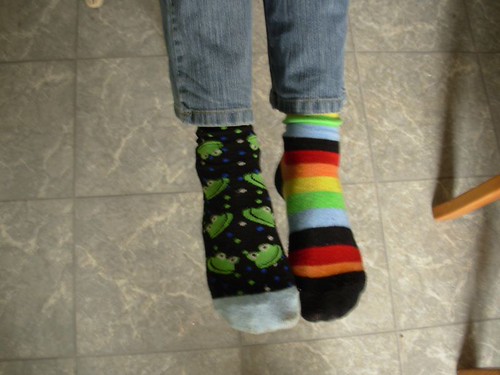
socks

Read Full Post »

Who Knows?

00016When school let out in June, Big Girl L was adamant that she wanted to homeschool for grades 7 and 8. She was tired of the other kids, tired of managing school on top of a demanding diving practice schedule, and eager to have time of her own again. She dragged a desk home from a yard sale, made lists of the supplies she’d need, and enthusiastically described the myriads of activities she imagined she’d be doing while all the other kids were sitting in a classroom.

Now, just a month later, she’s changed her mind. She’s all rested up, and eager for new experiences. Her friends have been talking about which schools they’ll be attending, and all of the teachers they’ll have, and how excited and nervous they are about meeting new kids, which has left her wondering whether she’ll be missing out on something if she stays home.

When she came to me to tell me how she was feeling, I told her that I thought she’d be just fine no matter which option she chose, that it really wasn’t a big deal, that there were advantages and disadvantages to both, and that she was really the best person to decide. I told her that if she was really concerned about missing out that she’d probably better give school a try.

I truly don’t think that I know what the best option is for her.

I just know that I love her, and that I’ll support her in whatever decisions she makes on her journey in life.

Read Full Post »

00008
The kids are back from their two weeks at the lake. I’m back from my two weeks of camping, canoeing, and cottaging. Which all added up to one huge mountain of laundry. I spent the bulk of today scrabbling to put a dent in the neglected household chores, all the while fighting down the rising sense of panic that periodically threatens to swamp me. Sometimes I look at the four kids, at the house, the yard, the rust spots on the van, and the never-ending list of unfinished jobs and I wonder what I’ve gotten myself into. Going to another room doesn’t help. Everywhere I go in this house I see something that I should have done, or should have gotten one of the kids to do, and I think If I just tackle one extra job each day, like say, cleaning out the muddy planting pots that have been sitting on the downstairs laundry shelf for the last 3 months, then I should be alright. Never mind the bigger, more important tasks, like dealing with the rotting wood under the eaves, or weather proofing the windows and doors before winter. My Do One Extra Thing Each Day plan certainly sounds reasonable, except that even in a pretty ordinary day, so many unexpected things happen that I never seem to find the time. If I happen to have a spare few minutes between the making of meals and hanging of laundry, I’m being asked to drive to a spur of the moment play date, or I’m dealing with moody crisis #27, or I’m searching in vain for insect repellant, or tennis balls, or trying to figure out what that darn smell in the basement is, or being recruited to help with whichever project is ongoing. Then it’s back to scrubbing pots and paying bills and answering the phone and squelching the fear that I’m not getting enough done.

Some days I can overlook the mess and the chaos and see what I’m accomplishing. Other days I feel as if I’m barely managing to keep ahead of the encroaching cloud of doom. Same situation, different mood.

Read Full Post »

We’re at a funny stage in our family homeschooling journey. I still have lots of ideas for projects, and still add items to the ongoing list of topics that I think the kids would enjoy learning about, but we almost never seem to get around to any of them because the kids are invariably busy with their own projects.

I’m wanting to make a sundial, dye cloth with berry juice, make paper, build a bat house, and go exploring with compasses. The kids want to do those things too, they say, but not right now Mom, I’m right in the middle of making this really cool map and then I wanted to have S over to play so that we could work on our clubhouse and then the doorbell rings and it’s a swarm of kids from the neighborhood and off they go.

In part, it’s a by-product of the season, what with all the school kids roaming free because of summer holidays, but it’s also really indicative of their growing independence and self-directedness.

I’ve said more than a few times that it’s the job of a good parent to make their job obsolete (or some such pithy thing, although I’m positive that it sounded pithier when I said it, because in writing it’s a bit clunky) and now that I see a glimmer of light at the end of the tunnel, I find it fascinating, inspiring, thrilling, and yet heart wrenching to watch the process in progress.

Read Full Post »

surfwise.preview.jpgDorian “Doc” Pascowitz, and his wife Juliette, together raised nine children, eight of whom were boys. That seems interesting enough. The fact that they raised them in a 24-foot camper, in willful poverty, makes their story fascinating. I watched Surfwise, the documentary about the nomadic Pascowitz family, with a mixture of curiosity, horror, and envy. I admired Doc’s passion and commitment, but was repelled by what appeared to be a narcissistic need to control his family, to make them live out his dream. The old video footage and family snapshots showed athletic, tanned, smiling children and an apparently happy family, and it was the closeness of the siblings in those photos that I found compelling. I could imagine how idyllic that family-centric sort of lifestyle would have been for the kids when they were young, and that’s the part that left me feeling envious. I wished I could have had that kind of growing up, or that I could be that kind of parent. Except for the fact that I would have had to be Juliette, not Doc, and Juliette, while she too lived the dream, was the one who had to sweep sand out of that trailer, make meals for all those kids, breastfeed, change diapers, wash clothes and oversee naps while Doc took everyone surfing. There weren’t that many pictures with Juliette in them.

I could relate to what Doc said about wanting his children around him, but I think he did them a huge disservice by not allowing them the freedom to make their own choices once they reached adolescence. In his desire to keep his family together, and in his insistence that they live by his rules, he destroyed his own dream. From the interviews of the now adult Pascowitz children, it seems as if they all needed to break ties with him for some length of time in order to find their identities, and it seems as if the famiily suffered a great deal, individually, and as a collective. All of the kids spoke with great respect for their father and his ideals, but also as if he was a towering figure in their memories. They tell some harrowing stories about him and his authoritarian approach to parenting. I guess he needed to be pretty darn strict to keep that many individuals toeing the party line. Trouble is, you can’t control kids forever, because they don’t stay kids forever. He would have made it easier on all of them if he could have put his relationships with his children ahead of his desire for them to live in the way he thought best. I think he truly did think he knew the secret to a happy life, and that he wanted that life for his kids, but once he got to to the point where he was shoving that life down their throats, he should have given his head a shake and realized that they might be better served by being given the opportunity to figure it out for themselves.

As for the homeschooling, the movie didn’t say much, except that all of the kids bemoaned their lack of education, their lack of opportunity, and what they felt was an inadequate preparation for “the real world”. Maybe Doc, living out a utopian fantasy in which his own Stanford education was cast aside as irrelevant, purposefully tried to prevent his children from learning in an traditional way, and neglected to ensure that they had basic skills. Just guessing. It seems hard to understand how he couldn’t have managed to have them all well educated otherwise.

Read Full Post »

00007

I don’t know what the book is about, but I love the title, love that my boy is engrossed in it, and love that he thinks it’s the best book ever. I love that he sews, cooks, cleans, and plays dolls with his sister. I love that he doesn’t yet relegate jobs into gender categories and that he’s perfectly comfortable holding my hand in public. He’s a scabby kneed, scruffy headed, roller blading, bike-riding, stick wielding nine-year old boy who doesn’t own one pair of pants that aren’t torn to shreds but he still sometimes crawls onto my lap at dinner parties. He hasn’t yet learned to think that some emotions are “girly” and to be avoided, and wouldn’t think it strange to hold the hand of a friend. He has a capable mother, strong sisters, and has been raised in somewhat of a protective bubble in that he has had limited access to TV, and a much smaller dose of the still prevalent gender bias that inundates our pop culture than many kids his age. He does the things he likes to do, and doesn’t have to deal with the peer group pressures that many boys have to contend with. I don’t think he’s ever heard anyone tell him to “be tough”, to “act like a man”, to not cry, or to not “be a girl”.

I’ve said in previous posts like this one, this one, and this one, that there are gender differences, and that boys definitely do have different interests, as a group, than girls, but I don’t think that it’s necessary or biologically determined for boys to think of girls as less capable than boys or for boys to innately feel ashamed of emotions that our culture has deemed feminine. Those things are learned, and with effort, maybe we adults can protect our boys from internalizing those opinions until they are old enough to think critically.

Read Full Post »

One of the most common questions I’m asked about homeschooling is how I can tolerate being around my children all the time. It’s often couched in tones of admiration, like: I just don’t know how you do it and You must be some kind of saint, but it’s usually accompanied by a shake of the head and a grimace that communicates how distasteful the idea sounds to the person saying it.

I get what they’re saying. I remember working long hours at the hospital, coming home to a toddler, and even though I hadn’t seen him all day, wishing I could just have two seconds of time to myself. I can imagine how someone might extrapolate from that, and find it mind boggling to contemplate day after day in the company of children.

The strange thing is that the more time I spend in with my children, the more I enjoy it. The more time with them, the more I appreciate the nuances of their personalities and the more I understand their particular perspectives. I don’t find that we’re at odds much, and I think it’s partly because they and I have shared goals. We’re working on building a cookie map of Canada, say, and need to fit the buying of the chocolate macaroon mountains around that day’s guitar lesson, my run, and a trip to the pond to search for tadpoles. I know which things are important to them, they know what is important to me, and we share an understanding of what needs to be done for the house to run efficiently. We’re a team, and we’re used to working together.

When I was working for a salary, I had to fit all of the second shift tasks in at the end of the day, or on weekends, and it was sometimes hard to appreciate the help of little fingers in my drive to get things done. The way it is now, the children are incorporated into the day, and I don’t find their helpful presence a hindrance the way I used to. My life isn’t compartmentalized into with/without children. I’m used to taking them where I go, and having them around. They’re used to going where I go, and are very good at managing themselves wherever we are, be it a waiting room, an office, or a hardware store. They even help without me asking, because they can see what needs to be done. Granted, they’re not toddlers anymore, but they could have morphed into surly preteens by now, and they haven’t. I genuinely like their company, they like mine, and it might in part be because of all the time we spend together.

Read Full Post »

It’s that time of year again. June reports. The only legal requirement for homeschoolers in this province is to submit a detailed report card on each child twice yearly. I actually don’t mind writing them because I’m always pleasantly surprised at how much the kids have learned, how many topics they’ve covered, and how many places we’ve visited during the school year. I would never remember all of it, so every day I jot down what the kids have done that day, and once in a while I add to the “subject” categories I make for them. So for example, if Tee learns long division, I add that to his math category. I also keep a list of the field trips we go on, and try to remember the lessons and activities they take part in. I used to keep track of all the books they read, but that just got way too onerous. I remember pages and pages of book titles when R was homeschooling. Kind of cool to look back on, but not the resource I thought it would be for the younger kids because each of them has such unique interests.

I often suffer pangs of anxiety during the school year, when I feel like the kids aren’t learning as much as they “should” be, mostly when they’re going through very busy times with their own projects and aren’t very interested in what I think they should be learning about. It’s easy to forget all of the topics they cover because they often learn in a scattered, many-topics-at-once way, so it can seem like they’re just picking up bits and pieces of unrelated information, but if I can get a handle on my need for a linear approach, and let them learn the way they want, it all comes together very nicely.

So thank you, government of this province, for insisting on the record keeping that ends up reminding me of the value of what I do.

Read Full Post »

It does not behoove us in this day and age to raise conformists. The hope of the future depends on original solutions and unrestrained intellect like it never has before, and there is no way to create true thinkers other than trusting children to be in charge of their own learning.

~ Amy Spang ( author of Anony-Mom-Ous blog)

I found Amy’s blog thanks to Life Learning’s unschooling blog directory (which I discovered today after it sent a few readers my way). I agree with her sentiments on allowing children to learn independently. Some people have implied that my desire to follow this unconventional (by modern standards) method of educating my children is arrogant, but it might be argued that the arrogance lies in the assumption we make when we dictate what children ought to know. We assume that we know what they will need to know in the future. Out of all of the possible bits of information in the vast storehouse of accumulated human knowledge, we know which bits are essential. Hmmph. We live our lives in the moment, often unaware of how particular to the moment our ways of living actually are. We do what we think is “right” based on what we see others doing, or based on what our parents, or our community, or our cultures have taught us to do, often disregarding the fact that things have been done differently in previous times, and are being done differently even now, in other parts of the world. It’s such a narrow, narrow perspective, and the rigidity of this kind of thinking doesn’t leave much room for individuality. It doesn’t lend itself to questioning, and without questioning, we as a culture will continue to make the same mistakes endlessly. We need to allow our children to discover their own particular strengths and their own particular interests by giving them the time and space to do so.

Read Full Post »

Right now it’s a rush to get ready for L’s grade 6 graduation ceremony. J and I are primping, but Tee is busy doing long division. I didn’t even notice, until R pointed it out. He’s doing long division? Music to a homeschooling mother’s ears! In the middle of the hustle and bustle, he had researched the relative values of precious metals, made an elaborate comparison chart which he glued to a cardboard background, and apparently, had to make use of the long division I taught him under great duress last week. Now if only I can convince him to find a clean shirt to wear.

Read Full Post »

00002

I spent a lovely couple of hours at the kitchen table this afternoon helping Tee make plasticine figures for his army. I think I should do it more often, because when he’s showing me how to do things, the power between us shifts. He was such a gentle, encouraging teacher that my heart squinched in the memory of all of the times that I’ve been the exact opposite towards him. I resolved to continue trying to slow down and appreciate the unique approach that this boy has towards the world.

I tried to make my first archer very detailed in a realistic sort of way, but Tee pointed out that it would take far too long to amass the sort of army he needed if we spent half an hour on each figure, so I copied his more stylized version.

Initially, I made the figures so that I could spend time with him, but after a while I started to genuinely enjoy the calm creativity involved. It was a nice way to have a meandering sort of chat too. He’s the kind of person who needs a lot of uninterrupted time for getting his thoughts together before they come out coherently, so the usual pace in this house of go-go-go is often too fast for the way he operates. He and I have the best conversations when it’s just the two of us. I need to make a more intentional effort to carve time out for just him.

Read Full Post »

I’m reading a book called Suburban Safari, which was written by a nature and travel writer. It’s an interesting look at the ecology of grassy backyards, the premise being that we don’t need to travel to exotic foreign locations to witness wildlife.00003

I read a bit of it this morning because the kids were immersed in their own activities, and they wanted nothing more than to be left alone. The parallels between the book and the kids leaped out at me. The two of them are often involved in detailed, complicated play that I am only superficially aware of even though it’s happening right there under my nose. To tell the honest truth, if I notice them playing happily together, I usually slink right back out of the room in the hopes that I wasn’t spotted, partly because I grab at every opportunity to get other things done, and partly because I know my presence will disrupt their fantasy world.

Today they sat next to each other, fingerknitting and pretending to babysit their respective animal babies. This was interspersed with some work on their homemade Pokemon cards, and it was interesting to hear how they’ve woven science facts, evolutionary theory, and Star Wars details into quite a comprehensive alternative world for the creatures on their cards.

00009

Kids play can seem so inconsequential and so unproductive compared to all of the very important jobs and errands we adults concern ourselves with. I’ve often superimposed my day’s agenda onto the kids, and justified it by saying that whatever I had planned needed to be done. The kids are forced to stop what they’re doing in favor of the task at hand, and they put up with it, but inevitably their play sneaks into the cracks of time between bits of important business. They talk to each other in invented languages, and bring along slips of significant paper covered in scrawled code, so that a trip to the grocery store barely puts a dent into the game at hand.
On the occasions that I’ve stopped checking off my mental lists long enough to pay attention to what they’re up to, I’m always taken aback by the worlds that they’ve created for themselves. When I listen to them, I realize how very invested they are in what they’re doing. No wonder they don’t clean up the bits of yarn, balls of paper, strips of cardboard and odd bits and bobs of detritus that follow in the wake of their invented games. That would mean putting their imaginations on hold in order to recognize the real world. Sometimes it’s useful for me to remind myself of how I feel when I’m powered by a great new idea, and to remember that the parallel universe that the kids inhabit is just as important to them as the one we actually live in.

Read Full Post »

Older Posts »

Design a site like this with WordPress.com
Get started