Feeds:
Posts
Comments

Posts Tagged ‘science’

The insect I know. It’s the larval form of a ladybug. But what is the spotted hard-shelled immobile creature?

00003

What on earth is that miniature albino zucchini that’s attached to the body of the cute green caterpillar?

00002

Here’s another view of it. Ignore my ragged cuticles and dirty, uncut fingernails.

00001

We found lots of elm leaves that had these cancerous looking lesions. Are they eggs imbedded in the leaf?

00004

It’s always this way with me. The kids find things that I can’t explain and can’t seem to find explanations for. And if I do spend time tracking down entymologists or researching in the library, by the time I come up with an answer, the question’s long been forgotten. I wish there was a book that had all the answers. I could jump up, grab the book, flip to the picture of the lesiony lump and say aha! it’s the this-or-that, and we’d all be that much wiser.

Another thing I wish is that I could find a printer that doesn’t drive me crazy. I hate printers. They never do what I want. It’s so aggravating to rush to the computer to print off a sheet of downloaded musical notation paper, or whatever musicians call those lines they compose music on, so that my young guitar player can jot down the song he’s just invented only to find that the printer is in a mood and won’t respond. I tried every thing I could think of to make it work as Tee slowly drifted off to another activity, and nothing I did made any difference, dratted thing, and then, without warning, several hours later it sprang to life and spat out the sheets. RRRRGH.

Read Full Post »

Meet Curly
00002
and Flicker
00001

Read Full Post »

00003

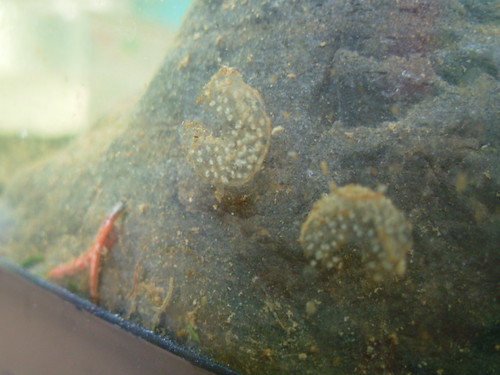
Anybody have any idea what these things are? They’ve started appearing in our tadpole aquarium. Jay thinks that they’re snail poo. They’re translucent, non-mobile crescents that attach to the glass sides of the tank. They have little dots on them, which we didn’t look at under magnification. Out of the water they look like whitish blobs of jelly.
Zach….? We need your help!

Read Full Post »

Owl Pellet

00047

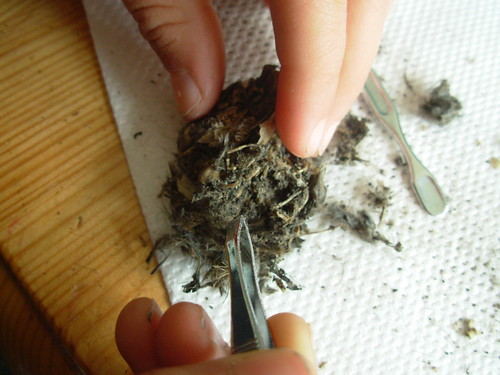
Dissecting this owl pellet was the highlight of the morning. At least for Jay. Tee was more interested in the book he was reading.

00049

I’m pretty sure that the skeleton was of a mouse, not a rat, based on the size of it, but it still had very impressive incisors.

Jay squealed with excitement at every new bone she found, and announced that she’s decided that she’d rather be a naturalist when she grows up than a plasticine sculptress. She spent the rest of the morning making observations in our backyard and jotting them down in her naturalist’s journal. Things like I saw a squirrel. I saw a bird.

Read Full Post »

00035

Look! Isn’t that a beautiful little bird? She/he’s eating right out of my hand! It’s my Mother Earth dream! I’m so close to nature that all of the little animals come right up to my skirts to eat the fresh bread crumbs I’ve collected in my apron for them.

00033

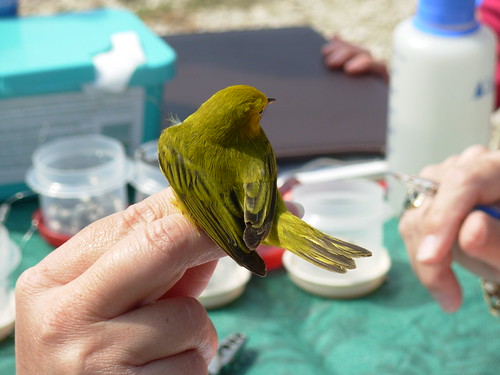
Here’s another one! I even know it’s name. It’s a yellow warbler.

00032

This is a particularly large variety of sparrow.

They’re actually in the hands of a naturalist, who was in the process of banding them. We got a chance to watch, and we saw oodles of different song birds. They were banded, had their wings measured, were identified, had the amount of fat on their breasts recorded, and put into little envelopes to be weighed before they were released. I was surprised at how docile they were during their ordeal, and also, how completely unscathed they seemed when they flew away.

0002900030

It was difficult to get a good shot of the mist net, the net that the birds are captured in, because it was virtually impossible to see.

00037

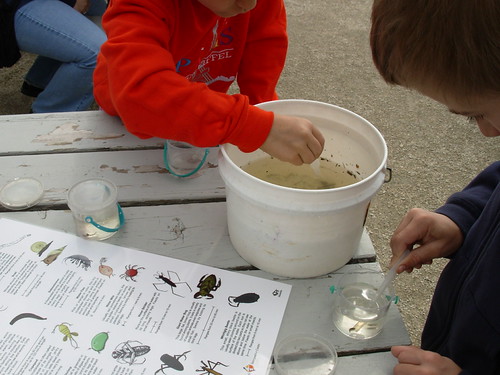
No day at the wetland is complete without some water organism identification.

00011

00019

The kids got to play at being scientists, and they were excited with the sheer number of little squigglies that live in the water. When we were on the way home, Tee looked at a sparkling pond at the side of the road, and said that while it looked inviting, he wasn’t sure he would want to swim in it now that he knows how many nymphs, leeches and larvae are in there.

00022

That’s a damselfly nymph. It looked like it was big enough to fly right out of the water.

Read Full Post »

00001

  1. Cut a strip of coffee filter
  2. Mark a dot on it with water soluble marker
  3. Fill a glass with water just high enough to wet the end of the strip of paper when it dangles into the glass
  4. Attach the strip to a pencil so that the pencil will bridge the mouth of the glass and allow the strip to dangle into the water
  5. Watch the water creep up the strip, taking the pigment with it, and, it your strip is long enough, separating out into the different pigments that made up that color of marker

I fudged just a bit and used this to help explain how plants “suck” water up from the ground with their roots. Not exactly the same process, because for plants it’s really capillary action, but similar enough.

Read Full Post »

Density Experiments

00016

This is a lovely example of fluids with different densities. Corn syrup at the bottom, water in the middle, and oil on the top. We also made a “wave in a bottle” with blue water and oil, and experimented with water by changing it’s temperature and adding salt. We were able to show that hot water (which we colored red) floated on top of cold water, and that cold water(which we colored blue) sinks in hot water.
I asked them to guess whether salty water would float or sink in regular water, and after we were able to prove that tap water does indeed make a layer on top of salty water, I explained that salt dissolving in water doesn’t change the volume of that water, therefore increasing it’s density. Tee totally understood it, but Jay is a little murky, insisting on calling the salty water “condensed”.

Here’s a picture of my “scientific” diagram of water molecules. It’s a wonder they learn anything at all!

00019

Read Full Post »

Make Your Own Gingerale

You’ll need:

1 clean and empty 2 L pop bottle with lid

1 cup sugar

1½ TBS finely grated fresh ginger

¼  tsp yeast


Using a funnel, put the sugar in the pop bottle. Add the yeast, shake to mix. Add the ginger, then fill with water, leaving about one inch of head room. Put on lid, and invert bottle several times to dissolve the sugar.

Leave at room temperature for 24-48 hours, until the bottle feels hard. Then refrigerate.

(The fermentation of the sugar by the yeast results in the production of CO², and a teensy bit of alcohol.)

Disclaimer: I haven’t tasted the stuff we made yet, so I can’t say if it’s any good.

Read Full Post »

Insulation Experiment

Bare Hand In Ice Water
DSCN1392

With Blubber
DSCN1396

The blubber was Crisco. I was trying to show the kids how a layer of blubber keeps arctic mammals warm in icy water.

Then I forced Tee to look up the word insulation in the dictionary, and we did an experiment with glasses of boiling water, to see what kind of material around the house would keep the water hot the longest. Of these materials: towel, tinfoil, leather, and winter jacket, the winter jacket won. Phew! I can just imagine how these two would look wearing tin foil all winter.

Read Full Post »

DSCN1132

This is the most crystallized of them all. I don’t think we put enough Borax into solution.

As for the sugar crystals, nothing is happening at all, and we put a TON of sugar into the water. Might be time to do a little internet research.

Read Full Post »

Saturday Science

DSCN1101

The  snowflakes are beginning to crystallize, and I’m thinking that the choice of pipecleaner color wasn’t the most inspired. They don’t look beautiful and Christmassy so much as “eerie starfish in specimen jars”-like.

The kids love them though. All of the talk about crystals has spawned a veritable crystal factory on my kitchen counter. Tomorrow we’ll see how the blue rock candy turned out, and whether brown sugar makes brown candy, or if, as L hypothesizes, the molasses sinks to the bottom of the jar. It’s amazing how much sugar it takes to super-saturate boiling water.

Read Full Post »

Flubber Fun

DSCN1082

Inspired by Angie, we did the Borax snowflake project, and then, while the Borax was out, I remembered about Flubber. A tad messy, but well worth it, because I was rewarded with squeals of excitement and even a “You’re the best mother ever!” I laughed, and reminded Tee that he doesn’t think I’m so great when it’s house cleaning day, so he amended his statement. “I mean, you’re the best science mother ever!” I’m okay with that.

In case you don’t already know, here’s the Flubber How-To:

Mix  1/3 cup warm water, food coloring(optional), and 1/2 cup white glue. (Yet another use for my industrial size jug of glue.) I used a cleaned out yogurt container for the mixing.

Mix 1 tsp of Borax with 1/3 cup of warm water inside a small ziploc bag.
DSCN1087

Add the glue mixture to the Borax mixture in the bag, seal, and knead until solid(ish).

Done! It will be a bit wet, but take it out of the bag and it will dry off quickly. Store in a clean ziploc bag.

Read Full Post »

Water Microscope

DSCN1054

Cut a hole in the side of a plastic container. Cover top with plastic wrap, and secure with an elastic. Put water on top of the plastic. Stick things (fingers, newspaper, dice etc) in the hole, and look through the top. Not a huge order of magnification, but enough to notice.

Read Full Post »

Cartesian Divers

DSCN0973

Still on the science kick.

Today it was the not-so-well-known Cartesian Divers experiment. Well, not so well known to me anyway. Something to do with density, and air pressure, easy enough to do but hard to explain. Tee found it absolutely riveting. He wrote a whole paragraph explaining the experiment in detail, drew a labeled diagram, and then went off to create “an irrigation system” out of the used pipette ends.

Next science project: make a magnifying “glass” using water and a clear container. While we were sticking our fingers in the water to fill up the pipettes, they noticed that our fingers looked huge through the sides of the water filled glass. Which led to questions, and garbled answers, and more questions….thank goodness for a postgraduate degree in science….and Google.

Read Full Post »

DSCN0851

Another classic. The Rubber Egg Experiment.

Put a raw egg in a glass of ½ vinegar/½ water. Wait at least 48 hours. Watch the egg develop bubbles on it’s surface. Watch the bubbles lift the egg to the surface of the liquid. Talk some more about gas vs liquid vs solid. Maybe talk about hot air balloons. Helium balloons.

Then take the egg out, and see what happens.

Read Full Post »

Kitchen Chemistry

DSCN0814

Homeschool science is fun in the early years. At least, I think so. There are so many great books in the kids section of the library, and so many great sites on the internet. I have stacks of books sitting around the house all earmarked and sticky-tabbed at pages for fun experiments and projects.

Today’s science investigation was Identify The White Powder. No, not what you may be thinking. Four white substances from the kitchen (flour, baking soda, salt, and sugar), a magnifying glass, some water, and some vinegar. No tasting allowed. Or sniffing.

The actual identification was quite easy for the kids, but that didn’t seem to bother them. They gabbled on about why and how and how else and look what happens when and see, I added water and it turned to glue, just what I suspected and how come the salt crystals aren’t as shiny as the sugar crystals, and then the talk turned to the acetic acid/bicarbonate reaction, which naturally lead to the discussion of the properties of a gas, and the three phases of matter, and of course atoms and atomic theory, and isn’t it cool how dry ice sublimates at room temperature?

All of the talk about gases gave Tee the idea to put a balloon over a bottle to see if we could capture the CO2 from the baking soda and vinegar combination.  Look at their faces! I think they were expecting Chernobyl.
DSCN0831

I was, of course, lumped with the cleanup, as they went on to discover more properties of balloons play, but I didn’t mind. My little contribution to science.

Read Full Post »

Design a site like this with WordPress.com
Get started