
Tags

I’ve always had a special interest in small wheeled bicycles. I believe that they should be much more common than they actually are as they have many advantages over their larger wheeled cousins. They are especially good at load carrying as the smaller wheel means luggage racks can be mounted lower down so that any weight doesn’t interfere too much with the bike’s centre of gravity. This makes them good for touring and also for utility riding such as a shopping trip.
Using components of similar quality, a small wheel is stronger and is therefore less likely to buckle or suffer from broken spokes and also lighter which means it is easier to accelerate the wheel up to speed which helps to make the bike much more nimble in urban traffic. Small wheel bikes usually feel easier to ride up hills for this reason.
A small wheeled bike is also shorter overall and takes up less space to store and is much easier to carry and manouvre which is a potential benefit to people who live in terraced houses or apartments and may lack the storage for a large bike and may need to carry it up or down stairs.
The traditional diamond framed bicycle which has been around in one form or another since James Starley’s original Rover Safety Bicycle has it’s design compromised by the need to package the large 26“ – 28“ wheels normally used, especially in the smaller frames sizes and often leads to toe overlap with the front wheel. The diamond frame bike also needs to be made in a variety of sizes with different stand-over heights and top tube/reaches to suit riders of different sizes.
The reasons that large wheels have traditionally been favoured is that they tend to ride better over bumps which was an important consideration before sealed road surfaces became the normal; especially so before the invention of John Dunlop’s pneumatic tyres, and also because of the issue of gearing. The Ordinary or Penny Farthing had evolved because it allowed a higher gear for faster cruising. Starley’s use of a chain drive on his Rover Safety Bicycle allowed the same gear ratio with a wheel half the size which made it much safer and easier to ride. The development of both hub gearing and primitive derailleur systems in the early years of the twentieth century meant that it would be possible to use smaller wheels and still have a range of useful gearing.
The British engineer Dr Alex Moulton began to question the design of the traditional diamond framed bicycle in the mid to late 1950s, prompted by the Suez crisis and energy shortage, he saw the benefits of cycling over driving. He had a background in aircraft design, rubber products (which were his family business) and also suspension design. The bicycle had remained basically unchanged at that point for about seventy years and saw the potential advantages which I have listed up page in using a smaller wheel.
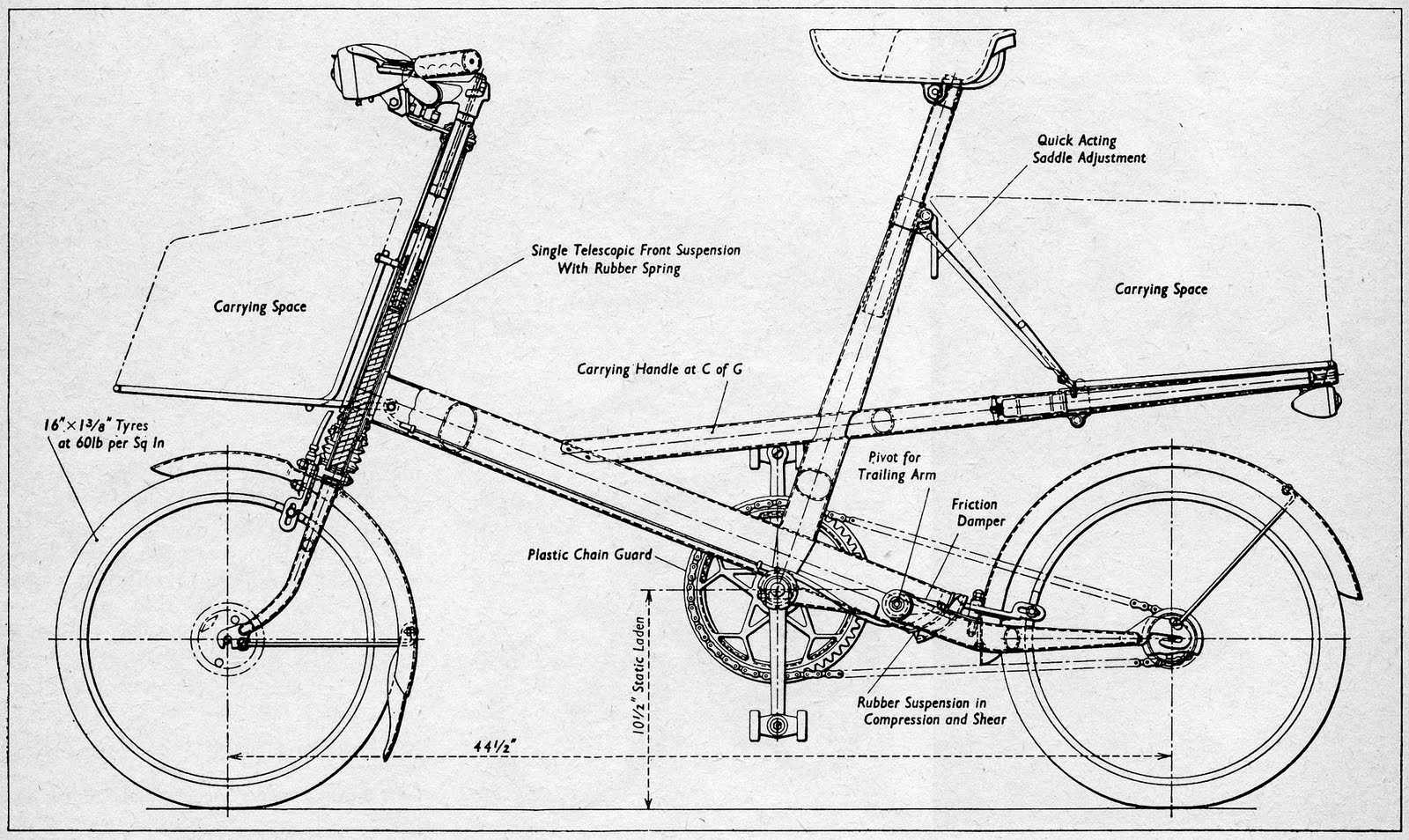
The potential downsides of rough ride quality he felt he could overcome with a simple rubber cone based suspension (Moulton had designed the rubber cone suspension design used in the original Austin Mini and the the later hydrolastic and hydragas systems that followed for other BMC/BL/Rover Group front wheel drive cars and the mid-engined MGF). His work on the Mini with his friend Sir Alec Issigonis highlighted the advantages of moving to a smaller wheel size and compact rubber cone based suspension in terms of freeing up a lot of space in the car’s interior. He aimed to do similar for cycle design.

Calling on his knowledge of aircraft design to create a very simple but strong frame design which was different in it’s construction from traditional lugged and brazed bicycle frames, he came up (after several other designs and prototypes) with what today is known as the F-Frame Moulton and it’s the ancestor of every other small wheeled adult bicycle that has come since such as the Raleigh Twenty, the Brompton, the Dahon and the Bike Friday.
The main advantages were the lower centre of gravity (especially when loaded), the strong, light and fast to accelerate sixteen inch wheels, the shorter overall bike length (Moulton used a very long wheelbase for the bike, partly to distinguish it from a child’s bike and I guess partly for stability and ride comfort but the small wheel size reduce the overall length of the bike), the convenient rack systems back and front for carrying luggage and also the fact that it only needed to be manufactured in one frame size which could be easily adjusted so that almost anyone could ride it comfortably. The frame was an open design too with all the strength in the in the oversized bottom tube which made it much easier and safer to mount than the diamond frame (and stronger than the typical “lady’s frame” of the time). A handle to carry it carefully located at the centre of gravity was included to make it easy to transport upstairs into apartment blocks etc. Despite what some think when they see one, the Moulton did not fold but a take apart version did appear later.
The Moulton was launched at Earls Court in 1962 and the response was overwhelming. After an early agreement with Raleigh didn’t work out he created his own factory to build the bike. Just like the Austin Mini, the Moulton bicycle became a huge fashion icon of the 1960s and the factory couldn’t build them fast enough. A subsidiary of BMC also started to build them for Moulton but there were quality issues. It quickly spawned copies like the Dawes Kingpin and the Raleigh RSW16 which although charismatic in their own way were technically inferior.

Moulton was also keen to promote the sporting potential of his small high pressure tyre combined with suspension bicycle and in December 1962, John Woodburn broke the London to Cardiff record on a Moulton Speed, the first of quite a few sporting achievements for the bike and led to the creation of the Moulton Speed 6 which was the first bike to have six speed derailleur gears. A Speed 6 is a highly prized collector’s item today. The majority of the original Moultons had the 4 speed FM version of the Sturmey Archer hub gear. Hub gears are very suited to small wheelers as it avoids running an easily damaged derailleur close to the road.
In the late 1960s, Raleigh did buy Moulton out although he remained as a consultant he continually carried out small improvements to the design, Raleigh were never really committed to the bike and pruned the range down to just a single model and sales fell away. They had there own small wheeler too in the form of the Twenty which although not as technically interesting or as good to ride was much cheaper to build and to sell and sold in big numbers. Moulton eventually ended up buying his business and patents back from Raleigh and beginning again with a much different design – the space frame – which used thin tubes to create a lighter frame. Variations of it continue in production today but second time around, Moulton concentrated on high end, higher quality rather than high volume production so they’ve never sold in the same numbers as the original F-Frame.

Given my love of small wheeled bikes, a Moulton was something I’ve always wanted to own. I didn’t even care which model in a way. I had ridden ones on short rides in the past and was impressed and always fancied having one of my own to get to know it better. When the opportunity came up recently to buy a 1964 Moulton Standard at a very reasonable price, I grabbed the opportunity with both hands. It wasn’t an immaculate example as it was in regular use and had some tweaks. The bars had been replaced with mountain bike type straight bars with bar ends, the wheels had been build with Brompton alloy rims and also a square taper Brompton chainset had replaced the original cottered cranks. None of this bothered me, in fact they are very worthwhile improvements as the brakes work better on alloy rims and they are lighter and a square taper chainset is stronger, lighter and easier to service than cottered chainsets.
I picked the bike up in Ballymoney and ventured for a ride around the cycle path system in Ballymoney, including time watching trains coming and going at the station from the top of the impressive looking Sustrans bridge over the lines. It took a little time to get to grips with the gearchange as the original Sturmey Archer four speed shifter has been replaced on this bike with a friction shifter of the type usually used on derailleur systems. Gear adjustment was always very tricky and problematical on the four speed Sturmey hubs so this is possibly a better solution although it took a little practice to use it smoothly. I’m sure grinding the gears is not good for the hub!

I was able to fit the bike into my small car without removing the wheels which was a good start and highlights one of the huge advantages of a small wheeled design. Once home I made some adjustments to the riding position and getting it to my satisfaction. Yesterday, when I had time to spare, it was time to take it for a longer ride to see what I really thought of Alex Moulton’s brainchild.

I had no set route but made my way through Castlefinn, Ballindrait, St. Johnston, Carrigans and eventually to Derry via the cycle path which runs along the Foyle from Carrigans on the route of a former railway line. I took a slightly different route home and had covered over sixty miles, more than I had planned but I enjoyed myself despite some heavy showers and the fact that it seems very cold for June. As the miles clocked up, my respect for the bike kept growing. It is just so comfortable and easy to ride. My average speed probably wasn’t very high but this was through sometimes very hilly terrain on a pretty stormy day and I am also not as fit as I was. I was very happy with the ride and how I felt afterwards and the bike exceeded all my expectations. It just highlights my point that small wheeled bikes should be more common.

I enjoyed the route too, on mostly pretty quiet roads with enough gradient to keep it interesting. I always like riding the path along the river Foyle too. It’s always nice to get completely away from traffic. I did go over the Peace Bridge to Ebrington Barracks in Derry and I think it’s great that Derry has all this shared space away from motor vehicles for people to enjoy walking or cycling.

I am definitely very happy with my purchase and very impressed with the design of the bike. I feel it is one of those things like the original Ferguson tractor that was just brilliantly conceived and every aspect of the design was considered and pretty much perfected. You can see this by the “carry handle” that is included in the frame between the seat tube and the main chassis member right at the centre of gravity. Pick the bike up using it and just feels so well balanced in your hand and easy to carry like that. Compare it to how awkward it can be to carry a normal bike. I also found that many random people I met along the way wanted to know what the bike was and where I got it from, clearly the design of it was such that sixty years later, it is still catching people’s attention and piquing their interest. I was trying to decide whether or not I prefer it to my Brompton but it’s not fair to answer that as they appeal in different ways. I do think it’s fair to say though that if the Moulton hadn’t been designed, then the Brompton probably wouldn’t have been created either.

I think something that needs to be said regarding the F-Frame Moulton (and also applies to the Brompton to a certain extent) is that it needs time to acclimatise to them and like any other suspension bike, they need to be ridden with a smooth, circular pedalling action to get the best out of them. Otherwise the tendency is to bounce up and down. (This is true of any bike anyway but a bike with suspension will make poor pedal technique much more obvious, as will a fixed wheel bike). I knew that before hand as I had ridden one before but only for short distances. What came to my attention during yesterday’s ride is how good a Moulton actually works in practice. On a short ride, it seems okay, a little weird but nothing special, yet as the miles build and I get a feel for it, my respect continued to grow for it. You stop even noticing the suspension. It just all feels very smooth, even on the often poorly surfaced minor roads that I was riding on.
Now I find myself hankering after a spaceframe Moulton….


 theoldbikeshome