Raindrops On Roses ~ Six On Saturday

Today it’s more like October than June. We’re back to grey skies, gusty wind and rain between showers. But the Peneloperoses are bearing up, even if their frocks are soaked and their flounces crumpled.
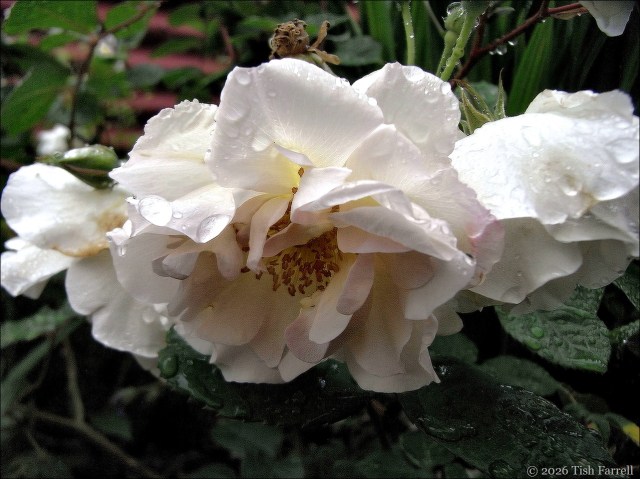
Here’s a photo from earlier in the week during a sudden sunny spell. The plant itself is a tending-tall, rather floppy shrub rose that can be trained as a short climber if you only have a short wall. I’m hoping that in time she will simply arc gracefully down the terrace wall without much in-put from me. She’s already doing her best.

RIMG0180 Penelope rose

RIMG0215 rose back garden

***

In the back garden the scabious are just beginning to flower – both the usual herbaceous border version which I bought as large plugs three years ago, but are only now performing, and a Sheep’s Bit variety called Jasione laevis Blue Light, which went in as a young plant last September. Both are presently keeping company with various hardy geraniums, but the Blue Light is already making a pleasing low clump on the border edge near the path.

RIMG0264 scabious

RIMG0260 Sheep's Bit scabious

RIMG0261 Sheep's Bit

***

Another first-time performer in the garden is the yellow Phlomis russeliana. I bought it because it’s drought tolerant, bee friendly, will bloom all summer and the dead flower heads still look good in winter. Last year, however, it sat out the long drought, and only made big leaves. It’s making up for it this year. I’m thinking that in due course it will need to move to the side wall bed, where it can keep the yellow rudbeckia and helianthus company.

***

On the edible front, the globe artichokes are making their presence felt. One of the plants has grown up hugely in a most annoying spot, squashed in between the Polka raspberries and the Jelly King crab apple tree. I know I did grow it from seed but somehow it escaped me during the planting phase and dug itself in. Anyway, the rain has brought it on, and it’s about to be eaten. I usually cut artichokes in half to remove the choke, and then steam them. Halves obviously don’t need so much cooking time as wholes, and it’s easier to see if they’re done. Garlicky butter to serve.

RIMG0201 globe artichoke

Also in the bottom border is a a purple headed variety. It’s strikingly ornamental growing alongside the sweet white rocket and foxgloves.

RIMG0205 artichoke

***

While I was inspecting this end of the garden, which takes some doing, what with the mammoth size of the artichoke leaves, I was pleased to see that the neighbouring old cooking apple tree looks to be bearing far more apples than we were expecting. The blossom came and went so fast in cold and windy weather, it seemed unlikely that much of it would be fertilised. But not so! We don’t know the variety, but the fruits are big and rose blushed and need no sugar when cooked.

RIMG0207 apples

***

And now back to my new favourite, as mentioned in two recent posts – Cenolophium denudatum, aka Baltic Parsley. Coming up is the version I have already settled in the bed along the top of the terrace wall. It grows rather like Cow Parsley/Queen Anne’s Lace, and indeed it was supposed to be white, according to the Great Dixter Nursery catalogue. Mine, however, turned out to be pink. I don’t mind. It looks good with the valerian whose massed umbels are hint-of-pink white.

RIMG0162 SoS

***

But then yesterday we were having a splendid day out in the walled garden at Wildegoose Nursery in the Corve Valley. And there I found a pale lemony version. It had to come home with me.

RIMG0243 Cenolophium

***

And to finish a shot of Wildegoose walled garden where I discovered it (along with a dozen or three other plants that roused acute spasms of gardener’s greed).

RIMG0247 alliums and euphorbia

Wildegoose Nursery Walled Garden

Copyright 2026 Tish Farrell

Six on Saturday 6 June 2026 Please call in on Jim as he prepares for his garden opening.

RIMG0273 header

Six On Saturday: After The Heat-Wave

RIMG0107 SoS

***

It’s been pretty darn hot this week in Shropshire, but nearly 9 degrees cooler now. On the whole, the garden, the gardener, and the gardener’s other half have weathered the sudden roasting, but the water butts are empty, one or two plants are looking frazzled, and the hot days have finished off the lovely ranunculus which, until last Saturday, had been blooming wonderfully, making the most of the long, cool spring. Also, some flowering plants like the Perry’s Blue iris, came and went very swiftly, while over the hedge,  hawthorn tree’s blossom fried. We now have siftings of crisp brown petals everywhere.

One real hot-weather bonus is that the bees (1), worryingly absent earlier in the month, are now back in the garden, feeding voraciously on the hardy geraniums, Welsh poppies and foxgloves. They seem to be making up for lost time.

RIMG0130 SoS

IMG_0687 SoS

***

In the back garden border the umbels (2) are the rising attraction. I’m always pleased when the valerian starts flowering, but this year it has a companion, one very like it, if more pink and more sweetly scented. Its common name, Baltic Parsley, sounds most unpromising for such an airy, delicate plant, but then this is hugely preferable to its tongue-twister botanical title of Cenolophium denudatum . I bought two young plants on-line last autumn from Great Dixter Nurseries, whose curated collections are altogether too tempting for the ever greedy gardener.

RIMG0073 starship

RIMG0164 SoS

***

This year I’ve decided to rein in the vegetable growing (3). Limited space is one factor, but the main reason is not liking all the ugly netting defences needed to keep the pigeons and  sparrows from eating everything. I’m still growing herbs, salad stuff, carrots in containers, a couple of rows of potatoes, some strawberries and raspberries, tomatoes in the greenhouse and also beans – all of which don’t need too much if any protection.

For several of the hot days I dithered about whether or not to plant out the large runner bean seedlings. In the end I decided it was better for them in the ground than drying out in their pots. I surrounded them with an emergency mulch of grass cuttings. Our neighbour had kindly just deposited a load over the fence and into our compost bin. I don’t usually use them for mulching, not wanting either crusts or a smelly, squidgy pan, but they soon dried out and the blackbirds have since been turning them over.

RIMG0149 SoS

Meanwhile on the other side of the garden, the potatoes are looking pretty good. The Charlotte row is thinking of flowering.

RIMG0150 SoS

***

And talking of mulch, my number (4) this week is a shout-out for the benefits of applying Strulch. This is very much for the small-garden gardener who doesn’t have access to masses of home-made compost. It’s a mineralised fine straw that comes in easy-to-move 9 litre bags. Last autumn I bought 2 bags and spread them over the two front garden beds, spots that are both exposed from the north in windy weather, but also sun-traps during heat-waves. There was still enough strulch left over to scatter less generously around some shrubs in the back garden. The stuff is not cheap, but you can find good deals on-line.

Apart from anything else, I’ve hardly had any weeds, and the herbaceous plants are emerging nicely to do their early summer stuff. I covered the entire soil surface, about an inch/2 cms deep.

RIMG0050 late May

RIMG0051 verbascum astrantia rock rose

***

From left to right: Helianthemum Wisley White, Astrantia Sparkling Stars middle, Verbascum Lavender Lass  front. And a closer look at the Astrantia. Isn’t she lovely?

RIMG0154 SoS

***

Not everything is going so well. Unseen pests (5) have been busy, most notably in the sweet peas, amongst which something, probably pigeons, have been gnawing off whole chunks of stems. For once, I’d grown some pretty chunky plants, and put them out early to grow up obelisks. But once they started growing, large parts began to go missing. I still have some flowers, but it’s not the display envisaged. I’ve never had this problem before, and can’t think how to protect them – i.e. that won’t end up in a big tangle of netting. (Note to self. The obelisks are probably the problem. Ideal perches for pigeons).

The other casualty, one that’s ongoing despite moving the plant to different locations, is the lovely blue-mauve lupin. Something keeps stripping the flowers. One minute they’re there, and the next time I look…

RIMG0141 SoS

***

But to end on a high note, and a deliciously fragrant one too – Cornelia Rose (6). She burst into flower this week. More power to her little pink petals. She’s growing by my greenhouse so I see a lot of her.

RIMG0132 SoS

Copyright 2026 Tish Farrell

Six on Saturday  Despite the heat-wave down in Cornwall, host Jim has some spectacular things on show in his garden, to say nothing of the magnificent Poplar moth in the greenhouse.

RIMG0107 SoS header

Six On Saturday: Frigid May

IMG_0629

We might have lost the cherry plum over the hedge, but we still have the hawthorn tree (1).  Just now it’s a tumble of creamy curds – may blossom in May. It’s a shame there are so few insects about to enjoy it. Even the stalwart bumble bees are scarce, which is worrying. I’m hoping they’ve tucked themselves up somewhere cosy until the Arctic winds have blown themselves out. So far, then, it’s been a very chilly May in Shropshire, and dry too, until these last few days. My water butts were empty, so even as I whinge at the cold wind, I’m pleased that rainwater supplies have resumed.

And spring is still happening in the garden despite the low temperatures. The apple blossom has been and gone, though signs of pollination looking sparse to absent on some of the trees. Now, then, is the time of columbines (2). As ever, they have grown themselves everywhere, including in the horrible hedge where one plant, trying to outdo the holly and privet, has used them for support and grown over four feet tall. It greatly improves the look of the hedge. Size-wise, they are more restrained at the bottom of the garden, but this year have arrived in many colours  from white to darkest claret, and shades in between.

columbine

*

I’m also pleased to see some lemon coloured Welsh poppies (3). Last autumn I pocketed seed from a neighbour, and scattered it under the old apple trees. We already had the self-sowing orange ones in the bed above the back terrace. For some reason I’m not too keen on the brassy version. This year, though, they’ve popped up among the Ranunculus.  I’m thinking they look rather good together.

Welsh poppies

Ranunculus poppies and geum

*

The blue flowered hardy geraniums are beginning to open, but the cranesbill Geranium phaeum Album (4) is well ahead. It does sprawl about, but its flowers are so delicate. It is supposed to be shade-loving, but I also have one that seems quite happy in full sun.

Album

*

And then there’s the rocket (arugula) (5). I’d never thought of it as a flowering plant till this year. All through the winter we were cropping a short row of it. Then, come March, it began to go to seed and I pulled most of it up. And then for some reason I left a clump. Now it’s a tall plant covered in a mass of flowers that seem to go on and on. They have curious, wonky propeller looks about them. I also thought the insects might like them if there were any about. Meanwhile, the bits of greenery down the stems are still perfectly edible, surprisingly mild in flavour. And it’s providing a bit of floral interest in front of my presently empty raised beds.

rocket flowers

IMG_0527

*

And to finish, here’s one of my newest plants bought in March. Iris Sibirica ‘Perry’s Blue’ (6) has just begun to flower. I’m rather taken with the startling contrast of the pale lavender with the russet-gold tones ofSpiraea Japonica Firelight. At a distance, as the wind blows, the flowers look like big butterflies.

Iris Sibirica Perry's Blue

*

Copyright 2026 Tish Farrell

*

Six on Saturday 16 May 2026: Please call in on our host Jim. There’s always something new to see in his garden. This week, among other lovely things, he has a gorgeous fern and some self-replenishing corydalis.

hawthorn header

Six On Saturday: Here Comes May

sparrow blackbird

Birds (1) are very much on our minds at present. This morning Graham emptied the seed dregs from the bird feeder onto the terrace wall. This invited a flurry of takers: several sparrows, a female blackbird and a wood pigeon. The advice of the Royal Society for the Protection of Birds is to stop feeding garden birds from May to the end of October, this to prevent the likely warm season spread of parasitic disease that’s affecting certain species, especially green finches.

All winter we have put out seeds and fat balls in feeders hidden in the hedge outside the kitchen window. This strategy has kept the jackdaws and pigeons away from the actual feeders, but not deterred the pigeons from scavenging for spilled seed in the hedge bottom. But we’ve otherwise enjoyed watching the regular sparrow visitors, and the not so frequent blackbirds, robins and bluetits.

The other RSPB reason for the feeding halt is to encourage birds to return to natural seasonal eating habits now there is plenty of wild-grown stuff about. We can see their point.

Anyway, now is also the time of year when the birds go in for some irritating garden habits, such as dust bathing around the roots of emerging herbaceous plants, thus compacting the soil and exposing roots (sparrows), or removing the mulch from the borders and tossing it around the paths (blackbirds). I’ve also discovered it’s the sparrows who have been nibbling the Swiss chard and spinach, even through the supposedly protective mesh. So, yes, maybe it is time they frequented fresh dining venues.

*

Lately I’ve been thinking that the tulips (2) are on the wane, but the unknown variety growing in the terrace wall pot keeps on flowering. Never mind the days and weeks of ferocious wind blowing them horizontal and drying out the pot. On dull days the petals  are very upright, but come a spot of sunshine, it’s full-fling abandonment…

tulips 3

*

Around the garden, the apple trees – eaters and crabs (3) are at various stages of flowering and finishing. In the front garden, the dwarf version of Laura, (a compact and columnar crab apple even when full-sized), has flowered with us for the first time. The crimson blossom is gorgeous against the claret-tinged foliage.

Laura crab apple

*

Also in the front garden the Ranunculus bulbs (4) are among the most striking of the  bright and early bloomers. They, too, have proved remarkably resilient to being blown off their roots. I planted them last summer at the wrong time, and was surprised when they flowered sporadically during our rainless weeks, and then produced quite a lot of foliage during the winter. Their red-hot shades are looking astonishing between the citrus green of the Euphorbia palustris ‘Walenburg’s Glorie’ and the deep russet heucheras. (That’s a dwarf Evereste crab apple in the middle).

front garden 2

front garden May

*

Another early flowering favourite is Phlox divaricata ‘Clouds of Perfume (5). It’s a low-growing, spreading variety, and more than living up to its name beside the front path. Makes me think of parma violet sweets we sometimes had as children, but smells much nicer.

phlox divaricata clouds of perfume

*

I’m very fond of hardy geraniums and have a number of young plants of several varieties in all the flower beds. The first to flower this year is Geranium phaeum ‘Samobor’ (6). The dusky wine coloured flowers are small, downward facing and all round unspectacular unless you get in close (also very difficult to photograph), but it is the foliage that is the more notable. I’m not sure that I have it in the right spot. It seems to have more woodland inclinations than herbaceous border frontage, but I like the leaves, which look rather good beside the two heucheras whose varieties I’ve forgotten.

samobor 4

samobor 3

*

Happy gardening, folks, whatever your hemisphere.

copyright 2026 Tish Farrell

*


Six On Saturday Please visit our host, Jim, in his Cornish garden.


birds header 2

Six On Saturday: Wind & Sun & Hail

heart's delight tulip

It’s been a week of many weathers, including a sudden heat wave on Wednesday with days of piercing winds and low temperatures either side.  One day we’re in the 20s C, and the next it’s down to 9 degrees. All very confusing, although I did manage to remember to think it was time to plant the seed potatoes – Red Rooster and Charlotte. They had grown some very chunky shoots while lingering in egg boxes in the downstairs cloakroom.

Also we could have done without the gale last Saturday. More of which in a moment. But first, the garden stars of the past two weeks have been these lovely little front garden tulips, Heart’s Delight (1). They have stood up to being roasted and thrashed, but I fear they won’t last today. As I write this, we’re having a hail storm and fierce sleety gusts. Most of their petals have already blown off.

IMG_0111ed

*

And so to last Saturday’s gale, and good bye cherry plum tree (2).  It wasn’t our tree, but it gracefully filled our kitchen window view and we liked to watch it through the seasons. It also made up for the ‘horrid holly hedge’ which we acquired along with the house. On Easter Sunday we woke to this:

cherry plum 2

cherry plum 7

cherry plum 1

*

The tree people came this week and cut the whole thing down. They said the remaining trunk showed signs of decay and had to go. There’s no denying it: it’s left a big gap.  I doubt that the housing association owners will replace it, planting space being rather limited. Here it is back in March.

cherry plum in March

cherry plum gap

We can now see the retirement home’s almond blossom tree across the road, but the immediate holly hedge view seems rather bleak and gloomy. I’m wondering about having a Japanese Maple in a big pot at the top of the old steps opposite the side window. It’s a semi-shaded, sheltered spot. It might work?

*

Of miniature trees (3). On a happier note, the garden’s tiny trees seem to be faring well. We don’t have a great deal of space, and although I realise shrubs generally form the ‘spine’ of a garden, I couldn’t get to grips with what to choose or where to put them. Instead, I thought of dwarf trees. The conference pear is the prettiest of them just now. It’s in a raised bed beside the potato patch.

back garden April

pear 3

pear 2

*

We also have 2 dwarf eating apple trees and a little Stella cherry on the top of the terrace wall, and in the front garden, two small crab apples (Evereste and upright Laura both about to flower), and a Merrybelle Plum, which is just over.

My thinking with the little trees is that we and the pollinators have the pleasure of the spring blossom (and maybe also some fruit come autumn), but they leave lots of room for the late spring and summer show of herbaceous perennials.  And if we lose sight of them for a while among the phlox, rdbeckia and Michaelmas daisies it doesn’t really matter.

Merrybelle 3

Merrybelle plum

terrace bed

About to flower – a dwarf Christmas Pearmain just visible to the left of the tulip pot.

*

The weather may be changeable and bitterly cold (even by English standards) but there have been plenty of sightings of butterflies: orange tips, tortoiseshells, Common Blues. I’ve also noticed bumble bees, especially in the Pulmonaria (lung wort) flowers. Diana Clare (4) with her striking silvery leaves, is a new plant bought last year, so I’m pleased to see she’s settling down, and especially after the pigeons snaffled her first leaves.

RIMG0065ed

*

Also looking its best with lots of flowers for the insects is the creeping rosemary (5), planted a couple of years ago along the front garden wall.

rosemary

*

And last, but not least, it’s all thanks to he who builds sheds and car ports that aren’t for cars, AKA Graham. This week he finished making me a cold frame (6). Brilliant! He’s also mended my ancestral (grandfather’s) spade  whose handle broke while I was trying to excavate the whirly washing line spike that needed to go somewhere else.

All we need now is to get growing with some warmer, less windy weather. Roll on spring!

cold frame

*

Six On Saturday April 11 2026


Reasons To Be Cheerful: Six On Saturday

snowdrops 9

January came with heavy snow and gale force gusts that brought down snow-laden trees. Then there were days of frost and biting winds, then heavy rains that flooded fields and roads. There were also many low cloud days, the hills around the Castle shrouded in murk the colour of mud; not much sight of the sun. But through it all the snowdrops have been emerging in ever bigger clumps. They are everywhere around the town, in pots and borders, on patches of abandoned garden, under walls and hedges. And they’re still going strong.

Our own snowdrops are too newly planted to make a clump or a photo worth taking, though we’re still pleased to see them. So these are the neighbours’ snowdrops.

*

The garden has been looking pretty dreary, but there are signs of spring  – when I put on my specs and do some low-level peering.  The Tete a Tete daffodils for one are looking promising:

daffodils

*

We’re also approaching the main season for hellebores. The December flowering Christmas Carols have kept going through snow and frost, but the rain has muddied and bruised their faces.

IMG_9727

*

This purplish-pink one, just opening outside the kitchen window, is faring better:

IMG_9808sq

And still in purplish mode the Ajuga reptans  looks to have put on a growth spurt along the back garden path. I think it may be Atropurpurea. It’s certainly looking very purple here in the afternoon light:

Ajuga

*

And since we’re in the back garden, it’s worth looking in on the winter greens. At one stage they were buried in six inches of snow, but now I see the Swiss Chard and perennial beet have begun to regrow, and the purple sprouting and cauliflowers planted out in the cleared runner bean bed in September are bulking up. The land cress, meanwhile, has been sprouting edible, peppery salad stems all winter.

Swiss chard 3

RIMG0020

IMG_9816

*

And finally there are the slivers of tiny mauve crocuses that have popped up all over the front garden. On dull days they are almost invisible, their petals in tightly wrapped small spikes that remind me more of fungi than flowers.

crocus ed 3

But earlier this week we actually had a blue-sky-full-on-sun day, and the tiny souls opened wide, though barely an inch across at full petal: their own small force of nature.

*

Six on Saturday Our host Jim, as ever, has plenty to show us in his garden; always something new to see or learn about there.

Six On Saturday: In The December Garden

IMG_9640sos

Now as the year ends, the garden is wet, wet, wet. Wet as in waterlogged, sodden, soggy and all round slithery. But yesterday we had sun. It seemed like a heavenly blessing after days of gloom and serial downpours. And suddenly, instead of finding the garden depressing, I started to notice the plants that were not only doing their best, but in their own way, putting on a show.

1) Top of the list is Nandina domestica, otherwise known as Heavenly Bamboo. It’s not a bamboo and so does not have bamboo’s bad infesting habit. The variety here is Fire Power. It’s compact, dome-like in habit, evergreen, and will grow around 18 inches tall with a two feet spread. It likes full sun, but otherwise is undemanding. It also seems unfazed by hard frost (we had several weeks of freezing weather last year). But what colours! It turns more red with the cold weather.

IMG_9629sos

*

Number 2) is a plant that has made a good recovery after a very unpromising start. It’s a Japanese Shield Fern I bought on-line back in the spring. After ten days being lost and tossed about by the delivery company, it arrived in very sorry state, much mangled and desiccated. Now it seems very happy in its pot, making new fronds even..

IMG_9628sos

*

3) The prize for steadfast out-of-season flowering goes to the Phlox paniculata Adessa in the front garden. This is a young plant, bought in the summer. I was not expecting it to flower until next year, but come November, spires of small white flowers appeared, and they’re still going, subtly scented too.

IMG_9641sos

*

4)  Also in the front garden is a tiny self-grown viola. It’s seeded from the pot of violas my sister gave me over a year ago. Such stalwart, exquisite little plants.

IMG_9639sos

*

5) Another surprise is the number of foxglove plants in the garden, all self-sown. They have been growing huge during the recent wet and mostly mild weather, having recovered from a spell of heavy frosting in November. Happy thoughts of summer then.

IMG_9634sos

*

6) Finally, and spot on for a December debut is hellebore Christmas Carol. It was a gift last year, since divided and planted out both in a pot and in the new back steps bed. It’s been so cheering on dull days, though, annoyingly, some beastie is biting holes in its petals. Last year it flowered from months and months.

IMG_9651sos

IMG_9649sos

*

Happy gardening everyone –

whether planning or planting, depending on your hemisphere

Six on Saturday  And thanks and Happy Christmas to host Jim. He has shown us so many fascinating plants, to say nothing of guiding us around his stunning planting schemes.

IMG_9640 sos header

Six On Saturday: Showing Their Colours

Evereste

Back at the end of October the garden was alive with drifts of cosmos, Michaelmas daisies and rudbeckia. And then the downpours began, plus some big winds. The cosmos is still hanging on, but the Michaelmas daisies are no more and rudbeckia down to the final few stems.

1) The rose trio, though, is hanging on, still doing their bit. Cornelia by the greenhouse is looking a little rain battered, but still very pretty. St. Cecilia on the terrace wall has been flowering sporadically for some weeks. But her neighbour, Penelope, has only started flowering this week, beautiful, but unexpected…IMG_9404

IMG_9373

Penelope

*

2) There have been other surprise openings this week, including the newly planted young Hesperanthus Wilfred H. Bryant…

Hesperanthus

Other curious (unseasonal?) discoveries this week include buds and flowers on two Vanilla Ice sunflower plants which I grew from seed in the spring. They’re multi-headed plants with medium,  in sunflower terms, sized flowers. Heaven knows why they’ve waited till November.

3) In the still going strong since the summer category, Salvia Amistad wins first prize. Actually, this is the best its looked since it was planted in the spring…

IMG_9425

4) And in the front garden, a new favourite Crocosmia Harlequin, as seen this morning. Isn’t this a lovely plant…

Harlequin

*

5) In between torrential rain and misty drizzle, garden tidying, and the usual plant shifting has begun. Our builder and son also came and removed an annoying (literally) stumbling block outside the back door. Last year we had the garden steps reconfigured, but the job wasn’t quite finished and the old bottom steps survived the exercise, were a real eye-sore and general all-round nuisance. But now transformation. They have been demolished and a brand new, semi-shade bed created. I’ve planted it up with assorted hellebores, (Christmas Carol in the right hand corner just in bud), dwarf daffodils, snowdrops under the hedge, pulmonaria Blue Ensign and Diana Clare (silvery leaves), and in the far left, a neat fern, Polystichum setiferum congestum. As the leaves go from the hedge end behind the house, it will get more light. A spring garden then.

new bed

*

6) Last but not least, when it comes to providing long-lasting colour and cheerfulness, to say nothing of eventually feeding the birds, it has to be the crab apple trees: a miniature Evereste in the front garden (header photo) which we can see from the sitting room, and Jelly King at the bottom of the garden, but visible from the kitchen. Even on the gloomiest days, they do their best to glow. Today, though, we have wall to wall sunshine and Wedgewood Blue sky, so here they are looking their brightest…

Jelly King

Evereste header


Six on Saturday Please call in on our host, Jim. He still has some fabulous plants still flowering in his garden

Feeling Blustered: Six On Saturday

IMG_9149

1. Storm-struck

This morning at breakfast time – with a high wind whooshing about the place and rain lashing the kitchen doors, the garden definitely looked a no-go area. I could see three dozen bean canes splayed like pick-up-sticks across the top path by the greenhouse. Drat and double drat. When I dismantled the runner bean rows a week or so ago, I had forgotten to tether them securely to the hedge. I could also see the cosmos at the top of the steps being tossed about. Since late September and the onset of rainy days, it has been flowering magnificently. Now it was having its petals blown off. More curses. And I could see that the Selinum (farthest right at the wall top) which is still flowering as well as seeding, was now rearranged at a 45 degree angle.

Not a happy gardener.

IMG_9160

Cosmos unclothed; Helianthus blown away.

IMG_9180

And then, quite suddenly, towards midday, the rain stopped and the sun came out, although we still have a mighty blow, with now-and-then gusts that lift you off your feet.

I did a quick tour of the garden, but there was not much to be done mid-gale, apart from attempting a bit of support for the Selinum.

2: Apples

apples

With the wind, I was expecting another heavy crop of windfalls. But when I went out to check the damage, I was pleased to see that most of our remaining apples are still clinging sturdily to their stalks. Which is good news as I already had a stack of windfalls in the kitchen. And there’s only so much apple sauce we can eat, and all the neighbours are overwhelmed with apples too and putting them out at their gates for anyone to take. However, I recently discovered an easy apple chilli chutney recipe, and so, as gardening was out, this was what happened next.

IMG_9192

*

3. In love with Michaelmas daisies

I’m not expecting the late flowering flowers to survive the wind, but that won’t include the Michaelmas daisies (Symphyotrichums/Asters whatever they’re called these days).  I took this photo with the wind still blowing. Only a couple of small side stems damaged.

IMG_9158

Its neighbour, a compact little variety (I think it could be Purple Dome) has only just decided to flower:

IMG_9167

And at the bottom of the garden this tall white bushy version, White Ladies maybe, and…

IMG_9176

…Aster x frikatii Monch have been flowering since the hot days of summer:

Aster × frikartii Mönch

*

4. Great Dixter Nursery

And so like Jim, I’ve been doing some plant buying. I have recently discovered that Great Dixter House and Gardens has an online plant shop. They sell some very lovely plants (1 and 2 litre sizes) at very reasonable prices. That’s where I found Patrinia as featured in an earlier SoS. And it’s where I also found ‘Symphyotrichum Les Moutiers’ which is now planted in my front garden. We’ll have to wait nearly a year before we see it in action though. Do give the link a quick look.

5. Ongoing edibles

The salad stuff hasn’t been troubled by the unruly weather. The radicchio and endive, rocket, land cress, and Moroccan Cress lettuce are presently thriving, though everything has to be netted against pigeons.

IMG_9185

We also have some Swiss chard, beetroot, parsnips and leeks, and a new bed of winter greens (planted out on the runner and borlotti bean bed) is looking quite good. And there are still a few climbing borlotti beans to pick in the side-garden wall bed.

IMG_9187

*

6. A happy face

IMG_9164

Now as I’m writing this, the rain is back and the wind is still blowing. So I’m finishing off with another garden stalwart. I was so pleased to find this marigold looking so fresh-faced as I went round the garden late-morning. Of course, we eat these too. Perhaps I shouldn’t mention that though.

Happy gardening folks – whatever your weather. Even on distinctly unpromising days, there’s usually something in the garden to be glad about.

copyright 2025 Tish Farrell

Six On Saturday  Please catch up with Jim at Garden Ruminations.

header

Season Of Mist and All Round Wetness ~ Six on Saturday

viola magnifico 2

Here in Bishop’s Castle the rainy weather continues as we head towards the autumn equinox. Just now it’s pouring steadily, threatening to dampen spirits for today’s Michaelmas Fair. This is always a hugely jolly affair of stalls, parades, Chinese dragons, steam engines, vintage vehicles and street performances – assorted bands, Morris dancers, a jester from Chester, the singing farmer, to name but a few of the events. And then the whole thing is rounded off mid-evening with a magical lantern procession through the town (the lanterns made by children). All very much dependent of weatherly cooperation. But then I’m sure, this being the Castle, everyone will make the best of it, brollies and waterproofs at the ready.

Definitely not a day for gardening though. Also as the season winds down, it’s hard not a feel a touch dispirited by the ongoing sogginess. The few roses on their second flowering don’t like it much either. But come hell or high water, to say nothing of last winter’s three solid weeks of snow and frost, the little pansies, viola magnifico [1] above still soldier on. This plant has been flowering continuously for twelve months.

And talking of pansies, what is it that nibbles the yellow ones? And is it the same thing that bites off the buds from my only lupin whenever it tries to flower?

*

yellow viola

*

The Cosmos [2]doesn’t mind the weather either. In fact it seems to be having a new lease of life, and I’m enjoying the drifty looks of it, its stems hanging in raindrops.

Cosmos

*

The Japanese ‘Uchiki Kuri’ squash [3] plants  weren’t as productive as I’d expected, and I had high hopes of some later planted plants. They’ve produced a couple of tiny ones, and I’ve nipped off extraneous shoots, but I think it’s probably too late for them now.

Japanese Squash 2

Japanese squash 3

japanese squash

*

The borlotti bean crop [4] is looking more promising. I picked all the dwarf variety some weeks ago, but the climbing ones are just beginning to dry in their pods. I love them for their looks alone, though they’re pretty good in the pot too.

borlotti

*

Despite my weather whingeing, the garden is still looking colourful. The rudbeckia and Michaelmas daisies certainly brighten the place up. There are also still some sunflowers at the bottom of the garden, and my two very small crab apples trees [5], Evereste and Jelly King are looking their vibrant best.

 Evereste

This miniature Evereste is in a corten steel raised bed, along with some origano Kent Beauty, and Santolina. Silvery Artemesia Powis Castle behind.

*

Jelly king

Jelly King is lighting up the furthest corner of the garden. I’m not sure I want to sacrifice the apples to making jelly (perverse I know, considering this is why I chose it). They look so lovely, and in fact, now I have found sources of wild apples (see previous post) I think I will leave them, first for us to look at, and later for the blackbirds.

Finally, here’s one of my newish garden plants that has been so glad of the rain, Persicaria Blackfield [6], red bistort. It really struggled all through the summer, despite my hand watering. But then with the first of the recent showers, it perked up and began to flower. It’s interesting that the drought seemed to have had a miniaturising effect on the whole plant, as if it was making itself small to save itself. I’m hoping it will settle in now and come into its own.

Persicaria Blackfield

*

Six on Saturday Please visit host Jim at Garden Ruminations. He’s been very busy despite the weather.