
You are currently browsing the tag archive for the ‘combinations’ tag.
When training combinations on a heavy bag or pad, or working combos in sparring, pay close attention to what your hands and arms do immediately following and between strikes. A few tendencies are very common:
- dropping the hand to waist height in between strikes with a bent elbow
- pulling the hands all the way past the lateral line behind the body
- letting the entire arm hang straight at the waist
These are common habits, especially among people who are new to training, bag work or successive sparring. People who train in arts that emphasize a “pullback” motion in tandem with every strike are especially prone to it, and it’s a habit that should be discouraged. I understand the utility of a pullback to create a force-couple with the target, but it is absolutely useless unless something is actually being grasped and pulled back- keep the other hand near your face, where it can serve a purpose (keeping your face from being rearranged).
Ideally, you want to train in the habit of returning the hands to a guard that covers the face following each strike. I prefer a higher guard, but the happy medium between people’s personal preferences is one that places the hands someplace between the chin and temple. If this is something that you or a student has a hard time doing, try the following strategies:
- Adopt the habit of keeping your thumbs or palms in contact with your temples. You may not prefer a guard that is quite this high, but the tactile feedback of the thumb contact often works better than repeated verbal coaching about the location of the hands. Once you begin returning naturally to this position, thumb/skin contact with the temples is no longer necessary.
- Put your bag near a mirror (or a mirror near your bag) so that you can watch what your hands do.
- Ask a trusted training partner to slap you lightly in the face when your hands drop during a drill. Touching may get the idea across, but a few light slaps will provide quite a bit more motivation to keep your guard up between strikes.
- Take a resistance cable or band with moderate tension and wrap it across your upper back, in line with the shoulders. Grasp the handles at roughly chin height. As you strike the bag (lightly) the cable will produce higher tension, providing an external motivation to return them to your face as opposed to dropping. Don’t let the tension cause your elbows to flare too wide from the body.
I’ve noticed lately that during my personal training time, I tend to default to a few combinations when it comes to working the heavy bag or ude makiwara. I may reshuffle the various techniques into different orders, but after awhile the same 4-5 strikes manifest themselves. Straight left, outside right hook, lead uppercut, hammer fist on the return, etc. There’s nothing wrong with having a few specialty techniques ingrained from doing lots of bagwork and from sparring experiences, but at some point a habit becomes a limitation. A problem made itself obvious: how can I incorporate a degree of randomness into this training time, thereby moving outside of certain habits, without becoming unproductive? I’ve also noticed that people learning karate generally learn best when they have “discovered” something for themselves rather than being given every minute detail and then told to master it all. So how to incoproprate this into my solo training, as well as for working with others?
In between rounds on the heavy bag last night, my mind wandered to thinking about getting some index cards for making flashcards of each unfamiliar word or phrase that I come across as I read through a collection of Latin American short stories in Spanish (another summer project). Look it up, use it in a variety of contexts, combine it with what I already know, learn it . And as I went back to the bag, I wondered “why not do that with striking combinations?” So I grabbed 50 or so index cards and wrote a different strike on each one:
Jab
Reverse punch
Shovel hook
Outside hook
Uppercut
Palm strike
Shuto
Haito
Forearm smash
Elbow smash
Rising elbow
Backfist
Reverse backfist
Front kick
Roundhouse kick
Knee Strike
For each strike I also included cards with simple variations, such as front hand/leg, rear hand/leg, low and high, to address all of the variables for using that technique. I also threw in some ‘wild cards’ that read “switchback,” “turning,” and “shifting” to incorporate some basic footwork into the deck. The result? A very effective way to train combinations and force your body to work in ways that you might ordinarily neglect. Below are four samples of random combos that I drew while training yesterday evening:
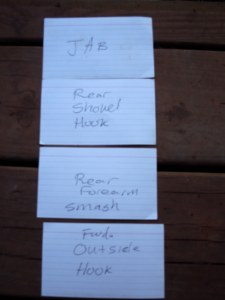

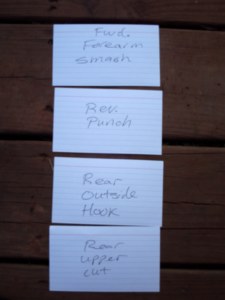

In these FOD (Flashcards of Doom) I found a very effective answer to my problem. Partner or not, I can shuffle through the deck and stretch both my brain and body a bit. I had a couple of willing students try them while doing some pad work this morning, with very good results. By the end of it they were moving through even the most counter-intuitive combos with fluidity and power. Give it a shot- just get a packet of index cards and write out your vocabulary of strikes and footwork. When you come across techniques that are new to you, or that you are uncomfortable with using freely, add them to the deck. Shuffle thoroughly and you’ve got hours of fun on your hands. Well, maybe not fun, but you will find yourself working combos that you’ve never thought of, and realizing that you have certain bad habits (dropping your hands between techniques, bad balance in transitions, pausing when throwing continuous strikes from the same limb etc). And you’ll be suprised at how much the random combo training eimproves the rest of your practice.


 FSRI Blog
Recent Comments