
You are currently browsing the tag archive for the ‘Kakiya’ tag.
A note of thanks to Mario McKenna, who graciously posted a photo of the kakiya from Kyoda Juhatsu’s garden dojo, and provided me with some estimates of it’s height and arm length.

By Popular Demand
I’ve received a few emails asking about where a kakiya can be purchased or how it can be made. I don’t know of any place where one can be purchased. Below are the materials and steps that I used to build mine. If you aren’t into power tools and concrete, I am open to the possibility of assembling kits and selling them: contact me at REMsimpson at gmail dot com and make an offer. The reader assumes all risks from building and using this piece of equipment.
Below are two more short sample clips of training with the kakiya. Training with a partner is best, but the kakiya can provide a good tool for skill refinement when a partner isn’t available. Plus, it’s just plain fun. In both drills, the demonstrator’s hands remain in a high guard and punches are thrown from this level instead of a pullback/hikite, a bad habit which karate training often imparts. As an added bonus, training on uneven ground prepares the student to use these skills in a more realistic setting than smooth dojo floors.
Low Kick Entry to Striking Combo
Here the kakiya is used to train basic entry and attack skills. Facing the kakiya at a close engagement distance, the student throws a low kick to the height of an opponent’s knees or groin. Immediately following the kick, he uses his lead hand to pass the “guard” of the kakiya arm to enter and throw a striking combination.
While higher kicks may be more visually impressive they place the kicker at a very high risk for disabling counters; a low kick to the kneecap or groin is far less risky, and will cause an attacker serious pain.
Kakiya Ducking Drill, Varied Response
Here a punch ducking and counter striking drill is practiced on the kakiya. The aim is to duck under the kakiya arm, which simulates an opponent’s extended arm. Both feet ideally clear the attack line to the outside of the arm, placing the student in a position to attack along the “opponent’s” weak line. Notice that his feet do not stay flat, as is commonly taught in karate. Flat feet reduce mobility, response speed and power. When ducking the arm, notice that his head remains upright enough to see the target.
When returning up from the duck, counter-strikes are thrown in conjunction with the rising and twisting of the body to exploit power generated by the rebound of the legs. The drill starts slowly and then progresses to half speed. The student ‘s responses begin with punching combinations, then progress to knee strikes and low lashing roundhouse kicks followed by strikes to the body and face.
Boy am I on a roll, posting up videos I mentioned a year or more ago!
The clip below shows some very basic drills that can be done using the kakiya in lieu of a live partner to condition for dynamic drills and responses. Grabs, presses, pulls, blocks and parries can be used in conjunction with a wide variety of strikes and striking combinations. The kakiya is not often seen in modern karate, but it was a common tool in many early Okinawan karate circles. The design seen here is based on information supplied by Mario McKenna with a few liberties taken for adjustability. More detailed drills and training ideas to follow (in the near future).
Nothing like 8″ of snow and 10 degree winds to hamper outdoor training…which is why there’s hot tea and karate DVD’s.
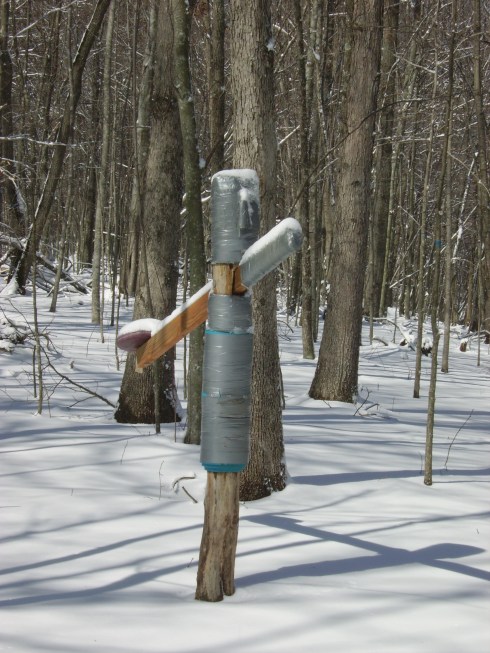
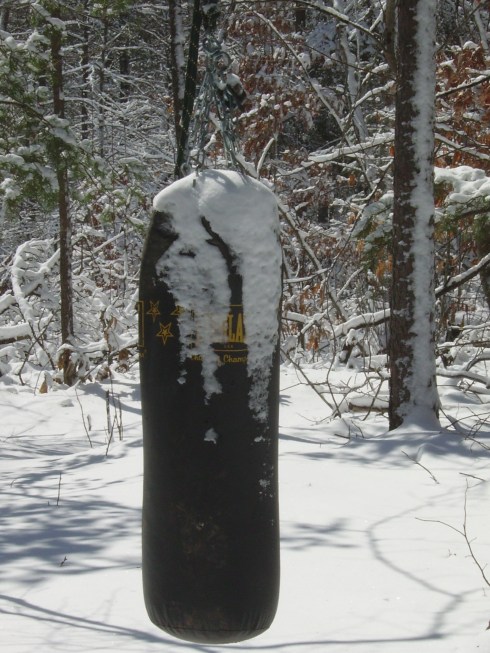
After a week of slushy winter rain, wind and snow, Spring is looking better and better! Here are a few shots taken by Lisa Henderson in the back yard dojo last year- so much green…

A bit of the old up and down.

My One-Eyed Tomcat Boxing style teacher, Genghis, inspecting the Hojo Undo gear.
Mario McKenna has posted a nice diagram and some information on the Kakiya, a piece of training equipment that is not generally seen/used by modern karate practitioners.
http://okinawakarateblog.blogspot.com
My homemade attempt, constructed with Mr. McKenna’s kind technical guidance:
http://www.flickr.com/photos/tkri/2697659838/


 FSRI Blog
Recent Comments