
Interesting Marden’s Theorem:
Physics <=> Affine Geometry
Elementary Math
Interesting Marden’s Theorem:
Physics <=> Affine Geometry

Entry From Classical Algebra to Abstract Algebra : Chinese Remainder Theorem
(九章算术) -> Ideal
0 is not a Natural Number (Peano’s axiom)
To be clearer, we denote
N* = Natural Number N Set without 0.
Finally Algebra allowed in PSLE taught to P6.

Markov Chain (Probability)
its unique feature :
it settles ultimately to a steady state.
这是一个非常经典的组合恒等式。李善兰恒等式(Li Shanlan’s Identity),也称为李善兰卷积,是中国清代数学家李善兰在其著作《则古昔斋算学》中提出并证明的一个重要恒等式。
它在现代组合数学中是一个标准结果,是超几何函数恒等式的一个特例,通常被称为 Chu-Vandermonde 恒等式 或 Vandermonde 卷积 的一种形式。李善兰的工作早于或独立于西方数学家,因此在中国数学史上具有重要意义。
李善兰恒等式可以表述为:
其中:
· r, s 是任意复数(通常为实数或整数)。
· m 是一个非负整数。
· 
当 r 和 s 是非负整数时,这个恒等式有非常直观的组合解释。
 时)
时)假设你有两个集合:
· 集合 A 有 r 个元素。
· 集合 B 有 s 个元素,且 A 与 B 不相交。
问题: 从并集 
答案显然是: 
另一种数法: 我们可以按“从 A 中选多少个”来分类:
· 如果从 A 中选 k 个元素,那么从 B 中就必须选 m-k 个元素。
· 从 A 中选 k 个有 

· 对 k 从 0 到 m 求和,得到总方法数为 
因为两种方法数的是同一个东西,所以等式成立。
标准的 Vandermonde 卷积 通常写作:
这与李善兰恒等式完全相同。因此,李善兰恒等式就是 Vandermonde 卷积。
· 历史背景:Alexandre-Théophile Vandermonde(1772年)和李善兰(19世纪中叶)都独立发现了这个公式。
· 更一般的形式:超几何函数形式为 
一个著名的特例是令 r = s = n , m = n :
这个结果在组合学中非常常见,它说明在 2n 个物品中选 n 个的方法数,等于从两组 n 个物品中各选 k 个(对所有 k 求和)的方法数平方和。
应用领域:
代数证明(使用生成函数):
考虑

展开左边:
右边展开:
比较两边 x^m 的系数,即得恒等式。
组合证明:如上文第2点所述。
李善兰(1811-1882)是中国近代数学的先驱。除了这个恒等式,他在数论(“李善兰素数定理”,即对伯特兰猜想的早期研究)、级数求和(“李善兰迭积术”,与斯特林数相关)以及微积分学翻译(与伟烈亚力合译《代微积拾级》)方面都有重要贡献。
李善兰恒等式是他独立研究成果的一个代表,展示了中国数学家在这一领域达到的深度。
无理数
√2 = 1.41421356 …
but
Why (√2)²
= (1.41421356 …)² = 2


Euclidean Division
He gives a rigourous proof for such infinite power towers.
1970s南大数学赛题 :
x^{x^{x^{…x}}=3
=> x^3=3
=> x= ³√3
is wrong for divergent cases in some interval of x
π = √2+√3 =
1.414 +
3.146
(π = 3.14159…“山顶一寺一壶酒”)
中三Trigo老师强迫我们背 ,终生不忘,好用handy 👍
√2=1.414 ,
√3=1.732

Make BP = CQ,PQ common=> BQ=CPAB=AC (等腰)Angles ∠B=∠CCongruence (SAS):ΔABQ Ξ ΔACP=> AP = AQ
八年级几何(难题)

Solution: x = 60°
👍 The key is 胖瘦定理。
Also “ai” guess:
None length given to find x°, then must be 3 cases of special angles :
为何最后 他说 “第一步补助线 DG ” 是多余的?
https://vt.tiktok.com/ZSUusAeKc/
Many profs teach eigen-vector/-value by definition with
Av = λv ,
only 1 American Prof Paul Halmos revealed λ = 1 could be Very useful too.
例子:
孙悟空(v)被二郎神的天犬追咬,老孙变(A)成一间庙(w), 但庙前的旗却在庙后(猴尾巴)。天犬被骗, 但二郎神猜出庙是🐒变!
Av(=w )= λv
λ = 1
w= 1v = v🐒
https://vt.tiktok.com/ZSDPQmP5K/

Trump is a “1st 流 Math teacher” 😄
Math Teachers 分4流:
4流:解题 但不解释
3流:文字解释清楚,不套公式
2流:“数学”导游,引发数学兴趣
1流: 学生motivated, 爱他的数学老师
“超”一流: 培养学生成为数学家。
[Note]
还有一个种 “不入流”的数学老师, 恰好是“反1流”:学生害怕凶巴巴的数学老师, 专门fail 人 by “Killer Math subject”.
中学/JC /大学 碰到许多这种数学老师/Prof, 就很倒霉。


中国古代算术很聪明, 求勾股triplet 有口诀,西洋数学没见过这个秘诀。
奇数: 7: 7²=49=25+24 => (7,24,25)
25² = 7²+ 24²
625=49 + 576
偶数:6 :6/2= 3 =>3²=9 => 9-1=8, 9+1=10 =(6,8,10)
10² = 6² + 8²
100 = 36 + 64

The term “反演变换” in the context of Chinese middle school (中考) mathematics is :
Inversion Transformation (or Geometric Inversion)
Key Details:
Example:
Application in China Secondary School (O-level) :
中考 O-level Geometry: 反演变换
Circle Inversion
No teacher / prof of Calculus ever explained the Product rule so intuitively…👍
(f.g)’ = f’g + f.g’
Beautiful proof:
1² + 2² +3² +….+ n²
= n.(n+1)(2n +1)/6

Elementary Math (O, A, IMO) solved easier by higher-level University Math.
Smart prove of algebraic identity using Linear Algebra (determinant of matrix)
det A.B = det A.det B
(for A, B Square matrices)
Also by complex number conjugate :
https://vt.tiktok.com/ZSBGTyQcL/
Good for Sec 3 Trigo students:
“才“字诀 记
sin, cos, tg : + quadrants

Std Deviation for data science using manual, excel, SQL or python


This is the Strategy 2 (of 8) “Equal Fractions” using Model + Unitary Method.
The key is to recognize EQUAL Fraction of Purple :
1/4 (= 3/12, before) = 3/8 (after).
Make numerators (3) equal for models
ie
3/12 = 3/8
then draw “3” boxes for purple units in total 12 boxes (before), and 3 boxes in total 8 boxes (after)
辅助线/Δ


Baccalaureat Géométrie en Complexe
The formula of the angle between 2 complex numbers (interesting).
https://vt.tiktok.com/ZSk1gG57s/
PRI 3 Maths :


Solution: Use Fermat’s 无穷递降 法 Infinite Descent Method (Note *)
https://vt.tiktok.com/ZShWpm7CR/

Note (*) : Fermat used this prove Light Refraction Law 光折射定律

Note:
This 4th strategy of the 8 Singapore Math Strategies is called
“Internal Transfer with Total unchanged”.
(Total = 100, Peter and Mary internal transfer).
Tricky is by working backward.
Tough for PSLE students unless déjà-vu similar type problems / techniques before.
I tried algebra also, complex equations to solve:
P = M
¾P + 2/7(100-¾P ) = 5/7(100-¾P)
P = 40

1st Conventional Method: By 1-variable simple Algebra

2nd Assumption Method: Assume all 50 units of P


Assume all (50 units) are P at 30¢
Group D&M as one category at 90¢ (50+40)
Total cost of 50 xP
=50*30= 1500
Short of 1830-1500 = 330
=>
330/ 30¢ = 11 units
[Note]
This 30 ¢ is the total price difference of
D-P: 50¢-30=20¢
M-P : 40¢-30=10¢
Total difference = 20+10=30¢ which affects the difference 330¢
Hence 330/30 = 11 units of “D&M” group
Since D and M have same number of unit,
Hence D=11 units= M
P = 50-11-11 = 28 units
Tuition Center Method:

What’s wrong logic by Tuition Center in STEP 3) below:
1) Assume HALF of total 50 = 25 pairs are D&M. So it would cost a total of = 25*0.9 = $22.5
This is 22.5-18.3=$4.2 in excess of the actual expenses.
2) $4.2÷ $0.3= 14 (excess due to P)
3) Half *2 = 50 pairs (WRONG !!!)
=> 14 excess ×2 = 28 P stickers (coincidence = answer )
4) D&M stickers are 50 – 28 = 22 stickers.
[Note]
Why TC assumed only 25 D&M (but not 50 D&M?)
BCOS:
25 D&M = 25 D + 25 M = 50 = ALL pieces
3rd Method: Guess and Check – simple logic but lengthy

Ternary Go : 黑/白/空

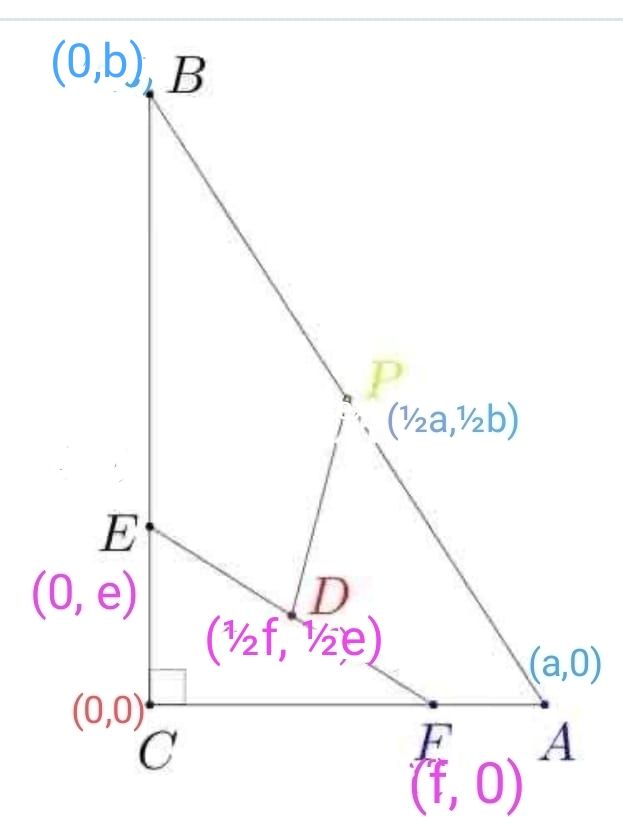

Given the corrected labels:


 — A point on the y-axis (BC)
 — A point on the x-axis (AC)
 — Midpoint of EF
 — Midpoint of AB
Given:
 (distance between
  and
and 
 .
.Step 1: Express |PD| Mathematically
The distance between 

Step 2: Incorporate Constraint EF = 4
Since 
Step 3: Minimize |PD|
We need to minimize 

This is equivalent to finding the point 

The minimal distance occurs when 


Thus, the minimal distance is:
Therefore: (From Step 1 above)
Step 4: Incorporate AB + AC = 12
Assuming 

 (distance from
  to
to 
Thus:
Let 
Step 5: Substitute into |PD|
Now,
Step 6: Apply Constraint BC ≥ AC ≥ 4
From the original problem:
 .
.Given 

Solve 
Square both sides
(valid since 
Solve the quadratic 
The relevant root is 
Thus, ![a \in [4, -12 + 12\sqrt{2}]](https://s0.wp.com/latex.php?latex=a+%5Cin+%5B4%2C+-12+%2B+12%5Csqrt%7B2%7D%5D&bg=ffffff&fg=375362&s=0&c=20201002)
Step 7: Find Minimal |PD|
We have 
To minimize |PD|, maximize 
The maximum 
Thus:
Final Answer
The minimum value of |PD| is:
[Note 1]
Parametric Derivation of (f, e) Coordinates
We want to find the point
1. Parametric Representation of the Circle
Any point on the circle can be expressed as:
2. Distance Squared Function
The squared distance between 
Expanding:
Simplifying using 
3. Minimizing the Distance
To minimize 

The maximum value is:
achieved when:
4. Optimal Coordinates (f, e)
Substituting the optimal 
5. Verification
Verify (f, e) lies on the circle:
6. Minimal Distance Calculation
The minimal distance is:

Thus:
Final Result
The coordinates that minimize
This parametric derivation confirms the geometric solution, showing explicitly how the angle parameter
[Note 2]
Let’s verify the equation:
Where we have:
Step-by-Step Verification:


Conclusion:
The verification confirms that:
is indeed correct.
This shows that the minimal distance between point (a,b) and the closest point (f,e) on the circle is exactly the distance from (a,b) to the origin minus the circle’s radius (4).

[Note 3]
Minimum PD Derivation

Note:
任何三角形:
大角对大边
小角对小边
=> 140° to a, 20° to b
=> a > b
so
assume (b > a ) not possible.
日本方法: 辅助三角形 (红)

Trigonometry: Sine Rule


Similar Exercise:


Step 1: Prove (a= h), I drew 窗帘 Red , Green to find 2 equal areas A

Step 2: I drew 窗帘 棕&红, △ECG = 3 (a=h , bisect △EDG), derive 1+3=4= △BCG = ½ square,
shaded area = full square – 3 = 4*2 – 3 = 5
Verification by Algebraic equations (Primary 5 still not taught Algebra):

We as a kid making kite using toilet-roll thin cover-paper and bamboo sticks from mom’s bamboo sweeper 竹扫帚, nobody had ever discovered this trick!!
https://vt.tiktok.com/ZShRopefX/
He used GeoGebra tool to draw the animation geometry.

Proof:
https://en.m.wikipedia.org/wiki/Fermat_point


![\begin{aligned} &\textbf{1. Starting Point} \\ &\text{Point } P \text{ at } \left(\frac{a}{2}, \frac{b}{2}\right)\text{ (midpoint of AB)} \\ &\text{Point } D \text{ moves along path from EF's midpoint (EF=4)} \\[5pt] &\textbf{2. Circle Constraint} \\ &\text{Parameterize using angle } \theta: \\ &f = 4\cos\theta,\; e = 4\sin\theta \\ &\Rightarrow D = (2\cos\theta, 2\sin\theta) \\[5pt] &\textbf{3. Distance Function} \\ &PD^2 = \left(\frac{a}{2} - 2\cos\theta\right)^2 + \left(\frac{b}{2} - 2\sin\theta\right)^2 \\[5pt] &\textbf{4. Critical Point} \\ &\frac{d}{d\theta}PD^2 = 0 \Rightarrow \tan\theta = \frac{b}{a} \\ &\text{Optimal angle aligns with } (a,b) \text{ direction} \\[5pt] &\textbf{5. Optimal Coordinates} \\ &\cos\theta = \frac{a}{\sqrt{a^2+b^2}},\; \sin\theta = \frac{b}{\sqrt{a^2+b^2}} \\ &PD = \frac{1}{2}\sqrt{a^2+b^2} - 2 \\[5pt] &\textbf{6. AB + AC Constraint} \\ &\sqrt{a^2+b^2} + a = 12 \\ &\Rightarrow \sqrt{a^2+b^2} = 12 - a \\ &b = \sqrt{144 - 24a} \\[5pt] &\textbf{7. Optimization} \\ &PD = 4 - \frac{a}{2} \\ &\text{Minimize PD by maximizing } a \\ & \\ &a = -12 + 12\sqrt{2} \approx 4.97 \\[5pt] &\textbf{8. Final Calculation} \\ &PD_{\min} = 4 - \frac{-12 + 12\sqrt{2}}{2} \\ &= 10 - 6\sqrt{2} \\[5pt] &\textbf{Why This Works} \\ &\bullet \text{Finds closest } D \text{ to } P \text{ with EF=4 constraint} \\ &\bullet \text{Converts geometry to optimization problem} \\ &\bullet \text{Minimum when } D \text{ aligns with } OP \text{ direction} \\ &\bullet \text{Exact solution from system of equations} \\[5pt] &\textbf{Verification} \\ &a = -12 + 12\sqrt{2} \Rightarrow \\ &\sqrt{a^2+b^2} \approx 7.03 \\ &PD \approx 1.515 \text{ matches } 10 - 6\sqrt{2} \end{aligned}](https://s0.wp.com/latex.php?latex=%5Cbegin%7Baligned%7D+%26%5Ctextbf%7B1.+Starting+Point%7D+%5C%5C+%26%5Ctext%7BPoint+%7D+P+%5Ctext%7B+at+%7D+%5Cleft%28%5Cfrac%7Ba%7D%7B2%7D%2C+%5Cfrac%7Bb%7D%7B2%7D%5Cright%29%5Ctext%7B+%28midpoint+of+AB%29%7D+%5C%5C+%26%5Ctext%7BPoint+%7D+D+%5Ctext%7B+moves+along+path+from+EF%27s+midpoint+%28EF%3D4%29%7D+%5C%5C%5B5pt%5D+%26%5Ctextbf%7B2.+Circle+Constraint%7D+%5C%5C+%26%5Ctext%7BParameterize+using+angle+%7D+%5Ctheta%3A+%5C%5C+%26f+%3D+4%5Ccos%5Ctheta%2C%5C%3B+e+%3D+4%5Csin%5Ctheta+%5C%5C+%26%5CRightarrow+D+%3D+%282%5Ccos%5Ctheta%2C+2%5Csin%5Ctheta%29+%5C%5C%5B5pt%5D+%26%5Ctextbf%7B3.+Distance+Function%7D+%5C%5C+%26PD%5E2+%3D+%5Cleft%28%5Cfrac%7Ba%7D%7B2%7D+-+2%5Ccos%5Ctheta%5Cright%29%5E2+%2B+%5Cleft%28%5Cfrac%7Bb%7D%7B2%7D+-+2%5Csin%5Ctheta%5Cright%29%5E2+%5C%5C%5B5pt%5D+%26%5Ctextbf%7B4.+Critical+Point%7D+%5C%5C+%26%5Cfrac%7Bd%7D%7Bd%5Ctheta%7DPD%5E2+%3D+0+%5CRightarrow+%5Ctan%5Ctheta+%3D+%5Cfrac%7Bb%7D%7Ba%7D+%5C%5C+%26%5Ctext%7BOptimal+angle+aligns+with+%7D+%28a%2Cb%29+%5Ctext%7B+direction%7D+%5C%5C%5B5pt%5D+%26%5Ctextbf%7B5.+Optimal+Coordinates%7D+%5C%5C+%26%5Ccos%5Ctheta+%3D+%5Cfrac%7Ba%7D%7B%5Csqrt%7Ba%5E2%2Bb%5E2%7D%7D%2C%5C%3B+%5Csin%5Ctheta+%3D+%5Cfrac%7Bb%7D%7B%5Csqrt%7Ba%5E2%2Bb%5E2%7D%7D+%5C%5C+%26PD+%3D+%5Cfrac%7B1%7D%7B2%7D%5Csqrt%7Ba%5E2%2Bb%5E2%7D+-+2+%5C%5C%5B5pt%5D+%26%5Ctextbf%7B6.+AB+%2B+AC+Constraint%7D+%5C%5C+%26%5Csqrt%7Ba%5E2%2Bb%5E2%7D+%2B+a+%3D+12+%5C%5C+%26%5CRightarrow+%5Csqrt%7Ba%5E2%2Bb%5E2%7D+%3D+12+-+a+%5C%5C+%26b+%3D+%5Csqrt%7B144+-+24a%7D+%5C%5C%5B5pt%5D+%26%5Ctextbf%7B7.+Optimization%7D+%5C%5C+%26PD+%3D+4+-+%5Cfrac%7Ba%7D%7B2%7D+%5C%5C+%26%5Ctext%7BMinimize+PD+by+maximizing+%7D+a+%5C%5C+%26+%5C%5C+%26a+%3D+-12+%2B+12%5Csqrt%7B2%7D+%5Capprox+4.97+%5C%5C%5B5pt%5D+%26%5Ctextbf%7B8.+Final+Calculation%7D+%5C%5C+%26PD_%7B%5Cmin%7D+%3D+4+-+%5Cfrac%7B-12+%2B+12%5Csqrt%7B2%7D%7D%7B2%7D+%5C%5C+%26%3D+10+-+6%5Csqrt%7B2%7D+%5C%5C%5B5pt%5D+%26%5Ctextbf%7BWhy+This+Works%7D+%5C%5C+%26%5Cbullet+%5Ctext%7BFinds+closest+%7D+D+%5Ctext%7B+to+%7D+P+%5Ctext%7B+with+EF%3D4+constraint%7D+%5C%5C+%26%5Cbullet+%5Ctext%7BConverts+geometry+to+optimization+problem%7D+%5C%5C+%26%5Cbullet+%5Ctext%7BMinimum+when+%7D+D+%5Ctext%7B+aligns+with+%7D+OP+%5Ctext%7B+direction%7D+%5C%5C+%26%5Cbullet+%5Ctext%7BExact+solution+from+system+of+equations%7D+%5C%5C%5B5pt%5D+%26%5Ctextbf%7BVerification%7D+%5C%5C+%26a+%3D+-12+%2B+12%5Csqrt%7B2%7D+%5CRightarrow+%5C%5C+%26%5Csqrt%7Ba%5E2%2Bb%5E2%7D+%5Capprox+7.03+%5C%5C+%26PD+%5Capprox+1.515+%5Ctext%7B+matches+%7D+10+-+6%5Csqrt%7B2%7D+%5Cend%7Baligned%7D&bg=ffffff&fg=375362&s=0&c=20201002)
 Math Online Tom Circle