[Continued from previous BM Category Theory …]

Intuition: [Artificial Intelligence] You teach the computer like to a Primary 6 kid, that Algebra is a type of expression (f) which, after evaluation, returns a value.
If a = i (initial) [or u (terminal)],

Intuition: Fix-point because, the Initial “i”, after evaluating the expression f, returns itself “i”.
Lambek’s Lemma

Note: Endo-functor is a functor (equivalent to function in Set Theory) within the same Category (Endo = Self = 自)
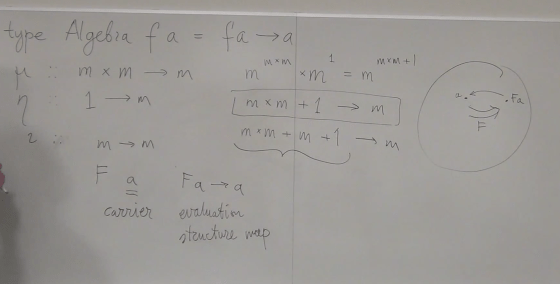

Video 8.1 F-Algebras & Lambek’s Lemma
Video 8.2 Catamorphism & Anamorphism
foldr ~ catamorphism (浅层变质) of a Fix-point endo-functor on a List.
Examples: Fibonacci, Sum_List
Remark: Cool Math! the more advanced concept it is, the more closer to Nature (eg.Geology, Biology) : Catamorphism 浅层(风化)变质, or “thin-layer change in nature” (in Functional Programming languages: foldr or map) eg : add1 to a list (1 5 3 8…)
= (2 6 4 9 …)


Intuition: Reverse of Algebra, given a value, Coalgebra returns an expression (f).

Anamorphism (合成变质) ~ unfoldr
Example: Prime numbers
Remark: Anamorphism (合成变质) or “synthesised change in nature“: eg. Start from a “seed” prime number “2” generates all other infinite prime numbers (3 5 7 9 11 13 17 …)

Note: In Haskell, no difference between Initial and Terminal Fix-points. However, since Fix-point is not unique, in Category Theory there is the Least Fix-point (Initial) and Greatest Fix-point (Terminal).
Ref:
Reading “Understanding F-Algebra ” by BM: https://bartoszmilewski.com/2013/06/10/understanding-f-algebras/
Catamorphism (下态) : https://www.zhihu.com/question/52180621/answer/129582557
Anamorphism : https://zhuanlan.zhihu.com/cofree/21354189
F-Algebra & F-coalgebra: http://stackoverflow.com/a/16022059/5822795


 Math Online Tom Circle