@profomarmath #greenscreen What happens when you remove axioms from groups? #mathajor #abstractalgebra #grouptheory
♬ original sound – ProfOmarMath – ProfOmarMath
Tag Archives: Group
Symmetry Groups in Physics
Group Theory of Symmetry in Physics Conservation Laws (in Energy, Momentum), Quantum Physics in unifying the 3 (out of 4, except Gravitational) universal Forces.
The ‘Useless’ Perspective That Transformed Mathematics | Quanta Magazine
“Representation” is the concretization / visualization of Abstract Math,
eg.
“Group Representation Theory” 群表示论 using Matrix (Linear Algebra).
Reference:
Artin’s Algebra book with matrix representation, lectured by Harvard Dean Prof Gross :

Hard Math Problems | Hardest Math Problems With Answers
“Poisson Distribution Intuition (and derivation)”
“Poisson Distribution Intuition (and derivation)” by Aerin Kim 🙏
https://link.medium.com/bho611jxSX
Poisson was a 19CE French mathematician, or Statistician, who invented the Poisson Distribution.


Note: “Applied” Math vs “Pure” (aka Modern / Abstract) Math
Poisson, being an Applied Math expert in the French Science Academy, did not understand the “abstract” Math paper submitted to him by the 19-year-old Evariste Galois in “Group Theory” for the “Insolvability of Quintic Polynomial Equations“. Poisson rejected the paper commenting it was too vague, destroying the final hope of Galois to make his invention the “Modern Math” known to the world. The dejected poor Galois died at 21 after a duel during the chaotic era of the French Revolution.
From Polynomial to Modern Algebra

Examples Polynomial with degree > 5


The “Prime Number” of Group: “Simple Group”
Group :
Simple Group :
Monster Group: its “discoverer” Simon Norton is an eccentric Cambridge Trinity College Math genius (same class year as Singapore PM Lee Hsien Loong).

直观 数学 Intuition in Abstract Math
Can Abstract Math be intuitive, ie understood with concrete examples from daily life objects and phenomena ?
Yes! and Abstract Math should be taught by intuitive way!
1. 直观 线性空间 : Intuition in Linear Space
(Part I & II) 矩阵 (Matrix), 线性变换 (Linear Transformation)
http://m.blog.csdn.net/myan/article/details/647511
(Part III)
http://m.blog.csdn.net/myan/article/details/1865397
Animation: English (Chinese subtitles)
http://m.bilibili.com/video/av6731067.html
2. 直观 群论 (Intuition in Group Theory)

https://www.zhihu.com/question/23091609
Symmetry, Algebra and the “Monster”
Very good introduction of Modern Math concept “Group” to secondary school math students by an American high school teacher.
Summary:
- Symmetry of a Square
- Isometry (*) or Rigid Motion (刚体运动) = no change in shape and size after a transformation
- What is a Group (群 “CAN I” ) ? = Closure Associative Neutral Inverse
- Monster Group = God ?
- String Theory: Higgs boson (玻色子) aka “God Particles”
Note (*): “保距映射” (Isometry),是指在度量空间 (metric space) 之中保持距离不变的”同构“关系 (Isomorphism) 。几何学中的对应概念是 “全等变换”。
苏联老师Arnold 如何 教中小学 抽象”群”
How this Russian math prof taught secondary school kids the advanced math in Group & Field Theory without the boring axiomatic approach which tortures most math students.


Table of Contents:
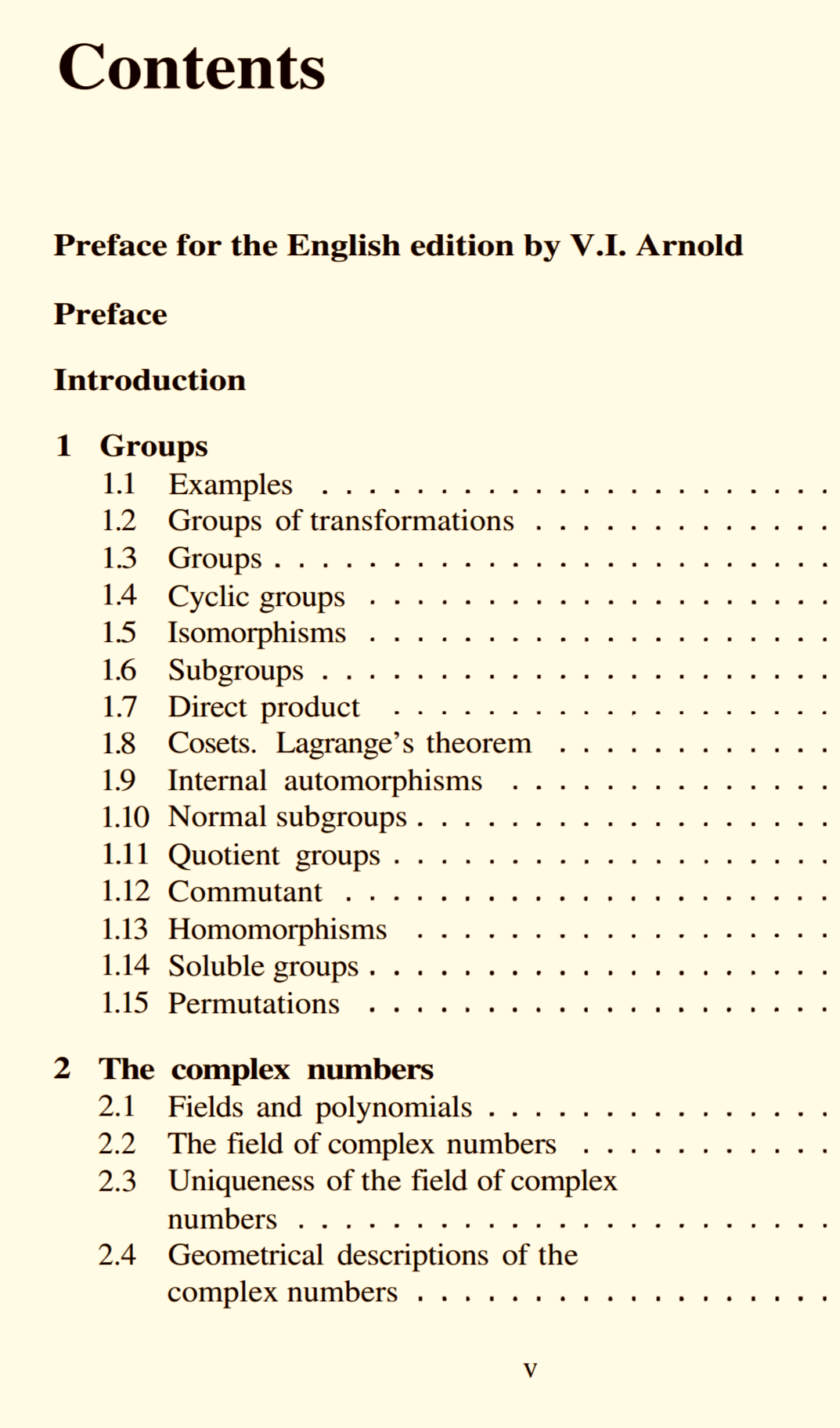
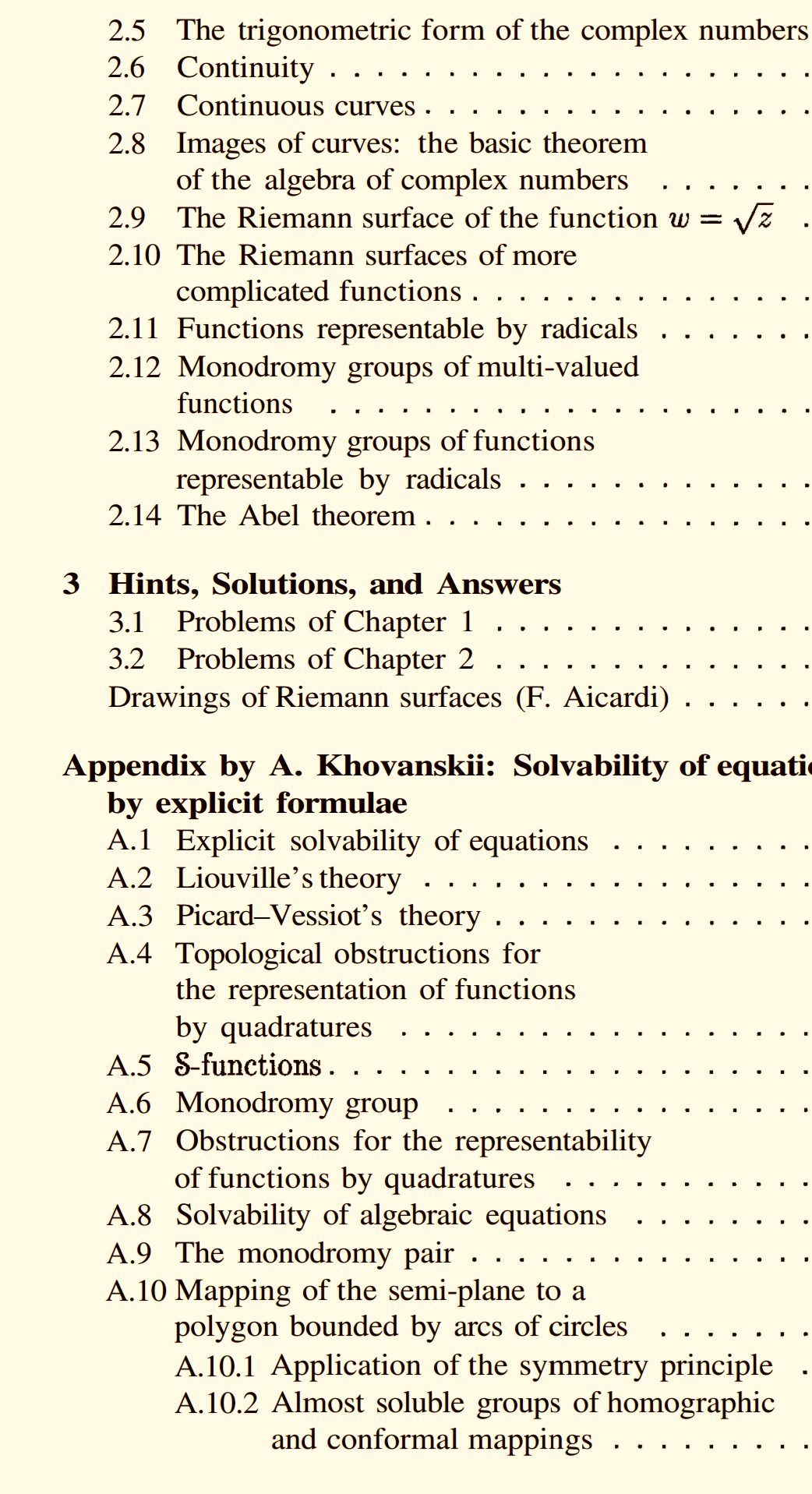
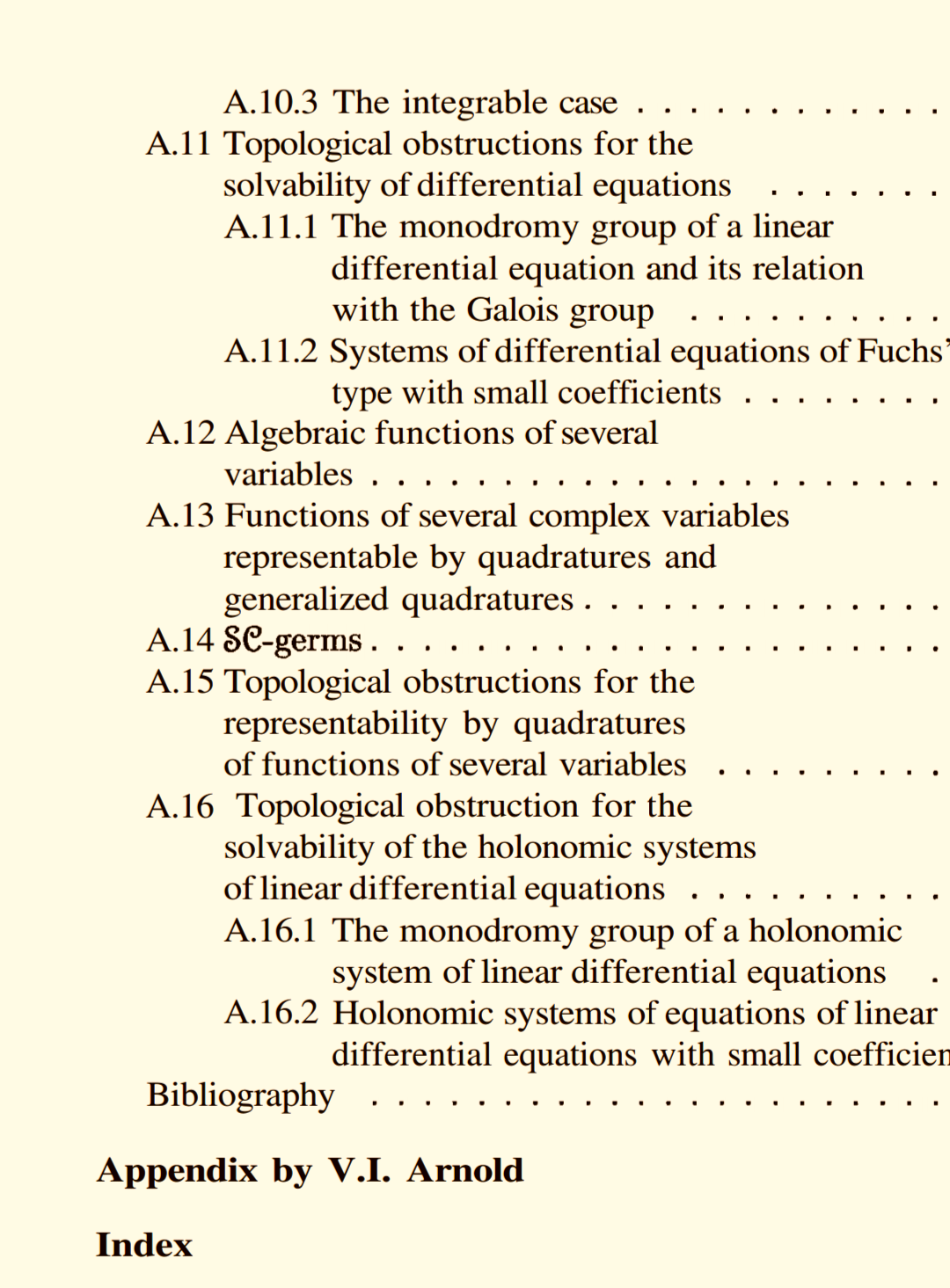
Does Abstract Math belong to Elementary Math ?
The answer is : “Yes” but with some exceptions.
Most pedagogy mistake made in Abstract Algebra teaching is in the wrong order (by historical chronological sequence of discovery):
[X] Group -> Ring -> Field
It would be better, conceptual wise, to reverse the teaching order as:
Field -> Ring -> Group
or better still as (the author thinks):
Ring -> Field -> Group
- Reason 1: Ring is the Integers, most familiar to 8~ 10-year-old kids in primary school arithmetic class involving only 3 operations: ” + – x”.
- Reason 2: Field is the Real numbers familiar in calculators involving 4 operations: ” + – × ÷”, 1 extra division operation than Ring.
- Reason 3: Group is “Symmetry”, although mistakenly viewed as ONLY 1 operation, but not as easily understandable like Ring and Field, because group operation can be non-numeric such as “rotation” of triangles, “permutation” of roots of equation, “composition” of functions, etc. The only familiar Group is (Z,+), ie Integers under ” +” operation.
Some features which separate Advanced Math from Elementary Math are:
Proof [1] Infinity [2] Abstract [3] Non Visual [4]
Note [1]: “Proof” is, unfortunately, postponed from high-school Math to university level. This does not include the Euclidean Geometry axiomatic proof or Trigonometry Identity proof, which are still in Secondary school Elementary Math but less emphasized since the 1990s (unfortunately).
Note [2]: However, some “potential” infinity still in Elementary math, such as 1/3 = 0.3333…only the “Cantor” Infinity of Real number, 
Note [3]: Some abstract Algebra like the axioms in Ring and Field (but not Group) can be in Elementary Math to “prove” (as in [1]): eg. By distributive law
By commutative law


Note [4]: Geometry was a “Visual” Math in Euclidean Geometry since ancient Greek. By 17 CE, Fermat and Descartes introduced Algebra into Geometry as the Analytical Geometry, still visual in (x, y) coordinate graphs.
20 CE Klein proposed treating Geometry as Group Transformation of Symmetry.
Abstract Algebra concept “Vector Space” with inner (aka dot) product is introduced into High School (Baccalaureate) Elementary Math – a fancy name in “AFFINE GEOMETRY” (仿射几何 , see Video 31).
eg. Let vectors
Translation:
Stretching by a factor 


Distance (x,y) from origin: |(x,y)|

Angle 


Ref: 《Elements of Mathematics – From Euclid to Gödel》by John Stillwell (Princeton University Press, 2016) [NLB # 510.711]
群论的哲学 Philosophical Group Theory
在一个群体里, 每个会员互动中存在一种”运作” (binary operation, 记号 *)关系, 并遵守以下4个原则:
1) 肥水不流外人田: 任何互动的结果要回归 群体。(Closure) = C
2) 互动不分前后次序 (Associative) = A
(a*b)*c = a*(b*c)
3) 群体有个 共同 的 “中立” 身份 (Neutral / Identity) = N (记号: e)
4) 和而不同: 每个人的意见都容许存在反面的意见 “逆元” (Inverse) = I (记号: a 的逆元 = 
Agree to disagree = Neutral

具有这四个性质的群体才是
群体的 “美 : “对称”
如果没有 (3)&(4): 半群
如果没有 (4) 反对者: 么半群
以上是 Group (群 ) 数学的定义: “CAN I”
CA = Semi-Group 半群
CAN = Monoid 么半群
群是 Evariste Galois 19 岁数学天才 (伽罗瓦)在法国大革命时牢狱中发明的, 解决 300年来 Quintic Equations (5次或以上的 方程式) 没有 “根式” 解 [1] (radical roots)。19世纪的 Modern Math (Abstract Algebra) 从此诞生, 群用来解释自然科学(物理, 化学, 生物)里 “对称”现象。Nobel Physicists (1958) 杨振宁/李政道 用群来证明物理 弱力 (Weak Force) 粒子(Particles) 的不对称 (Assymetry )。
Note [1]:”根式” =
![\sqrt[n]{x}](https://s0.wp.com/latex.php?latex=%5Csqrt%5Bn%5D%7Bx%7D+&bg=ffffff&fg=375362&s=0&c=20201002)
比如: Quadratic equation (二次方程式) 有 “根式” 解:[最早发现者 : Babylon 和 三国时期的吴国 数学家 赵爽]


3次方程式 (16世纪 意大利数学家 解根 时发现 
1930民国初 一位苏家驹教授 写论文称他证明 5次方程有”根式”解。当时15岁的杂货店员 华罗庚 用19世纪Galois的证明 反驳。此事得到清华大学数学系主任 (留法博士) 熊庆来教授 和 杨武之教授 (杨振宁的父亲, 中国第一位”庚子赔款”奖学金 留美 数学博士)的注意, 破格收”只有中二学历”的华罗庚进入清华读数学。 毕业后, 熊再保送他去 英国剑桥大学深造三年, 跟从当代世界最伟大的数论大师 Prof G.Hardy (Ramanujian 的老师)。华罗庚青出于蓝, 比2位恩师更有成就, 尤其对 1960 ~ 1980的 中学数学教育的贡献, 考察苏联 大师 А. Н. Колмогоров 的数学教育改革, 编撰中国中学数学课本, 影响中国和星/马华校学子。
Group Theory in Rubik’s Cube & Music
Group is the “mathematical language” of Symmetry — the beauty which pleases human’s eyes and animal’s eyes: We are attracted by a symmetrical face (五官端正), bees are attracted by a symmetrical flower…
Group was discovered by a 19-year-old French genius Evariste Galois (sound: \ga-lua, 1811-1832), who was attempting to explain why any quintic equations (polynomial with degree 5 or more) could not have a solution formula (like quadratic, cubic, equations) using +, -, ×, /, nth root radicals. This 300-year problem since 16th century defeated even then the world’s greatest Mathematician Gauss. Before a fatal duel which killed him, Galois wrote down his discovery of ‘Group Theory’ which was understood only 14 years later by Professor Louisville of the Ecole Polytechnique — ironically the same university which failed Galois twice in admission exams (Concours, aka French imitation of Chinese 科举).
Group has 4 properties: “CAN I ?”
C: Closure
A: Associative
N: Neutral element (or Identity)
I: Inverse
Rubik’s cube is group. It is a fun game.
Music is group. It is pleasing to ears if the music is nice, or “symmetric”.
Cayley graphs and the geometry of groups
Terence Tao’s wrote this easy-to-understand Group Theory. It is rare for mathematicians to be also a good writer in explaining difficult math in layman’s terms. Highly recommended!
To be continued (Part 2):

In most undergraduate courses, groups are first introduced as a primarily algebraic concept – a set equipped with a number of algebraic operations (group multiplication, multiplicative inverse, and multiplicative identity) and obeying a number of rules of algebra (most notably the associative law). It is only somewhat later that one learns that groups are not solely an algebraic object, but can also be equipped with the structure of a manifold (giving rise to Lie groups) or a topological space (giving rise to topological groups). (See also this post for a number of other ways to think about groups.)
Another important way to enrich the structure of a group $latex {G}&fg=000000$ is to give it some geometry. A fundamental way to provide such a geometric structure is to specify a list of generators $latex {S}&fg=000000$ of the group $latex {G}&fg=000000$. Let us call such a pair $latex {(G,S)}&fg=000000$…
View original post 2,096 more words
Great Math Popular Books

日本数学科普作家写的好书。深入浅出, 适合中学生读最高深数学。
結城 浩 Hiroshi Yuki (1963 -) is a Japanese Math Popular Book Writer for Secondary and High School students. In the “Galois Theory” (Chapter 10) he boldly attempted to explain to them such complicated concepts: Quotient Group, Field Extension, Group Order, Normal Sub-Group, Solvable Group …
Evariste Galois‘s genius is he built a “bridge” between Field (域/体) and Group (群) – both new concepts invented by him. The “bridge” is called Galois Group, or by Emile Artin the “Group Automorphism”. He transferred the difficult problem of solving complicated 4 -ops (+-×/) Field (coefficients) to the single-op (permutation of roots) Group.
Galois Group is the ultimate TRUTH of all Math — Fermat’s Last Theorem, and any advanced Math, will use Galois Group or Field, to solve. Prof C.N. Yang 杨振宁 Nobel-Prize Physics discovery was based on Group Theory.
Evariste Galois was a French Math genius, died at 21 in a duel during French Revolution. He is the ‘Father’ of Modern Algebra. Failed 2 years in Ecole Polytechnique CONCOURS Entrance Exams, then kicked out by Ecole Normale Supérieure, his Math was not understood by all the 19th century World’s greatest Math Masters : Gauss, Fourier, Poisson, Cauchy…
“Galois Theory” — the ultimate Math “葵花宝典” (a.k.a. “Kongfu Bible“) — is only taught in the Math Honors Undergraduate or Masters degree Course.
自己学习《Galois Theory》(Page 365):
— “高中会教这种困难的数学吗 ?”
— “…我觉得比起給高中老师教, 不如自己好好学吧。”
— ” 重要的是自己学习。”
Visualizing Group Theory


Visual Group Theory Podcast Episode 1:
Ref:
http://web.bentley.edu/empl/c/ncarter/vgt/
Visual Group Theory (MAA Problem Book Series) by Nathan Carter
Modern Algebra (Abstract Algebra) Made Easy
UReddit Courses:
http://ureddit.com/category/23446/mathematics-and-statistics
Modern Algebra (Abstract Algebra) Made Easy
This video series is really well done ! short and sharp, yet cover the entire syllabus in the Group Theory.
Strongly recommended for those Math-inclined students from upper secondary schools (Secondary 3 to JC2). Although the Singapore school Math syllabus based on Cambridge ‘O’ and ‘A’ level do not cover modern math – which is a serious weakness for being biaised on computational applied math, an outdated pedagogy for the last 40 years with no major changes – we miss the latest Math development since 19 century, the so called ‘Modern Math’ but already 300 years old.
Group Theory is the stepping stone to open the door of interesting advanced Math, physics, chemistry, bio-science and engineering. It should not be limited only to the Math-major undergraduates in university. (Note: Why France and China make Modern Algebra compulsory for all science and engineering students )
Part 0: Binary Operations
Part 1: Group
Note: Why ‘e’ for Identity, ‘Z’ integers
Part 2: Subgroup
Part 3: Cyclic Group & its Generator
Part 4: Permutations
Part 5: Orbits & Cycles
Part 6 : Cosets & Lagrange’s Theorem
Part 7 : Direct Products / Finitely generated Abelian groups
Part 8: Group Homomorphism
Part 9: Quotient Groups
Part 10: Rings & Fields
Part 11: Integral Domains
Reference: further studies in deeper and advanced Abstract Algebra at:
Harvard Online Free Course by Prof Benedict Gross
Monster Group – 196,883 dimensions – “The Voice of God”
Monster Group (code name “Moonshine”) is the largest (simple) group, discovered by two Cambridge Mathematicians John Conway and Simon Norton.
Monster Group – (1)
Monster Group (2):
John Conway: Life, Death and the Monster (3)
Ref:
1. Simon Norton (1952 -)
http://catalogue.nlb.gov.sg/cgi-bin/spydus.exe/ENQ/EXPNOS/BIBENQ?ENTRY=The%20genius%20in%20my%20basement&ENTRY_NAME=BS&ENTRY_TYPE=K&SORTS=DTE.DATE1.DESC%5DHBT.SOVR

Note:
Simon Norton and Lee Hsien Loong (Singapore Prime Minister) both studied in the same year (1973) in Cambridge Mathematics Tripos.
2.
Finding Moonshine: A Mathematician’s Journey Through Symmetry by Marcus Du Sautoy

Les maths ne sont qu’une histoire de groupes
Clay Mathematics Seminar 2010:
“Math is nothing but a history of Group”
Director of Institute Henri Poincaré : Cédric Villani (Fields Medalist, 2010)
Speaker: Prof Etienne Ghys
École Normale Supérieure de Lyon
The Math teaching from primary schools to secondary / high schools should begin from the journey of Symmetry.
After all, the Universe is about Symmetry, from flowers to butterflies to our body, and the celestial body of planets. Mathematics is the language of the Universe, hence
Math = Symmetry
It was discovered by the 19th century French tragic genius Evariste Galois who, until the eve of his fatal death at 21, wrote about his Mathematical study of ambiguities.
Another French genius of the 20th century, Henri Poincaré, re-discovered this ambiguity which is Symmetry : Group, Differential Equation, etc.
Only in university we study the Group Theory to explore the Symmetry.


Groups Lecture Notes (Cambridge Math Tripos)
Excellent Notes on Group Theory.
Sub-group Test
2-Step Test subgroups:
H subset of group G is subgroup if:
1. H is non-empty
(check: identity of G ∈ H)
2.

Prove Subset not a subgroup:
1. For infinite Group: sufficient to prove subset doesn’t contain e (identity).
2. For finite group: sufficient to prove subset not closed.
H is subgroup of G

Group Problem
Let G be a group.
∀x,y ∈ G
Prove that xy and yx have the same order n ?
ie.

Proof:
Let
(xy)(xy)…..(xy)(xy) = e
[(xy) n times]
By associativity,
x.(yx)(yx)…(yx).y=e
ie yx has order n.
[QED]


Galois Theory Simplified
Galois discovered Quintic Equation has no radical (expressed with +,-,*,/, nth root) solutions, but his new Math “Group Theory” also explains:
but


Why ?
which can be expressed in
hence in {+,-,*,/, √ }
ie


=>

Theorem: All Cyclic Groups are Solvable
=>

However,
because the permutation of solutions is A5 (Alternating Group) which is Simple
ie no Normal Subgroup
=> no Symmetry!

See also: From Durian to Group


Galois Theory, Third Edition (Chapman Hall/CRC Mathematics Series)


Group Action: Orbit
Orbit demystified
Let G= {rotation around center O }
Let X= point {x,y } ∈ R²
Orbit (X) = subset of points X on the concentric circles of different radius, centered at point O.
In fact,
Orbit = Coset
Hence is equivalent relation
=> can partition set X
=> X = Uj Orbit (Xj)
French Flag Colors
National Flag of France has 3 color stripes: red,white, blue = (r,w,b)
If we permute the 3 colors, how many flags are there ?
Eg. (w,b,r) = (r,b,w) since they are same if flip over the flag.
Eg. (b,b,b),(r,w,r)… repeat color allowed.
[Ans: 18]
Hint: Apply Group action on the Set (r,w,b)
French Flag:
Let Group G = {g1,g2 }
g1={e}= {(1)(2)(3)}
g2={(1 3)(2)}
|G|=order = 2
Apply Group Action on 3 colors set X {r,w,b}:
g1.X=e.{r,w,b} => Fix 3 stripes each with 3 colors
=> |Fix(g1)|= 3³ ways
(1 3)= Fix 1st & 3rd stripe as 1 stripe, x 3 colors => 3 ways
(2) => Fix 2nd stripe x 3 colors = 3 ways
g2.X=(1 3)(2).X=> 3×3
=> |Fix(g2)|= 3²
By Counting Theorem:
Total Flags = Orbit(X)
= ∑|Fix(g) | /|G|
= (3³ + 3² ) / 2
= 18

Exercise:
Chessboard (8×8=64) colored arbitrarily in black or white.
How many different patterns are there ?
[Consider 2 patterns as the same if a rotation (90, 180, 270 degrees) takes one to another ?]
Group Representation
Group Representation
Faithful: Isomorphic (1 to 1)
Unfaithful: homomorphic (m to 1)
Group of Equilateral Triangle
Permute the 3 vertices.
Isomorphic to S3 (permute 1 2 3)
Faithful representation by matrices:
e =

C₃=

C₃² =

σ₁ =

σ₂ =

σ₃ =

Group Theorems: Lagrange, Sylow, Cauchy
1. Lagrange Theorem:
Order of subgroup H divides order of Group G
Converse false:
having h | g does not imply there exists a subgroup H of order h.
Example: Z3 = {0,1,2} is not subgroup of Z6
although o(Z3)= 3 which divides o(Z6)= 6
However,
if h = p (prime number),
=>
2. Cauchy Theorem: if p | g
then G contains an element x (so a subgroup) of order p.
ie.

3. Sylow Theorem :
for p prime,
if p^n | g
=> G has a subgroup H of order p^n:

Conclusion: h | g
Lagrange (h) => Sylow (h=p^n) => Cauchy (h= p, n=1)
Trick to Remember:
g = kh (god =kind holy)
=> h | g
g : order of group G
h : order of subgroup H of G
k : index
Note:
Prime order Group is cyclic
(Z/pZ, +) order p is cyclic & commutative.
Order 4: Z4 not isomorphic to Z2xZ2
Order 6: only Z6 isomorphic Z2xZ3.
Z6 non-commutative
S3 = {1 2 3} ≈ D3 Not Abelian
(1 2)(1 3) = (1 3 2)
(1 3)(1 2) =(1 2 3)
Lagrange: |G|=6
=> order of subgroups in G = 1,2,3,6
6= 2×3
Cauchy : 2|6, 3|6 (2,3 prime)
=> order of elements in G
= 2, 3
Abelian Group
This interesting example is like solving simultaneous equations in Group, using only one Group property tool (Inverse => cancellation law)
Let Group G, ∀a,b ∈G,
for any 3 consecutive integers i,
Prove:G is abelian?
[Herstein: i, i+1,i+2]

Proof:
(a.b)ⁿ= aⁿ.bⁿ …(1)
(a.b)ⁿ⁺¹= aⁿ⁺¹.bⁿ⁺¹ …(2)
(a.b)ⁿ⁺² = aⁿ⁺².bⁿ⁺² …(3)
Take inverse (1):
(a.b)⁻ⁿ = (aⁿ.bⁿ)⁻¹ = b⁻ⁿ.a⁻ⁿ …(4)
Left * (4) to (2)
(a.b)ⁿ⁺¹(a.b)⁻ⁿ =ab
{Right *} (4) to (2):
ab = (aⁿ⁺¹.bⁿ⁺¹).(b⁻ⁿ.a⁻ⁿ) = aⁿ⁺¹.b.a⁻ⁿ
{Left *} a⁻¹
=> a⁻¹(ab) = b = (a⁻¹aⁿ⁺¹).b.a⁻ⁿ = aⁿ.ba⁻ⁿ
Right x aⁿ
=> b.aⁿ = aⁿ.b(a⁻ⁿaⁿ) = aⁿ.b …(5)
Take inverse of (2):
(a.b)⁻ⁿ⁻¹= b⁻ⁿ⁻¹.a⁻ⁿ⁻¹ …(6)
Right x (6) to (3)
(a.b) = aⁿ⁺².bⁿ⁺².(b⁻ⁿ⁻¹.a⁻ⁿ⁻¹)
ab = aⁿ⁺².b.a⁻ⁿ⁻¹ …(7)
Right x aⁿ⁺¹
abaⁿ⁺¹ = aⁿ⁺².b
Left x a⁻¹
baⁿ⁺¹ = aⁿ⁺¹.b …(8)
(b.aⁿ).a = (aⁿ.b).a from (5) b.aⁿ = aⁿ.b
aⁿ.b.a = aⁿ⁺¹.b
cancellation law:
=> ba= ab
=> G is abelian [QED]
Note:
Trick is inverse (1) then x to (2):
b.aⁿ = aⁿ.b …(5)
Similarly inverse (2) then x (3):
baⁿ⁺¹ = aⁿ⁺¹.b …(8)
Solve (5) & (8): by cancellation law
aⁿ.b.a = aⁿ⁺¹.b
=> ba= ab
Group is Symmetry
Landau’s book “Symmetry” explains it as follow:
Automorphism = Congruence= 叠合 has
1). Proper 真叠合 (symmetry: left= left, right = right)
2). Improper 非真叠合 (non-symmetry: reflection: left changed to right, vice-versa).
Congruence => preserve size / length
=> Movement 运动 (translation 平移, rotation about O )
= Proper congruence (Symmetry)
In Space S, the Automorphism that preserves the structure of S forms a Group Aut(G).
=> Group Aut(G) describes the Symmetry of Space S.
Hence Group is the language to describe Symmetry.
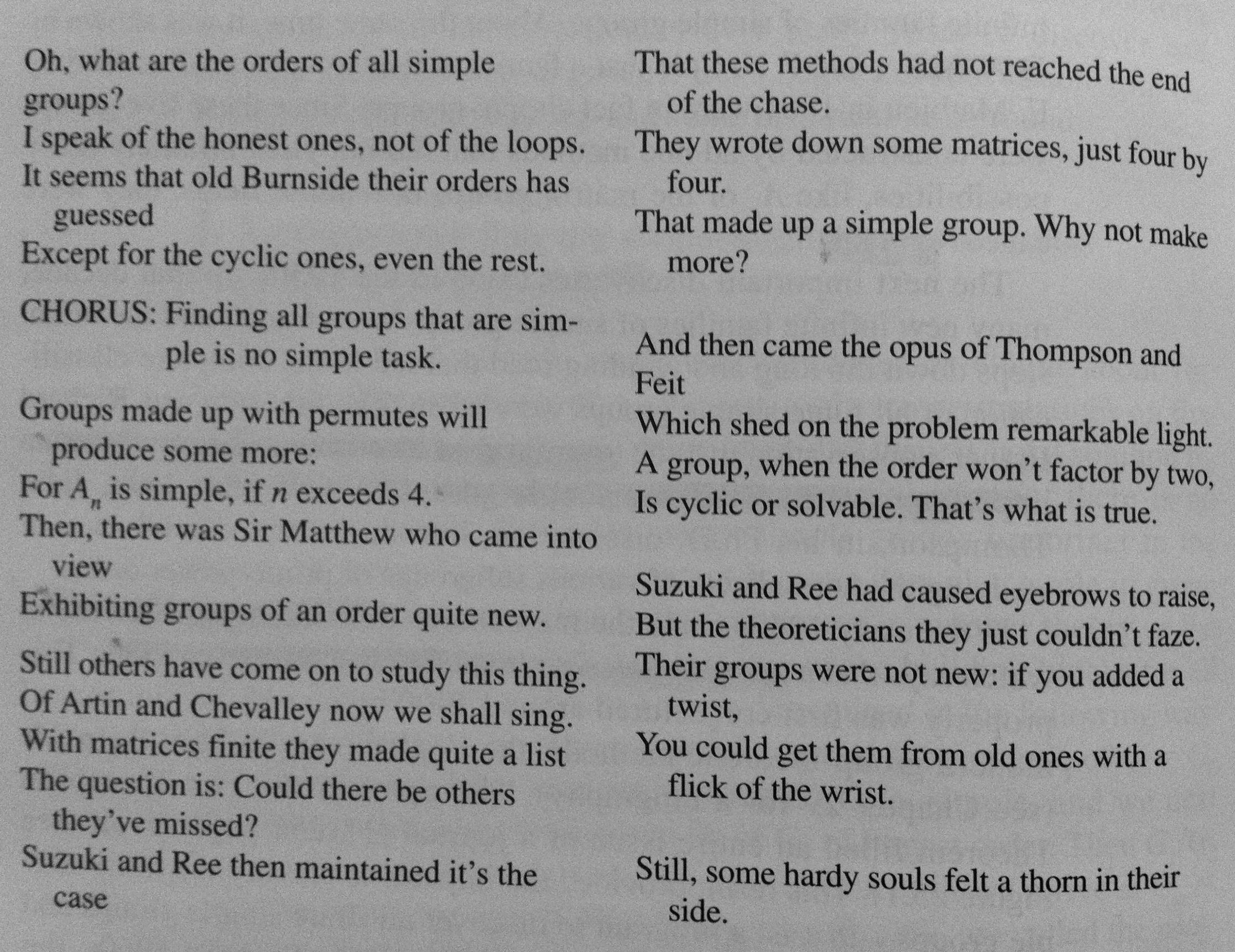
Song of Simple Group
http://www.youtube.com/watch?v=lJhmJJ_q6Go&NR=1
The lyrics to the song can be found in “Contemporary Abstract Algebra” (Seventh Edition) by Joseph A. Gallian
(ISBN 978-0-547-16509-7) pages 422 & 423.

Group: Fermat Little Theorem
Use Group to prove Fermat Little Theorem:
For any prime p,
Let Group (Zp,*mod p) = {1,2,3….p-1}; [*mod p= multiply modulo p]
For any non-zero m in Zp,
Since Zp isomorphic~ to the ring of co-sets of the form m+pZ (eg. Z2 ~ {0+2Z, 1+2Z}
For any m in Z not in the co-set {0+pZ}
ie m ≠0 (mod p)
or p not divisible by m


For general case: no need the (m, p) co-prime condition
(x m both sides)

Automorphism = Symmetry
Automorphism of a Set is an expression of its SYMMETRY.
1. Geometry figure (e.g. triangle) under certain transformations (reflection, rotation, …), it is mapped upon itself, certain properties (distance, angle, relative location) are preserved.
=> the figure admits certain automorphism relative to its properties.
2. Automorphism of an arbitrary Set (with arbitrary relations between its elements) form an Automorphism Group of the set.
Group Definition
Memorize Trick for Group Definition
C.A.N. I. ?
C= Closure
A= Associative: (ab)c = a(bc)
N= Neutral element (e):
I= Inverse:


If only 50% (C.A.)=> Semi-Group
If Semi-Group + Neutral = (C.A.N.) = MoNoid
Note: No Inverse => not a Group
Arthur Cayley (UK, 1821-1895): first gave an abstract definition of Group @1854 while being a lawyer for 14 yrs, couldn’t find a teaching job. His definition was ignored for 25 years until 1882 by Walter Van Dyck who gave the final Axiomatic definition of Abstract Group. ie above [C.A.N.I.]
 Math Online Tom Circle