This is an excellent quick revision of the French Baccalaureat Math during the first month of French university. (Unfortunately common A-level Math syllabus lacks such rigourous Math foundation.)
Most non-rigourous high-school students / teachers abuse the use of :
“=> ” , “<=>” .
Prove by “Reductio ad Absurdum” 反证法 (Par l’absurde / By contradiction) is a clever mathematical logic :

Famous Examples: 1) Prove  is irrational ; 2) There are infinite prime numbers (by Greek mathematician Euclid 3,000 years ago).
Example: Prove  … (*)
… (*)
Proof: (by reductio ad absurdum)
Assume the opposite of (*) is true:


[Rigor: Square both sides, “<“ relation still kept since both sides are positive and Square is a strictly monotonous (increasing) function]
…

Hence, (*) is True : 

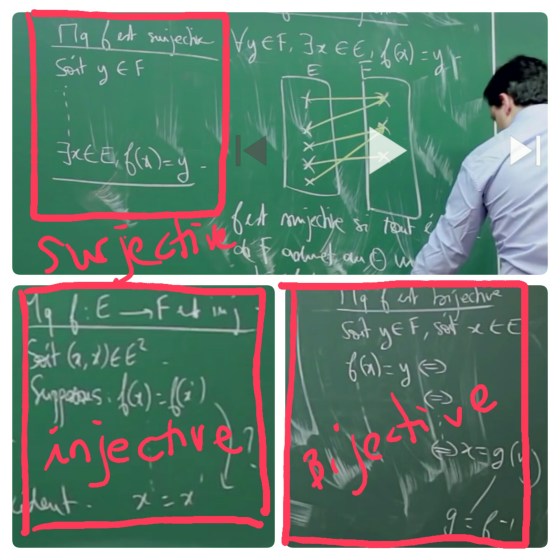
The young teacher showed the techniques of proving Functional mapping:


Caution: A Function from E to F always has ONE and ONLY ONE image in F.
I.) Surjective (On-to) – best understood in Chinese 满射 (Full Mapping).
By definition:

To prove Surjective:

…
…

He used an analogy of (the Set of) red Indians shooting (the Set of) bisons 野牛: ALL bisons are shot by arrows from 1 or more Indians. (Surjective shoot)
II.) Injective (1-to-1) 单射
By definition: 
To prove Injective, more practical to prove by contradiction:

…
…
prove: x = x’
III.) Bijective (On-to & 1-to-1) 双射
Definition:

To prove Bijective,


My example: Membership cards are issued to ALL club members (Surjective or On-to), and every member has one unique membership card identity number (1-to-1 or Injective), thus
“Cards – Members” mapping is Bijective.
(My Remark): If the mappings f and g are both surjective (满射), then
the composed mapping f(g) is also 满 (满) 射 = 满射 surjective ! (Trivial). [#]
He highlighted other methods of proof by higher math (Linear Algebra or Isomorphism).
Note [#]: “Abstract” Math concepts expressed in rich Chinese characters are more intuitive than the esoteric “anglo-franco-greco-germanic” terminologies. Some good examples are: homo-/endo-/iso-/auto-/homeo-morphism (同态/自同态/同构/自同构/同胚), homology (同调), homotopy (同伦), matrix (矩阵), determinant (行列式), eigen-value/vector (特征 值 /向量), manifold (流形), simplicial (单纯) complex (复形), ideal (理想), topology (拓扑), monad (单子), monoid (么半群)…
No wonder André Weil (WW2 Modern Math French/USA “Bourbaki School” Founder) had remarked:
“One day the westerners will have to learn Math in Chinese.”


 Math Online Tom Circle