
The dance marathon became a phenomenon beginning in the 1920’s. Unlike flag pole sitting, another craze of those times, dance marathons had many participants who at first danced for just the pleasure of the wild heady experience, but later on as we entered the 1930’s and the depression, danced out of necessity for much needed money. The winner would get $1,000. Even if you did not win, you were fed, and had a place to keep warm. With the Great Depression going at full speed, there were many people in desperate need looking for any way possible to make a few dollars. The contests were long grueling endurance affairs going on for weeks, even months at a time before there was only one couple left standing and declared the winner.
 Rules were different depending on who held the contest. Some allowed 15-minute breaks on the hour allowing time for a bathroom pit stop, sleep and change of clothes. Horace McCoy’s 1930’s novel, They Shoot Horses, Don’t They? gives a notable account of what these contests entailed. While the contestants were hard pressed folks out of work and luck, the promoters did create jobs for many other people like nurses, doctors, janitors, announcers, and others involved in putting on the event. McCoy’s novel, not surprisingly, was ignored by the public when first published in the middle of the depression; however, it was eventually made into a magnificent movie in 1969, directed by Sydney Pollack and starring Jane Fonda, Susannah York, Michael Sarrazin and Gig Young.
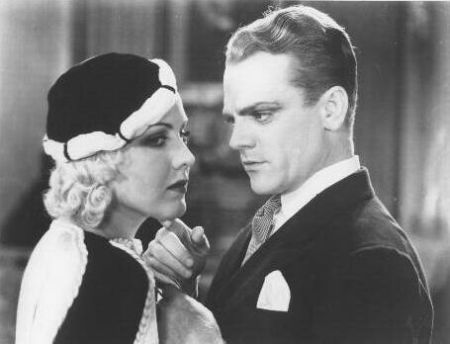
Over thirty years earlier, Mervyn LeRoy directed the 1933 film, Hard to Handle, a James Cagney vehicle, which starts on a somewhat serious tone during the opening dance marathon, providing a realistic harsh look at what these lengthy contests involved, and reminding me much of the Pollack classic. However, soon after, the film moves into a different direction more toward a lighthearted energetic comedy. It could have just as easily turned into a con game/gangster drama from the early tone of the film.
Cagney is Lefty Merrill, who along with his shady partner are running a dance marathon, which, “surprisingly” is won by Lefty’s girlfriend, Ruth Waters (Mary Brian). The opening scenes, reminiscent of Pollack’s excellent downbeat 1969 film, finds Allan Jenkins, in the Gig Young role, as the marathon’s emcee, rousing the audience to cheer on the final two surviving couples who are barely able to stand, (the second couple’s male dancer is a young Sterling Holloway). Watching this scene with the audience’s bloodthirsty cheers edging the couples onward, reminds me of the vulture culture, that today’s TV audience has for shows like Survivor and other reality type shows. The similarities between this film and They Shoot Horses, Don’t They? quickly end with the marathon scenes conclusion. Horses goes on to be a bleak dark vision of the depression times and its toll on a group of people, while Hard to Handle veers off in the direction of a fast moving light comedy.
The second dancing couple soon falls by the wayside, and Ruth and her partner are declared the winners. What should be a happy moment for Ruth, her clinging mother, Lil (Ruth Donnelly) and for Lefty turns into a nightmare when Lefty’s partner runs off with all the proceeds from the contest, leaving Lefty to face an angry crowd who believe they have been swindled. Lil is more outraged at Lefty for the loss of the money than Ruth is, but Lefty has more immediate problems, like quickly getting away from the massive angry crowd.
Lefty soon falls on hard times financially when he finds Ruth, now a model, on the cover of Vogue, and finds her dating a successful fashion photographer. He begs to stay with Ruth and her mother just until he can get back on his feet. Lefty, ever the ingenious publicist gets a new idea when he spots Ruth struggling to rub facial cream on her face one day, and comes up with the absurd notion that women can lose calories this way, and promotes the facial cream as a diet treatment! The idea is “unbelievably” successful, and so lucrative that even money conscience Mamma Lil decides Lefty is marital worthy material again for her daughter Ruth.
 Lefty financially successful again, next promotes a fund raising campaign for a small college where he successfully raises one million dollars and gains the attention of young student Marlene Reeves (Claire Dodd), who has eyes for him. Marlene’s father hires Lefty to promote a real estate deal in Florida, Grapefruit Acres. Lefty wants to marry Ruth but she is still resistant, saying she will marry him only after he comes back from his big deal in Florida. While in Florida, Lefty is surprised to find Marlene there who makes it plain that she is very interested in Lefty, who defensively, declares his love for Ruth. Ruth and Lil decide to fly down to the sunshine state to surprise Lefty, and are surprised themselves when they find him and Marlene having breakfast together in their pajamas. Lefty claims that nothing happened, though that is hard to believe, since he is in her hotel room in his PJ’s. The Waters women fly quickly back to New York with Lefty chasing after them trying to explain. Soon after, Lefty is arrested for false advertising related to the Grapefruit Acres project. While in jail, he meets his thieving dance marathon partner who happens to tells him he lost weight over the past few days just eating nothing but grapefruit. Lefty’s new idea, The 18 day Grapefruit Diet, which becomes the nation’s latest fad. A success again, and in Mama Lil’s favor again, Lefty finally, with some trickery, gets Ruth to say yes and marry him.
Hard to Handle is certainly entertaining enough with the usually fine performance by Mr. Cagney, and a especially entertaining performance by Ruth Donnelly who plays the money hungry Mama Lil, despite in real life being only three years older than Jimmy and ten years older the Mary Brian. Her character has plenty of sharp funny lines, delivered with fine timing, constantly referring to her daughter and herself as “we” when marrying and not marrying Cagney’s Lefty Merrill. Anyone marrying Ruth was definitely getting two for the price of one. While Mary Brian is competent, I would have liked to have seen Joan Blondell in the role of Ruth. She and Donnelly would have been two quick pistols together and the charisma between Cagney and Blondell is always electric. The picture moves at lightening speed, thanks to Cagney’s exceptional flair for rapid speech, which gives no one any time to pause.
The film unfortunately has never been released in the home video format and remains a hard film to see, undeservedly so. Hopefully, Warner Brothers will see fit to release this film in the near future. Hard to Handle was originally brought to my attention by Judy of Movie Classics’s who has written her own great review some time back, and as a Cagney admirer, is certainly worth reading to get her perspective on this film and other classics.

 Paul Muni is James Allen a recently discharged World War I veteran returning to his middle America small town where he is greeted by his mother, brother and girlfriend. His mother and brother want James to go back to his factory job but no one seems to understand how war changes a man. His brother Chris, a reverend, sees James as being ungrateful when Mr. Parker, his former boss at the factory, offers him his job back and James doesn’t want it (there was no G.I. Bill at the time). His brother encourages him to take the job and be “a soldier of peace instead of a soldier of war.” James does not want to be a soldier of any kind, he’s restless and wants to find himself, maybe be an engineer, which he learned something about while in the Army. Reluctantly, James succumbs and goes back to the factory but it just isn’t working out. He soon leaves and heads to New England, gets a job but is quickly laid off. He makes his way down south, then back up North and then South again to New Orleans eventually ending up in Georgia (not explicitly stated) out of work, riding the rails and penniless. James is pounding the pavement when he meets another out of work vagrant, Pete (Preston Foster), who convinces him they can get a couple of burgers for free at a local dumpy diner. Once inside the diner, Pete pulls out a pistol and tells James to take the money from the cash register. James is surprised by the turn of events but does as he is told. As they make their way out of the diner, the police, somewhat magically, come busting through, shoot Pete, and capture James as he tries to escape.
 Not without minor faults,” I Am a Fugitive From A Chain Gang”, is still a powerfully strong piece of social medicine. The kind of relevant film Warner Brothers did so well in the 1930’s. Far from running away from the tough issue, Warners seemed to embrace them and provide realistic looks at what they were like. In fact, the film feels more like a 1930’s depression era film that one that takes place soon after World War I. Whether Warners realism was due to social consciousness or just grabbing the newspaper headlines of the day and turning them into lurid films to draw audiences, and their money, is irrelevant. Many of these films turned out well on both counts. The film’s look at what life is like inside the prison system is downright gruesome making “Cool Hand Luke” look like a pleasant weekend at a vacation resort. Men are beaten, one scene shows a prisoner, standing in the hot sun tied to a post. The food, and the term is used loosely, is putrid and any humane treatment was left at the prison gate. These scenes inside the camp are some of the most powerful and disturbing in the film.
  The film does have some questionable scenes. The character of the Marie, the Landlady, who seems so anxious to give James a reduced rate enticing him to take the apartment, one has to ask why. While James is ambitious, there are no signs yet that he would be a success, or was it that Marie is just attracted to him. Marie seems almost desperate to keep him there and it is never clear why. Then there is the scene with Helen, the good time girl his former prison mate Barney provides him with for the night. James seems almost reluctant to accept her advances and keep shying away. For a heterosexual male who has been deprived of female companionship for a long time he is strangely unenthusiastic about accepting her advances. Overall, these are minor quibbles and certainly do not distract from what a gripping powerful film.
 Twenty Four Frames