Sunday, June 14, 2009

Are we "alongside night" yet?


Very, very nice! J. Neil Schulman is now offering his 1979 classic libertarian sci-fi novel Alongside Night as an absolutely FREE downloadable PDF. Pass it on! (Read it first, though, if you haven't already...)

Labels: , , , ,

Thursday, May 14, 2009

The naughty side of Sherlock Holmes


The cover of this 1950s paperback edition of Conan Doyle's The Hound of the Baskervilles is sooooooo odd, so '50s, so pulp, and so, well, naughty, that it's one of my favorites.

Labels: , , ,

Tuesday, April 21, 2009

RIP J. G. Ballard, 1930-2009

Labels: , ,

Saturday, April 04, 2009

Literary one-hit wonders

Gee, I love lists. Here's a good one of literary one-hit wonders, authors whose fame is based on a single novel. Harper Lee, Margaret Mitchell, J.D. Salinger... Love it.

Labels:

Thursday, March 26, 2009

Things I miss about the 1960s

Classic private eye literature like this.

Labels: , ,

Monday, December 08, 2008

Just in time for Christmas...


Old friend Vic Koman has finally published the late Samuel Edward Konkin III's An Agorist Primer. Many of us have been waiting for this book for more than 20 years. This first edition is in hardcover, it's reasonably priced, and it's the perfect gift for every Libertarian Leftist on your holiday gift-giving list!

Labels: , , ,

Tuesday, November 04, 2008

My apologies to Naomi Wolf

A few weeks ago, I didn’t have much good to say here about Naomi Wolf’s new Give Me Liberty: A Handbook for American Revolutionaries. I called the book “a mixed and largely uninspired bag of left-centrist polemic against the usual suspects (Bush, Cheney, et al.), battle cry rhetoric, and sketchy advice on writing press releases, arranging town hall meetings, launching blogs, petitioning our masters and, of course, getting out the vote (especially after we dump that pesky ol’ Electoral College).” And of Wolf herself, I wrote that she’s “neither an out-of-the-box thinker nor particularly radical.”

Now I’m regretting that review. Not because I don’t stand by my assessment of the book, but because I was way too hard on Naomi Wolf, whose humility, insight, and integrity really shine in her podcast interview last week on “The Lew Rockwell Show.” This podcast is absolutely riveting. Wolf spends as much time asking Lew questions as he does questioning her. It’s a real give-and-take, a sharing of common ground that, I suspect, surprised Wolf. And it certainly seems to have delighted Lew, who in the course of 51 minutes opens Wolf’s “progressive” eyes to the realities of the State, the Federal Reserve, government schools, and so much more. More than once in the discussion, Wolf’s conventional left-center beliefs are obviously shaken and she confesses, “You’re so right. I’d never made that connection before.”

This extraordinary podcast is something you’ll want to download right here and copy onto CDs for your “progressive” friends and family. It’s a revelation. And I’ll look forward to seeing how some of Naomi Wolf’s “light bulb” moments during this interview are reflected in her future interviews and writings.

Labels: , , , , , ,

Thursday, October 16, 2008

"That's how democracy works"

“I’m really starting to hate those protesters. I’m tired of their shit. They need to take it up at the ballot box if they don’t like it.”

“You’ve already beaten them at the ballot box, remember? They won a referendum, and before they could get it implemented you got another referendum on the ballot and overturned them. That’s why they’re holding signs and throwing water balloons.”

“Well, that’s how democracy works.”

The Army of the Republic
by Stuart Archer Cohen
(St. Martin’s Press, 2008)

Labels: , , , ,

Thursday, September 25, 2008

Tired ideas for would-be radicals

Naomi Wolf’s Give Me Liberty: A Handbook for American Revolutionaries follows up last year’s The End of America, her belated warning of a “fascist shift” in the U.S. For radical libertarians, The End of America was pretty pedestrian, revelatory only to readers who never graze much beyond the bestseller list.

Nevertheless, I couldn’t resist grabbing Wolf’s new political handbook, since I’m always on the lookout for a modern how-to to rival Saul Alinsky’s 1971 classic Rules for Radicals. But unlike the late Alinsky, Wolf is neither an out-of-the-box thinker nor particularly radical. So Give Me Liberty is a mixed and largely uninspired bag of left-centrist polemic against the usual suspects (Bush, Cheney, et al.), battle cry rhetoric, and sketchy advice on writing press releases, arranging town hall meetings, launching blogs, petitioning our masters and, of course, getting out the vote (especially after we dump that pesky ol’ Electoral College). Early on in the book, Wolf writes that she was recently startled to discover that the Declaration of Independence is a radical document that exhorts the right to revolution. Egad! Too bad her definition of revolution is limited to working the system and playing electoral politics. “There are concrete laws we must pass to restore liberty,” Wolf writes. When she discusses the Bill of Rights, her only comment on the Second Amendment is that it “protects the right to own guns, at least in certain circumstances.” Now that’s revolutionary thinking. Not.

In the book’s “user’s guide,” Wolf is joined by other activists — what she calls her “citizens’ council” — including Trevor “Oyate” and Raymond D. Powell from Ron Paul’s camp, neither of whom have much to say. In her introduction to this section, Wolf explains, “We compiled a wish list at the end for laws, entities, and practices that we need to brainstorm about, create, enact, or build.” All of the items on that wish list, not surprisingly, are about making political elections fairer, more inclusive, and even making election fraud a “major felony.” One of Wolf’s cohorts, broadcaster-activist Curtis Ellis, suggests “making voting mandatory, with fines for not voting. When you renew your auto registration or file your taxes, you should have to show that you voted in elections.” Thanks, Curtis. You’ve just offered us one more good reason to avoid vehicle registration and evade taxes.

Give Me Liberty is of little use to Libertarian Leftists. There’s still a valuable activists’ how-to that needs to be written. Maybe one of these days, I’ll write the damn thing myself.

Labels: , , ,

Thursday, September 11, 2008

Gregory Mcdonald RIP

Author Gregory Mcdonald died from cancer last Sunday. He was 71.

Besides writing for newspapers, Mcdonald wrote the Fletch series of crime thrillers. If your only experiences with Fletch are the horrible two movies starring Chevy Chase, do yourself a very big favor and get hold of Mcdonald’s first three books, all published in the ’70s — Fletch; Confess, Fletch (which introduced another series character, Flynn); and Fletch’s Fortune. Over the past thirty years, I’ve read each of those novels at least five times. They are all massively entertaining, and they taught me a lot about writing.

Mcdonald wrote eight other novels in the Fletch series, two of them about Fletch’s son. Unfortunately, none of them are as good as the original three.

I’ll miss Gregory Mcdonald.

Labels: , , ,

Thursday, September 04, 2008

Beyond Galt's Gulch, there's Macrolife

Macrolife, by George Zebrowski, is utterly mind-boggling science fiction. Its scope is certainly epic, spanning one hundred billion years, so I suppose it qualifies as space opera. Maybe Space Opera Plus. And I think it offers exciting ideas for radical libertarians, freedom-seeking secessionists, and anarcho-transhumanists to mull over.

First published thirty years ago, the book is a heady mix. It’s a novel, yes, but it’s also a future history, a polemic, and a call to action. More than anything else, it’s a far-reaching meditation on the ultimate survival of humankind. You don’t dash through this book and then toss it aside. After I finished reading Macrolife, I didn’t slip it back on a shelf. It sits bedside, where I plan to take a sip from time to time.

The novel’s premise is compelling. Its author contends that our species must reach out to the stars in order to endure. Zebrowski writes in an afterword to this latest edition (2006):

“[E]ven in the near term, across the next millennium, our failure to become a space-faring world may well be suicidal when we consider what we can do for our world from the high ground of the solar system: energy and resources, planetary management, and most important the ability to prevent the world-ending catastrophe of an asteroid strike. This last threat will happen; it is not a question of if but when. Today we are utterly helpless before such a danger and would know of it only when it was already happening.”

But Zebrowski argues that merely vacating Earth and populating other planets — or “dirtworlds” — is only a short-term solution. Limited resources, he says, assure the consistent failure of planet-based civilizations. Likewise, the proposed “space cylinder” habitats of Gerard O’Neill, which assume construction from scratch, lack long-term vision. With a nod to futurist Dandridge M. Cole, Zebrowski suggests that hollowed-out asteroids serve us as nomadic “societal containers,” or macrolife, “a mobile … organism comprised of human and human-derived intelligences. It’s an organism because it reproduces, with its human and other elements, moves and reacts on the scale of the Galaxy.” These “mobile utopias” will be larger inside “than the surface of a planet. And larger still within its minds.” In the Big Picture, macrolife is an open-ended, expanding union of organic, cybernetic, and machine intelligences, spreading itself through the galaxies.

Macrolife suggests futures beyond this planet, beyond Old World cultures, beyond governments, beyond authoritarian institutions. It’s utopian but acknowledges the dangers of utopianism. It’s worth reading, worth study, and worth serious discussion.

Labels: , , , , ,

Tuesday, September 02, 2008

Your Tuesday night moment of noir

Some novels’ opening sentences are so goddamn fantastic, you just gotta share ’em. Hat tip to Duane, who’s written some brilliant opening sentences himself.

“When his girlfriend greeted him at the door dressed only in a T-shirt and thong, then kissed him hard on the mouth without a word before pulling him into her ground-floor bedroom, she was so worked up she didn’t even notice that he was wearing gloves.”

Deadline
by Simon Kernick
(Corgi, 2008)

Labels: , , ,

Monday, September 01, 2008

Happy birthday, Edgar Rice Burroughs!

Labels: , , ,

Saturday, August 30, 2008

Must listening


Fer crissakes, listen to Rick Kleffel interview Cory Doctorow about standing firm, not being afraid, state surveillance, and his sci-fi "juvenile" Little Brother, which I think may be the best "libertarian" novel since Suprynowicz's The Black Arrow. Download the MP3 file (or listen to it) right here.

Labels: , , , , ,

Sunday, August 10, 2008

The lurid world of George Orwell

The copy on the back cover of this 1954 Signet paperback edition of Orwell’s 1984 reads:

Which One Will YOU Be In the Year 1984?

There won’t be much choice, of course, if this book’s predictions turn out to be true. But you’ll probably become one of the following four types:

Proletarian — Considered inferior and kept in total ignorance, you’ll be fed lies from the Ministry of Truth, eliminated upon signs of promise of ability!

Police Guard — Chosen for lack of intelligence but superior brawn, you’ll be suspicious of everyone and be ready to give your life for Big Brother, the leader you’ve never even seen!

Party Member: Male — Face-less, mind-less, a flesh-and-blood robot with a push-button brain, you’re denied love by law, taught hate by the flick of a switch!

Party Member: Female — A member of the Anti-Sex League from birth, your duty will be to smother all human emotion, and your children might not be your husband’s!

Unbelievable? You’ll feel differently after you’ve read this best-selling book of forbidden love and terror in a world many of us may live to see!

And how about that front cover illustration? Who’da thought Julia was so, well, HOT?

Labels: , , , ,

Tuesday, July 22, 2008

2008 Prometheus Awards announced

The Libertarian Futurist Society has released the names of this year’s winners of the Prometheus Awards — two full weeks before their presentation at Denvention 3, the 66th World Science Fiction Convention in Denver (August 6-10).

The Best Novel award will go to two novels this year, marking the first time in the award’s 29-year history that there was a tie in the voting. Both novels are alternative histories and sequels: Harry Turtledove’s The Gladiator and Jo Walton’s Ha’penny.

A Clockwork Orange, by Anthony Burgess, is winner of the 2008 Hall of Fame award.

The Prometheus Award, says the LFS, "is given each year to sci-fi/fantasy that explores the possibilities of a free future, champions human rights, dramatizes the perennial conflict between individuals and coercive governments, or critiques the tragic consequences of abuse of power."

Labels: , ,

Monday, July 14, 2008

Appreciating Steve Ditko

In 1966, when I was just a wee lad of 11, what then seemed a very big honkin’ piece of my world fractured and dropped away. Steve Ditko split from Marvel Comics and forever left behind Doctor Strange and, most horribly, Spider-Man. Neither character has been the same since. And if I may be so bold, neither has ever again been quite as good.

Ditko was the first comic book artist I really paid attention to, and his famous three-part Master Planner story (Amazing Spider-Man #31-33) locked in a diehard fanaticism that remains today. I followed him through his days at Charlton (doing the Blue Beetle, Captain Atom, and The Question), his brief periods with DC (creating the Creeper and the Hawk and Dove), into those days when you only found his stuff in fanzines like witzend and Guts. Part of Ditko’s magic may have been the mystery surrounding him. He didn’t sit still for interviews. He didn’t rub elbows with fans. As years passed, his work became harder and harder to find. Not until the past few years, when so much old Silver Age material has been collected into beautiful hardcover volumes, have I been able to revisit much of Steve Ditko’s great work.

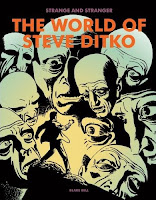
Now, long overdue in my opinion, here comes Strange and Stranger: The World of Steve Ditko, an oversized, hardcover appreciation, biography, and analysis by Blake Bell. As soon as this bugger landed on my doorstep, I immersed myself in it. It’s fantastic.

Bell seems to have scraped together every bit of info, every mention he could about Ditko. There are wonderful things here, including a color reproduction (granted, it’s small) of Ditko’s original cover for Amazing Fantasy #15, Spider-Man’s debut in 1962; it was rejected and replaced with a cover by Jack Kirby (though Steve did the inking). Likewise, Ditko’s original cover for Amazing Spider-Man #10, featuring the Enforcers, is presented in this lovely book for, I think, the first time. For 40 years, I’ve wondered why an absolutely horrible, plain-as-vanilla Kirby cover graced that issue. I still don’t have the answer, but at least I’ve now seen Ditko’s terrific version.

One of the things that makes Steve Ditko fascinating to me is his steadfast commitment to his principles and the promotion of those principles, which are rooted in Ayn Rand’s black-and-white Objectivism. Not only did Rand shape almost all of Ditko’s work for the past four decades, her philosophy impacted his career and way of doing business — usually at great cost emotionally and financially. Strange and Stranger, as you’d expect, spends a lot of time in this area. Both the author’s account of this long period and his analysis is really first-rate. It’s really a tragic tale, with the uncompromising Ditko playing a defeated Howard Roark in an industry that never fully understands him. You can’t help but respect Ditko's unflinching determination, but at the same time, you’re frustrated whenever he shoots himself in the foot. For instance, the book reveals that about 15 years ago, Frank Miller approached Ditko with the suggestion that the two of them relaunch Steve’s Mr. A, his seminal Randian hero from the late 1960s. Miller wanted to present the character without concessions to political correctness. In the ’60s, the hard-right Mr. A had struggled in a flower power world. But in the tougher ’90s, an era that embraced Miller’s hardboiled classics like The Dark Knight Returns and Sin City, Mr. A might have become a sensation, catapulting Ditko out of the doldrums and to heights he hadn’t experienced since his old Marvel days. But alas, Ditko declined Miller’s offer, believing that Mr. A just wouldn’t sell.

Blake Bell’s Strange and Stranger: The World of Steve Ditko is essential for fans of the great artist. And if you’re a comic book fan unfamiliar with Ditko, this book might just pull you into his camp of devotees.

Labels: , , , ,

Friday, July 04, 2008

"It makes a pretty book"

From the press and just sewn together, it still smelled of ink and smudged as Paine held it in his hands, a thin book called “Common Sense, written by an Englishman,” with big black letters on the cover, sticky as Paine opened it.

“Done,” Bell said.

Paine told him, “I don’t want you to suffer for this,” and Bell shrugged. “I’ll want to buy a few copies,” said Paine.

Bell nodded.

“To show them to my friends.”

“Ye may.”

“You’ll give it to me a little cheaper than the regular price?” Paine remarked, not able to keep a note of anxiety out of his voice, his hand in his pocket, holding all the money he had in the world.

“I may.”

“It makes a pretty book,” said Paine.

Citizen Tom Paine
by Howard Fast
(Duell, Sloan and Pearce, 1943)

Labels: ,

Thursday, July 03, 2008

New agitprop from Cory Doctorow

Cory Doctorow’s Little Brother is marketed as Young Adult fiction. I suppose that makes sense, since its protagonists are all teenagers. But just as Heinlein’s old “juveniles” and even J. Neil Schulman’s Alongside Night are all “adult-friendly” despite their tilt toward a young market, Little Brother is solid, entertaining, and very scary reading for all ages. And it may be the best “libertarian” science fiction novel since Suprynowicz’s The Black Arrow three years ago.

The story is set in the very, very near-future, when Homeland Security has really gone batshit. Marcus and his three best friends ditch school one day and get horribly caught up in the aftermath of a terrorist attack on San Francisco’s Bay Bridge. DHS carts all three of them off to a secret Gitmo-by-the-Bay, where they’re questioned and tortured, but not necessarily in that order. Eventually released, Marcus determines to save one missing chum and take down DHS in the bargain. What follows is 300 pages of techno-geek, teenage revolution, and it’s all pretty damn cool. I’ve heard a couple reviewers complain that the tale occasionally comes to dead stops for computer info dumps. And that’s true, but it didn’t bother me. I think those few moments are actually needed for a full understanding of the action.

Anyway, Doctorow’s characters are generally well defined and appealing. Even some of the adult characters who can’t understand why anyone would refuse to surrender liberty for security are fully drawn and sympathetic. The story is fast-paced and told with passion. There’s no question that the author believes his novel’s warnings are urgent. Radical libertarians like myself will find naïve his traditionalist notion that solutions still lie in the voting booth. But Doctorow’s heart is in the right place, and there’s no question that he’s one of the Good Guys.

My biggest reservation about Little Brother is this: it’s like a hand-grenade. Its life expectancy is short. It will date quickly, and in just a few years, its message may be too late. So my suggestion is that you pick up a copy right now — don’t wait six months or more for a paperback edition — read it quickly, then start passing it down the chain to your kids, their friends, and their friends’ friends.

Little Brother is a handy tool to add to our agitprop arsenals.

Labels: , , , ,

Thursday, June 12, 2008

Don't yield! Back SHIELD!

…or Wally frolics among the pages of his favorite statist, Cold War comic book series.

It’s been a slow week. We had a new roof put on the house last week. We’ll be launching into phase three of our “home revitalization” in the next few days — tearing up the lawn, replanting with drought-resistant plants, some flagstone work for the patio. In the meantime, though, a slow week.

So when I saw a package sitting on the front porch yesterday, and it turned out to be my eagerly anticipated copy of Marvel Masterworks: Nick Fury, Agent of SHIELD Vol. 1, things started to perk up. I dived right into the book, revisiting old comic book ground I hadn’t traipsed through in more than 40 years.

This very handsome book includes all the Strange Tales pre-hardcore Jim Steranko stuff. Steranko did draw over Jack Kirby’s layouts for the last three stories in this volume, but he didn’t begin to blossom as artist and writer until just after the last story presented here. So this hardcover is made up of 20 short SHIELD stories from Strange Tales #135-153 and Tales of Suspense #78 (technically, a Captain America tale), plus a pre-SHIELD Nick Fury appearance in Fantastic Four, circa 1963. Kirby fully illustrated maybe five of these yarns, although he provided breakdowns for all of them. John Severin, Joe Sinnott, Don Heck, Howard Purcell, and Ogden Whitney picked up the art chores to varying degrees of success on the remaining stories. So all the series’ initial up’s and down’s, and its shaky footing for almost two years before Steranko’s earthshattering run, are here to experience again. The 1965 Stan Lee-Jack Kirby SHIELD debut in ST #135 is just as I remembered it from age 10 — a quick 12 pages of boffo action and excitement, featuring hooded HYDRA baddies, a super-cool airborne Porsche, and that wonderful heli-carrier that’s now survived 43 years with little variation (that’s how cool Kirby was). Classic. From there, though, the SHIELD series doesn’t quite take a full nosedive but it does move into spotty territory. Kirby’s pencils immediately disappear, for one thing, which hobbles the first five-part HYDRA story, although it manages to be fun overall. A three-part story about an assault on SHIELD headquarters benefits tremendously from a partial return of Kirby. But a two-parter about a guy called The Druid is a real low-point, and the multi-part introduction of AIM (the guys with the bright beekeepers’ outfits) is really just a rerun of the earlier HYDRA tale. Things look up with the last four stories, one penciled by John Buscema and the final three by Steranko. These episodes mark the return of HYDRA, which was a very good thing that later became exhilarating when Steranko fully took over the series.

Don’t get me wrong. Despite some weak stuff (most of which I’d forgotten over four decades), this is a pretty solid collection. And for fans of Marvel’s “coming of age” in the mid to late 1960s, the book’s a lot of fun. And it provides essential background for a full appreciation of Jim Steranko’s brief, shining comics career, which should make up all of Vol. 2. Now that, friends, will be a reprint volume to be reckoned with.

Labels: , , ,