Back when I was writing guest posts for The Sharpened Axe blog, I reviewed the Jersey Classic Axe from Council Tool in several articles. Since writing those articles and doing the initial testing, I have used the axe from time to time to limb, buck and split up several fallen trees. I thought it might benefit some of you if I rewrote and updated my review and presented it to you here, as some of you might not have seen it. So, without further ado…

In November of 2010 I ordered the Jersey Classic axe with the 36″ handle from Council Tool. It took almost a month to get to me here in Finland because of international shipping, customs handling etc., but I’m sure it would only take a few days within the US. At the time, the axe cost a very reasonable sum of around $60 (plus shipping and customs duties). One of my favorite things about it is that it’s made in the US.

The axe came with the head wrapped in thick paper, and the entire axe was wrapped in bubble wrap. Despite some ham-handed delivery/handling person managing to bend the box in several places along its journey to me, the axe arrived without a scratch thanks to the great packing job.
The Jersey Classic has a 3.5 lb (1.6 kg) head with a 5 1/8″ (12.8 cm) cutting edge and is one beast of a tool! If I remember correctly, the overall weight is about 5 lb (2.27 kg). I’d never owned an axe of this size before, and I bought it with the intention of using it for larger felling, bucking and splitting tasks. Because of its size and weight, I didn’t intend to use it on camping trips where I hike in.
The Jersey pattern head of this axe was attached to the handle via an epoxied serrated aluminum wedge.
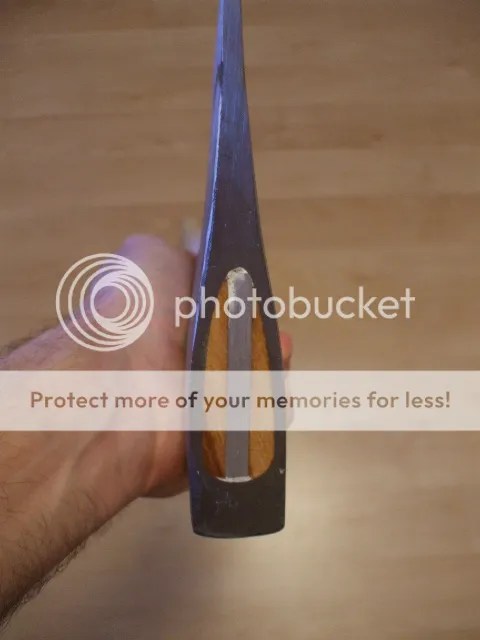
First, a few critiques. The hickory handle as it came was quite thick, which is common on new axes these days. The head was a bit misaligned, but field use out in the woods showed it to be a non-issue. Though the axe would cut as is, a large burr/roll was left on the edge after sharpening at the factory. One of the four “phantom bevels” on the head was much less prominent than the others, so that side of the head looked a bit weird.

Now to the good stuff. It seemed like a very solid axe. The grain orientation of the handle was OK, and the quality of the hickory was great. The finish of the steel was also nice. The bit profile was really nice, and looked like it would cut deep. So many cheap hardware store axes hardly have an edge at all and are as thick as splitting mauls. The Council Tool Jersey Classic is not a hardware store axe!


When I get a new tool, piece of outdoor gear, etc. I seldom leave it the way it is. To me, customizing equipment is something that makes it mine, so I got out my tools and went to work.
My first task was to reshape and thin down the handle with my puukko knife. I would say I have medium-sized hands, and the handle of this axe as it came was a bit thick for my liking. Then I spent some time doing finishing touches to and sanding down the handle. I used 60 grit at first, then wet the handle to raise the grain, then sanded lightly with 240 grit after it had dried. Finally, I applied several light coats of linseed oil.

I wasn’t sure what I was going to do about the partially-missing phantom bevels, but I decided at the time to keep them all instead of sanding them smooth. I redefined/fleshed them out a bit to make them all even and put a patina on them.
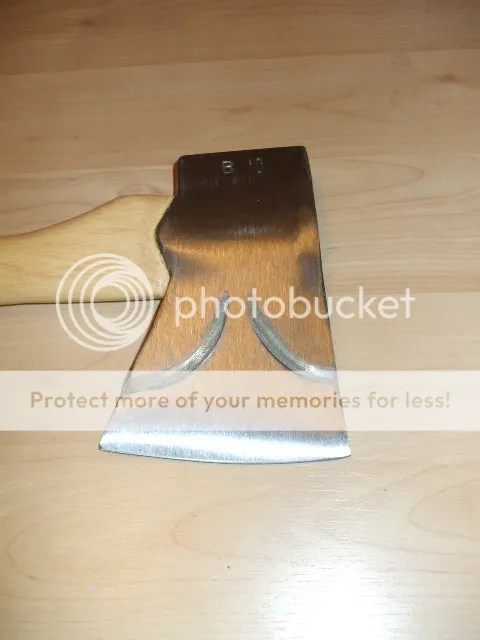
Finally, I put a working edge on the bit. I filed off the burr and sharpened the edge with a file and then moved on to a stone. The edge cut paper pretty cleanly after that.
At that point, I was happy with how it looked and felt. Truth be told, if you don’t mind a thicker handle, all you’d really need to do would be to take a few minutes to file and sharpen the edge. I like a thinner handle, so I put the extra work in.
The real test for any tool, of course, is how well it works, so check back soon for Part 2, where I’ll cover my experiences in felling, limbing, bucking and splitting with the Council Tool Jersey Classic axe.
For size comparison, here is the axe next to my vintage Gränsfors (26″/65 cm), Wetterlings LHA (20″/50 cm) and Wetterlings Mini axe (12″/30 cm).


 The Weekend Woodsman