Atompacks Prospector (Mo) – A review

Overview

The Atompacks Prospector (formally the Mo) is an ultralight backpack with a single main section and between three to eight external pockets depending on what you specify. It comes in three capacities 40, 50 or 60 L volume. Of this total volume, each side pocket is said to hold 2.5 litres, but in reality you are likely to use them to support taller items which protrude from the top, thus actually having a much greater volume. The packs come in three back lengths and with three sizes of hip belt so you can be sure to find one that fits you well even if you are an unusual combination of height and girth.

The sacks have a roll top rather than a lid so you lose the pocket you would normally find in the lid. Whilst made from a waterproof fabric, don’t let this and the roll top fool you into thinking the pack is waterproof like an Ortlieb pannier, because the seams are stitched rather than welded and are not seam sealed. You will still need a pack liner or cover to keep your kit dry – as you do with almost every other pack on the market.

An aspect that makes these packs unusual is that you can both buy a standard specification, or you can custom design a pack and alter the colour, pocket combination and strap arrangement to suit your needs.

What makes Atompacks ‘Ultralight’

  • The main fabric is a 200 g/m2 sailcloth rather than 500d Cordura at 250 g/m2

  • Roll top rather than snow skirt, lid and lid pocket

  • Single main section

  • Lower amount of webbing straps

  • 15 mm webbing straps rather than 19 mm

  • No zip closures

  • Elastic cord for side compression rather than straps and clips

  • Waist belt based on two 15 mm straps rather than one 50 mm strap

Why did I buy one / what are they best for?

I wanted a 45 L pack for 2-3 day self supported three season backpacking adventures. For weekend micro-adventures I enjoy being able to cover longer distances ‘fast and light’ and I wanted a smaller and lighter pack for 8-10 kg pack weights. At 990 grams, my 50 L Prospector is a significant 1300 g lighter than my Macpac 55 L pack. I also wanted something simple, ideally just one main section and one pocket – with customisation one can get close to this.

I’ve used mine on two short trips so far and whilst I have found it extremely comfortable, I suspect I would not want to use a 60 L model with the 12-15 kg more common with winter backpacking trips.

Design features – description and effectiveness.

Fundamental weight weight carrying design

Front - webshotThe Prospector has a plastic frame, kept rigid with an aluminium stay down the centre. This is padded with closed cell foam for comfort. Load lifters, work with the frame to enable you to adjust the proportion of the pack weight which is carried shoulders vs. hips. Weight is transferred to the hips via 100 mm wide padded hip belt with novel dual adjustment straps which independently adjust the tension of the top and bottom of the hip belt. Whilst the two 15 mm straps look very flimsy against the ubiquitous 50 mm single strap design, the end result is the most effective hip belt I’ve ever experienced. Having the ability to hug the belt above and below your hip bones mades it possible to effectively transfer the bulk of the pack weight to your hips without the hip belt having to be uber-tight. Additionally the straps are tightened by pulling inwards rather than outwards which makes adjustment so much easier to achieve.

The above system works supremely well, making this a highly comfortable pack to carry. Some might argue that a frame is not necessary with this size of pack, but do not under estimate how much easier it is to pack a rucksack with a rigid back vs a floppy bag with shoulder straps. This becomes of even greater value when you are seeking to pack your bag inside a small tent. Critically, having a frame allows the use of load lifters, and I learned by painful experience ( Severe trapezius pain carrying the Auguille Bora ) that load lifters are another key facet to a comfortable multi-day pack for me. Whilst their primary purpose is to adjust the weight loading between shoulders and hips, they allow for you to correct for any asymmetry in your shoulders. Whilst I may be unusually wonky (!), statistically it is unlikely that the majority of people are wholly left-right symmetrical and thus most people could probably benefit from load lifters

Take home points: Supremely comfortable pack for 8-10 kg. Frame also makes packing easier.

Pockets

The standard pack comes with two side pockets (2.5 L each), a stretchy pocket on the back, with criss cross bungees over this to carry (dry out) wet items and an unusual stretch pocket on the base of the pack. There is also a stretch pocket on the front of each of the shoulder straps designed to take items up to a 700 ml bottle.

Side pockets – to say these hold (only) 2.5 L is rather misleading, because it is very likely that you will use these deep side pockets to carry items that extend far out of the top of the pockets too – items such as a tent or tall water bottles or a pair of walking poles. I’ve easily stowed my Hilleberg Enan in one of these side pockets. (Out of interest I found I could also get my Soulo into a pocket too, but something of this weight would be better strapped to the top of the pack.) Alternatively, each pocket can hold 2 x 1 L water bottles. Remarkably too, these pockets are positioned so you can easily access them on the move so I have used the second pocket for hat and gloves.

Mine is a custom pack and I did not opt for the bottom stretch pocket. The rear stretch pocket is best filled once the main pack is already full and will readily take a Gore Tex jacket plus several small food items.

I saw having to accept the lack of top pocket as something of a compromise, but I’ve actually found my substitute solution far more convenient. For me the top pocket of a backpacking rucksack is used for small items (so they don’t get lost in the main section) and urgently needed items such as head-torch and first aid kit. I now use a 6 L dry bag for these items, which I stow at the top the pack. In reality most of what I once carried in the top pocket is stuff I need overnight so being able to pull out a single dry bag and fling into the tent is actually rather more convenient. Small food items fit into the stretchy back pocket with my waterproofs.

I opted for just one stretch pocket on a shoulder strap. I wanted to leave the webbing free on the other strap to hold my inReach tracker and a clip for my hydration hose. The stretch pocket is excellent for holding a phone (when it is not raining) or a Garmin GPS when it is. The unusually narrow shoulder webbing proved a challenge on my first walk as my hydration tube clip is designed for standard 19 mm (¾”) webbing and kept slipping off the narrow webbing used by Atompacks. Fortunately I’ve come up with a solution to this, using a pair of cable ties.

Other features

The pack comes with a Y strap to hold items onto the top of the bag. I’ve used this for my sit pad, but would also be excellent for holding a winter tent, jacket, baguette or other bulky item. There are Z shaped bungees on the side of the pack, but I would suggest you would be better to have the optional webbing straps in their place, because the side pockets are so deep that you only really need one strap high up for very tall items such as a tent or poles. Webbing straps offer much more flexibility at very little extra weight.

Hip belt pockets can be bought and fitted as an optional extra. There are webbing loops on the hip belt to clip these to, to prevent them slipping off. I found that my existing Aiguille pouches fit perfectly and can be secured to the loops with climbing cord. Whilst I am generally ‘anti-pockets’, I do find a hip belt pouch useful to have batteries and snacks accessible on the move, but I may try without a pouch on my next trip since I’ve found that the existing side pockets are so easy to access on the move too.

There is a clip inside the pack to hold a water bladder and a port on either side of the pack to feed the hose through. The sternum strap is rather unusual, in that the female part of the clip is attached directly to the shoulder strap and not on the end of a short length of webbing. The clip is thus obscured by the shoulder pocket and clicking it in place is a fiddly new skill which has taken time to acquire.

Take home points: The side pockets are very function flexible.  I would have preferred side straps to Z bungees

Conclusions

My primary goals were for a simple, lightweight yet supremely comfortable pack suitable for 2-3 day backpacking / wild walking adventures. Because Atompacks offer customisation I could strip off unnecessary pockets so that ticks the ‘simple’ box and the pack has proved extremely comfortable when carrying 8-10 kg for 6 hour / 15 mile days. I am sceptical how comfortable it would be were you to to carry it’s alleged maximum capacity of 19 kg but that’s just a gut feeling for now. I would advise anyone buying an Atompack to opt for the webbing straps on the side rather than the Z bungee because the Z shape seems to add hassle without adding any benefit. As for the robustness of a pack made from lighter materials, only time will tell, but with my previous packs it has been the hip belt which has worn out first, and on Atompacks this part is easily replaced by the user.

Aiguille ‘Big One’ 10 L Belt / Bum bag – Long term review

PXL_20240926_101803476-EDIT

Overview

This review covers my experience of Aiguille’s capacious belt / bum bag which they call ‘The Big One’. I’ve used a variety of such bags from a range of manufacturers over the past twenty years for a wide range of activities; day walks, mountain biking, horse riding, this current model is even big enough to carry by lunchbox and a litre of juice into work. When I bought this bag I was looking primarily for something to use on summer day walks to avoid having to carry a day pack and thus avoid getting a sweaty back as I yomped over the local fells. Other folks I know prefer to use running hydration vests, but these cover your back, something I wanted to avoid as outlined above.

I wanted the largest capacity belt / bum bag I could find and something that would last longer than my previous previous bags. This long term review confirms that I made a good choice for my needs.

Who are Aiguille?

Aiguille are a small company based in Staveley in Cumbria, a village between Kendal and Windermere. They made range of mostly fabric based equipment for mountain sports, climbing, ski touring and bike packing.  Their customer service is second to none and offer customisation on packs and pouches at a modest additional cost.

The review…

Build quality & weight

This bag is extremely well constructed from very robust 1000 denier nylon fabric. All the seams are triple stitched. I’ve owned mine for six years at the time of writing and whilst it is a little grubby it has yet to show any sign of wear. I used it every day into work for a period of three years and continue to use it at least one day each week outside of winter. Some would argue that it is relatively heavy at 520 g, but for something I want to use frequently I value the robustness over weight.

Another positive is their choice of colours.  With so much equipment now available only in black, the choice of eight colour options is another plus for me.

Practicality / features

     > Volume – 10 litres + what you can strap on the outside

     > Main section plus small zipped outer pocket

     > Twin compression / extra kit straps

     > Nicely padded hip fins.

     > Interior key clip

     > Grab handle

     > Side stability straps (to pull closer to the body when running)

The main section is really very large for a bag of this type, the biggest I could find on the market in UK in 2018. I can fit lunch, plus a light jacket or lightweight waterproof into the main section plus a GPS or guidebook. Alternatively I can fit a windproof, mid-layer, lunch and a 600 ml water bottle instead.   I do find the exterior pocket a little small, it would be nice if it had bellows so it could hold a tad more. When the main section is full I can just about fit in a thin wallet and 4 AA batteries, but I cannot easily get get a phone in / out of it. However whilst this is a niggle, it is is a small niggle when seen alongside the overall capacity including the ability to strap extra gear onto the outside too.

Ideally I wanted at least one water bottle holder on the outside of the main section, but back in 2018 If I wanted water bottle holders I had to live with a 6 L bag. That said, the straps on the outside of the bag save the day. I’ve found that I can use a side stability straps and a carabinier to hold a 600 ml Sigg bottle (or two) securely on the outside of the bag.

PXL_20240926_102211938

The compression straps are really long which again allows you to carry extra stuff like walking poles or a light jacket with ease

Whilst the outside pocket is a little smaller than I would consider ideal, it is possible to put additional belt pouch/es onto the waist belt to hold small items.

PXL_20240926_102400834

Usage scenarios

The main activity I use this bag for is Summer and Autumn day walks. For me it is great to be able to walk in warmer weather without the extra insulation of a backpack and the resultant sweaty back. If you want to grab something on the move it is easy to spin the bag around to your front and take out / put in what you need too. This can be done without need to stop. Whilst belt bags are not ideal to use in tourist hot spots because they are easily stolen, with this bag I am able to lock the loops at the end of the waist strap together with a carabinier to make it more secure. It is great on a bike or on a horse, where you can cinch in the stability straps to prevent unwanted movement.  It was also really good for when I used to run into work.

Conclusions

My ‘Big One’ bag has seen a lot of use over the past six years and on the basis of the absence of visible wear over that time I suspect it will be the last belt / bum bag I will ever need to buy. Kit like this is great for the environment because it will never need to go into landfill or be recycled. It is really comfortable to carry, once on I forget that it is there. Whilst the small pocket is really a little too slim to be ideal, that issue can be overcome by adding an additional hip belt pouch. Shaking the internet has shown me that today there are now other 10 litre belt / bum bags on the market (e.g. Fjallraven Singi, Mountainsmith Tour ) which were not available in the UK when I bought my bag. You should contrast these against the Aiguille bag, but make sure you are seated before you see the price of the Fjallraven! I love my bag and have no need or desire to change it. It is wearing more slowly than me, and thus will likely outlast me!

Auguille Bora 42 L Rucksack – A review

PXL_20240908_145252691~3

Overview

This review covers my thoughts on the suitability of the Aiguille Bora rucksack vs. the purpose for which I purchased it. Whilst it is marketed as climbing pack, I bought it for 2-3 day lightweight backpacking trips, where I aimed to carry 8-9 kg of weight. I wanted a simple pack of 40-45 L volume which was practical and without multiple pockets – simply a single main section for most of my gear and a single pocket to hold small and rapidly accessible items such as torch, snacks, hat, gloves etc.

The design of the Bora, on paper, almost exactly matched my wish list. It has a single main section, and a lid pocket, a capacity of 42 litres, the straps to allow the flexibility to secure a tent, walking poles and an ice axe. For a full specification click through to the Aiguille webpage.

Who are Aiguille?

Aiguille are a small company based in Staveley in Cumbria, a village between Kendal and Windermere. They made range of mostly fabric based equipment for mountain sports, climbing, ski touring and bike packing.


THE REVIEW

Build quality & weight

The Bora is extremely well constructed, whilst I only had this pack for 16 months and took it on just four outings I would fully imagine it would last 10’s of years in all but the most demanding of environments. The seams, for example, are all triple stitched. The Bora, and most of their other packs are available in four different back sizes, and I visited their factory / shop for a detailed fitting. The customer service is excellent, by phone, email or in person in their shop.

The pack is not designed to be ultralight, but because of it’s simplicity is not much heavier than ultralight packs of similar capacity (and it is considerably more robust)

Pack

Volume

Weight

Bora

42 L

1030 g

Atom-Packs Prospector (Mo)

50 L

910 g

Gossamer Gear Gorilla 40

50 L

890 g

Practicality

PXL_20240908_145305081~2This pack would hold my wild walking / camping kit for three days without being rammed full. I don’t consider it practical to have pack which is only just big enough as this usually means that your kit will only fit if it is packed perfectly which takes time, memory and limits your flexibility to change what is at the top of your pack to suit the weather.

The main pack is in a single section (my ideal) and the top pocket is big enough for all my small, precious or frequently needed items and even includes a key clip so you can secure your keys without fear of them dropping out of your pocket whilst you scramble up to a summit. There are two straps on each side of the pack and a pair of wand / walking pole pockets. The pockets are designed for walking poles so are not big enough to hold a water bottle or the bottom of a tent, but would take a set of tent poles. However the straps tighten well and do not work loose so held my tent (Hilleberg Enan) securely

The daisy chain on the shoulder straps works well for clipping on a drinking tube, GPS tracker and similar items. Whilst the daisy chains on the rear of the pack were probably designed for holding climbing protection, I threaded elastic cord though them for flexible storage of wet items such as gaiters or waterproof jacket.

An unexpected, but significant, downside of the pack is that the absence of a frame makes it much less easy to pack within the confined space of a tent than a framed pack, that rigidity really helps. I’ve never had a frameless pack before, and would not buy one again for multi-day duties.

Comfort

PXL_20240908_145405967~2Sadly, now we come to the major weak link for this pack. I found carrying 8-9 kg of kit very uncomfortable for more than half a day. On my first walk along the Offa’s Dyke Path one of my shoulder muscles was so sore that I stopped for a sports massage on my penultimate day. After this experience I went back to Aiguille to check I really did have the correct sized pack. They advised me that I had the shoulder straps too tight and showed me what they considered the correct way to adjust the shoulder / hip belt straps on a pack. Whilst they seemed very knowledgeable, were very willing to help and their method is something I have subsequently verified, I will have been adjusting all the different packs I’ve had over the past 35 years using the very antithesis of their advice and not suffered any such shoulder pain before.
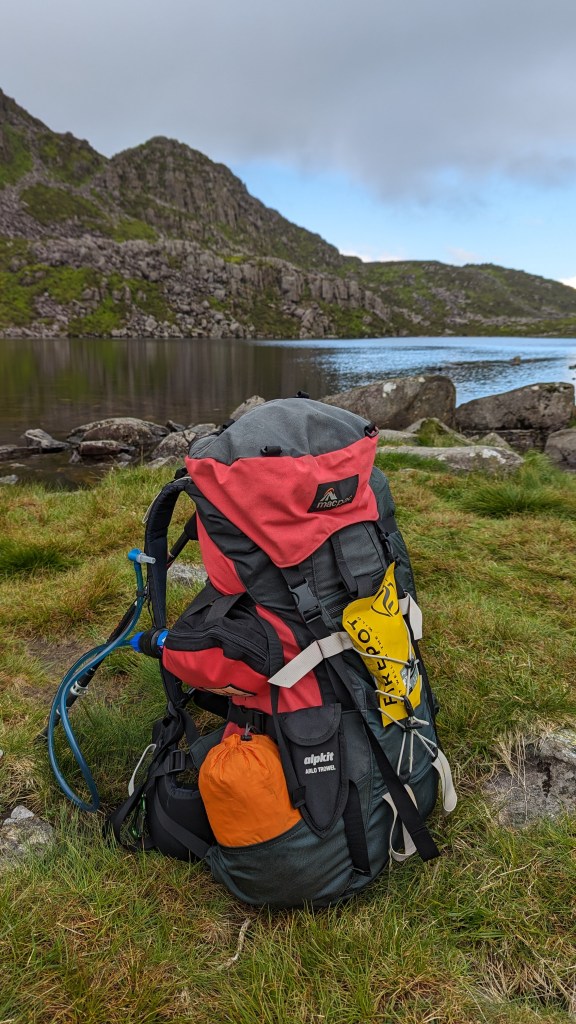
On my next walk, two days along the Sandstone Trail, I followed their advice and was grateful not to experience any shoulder pain, but now I had significant discomfort on the iliac crest of both hips instead.

Conclusion

I was told during my sports massage that my shoulders are significantly asymmetrical and I suspect this did not help, however the Bora has been the first uncomfortable pack I’ve ever owned in 35 years of backpacking / walking experience. Cutting to the chase, these are the conclusions to which I have arrived:

  • The frame in a pack probably does something to force me into a better posture and I should not seek to carry a frameless pack.
  • Load lifters, a feature only possible with a framed pack, would seem to enable me to effectively compensate for the asymmetry of my shoulders. Furthermore, since suspect that most of the population are not wholly symmetrical this a feature useful to most people seeking to carry more just a day’s gear.
  • If you are going to carry 8 kg of weight (which doesn’t seem like a lot) for a whole day or multiple days then hip fins do not spread the load around your hips well enough and a full length padded hip belt is necessary.

Together this means that a pack of the design of the Bora is not suitable for lightweight backpacking. The pack would be good for voluminous items, but not carrying significant weight. That said, I would not consider 8-9 kg to be particularly heavy. I cannot comment whether this pack, which is reasonably light, very well constructed and very robust would be good to carry climbing gear to the base of a cliff for a days climbing, but it did not prove suitable for my needs and I could not recommend it for multi-day use.

Epilogue

I still want a 40 L pack for 2-3 lightweight backpacking but have learned that I need to look for a longer list of characteristics.

  • Framed pack *
  • Load lifters *
  • Fully padded hip belt *
  • Well padded shoulder straps *
  • 40-45 L capacity *
  • Side straps to hold tent / walking poles *
  • Water bladder compatible **
  • Simple design (a challenge in today’s market) **

* Essential. ** Nice to have.

After further research, I have very recently bought an Atom-Packs Prospector EP50 (formally the Mo), which whilst it compromises on simplicity, I was able to have custom designed to remove excess pockets for which I had no purpose. Look out for a review later in 2024 / early in 2025.

Lightweight Backpacking – Cost effective strategies for reducing your base weight.

Backpacking / through-hiking has grown in popularity over the past ten years. YouTube videos, blogs and outdoor equipment companies are all promoting the benefit of light or ultralight gear, and as you might expect as the weight goes down, the price goes up. I’ve been backpacking since the 80’s and the aim of this article is to share some of the things I’ve learned about travelling light without ending up with an ultralight bank balance at the end of the experience.

I should start by putting my approach into context. When I go for multi-day walks I want to be comfortable and to know that I am safe and secure against all weathers. I do not subscribe to the philosophy of ¾ length camping mats or sleeping under a DCF tarp. My 2-3 day kit usually weighs 8-9 kg, not the 6-7 kg of US through hikers. But at this weight I can still walk for 6-7 hours (plus breaks) and take 900 m peaks / 1200 m of total height gain in my stride each day. If I can do this with ease at 53, so can you…

Here are the principles I work to:

Take less…

The cheapest way to reduce your pack weight is to simply take less stuff. Think about what you absolutely need under each of these categories and write yourself a packing list:

  • Navigation & communication
  • Keeping warm & dry in the day – Clothing
  • Keeping warm & dry at night – shelter and sleeping gear
  • Eating & drinking
  • Evening entertainment & luxuries

Before you pack your bag, critically review your list, is there anything you could safely cut out? When you get back from a walk, review the list again – what did you take that you didn’t use? Can you drop that off your packing list next time?

Water – I take less water by using a water filter. I used to start each day with two litres of water in a pair of aluminium bottles and carry iodate tablets. These antimicrobial tablets are relatively slow to act and also taint your water. Swapping to a water filter and two one litre flexible bottles (Hydrapak Stow) means I now carry a maximum of one litre of water at any time, and I harvest water as I go. In the mountain and fell regions of the UK a shortage of water has never been a problem. You do need to review your route for water harvesting options as part of your itinerary preparation though – but that for me adds as extra dimension of enjoyment to the planning. The only time I carry more water is after the final water harvest for the day when I fill both my bottles ready for cooking and brews. Normally that is for < 30 min of the day.

Then review your kit list vs. my next principle…

Multi-function equipment…

What items can you take which can fulfil more than one function? Why, for example, take an inflatable pillow when you can you can wrap your spare layers in a jacket and use this as a pillow. Examples of other multi-function equipment which I use:

Myti_mug_outdoor_picTitanium cooking mug – I can both boil water in this and drink tea from it. If I take freeze dried or dehydrated (the former tends to be more tasty) food then my cooking mug never needs washing out because I eat out of the pouch.  Thus I don’t carry any cleaning stuff either.

Cutlery – you only need a spoon or spork.

Sleeping bag – use this for keeping warm in the evenings. I take a jacket which will be just warm enough for my rest stops, not warm enough for the evenings too*  Ditto the down over trousers beloved of may YouTubers, why add the weight when you have a down insulation for your legs already?

rab200

*The one caveat to this is walking in the winter when I will always take my down jacket when I know the nights will drop below freezing.

Buff – This is a new bit of kit in the last year. I was sceptical, but now I’m a convert for year round walking. The marketing spiel isn’t just hype. I’ve found the following uses to be practical and comfortable: (i) scarf, (ii) sun protector*, (iii) lightweight hat for evenings and mornings in the tent, (iv) ear warmer, (v) eye guard for short summer nights, (vi) comfortable mouth and nose insulation for sleeping on really cold nights, (vii) add to a hat to form a balaclava in the winter, (viii) pot cozy for meal rehydration (a fleece or wool hat works well for this in the winter too).

This slideshow requires JavaScript.

* Mine is made from merino wool which cool when it’s hot, and warm when it’s cold. I would highly recommend this option. In the winter,I do take a warmer hat in addition to my Buff but I no longer carry Ear Gear or a balaclava.

Quick drying clothing – wear this instead of taking an excess of spare clothing. The only spare clothing I take for the first four days of a walk is underwear and socks. If I am going between fixed accommodation and need to be ‘civilised’ in the evening I take a clean shirt which I only use in the evenings and make my walking T’s last for 3-4 days.

Clothes pegs – I always take two and they have find a myriad of uses.

Resupply parcels – If you are walking for more than four days, consider whether there is somewhere which you could post a resupply parcel to. In these, as well as food, I also pack fresh clothes and batteries for my GPS. Normally I use a campsite as my collection point so I’ll also post my towel, which I’ll then post home the following morning with my dirty clothes.

Are there any other items you would add to this list?  Drop details in the comments so we can all learn together.

Spend some money

Whilst none of the above suggestions should cost much money, they are some items on which experiences tells me that it is worth spending some cash to drop my base weight. I chose to buy the following good quality lightweight items.

Hilleberg Enan in the Cairngorms

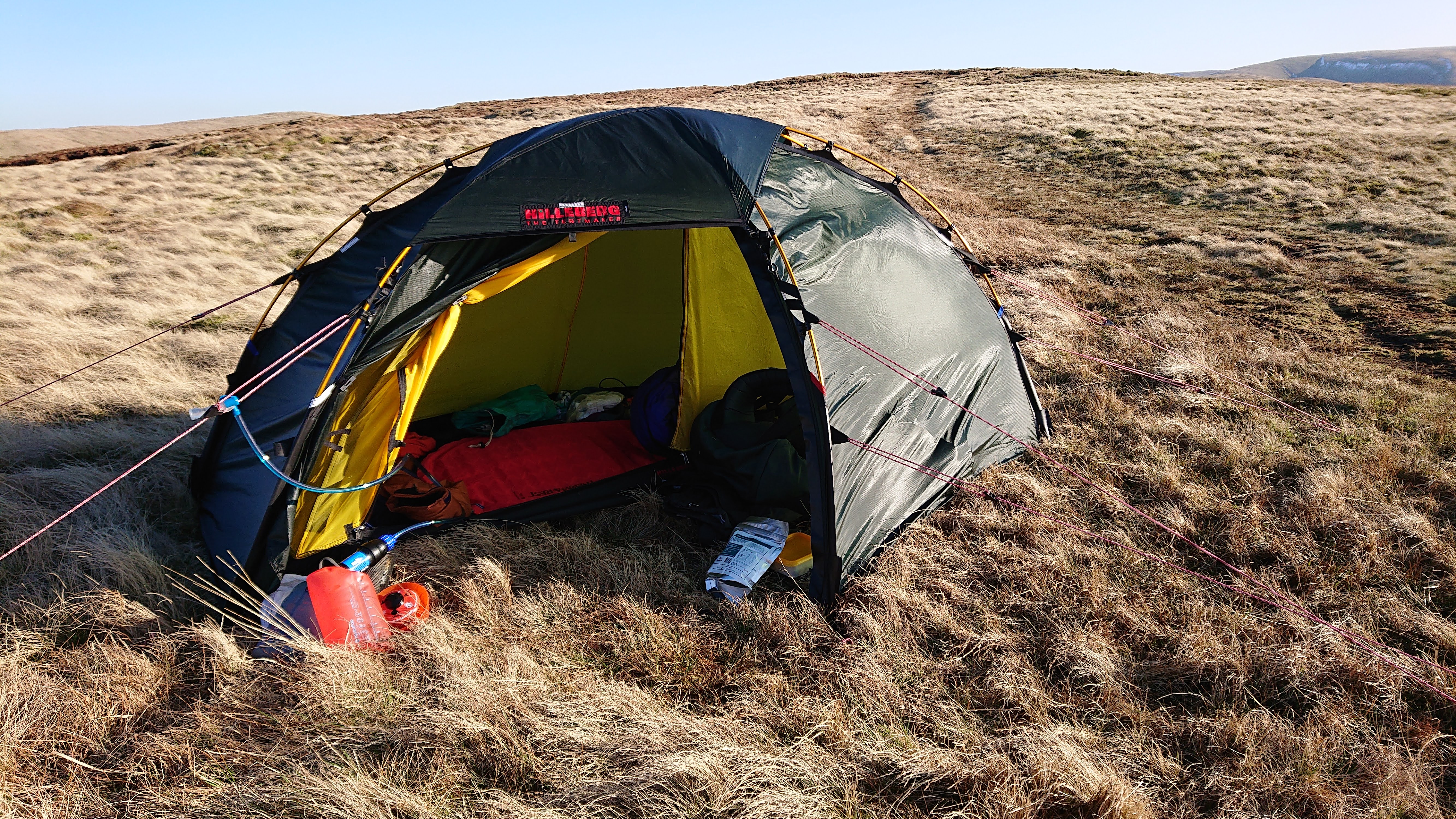
Tent – Outside of the winter, I use either a Hilleberg Enan (1.2 kg) which is tent I could not recommend more highly for solo three season use*. If I’m on a multi-day walk, I want a tent I don’t have to treat with kid gloves and one which will stand up to poor weather even on a mountain summit.

Nordisk Lofoten on Berwickshire Coast

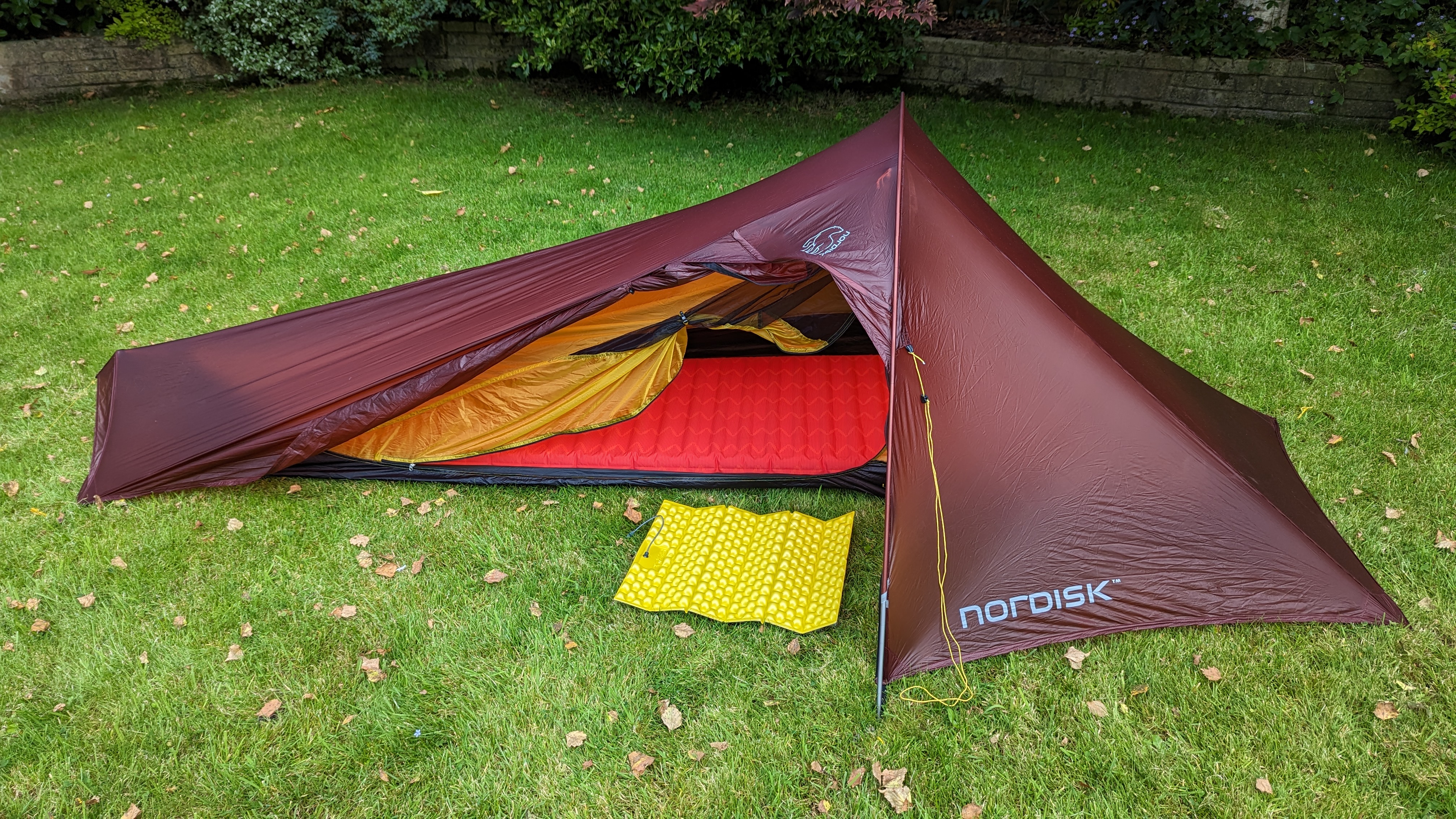
If I am going ‘fast and ultralight’ my extravagance is a Nordisk Lofoten (600 g all in inc. polycro footprint). This shelter is lots of fun, and much more comfortable and secure than a tarp (a solution I tried and rejected after two multi-day walks in 2023) and no heavier either.

Sleeping bag – with today’s water resistant down technology, there’s no reason to be fearful of using down (assuming you have a reliable shelter). I’ve used bags from three different manufacturers over the years, and my Rab Neutrino has proven by far the best. For a lightweight thermal boost, consider a pair of long johns in the winter.

Sleeping mat – arguably this is more important to warmth than your sleeping bag itself. When I know that if I am on the limit of a sleeping bags temperature rating I use a higher R value mat in place of a higher rated bag and save weight with no compromise to my comfort.

Rucksack – This item is likely to be one of your three heaviest items so definitely needs to be considered. However whatever you choose, it needs to be comfortable all day, every day, week in week out. I cannot offer you advice here as my Macpac Pursuit 50 is quite heavy by today’s standards, but I love it and plan to keep on using it until it wears out.

Stove – modern gas stoves don’t have to be expensive to be light in weight. Check out the offering from Alpkit. If you do opt for a gas stove I would recommend you consider a canister stove as these allow you to invert the cylinder and thus work well in most temperatures – to learn more read this article. Meths stoves are also well worth considering for short trips, but note that you will burn more grams of meths per pot of water boiled (and are slower too) so their benefit wains for longer trips.

* Many people class Hilleberg tents as over expensive and are quick to say they they ‘would never spend over £200 on a tent.’ However I compare the price of my tent, per night, to that of a B&B. The minimum you are likely to spend on this would be £60 per night as a solo traveller. I use my Enan for 10-15 nights per year. I only need to use it for a year for it to have paid for itself and it has a likely lifetime of 10 years at my rate of usage. I enjoy camping on high ridges and mountain summits and I know I can wholly rely on my Hilleberg Enan in foul weather, and my Hilleberg Soulo in extreme weather, cold and heavy snow. I sleep better knowing the weather can do its worst and I’ll be safe and warm in my shelter,

Nordisk Lofoten (ongoing review) – a fell side test night with beautiful skies.

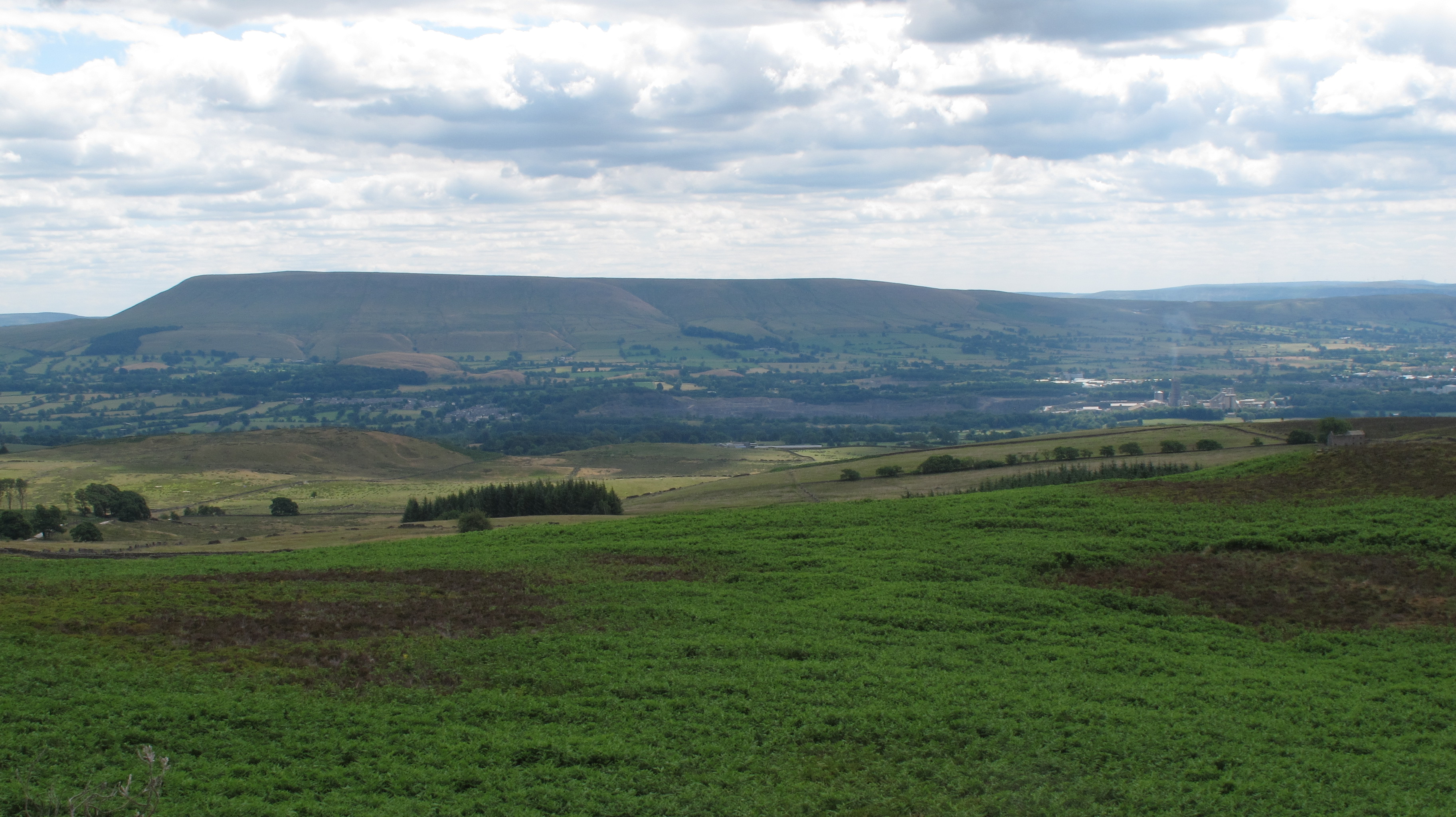
Pendle viewed from Waddington Fell.

There are three spots on Pendle where I like to enjoy an overnight micro-adventure. One is good for storm testing, one is ideal when I go up with Junior and then there is a small flat ledge at 440 m which has the best view, but has only just enough space for a solo tent.

PXL_20230923_174402776

No one in the UK can have missed what a wet year it has been. So whilst I continue to wait for a dry weekend for an autumnal wild walk, I saw the forecast of a sunny afternoon, with rain only during the wee hours. I wanted both some head-space and the chance to test out my new micro-tent, a Nordisk Lofoten so I packed a bag and headed out after tea. For my detailed preliminary review of this micro tent, click here.

The Lofoten is best thought of as a luxury hooped bivvy rather than a tent, so some experience is required to know how to best work with it given that it is not tall enough (70 cm) to sit up within. There are a number of micro-tents on the market now from Nordisk, Terra Nova and Vango, but that which is easiest to pitch and has the smallest pack size is the Lofoten. All these ‘tents’ are side entry, which when you compare to a hooped bivvy has a range of advantages:

  • Easier to get into / out from
  • Much less claustrophobic
  • A porch to store your boots and waterproofs within
  • Better views of your surroundings.
  • Space to get dressed (with a free yoga session thrown in!)

pxl_20230923_175301905A game changing feature of the Lofoten is being able to use the door as a tarp which gives you covered space to cook under, so long as the wind is not too strong (≤ 20-25 mph).

PXL_20230904_075535368

Additionally, it has a pole sleeve for the main pole and not Velcro tabs so it is far far easier and quicker to pitch. It was great just to sit out of the wind (in the open porch) and enjoy seeing the sun set and the lights of the town start to illuminate.

The sky would not have won photographic prizes, but together with the peace and isolation of altitude that half hour was music for my soul.

This slideshow requires JavaScript.

So what did I learn about my new micro-tent?

  • Pitched with the correct orientation to the wind it was much more capable than I imagined. The wind was rather stronger than I was expecting, gusting to around 35 mph at 0200. (In future I would seek a sheltered pitch if winds above 25 mph were forecast, had the wind swung around to ‘side on’ it could have been a different story)
  • The combination of heavy rain and driving wind did not lead to any water ingress.
  • Even though the temperature dipped to 9 C and I had the door fully closed, the catenary cut of the fly looks to work, as I had zero condensation.
  • It is much easier to enter, exit and get dressed within than under a tarp.
  • The porch could accommodate my boots, waterproofs and a 40 L pack, so long as I was prepared to store the pack on my exit route and move each time I wanted to get in / out. Had my pitch not been sloping L2R I could have reduced the width of the inner (it is designed to do this) and given myself more porch space. This is the first night I have closed the door and I was pleasantly surprised with the size of the porch – yes it is petite, but it is not Lilliputian!
  • I could pack up everything other than my Thermarest without getting out of the tent or opening the door.

Questions which still need to be addressed:

  • How to manage the challenges of entry and exit in heavy rain (I have a plan, but will it work?)
  • Limits to the weather conditions which would allow you to use the door in ‘tarp mode’ and thus have a covered cooking area.
  • When will there be a dry enough weekend to facilitate a two day wild walk I the Dales without the tops being obscured by cloud?!?

Nordisk Lofoten ULW solo tent – a review

Could it be suitable as a ‘Fast & Light’ backpacking / bike-packing shelter?

Background

Lofoten vs. 1 litre bottle

Lofoten – packed volume = 2375 ml

I started experimenting with a Hilleberg Tarp 5 as a ‘fast and light’ backpacking shelter last year. The first three day trip went well, but using it on my more recent five day walk along the Offa’s Dyke Path was far less satisfactory. Whilst it was a secure shelter that kept my kit and myself dry on some very wet nights, it did not provide the level of protection from the wind which I desire. Since I have very much enjoyed carrying a 35 L / 8 kg pack for certain multi-day walks, I set about researching alternative low weight / low volume shelters that might better meet my needs & desires. I settled on the Lofoten

This is an initial review of the Nordisk Lofoten after pitching for a few test nights, either in the remote wilderness which is our back garden, or atop a local fell.

User Requirements:

Essential features

  • A shelter that can keep out heavy rain and moderate winds

  • Pitches quickly & easily

  • Very low packed volume (to enable use of 35 L pack for 3 day walk)

  • Weighs < 700 g inc. all components (pegs, guys, bag etc)

  • Provides reasonable shelter for cooking in the rain.

  • Ten year lifespan at 8 nights use per year

  • Holds it’s value so I can sell on without too large a loss (this is a niche item I’ll either love or hate)

Acceptable compromises

Review – Space (Score – see below )

PXL_20230902_110228501

The Lofoten is the antithesis of the Tardis; one’s first impression is that it looks a reasonable size but that myth is soon dispelled when you get inside. This is very specialist shelter, made for the mountain marathon market, meaning that it does the very minimum to meet their requirements for a shelter.   For sleeping the size and design is wholly acceptable. It is a standard 220 cm long which is a good length for me at 5’ 11” (180 cm). Once lying down I had space for my sleeping bag foot-box, plus the full length of me and a spare approx. 20 cm at my head end where I could keep book, torch, phone, map etc. It has a pentagonal footprint so there is a triangular space next to the pole for your next days clothes.


…it’s really best to view the Lofoten not as a tent, but as a luxury hooped bivvy


Sensibly the bathtub extends to the full height of the inner at the foot end which should minimise the chance of dampness from the fly wetting your sleeping bag. It will stop moisture transferring from the fly, but can itself be subject to condensation on cold nights. Thus I will continue with my normal practice of wrapping my windproof or waterproof jacket around my feet as insurance. I would not want to use a winter down sleeping bag in this tent as it would touch the ceiling and at least one side of the inner tent. (But then I would never have viewed this as a winter tent.). I sleep on a self inflating pad (ca. 25 mm thick) and suspect that the considerably thicker air-pads such as the Neoair might be thick enough to cause the foot-box of your sleeping bag to touch the top of the inner. I plan to borrow an air pad to test this before I consider investing in one.

PXL_20230910_054810564

I found it easier to get undressed / dressed in the Lofoten than under the tarp, in part because the inner tent protects you from condensation on the fly and also because the height does not drop away as sharply. The “headroom” around my waist and thighs is actually greater. That said, unless you are a child you’ll not be able to sit up, the maximum headroom being a very modest 70 cm.

The unresolved challenge I see, is how one should get changed out of full waterproofs and get into the shelter if it is still raining heavily at the time. There is no porch area which is tall enough to sit in. If anyone reading this has devised a good way to deal with this issue when ‘camping’ in a bivvy bag please do leave me your advice in a comment.

PXL_20230910_054519644

There is just about space for boots, stove & waterproofs in the fixed section of the tiny porch – see photo. If you have the door open in ‘tarp mode’ you have lots of covered space, but if you want to keep your pack undercover it will need to be in the wide part of the ‘opening section’ of the porch and pushed out of the way when you want to get in and out of the tent. This leaves the narrow end of the porch somewhere you are best not to store any gear.

Considering all the above, it’s really best to view the Lofoten not as a tent, but as a luxury hooped bivvy. But because the entrance is on the side rather than the end it is much easier and more pleasant to get into / out from. Additionally I do not feel any sense of claustrophobia because the tent is at it’s tallest above your shoulders, the head wall of the inner is very steep and together this means the inner is well away from your face.

An unusual, excellent and game-changing feature is being able to prop up the door with the supplied bonus pole to make a tarp like cover over the entrance. This gives a good level of protection to safely cook in the rain and is lovely to leave open all night leaving you with the views of a tarp shelter but much greater protection. I’d plan to store my pack under ‘tarp’ section knowing that if bad weather sets in I can remove the tarp pole and seal myself away from the rain. It is possible to use a fully compressed trekking pole in place of the tarp pole and save yet further weight.

PXL_20230904_075535368


…being able to turn the door into a tarp over the entrance is a game changing feature.


Score (5/5 vs a hooped bivvy, 2/5 vs a conventional tent)

Ease of pitching (Score 4 ½/5)

This tent is very easy and quick to pitch even the first time you get it out of the bag. With practice I’d expect it to take < 3 minutes to erect. It pitches with a minimum of five pegs, but I’d carry another five so you can peg down the pole ends, add the two guys (supplied) and guy out the door as a tarp as discussed above. The tent is supplied with two sets of pegs – five titanium toothpicks, with which the 490 g weight is achieved, and five decent Y pegs akin to MSR Groundhogs. Peg choice is a heated topic, but I would suggest that the Y pegs should work well in all the conditions in which you be likely to use this tent. I’ve found carrying eight of these plus two of the toothpicks to peg down the pole ends is an excellent compromise.

The inner is semi-permanently attached to the fly with Dyneema guy cord, so the tent pitches ‘all in one’ as is common with most of today’s tunnel tents. It is possible to separate the two but this involves undoing knots in 2 mm cord which is a tricky, lengthy task.

My one complaint would be the fixed length guy at the foot end of the tent. Given that this is a Si-Nylon fly which will stretch in the wet it would have been far better to have a guy runner so you could easily adjust the tension and also have the option to choose where to put the peg if you are on stony ground. I have upgraded this guy.

PXL_20230909_185929812_Annotated_Guy_Line

Weather worthiness (Score – pending)

So far I’ve only used the tent on dry still nights so it’s too early to say. That the flysheet is Si-nylon with a hydrostatic head (HH) of 1600 mm which bodes well for sheltered 3 season use. The groundsheet has a 3600 mm HH.

When you do get a breeze you are advised to pitch the head / high end into the wind so you can take advantage of the shelter of the fixed porch area. Pitched in the reverse would form a windsock!

Ventilation / Condensation (Score – pending)

So far I’ve only pitched on windless nights when we saw a swings from 25-27 Celsius in the day to 10-12 Celsius at night, so maximised condensation potential for any tent design. Thus it’s too early to assess. The catenary cut fly at the head end and a covered mesh panel at the foot should aid ventilation even if you have the outer door closed. On one night I did see a small but appreciable amount of condensation form on the groundsheet just at the foot end of the tent, ironically this may have been due to the cooling effect of the vent in the fly at this end of the tent because I did not see any on any other part of the groundsheet.

Footprint (Score 4/5)

The footprint is about as small as could ever be possible. The guys are modest in length vs a tarp, so the Lofoten can be pitched into very tight spaces. Note though, that because the groundsheet is only 15 Denier it would not be happy on rocky ground without some kind of sacrificial footprint.

Also, most regular sized single hoop tents (e.g. the Enan or Laser) are symmetrical in the shape they present to the wind, the Lofoten is not. So, if you can only find a sloped pitch you may not be able to pitch it in the correct orientation to the wind and sleep with your head above your feet. This will probably mean hunting further for a pitch which is level or where the uphill end is into the wind. This may present a challenge to wild campers.

Weight / Robustness (Score 3½ / 5)

The only two skin tents lighter than the Lofoten (my real world weight 590 g) are the Terra Nova Pulse (total weight* 545 g) or Pulse Ultra (total weight* 490 g). The pitching method for the Pulse looks a real faff with the main pole being held to the fly with velcro tabs which is why I opted for the Lofoten.

Ti pegs 2 grams

All the above *claimed weights are achieved using 2 g titanium toothpick pegs. These are simply not practical options for real world camping – they are only really useful for use on a golfing green on a calm night! The Lofoten was supplied with a set of toothpicks and also a set of standard Y pegs. When I add all the guys, eight Y pegs and two toothpicks (for the pole ends) but exclude the zip out inner pocket cum-tent-bag my real world weight comes to 590 g. That’s nicely inside the 700 g target which was the combined weight of my tarp, and accessories. Honestly, the weight, but especially the packed volume of this tent, are amazing. It’s lighter than any hooped bivvy.

The design of the tent has a curved pole (6.5 mm Al) at the head and a short upright pole at the foot. The poles have unusually short pole sections (22 cm) which would work very well for bike-packers. There are three guying points, one essential one at the foot and two optional ones on the main pole. All guys are provided. To achieve both the ultralight weight and the impressive pack size ( 25 cm long by 11 cm diameter) very thin fabrics have been used, but the 7D fly still has a tear strength of 3.5 kg (Hilleberg’s Kerlon 1000 is 8 kg for comparison) and high tension points have been reinforced. My only disappointment is the 15D groundsheet which will need me to buy or make a footprint for use on all but campsites or the aforementioned golfing green. Careful handling will be essential, but if you want something of ultra low volume this is a price which physics demands that you pay. I am happier with thin nylon than DCF; this has now been in the market place for a while now and there are a number of reports of it having a too short a lifespan in real-world use. Furthermore, Si-nylon packs down smaller.

Conclusions

PXL_20230910_064007799

After a few test nights I think this tent shows promise with meeting my requirements, buying pre-loved was clearly a good idea, as how I cope with the low headroom (low every-type-of-room to be honest!) is something only experience will reveal. I am impressed with how well it has been manufactured and how quick and easy it is to pitch and strike. The true test is to take it away for a multi-day walk and see what it’s like to use when I’m tired and how much hassle it is to pack a bag from inside it. Also it will be interesting to see how one manges entrance / egress in heavy rain. It is certainly a niche design which will lead to polarised opinions. Either you / I will love it or hate it. I will write up a further review when I have the experience to know which is true for me.

If you have found this review helpful, you may also enjoy my other tent reviews:


Paramo Torres Activo Jacket – a review.

Langden Castle

I’d been looking for a water resistant, windproof shoulder season insulated jacket to use to walk too and from work in notoriously wet Lancashire when I stumbled on a Torres Activo Jacket on Outdoor Gear Exchange. It was the same ‘size’ as my other Paramo tops so I snapped it up.

The Paramo system assumes that you will overlayer your windproof or waterproof with an insulator, not remove your ‘outer shell layer’ to put something warm underneath. The benefit of this is not getting cold in the process of trying to get warm. Lots of odd concepts have been developed in the outdoor clothing world and many simply don’t work. But I’ve found the Paramo approach to work well for me over the past ten years. I am a fell walker and multi-day wild walker.

Features

The Activo is a simple jacket and one designed for walking and climbing and not for the High Street. The outer pockets are ‘Napoleon’ pockets, designed for use and access when wearing a harness or rucksack hip belt. There is also one generously sized inside pocket, large enough to hold an OS map.

PXL_20221128_201616369

The hood has plenty of adjustment and moves with your head so does not restrict your vision. I normally don’t like hoods, but something about the cut of Paramo hoods allows me to get on with them where I would normally not.

Sizing

It is essential to note that the Activo jacket is not sized to take a thick layer underneath if you choose your ‘normal size’. If this is what you want, you would need to go for the next size up. I also have the warmer Alturo jacket in the same notional size and this allows for a thick midlayer and a Paramo waterproof (themselves thicker than Goretex) to be readily worn underneath (or two layers of fleece top). However, it is a good length, coming well down over the bum so there is never any gap between jacket and trousers.

PXL_20221128_201717562

My verdict

Had I had chance to try it on first, I would have opted for the next size up. The back and arm length is perfect for me, it is just a snug fit that will only accommodate a base layer and windproof underneath. What is remarkable with this jacket is the effectiveness of the insulation. Because it is insulation fibres inside a shell it is fundamentally windproof unlike a fleece, but is far warmer than any softshell I’ve ever worn and yet is at least equally rain resistant.  It is no heavier than a softshell and packs down better too.

I am finding it ideal for a shoulder season walking / backpacking jacket. On a recent wild walk I was plenty warm enough sat under my tarp all evening at temperatures down to 8 Celsius. I was fully expecting to have to climb into my sleeping bag early, but with the hood up I was plenty warm enough. Surprisingly good for a 470 gram synthetic jacket. The same weight as a Rab Microlight down jacket yet highly water resistant, fast drying and just as warm wet as dry.

I see this finding it’s place as a really flexible windproof ‘jumper’ for shoulder season walking. But, being a jacket means a lot of flexibility for ventilation because it has a full length zip.

Summary

So in the end this jacket has not been suitable for my walk to work, for this I would prefer waist level ‘hand warmer’ pockets for this duty and the space to put a warm layer on underneath. This design is difficult to find new so it may not be possible for me to trade it for the next size up. In the meantime however, what was bought for one purpose has found use elsewhere.

I would describe this jacket as filling a very small niche – if Paramo develop something of a similar weigh yet a more generous cut I would certainly give it a try because the insulation performance, build quality and likely longevity (if my 12 year old Velez is anything to go by) of their insulation is really excellent. Having hand warmer as well as Napoleon pockets would be a great addition too.

Tarp camping – my verdict…

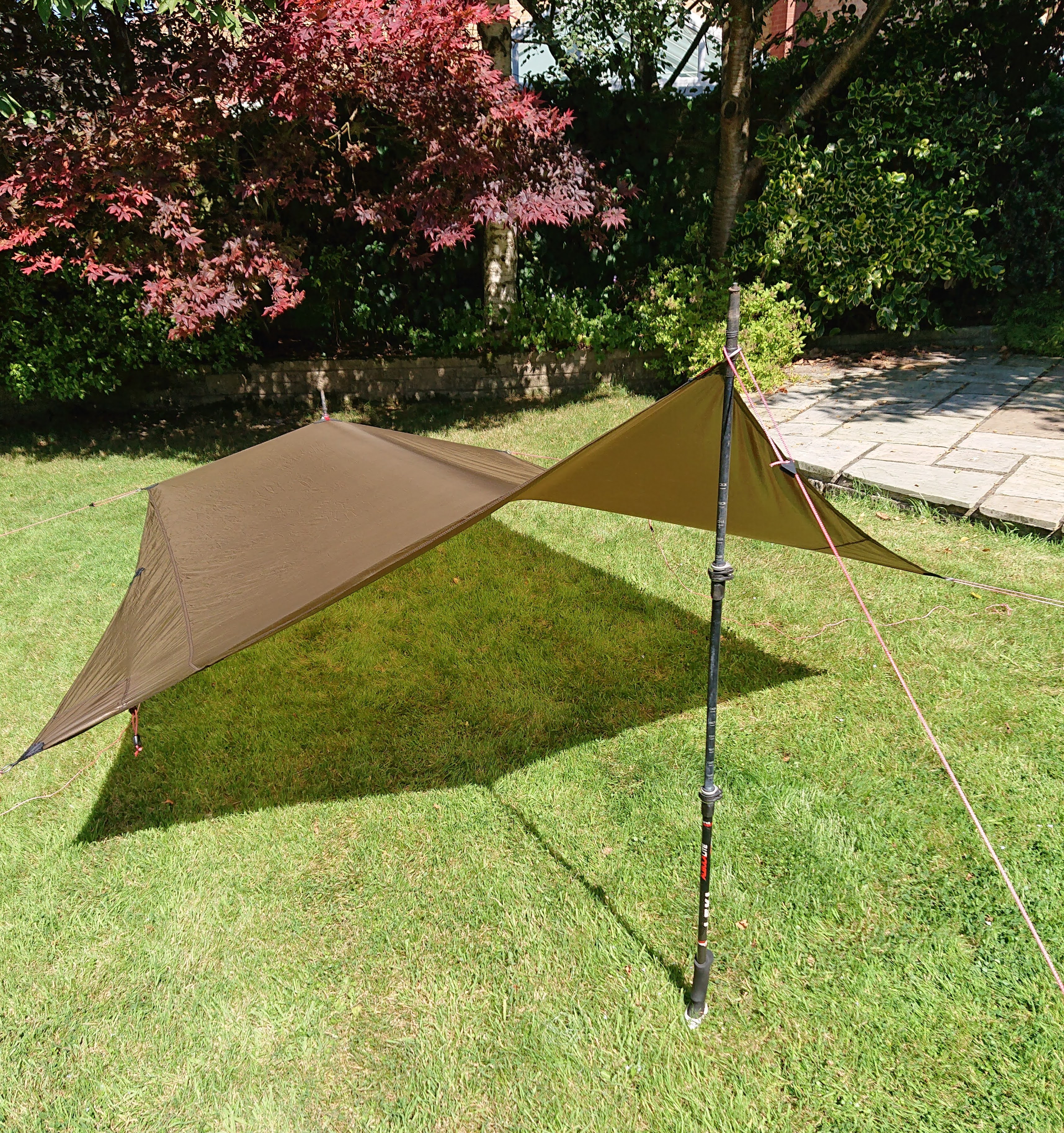
After playing in the back garden over the summer to look at pitching and bug net options I’ve taken my tarp out for its maiden voyage. Because I didn’t know if tarp camping would be something I would enjoy I chose to buy a tarp second hand and accessorize it as cheaply as possible. Buying second hand meant taking what I could find, which in this case was a Hilleberg Tarp 5.

DSC_2904

Regular A-frame

The prevailing advice with tarp camping is to start with something large and then only once you have some experience move to something more minimal in covered area. My experience thus far suggests that this is sound advice, it’s just that I opted not to take it! In my earlier post I covered the conceptional pro’s and con’s of tarp camping and busted a few myths along the way; So, how did these ideas measure up in a real world two night wild walk you ask? Read on…

For my first tarp camping trip I chose to use it for my shelter on a three day walk along the Lancashire Way.

What did I discover?

Positives

  • The Tarp 5 only weights 320 g inc. guylines.  400 g when you include the pegs.
  • Having a roof over you provides reassurance and is far nicer than using a bivvy bag.
  • A tarp can hold out wind blown rain if pitched correctly vs. the wind.

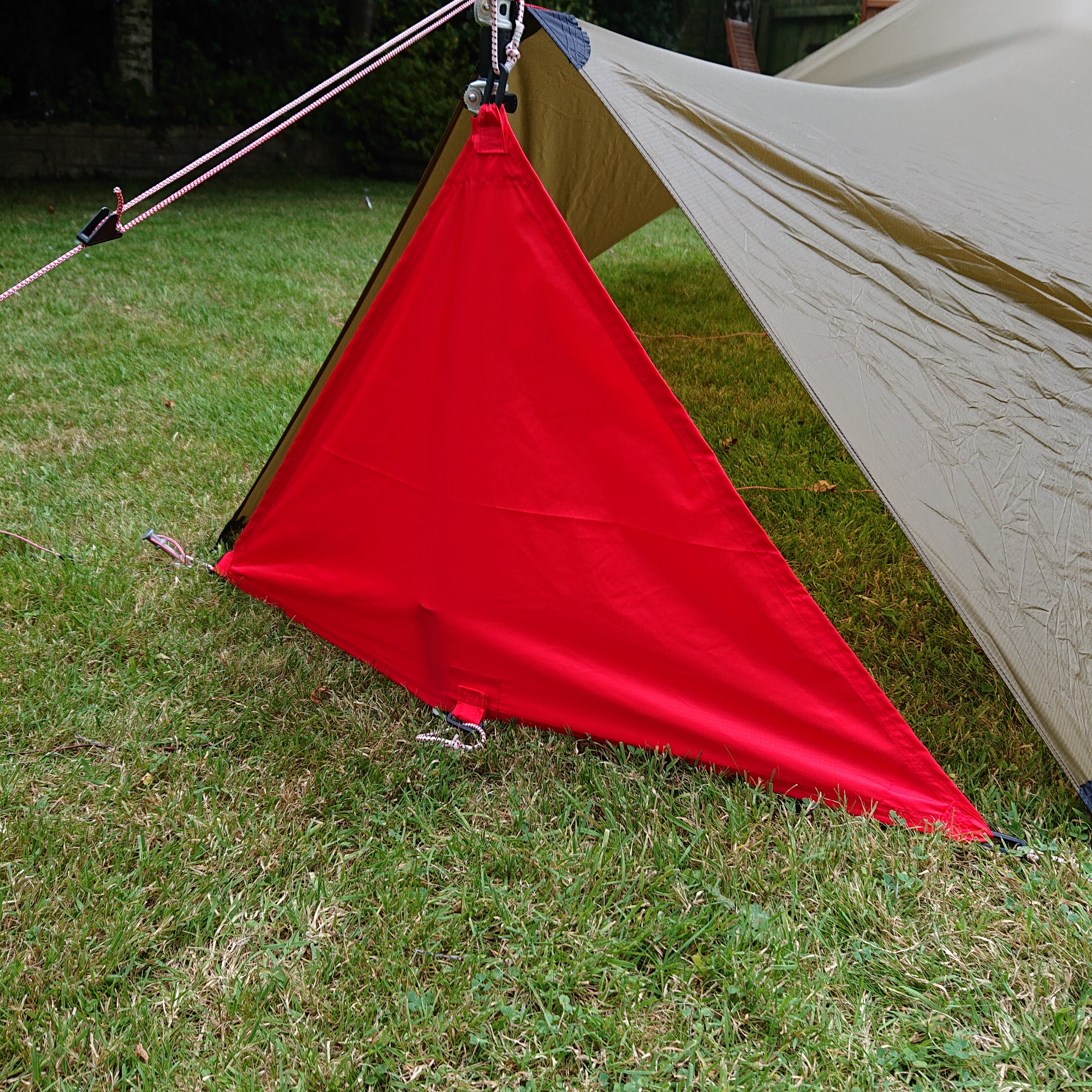
However I’ve taken an unconventional approach to pitching in the wind, treating my tarp like a tent if it looks like it is going to rain. Normally you’d need a shaped tarp to do this but I’ve designed a foot end panel which should offer the best of both designs. More of this below.

Fast & Light

The tarp & pegs are all in the red Aiguille pocket nearest to the camera

  • I loved the low volume of the tarp and associated kit
  • My low cost bug mesh solution worked very well.
  • Very satisfying in the rain
  • The light weight and low volume facilitated a great walk allowing for 16-18 miles / day.

Negatives

  • The covered area in which you can sit to cook in the rain is very limited.

Not sure if this is going to be a problem as whilst I experienced heavy rain, this was only after I’d finished cooking and eating.

  • Didn’t really feel that extra connection to the environment

But that may well have been due to the short daylight hours and me being too tired to do more than pitch, eat then sleep. One aim of this walk was to break a period of insomnia – which wonderfully it did.

  • A tent is a lot more comfortable in the mornings

It is warmer to get dressed in, especially if the heat of brewing-up is captured which takes the edge off the chill when you are getting dressed.

  • The lower amount of headroom of a tarp makes getting undressed / redressed a challenge vs. my experience of a tent.

My accessories – how did they work?

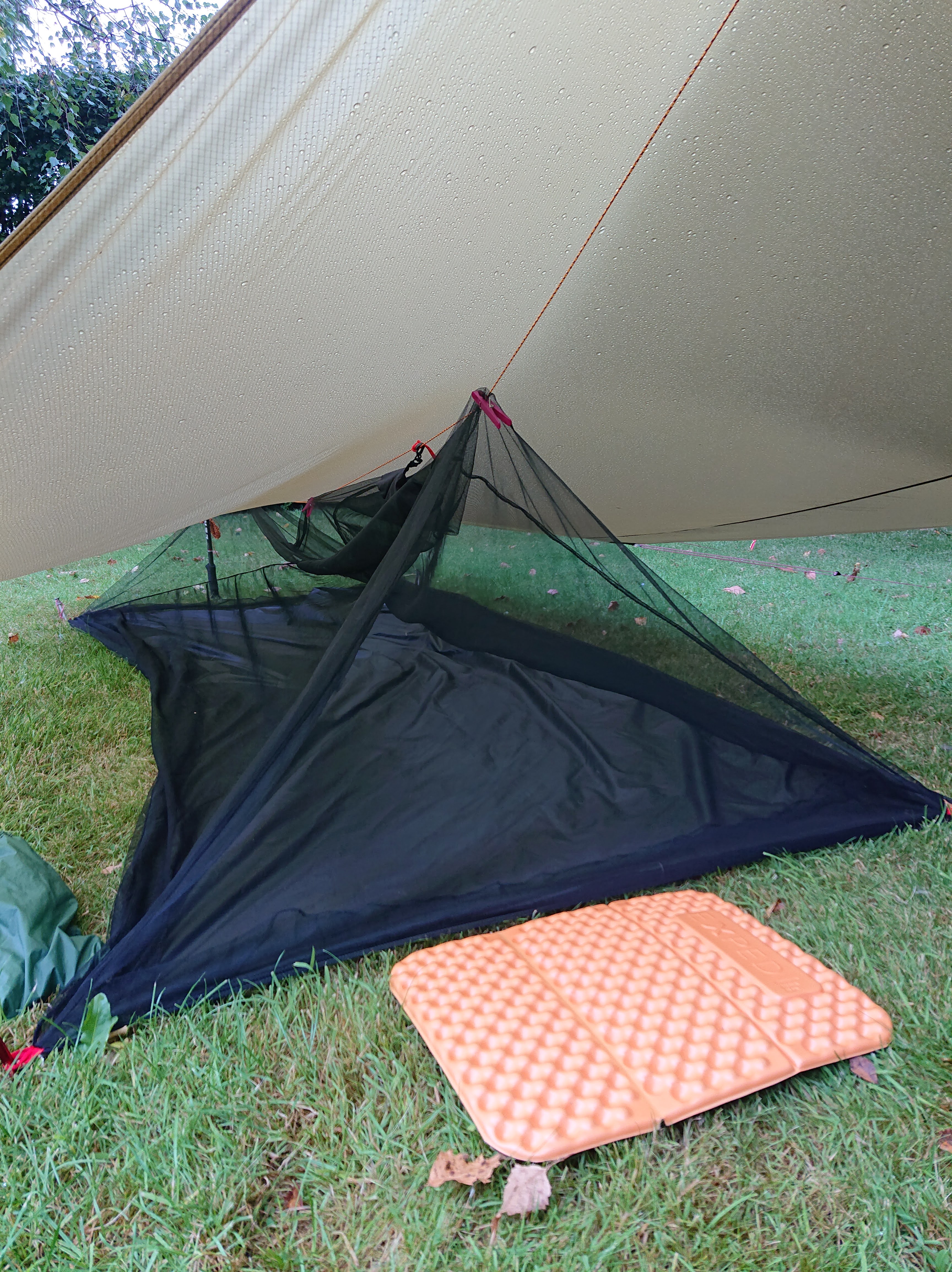
My bug net solution was comfortable and kept me insect free. For me comfort and convenience comes ahead of price, but at £20 the Sea to Summit Mosquito Pyramid Net, paired with an old footprint (groundsheet protector) felt almost as convenient as a purpose made bug tent costing considerably more. Adding a hand-sized loop of climbing cord to one of the front pegging points made for an easily visible and accessible handle to give a route in and out of the netting.

DSC_3016

The really pleasing addition was the end panel which I designed and a friend made for me.

DSC_2976

Whilst I know that the design could be improved on, I experienced winds of around 25 mph and rain at 1.5 mm / hr for a few hours and remained wholly dry. It is true that some rain blew through the obvious gaps but because my feet / legs were in the centre they remained fully protected. This is something to be aware with a tarp; rain will be driven under the sides for a short distance and this is why tarps are very wide compared to a tent. The extra overhang ensures that the core area remains dry. Rather like a porch or veranda on a house.

Titanium pegs

Ti pegs 2 grams

I wouldn’t trust these on a guy line, but there were perfect for pinning down the groundsheet and only 2 grams a piece.

The ultimate test – will I go tarp camping again?

Updated Sept 23 – When I originally wrote this post I thought I would use the tarp for a multi-day walk again and indeed I did.  I used it on a 5 day stretch of the Offa’s Dyke Path in Aug-23 in mixed weather.  It proved excellent at keeping me and my kit dry during periods of significant overnight rain.  It was not what I’d describe as comfortable however.  Whilst it performed excellently against driving rain, on cooler days or when I found myself in the cloud it just didn’t seem possible to block out the cool wind and so I had to climb into my sleeping bag even at 4pm.  You might reasonably say that this price of travelling ultra-light.  After all such tactics are required for winter backpacking / wild walking.

What I loved about the tarp was it’s ultra small pack volume, allowing me to walk for 3 days with a 35 L pack and up to 6 days with only a 40 L pack.  Smaller packs are not just lighter but also physically smaller, giving you a sense of being unencumbered.  I love that.  So after a lot of research and conversations with ultra-light enthusiasts I bought what I’d term a ‘micro-tent’ which offers much better wind protection, a faster pitch and is amazingly over 100 g lighter than the tarp and it’s necessary accessories.   It is thus under half the weight of my normal solo tent (Hilleberg Enan, 1200 g).

This new shelter is a Nordisk Lofoten 1, which right now I’ve only used for a handful of single night ‘test nights’ which form the basis of a preliminary review.


…two tents, same location – had I pitched them side by side you would see that not only is the Lofoten about half the width, it is also 30 cm less tall.


The Lofoten is an upgraded experience vs the tarp and should be compared against a tarp, or more accurately a hooped bivvy. It will not replace my Enan for > 3 day walks or fell top wild camping but this was never the aim.

Hilleberg Soulo – long term review.

If you’ve watched any wild camping video’s on YouTube you will be familiar with the Hilleberg Soulo, as alongside the Tarptent Scarp 1 it is one of the two most popular solo tent designs which feature. I’ve now used mine through two winter seasons.

hilleberg-soulo-first-pitch

Why did I buy one?

I returned to backpacking in 2017 after a 25 year gap and was drawn back by Alastair Humphreys descriptions of micro-adventures and by wanting to explore the Forest of Bowland after seeing an enticing track wiggle up into the hills. After a couple of years of weekend walking / wild camping adventures from Spring to Autumn, I decided I wanted to expand my rediscovered hobby into winter and to be able to camp on fell tops in the coldest or wildest of weathers.

Space (4/5)

There is a good area of excellent headroom in the tent thanks to it’s semi-geodesic design, I am 5’ 11” and am very comfortable. The length of the inner leaves space for your next days clothes at your feet and the steep side walls means that when you are sleeping there is plenty of space above your head even at the end of the tent. In strong winds my preference is to sleep with my head at the leeward end where the slope of my pitch allows this.  The pentagonal footprint leaves good space next to the middle of your sleeping pad for a book, map, torch, water etc. There is a single pocket for watch, phone, matches and the like. The porch is just about big enough for all my wet gear and cooking stuff.  For me the ideal porch space is 0.7 m2 per person and the Soulo offers 0.6 m2. The steep walls of the fly do mean you can make the most of this space and the other features of the tent make this sacrifice acceptable.

I would not want to spend more than a week in a tent of this size, but I doubt I’d ever go on a solo walk of longer than four days in conditions that justified such a design. For base camp use, I would choose something larger.

Ease of pitching (4/5)

The Soulo is easy to pitch, but having three poles means it it takes 10-15 min to get set up, 15-20 min if it’s really blowing a hoolie.  The poles are attached to the fly with clips with a short sleeve at the base of each pole.  This design aids pitching in strong winds as you can firmly fix the base then gradually pitch the fly higher up each pole in turn. One very big plus is that it goes up ‘all in one’ which means once the fly is pitched, the job is complete. Having a fly first, or ‘all in one’ pitch design seems essential (to me) if you are planning to use your tent in extreme weather. In today’s market place the large majority of tents pitch inner first which is not want you want in a tent for the 4th season.

One thing I learnt on my first ‘foul conditions’ trial was to double peg the first two peg placements – for more info click here. You don’t actually need extra pegs for this, as once you have the geminal points pinned down and a couple of guys in place you have spread the load over 8 pegs and can remove the ‘doubles’ for use on the remaining guy lines. If you are planning on pitching at above Force 6 having a few extra pegs is wise anyway.

Another thing I learned was to mark up the windward end pegging points with some bright cord so it’s easy to know which end is which in wild pitching conditions. The porch has a fixed and an opening section and in bad weather you’ll want the fixed section at the windward end.

DSC_2570

All the guys out and double pegged – High winds on the Howgills

The Soulo comes with 12 guy lines, six sets of two. However it is only supplied with enough pegs to mean that by design you peg each pair of guys to one peg. The weak point of a guy is usually the peg placement and unless you are willing to carry the extra pegs you might as well remove some of the lower guy lines in my view. I have removed four (to save weight and to simplify) as for single night use in even poor conditions I can only see the point of having double guys at the windward end. I carry extra pegs so I have one per guy.

Weather worthiness (5/5)

Soulo

Trusty Soulo after a cold night

This is where the Soulo is in a league of it’s own. So far I’ve used use it in very strong winds, heavy rain, driving horizontal rain, low temperatures (down to -6 C) and on very poor ground. I’ve spent a relaxed, warm, dry and secure night in each case. The only ‘4th season’ condition I’ve not tested it in is heavy snow fall. The covered high level vent keeps out spindrift and the heaviest of rain, so long as that rain isn’t horizontal. The semi-geodesic design should be easily strong enough for a high snow load.  When I did have horizontal rain and had to close the vent, the wind coming under the (down to the ground) fly was enough to prevent any condensation.

Ventilation / Condensation (3 / 5)

This is the one weakness of the Soulo. In colder weather, unless you have a moderate wind ( > ca. 15 mph)  wind you will suffer moderate levels of condensation on the fly. In sub zero conditions I’ve had small amounts of ice on the inner tent too. For me this has never been more than an inconvenience and extra weight to carry the next day. However, for some users condensation is a real issue, to the point of their sleeping bag getting wet. Perhaps I respire less water overnight than average, or maybe I have less of an issue because I never pitch my Soulo in a sheltered position on a cold night?  One of the inner doors can be zipped open to reveal a mesh panel to aid ventilation of the inner, I always have this partly open.

hilleberg-soulo-first-pitch

If you want a tent which will keep out wind blown snow you will have to have a flysheet that comes down to the ground, in the past snow skirts were also used. This is almost certain to lead to condensation in a (low volume) solo tent. I know I see more condensation in the Soulo than my two man four season tent under comparable conditions, presumably because of the lower volume per person and thus ease of reaching the dew point. Also, two man four season tents tend to have two doors and thus a cross venting option.

My conclusions are these:

  • The Soulo is a tent for the 4th season and is not ideal to use all year round in the UK.
  • I get a 5-6 C temperature differential in the Soulo in winter, higher than the 2 C differential of my Enan – this is welcome when it is below zero outside.
  • You are best not to pitch the Soulo in a sheltered position, make use of the breeze to reduce condensation.

If you only feel comfortable pitching in a sheltered position and don’t want heavy condensation then a 3 season tent is probably the best choice for you. It will vent better, be lighter and usually cost less to buy. A good 3 season tent will cope with most UK conditions all year round. Only if you are fool enough to want to pitch your tent on a fell top in a gale or somewhere with heavy snow fall then the Soulo would be something to seriously consider. These are the reasons I have one and I’m when I do use it I am delighted to have it.

Footprint (Score 5 / 5)

As a solo tent which is just the right size, the footprint is small and I’ve been able to pitch the tent small spaces. Given my renewed love of wild camping this is an excellent characteristic. Also, because it is free-standing you can pitch it well on ground which is far from ideal – say on top of heather, or even somewhere you cannot use all / any of your pegs. I once used a mountain bike as my tent anchor when I pitched on volcanic ash which would simply not hold a peg securely.

dsc_1693

Weight vs. Robustness (Score 4/5)

The Soulo is unarguably robust. In terms of design, geodesic tents are the strongest, if you push down on the roof and feel it spring back you get a good sense of this.  The materials are very strong and the construction excellent. I have the Red Label version – for an explanation of the colour system click here. A Black Label – even stronger – version is now also available. However, from my experience the only place I feel this would add value would be for group use / commercial / hire situations.

At 2.4 kg it cannot be considered a lightweight tent by today’s standards. I have carried it for 2-4 day walks, but would not want to carry it for a week. If the weather is simply cold (below -3 C is cold in my books) but not wild I’m better to carry a warmer sleep system and a three season tent as I did here. However if I am expecting strong winds for an elevated camp I am delighted to use the Soulo. It was ideal on my recent winter traverse of the Dales Highway with high elevation pitches on Ingleborough and the Howgills

Summary

If you want a totally reliable 4th season solo tent, and you are happy to own another tent for milder conditions, the Soulo should certainly be on your shortlist.  For such a need I would always choose a geodesic / semi-geodesic / dome design – to understand why read this article. It’s not a good idea to choose a tent from it’s statistics alone, I’d always draw up a shortlist on paper then go and see these options pitched at a local stockist and have a good poke around. If I had the chance of a month’s trial ( If you are listening Terra Nova! ) with other models in place of my Soulo those I would seriously considered would be:

  • Terra Nova Southern Cross 1 – total weight 1.7 kg (£600)
  • Tarptent Scarpa 1 with the extra cross poles – total weight 1.9 kg (approx £620 inc. tax & duty)

I bought my first Hilleberg Tent in 2001 for a cycle tour of Iceland and was blown away by it’s quality, easy of pitching and well thought out design. They were rare in the UK back then. My original Hilleberg is still in great condition and used to this day, albeit infrequently because Mrs W is now rather less keen on camping.  In the last 20 years I’ve tried models from a number of other European makers but when it came to choosing a tent for wild walking I returned again to Hilleberg.  Whilst they are expensive (Soulo RRP is £895 at time of writing), if you plan to use your tent both frequently and to it’s limits of it’s capability I would contend that they offer excellent value.  The Soulo is not a tent for the occasional weekend on a campsite, but if you need true 4th season performance, my experience is that it does not let you down.

I’d summarise my comments by saying that the Soulo is a tent for niche applications, but within that niche it excels.

dsc_1729-1

After my ‘foul conditions’ test night – Storm Bella (Force 8 gusts) on top of a local fell.

If you have found this review helpful, you might also find value in reading my other tent reviews:

HydraPak Stow – One litre soft bottle / bladder – A review.

DSC_2228

I’ve never liked the idea of all the extra hassle which goes with the use of a water bladder. However when I moved to the use of a water filter rather than iodate tablets I needed a ‘dirty water’ supply container which would collapse as the liquid was removed so that I could use my filter. You’ll find many posts on the use of single use water bottles as the feed reservoir. If you want a source bottle you can squeeze this seems to work for many people. But I figured that if I was going to have a bladder type bottle then I might as well go the whole hog and get one that I could use with a drinking tube. When I walk as a part of a pair, we pass water bottles between each other, but on my solo walks having a drinking tube means I can rehydrate without having to stop / take my pack off.

I started with a CNOC water bag / bladder. This was really easy to fill because you can open the whole base to fill it, then roll and clip to reseal.

DSC_1647

But for my solo walks it was simply too large at two litres. Although it fitted reasonably well to the side of my pack, the water inside this large volume container sloshed around leading to both undesirable noise and an instability to my pack. Thus I shook the internet to see if I could find a one litre option which was well reviewed. The bladder I tried next is the subject of this review, the HydraPak Stow.

The Stow soft-bottle has gone through several iterations. It is important to avoid the first DSC_2229version for two reasons (1) The one I tried leaked badly around the cap seal (2) The neck thread is not the 28mm size which you need to fit directly to Sawyer and similar water filters. Version one is easily identified as the lid is a matching colour to the bottle. Later versions have a grey cap irrespective of the bottle colour. For these reasons it is a version 2 (or later) that you should go for.

I’ve used mine for five multi-day trips so far and I’m very pleased. I don’t have a bladder pocket on my rucksack so I strapped mine to the top of the lid of the pack. I started using a mesh of elastic cords, but I found that once the bottle reduced in volume it became loose and fell off. The sharp whack on the legs took me my surprise a few times. My next (and current) method is putting the bottle into ‘hip belt pocket’ which I strap to the same attachment points on the lid of my pack. Whilst this isn’t perfect it works pretty well. I really recommend the pack makers who made my pocket, Aiguille. They will do bespoke modifications too, so I’m considering sending them a picture of my lid attachments points and getting them to make something with clips in the right places. I have a 10 litre bum bag from the same people and it is excellent.

But back to the bladder / soft bottle. I carry two, and it’s handy that I can roll up the second one until I need to fill it at the end of the day. At this point I make use of its haul loop so I can secure it to the side of my pack with a karabiner. As for the hassle of cleaning, I found that I had a trick up my sleeve in the form of the no-rinse sanitizer that I used when brewing. Once I’ve flushed it out at the end of a trip I put 20-30 ml of this into the bottle, shake and them empty and seal it and this keeps it free of new life forms with reasonable ease. As a commercial brewer I use 100 ppm peracetic acid solution, but the more easily obtained StarSan would be another good option. As a final tip, if you carry two like me, get two different colours so you have a clear distinction between your dirty and clean water container. If you draw some water from a clean source (i.e. a tap) or want to filter some water in advance then this makes for an easily tell which is which. For example, I’ve found that pre-filtering is necessary if you plan to use such a system below ca. -2 C when the filter is prone to freezing. Once filtered you can sleep with the clean water in / close to your sleeping bag so it’s liquid and ready for a brew up in the morning.

Final comments

Whilst the CNOC bottle is easier to fill, I’ve never yet found a water source that I could not harvest with almost the same easy with the HydraPak Stow. The one litre size is really convenient and having two smaller bottles rather than one larger one is working very well for me. I’d happily recommend them as a water reservoir solution to use with a filter like the Sawyer or Katadyne.

*This post is not sponsored.  It was simply written to give back my experiences to the walking / wild walking community.