
Background
The Dorset Coast Path forms part of the larger South West Peninsular Coast Path (SWCP), which at approx. 630 miles is the longest National Trail in the UK. Twice voted the ‘Best Long Distance Path in the UK’ by members of The Ramblers Association, it is a true gem.
As a Scout in the 80’s we regularly went backpacking, but of these walks the first one I actually enjoyed was a three day section of the Dorset Coast Path. Not only were the views and the variety of landscapes inspiring, it was the first multi-day walk I can recall doing without pain which probably explains the special place it has in my memory. Enjoying this walk sparked the interest to complete the whole SWCP over the following five years and from that grew a life long love of long distance trail walking.
Formally, the Dorset Coast path starts at Poole Harbour then heads West as far as Lyme Regis. For easy of public transport connections, and the lack of desire to walk the 3.3 mile Studland’s Beach section I started my walk in Swanage and walked to Charmouth.
Day 1 – Swanage to Worbarrow Tout – 16 miles
My bus dropped me outside of Swanage Station at 0940 and within five minutes I was on the coast.

Walking through Swanage brought back halcyon memories as I had spent my many summer weekends here as a child. Unlike the coastal resorts of the North West, Swanage remains well maintained, tasteful and attractive. I was soon at the lighthouse at Anvil point, away from the town and enjoying cliff top views
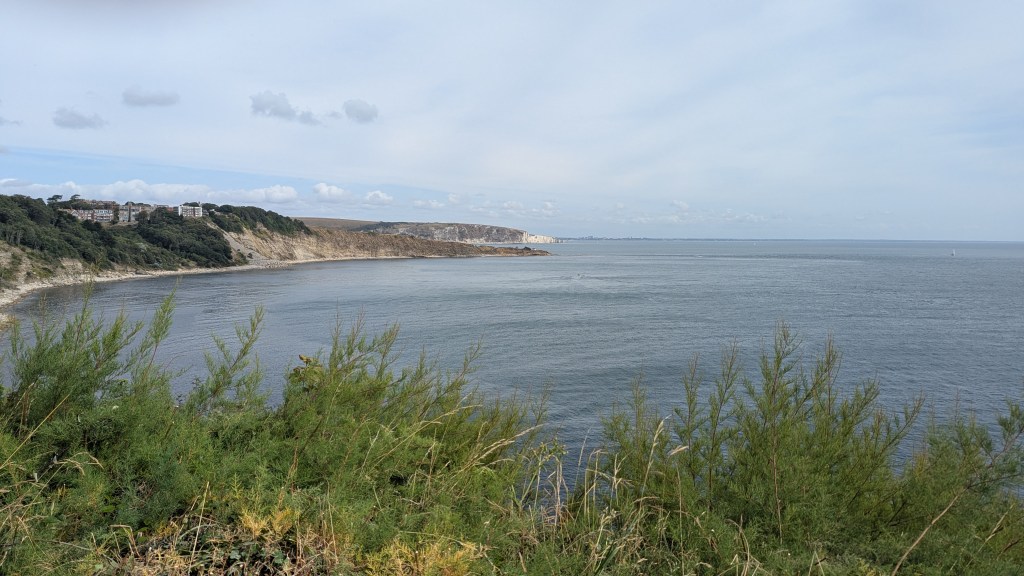
I took a break at Dancing Ledge and enjoyed watching groups of youth learning how to climb, abseil and coasteer. Dancing Ledge is noted for the tidal swimming pool which was blasted out from the rock shelf many years ago for the use of local prep schools. I enjoyed swimming in this as a child and seeing the anemones living in the shallows. The next highlight was the Winspit Quarry. We walked here a a family in 1981 and I still remember the excitement of seeing people set up the area as a film set for an episode of Blake’s 7, my absolute favourite TV programme of the time. Despite my begging, my parents would not let me stay on to see the filming. I had to wait a long four months to see that episode screened and recognise the location.
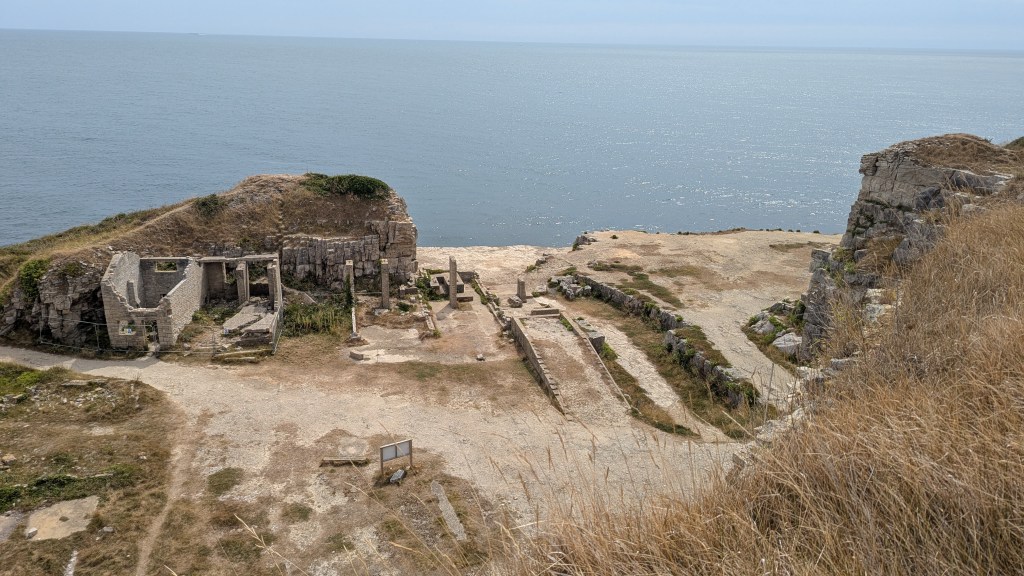
Just as in 1981, I could not linger, so I walked on to the top of St Aldhelm’s Head where I could enjoy a view over Chapman’s Pool whilst eating my lunch.

After lunch, the 100’s of steps which are etched into my childhood memories of this area meant that my walking pleasures were now hard won. The views down the coast, the patterns in the cliffs and the sight of sailing boats plying down the coast are all fabulous though. I am pleased to say that the path to the top of Houns Tout (the headland shown above) has been rerouted and opened after a significant cliff fall closed the original path in April 2024.
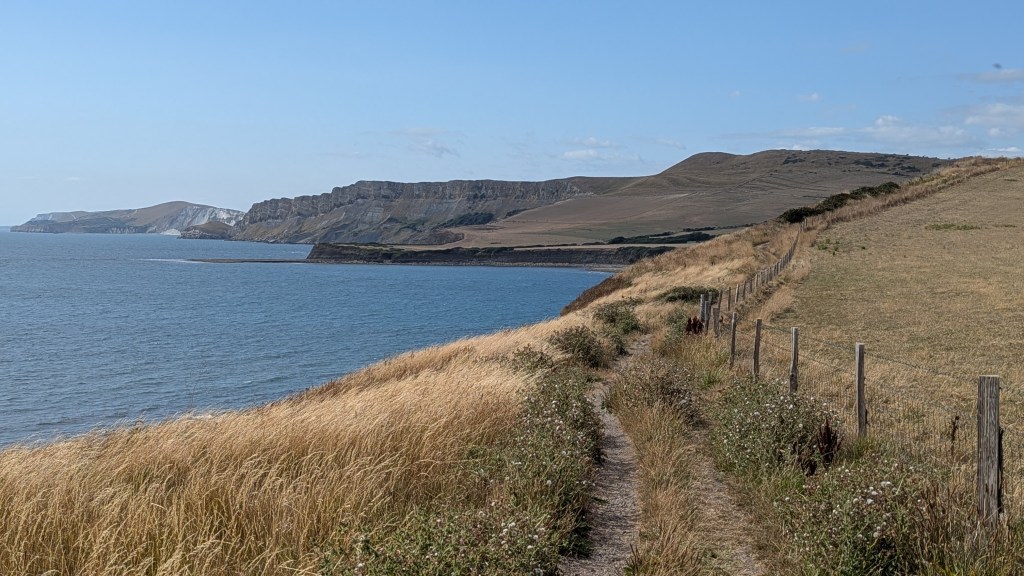


There are no campsites directly on the coast on this stretch. Originally I thought I would walk inland to the campsite at Worth Matravers but because I was able to get an earlier bus than I originally planned I had the opportunity to walk further than I had initially scheduled. Long story short, I reasoned that for a wild-camp the least populous and least tourist infested area in the next few miles would be the Lulworth Ranges so I walked on.
After collecting water at Kimmeridge Bay I entered the firing range which is not active in the school summer holidays. I found a good potential pitch approaching the top of Tyneham Cap, but for reasons beyond my ken I continued on. Momentarily I regretting this decision as there was nowhere flat to camp for the next 30 minutes, but lady luck shone on me as I reached Worbarrow Tout where I found a quiet picnic area next to the beach. There was a CCTV camera watching the bay (!) but I found a spot outside of it’s range and pitched up for the night. One of the rangers did rock up later that evening, but he simply smiled and gave me the thumbs up.
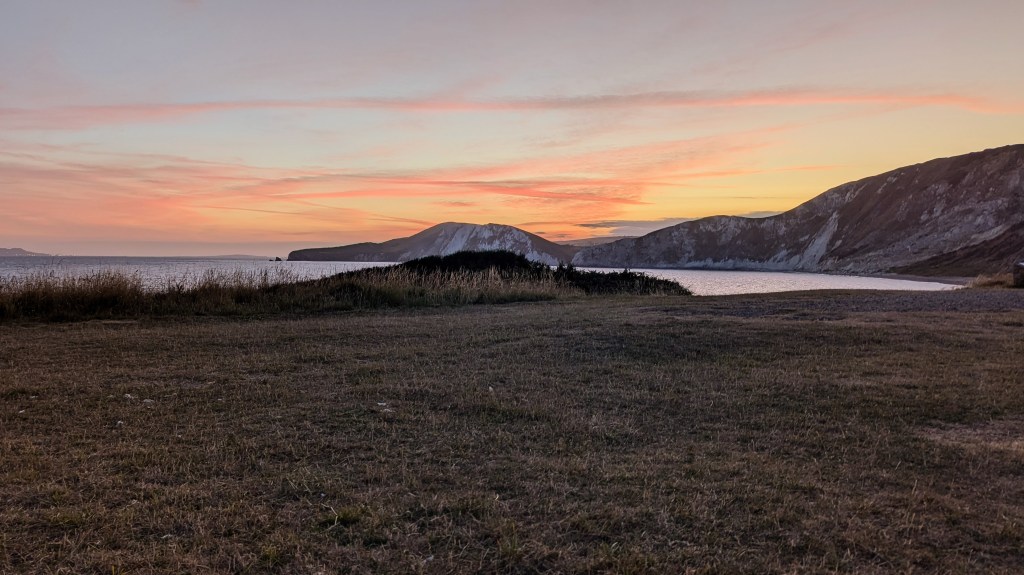
Day 2 – Worbarrow Tout to Redcliff Point – 12 miles / 4 pints
I woke to a beautiful morning view over the bay –
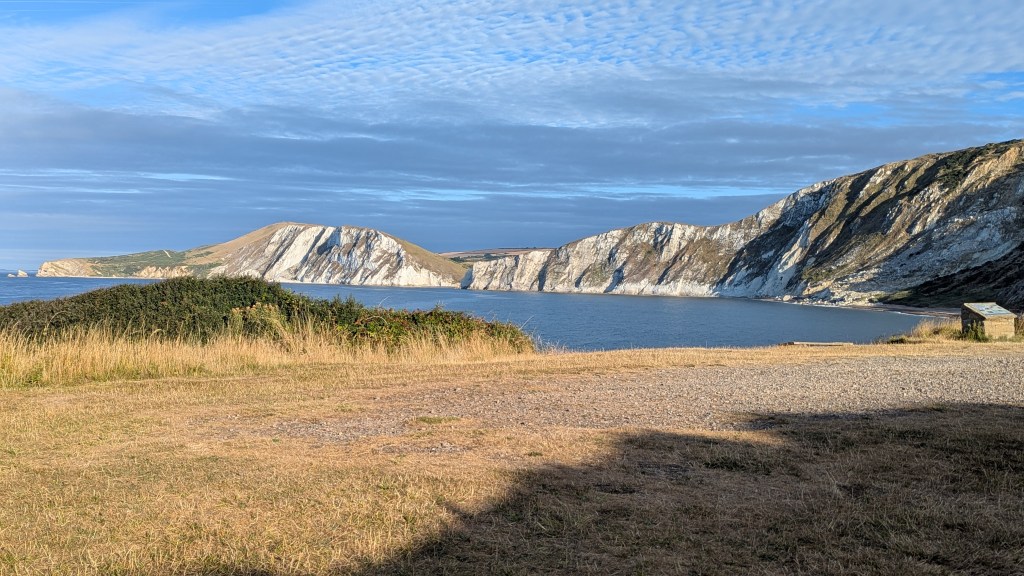
As I started my day I walked past a number of other potential wild camping spots which were more isolated than that which I’d used. Camping in the middle of the Flower’s Barrow Hill Fort might have been a fun option and far enough from the tourist track to have no one hassle you. The first highlights of the day were the iconic Lulworth Cove and the even more famous Durdle Door
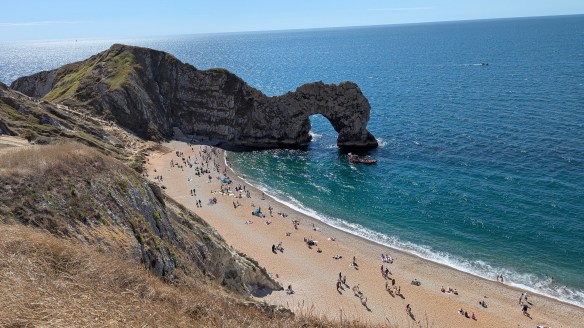
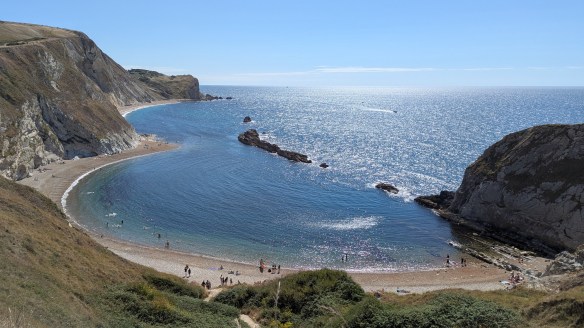
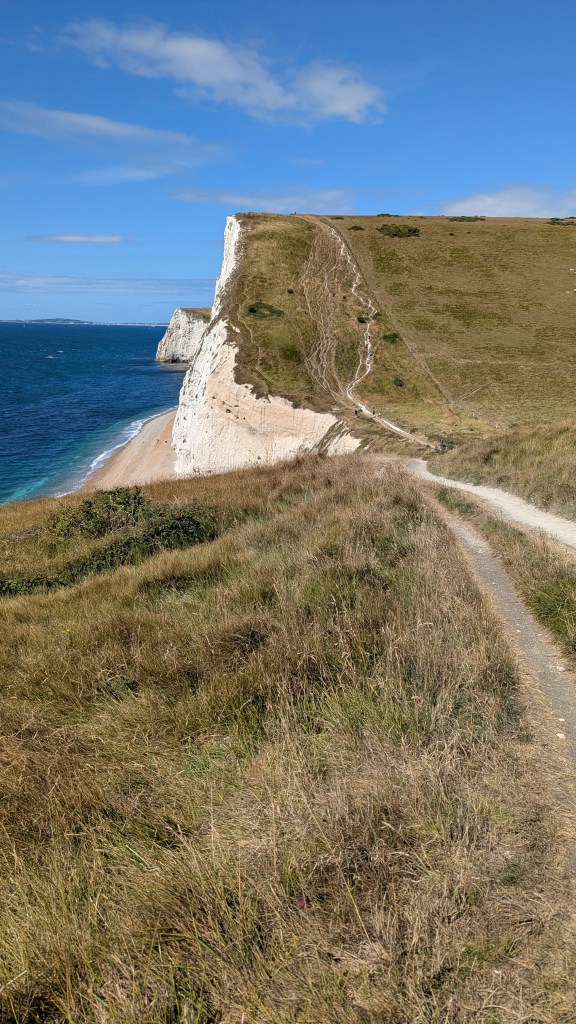
The path did a long of rising and falling and I was glad to have a light pack (11.5 kg including food and water). Lunch in the sunshine on White Nothe overlooking Ringstead Bay was beautiful. I hatched a plan to have a short day and enjoy a couple of beers and dinner in the Smuggler’s Inn in Osmington Mills. I can report that the Badger Beer and even their Helles Larger was very good. The food was disappointing and overpriced however – more of an calorie top up rather than a pleasurable meal. Next time I’d enjoy the beer and boil my own water for a rehydrated meal. My plan to stay in the local campsite was scuppered because they were full. So once again I was on the hunt for a wild camping pitch.
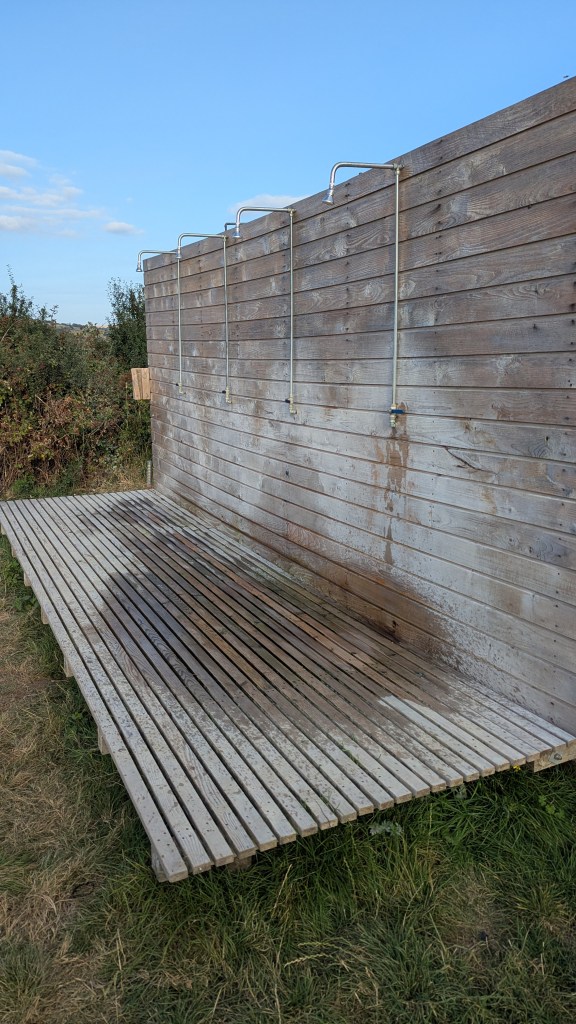
I passed through a ‘pop up’ glamping site with lines of white bell tents. I could not but feel sorry for the poor exploited souls staying there. The coastal field was significantly sloped. Assessing the pitches I saw, I’d estimate that only around 20% were on ground level enough to consider camping upon. Then there were the showers…
Shocking. I bet it wasn’t cheap either. I quickly dismissed the ideas of asking for a backpacker’s pitch because of the way they were cynically exploiting so many families. A review of the map suggested that the very tip of Redcliffe point should be flat and far enough away from the path to be secluded and not cause any negative impact.
The map didn’t lie, and I had a better pitch than any of the glampers – in my case with a fabulous view across Weymouth Bay to the Isle of Portland.
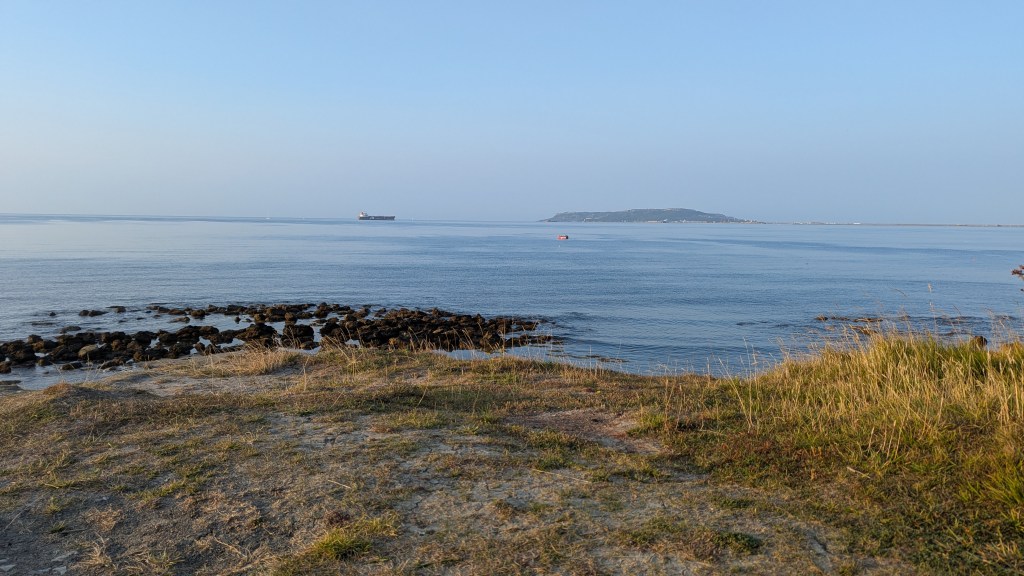

Day 3 Redcliffe Point to West Bexington / Cogden Beach – 23 miles
Despite its’ feeling of splendid isolation, Redcliffe Point was only a 20 minute walk from the outskirts of Weymouth and I was soon yomping along the seafront prom at a good pace. On the previous evening I had reviewed the weather forecast, which promised even more hours of sunshine than it had a week previously and, now, absolutely no chance of any rain. Once in the town centre I found a really helpful sub-post-office which could sell me a giant padded envelope into which I stashed my waterproofs and my trousers (fear not, I had my shorts on!) which I posted home. My windproof was good enough insurance against the unlikely event of a shower.
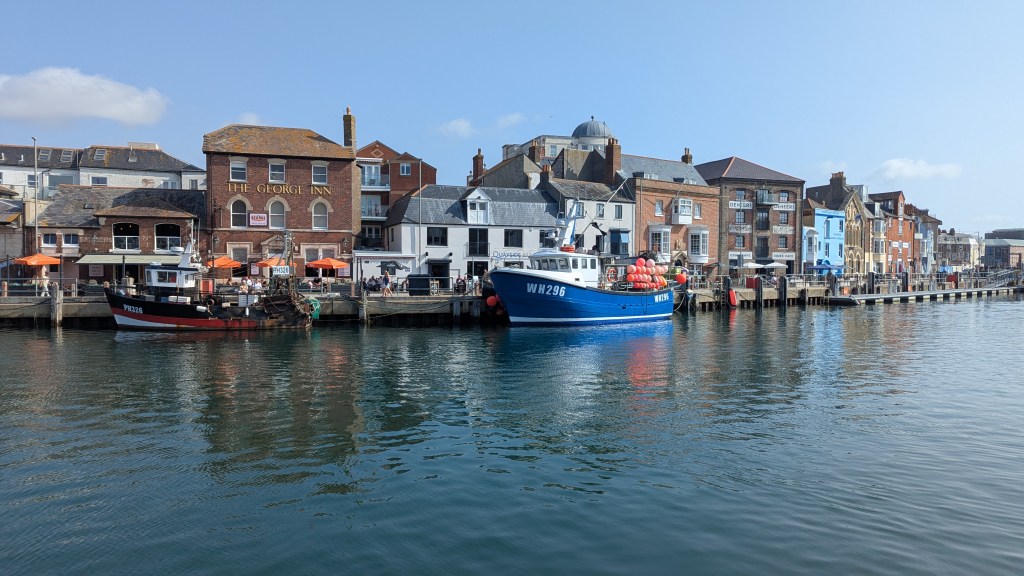
As with my last traverse of the SWCP I opted to skip walking around Portland Bill. When I had walked this section at sixteen the narrow sightedness of youth had convinced me that walking the shorter distance along Chesil Beach would be a better option that taking the official somewhat wiggly path on the edge of the mainland. I did not make that mistake again. Walking along ten miles of loose pebbles had been akin to torture. This section of the coast, between Portland and Abbotsbury was a lot less attractive than that which I had enjoyed up to now. On the positive side were the massive number of blackberries available next to the path. I ate so many as to only want a modest amount of lunch at midday. The views picked up once again whilst I was walking along the top of the Hanger into Abbotsbury. I pondered asking to camp in the Abbotsbury pub beer garden, but the quality of their beer selection was very poor indeed so I didn’t ask, didn’t have a beer, but instead got an excellent sorbet from the very fine Farm Shop Cafe.

By this point I had covered 19 miles, but the sugar in the sorbet gave me a welcome boost and I set off again with regained vigour and the aim to get to the well reviewed seafood restaurant in West Bexington. Very sadly, and despite a prestigious pace, I missed last orders, I had now walked 22 miles so did not fancy a two mile diversion inland to my planned campsite at Punchknowle. Whilst I would have loved a shower, all I really needed was a hot meal and to go directly to bed. Thankfully it was possible to take a footpath through the fields directly behind the extension of Chesil Bank from this point Westwards and avoid walking along the pebble bank. One I was far enough out of West Bexington I soon found somewhere suitable to for my tent, but it felt too early to risk a pitch. It was a glorious evening so I sat on top of the pebble bank and cooked my dinner and enjoyed my book.
I had a (well needed) wash in the sea and just as the light faded I pitched my tent and was soon dead to the world.
Day 4 – Cogden Beach to Charmouth – 12 miles
I awoke to another glorious sunny morning. I shook the internet and found that there were a number of cafe options in West Bay, so having missed out on a fine meal the previous night I opted to simply have a mug of Earl Grey to start the day and to treat myself to breakfast once in West Bay. I was back on the trail by 0630.
My route took me past the large campsite at Burton Freshwater.

I could hardly believe that people sought to get away from their crowded cheek by jowl housing in the South East to enjoy a break in an area with an even higher population density. The contrast to where I had pitched on the past three evenings could not have been more stark.
In West Bay I soon found my breakfast cafe (a sister establishment to the farm cafe in Abbotsbury) Whilst they were not yet formally open, they were happy for me sit on their terrace and use WiFi to review my options for the end of the day – would I stay in the campsite I’d already identified on the outskirts of Charmouth (the end of my planned walk) or had my early start meant I would be able to get a train back to Preston that very evening?
At a squeak before 0900 a motorbike roared up to the cafe, this turned out to be the breakfast chef. My Ultimate Breakfast Bap delivered exactly what it promised, I could not have hoped for better. With my tank refilled I set off. I had been really looking forward to this next, and my final, section of cliff path. I have strong memories of dragging myself, laden with a ca. 21 kg pack up to the top of Golden Cap some 28 years prior. How would my performance compare today?
I had a few more tops to cover before coming to Golden Cap itself.


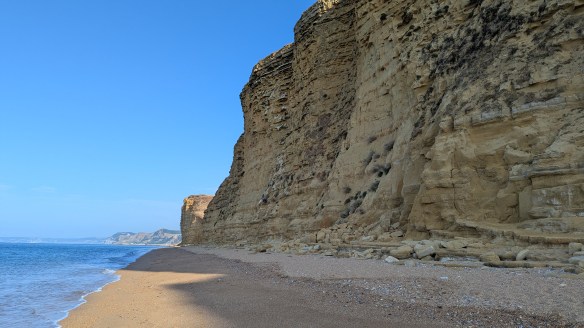
I had a couple of rest breaks on my way up to the top, but today that was due to the heat rather than the weight I was carrying. As the highest point of the Southern facing section of the SWCP, Golden Cap feels like a place of significance. Someone kindly offered to take my photo in front of the view, but looking at the result I am now in two minds whether this is how I would want to be remembered!

I now had just three miles until the end of my Dorset coastal walk. With the exception of the Chesil Beach section it had been wholly glorious. I was now racing along, full of joy and with the expectation of being able to get an evening train back to Preston at a sensible hour (little did I know what SW Trains still had in store for me…) I was delighted to have covered 12 miles and yet still caught the 1303 bus to Axminster railway station. My Ultimate Breakfast Bap really had delivered!
Final thoughts
The coast around the Isle of Purbeck is surely one of the very finest sections of coastline around the UK. Additionally, having the freedom of reviewing the map mid afternoon to decide where I would stop that night (rather than having a rigid schedule) took me right back to when I had walked the SWCP the first time. One of the great pleasures of backpacking is having with you all you need, so you can walk as little, or as far, each day as the mood takes you.
Apart from the shear pleasure of the scenery and the opportunity for warm nostalgia what I took away from this walk above all else is how the sense of scale of places and terrain in our memories can become out of proportion with reality. I remember the Kimmeridge Ledges as been a half day section of flat path, whereas it is only 3km in length. I recall 1000’s of steps up and down the headlands but the reality was in the 100’s. That is just two examples of features which were written much larger in my memory than I experienced re-walking this path some 28 years later.
I loved this walk the first time, and this time with a much lighter pack I loved it even more. With today’s materials and equipment designs you can have more comfort than was possible in the 1980’s aided by only having to carry 60% of the weight. This was the first ‘longer ‘walk I’d done with my Atompacks Prospector pack and with the pack loaded to capacity it was still extremely comfortable. Furthermore, the non-traditional aspects of its design made it very convenient to stash and access my gear, more so than a traditional pack design. After five years or regular use I continue to love also my Hilleberg Enan tent. For me it has the perfect balance of robustness, weight (1200 g) and space to be a secure, comfortable shelter that you know you can trust in a wide range of weathers.


 The Prospector has a plastic frame, kept rigid with an aluminium stay down the centre. This is padded with closed cell foam for comfort. Load lifters, work with the frame to enable you to adjust the proportion of the pack weight which is carried shoulders vs. hips. Weight is transferred to the hips via 100 mm wide padded hip belt with novel dual adjustment straps which independently adjust the tension of the top and bottom of the hip belt. Whilst the two 15 mm straps look very flimsy against the ubiquitous 50 mm single strap design, the end result is the most effective hip belt I’ve ever experienced. Having the ability to hug the belt above and below your hip bones mades it possible to effectively transfer the bulk of the pack weight to your hips without the hip belt having to be uber-tight. Additionally the straps are tightened by pulling inwards rather than outwards which makes adjustment so much easier to achieve.
 weston.front