
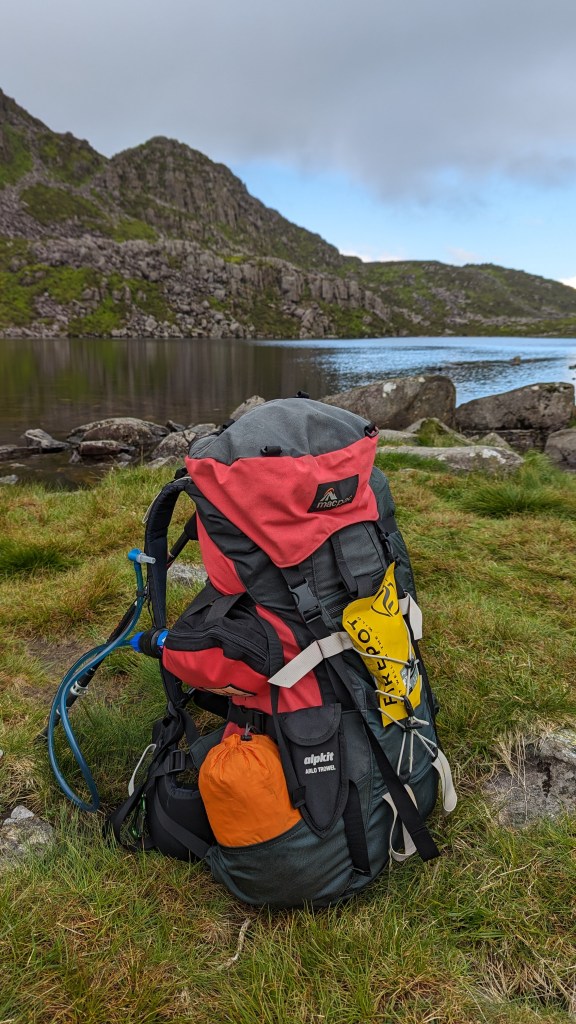
Backpacking / through-hiking has grown in popularity over the past ten years. YouTube videos, blogs and outdoor equipment companies are all promoting the benefit of light or ultralight gear, and as you might expect as the weight goes down, the price goes up. I’ve been backpacking since the 80’s and the aim of this article is to share some of the things I’ve learned about travelling light without ending up with an ultralight bank balance at the end of the experience.
I should start by putting my approach into context. When I go for multi-day walks I want to be comfortable and to know that I am safe and secure against all weathers. I do not subscribe to the philosophy of ¾ length camping mats or sleeping under a DCF tarp. My 2-3 day kit usually weighs 8-9 kg, not the 6-7 kg of US through hikers. But at this weight I can still walk for 6-7 hours (plus breaks) and take 900 m peaks / 1200 m of total height gain in my stride each day. If I can do this with ease at 53, so can you…
Here are the principles I work to:
Take less…
The cheapest way to reduce your pack weight is to simply take less stuff. Think about what you absolutely need under each of these categories and write yourself a packing list:
- Navigation & communication
- Keeping warm & dry in the day – Clothing
- Keeping warm & dry at night – shelter and sleeping gear
- Eating & drinking
- Evening entertainment & luxuries
Before you pack your bag, critically review your list, is there anything you could safely cut out? When you get back from a walk, review the list again – what did you take that you didn’t use? Can you drop that off your packing list next time?
Water – I take less water by using a water filter. I used to start each day with two litres of water in a pair of aluminium bottles and carry iodate tablets. These antimicrobial tablets are relatively slow to act and also taint your water. Swapping to a water filter and two one litre flexible bottles (Hydrapak Stow) means I now carry a maximum of one litre of water at any time, and I harvest water as I go. In the mountain and fell regions of the UK a shortage of water has never been a problem. You do need to review your route for water harvesting options as part of your itinerary preparation though – but that for me adds as extra dimension of enjoyment to the planning. The only time I carry more water is after the final water harvest for the day when I fill both my bottles ready for cooking and brews. Normally that is for < 30 min of the day.
Then review your kit list vs. my next principle…
Multi-function equipment…
What items can you take which can fulfil more than one function? Why, for example, take an inflatable pillow when you can you can wrap your spare layers in a jacket and use this as a pillow. Examples of other multi-function equipment which I use:
 Titanium cooking mug – I can both boil water in this and drink tea from it. If I take freeze dried or dehydrated (the former tends to be more tasty) food then my cooking mug never needs washing out because I eat out of the pouch. Thus I don’t carry any cleaning stuff either.
Cutlery – you only need a spoon or spork.
Sleeping bag – use this for keeping warm in the evenings. I take a jacket which will be just warm enough for my rest stops, not warm enough for the evenings too* Ditto the down over trousers beloved of may YouTubers, why add the weight when you have a down insulation for your legs already?

*The one caveat to this is walking in the winter when I will always take my down jacket when I know the nights will drop below freezing.
Buff – This is a new bit of kit in the last year. I was sceptical, but now I’m a convert for year round walking. The marketing spiel isn’t just hype. I’ve found the following uses to be practical and comfortable: (i) scarf, (ii) sun protector*, (iii) lightweight hat for evenings and mornings in the tent, (iv) ear warmer, (v) eye guard for short summer nights, (vi) comfortable mouth and nose insulation for sleeping on really cold nights, (vii) add to a hat to form a balaclava in the winter, (viii) pot cozy for meal rehydration (a fleece or wool hat works well for this in the winter too).
* Mine is made from merino wool which cool when it’s hot, and warm when it’s cold. I would highly recommend this option. In the winter,I do take a warmer hat in addition to my Buff but I no longer carry Ear Gear or a balaclava.
Quick drying clothing – wear this instead of taking an excess of spare clothing. The only spare clothing I take for the first four days of a walk is underwear and socks. If I am going between fixed accommodation and need to be ‘civilised’ in the evening I take a clean shirt which I only use in the evenings and make my walking T’s last for 3-4 days.
Clothes pegs – I always take two and they have find a myriad of uses.
Resupply parcels – If you are walking for more than four days, consider whether there is somewhere which you could post a resupply parcel to. In these, as well as food, I also pack fresh clothes and batteries for my GPS. Normally I use a campsite as my collection point so I’ll also post my towel, which I’ll then post home the following morning with my dirty clothes.
Are there any other items you would add to this list? Drop details in the comments so we can all learn together.
Spend some money
Whilst none of the above suggestions should cost much money, they are some items on which experiences tells me that it is worth spending some cash to drop my base weight. I chose to buy the following good quality lightweight items.

Tent – Outside of the winter, I use either a Hilleberg Enan (1.2 kg) which is tent I could not recommend more highly for solo three season use*. If I’m on a multi-day walk, I want a tent I don’t have to treat with kid gloves and one which will stand up to poor weather even on a mountain summit.

If I am going ‘fast and ultralight’ my extravagance is a Nordisk Lofoten (600 g all in inc. polycro footprint). This shelter is lots of fun, and much more comfortable and secure than a tarp (a solution I tried and rejected after two multi-day walks in 2023) and no heavier either.
Sleeping bag – with today’s water resistant down technology, there’s no reason to be fearful of using down (assuming you have a reliable shelter). I’ve used bags from three different manufacturers over the years, and my Rab Neutrino has proven by far the best. For a lightweight thermal boost, consider a pair of long johns in the winter.
Sleeping mat – arguably this is more important to warmth than your sleeping bag itself. When I know that if I am on the limit of a sleeping bags temperature rating I use a higher R value mat in place of a higher rated bag and save weight with no compromise to my comfort.
Rucksack – This item is likely to be one of your three heaviest items so definitely needs to be considered. However whatever you choose, it needs to be comfortable all day, every day, week in week out. I cannot offer you advice here as my Macpac Pursuit 50 is quite heavy by today’s standards, but I love it and plan to keep on using it until it wears out.

Stove – modern gas stoves don’t have to be expensive to be light in weight. Check out the offering from Alpkit. If you do opt for a gas stove I would recommend you consider a canister stove as these allow you to invert the cylinder and thus work well in most temperatures – to learn more read this article. Meths stoves are also well worth considering for short trips, but note that you will burn more grams of meths per pot of water boiled (and are slower too) so their benefit wains for longer trips.
* Many people class Hilleberg tents as over expensive and are quick to say they they ‘would never spend over £200 on a tent.’ However I compare the price of my tent, per night, to that of a B&B. The minimum you are likely to spend on this would be £60 per night as a solo traveller. I use my Enan for 10-15 nights per year. I only need to use it for a year for it to have paid for itself and it has a likely lifetime of 10 years at my rate of usage. I enjoy camping on high ridges and mountain summits and I know I can wholly rely on my Hilleberg Enan in foul weather, and my Hilleberg Soulo in extreme weather, cold and heavy snow. I sleep better knowing the weather can do its worst and I’ll be safe and warm in my shelter,
 weston.front