Tag Archives: inspiration

D. A. Ratliff: Mr. Price’s Dinner Table

Mr. Price’s Dinner Table

D. A. Ratliff

Image from https://www.visitaikensc.com/

As those of you who have followed me know, I am a Southerner and quite proud of my roots. Growing up in South Carolina, I was fortunate to have parents who saw no color differences in their fellow man. People from all levels of society and cultures were visitors to our home.

My memories of my childhood remain clear today. The mimosa tree that I played under in our yard. Houses where all openings were trimmed in blue to ward off evil spirits. The dime bags of boiled peanuts sold on the street. The ‘air-conditioned tree’ at the Herlong Orchard peach stand where the temperature was twenty degrees cooler in the shade and the water stored in a metal canteen was ice cold. While there was a horrible undercurrent of fear and anger in this place I love so much, there was also a goodness of soul. Family, friends, food, and good times existed as well.

My father worked at the Savannah River Plant in Aiken, South Carolina, a manufacturer of hydrogen bombs. With workers from all over the world employed there, I met people from everywhere as a child. One of my father’s best friends was a bear of a man, a Navaho by the name of Jess Brown. His wife Athea, a small, plump woman who might have been a better cook than my grandmothers, was like an aunt to me. I am about one-sixteenth Cherokee and Jess, and Athea gave me a sense of what being Native American meant. Good, kind, hard-working, gentle people.

Yet, one friend of my parents impacted my life more than I realized. Mr. Price. Honestly, I am not certain what his first name was. My parents never called him anything but Mr. Price. He was older, a slight man but regal in bearing, with snow-white hair and a deep Southern accent that held a lilt of his mother’s heritage. She was a Cajun from southwest Louisiana. His reminisces about his mother’s upbringing fueled my love of the Cajun culture.

In those days in the South, people referred to Mr. Price,  an unmarried man of means and patron of the arts, as a ‘bachelor.’ Anyone who has read “Midnight in the Garden of Good and Evil” by John Berendt will recognize who Mr. Price was. Polite society did not mention the word homosexual as that wouldn’t be gracious and respectful.

We often had Sunday dinner at Mr. Price’s home, a large two-story house near downtown Aiken. I remember the opulent crimson flocked wallpaper in the parlor, the deep green walls in the dining room. If the weather cooperated, we would often eat on the back terrace surrounded by a lush garden.

But dinner? Not what you might expect for a South Carolina gentleman. While on occasion we might have shrimp and grits or barbequed chicken, we often feasted on shrimp etouffee or jambalaya, dishes Mr. Price’s mother made when he was small. I had my first taste of chicory coffee at his dinner table when I was ten.

I sat mesmerized as he told us of his mother’s home in Lake Charles and his grandparents’ home in the country nearby. He would spin tales of fun in the bayou that hooked me for life. While I loved South Carolina, my heart drifted toward Cajun Louisiana. His memories stirred emotions in me that I have kept to this day.

When I began to write fiction again a few years ago, I knew I would set my stories in the South. While I have never sugarcoated the area’s problems, which are no different from any other part of the United States, there is an ambiance and tone about the South, the southern coast especially, that is alluring. Yet, when I began to write, it was in Louisiana, New Orleans, to be specific, where I set my first novel.

Having visited New Orleans a few times as an adult, I discovered that my writing muse was evidently a resident of the French Quarter. New Orleans, the bayou, the jazz, the beignets, the sultry weather, all characters in themselves and ones I find creeping into my writing.

On a recent Sunday, I watched one of Anthony Bourdain’s final “Parts Unknown” episodes. We lost a unique individual with Bourdain’s death. A notable essayist on life and culture and how food is intrinsic to our existence, not only for sustenance but for the soul. This show centered on Cajun Mardi Gras as celebrated in Southwest Louisiana.

We know of Mardi Gras as a glitzy party of drunken revelry, resplendent with cheap shiny beads, elaborate and gaudy costumes, and over-the-top parades, as well as – well –  fun. Bourdain showed us a Mardi Gras celebrated away from the French Quarter that few outsiders know occurs. Equally as gaudy and drunken but steeped in tradition and meaning.

Despite the commercial decadence of the more popular party in the French Quarter or the more traditional decadence of Cajun Mardi Gras, the spirit of the Cajun people, their passion for life, food, and even voodoo fuel the imagination and the soul.

I wrote a short story for a romance anthology. As I developed the story, I struggled with the setting until my muse dragged me into a jazz bar in the Quarter and reminded me that I was a mystery writer and knew where my story belonged. My story is now a romance between a TV reporter and a detective brought together by a murder. The location, you ask. The French Quarter.

There is something about the tenor and vibe of that city that touches me—a mysterious city in a mysterious state unlike any other part of our country. A place steeped in tradition and, like its chronicler, Anthony Bourdain, unique.

As I get closer to publishing my first novel, Crescent City Lies, a mystery set in New Orleans, I realize that the Cajun culture remains embedded within me, sparked so many years ago at Mr. Price’s dinner table.

Please visit Deborah on her new blog: https://daratliffauthor.wordpress.com/

If you are traveling South, please stop by Aiken, South Carolina—a beautiful town with the best bar-b-que you will find anywhere! https://www.visitaikensc.com/


Michele Sayre: Coming Together in Revisions

I love it when a plan comes together.” –

Hannibal Smith, ‘The A-Team’

(television show originally created by Stephen J. Cannell)

Over the last three days I’ve begun to get a handle on the ‘Breaking Radio Silence’ project and damn it feels good. Granted, I’m only into the first chapter but I can see where it’s going. The writing is rough and there will be a lot of editing down the road but since I’ve never written book-length non-fiction before, it’s a good start. I’m not feeling the twinge-thought of ‘Oh, I’m not too sure about this’ and here’s why:

It’s not just the fact that I’ve got some structure points to use as writing prompts, but also because I’ve told myself length doesn’t matter. I know I shouldn’t have thought about length at all in this early stage of writing but sadly, the dumb thought crept into my mind and stayed until I kicked it out again.

The writer Annie Lamont wrote that you have to give yourself permission to write crap sometimes. I take exception to the word ‘crap’ because I don’t feel the need to label rough and unedited writing as crap. Because as my favorite romance writer Nora Roberts said, ‘You can’t revise a blank page.’ And because you have to have words to revise, I don’t believe all words written are crap. They just need to be revised and edited so my saying here is this: ‘You can always revise later.’

I also feel like I don’t know if a particular direction in my writing will work until I write it out. Because last night I was looking at my first chapter on my novel and realizing the way I’d worked the first scene wasn’t the way to go. I saw that when I thought about what I needed in the next scene. So needless to say I deleted lots of words and now need to write it back to what I’d done before. This happened because I’d let doubt creep into my mind and thought I had to do something a certain way. But in the end, I know my initial instinct on this was right.

So why do writers get doubts like these in our minds?

We’re human, and prone to messing up like everyone else would be the first line of defense-answer here. Which is why I know of writers who try to isolate themselves as much as possible from any outside influences when they’re writing. We sometimes refer to this as retreating into the writing cave and with good reason. But retreating there won’t get you away from the thoughts pinging around inside your mind. Hence the reason for thought-cleansing mantras that are more than just good advice.

I’ve said this before but I won’t apologize or call myself ten grades of idiot for saying it yet again. I honestly don’t think I was mistaken in writing stuff I’ve later deleted, because I wouldn’t have known if it was good or not until I wrote it. You can’t judge whether or not something will work if there isn’t something there in front of you to begin with.

For something to come together, you’ve got to do the work, make mistakes, and go off in directions that don’t always work for you. And if anyone, even if it is the doubt-demon in your mind says otherwise, don’t listen to them because they’re not the ones doing the writing and revising.

Or to reply to Colonel Hannibal Smith above: they’re not a part of your plan and they’re not going to make it come together.

You are.

This image has an empty alt attribute; its file name is divider-2.png
ReviseLater

For more by Michele Sayre, please visit www.michelesayre.com

Michele Sayre: WRITING INSPIRATION BULLOCKS

I’m sure there is someone out in this world who would love to slap my mouth shut for putting those three words together in today’s blog title. But sometimes I feel like all I see when it comes to writing is finding the motivation and inspiration to write instead of complete works of writing instead.

So in response to all that glorious writing motivation and inspiration I say this:

You don’t have to write.

I know you may feel like if you don’t write your brain is going to explode or all your wonderful ideas and stories will just die with you and take a few million years to regroup from the stardust of your demise. But that’s not going to happen because you felt like you had to write, but because you went out and wrote then edited the crap out of what you wrote till it shined like a clean toilet.

I write despite all the bullshit that comes along with it. But I refuse to be all high-and-mighty and lofty and say ‘I have to write’. No, for me it is a conscious choice to park my butt and write the words and edit the crap out of them before I share them with the rest of the world.

For me it’s never been about having the need to write, but wanting to do it. It’s wanting to see the words hit the page, wanting to push myself to sharpen them to the brightest points, and hearing their truth not just inside my head, but with my own ears, too.

I know I don’t have to be in the perfect mood to write. I know my mind can be a mess and most of all, I know it doesn’t have to be set in a certain way. I can write in a flying-hot good mood, or in a dark and cold pisser of a mood. And I can always edit until I get it to where it flows the way I want it to. I don’t have to kill my darlings but instead keep at them until they make it out of the jungle of my mind.

I don’t need a room of my own, or a lot of time, either. And as for the thoughts that question the worth of my words and whether they’re good enough for others to see, bullocks to them. I know someone out in the world won’t like me and what I write, but I’ve kept on going despite being told that in more variations than I care to admit to. Every day I feel like I’m learning more and more how to kick that crap out of my way even when it keeps coming into my path.

So if you’re looking for any writing inspiration from me I’ll tell you one thing: write because you want to, and never mind the bullocks that comes along with it.

This image has an empty alt attribute; its file name is divider-2.png

Please visit Michele Sayre’s website:
https://tinyurl.com/yb42gyt2

Writers Unite! Tips on Writing: Grammar

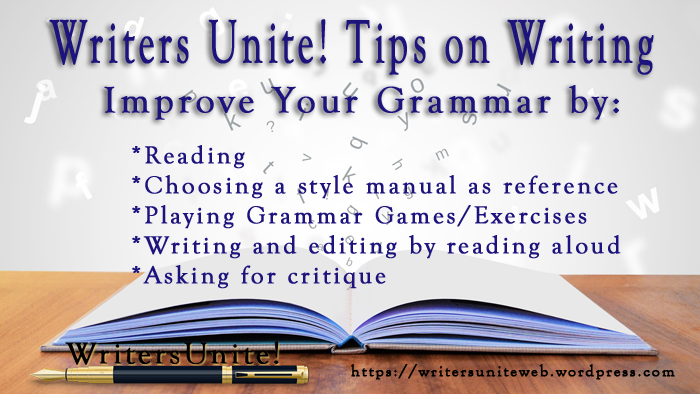
WT- Improve Grammar

Words Of Ernest Hemingway

Writing-Quotes-eh2-1024x499

Nobel Prize winner Ernest Hemingway is seen as one of the great American 20th century novelists, and is known for works like ‘A Farewell to Arms’ and ‘The Old Man and the Sea.’
Born on July 21, 1899, in Cicero (now in Oak Park), Illinois, Ernest Hemingway served in World War I and worked in journalism before publishing his story collection In Our Time. He was renowned for novels like The Sun Also RisesA Farewell to ArmsFor Whom the Bell Tolls, and The Old Man and the Sea, which won the 1953 Pulitzer. In 1954, Hemingway won the Nobel Prize. He committed suicide on July 2, 1961, in Ketchum, Idaho.

Hemingway left behind an impressive body of work and an iconic style that still influences writers today. His personality and constant pursuit of adventure loomed almost as large as his creative talent.

When asked by George Plimpton about the function of his art, Hemingway proved once again to be a master of the “one true sentence”: “From things that have happened and from things as they exist and from all things that you know and all those you cannot know, you make something through your invention that is not a representation but a whole new thing truer than anything true and alive, and you make it alive, and if you make it well enough, you give it immortality.”

In August 2018, a 62-year-old short story by Hemingway, “A Room on the Garden Side,” was published for the first time in The Strand Magazine. Set in Paris shortly after the liberation of the city from Nazi forces in 1944, the story was one of five composed by the writer in 1956 about his World War II experiences. It became the second story from the series to earn posthumous publication, following “Black Ass at the Crossroads.”


divider-2

Resources:

Image: https://medium.com/@Reedsy/30-inspiring-writing-quotes-from-famous-authors-ca601bfa5915

https://www.biography.com/people/ernest-hemingway-9334498

Words of Hunter S. Thompson


Writing-Quotes-hst-1024x499


Hunter S. Thompson was born in Louisville, Kentucky, in 1937. He showed a knack for writing at a young age, and after high school began his career in journalism while serving in the United States Air Force. Following his military service, Thompson traveled the country to cover a wide array of topics for numerous magazines and developed an immersive, highly personal style of reporting that would become known as “Gonzo journalism.” He would employ the style in the 1972 book for which he is best known, Fear and Loathing in Las Vegas, which was an instant and lasting success. For the remainder of his life, Thompson’s hard-driving lifestyle—which included the steady use of illicit drugs and an ongoing love affair with firearms—and his relentlessly antiauthoritarian work made him a perpetual counterculture icon. However, his fondness for substances also contributed to several bouts of poor health, and in 2005 Thompson committed suicide at the age of 67.

divider-2

https://www.biography.com/people/hunter-s-thompson-9506260

A Look Back….

pocket-watch-1637396_1920

Today marks the two-year anniversary of the Writers Unite! blog, and we want to share a bit about how the blog came to be and why.

Writers Unite! was created as a haven for all writers to share their writing for critique without fear of ridicule and where novice and experienced writers could learn from each other. We were fortunate to enjoy very steady growth and to gain exposure by appearing on Paul Reeves’s radio program, Dr. Paul’s Family Talk. As our outreach broadened, we began to grow at a staggering rate.

In the late summer of 2016, the admins decided that we needed to take the Facebook group, Writers Unite! to the internet to increase the exposure of the group and expand the content we could provide. On October 12, 2016, Writers Unite!’s blog on WordPress launched.

Building a blog is a slow process, but we have labored to bring a quality blog to our members. Included in the content available are series about writing your first novel, self-editing, marketing, as well as guest articles and podcasts of interviews from Dr. Paul’s Family Talk of authors (many who are members of WU!) and the group administrators. You will also find writing tips and writing advice from famous authors.

We are a global community and this is your blog. The admins want it to reflect the information you want to see. Please let us know what content you would like to see posted.

Thank you for the support all of our members have shown for the Facebook site and the blog. We couldn’t do this without you!  Happy Anniversary to YOUR blog!

The Admins of Writers Unite.

divider-2

Follow the WU! blog or enroll using your email address.

Words of Ray Bradbury

Writing-Quotes-rb2-1024x499


Ray Bradbury was an American fantasy and horror author who rejected being categorized as a science fiction author, claiming that his work was based on the fantastical and unreal. His best-known novel is Fahrenheit 451, a dystopian study of future American society in which critical thought is outlawed. He is also remembered for several other popular works, including The Martian Chronicles and Something Wicked This Way Comes. Bradbury won the Pulitzer in 2004, and is one of the most celebrated authors of the 21st century. He died in Los Angeles on June 5, 2012, at the age of 91.

divider-2

Resources:

https://www.biography.com/people/ray-bradbury-9223240

Words of Neil Gaiman

enhanced-buzz-30757-1345042131-3


While this is very true for writers, it is also true in life.

Adam J. Johnson: Channeling your Muse

apollo-and-the-muses-876292_1920

Writer’s block is a topic we like to frequently touch on because it’s something that plagues us all! No matter what type of writer you may be, whether it’s technical writing, blogging, journalism, or you’re purely an author, you have done battle with this daunting foe. It rears its head at the most inconvenient times and makes you feel powerless. It’s seemingly a random occurrence that shows up and leaves as it pleases. This however, is not the case. There are several reasons that we suffer from writer’s block and several reasons why some are less plagued by it than others. Our muse or personal source of inspiration is one of the tools in our arsenal against writer’s block. Sadly, we often view our muse in the same way that we do writer’s block. We think it’s random. How many times have you felt the rush of inspiration striking and urging you to take action? How many times have you thought, “I just don’t feel inspired,” or “I wish my muse would speak to me?” Let me tell you, your muse is like that old friend you haven’t spoken to in awhile. You really miss them and want to talk to them, but you aren’t sure how to approach it. The answer is always as simple as reaching out and connecting with them.

The first step is identifying your muse. Now, I know this may seem pretty basic, but there are several of us who go completely by feel and haven’t put much thought into where their inspiration comes from. Your muse is, at its simplest, what motivates you. Let’s dive into that, shall we? Naturally, this will be different for everyone, but the core ideas are the same. Your muse speaks to you. You just have to stop, cut out the noise and distraction of everyday life, and listen. For authors, I find that your muse is often tied to the genre you are writing in. When you search for her using that filter, it will be much easier to identify your muse. For example, I love Fantasy. I love reading it, and I love writing it! So, I look at what inspires me most about Fantasy and I surround myself with those things while I’m writing. Which brings me to the second step of channeling your muse. Keeping your inspiration consistent throughout your day!

I am a visual person, so Fantasy imagery strikes me hard and inspires me without fail! Since I primarily write Fantasy, I will keep posters with Fantasy themes in my writing space, and I will change the lock screens of my phone and laptop to mirror the ideas of my current project. This is me channeling my muse, keeping in contact with my old friend inspiration. I also love music, as most of us do, so let your muse speak through the music you listen to as well. I personally love metal music, but not all of it is really inspiring for Fantasy, but I find some that is. When in the middle of a project, I listen to a lot of symphonic metal bands like Epica and Nightwish. The orchestral elements submerge me in a feel of the old world and put me in the Fantasy writing mood. If i’m feeling something a little lighter, I will listen to bands like Flogging Molly. The old Irish culture flows through the lyrics while the fiddles transport me to that medieval state of mind. A few common enemies to inspiration are distractions like TV and the internet, so I try to find creative ways to turn distractions into inspiration. Don’t get me wrong, even if you execute this part well, they are still distractions and too much of it will lead to excuses to not get your work done.

So, what do I mean by turning distractions into inspiration? I’m going to continue with writing Fantasy as an example. If I feel like binge watching TV, I try to keep the themes of what I’m watching within the realm of Fantasy. I will watch shows like The Magicians or movies like Lord of the Rings. The internet, particularly Facebook and social media, seems to be a huge source of distraction for us these days. In order to combat that, I try to follow a lot of pages that are Fantasy themed or engage in Fantasy discussions within the writers’ groups. Also, if I find myself staring at my phone or the computer, I will search through Pinterest boards. Just shuffling through Fantasy images usually helps send a shockwave of inspiration through my brain.

Obviously, you won’t be able to spend your whole day totally immersed in themes and elements from your genre. That could even be counterproductive. However, these are just some ways that you can channel your muse throughout your day to keep your inspiration flowing strong. Don’t Look at inspiration as some random phenomenon that strikes as it feels. Remember that your muse is as much a part of you as your willpower or your sense of humor. She is always there waiting to inspire you. It just depends on how much you feed her and nurture the relationship. When you combine steps 1 and 2, you are not only channeling your muse, but you are feeding her. Making her grow stronger and giving her a more prominent voice in your mind. So, instead of it being a step-by-step process, it’s more of an equation to bolster your personal investment.

As always, the team at WU! wishes you happy writing, urges you to stay inspired, and insists that you live limitless!!

Adam J Johnson

success-846055_1920

divider-37709_640

(Illustration: Apollo and the Muses)