Buy New
-
To see product details, add this item to your cart.
Ships from: Amazon.com Sold by: Amazon.com
Save with Used - Like New
-
To see product details, add this item to your cart.
Ships from: Swita Sales Northwest Sold by: Swita Sales Northwest
Sorry, there was a problem.
There was an error retrieving your Wish Lists. Please try again.Sorry, there was a problem.
List unavailable.
Download the free Kindle app and start reading Kindle books instantly on your smartphone, tablet, or computer - no Kindle device required.
Read instantly on your browser with Kindle for Web.
Using your mobile phone camera - scan the code below and download the Kindle app.
Follow the author
OK
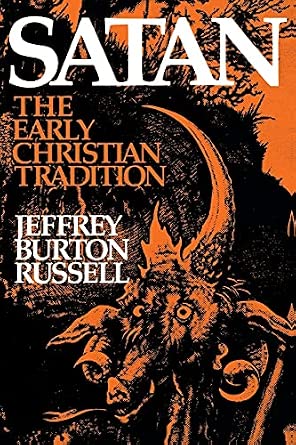
Satan: The Early Christian Tradition (Cornell Paperbacks)
Purchase options and add-ons
"Russell has complete mastery of his material, and the book's sweep is grand: a tour of the first five centuries of Christian intellectual history with the spotlight on the villain instead of the hero.... Satan is a valuable introduction to the theological portion of the Western Devil tradition."
― Speculum
Undeniably, evil exists in our world; we ourselves commit evil acts. How can one account for evil's ageless presence, its attraction, and its fruits? The question is one that Jeffrey Burton Russell addresses in his history of the concept of the Devil—the personification of evil itself. In the predecessor to this book, The Devil: Perceptions of Evil from Antiquity to Primitive Christianity, Russell traced the idea of the Devil in comparative religions and examined its development in Western thought through ancient Hebrew religion and the New Testament. This volume follows its course over the first five centuries of the Christian era.
Like most theological problems, the question of evil was largely ignored by the primitive Christian community. The later Christian thinkers who wrestled with it for many centuries were faced with a seemingly irreconcilable paradox: if God is benevolent and omnipotent, why does He permit evil? How, on the other hand, can God be all-powerful if one adopts a dualist stance, and posits two divine forces, one good and one evil?
Drawing upon a rich variety of literary sources as well as upon the visual arts, Russell discusses the apostolic fathers, the apologetic fathers, and the Gnostics. He goes on to treat the thought of Irenaeus and Tertullian, and to describe the diabology of the Alexandrian fathers, Clement and Origen, as well as the dualist tendencies in Lactantius and in the monastic fathers. Finally he addresses the syntheses of the fifth century, especially that of Augustine, whose view of the Devil has been widely accepted in the entire Christian community ever since.
Satan is both a revealing study of the compelling figure of the Devil and an imaginative and persuasive inquiry into the forces that shape a concept and ensure its survival.
- Print length258 pages
- LanguageEnglish
- PublisherCornell University Press
- Publication dateAugust 25, 1987
- Reading age18 years and up
- Dimensions6 x 0.75 x 9 inches
- ISBN-100801494133
- ISBN-13978-0801494130
Book recommendations, author interviews, editors' picks, and more. Read it now
Frequently bought together

Customers who viewed this item also viewed
The Devil: Perceptions of Evil from Antiquity to Primitive ChristianityPaperbackFREE Shipping on orders over $35 shipped by AmazonGet it as soon as Thursday, Jun 11
Lucifer: The Devil in the Middle Ages (Cornell Paperbacks)PaperbackFREE Shipping on orders over $35 shipped by AmazonGet it as soon as Thursday, Jun 11Only 15 left in stock (more on the way).
The Prince of Darkness: Radical Evil and the Power of Good in HistoryPaperbackFREE Shipping on orders over $35 shipped by AmazonGet it as soon as Thursday, Jun 11
The Origin of Satan: How Christians Demonized Jews, Pagans, and HereticsPaperbackFREE Shipping on orders over $35 shipped by AmazonGet it as soon as Thursday, Jun 11
The Great Mother: An Analysis of the Archetype (Mythos: The Princeton/Bollingen Series in World Mythology)PaperbackFREE Shipping on orders over $35 shipped by AmazonGet it as soon as Thursday, Jun 11
Customers also bought or read
- The Devil: Perceptions of Evil from Antiquity to Primitive Christianity
Paperback$21.98$21.98Delivery Thu, Jun 11 - Suffering and Evil in Early Christian Thought (Holy Cross Studies in Patristic Theology and History)
Paperback$18.45$18.45Delivery Thu, Jun 11 - The Origin of Satan: How Christians Demonized Jews, Pagans, and Heretics
Paperback$11.58$11.58Delivery Thu, Jun 11 - The Prince of Darkness: Radical Evil and the Power of Good in History
Paperback$18.17$18.17Delivery Thu, Jun 11 - The Dictionary of Demons: Expanded & Revised: Names of the Damned
Paperback$28.92$28.92Delivery Thu, Jun 11 - Athanasius : The Life of Antony and the Letter To Marcellinus
Paperback$22.81$22.81Delivery Thu, Jun 11 - Homo Necans: The Anthropology of Ancient Greek Sacrificial Ritual and Myth
Paperback$33.32$33.32Delivery Thu, Jun 11 - The Rise of Satan: How God's Executioner Became the Enemy
Paperback$35.99$35.99FREE delivery Thu, Jun 11 - The Witch: A History of Fear, from Ancient Times to the Present
Paperback$15.94$15.94Delivery Thu, Jun 11 - Nietzsche: Philosopher, Psychologist, Antichrist (Princeton Classics)
Paperback$17.92$17.92Delivery Thu, Jun 11 - A History of Religious Ideas, Volume 1: From the Stone Age to the Eleusinian Mysteries
Paperback$19.21$19.21Delivery Thu, Jun 11 - The Origins and History of Consciousness (Princeton Classics)
Paperback$13.67$13.67Delivery Thu, Jun 11 - The Secret Doctrine: The Classic Work, Abridged and Annotated
Paperback$14.78$14.78Delivery Thu, Jun 11 - Answer to Job: (From Vol. 11 of the Collected Works of C. G. Jung) (Jung Extracts)
Paperback$9.95$9.95Delivery Thu, Jun 11 - The King's Two Bodies: A Study in Medieval Political Theology (Princeton Classics)
Paperback$21.79$21.79Delivery Thu, Jun 11 - The Unseen Realm (Expanded Edition): Discovering the Supernatural World of the Bible#1 Best SellerChristian Bible Criticism & Interpretation
Hardcover$24.98$24.98Delivery Thu, Jun 11
Editorial Reviews
Review
Drawing extensively on earlier scholarly literature, as well as his own original research in complex source materials, Russell has offered a coherent account of the development of a tradition in Christian thought that should be of great interest to specialists and nonspecialists alike. Although Russell would be the very last to claim that he can draw out leviathan with a hook, he has competently and diligently drawn out an image of leviathan that takes a respectable place in the literature of early church history.
― American Historical ReviewRussell has complete mastery of his material, and the book's sweep is grand: a tour of the first five centuries of Christian intellectual history with the spotlight on the villain instead of the hero.... Satan is a valuable introduction to the theological portion of the Western Devil tradition.
― SpeculumAbout the Author
Jeffrey Burton Russell is Professor of History Emeritus at the University of California, Santa Barbara.
Product details
- Publisher : Cornell University Press
- Publication date : August 25, 1987
- Edition : First Paperback Edition
- Language : English
- Print length : 258 pages
- ISBN-10 : 0801494133
- ISBN-13 : 978-0801494130
- Item Weight : 15.3 ounces
- Reading age : 18 years and up
- Dimensions : 6 x 0.75 x 9 inches
- Best Sellers Rank: #968,903 in Books (See Top 100 in Books)
- #428 in Religious Cults (Books)
- #3,614 in History of Christianity (Books)
- #4,498 in Christian Church History (Books)
- Customer Reviews:
About the author

Discover more of the author’s books, see similar authors, read book recommendations and more.
Related books
Customer reviews
Customer Reviews, including Product Star Ratings help customers to learn more about the product and decide whether it is the right product for them.
To calculate the overall star rating and percentage breakdown by star, we don’t use a simple average. Instead, our system considers things like how recent a review is and if the reviewer bought the item on Amazon. It also analyzed reviews to verify trustworthiness.
Learn more how customers reviews work on AmazonTop reviews from the United States
- 5 out of 5 stars
More than a book about the devil and his friends
Reviewed in the United States on May 15, 2011This is a fantastic book. So much history regarding the development and wanderings of the church with regards to evil, satan, demons, angels and God's purpose in it all. I really liked the chapter on asceticism. Great old stories of monks confronting demons in the wilderness. One story recounts a demon presenting himself as an enticing woman, for example. Even more interesting are the notions of people like Origin, Clement and other Fathers regarding the heirarchy of the spiritual realm.
8 people found this helpfulSending feedback...Sending feedback...HelpfulThank you for your feedback.Sorry, we failed to record your vote. Please try againThanks, we'll investigate in the next few days.Sorry, We failed to report this review. Please try again - 5 out of 5 stars
Great Book on the Subject
Reviewed in the United States on July 14, 2020I love his historical approach to the topic.
Thought provoking. Informative. Well researched.
Sending feedback...Sending feedback...HelpfulThank you for your feedback.Sorry, we failed to record your vote. Please try againThanks, we'll investigate in the next few days.Sorry, We failed to report this review. Please try again - 5 out of 5 stars
Very good
Reviewed in the United States on January 2, 2020A classic study on the origin of evil in the Christian tradition from an unbiased perspective.
Sending feedback...Sending feedback...HelpfulThank you for your feedback.Sorry, we failed to record your vote. Please try againThanks, we'll investigate in the next few days.Sorry, We failed to report this review. Please try again - 4 out of 5 stars
The Problem of Evil
Reviewed in the United States on August 10, 2011In Russell's first volume, [book:The Devil: Personifications of Evil from Antiquity to Primitive Christianity|11152379], he dealt with an era of time that was much more diverse, covering ancient history of all kinds of religious views. This time around, he sticks with Christian history, and focuses on only the first few hundred years of church history. A much easier read than the first volume, and covering an era already somewhat familiar to me, this volume was easier to digest overall.
I found it very interesting to read some of the understandings held by the early monks, and the ways they believed and dealt with evil, demons and possession. It revealed a glimpse into where some of the traditions of the Roman Catholic church started from (i.e. sign of the cross, views on baptism).
This volumes ultimately comes out to be a large discussion on the problem of evil, and how they sought to explain it. It seems the most common explanation they have used to explain the existence of it was that it was tied to man's free will. It was not until Augustine comes on the scene that this view changes to more of a mix between free will and predestination. but the struggle in understanding has never really been exhausted or satisfactorily answered for some. Good stuff.
9 people found this helpfulSending feedback...Sending feedback...HelpfulThank you for your feedback.Sorry, we failed to record your vote. Please try againThanks, we'll investigate in the next few days.Sorry, We failed to report this review. Please try again - 5 out of 5 stars
Authoritative and Impartial
Reviewed in the United States on December 13, 2008This volume more resembles a volume on the theology of evil of this time period, rather than upon the entity of Satan himself. Much of this volume discusses the theology of evil that was proposed by the early church fathers. Though this is largely acceptable under Russell's stated purview, Russell does spend much less time discussing Satan, and the perception of Satan, then in the first volume of the series.
The main problem that I found with Russell's first volume "The Devil: perceptions of evil from antiquity to early Christianity" was the amount of theology that he imposed apon history. Russell seemed to take advantage of the fact that early history was largely obscure and unknowable by plugging the inherent historical holes with what he thought the ancients believed.
This has definitely changed in this next volume. Due to the fact that we know more about this time in history than previously, there is thus less theology that Russel has to assume the subjects believed. Russell delves deeply into the current thought of that time, and where space restricts him he supply plenty of references for further study.
I was a little disappointed with Russell's lack of study into the beliefs of the Christian society. Russell only discussed a couple of the early church fathers and really failed to go much further than that. Sure this may have been the general position of the Christian thinkers of that time, but I was also interested in knowing what the common Christian's perception of satan was. Russel just seemed to focus on the thoughts of the Christian `elite'.
This volume is much more a study of the facts, as apposed to the fist volume where Russell seemed to just fabricate what was missing.
Russell also spends a couple of pages at the end of this volume discussing his thoughts of evil, something I wished he had done in his first volume. And in this I found one of the most outstanding efforts at theodicy in regards to the existence of evil that I have seen, I found it quite profound and inspiring. And it is also clear from knowing his own beliefs that he does not let them cloud his research.
Russell's research is quite superb, and conveys his thesis eloquently and precisely. I really have no serious quibbles with this book. Though I found myself disappointed a few times, this was more due to my false expectations then any fault in the book.
Thus I have no troubles giving it five stars.
3 people found this helpfulSending feedback...Sending feedback...HelpfulThank you for your feedback.Sorry, we failed to record your vote. Please try againThanks, we'll investigate in the next few days.Sorry, We failed to report this review. Please try again - 3 out of 5 stars
looking for stories
Reviewed in the United States on December 3, 2014Not what I expected
Sending feedback...Sending feedback...HelpfulThank you for your feedback.Sorry, we failed to record your vote. Please try againThanks, we'll investigate in the next few days.Sorry, We failed to report this review. Please try again - 4 out of 5 stars
a solemn but thorough look at the rise of the Adversary
Reviewed in the United States on January 30, 2014In this second book in the series that began with The Devil: Perceptions of Evil from Antiquity to Primitive Christianity, Jeffrey Burton Russell picks up the story of the Devil where the New Testament left it and carries it on to the time of St. Augustine in the 5th century.
The “story” he’s telling is actually that of the development of the “concept” of the Devil, a term that he is at pains to distinguish from that of “idea”. For Russell, while an idea “is intellectual and closely defined, a concept includes the affective as well as the analytical and has hazier boundaries”. He thinks that a concept changes over time, remaining current and valid only so long as people find it useful. A concept may or may not correspond to something in objective reality.
I’m not sure that I accept Russell’s distinction between ideas and concepts, but he does make clear how he uses these terms, so I was fine with it in reading the book. One interesting point is that Russell himself believes in the Devil, in Satan, as a really existing person who is responsible for the evil in the universe. This means that the author has some serious skin in the game of this subject, and it more than explains why he has devoted at least four volumes to examining the history of Satan. For if there really is such a being as Satan, surely there could be few facts as important in all our lives—and our post-lives.
But Russell doesn’t spend time trying to convince the reader of Satan’s existence. He merely leaves us with the question of why people are gassed to death in concentration camps and why children are napalmed. If we believe in God even hypothetically, then we’ve got a problem explaining those things. Instead, Russell traces those historical figures who have been the most influential in fleshing out our image of Satan, sketching in their diabology and examining the logical and doctrinal problems raised by their positions. For any picture of Satan creates logical problems. As God came to be seen as all-good, then the cause of cosmic evil had to be outsourced. That role went to Satan. But, as Russell observes, blaming Satan for the existence of evil doesn’t really work, because God created Satan, and presumably Satan cannot operate without God’s permission or acquiescence. If the universe is truly run by God, then the buck stops with him, no matter how many intermediaries there may be in the cosmic bureaucracy.
The church fathers and their theological successors all grappled with the problem in various ways. Russell outlines the teachings on Satan of the apostolic fathers, the so-called apologetic fathers who succeeded them, Irenaeus, Tertullian, the scholars of Alexandria, the monks of the desert, and finally the great theologian Augustine. These thinkers shifted back and forth with questions about whether Satan was the serpent in the Garden of Eden, and if not what their relationship was; whether Satan was involved with the story of the Watchers, an early account of angels falling to Earth; whether demons are in fact fallen angels; when Satan fell; what sin caused him to fall; and so on. As orthodoxy was gradually defined, some of these thinkers would find themselves anathematized, the upstanding Christian of today becoming the heretic of tomorrow.
Augustine, fighting off educated pagans and heretics, developed the most comprehensive and systematic theology, including an account of Satan. As Neil Forsyth says in his book The Old Enemy, Augustine finally created a coherent Christian theology that was able to withstand the attacks of critics from all sides, and it was built around the ancient myth of the enemy of the king of the gods. But Augustine was still not able to make it entirely consistent, and he wavered between a free-will and a predestinarian view of the human spirit. The question remains unresolved today.
Even though I’m very interested in this topic material, I find Russell’s style dry and lacking in humor. Evil is a grim topic, but that doesn’t mean the prose needs to be grim. But he doesn’t flinch from the difficulties and contradictions in the idea, and lays out the various logical issues clearly and comprehensively. Even though I found the reading a bit tough my copy of the book is now heavily highlighted.
Evil acts occur all the time; we perpetrate them ourselves. Why? It’s a really good, important question, and for millions of people right up to the present day the answer has a name: Satan. And if he isn’t real, then he’s doing a damn good job for someone who doesn’t exist.
5 people found this helpfulSending feedback...Sending feedback...HelpfulThank you for your feedback.Sorry, we failed to record your vote. Please try againThanks, we'll investigate in the next few days.Sorry, We failed to report this review. Please try again - 4 out of 5 stars
The Adversary Goes West ~ Personification of Evil In Biblical Scripture And Early Church Teaching
Reviewed in the United States on June 6, 2006'Satan: the Early Christian Traditiion' was originally published in a hardcover edition in '81 and is Jeffrey Burton Russell's second foray into the darkside of human history, the concept of evil and the possible existence of the Devil.
I liked this book better than his previous book. That might be because here he's working within a more focused Christian perspective, so it's probably more a subjective opinion than a critical analysis on my part.
Pretty dry reading, but than the author is a historian, not a theologian. Good, solid research all in all.
2 people found this helpfulSending feedback...Sending feedback...HelpfulThank you for your feedback.Sorry, we failed to record your vote. Please try againThanks, we'll investigate in the next few days.Sorry, We failed to report this review. Please try again
Top reviews from other countries
Amazon Customer5 out of 5 starsWork of a master
Reviewed in the United Kingdom on November 23, 2020Fascinating work written by a master of the subject.
Sending feedback...Thanks, we'll investigate in the next few days.Sorry, We failed to report this review. Please try again
paul halford5 out of 5 starsRead it
Reviewed in the United Kingdom on October 21, 2018A great book
Sending feedback...Thanks, we'll investigate in the next few days.Sorry, We failed to report this review. Please try again
Neutral4 out of 5 starsThe Devil is in the Detail
Reviewed in the United Kingdom on November 20, 2008Russell's book - one of a series written about the concept of the Devil - is concerned with the nature of evil in the world. However, while the book addresses the problem of evil it does not pretend to be able to solve it. Indeed, it recognises the fundamental disagreements over the nature of evil and its existence in theological interpretations of the cosmos.
Unlike critics of religion, who attribute evil to religious practice and opinion, Russell points out that the problem of evil transcends religion. Evil, rather like the concept of the Devil, has been used by human beings to attribute evil to anything and anybody who is opposed to particular individuals or groups in the human world. Irrespective of what John Lennon suggested in his song "Imagine" if the world was full of atheists with "no religion too" evil would still exist.
Which raises the question of what evil is and how it can exist in a world created by an all knowing, all loving God? In fact any convincing idea of God must carry with it an ability to account for good and evil in the world. The Devil, whether portrayed as a fallen angel or a spirit who chose through free will to ignore God's commands, is a concept for dealing with metaphysical ideas of objective reality which cannot, by their very nature, be established other than by conviction and belief. As Russell points out, "in human affairs the truth is often inversely proportional to the certitude with which it is stated." Hence the need to evaluate by reference to history.
Concepts which have developed historically should be read in their historical context and identified by that context and development. Rebellions against the established Church institutions were often fired by protests against the way in which historical concepts had become institutionalised in a manner foreign to the contemporary society in which the rebellions arose. This, in a sense, is the weakness of many critics of Christianity who attack the Christian Faith as being non historical - when clearly it is factually based - and being confined to its own social context, which it isn't. The historical development of the Church is a reflection of every social context in which it found itself, some of which moved a substantial distance away from the teachings of Jesus himself.
In Judaism the Devil was an allegory of the evil inclination amongst humans, in early Christianity this was translated into diabology rather than ontology. The relevance of either to the teaching of Jesus wasn't always apparent but it must be remembered that, while the early Christian church had Jewish origins, after the Pharisees emerged as the dominant Jewish faction following the fall of Jerusalem in A D 70 Christians were anathemised. This at a time when Christian congregations consisted of both Jews and Gentiles. Disagreements between both parties were common and, unlike the those referred to in the letters of Paul, attempts to settle disputes no longer carried the authority of personal experience. It was common for the Apostolic Fathers to identify divisions as the work of the Devil, rather than the failings of human beings per se. This sometimes spilled over into defining people with non orthodox views as heretics working on behalf of evil forces opposed to the person and teaching of Christ.
The prevailing desire of the Apostolic Fathers was to ensure there was unity within the Church and in its teaching. This wandered into non Biblical creations such as guardian angels and speculation on the nature of the Devil rather than the existence of evil in the world. It laid the foundations for medieval corruption from which the horned Devil emerged as a reality rather than an allegory. One is reminded of the conclusion of Animal Farm where pig and man become indistinguishable from each other. In the final analysis the Fall of Mankind was a far clearer explanation for the existence of evil in an alien world than the personalisation of evil in the form of the Devil himself. The evil is within ourselves. We have the free will to do good or evil.
Evolutionary biologists, working from the false premises of Darwin's struggle for existence and the inappropriate transfer of animal and insect behaviour to human beings, put it all down to our genes. Selfish genes abolish free will in favour of the Nazi defence of "I was only obeying orders". Yet, people, whether religious or not, have the capacity to determine their own choices. That such choices are often heavily influenced by context is irrelevant. Treating other people as subservient to one's own existence, as in the case of suicide bombers or fanatics (whether political or social), can be rejected.
It's often forgotten that Roman persecution of Christians was based on the idea they were atheists and that Christians such as Justin Martyr and Clement of Alexandria responded in a manner that reflected both Christian and Platonic influences. Thus the perceived physical order of the world from Hell to Heaven provided for a variety of beings which did not exist in Christ's teaching. It is perhaps ironic that Christian apologists confronted paganism with calls for tolerance which, when Christianity became the official Roman religion, it often failed to show to other Christians.
Russell's book covers the full gamut of explanations of evil in the world, a fact which illustrates the incapacity of the human mind to comprehend the reality of God by its inability to grasp the nature of evil. Does evil exist so we can comprehend good or is it a reminder of the sinful nature of human kind? In defining evil what standards are we applying and for what purpose? We can all recognise evil when it appears - or can we? Too often evil is what we want it to be. These days, mea culpa seems less fashionable than a denial of any wrongdoing. In philosophy - and early Christians often saw their faith as a mature philosophy - politics is always on hand.
Russell traces the concept of the Devil from the pre-Christian monism in which good and evil were seen as the two sides of God to the diabology of Augustine in the mid-fifth century which had not reached the dualist position that God and the Devil were two independent principals. God did not will evil to exist but tolerated it for the greater good. The substantive argument hasn't changed much in the last 16oo years.
Russell, quoting the experience of Job and the view of many theologians, suggests that God's goodness is not a human quality but of a nature which human beings are incapable of understanding. He writes, "We may assume that God ultimately loves his creatures, though in ways beyond our grasp," concluding that, "the Devil has some purpose in the cosmos that we cannot grasp; the Devil is God's enemy and our enemy and must be resisted with all our strength. This is true whether the Devil is an ontological entity or the personification of the "demonic" in humanity."
Clearly such a conclusion is a metaphysical one, relying on assumptions which will not be shared by everyone. The beauty of Russell's book, however, lies in its sources. It's far too easy to dismiss the concept of the Devil by default, basing such dismissal on medieval distortions of primitive Christianity. By examining the origins and development of the concept as a means of trying to explain the existence of evil in the world, Russell demonstrates the intellectual shallowness of those who equate modernity with knowledge and historical knowledge with ignorance. In understanding the concept of the Devil, as understood historically, we can understand how that concept applies to modern day society. If Russell's scholarly work proves anything it's that's there is nothing new under the sun.
In fairness this is not a light read and will probably only be of interest of those who enjoy looking for an in depth study of how concepts develop and in those concepts themselves as philosophical or theological interpretations of reality. As ever, the devil is in the detail.
Sending feedback...Thanks, we'll investigate in the next few days.Sorry, We failed to report this review. Please try again
Wyrd One4 out of 5 starsThere is a large inflection of Russell's own views on the nature of evil that detract from an otherwise excellent work and cost it one-star in the rating
Reviewed in the United Kingdom on October 6, 2017As a more focussed work, the second part of Russell's four-part series on the history of the concept known as 'the Devil' lacks the impressive breath of the first-part. Here, Russell presents an in-depth study into the development of ideas of evil within the early Christian church. The analysis of the develpments between monist and dualist theologies is impressive. There is a large inflection of Russell's own views on the nature of evil that detract from an otherwise excellent work and cost it one-star in the rating.
Sending feedback...Thanks, we'll investigate in the next few days.Sorry, We failed to report this review. Please try again