Showing posts with label press gang. Show all posts

Thursday, March 28, 2019

Poseidon’s Curse

Today's guest post comes from Christopher P. Magra, Professor of Early American History at the University of Tennessee and an expert on naval impressment. His new book Poseidon's Curse: British Naval Impressment and Atlantic Origins of the American Revolution is available for sale now, and British Tars: 1740-1790 readers can get 20% by following this link.

Cambridge University Press published my new book, Poseidon’s Curse, which explains the longue durĂ©e, semi-global dimensions of the American Revolution. I spent ten years doing archival research for this book. I hope you will give it a read. In the meantime, enjoy the abstract below.
Parliament made it legal for the British navy to press mariners and ships into military service in North America in 1775. A 1708 law banned naval impressment in this part of Britain’s seaborne empire. But, this ban had become 'prejudicial' to the British navy, as it 'proved an Encouragement to Mariners belonging thereto to desert in Time of War, or at the Appearance of a War, to the British Plantations on the said Continent of America.'[1] The British navy was short on volunteers throughout the early modern era. Desertion remained an additional manning problem. And the navy needed commercial ships for troop transport, message delivery, and special assignment, as well.

News of the 1775 legislation spread very quickly across the Atlantic Ocean.  American newspapers printed detailed descriptions.[2] Colonial readers learned that the Crown and Parliament had expressed their willingness to do everything in their power to force Americans to comply with the new law. 

William Tudor, a Harvard graduate who practiced law in John Adams’ office in Boston, described the sensation the impressment legislation caused in Massachusetts. In Tudor’s words, the new law 'had almost as great an Effect on the People in this Town as the Arrival of the Port Bill produced.' The Boston Port Bill, one of the Intolerable Acts, or Coercive Acts, closed the large American seaport to all commercial traffic in 1774 in response to the Boston Tea Party. The new law, Tudor believed, generated a great deal of anxiety in the maritime community. 'The Women are terrify'd,' Tudor wrote, about the fate of their mariner husbands, sons, and brothers. Local merchants were 'dispirited' about the fate of their commercial shipping and perishable cargo. Tudor expected 'The Gloom which at present prevails will go off in a Day or two,' as it had in the wake of the Port Act. He believed Americans would stir from their shock and take action to forcibly resist the new impressment law. 'Americans may now show whether they deserve Freedom,' Tudor wrote, 'by discovering Resolution' and resisting 'Slavery.'[3]

Tudor’s law partner, John Adams, was serving as a representative from Massachusetts in the Continental Congress in Philadelphia, Pennsylvania. Adams referred to the 1775 legislation as the 'Piratical Act; or Plundering Act,' as it robbed Americans of maritime employment and profits from overseas trade. Adams also saw it as the straw that broke the camel’s back. He believed it was responsible for 'sundering' America from the British Empire 'I think, forever.'[4]

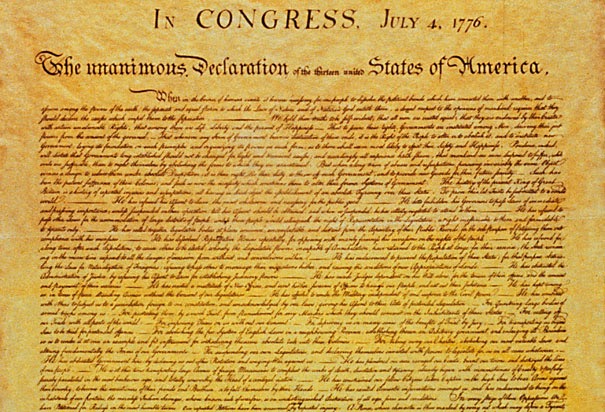
Adams served on the 'Committee of Five' that drafted the American Declaration of Independence in 1776. The committee thought fit to include naval impressment as a grievance in this momentous document. Congress approved the grievance. It stated that the British government 'constrained our fellow Citizens.' These citizens had been 'taken Captive on the high Seas.' They were forced to serve in the British navy at the start of the Revolutionary War, and they were made 'to bear Arms against their Country, to become the executioners of their friends and Brethren, or to fall themselves by their Hands.'[5]

There was an immediate context for this grievance. By 30 June 1775, there were twenty-nine British warships stationed off the North America coast between Florida and Nova Scotia. These warships carried a total of 584 guns and 3,915 men.[6] By 9 October 1775, another six warships patrolled North America’s coastline in an effort to suppress rebellion along the waterfront.[7] The commanding officer, Vice Admiral Samuel Graves, resorted to impressment to accomplish this mission. At Boston on 20 February 1775, he explained to the Admiralty, 'Necessity obliges me, contrary to my inclination, to use this method to man the King’s Ships.' He reported that 'The Ships with me at Boston are beginning to be sickly, they have lately lost several men by deaths, and as desertions happen, notwithstanding the utmost care is taken to prevent it,' he had ordered press gangs to do their work along the eastern seaboard.[8] Americans that read and heard the Declaration would have understood that Graves’ gangs had taken men and made them fight their neighbors.

There also existed a longer and geographically expansive context for this grievance. The British navy had been pressing mariners and commercial vessels around the Atlantic Ocean for over one hundred years by 1776. It had 'constrained' a lot of people, not just Americans, and not only maritime laborers. The Atlantic approach to studying the past that I use in Poseidon’s Curse helps me bring this deeper context to the surface.[9]
The Liberty of the Subject, by James Gillray, 1779, National Portrait Gallery (UK)
There were Britons living and working along the coast of Africa, in the British Isles, in the Caribbean, and on the eastern seaboard of North America who resented the ways in which press gangs constrained their economic freedoms. Maritime entrepreneurs, including merchants and ship owners who charged freight rates to transport goods, believed the state appropriation of ships and maritime laborers posed a threat to profit margins. There was a great deal of profit to be made in shipping lucrative commodities such as dried, salted cod, slaves, sugar, and tobacco long-distance to overseas markets. Impressment elevated labor costs, which shrunk profit margins. It also delayed, disrupted, and destroyed maritime commerce. The requisitioning of privately owned commercial vessels led to property damage and temporary and permanent forms of property loss. Members of the British Atlantic business community closely linked the preservation of their private property rights and their ability to maximize profits with their political liberty.

By the eighteenth century, employment options and earnings had become vital to maritime laborers and their families. They viewed them as necessary survival mechanisms in a capitalist system. They may not have loved them, any more than they had love for competitive labor markets, but they found them necessary. Moreover, they associated these economic freedoms with their political liberty. Impressment curtailed these freedoms without providing workers with a viable alternative. The American Revolution was moored in this deep and wide sea of shared resentment.

Having said this, Americans felt especially constrained. Though press gangs were most active in Great Britain, they were the most highly regulated there. The British government established the Impress Service for coastal communities in the British Isles during the eighteenth century to ameliorate the harsh effects of naval impressment. The Admiralty stationed regulating captains in coastal communities and set up rendezvous points to carefully process pressed men. This was explicitly done to limit the threat to Britons’ liberties. Between 1746 and 1775, Parliament permanently banned impressment on and around Newfoundland and Caribbean island colonies to encourage commerce and safeguard economic and political freedoms in these areas. Americans were jealous about the encouragement the British government bestowed upon other colonists in the Atlantic World. They were also particularly anxious about the implications of this imperial favor. They feared that it meant Americans would support the expansion and maintenance of Britain’s seaborne empire at their own expense. There were Americans who believed they were being unduly constrained, while others were allowed to prosper. The Revolution was moored in these particular concerns that were unique to North America.

The American Revolution was not solely the result of frontier land disputes or even just events in North America. There was demand for naval protection along the four corners of the Atlantic Ocean and across shipping lanes. The British navy pressed mariners and commercial vessels into military service to provide this protection. The British government deemed military force necessary for the elaboration and maintenance of overseas colonies and trade. The state appropriation of free labor and private property generated widespread resentment among business owners and workers. Britons on both sides of the Atlantic Ocean wanted the benefits of a seaborne empire without too many costs. They sent anti-impressment signals to Parliament. The British government decided to favor certain Atlantic interests over others. These decisions incentivized the behavior of stakeholders who defended the imperial system. They motivated colonists who were not beneficiaries to want to leave that system. Events on and around the Atlantic World shaped the contours of the imperial crisis.

The state appropriation of free labor and private property played an important role in the decline of Britain’s seaborne empire. These constraints helped convince colonists that there were imperial chains that needed to be cast off. Colonial American merchants and mariners resented the ways in which press gangs negatively impacted their living standards and their economic freedoms. A mid-eighteenth-century shift in Britain’s blue water policy and impressment legislation in 1708, 1746, and 1775 converted this resentment into rebellion.

Alexis de Tocqueville captured Americans’ sense of being constrained within Britain’s seaborne empire. He wrote, 'The Declaration of Independence broke the commercial restrictions which united them to England, and gave a fresh and powerful stimulus to their maritime genius.'[10] Of course, Americans still had work to do to free themselves from British naval impressment. It took the War of 1812 to finally lift that constraint.

---
[1] 15 George III, c. 31.
[2] See, for example, Boston Evening Post, 3 April 1775 and 10 April 1775.  
[3] William Tudor to John Adams, 4 April 1775. Papers of John Adams, Digital Edition, Massachusetts Historical Society,  http://www.masshist.org/publications/apde2/view?id=ADMS-06-02-02-0086.  
[4] American Archives, documents of the American Revolution, 1774-76, http://amarch.lib.niu.edu/redirect, Series 4, Vol. 5, 472.
[5] The Declaration of Independence, http://www.loc.gov/rr/program/bib/ourdocs/DeclarInd.html.  
[6] “Vice Admiral Samuel Graves to General Thomas Gage,” Boston, June 30, 1775, William Bell Clark, et al., eds.  Naval Documents of the American Revolution (Washington, D.C.: U.S. Government Printing Office, 1964-), (hereafter NDAR) Vol. 1, 785.
[7] The National Archives, Kew, England, Records of the Colonial Office, 5/122/35.
[8] NDAR I:98.  Vice Admiral Samuel Graves to Admiralty Secretary Philip Stephens, 20 February 1775.  For evidence that Graves continued to order the captains under his command to press Americans, see NDAR I:177.  On 24 June 1775 the Admiralty acknowledged “that many of your Ships are considerably short of their Compliment of Men.  And that there is no likelihood of making up the deficiency by Volunteers.”  They sent Graves press warrants “empowering the Officers of the Ships of your Squadron to Impress such a Number of Seamen & Seafaring Men as may be necessary to complete their respective Compliments.  The Clause of the Act of the 6th of Queen Anne which forbid the impressing of Seamen in America being repealed by an Act passed in the last Session of Parliament as you will see by the enclosed Copy which I send you.”  NDAR I:492.  Stephens to Graves, 24 June 1775.
[9] Other Atlantic approaches to the study of the American Revolution include Janet Polasky, Revolutions Without Borders: The Call to Liberty in the Atlantic World (Yale University Press, 2015); David Armitage, “The First Atlantic Crisis: The American Revolution,” in Philip D. Morgan and Molly A. Warsh, eds., Early North America in Global Perspective (New York: Routledge, 2014): 309-336; David Armitage, “The American Revolution in Atlantic Perspective,” in Nicholas Canny and Philip Morgan, eds., The Oxford Handbook of the Atlantic World, 1450-1850 (Oxford University Press, 2011): 516-532; Thomas Bender, Laurent Dubois, and Richard Rabinowitz, eds., Revolution!: The Atlantic World Reborn (New York: Giles, 2011); and Wim Klooster, Revolutions In the Atlantic World (New York University Press, 2009). None of this scholarship on the origins of the Revolution focuses on naval matters.
[10] Alexis de Tocqueville, Democracy In America, edited by Bruce Frohnen (New York: Gateway Editions, 2003), 333.

Wednesday, February 7, 2018

Executioners of Their Friends: Impressment and the Revolution

Detail from The Press Gang, John Collet, c.1760's,
from The Foundling Museum
Representatives of the thirteen rebellious British colonies in North America famously listed their grievances with the Crown in the Declaration of Independence. From the dissolving of assemblies to the use of German mercenaries, the Founders laid out every major offense to the liberty of Americans. The Declaration of Independence is known to every American school child. The assertion that 'all men are created equal' is arguably the cornerstone of American political philosophy.

What is little explored and little known is the argument that the King:
has constrained our fellow Citizens taken Captive on the high Seas to bear Arms against their Country, to become the executioners of their friends and Brethren, or to fall themselves by their Hands.[1]
Their argument was the culmination of decades of anger over the kidnapping of American sailors, and colonial resistance (both of the legal and violent varieties) to a controversial system.

I argue that the Revolution did not end the troubles of impressment, but exacerbated them. This was largely because the Americans themselves relied on the British tradition of impressment to man their ships. Such a clearly hypocritical action (and one that many Americans were clearly uncomfortable with) undermined and eroded their argument until it was no longer a viable point to stand on.

I'm not the first to make this argument. Tim McGrath mentioned American impressment in his 2014 book Give Me a Fast Ship: The Continental Navy and America's Revolution at Sea. Mark Strecker mentions it in the introduction to his 2014 book Shanghaiing Sailors: A Maritime History of Forced Labor, 1849–1915 and makes the same argument that I do concerning the hypocrisy created by this act. William M. Fowler Jr. also addressed it as far back as 1974 in his paper 'The Non-Volunteer Navy' published in the United States Naval Institute Proceedings, and again in his 1976 book Rebels Under Sail: The American Navy During the Revolution.

Americans detested naval impressment. In the 1765 case of the the Rhode Island guineaman Ospray, whose sailors were pressed by the Royal Navy frigate Maidstone, the people of Newport were so angered that they rioted. As Timothy Abbott relates in his blog 'Another Pair Not Fellows,' when the Maidstone's tender Saint John sent a boat ashore to retrieve a deserter who may have been a pressed man:
Pelting the sailors with stones, the large crowd injured a number of the men in Saint John's boat and took a midshipman hostage. Then some of the mob took up muskets and pursued the retreating longboat back toward the Saint John in a sloop. Before the end of the affair, the colonial gunners at the Fort George on Goat Island even fired cannon (one shot allegedly piercing her Mainsail) at Saint John.
Five years before the Boston Massacre, a full decade before Lexington and Concord, Americans fired on a Royal Navy vessel over naval impressment.

One reason the British did not more aggressively pursue suppression of American resistance to impressment was the tricky legal situation it placed British commanders in.

An example of the complicate legal scene can be found in the affair of the Pitt Packet. Sailing into Boston in 1769, she was stopped by the frigate Rose. The sailors, believing themselves to be protected from impressment by law, barricaded themselves in the Pitt Packet's forepeak and fought back against a press gang led by Lieutenant Henry Panton. John Adams later wrote that the sailor Michael Corbet drew a line with salt across the deck, and warned Lieutenant Panton
If you step over that line, I shall consider it as a proof that you are determined to impress me, and by the eternal God of Heaven, you are a dead man.” “Aye, my lad,” said the lieutenant, “I have seen many a brave fellow before now.” Taking his snuff-box out of his pocket, and taking a pinch of snuff, he very deliberately stepped over the line, and attempted to seize Corbet. The latter, drawing back his arm, and driving his harpoon with all his force, cut off the carotid artery and jugular vein, and laid the lieutenant dead at his feet.[2]
John Adams, future founding father, made the interesting argument that naval impressment was justifiable, but so too was violent resistance to impressment:
I think that Impresses may be allowed to be legal, and yet Corbit might have a Right to resist. To be more particular, when I say Impresses may be legal, I mean that the Lieutenant or other officer who Impresses, may not be liable to any Action of false Imprisonment at the suit of the Party, or to any Indictment at the suit of the Crown, for an Assault, or Riot. The Custom may be admitted to extend so far, and yet it will not follow, that the Seaman has not a Right to resist, and keep himself out of the officers Power, if he can.[3]
Adams hadn't even finished his closing argument before the court abruptly adjourned, and reconvened hours later with the hasty decision to release the accused as having committed a justifiable homicide.

In America, the face of resistance was common sailors and lawyers. In Britain, the face of resistance was female. This was made apparent by the Falkland Island crisis of 1770. As Denver Brunsman related in his The Evil Necessity: British Naval Impressment in the Eighteenth Century Atlantic World, to prepare for a possible war with Spain, King George III's 'navy impressed seamen on a massive scale.'[4]
Detail from The Press Gang, or English Liberty Display'd,
artist unknown, 1770, Yale University Lewis Walpole Library.
Detail from The Press Gang, artist unknown, 1770,
Yale University Lewis Walpole Library
Satiric cartoons printed in Britain illustrated the injustice of impressment as men were hustled off by sailors, while their wives wept at the feet of uncaring naval officers.

Tugging at the heart strings was one way to resist, but women were also willing to directly confront press gangs and challenge their courage and manhood. Many newspapers on both sides of the Atlantic reported the appearance of 'the famous Hannah Snell' in confronting press gangs.

April 11, 1771, The Maryland Gazette, page 2
Hannah was not bluffing when she dared them to 'take Brown Bess on your Shoulder, and march through Germany, as I have done; Ye Dogs, I have more Wounds about me than ye have Fingers.' As a younger woman, she disguised herself as a man, served in the marines, and was wounded in battle.

Resistance to impressment was present throughout the British Atlantic World, and so when the Continental Congress included a condemnation of impressment after the outbreak of hostilities, they were likely to find a receptive audience among the British.

Sadly, this argument was almost immediately undermined. The Continental Navy, America's new and tiny maritime force, was chronically undermanned and undersupplied. To solve the former problem, sometimes press gangs were employed.

The impressment of sailors by American ships at first targeted British sailors and exempted Americans. A ship's carpenter recalled that when he and his mates were taken prisoner by the Americans in 1776, they were well treated 'and had Passes given us to protect us from being impressed by the American Sea Officers.'[5] Another British prisoner in 1776 recalled the use of impressment against British sailors: 'About the 20th of October, the Boston, a 30 gun frigate, came round from Newbury to Boston, to fit out under the command of Capt. M'Neil; she was navigated by thirty English sailors, whom they impressed for that service only.'[6]

Still, the Americans tried to practice what they preached about naval impressment. Writing to the Massachusetts House of Representatives, Continental Army general Horatio Gates mentioned a seaman named William Beard among prisoners (soldiers and sailors) taken by his command. Beard, wrote Gates, 'appears to be an Impress'd Man, on board of a Man of War, at Hampton in Virginia; he may also have his Liberty at Worcester.'[7] The Americans were fighting a war of liberation, and if they could free British subjects from the oppression perpetrated by their own government, it would underline the moral justice of their cause.

Their moral fortitude was not to last. As the Americans became desperate, principles gave way and captains began pressing American sailors. The most notorious incident involved Captain James Nicholson, commanding the frigate Virginia in Baltimore, Maryland. Nicholson was ordered by the Marine Committee in 1777 to 'be particularly attentive to collect as many Seamen as possible, not only what may be necessary for the Virginia, but as many as you can bring to assist in manning the rest of our Navy.'[8] Given that Baltimore was a vibrant privateer port, there were few sailors willing to take on the low pay of a Continental Navy vessel. Nicholson ran a press in Baltimore and infuriated the Marylanders.

Governor Thomas Johnson scolded Nicholson in a letter demanding he cease impressment and discharge all men forced into his service. Johnson adopted the rebels rhetoric in reminding Nicholson of the responsibility that came with authority:
It is the Office of Government to protect every Subject in his Liberty and his Property, nor shall we, who are honored by our Country with the highest Department, be idle Spectators of the Oppression of any Man in it.[9]
When Nicholson persisted, Johnson wrote to the Continental Congress and implied that the captain was becoming something of a tyrant with unchecked powers:
I am sorry the Congress did not at once say what Capt Nicholson should do by way of Concession and appoint some Body to discharge the Men there's an indelicacy in saying what any shall do by a Man to himself.[10]
Nicholson was not the only Continental Navy officer to practice impressment. The legendary John Paul Jones was accused of pressing privateersmen, provoking a protest that was sent directly to Congress:
The Owners of the Privateer Schooner Eagle request that you will present to Congress, and support with your good Influence, the inclosed Memorial and Protest, relative to the Conduct of Capt. Jones, Commander of the Ship Alfred, in impressing a Number of Hands from the Said Schooner, maltreating the Officers, and breaking up her Cruize.[11]
Impressment was also practiced by Captain Webb of the Pennsylvania State Navy, Captain Isaiah Robinson of the Continental brig Andrew Doria, and Captain John Burroughs Hopkins of the Continental ship Warren.[12]

With the entry of France into the war, Britain's already strained resources were pressed even further. Impressment was used, as it had been throughout the century, to man the Royal Navy, and certainly on a much broader scale than the Americans were. In a telling political cartoon published in 1779, James Gillray used the language of the American rebels to protest impressment.
The Liberty of the Subject, by James Gillray, 1779, National Portrait Gallery (UK)
Gillray shows women violently resisting the gang, pulling their hair and swinging sticks. The term 'Liberty' is front and center. Gillray was using the Americans' vocabulary of Revolution to call out unjust practices in the mother country, but the Americans still failed to live up to their rhetoric. In 1781 Jacob Nagle, an American citizen, was targeted for impressment by a Continental Navy warship.
The Confederacy frigate sent her boat on board and took 4 men out, and expecting more to be stowed away below, but could not find us. They left three midshipmen on board with a brace of pistols and cutlashes each.[13]
The Declaration of Independence bore a strong argument against naval impressment that would have resounded with British sympathizers. In failing to follow the high ideals of the new nation, the Continental Navy drained that argument of its effectiveness. Despite the role of press gangs in provoking colonials toward rebellion, it failed to find a place among the American pantheon of British injustice, like quartering troops, dissolving legislatures, taxation without representation, and hiring German armies to fight in America.

A generation later, naval impressment reemerged as a wedge in American-British relations, and led directly to the War of 1812.


---
[1] 'Engrossed Declaration of Independence,' The U.S. National Archives and Records Administration, Record Group 360: Records of the Continental and Confederation Congresses and the Constitutional Convention, 1765 - 1821, accessed January 25, 2018, <https://catalog.archives.gov/id/1419123>.
[2] John Adams, 'The Indamissable Principles of the King of England's Proclamation of October 26, 1807,' The Works of John Adams, Volume 9, Boston: Little, Brown, & Company, 1854, page 312.
[3] 'Adams' Argument and Report, Special Court of Admiralty, Boston, June 1769' in Legal Papers of John Adams Volume 2, Massachussetts Historical Society, accessed January 25, 2018, <https://www.masshist.org/publications/apde2/view?&id=LJA02d077#LJA02d077n1>.
[4] Brunsman, Denver, The Evil Necessity: British Naval Impressment in the Eighteenth Century Atlantic World, Charlottesville: University of Virginia Press, 2013, page 244.
[5] Naval Documents of the American Revolution, William Bell Clark, ed., volume 4, Washington, DC: Government Printing Office, 1969, page 1115.
[6] Naval Documents, volume 7, page 299.
[7] Naval Documents, Volume 3, page 601-602.
[8] Naval Documents, volume 8, page 297.
[9] Maryland State Archives, Journal and Correspondence of the Maryland Council of Safety, January 1-March 20, 1777, Maryland Archives Online, Volume 16, page 277, accessed January 26, 2018, <http://msa.maryland.gov/megafile/msa/speccol/sc2900/sc2908/000001/000016/html/am16--227.html>.
[10] Naval Documents, volume 8, page 966.
[11] Naval Documents, volume 7, page 357.
[12] Naval Documents, volume 8, pages 459, 381, and 1044.

[13] Nagle, Jacob, The Nagle Journal: A Diary of the Life of Jacob Nagle, Sailor, from the Year 1775 to 1841, edited by John C. Dann, New York: Weidenfield & Nicolson, 1988, page 25.

Monday, October 23, 2017

The Press Gang, c.1760


The Press Gang, John Collet, c.1760's, from The Foundling Museum.

I was directed to this image by The 18th Century Material Cultural Resource Center. Among their many excellent slideshows are a few focused on naval material culture.

Unfortunately, the Foundling Museum does not have a date for this piece. The 18th Century Material Culture Resource center gives this an approximate dating of c.1760's. Based on the clothing worn by men and women throughout this painting, I would agree with that approximation. As with many tavern scenes of the time, this is a chaotic piece with a lot going on.


Starting at the far left is a tar sharing a word with a woman, possibly his wife. He gestures toward a boy who holds what appears to be a British flag. The sailor wears the familiar reversed cocked hat, perhaps with the brim bound in tape. The tar's blue jacket ends about the middle of the thigh, with slash cuffs. His neckcloth and waistcoat are both red, and his white petticoat trousers that end just below the knee. Gray stockings lead to round toe shoes, but the quality of this copy does not allow us to see the buckles. The boy also wears the dress of a sailor: a round hat with cylindrical crown bound in white tape, blue jacket, and plain white trousers.


In the right of the frame, a pair of sailors drag a poor chap before woman on her knee, pleading for his release. The jack on the left is wearing a  cocked hat, red neckcloth, blue short jacket, petticoat trousers, and plain white or gray stockings. His mate on the right is wearing precisely the same slop clothes, though he might be holding a walking stick.


In the foreground at the right is a sailor lounging on a bench and lifting a lidded tankard. His cocked hat is turned with the point forward, and he wears a red jacket. The petticoat trousers hang long, but we can still see the gray or white stockings about his legs.


In the background a mess of tars play cards and carouse with women. They wear cocked hats and cocked hats, and the bareheaded mariners on the right wear bob wigs. Though the image is faded, they appear to be wearing red neckcloths and waistcoats.

Wednesday, April 26, 2017

The Profane laying hands on the Over Righteous, c1776-1785


The Profane Laying Hands on the Over Righteous, Robert Sayer, c1776-1784, British Museum.

Sayer proudly proclaims that this print is 'a real scene on Tower Hill.' Robert Dighton, the artist and engraver who created this image for Sayer to produce, gives us a scene of a preacher standing atop a barrel preaching to a crowd even as a press gang closes in on him. While one of the gang grabs the peacher by his coat, a sailor can be seen darting away in the left of the frame.

A sharp eyed reader, Bernard Roobaert, brought a detail to my attention: "The engraving...shows an interesting detail that seems to be unknown: a model of a ship on Tower Hill." 

Not only did he catch that obvious detail I'd somehow missed for near five years, but he helpfully provides primary sources about the model, apparently a well known landmark. In Charles P. Moritz's 1782 Travels in London, he describes the model as a trap to capture unwary subjects:

A foreigner has here nothing to fear from being pressed as a sailor, unless, indeed, he should be found at any suspicious place.  A singular invention for this purpose of pressing is a ship, which is placed on land not far from the Tower, on Tower Hill, furnished with masts and all the appurtenances of a ship.  The persons attending this ship promise simple country people, who happen to be standing and staring at it, to show it to them for a trifle, and as soon as they are in, they are secured as in a trap, and according to circumstances made sailors of or let go again.[1]


What event is being portrayed here?

The British Museum's curators declare the preacher to be a Methodist. This makes sense for a press gang. Even though they tended to be focused on experienced sailors who could actually help the navy (rather than taking on inexperienced men who possessed no nautical skills and would prove more a burden than a benefit), press gangs did sometimes target Methodists.

Denver Brunsman, in his excellent book The Evil Necessity: British Naval Impressment in the Eighteenth-Century Atlantic World, relates several cases of Methodists being pressed in the 1740's and 1750's, including John Wesley, one of the co-founders of Methodism.

This does create a problem with the date on this piece. The officer is wearing a pattern of uniform proscribed after 1767, and the dress of all participants suggests at least a 1770's date, and well within the c.1780 date offered by the curators of Collage: The London Picture Archives, or even the 1784 date offered by the British Museum.

1784, however, poses a problem. When I reached out to Denver Brunsman, he stated "I have not documented any cases of press gangs harassing Methodists past the 1750s" and promised to look into it. We both returned to our research, where I eventually dug up a single reference to an event like this within the rough 1770-1784 timeframe.

Edinburgh Advertiser, November 8, 1776, page 10
The British Museum curators cite the 1887 A Catalogue of Maps, Plans, and Views of London, Westminster & Southark as the source of their date. Indeed on page 430, the author does state explicitly that the print was created in 1784, but provides no citation for this.

Do you know of any other events in which Methodists were targeted by press gangs? Leave a comment below!


Using the preacher as a distraction, this sailor takes to his heels before the press gang takes notice of him. He wears a round hat with something fluttering behind the cylindrical crown. I think it may be the bow of a ribbon tied around the base. His jacket has closed slit cuffs and ends about the top of the thigh. A plain neckcloth is tied above his single breasted waistcoat and breeches run down to loose fitting stockings. The straps of his shoes are hanging about in 'sailor fashion.' As with any good sailor ashore, he carries a stick.


The press gang and their sneering officer make for a visibly unwelcoming lot to intrude on the sermon.

The sailors all wear jackets that end about the top of the thigh and have closed mariners cuffs. They all wear round hats, save for one fellow on the far left who appears to wear a strange sort of cocked hat. The burliest sailor, who grasps the pastor's coat and holds a cudgel in his free hand, is the one we get the best look at.

He wears his own hair, curled and loose, above his shoulder. His handkerchief is black and rests on the double breasted waistcoat of narrow vertically striped fabric. The entire gang wear petticoat trousers that end just below the knee and pointed toe shoes with rectangular buckles.


---

[1] Moritz, Charles P., Travels in England in 1782, London: Cassell & Company Limited, 1886, transcribed by David Price, July 2, 2014, Project Gutenberg, accessed August 15, 2023, <https://www.gutenberg.org/files/5249/5249-h/5249-h.htm>.

[2]

Saturday, February 20, 2016

The Banks of the Shannon, 1787


The Banks of the Shannon, published by Bowles & Carver, 1787, reprinted 1799, British Museum.

A colorful print, this Bowles and Carver piece touches on the Sailor's Farewell trope, but with a twist. The young gentleman clasps the hand of his crying sweetheart, but the insistent hand on his shoulder of a naval officer bids him away with the press gang. His lover gives us a tearful poem:
But woe is me the Press gang came and forc'd my Ned away,
Just when we nam'd next Monday fair to be our Wedding day.
 My love he cry'd they force me hence but still my heart is thine
All peace be yours my gentle Pat while War and toil is mine
With riches I'll return to thee, I sob'd out words of thanks
And then we vow'd eternal truth on Shannon's flow'ry Banks.
Among the many things that make this piece interesting is the fact that this is the River Shannon, and so the main figures are Irish. Upon reflection, I cannot think of any other prints, drawings, or paintings that I have examined that explicitly illustrated Irish tars. Scotch, American, and English certainly, but thus far the Irish have escaped notice. It is perhaps the leveling nature of the Wooden World (as NAM Rodger calls it) that makes them invisible to art. The overwhelming majority of images do not give any nationality to sailors. They are all of a kind.

Pat and Ned look clearly distraught, but the press gang seem to be enjoying this tearful parting.


With cudgel in hand, a grinning officer tugs at Ned's shoulder. Behind him are array the men of the press gang, and at least one of them also carries a cudgel.

They are uniformly equipped with black round hats that sport narrow upturned brims and big blue bows. Blue bows on round hats are typical of Bowles' prints. Most of the mariners are hidden behind the officer, but we do get a peek at a pair of white trousers with narrow vertical red stripes over white stockings.

There is one sailor in particular that we get a good look at.


His hair hangs down in brown curls and appear to just barely drape over the black silk neckcloth over his blue jacket with its slit cuffs. A red double breasted waistcoat with white metal buttons hangs above his plain white slops/petticoat trousers. The shading indicates that this waistcoat is not tucked in, and is cut off at the natural waist. He wears white stockings and pointed toe shoes.

Friday, September 4, 2015

The Liberty of the Subject, 1779

National Portrait Gallery (UK)

National Maritime Museum

Walpole Library

The Liberty of the Subject, by James Gillray, 1779, National Portrait Gallery (UK), National Maritime Museum, and Lewis Walpole Library.

Wikimedia Commons also hosts a high quality version of the National Portrait Gallery print. Due to a copyright claim on the part of the NPG against Wikimedia, I will not be hosting their copy of that version.

In this very entertaining cartoon, a group of British women try to fight off a press gang. Their victim, a hapless tailor with tape and scissors in his waistcoat pocket, is shuffled away while the gang trades blows with the women. There's a number of sailors in the gang, but we only get a good view of the two dragging away the sailor.

Gillray's print is the same in each of the above collections. What is interesting is the variation in color. Colorists were not beholden to the artist's original intentions, and projected their own expectations on the prints. Some were lazy (only the colorist on the National Portrait Gallery's
copy bothered to paint the hand grasping the poor tailor's left arm), but all of them brought their preconceived notions to the table. While there are certainly variations in the three prints, the similarities are notable.


The sailor on the left has lost his hat in the fray, and despite having his short hair pulled by one of the women in the crowd, seems to be enjoying himself. His neckcloth is variously depicted as yellow with red dots, salmon colored, or pale yellow. In every iteration, his double breasted jacket is blue with cloth covered buttons both on the lapels and the short slit cuffs. The waistcoat is triple breasted with cloth covered buttons, fashioned with a short cut off, and hangs down to the waist. The National Maritime Museum's copy shows his waistcoat as yellow, but the other two are red. His loose trousers are long, all the way to the ankles, and plain, except in the National Portrait Gallery's copy, where they are decorated with narrow vertical red stripes.


His mate to the right looks considerably more alarmed. He wears a black round hat turned up on the right side. His white hair or wig is in a bob style. The neckcloth projecting from his jacket or sleeved waistcoat is white, except in the NPG copy where it is black, and is tied in a very interesting knot that I can't quite place. His single breasted jacket is a light purple, a dark bluish purple, and blue with cloth covered buttons. His slops/petticoat trousers range in hue from white to brown. In every copy his stockings are white.

Both sailors wear shoes with gradual pointed toes and rectangular white metal buckles with rounded corners.

Friday, August 29, 2014

Press Gang Week: The Murder of Thomas Nogan

For our final installment in support of HMS Acasta's Press Gang Week, we cross the Atlantic to London.

"The Press Gang," Walpole Library

Thomas Nogan was a pressed man. He was also a murder victim. We know both of these facts because of a transcript of a trial held at the Old Bailey on October 24, 1759.

Desertion from the Royal Navy was rampant. In turn, impressment was used to replace those who fled. Understandably, men pressed into service were discontented, and themselves deserted. This created a circle of desertion and impressment from which the Royal Navy could not escape until well into the nineteenth century.

Nogan typified this dilemma. Pressed into service aboard the hospital ship Phoenix (or Phenix as recorded by the Old Bailey's stenographer), Nogan sought his escape by stealing a boat to take him ashore. Almost immediately his bad luck began. Shouts erupted from the ship at his escape: "Come to! Come to!" and "Stop the man!" According to a witness at the trial by the name of John Walker, Nogan "did not understand rowing the boat very well" and was pursued by another boat a mere twenty yards off.  James Pritchard, a waterman serving aboard the Phoenix confirmed that they were closing on Nogan when someone shouted "Fire!" Though the source of the order is unclear, both Surgeon's Steward Matthew Makepeace and Boatswain's Steward Joshua Squire were accused of uttering the fatal word. One witness even claimed that both had said it.

Marine John Neale proclaimed "If I have orders to fire, I'll fire." He took up his musket from the ship's wheel, and pulled the trigger. The bullet found its mark and Nogan "failed in his rowing upon the first fire." Matthew Makepeace called out "For God's sake, fire no more!" Squire, however, commanded another shot. Neale grabbed fellow Marine Samuel Black's musket and bored a hole in Nogan's boat with the ball.

Pritchard, in pursuit, pulled alongside and took Nogan's boat in tow, helping the mortally wounded man back onto the ship. Despite medical treatment and four days in hospital, Nogan succumbed to his wound.

In the end, the court found Makepeace, Squire, and Neale all guilty of manslaughter. Each was sentenced to a painful branding on the hand.

The sentence in this case may represent the uneasy attitude of the British people toward impressment. It was perfectly understandable for a man to try and escape a situation in which he is physically and sometimes violently forced into a life not of his choosing. Though the need to stop him from escape was not disputed, the use of deadly force to prevent that escape was being examined here. The questions asked of the witnesses often dealt with the likelihood of his apprehension. How far off from the pursuit boat was he? Was he likely to evade his pursuers? Where was he headed? These questions imply that the concern of the court was whether the death of the man was really necessary to prevent his escape. In this case it was not.

Though Nogan's case was extreme, he was one of the innumerable sailors and common men kidnapped and pressed into service throughout the eighteenth century.

Thursday, August 28, 2014

Press Gang Week: Press Gangs in Nova Scotia

Today we continue our posts in support of HMS Acasta's Press Gang Week.

"The Press Gang," John Collet

One region of British North America that I often neglect is that of Nova Scotia and Canada. Part of the reason for this is that neither was actually part of the British Empire until their capture in the French and Indian War. Thousands of New Englanders moved to Nova Scotia following the end of that conflict in 1763, and brought with them the resistance to the press gangs that Yankees were known for.

In the short history of the province, there had been no major issue with impressment, but the manpower needs of the Royal Navy increased dramatically with the American Revolutionary War, and the original thirteen North American colonies could no longer be used to make up the shortfall. The war years would be especially rough on the small population of Nova Scotia.

Thanks to Keith Mercer's 2008 PhD dissertation North Atlantic Press Gangs: Impressment and Naval-Civilian Relations in Nova Scotia and Newfoundland, 1749-1815, we have a thorough summation and examination of the use and consequences of press-gangs in the new colony.

Of particular interest to me is the proclamation issued by Lieutenant Governor Richard Hughes against the use of impressment in Nova Scotia:
Whereas impressing Men on the Land for the Sea Service without the Countenance & permission of Civil Authority and the Search after Deserters from that Service without the Power of the Magistrate are both proceedings irregular, unjustifiable and unlawfull, and are frequently attended with Quarrels and Bloodshed, and the loss of life. In order therefore to prevent such Evils, and for the Public Security[,] I have thought fit to Publish this Proclamation hereby restricting all Persons whatever, from such irregular and illegal Practices, as they would avoid the pains & penalties following the prosecutions at Law to which Offenders in such Cases become liable.
Despite his efforts, the press gangs and the officers who commanded them would continue to bring "Quarrels and Bloodshed, and the loss of life" throughout the American Revolution.

Tomorrow we'll return to England and finish Press Gang Week with a look at the unfortunate end to one of the countless victims of impressment.

Wednesday, August 27, 2014

Press Gang Week: Impressment in the Continental Navy

This is another part in support of HMS Acasta's Press Gang Week.

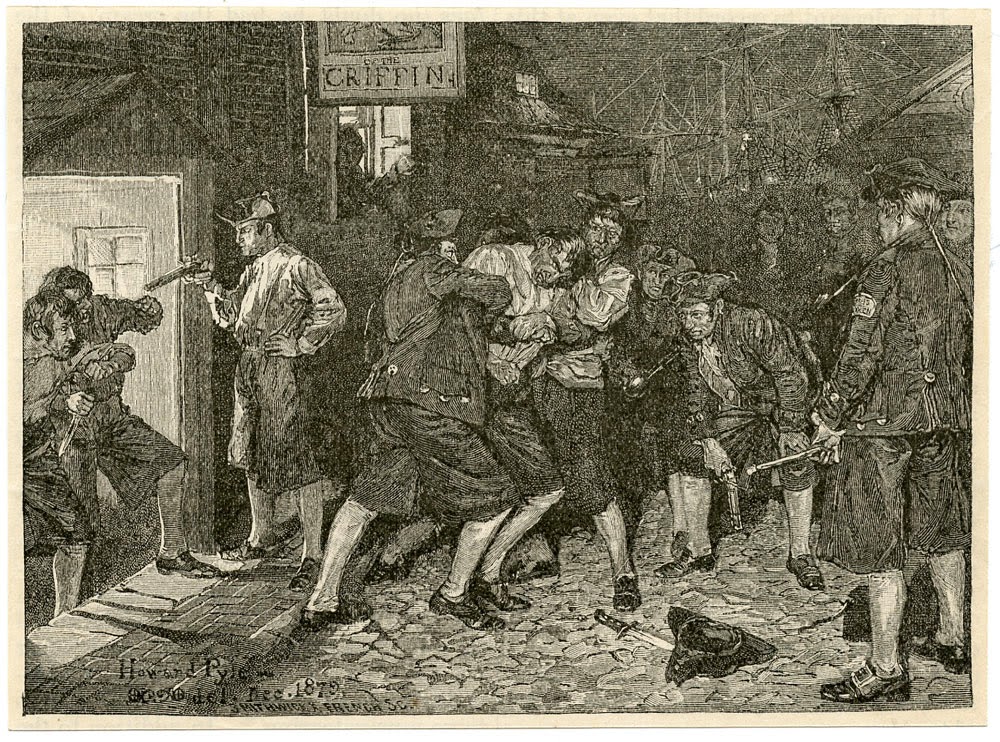
"The Press-Gang in New York," Howard Pyle, 1882.

When we think of impressment we think of the Royal Navy, and this is not without reason. British impressment was a factor in countless court cases and two wars with America.

Thanks to the American Naval Records Society, and their remarkable effort to convert all of the gargantuan collection Naval Documents of the American Revolution into searchable .pdf files, I learned of an attempt at impressment by an American naval officer during the American Revolution!

Governor Thomas Johnson, who had been elected the first governor of the state of Maryland only a month before, took up his pen to write an indignant letter to Captain James Nicholson of the Virginia late in March of 1777:
Sir,
We have received repeated Accounts of your having impressed, and detained a number of Seafaring Men, and others, who either resided in, or were occasionally at Baltimore Town, and that beside the wrong to the Individuals, it's [sic] consequences have been injurious to the Town, in deterring People from going to Market there, for fear of being treated in the same manner. -
We do not know that you can have any Authority, under which to justify such violence, or to interfere in any manner with any Person, who has not voluntarily enlisted in the Continental Marine Service. - If you have any Person, under Colour of his being impressed, we require you instantly to discharge him, and to forbear from a further Exercise of Such an unwarrantable power. It is the Office of Government to protect every Subject in his Liberty and property, nor shall we who are honoured by our Country with the highest Department, be idle Spectators of the Oppression of any man in it.
We are Sir [&c.]
Tho Johnson
Nicholson is a notorious figure in the history of the Continental Navy. A native of Chestertown, Maryland, he was far better at navigating the politics of Congress than he ever was commanding a ship. It was through this maneuvering that he gained command of the Virginia.

The Virginia, despite her name, was of Maryland construction, having been laid down in Fells Point. Nicholson was given orders to take her out and run the British blockade of the Chesapeake. He failed numerous times in this mission, and also failed to keep his restive crew in check. Desertions were "so numerous that Virginia was unable to leave the docks." A frustrated Nicholson eventually turned to impressment. It was a practice he would continue into 1780, despite the numerous official and unofficial protests.

What makes this letter particularly interesting is the way in which Governor Johnson frames Captain Nicholson's transgression: "It is the Office of Government to protect every Subject in his Liberty and property." The very foundation of the rebellious government was liberty. The English themselves had long been uncomfortable with impressment, but the Americans were taking a stand on it.

Nicholson's attempt appears to be the only time an American naval officer used press gangs. Are you aware of any others?

Tuesday, August 26, 2014

Press Gang Week: The Knowles Riot of 1747

As we saw yesterday in the first part our posts in support of HMS Acasta's Press Gang Week, the use of naval impressment in America was one of the causes of the American Revolution. What may surprise you is that the use of press gangs in America, and resistance to them, predates even the earliest thoughts of independence.

In 1747, during the humorously named War of Jenkin's Ear, the accomplished Royal Navy commander Charles Knowles (recently promoted to Rear Admiral of the White) anchored his fleet beside Boston to refit and resupply before sailing to the West Indies. While in Boston, he was plagued with that ever present drain on manpower: desertion.


His solution was predictable: use the press gangs to make up for the loss. As I mentioned yesterday, the use of press gangs in America was a legal gray area. The Royal Navy felt they were entitled to use it for the mutual defense of Britain and her colonies, but Americans wouldn't stand for it.

Knowles may have been able to work around this stalemate. Provincial Governors could give permission to press men into the Navy from their colony. If a ship was inward bound, rather than outward, it was far less injurious to the economy, and therefore more acceptable.

In fact, this was almost done successfully in 1745 by the HMS Wager. Her captain appealed to the authorities for permission to press, which was granted providing that the press gangs only take men who were not Massachusetts subjects, and that they press no veterans of the successful and famous Louisbourg campaign. Though the gangs of the HMS Wager did not follow these instructions, it does demonstrate the limited willingness of colonial governments to cooperate.

Knowles ignored all precedents. Outward bound crews were pressed, men expressly exempted from impressment by law and by the request of the governor were pressed. The people of Boston would tolerate Knowles brazen disregard.

"The Press Gang, or English Liberty Display'd," 1770, Walpole Library

On the morning of November 16, 1747, hundreds of Bostonian sailors armed "with Cutlasses and Clubs" began taking hostages. Naval officers were targeted as especially valuable to their cause. A sheriff unwisely arrested two of the mob, and was attacked in turn until he released the two prisoners. Throughout the day the mob rioted, taking more naval officers into their grasp. A series of exchanges, rescues, and narrow escapes ensued. Regular soldiers were called out to protect the governor's house. The crowd continued to grow into the thousands. At one point, the mob even rampaged into the Town House!

At its worst, Governor Shirley fled the town, and Knowles threatened to level the city with his ships guns. The conflict over impressment would not again be this heated until the War of 1812.

It was not until the impressed Bostonians were released that the the mob finally abated. Knowles left the town dissatisfied, but a bloodbath had been avoided.

To read more about the riots caused by the HMS Wager and Charles Knowles, check out Jack Tager's Boston Riots: Three Centuries of Social Violence and Russel Bourne's Cradle of Violence: How Boston's Waterfront Mobs Ignited the American Revolution.

Tomorrow: Did the American navy ever use press gangs?

Monday, August 25, 2014

Press Gang Week: Independence and Impressment

This is the first part in a series of posts supporting HMS Acasta's Press Gang Week.

From history.com

Though Americans are familiar with the general gist of the Declaration of Independence, the specific points are less well known.

Among the many complaints that the founding fathers leveled against the Crown is this one:
He [King George III] has constrained our fellow Citizens taken Captive on the high Seas to bear Arms against their Country, to become the executioners of their friends and Brethren, or to fall themselves by their Hands.
With renewed enforcement of the Navigation Acts in the 1760's and 1770's, many Americans were being arrested at sea. This grievance, however, is not what is being addressed here. Those smugglers who violated the Navigation Acts were prisoners, not necessarily pressed.

This specific complaint is instead about the effective nullification of the American Act of 1708, sometimes called the Sixth of Anne, that (among other things) forbid the use of impressment against American colonists, deeming it to cause unwarranted damage to the empire's economy. Legal opinions over the next few decades cast doubt on the act, and though Americans were staunchly opposed to these opinions, the Royal Navy maintained that it had the legal right to press Americans into service. The insistence by the Crown and the Royal Navy of their right to force subjects onto warships contributed to the colonists' agitations.

Throughout the eighteenth century numerous riots, especially in Boston, were sparked by the violent press gangs. Next time, we'll be addressing one of the most sensational of these: The Knowles Riot of 1747.

Monday, June 30, 2014

The Pressgang, 1790


The Pressgang, George Morland, 1790, Wikiart.

It has been quite some time since we've featured press gangs on here! The practice continued throughout the eighteenth and well into the nineteenth century, going so far as to spark international incidents and at least one war. Though this period is beyond the scope of our blog, you'll find plenty of information on the period from 1790-1820 at other websites.

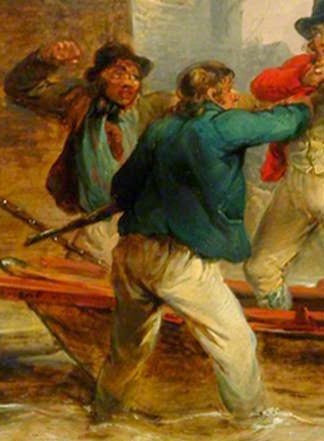
Back to the matter at hand. Here we see three tars in a press gang taking hold of a man standing aboard a small boat, while a couple and their dog look on in horror.


On the far left, holding the boat ashore by its chain, one Jack is clad in a black cap (possibly knit, though impossible to tell), a short blue jacket with short slashed cuffs, a plain white pair of slops, red waistcoat, and unusual black stockings. A gnarled walking stick, cudgel, or rattan is tucked under one arm. In the water beside him floats a round hat that, presumably, belongs to the bare headed tar at the center of the piece.


He wears a blue jacket that ends at his waist with waist pockets and (though I'm not positive) a single vent at the back. Though we cannot see his front, we can say he wears a pair of white trousers and also carries a rattan or cudgel. To the starboard of the boat stands another sailor with a raised fist. He too has a round hat, but his jacket is brown. The shirt is a light blue, with a black neckcloth at his collar. This seafarer wears either a pair of slops or trousers, though it is difficult to say exactly.

Thursday, April 10, 2014

Attic Miscellany, Manning the Navy, 1790


Attic Miscellany, Manning the Navy, J. Barlow, 1790, National Maritime Museum.

Another press gang! A pair of Naval officers guide their tars in rounding up men suitable for the service. On the right, a notably short and fat hobbit of a man is inspected by an officer while sailors rough up helplesss men on the left.


Starting on the far right, we find a jack manhandling the short and fat fellow for his officer. The tar wears a tall "coachman" style hat, though the brim is not terribly stiff, suggesting a loose material of some sort: possibly felt or canvas. His blue jacket is simple and ends just at the top of the thigh without pockets, cuffs or lapel, but it does have a collar. There appears to be no waistcoat, but just a white shirt and black neckcloth. Unlike virtually every other example we've ever seen, this sailor wears a pair of blue slops! Besides that, he wears white stockings and pointed toe shoes.


To the left of the officer is another mariner. He bears a cudgel, ready to bring down on the head of the fellow he grasps by his cravat. This seaman, too, wears a tall "coachman" style hat and short jacket. His short jacket is of a light brown or dusty yellow color, and is lined in white. The slops are beige in color, perhaps meant to represent old sailcloth. In the typically disheveled fashion of sailors, his stockings are baggy.


Another cudgel wielding jack stands with his hand on the shoulder of his shipmate's target. The crown on his hat is shorter, but it is the same style as the other two sailors, and (as with the sailor in the middle) his hat is fitted with a black bow. A blue jacket is worn over his white single breasted waistcoat, and his neckcloth is tied around his neck and stuffed beneath the waistcoat.