Indisposed

FDR’s sense of humor was a winner with the press. One day, when he was laid up in bed with a cold, the Post pulled a classic typographical error. The page one headline read: FDR IN BED WITH COED. Hardly had that early edition reached the White House than a Post reporter picked up the phone to hear: ‘This is Frank Roosevelt. I’d like 100 copies of that first edition of the Post. I want to send it to all my friends.’ Alas, the circulation department had scurried out to recover all the papers from the corner stands and destroy them. FDR never got his 100 copies.

— Kenneth W. Thompson, The Roosevelt Presidency, 1982

Strike Up the Bland

In 1986, Michael Kinsley, editor of The New Republic, spotted the headline “Worthwhile Canadian Initiative” in the New York Times and challenged his readers to come up with a more boring one. This was a tall order: The Times head, someone said, manages to be “not only boring as a whole, but boring word by word.” Submissions included:

  • “U.S. Leadership Needed” (New York Times)
  • “Trade, A Two-Way Street” (New York Times)
  • “Beyond the News, Larger Issues” (New York Times)
  • “Thoughts at Graduation Time” (New York Times)
  • “Continue Manned Flight in Space” (New York Times)
  • “Chill Falls on Warming Relations Between Australia and Indonesia” (New York Times)
  • “University of Rochester Decides to Keep Name” (New York Times)
  • “Dramatic Changes Fail to Materialize on Hill” (Washington Post)
  • “Surprises Unlikely in Indiana” (Chicago Tribune)
  • “CIA Analysis Sees Soviet Economy in Need of Changes” (San Diego Union)
  • “Prevent Burglary by Locking House, Detectives Urge” (Boston Globe)
  • “Methodists Oppose Use of Nuclear Arms” (New York Times)
  • “Economist Dies” (Wisconsin State Journal)
  • “Turbulent Days for Donald D. Engen” (New York Times)

The winner was found in the New York Times science section: “Debate Goes on Over the Nature of Reality.”

In a Word

https://books.google.com/books?id=iq4vAAAAMAAJ&pg=PA794#v=onepage&q&f=false

janiform
adj. having two faces, sides, or contrasting aspects

esemplastic
adj. having the function of moulding into unity; unifying

theriomorphic
adj. having the form of a wild beast

anabiosis
n. a coming to life again; revival, resuscitation

From the Strand, December 1903:

The only violin in the world made from the claw of a giant lobster has just been completed by John H. Dadmun, of 429, Berkley Street, Camden, N.J. This unique instrument, strange to say, can be made to produce as sweet musical tones as any high-class violin. Its owner gives the following as the story of its life.

The lobster from which the claw was taken was caught off Gloucester, Mass., in March 1862. In time it came to Concord, N.H., where Mr. Dadmun saw it. At that time the lobster weighed seventeen pounds and a half. A single claw weighed five pounds and a quarter. The claw that Mr. Dadmun preserved, after the lobster had gone the way of such things, was thirteen and a quarter inches long, seven inches broad, and three and a quarter inches thick.

Preserved among other curiosities of the Dadmun household the giant claw remained a claw for many years. One day it occurred to its owner that it was shaped something like a violin, and he tried the experiment of fashioning it to look more like that popular musical instrument. After much patient effort Mr. Dadmun managed to transform the claw into a violin that could be played. The tone was very sweet, but not loud enough for an orchestra. Experiment proved that by changing the fittings and settings the tone could be made much louder. As it is now the violin when played properly sounds exactly like any other violin. It is doubtless the most curious musical instrument ever made.

Lingua Franca

Mathematician Giuseppe Peano created an auxiliary language to facilitate communication between people of different nations. Latin already served as an international language, he reasoned; “Latino sine flexione” could retain that language’s vocabulary but simplify its grammar as much as possible. In a 1908 speech announcing the idea, he began speaking in classical Latin and adopted each simplification as he described it until he was speaking in the new language. Here’s the Lord’s Prayer:

Nostro patre, qui es in caelos,
que tuo nomine fi sanctificato;
que tuo regno adveni;
que tuo voluntate es facto
sicut in caelo et in terra.
Da hodie ad nos nostro pane quotidiano,
et remitte ad nos nostro debitos,
sicut et nos remitte ad nostro debitores.
Et non induce nos in tentatione,
sed libera nos ab malo.
Amen.

In the end it was not widely adopted, but most of Peano’s books and papers are written in his proposed language.

Misc

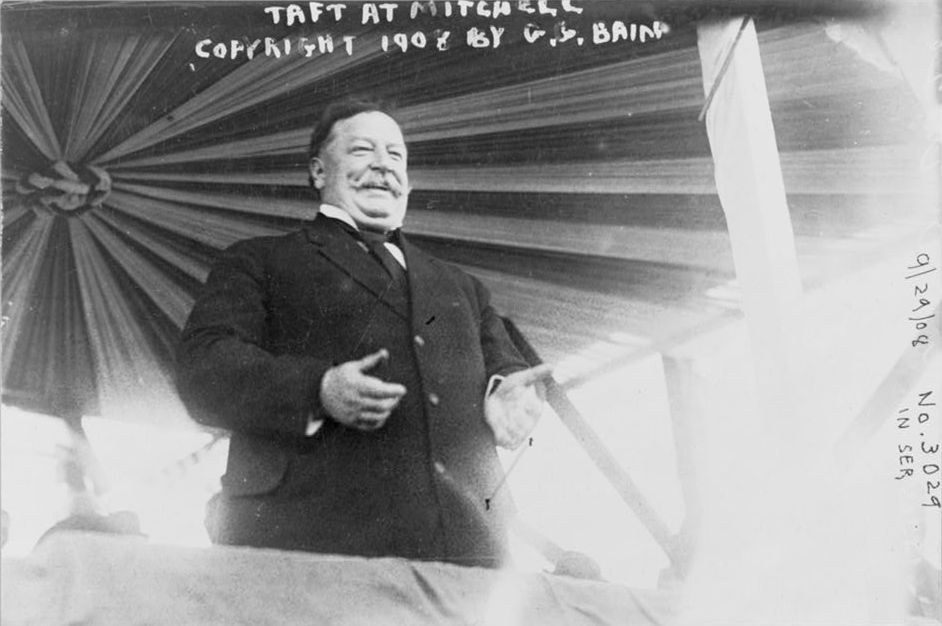
https://commons.wikimedia.org/wiki/File:Taft_at_Mitchell.jpg

  • TAFT: FAT is a palindrome. (Dmitri Borgmann)
  • Valencia is the name of the third-largest city in both Venezuela and Spain.
  • Rearrange COORDINATES and you get DECORATIONS.
  • 32759 = (3 – (2 – 7))5 – 9
  • “Nonbeing must in some sense be, otherwise what is it that there is not?” — W.V.O. Quine

Roll Call

Surveying the American South in the 1980s, University of Florida linguist Thomas Pyles found so many unusual personal names that he managed to make a poem of them:

Yerdith, Virtus, Frow, LaDonna,
Nishie, Alderine, Zollie, Conna;
Garalene, Methalene, Ethelyne, Fal,
Bennilene, Gatsey, Ripsie, Ral.

Dolliree, Jetteree, Mauderie, Flem,
Nubit, Wogan, Omria, Kem;
Pheriba, Yuba, Twylah Jo,
Ovidetta, Zava Roe.

Leos, Cubie, Dicie, Metha,
Shi, Revonie, Sag, Uretha;
Arsie, Kissie, Bussie, Missie,
Yada, Telka, Clell, Elissie.

Ozena, Madula, Oleta, Zippie,
Ozella, Schiley, Florine, Rippie;
Amorus, Onan, Coeta, Pasco,
Reion, Merkin, Jeline, Vasco.

Incia, Phenis, Phalla, Icy,
Idlene, Birdene, Ala, Nicy.
Rectus, Dilly, Dally, Nil;
Mosco, Oco, Rumbo, Zill.

Stobo, Chlorine, Bamma, Floyce,
Willamane, Voncile, Thair, La Voice;
O’Leita, La Gita, Ludille, La Coy,
Arnetta, Loonis, Fanida, Hoy.

Shira, Reva, Terrayne, Aslean,
Etrelle, Mardelle, La Nan, Rudine.
Zazzelle, Glathu, Lavora, Troy,
Colonys, Wylodean, Cy, La Joy.

Alfa, Alto, Shyne, Arveta,
Pledger, Mortis, Cance, La Nita;
Anys, Cyrese, Bink, Eloyde,
Verdine, Merdine, Pink, La Void.

Raysal, Quintelle, Raz, Zerene,
Estyl, Bytha, Bevelene;
Boysy, Lugen, Lavator, Lake,
Eskaleen, Lueverine, Voline, Flake.

La Vada, La Voime, Donrue, La Nelle,
Kartaleen, Avalene, Zan Jamelle;
Ronalene, Darlene, Denna Fo,
Japnel, Oynel, Wynell, Bo.

Vivett, La Carl, La Bruce, La Don,
La Vondus, Burtis, Joette, Lavon;
Zedro, Velpo, Bryna Lee,
Zefferine, Windell, Zim, La Mee.

Oklahoma’s Hoyette White named her daughters Norvetta, Yerdith, Arthetta, Marlynne, and Wilbarine. “I wanted names no one had ever had and names nobody would ever want,” she said. “So I made them up.”

(Thomas Pyles, “Bible Belt Onomastics or Some Curiosities of Anti-Pedobaptist Nomenclature,” in Kelsie B. Harder, ed., Names and Their Varieties, 1986.)

Summary Advice

Full text of a memo from Winston Churchill to his War Cabinet, Aug. 9, 1940:

To do our work, we all have to read a mass of papers. Nearly all of them are far too long. This wastes time, while energy has to be spent in looking for the essential points.

I ask my colleagues and their staffs to see to it that their Reports are shorter.

(i) The aim should be Reports which set out the main points in a series of short, crisp paragraphs.

(ii) If a Report relies on detailed analysis of some complicated factors, or on statistics, these should be set out in an Appendix.

(iii) Often the occasion is best met by submitting not a full-dress Report, but an Aide-memoire consisting of headings only, which can be expanded orally if needed.

(iv) Let us have an end of such phrases as these: ‘It is also of importance to bear in mind the following considerations …’, or ‘Consideration should be given to the possibility of carrying into effect …’. Most of these woolly phrases are mere padding, which can be left out altogether, or replaced by a single word. Let us not shrink from using the short expressive phrase, even if it is conversational.

Reports drawn up on the lines I propose may at first seem rough as compared with the flat surface of officialese jargon. But the saving in time will be great, while the discipline of setting out the real points concisely will prove an aid to clearer thinking.

W.S.C.

He followed this up in November 1951:

BREVITY

Official papers are too long and too diffuse. In 1940 I called for brevity. Evidently I must do so again. I ask my colleagues to read what I wrote then (it is reproduced overleaf) and to make my wishes known to their staffs.

I also invite attention to the Foreign Secretary’s recent despatch to Heads of Missions about the length of telegrams.

W.S.C.

In a Word

https://commons.wikimedia.org/wiki/File:Noahs_Ark.jpg

anatine: of or pertaining to, resembling or characteristic of, a duck
cancrine: having the qualities of a crab
caprine: of or relating to a goat
columbine: of, belonging to, or of the nature of, a dove or pigeon
formicine: of, or of the nature of, ants
fringilline: pertaining to the finches
hippotigrine: of or relating to a zebra
leporine: relating to a hare
lutrine: relating to the otter family
musteline: of or like a weasel
pavonine: of, relating to, resembling, or characteristic of a peacock
procyonine: of raccoons
sciurine: of or relating to squirrels
suilline: of or relating to pigs
talpine: relating to the moles
viverrine: resembling or related to the civet
vulpine: characteristic of a fox

“The sight of an old limping horse, tugged forward by one man while another kept beating it with a stick to get it to the knacker’s yard at Colmar, haunted me for weeks,” wrote Albert Schweitzer in his 1924 memoir. “So when my mother had prayed with me and had kissed me good-night, I used to add silently a prayer that I had composed myself for all living creatures. It ran thus: ‘O, heavenly Father, protect and bless all things that have breath; guard them from all evil, and let them sleep in peace.'”

Frugal

http://commons.wikimedia.org/wiki/Image:Gould_John_Duckbilled_Platypus_1845-1863.png

In 1884, zoologist William Hay Caldwell sent a historic cable from Australia to his colleagues at the British Association for the Advancement of Science:

MONOTREMES OVIPAROUS, OVUM MEROBLASTIC

In four words this manages to proclaim that the platypus lays eggs and that the early stages of its embryo formation resemble those seen in birds and reptiles rather than mammals.

Further economical dispatches.

His and Hers

In German, a young lady has no sex, while a turnip has. Think what overwrought reverence that shows for the turnip, and what callous disrespect for the girl. See how it looks in print — I translate this from a conversation in one of the best of the German Sunday-school books:

Gretchen. Wilhelm, where is the turnip?

Wilhelm. She has gone to the kitchen.

Gretchen. Where is the accomplished and beautiful English maiden?

Wilhelm. It has gone to the opera.

… A tree is male, its buds are female, its leaves are neuter; horses are sexless, dogs are male, cats are female — tomcats included, of course; a person’s mouth, neck, bosom, elbows, fingers, nails, feet, and body are of the male sex, and his head is male or neuter according to the word selected to signify it, and not according to the sex of the individual who wears it — for in Germany all the women wear either male heads or sexless ones; a person’s nose, lips, shoulders, breast, hands, and toes are of the female sex; and his hair, ears, eyes, chin, legs, knees, heart, and conscience haven’t any sex at all. The inventor of the language probably got what he knew about a conscience from hearsay.

— Mark Twain (from A Tramp Abroad)