
see märksõna sisse Java
 James Hartman
⚡ Nutikas kokkuvõte
Java this Keyword is a reference variable that points to the current object inside a method or constructor. Lessons cover purpose, common uses, naming conflicts, constructor chaining, and a worked example.
Milles see märksõna on? Java?
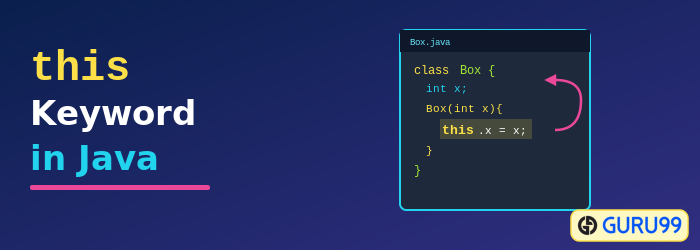
. see märksõna sisse Java on viitemuutuja, mis viitab meetodi või konstruktori praegusele objektile. Selle märksõna kasutamise peamine eesmärk Java is to remove the confusion between class attributes and parameters that have the same name.
Selle märksõna kasutamine Java
Following are various uses of the this keyword in Java:
- It can be used to refer to the instance variable of the current class.
- It can be used to invoke or initiate the current class constructor.
- It can be passed as an argument in a method call.
- It can be passed as an argument in a constructor call.
- It can be used to return the current class instance.
Click siin kui video pole juurdepääsetav
How to Understand the this Keyword With an Example

- klass: klassi konto
- Eksemplari muutuja: a ja b
- Meetod Määra andmed: a ja b väärtuse määramiseks.
- Meetod Näita andmeid: a ja b väärtuste kuvamiseks.
- Peamine meetod: where we create an object for the Account class and call methods set data and show data.
Walking Through the Compiler Confusion
Let us compile and run the code.
Meie eeldatav väljund A ja B jaoks tuleks lähtestada vastavalt väärtustele 2 ja 3.
But the value is 0. Why? Let us investigate.

In the method Set data, the arguments are declared as a and b, while the instance variables are also named a and b.

During execution, the compiler is confused. Whether “a” on the left side of the assigned operator is the instance variable or the local variable. Hence, it does not set the value of “a” when the method set data is called.

The solution is the this keyword.
Append both “a” and “b” with the Java sellele märksõnale järgneb punkt (.) operaator.

During code execution when an object calls the method setdata, the keyword this is replaced by the object handler “obj.” (See the image below.)

Nüüd teab koostaja,
- The “a” on the left-hand side is an instance variable.
- Whereas the “a” on the right-hand side is a local variable.
. muutujad on õigesti lähtestatud ja kuvatakse oodatav väljund.

How the Compiler Handles Multiple Objects
Suppose you choose different names for your instance variable and method arguments.

Kuid seekord loote kaks klassi objekti, millest igaüks kutsub välja andmemäärangu meetodi.
How will the compiler determine whether it is supposed to work on the instance variable of object 1 or object 2?

Noh, see on kompilaator lisab kaudselt the instance variable with the this keyword (image below).

Nii, et kui objekt 1 kutsub välja andmekomplekti meetodi, lisatakse eksemplari muutuja selle võrdlusmuutuja juurde.

Sel ajal, kui objekt 2 kutsub välja andmekomplekti meetodi, muudetakse objekti 2 eksemplari muutujat.

The compiler handles this automatically. You do not have to append the this keyword explicitly unless an exceptional situation requires it.
Example: this Keyword in Java koos Code
Näide: To learn the use of the this keyword.
Step 1) Kopeerige järgmine kood märkmikusse.
class Account{
int a;
int b;

 public void setData(int a ,int b){
  a = a;
  b = b;
 }
 public void showData(){
   System.out.println("Value of A ="+a);
   System.out.println("Value of B ="+b);
 }
 public static void main(String args[]){
   Account obj = new Account();
   obj.setData(2,3);
   obj.showData();
 }
}
Step 2) Salvesta, kompileeri ja käivita kood.
Step 3) Value of a and b is shown as zero? To correct the error, append line # 6 and 7 with the see märksõna.
this.a =a;
this.b =b;
Step 4) Save, compile, and run the code. This time around, the values of a and b are set to 2 and 3 respectively.
KKK
Vaadake meie artiklit Java Intervjuu küsimused: - Kliki siia
