|
Findenser requires no running water to operate. Water is a precious resource. It makes little economic or environmental sense to waste thousands of litres just to cool a single condenser.
What are the benefits?
- No risk of flooding from running water
- Eliminate water purchase and disposal costs
- For solvent volumes from 5ml up to 1 litre
- Helps meet sustainable water reduction targets

Findenser - performs as well as a water condenser
Findenser replaces water-cooled condensers in over 95% of common chemistry applications
Findenser performance testing
A range of solvents, in identical flasks and set-ups, were tested with a Findenser, water condenser and air condenser to record solvent loss by weight.
Compared with an air condenser
For synthesis with ‘low’ boiling point solvents, Findenser showed a significant improvement in solvent retention. With acetone or DCM the reaction boiled dry when using an air condenser, yet Findenser retained 95% of the solvent under the same conditions.
For synthesis with ‘medium’ boiling point solvents, Findenser delivered improved solvent retention particularly with larger volumes and high temperatures.
Compared with a water condenser
Under identical conditions, Findenser retained solvent to the same level as a water condenser (with the exception of diethyl ether).

How does Findenser work?
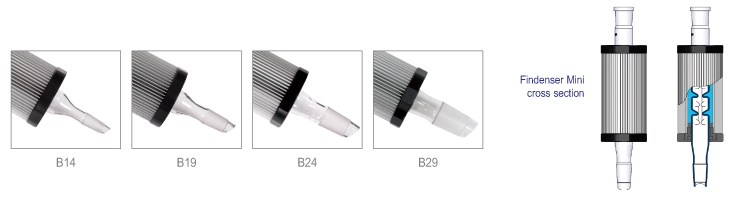
- Findenser comprises of an internal glass condenser and an external, finned aluminium jacket, between which a small amount of water is permanently sealed.
- The glass condenser design has a greater internal surface area than traditional condensers, increasing heat transfer capacity.
- The finned jacket fits around the glass condenser, further increasing the external surface area.
- The result is a "SUPER air condenser".
Choice of B14, B19, B24 and B29 joint sizes
|


