One of the things that I like about trying to learn foreign languages is the insights it gives you into different national preoccupations. For a perfect example consider the Hungarian version, which I only learnt today, of the English phrase "streets paved with gold". It is, apparently, "kolbászból van a kerítés".
"Kolbász", as many probably know - similar words denote the same thing in various Slavic languages - means sausage. "-ból" is the suffix meaning "out of" and "kerités" means fence. In other words, Hungarians see sausage as the most valuable thing in life and imagine a really wonderful place as one with fences made from salamis.
This actually seems a very wise way of looking at things, since, when you think about it - (you cannot eat it and it only has value because an unquestioning collective agreement has grown up that insists it is) - gold is useless. Sausage on the other hand can be enjoyed at any time, plucked from a park railing or the enclosure round a cow paddock, tasty in all weathers, portable without being messy, remarkably long-lasting, really an all-round, ever-welcome thing.
Showing posts with label Hungary. Show all posts
Showing posts with label Hungary. Show all posts
Tuesday, 9 August 2016

Monday, 6 May 2013
Paw Thing
When I had no furniture except a few old packing cases and a sofa with disturbing stains, I used to try to disguise the true horror of these objects by hurling shawls over them before visitors arrived. In a similar manner, politicians often attempt to disguise rats' nests of disgrace and corruption under anodyne statements of the "I want to spend more time with my family" variety. Most of the time, these verbal shawls are pretty dull. Occasionally though, one comes along that makes you - or me anyway - laugh out loud:
 I think it's partly the indefinite article that I like about this. A dog - it just appeared on the hearth rug, we don't own one but suddenly there it was. No wonder she fell over it. Who wouldn't?

Wednesday, 17 October 2012
Friday, 31 August 2012
Saturday, 25 August 2012
Wednesday, 8 August 2012
Tuesday, 31 July 2012
Abundance
There was a lot of twittering recently about a man from America who'd been at the Wheeler Centre in Melbourne pointing out that food corporations make disgusting food. He was advocating a return to purer food sources, I think. What I dislike about both Australia and England in this context is the fact that, to buy food that farmers haven't been paid tuppence for and that doesn't come in sealed plastic boxes and so forth, you have to turn to trendy 'alternative' stores or get up at some appalling time in the morning and go to a so-called farmers' market.
Here in Hungary I've barely seen a plastic box containing food for weeks. That makes a change, particularly from Sainsbury's, where I used to shop when I lived in London - but Australian supermarkets are also pretty keen on putting stuff onto polystyrene trays and wrapping it all up in yards of clingfilm. These things may come, of course, but for now, despite the fact that Tesco's is engaged in a creeping invasion of Hungary, it has not yet conquered all before it.
As a result, for the time being in Budapest my choice is not limited to chain stores or upmarket 'wholefood' places. Here, I either go round the corner to the greengrocer - a kindly man with a moustache who is on such good terms with some of his female customers that, after hearing all the ins and outs of their family's ailments et cetera, as he measures out apricots and potatoes, and then carrying their groaning bags out to the pavement and ensuring they've grasped them firmly enough to get back up the street to their apartments, he receives warm goodbye kisses - or I go to one of the local markets.
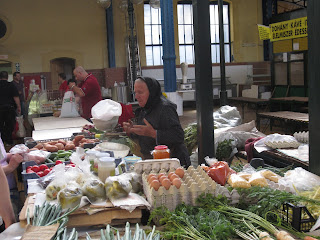
There's nothing especially exciting about any of the stuff on offer - it's not exotic like Brunei. However, I love the sheer abundance and the faces of some of the people behind the counters:


Here in Hungary I've barely seen a plastic box containing food for weeks. That makes a change, particularly from Sainsbury's, where I used to shop when I lived in London - but Australian supermarkets are also pretty keen on putting stuff onto polystyrene trays and wrapping it all up in yards of clingfilm. These things may come, of course, but for now, despite the fact that Tesco's is engaged in a creeping invasion of Hungary, it has not yet conquered all before it.
As a result, for the time being in Budapest my choice is not limited to chain stores or upmarket 'wholefood' places. Here, I either go round the corner to the greengrocer - a kindly man with a moustache who is on such good terms with some of his female customers that, after hearing all the ins and outs of their family's ailments et cetera, as he measures out apricots and potatoes, and then carrying their groaning bags out to the pavement and ensuring they've grasped them firmly enough to get back up the street to their apartments, he receives warm goodbye kisses - or I go to one of the local markets.
There's nothing especially exciting about any of the stuff on offer - it's not exotic like Brunei. However, I love the sheer abundance and the faces of some of the people behind the counters:


 |
| Uh oh, plastic boxes - whatever happened to those wicker punnets of my childhood |


 |
| My husband likes this lady because she calls him young man - and indeed, if I go to the market without him, she asks where the young man is (I suppose youth is a matter of perspective) |
Thursday, 19 July 2012
Hungarian Singsong
Hungarians have more than their fair share of beautiful, melancholic sounding songs. Sometimes they will sing them for you, if you ask them nicely:
It turns out that Freddie Mercury decided to repay the favour, when he visited Budapest in 1986, by singing one of their own songs to the Hungarians. The result, I think, is one of the loveliest things he ever did:
Friday, 29 June 2012
Nearly There
Most of the time I go around thinking that feminism is a done deal in the free world and our attention should be directed solely to helping our oppressed sisters who live in areas controlled by extreme adherents of the Muslim faith. Then I spot something that is so ridiculously, hilariously neanderthal that I'm forced to admit we're not quite there yet.
That's what happened to me yesterday in Budapest:

That's what happened to me yesterday in Budapest:

Friday, 22 June 2012
All this Could Be Yours
A couple of days ago I went out of Budapest to see a friend in the country. I took a train to Csorna:
and then I got on this one-carriage train that feels like something straight out of Thomas the Tank Engine. The locals call it Tiny Red:


A very nice young employee of the Hungarian railways got out when Tiny Red arrived at my destination and insisted on lifting my bag down on to the grass beside the track for me. If I hadn't eaten so much breakfast, I think he might even have lifted me down. Hungarian state railway employees are surprisingly helpful in my experience, apologetic when they find they have to charge you because you have the wrong ticket and, in one case, running across the lines to the ticket office and back to get me the right piece of paper, because the train was about to leave and I wouldn't be able to get there in time. Imagine a British rail employee doing that? Imagine a useful passenger rail network in Australia at all.
My friend lives in a little village of perhaps 1500 inhabitants. It is not too far from Gyor and most of the houses are one-storey and look as if they are quite small from the front:


They are actually much bigger than you think though, as they have long sections that go back from the street at right angles - partly rooms and partly stables. Almost everybody has a vegetable garden and, one realises at this time of the year, when the smell gives away all secrets, that many of them have pigs.
This year they also have a stork nesting opposite the village shop:


It is wonderfully quiet in the village but, like anywhere, there are all sorts of dramas. One person in my friend's street called his neighbour a 'dirty peasant' and so the so-called 'dirty peasant' is now refusing to let his neighbour have access to his property in order to put in some insulation. Ah humanity.
There is a house for sale in the village for 5000 EUR (negotiable). For a moment, it seemed a tempting proposition, at that price. All the same, much I'd appreciate the opportunity to spend my days wearing a pinnie, I'd probably end up with the same faintly hunted look as this old woman:


My other worry would be that the locals might get their hands on large sums of money. I don't begrudge anyone success, but if the result is that they replace buildings like these:


with this kind of thing, the village won't be all that pleasant, at least not for me:

Anyway, if anyone reading this feels it's time for a change of gears, there's a house in Hungary, complete with fully stocked vegetable garden, that awaits your cheque for 5000 EURO.
 |
| That's a picture you wouldn't have missed, I'll bet |
and then I got on this one-carriage train that feels like something straight out of Thomas the Tank Engine. The locals call it Tiny Red:


 |
| Here's one of my fellow passengers having a long chat with the conductor on the return journey - the conductor remains friendly and pleasant throughout, despite the fact that the conversation is very uninteresting and repetitive |
My friend lives in a little village of perhaps 1500 inhabitants. It is not too far from Gyor and most of the houses are one-storey and look as if they are quite small from the front:


They are actually much bigger than you think though, as they have long sections that go back from the street at right angles - partly rooms and partly stables. Almost everybody has a vegetable garden and, one realises at this time of the year, when the smell gives away all secrets, that many of them have pigs.
This year they also have a stork nesting opposite the village shop:


It is wonderfully quiet in the village but, like anywhere, there are all sorts of dramas. One person in my friend's street called his neighbour a 'dirty peasant' and so the so-called 'dirty peasant' is now refusing to let his neighbour have access to his property in order to put in some insulation. Ah humanity.
There is a house for sale in the village for 5000 EUR (negotiable). For a moment, it seemed a tempting proposition, at that price. All the same, much I'd appreciate the opportunity to spend my days wearing a pinnie, I'd probably end up with the same faintly hunted look as this old woman:


My other worry would be that the locals might get their hands on large sums of money. I don't begrudge anyone success, but if the result is that they replace buildings like these:


with this kind of thing, the village won't be all that pleasant, at least not for me:

Anyway, if anyone reading this feels it's time for a change of gears, there's a house in Hungary, complete with fully stocked vegetable garden, that awaits your cheque for 5000 EURO.
Sunday, 27 May 2012
It's Later than I Thought
After reading George, at 20011, who was wondering if the word 'ersatz' will mean nothing to our children, I met up with a Hungarian friend for a meal. She was in Budapest recently and was surprised by an 11-year-old nephew who,after listening to the adults talking about what she had considered quite recent family history, asked, 'What does it mean, this thing you say Uncle Laszlo and Auntie Tunde did? '
'What thing?' the adults asked, trying to recall what exactly they had been saying.
"'Defect"- you said they "defected"- what is that? What does it mean?'
'What thing?' the adults asked, trying to recall what exactly they had been saying.
"'Defect"- you said they "defected"- what is that? What does it mean?'
Friday, 6 January 2012
Planet Paprika
Extra-terrestrial travel would be much more appealing, if one could be certain that there was a cafe serving Dobos Torte at the other end:
"In wartime Los Alamos, there was a conversation piece known as the Fermi Paradox, posed by the Italian physicist Enrico Fermi. Given the high overall probability that intelligent life existed elsewhere in the universe, why hadn’t the extraterrestrials made contact? ‘They are among us,’ Leó Szilárd replied, ‘but they call themselves Hungarians.’ The story was told by the Hungarians themselves and it went like this: the Men from Mars were a restless sort and, in search of new worlds to colonise, they long ago came to Earth, landing on the banks of the Danube. They had effectively concealed their true identity, but there were several signs that could give away their Martian origins. One was their wanderlust: they loved to travel and they readily upped sticks; second was their language, which had no known earthly relation; and third was their supernatural intelligence – they knew things, and could think in a way, that no other people did. One could add a corollary: though they often had a profound understanding of the whole spectrum of mere earthly culture, they seemed to understand it, as it were, from the outside."
The major flaw that I can see in this theory is the notion that Hungarians have a sense of wanderlust. They seem to me - and this is borne out by the fact that it was Poles in large numbers, rather than Hungarians, who took the opportunity to move to Britain and work, when EU regulations made it possible - fairly resistant to leaving their homeland, unless they have to. Not that I blame them.
(From a review of a book about Michael Polanyi in the London Review of Books)
"In wartime Los Alamos, there was a conversation piece known as the Fermi Paradox, posed by the Italian physicist Enrico Fermi. Given the high overall probability that intelligent life existed elsewhere in the universe, why hadn’t the extraterrestrials made contact? ‘They are among us,’ Leó Szilárd replied, ‘but they call themselves Hungarians.’ The story was told by the Hungarians themselves and it went like this: the Men from Mars were a restless sort and, in search of new worlds to colonise, they long ago came to Earth, landing on the banks of the Danube. They had effectively concealed their true identity, but there were several signs that could give away their Martian origins. One was their wanderlust: they loved to travel and they readily upped sticks; second was their language, which had no known earthly relation; and third was their supernatural intelligence – they knew things, and could think in a way, that no other people did. One could add a corollary: though they often had a profound understanding of the whole spectrum of mere earthly culture, they seemed to understand it, as it were, from the outside."
The major flaw that I can see in this theory is the notion that Hungarians have a sense of wanderlust. They seem to me - and this is borne out by the fact that it was Poles in large numbers, rather than Hungarians, who took the opportunity to move to Britain and work, when EU regulations made it possible - fairly resistant to leaving their homeland, unless they have to. Not that I blame them.
(From a review of a book about Michael Polanyi in the London Review of Books)
Wednesday, 7 December 2011
Mysteries of the Post Communist World
Wherever you walk in the cities of post-Communist Europe, you pass buildings like these, where great chunks of the stucco have fallen off the facades:


 Yet you never see any of it falling. You never come round the corner to find chunks of stone hurtling toward unwitting pedestrians. You never discover flattened citizens lying under lumps of carved ornamentation that have crashed down onto the pavement. Is this just luck or is the stuff disappearing invisibly, draining away somehow, like sand?


Thursday, 10 November 2011
The One that I Love
The first thing any tour guide will tell you about Budapest is that it was originally two settlements, Buda and Pest, one on each side of the Danube. It doesn't take a genius to work out from this that the city is built along the banks of the great river and that, therefore, it has a number of bridges, which allow the two separate parts to become one.
Each afternoon when I am in Budapest, I cross the Danube, walking across the Elizabeth Bridge to reach the bottom of the Gellert Hill, on which since the early 20th century a statue of Saint Gellert, usually referred to in Budapest as the patron saint of commuters, because of his position above a busy junction leading to the city, stands:


I then tramp up the hill, reminding myself how good this is for me and enjoying the views:


 (that's the Chain Bridge, you can see down there)

 (that's the Elizabeth Bridge)


until I reach the monument which stands at its peak:


I take no notice of this monument, which is usually surrounded by Russian tourists being lectured to by guides who, from the scraps I hear as I pass, are telling a rather sweetened version of the history of Russo-Hungarian relations to their sensitive charges. I head straight down the steps to the slopes on the other side of Gellert Hill,, which are criss-crossed by a network of different pathways and, at this time of year, radiant with 'autumn colour':


 (very artistic, don't you think?)


 (a glimpse of the local wildlife)


Finally, I reach my real goal - my favourite bridge, once called the Franz-Josef and now the Freedom.
It was renovated not too long ago and looks more splendid than ever, both from a distance:


and on close inspection:


I like the fact that a bird has decided it is also a good place to make a nest and raise a family (no not the one at the top, a bit lower down). Actually, I think you'll have to take my word for that as in the pictures, even though I tried hard to capture them, it's impossible to see the twigs that are so clearly visible on the spot:


I think the Freedom Bridge is one of the prettiest bridges in the world.
Each afternoon when I am in Budapest, I cross the Danube, walking across the Elizabeth Bridge to reach the bottom of the Gellert Hill, on which since the early 20th century a statue of Saint Gellert, usually referred to in Budapest as the patron saint of commuters, because of his position above a busy junction leading to the city, stands:


I then tramp up the hill, reminding myself how good this is for me and enjoying the views:


until I reach the monument which stands at its peak:


I take no notice of this monument, which is usually surrounded by Russian tourists being lectured to by guides who, from the scraps I hear as I pass, are telling a rather sweetened version of the history of Russo-Hungarian relations to their sensitive charges. I head straight down the steps to the slopes on the other side of Gellert Hill,, which are criss-crossed by a network of different pathways and, at this time of year, radiant with 'autumn colour':


Finally, I reach my real goal - my favourite bridge, once called the Franz-Josef and now the Freedom.
It was renovated not too long ago and looks more splendid than ever, both from a distance:


and on close inspection:


I like the fact that a bird has decided it is also a good place to make a nest and raise a family (no not the one at the top, a bit lower down). Actually, I think you'll have to take my word for that as in the pictures, even though I tried hard to capture them, it's impossible to see the twigs that are so clearly visible on the spot:


I think the Freedom Bridge is one of the prettiest bridges in the world.
Subscribe to:
Comments (Atom)