2016UNDP GLOBAL
ENVIRONMENTAL
FINANCE UNIT
Annual Performance Report
UNDP partners with people at all levels of society to help build nations that can withstand
crisis, and drive and sustain the kind of growth that improves the quality of life for everyone.
On the ground in nearly 170 countries and territories, we offer global perspective and local
insight to help empower lives and build resilient nations. www.undp.org
May 2017
© United Nations Development Programme
304 East 45th
Street, 9th
Floor
NewYork, NY 10017 USA
www.undp.org
All rights reserved. This publication or parts of it may not be reproduced, stored by means
of any system or transmitted, in any form or by any medium, whether electronic, mechanical,
photocopied, recorded or of any other type, without the prior permission of the United
Nations Development Programme.
This publication is digitally printed using eco-friendly practices including sustainably
manufactured paper, carbon-neutral presses and environmentally-friendly ink.
AUTHORS: Margarita Arguelles, Nancy Bennet, Ciara Daniels, Jessie Mee, Estefania Samper.
ART DIRECTION & DESIGN: Camilo J. Salomón (www.cjsalomon.com)
INFOGRAPHICS: Ipsita Sarkar (ipsita.sk@gmail.com)
PRINTER: Influence Graphics.
COVER PHOTO: Farmers learn more sustainable practices, reversing degradation and
improving economic wellbeing in Strumica River Basin, the former Yugoslav Republic
of Macedonia. Photo by Ljubo Stefanov/UNDP.
The Global Environment Facility (GEF), established on the eve of the 1992 Rio Earth
Summit, is a catalyst for action on the environment — and much more. Through
its strategic investments, the GEF works with partners to tackle the planet’s biggest
environmental issues.
Foreword	2
UNDP and Global Environmental Vertical Funds	 4
Demonstrating Impact	 8
	 Africa	 12
	 Arab States	 16
	 Asia and the Pacific	 20
	 Europe and Central Asia	 24
	 Latin America and the Caribbean	28
Gender in Action	 32
GEF Small Grants Programme	 38
Annex 1: Corporate Scorecard	39
Annex 2: Projects Active in 2016	42
Contents
Photo by UNDP Sudan. 12016 UNDP-GEF annual performance report I
Year 2016 was a year of celebration! UNDP celebrated its 50th
year as a leader in international development,
while also marking the 25th year of our outstanding partnership with the Global Environment Facility (GEF).
As one of the founding members of the GEF, we are especially proud to celebrate the achievements of this
great partnership. The partnership has enabled countries to deliver high quality results for our people and
our planet. As outlined in this ninth annual performance report—and in several anniversary publications—
the investments made over the past 25 years have helped to transform markets, empower and strengthen
the resilience of vulnerable communities, and build the capacity of countries to safeguard their natural capital
as the foundation of sustainable development. The GEF continues to play a critical role in providing financing
to developing countries to achieve global environmental benefits that reduce or reverse the pressures on
planetary boundaries.
In 2016, the new UNDP partnership with the Green Climate Fund (GCF) began to flourish. Eleven countries
were successful in accessing US$348 million of GCF grant financing, with the support of UNDP, to undertake
innovative approaches focused on scaling up climate change adaptation measures—contributing to food
and water security, improved coastal zone management, and reduced vulnerability of communities—and
mitigation measures through reducing emissions from deforestation and forest degradation, and generating
accessible, sustainable, and affordable energy. This was a wonderful first chapter of what will be an exciting,
strategic and results-driven partnership with the GCF.
Addressing poverty and persistent inequalities when several planetary boundaries have already been
transgressed is a daunting task. The good news is the world has never been so aligned around a vision as
it is now. The Sustainable Development Goals (SDGs) are not just aspirational, but transformational; if fully
implemented they will change the trajectory of development for all countries and peoples. The consonance
of the SDGs and the Paris Agreement signals a new era of commitment and political will. The 2030 Agenda
is notable for the extent to which it reflects a widespread acknowledgement by UN Member States that
the health of the planet—from climate, to oceans, water, land, biodiversity and forests—is essential for
sustainable development. Our work demonstrates that investments in the environment contribute to
the achievement of SDGs 13, 14, and 15 and accelerate the achievement of the other SDGs including those
aimed at eradicating poverty and hunger, and building strong institutions, peace, and stability.
UNDP’s partnerships with the GEF, the GCF, and other vertical funds and partners demonstrate our shared
commitment to advance the 2030 Agenda and support countries in turning the vision of long-term
prosperity, human development, and environmental well-being into reality. This ninth annual performance
report of the UNDP Global Environmental Finance Unit provides a snapshot of progress made in delivering
impact in 143 countries through 810 projects representing a total investment of $3.1 billion. We also
include—for the first time—a corporate scorecard that tracks the efficiency and effectiveness of the portfolio
of GEF-financed projects, demonstrating our commitment to deliver value for money to those who support
us in our mission.
I continue to be inspired by every one of the magnificent people who have contributed so much on our
shared journey to deliver high quality results for people and the planet. Thank you!
Adriana Dinu
Executive Coordinator
UNDP Global Environmental Finance Unit
Sustainable Development Cluster
Bureau for Policy and Programme Support
UNDP
Foreword
ADRIANA DINU
I 2016 UNDP-GEF annual performance report2
Alignment of our work with the Sustainable Development Goals
Relative circle sizes indicate the percentage of active GEF-financed projects that contribute to each SDG shown
OVERARCHING OBJECTIVES
OUR PLANET’S LIFE SUPPORT SYSTEMS
DEVELOPMENT IMPACTS AND SUSTAINING TRANSFORMATIONAL CHANGE
32016 UNDP-GEF annual performance report I
Thoddoo Island, Maldives. Photo by UNDP.
UNDP AND GLOBAL ENVIRONMENTAL
VERTICAL FUNDS
I 2016 UNDP-GEF annual performance report4
UNDP partners with environmental vertical funds to support
countries in accessing, combining and sequencing various sources
of environmental finance and financial instruments for high-impact
environmental benefits that advance sustainable development.
UNDP was one of the founding implementing agencies of the
Global Environment Facility (GEF), and in 2016 celebrated 25 years
of partnership with the GEF. Since 1992, UNDP has mobilized a total
of US$6.6 billion in GEF resources, assisting 150 developing countries
in addressing the key drivers of environmental degradation which
undermine sustainable development. With a current market share
of 39 percent, UNDP is the largest of the 18 GEF Agencies.
The Green Climate Fund (GCF) is the newest vertical fund partner
of UNDP. UNDP was the first UN agency to be accredited to the GCF
and in 2016 became the first international Accredited Entity with
approved projects to sign an Accreditation Master Agreement with
the GCF. UNDP is one of only three international entities to have
signed a Framework Readiness and Preparation Support Grant
Agreement with GCF, governing UNDP’s engagement as a delivery
partner for climate readiness.
These environmental vertical funds require all Accredited Agencies
(also called entities) to provide fund-specific services, and provide
a fee to the accredited agency for the delivery of these services.
In the case of the GEF managed funds, services are defined by the
GEF Council and include corporate services such as portfolio-level
financial and results reporting, and project cycle management
services, such as project design, monitoring and evaluation.
Similar services are required by the GCF and the Adaptation Fund.
UNDP Global Environmental Finance (UNDP-GEF) Unit
For managing the relationship with the environmental vertical
funds, the Global Environmental Finance Unit in the Sustainable
Development Cluster of the Bureau for Policy and Programme
Support works with countries to access environmental finance
for sustainable development. The Unit provides GEF programming
and implementation support services to countries in five thematic
areas: sustainable management of biodiversity and ecosystems;
sustainable, affordable, and accessible energy services; scaling up
climate change adaptation and mitigation; sustainable management
of chemicals and waste; and improved water and ocean governance.
The Unit also provides GCF programming and implementation support
services covering sustainable, affordable and accessible energy;
and scaling up climate change mitigation and adaptation. This
work represents a major conduit of finance for implementing
the four environmental outputs in the UNDP Strategic Plan.
1
	 Cost-sharingisadditionalfundingreceivedforalreadyapprovedGEF-fundedprojectsfromtheGovernmentsofAustralia,Austria,Brittany,Canada,Denmark,Flanders,Norway,SwitzerlandandtheUnitedStates,aswellastheEuropeanCommission.
Total Resources Mobilized since 1992
(IN MILLION US$)
GEFTrust LDCF GCF
Cost
Sharing1
Adaptation
Fund SCCF NPIF
TOTAL
5,417 539 350 156 135 82 7
$6.6
BILLION
LDCF is the Least Developed Countries Fund; GCF is the Green Climate Fund; SCCF is the Special Climate Change Fund; NPIF is the Nagoya Protocol Implementation Fund.
2016 UNDP-GEF annual performance report I 5
Managing for Results
Projects financed by environmental vertical funds are required to follow
the specific policies and procedures of each vertical fund in addition to
UNDP policies and procedures. The UNDP-GEF Directorate closely monitors
compliance with the vertical fund requirements to ensure that UNDP
delivers high quality services to each vertical fund thereby maintaining
UNDP’s reputation as a reliable, effective, and efficient partner.
The Corporate Scorecard in Annex 1 highlights progress made by the UNDP
portfolio of active GEF-financed projects against key project cycle milestones.
Where appropriate, UNDP’s performance is compared to the overall GEF
average, which combines the performance of all 18 GEF Agencies.
Projects Covered in this Report
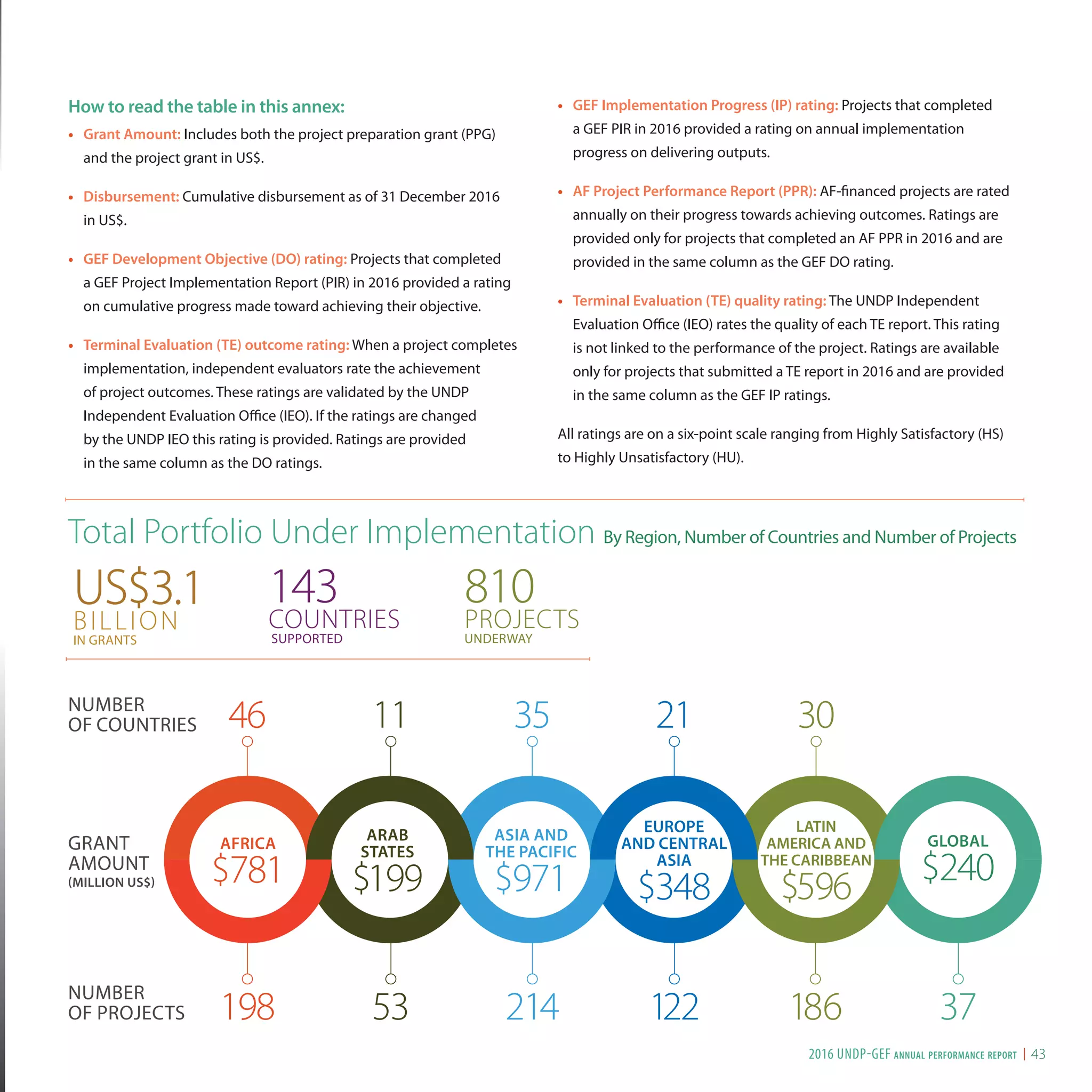
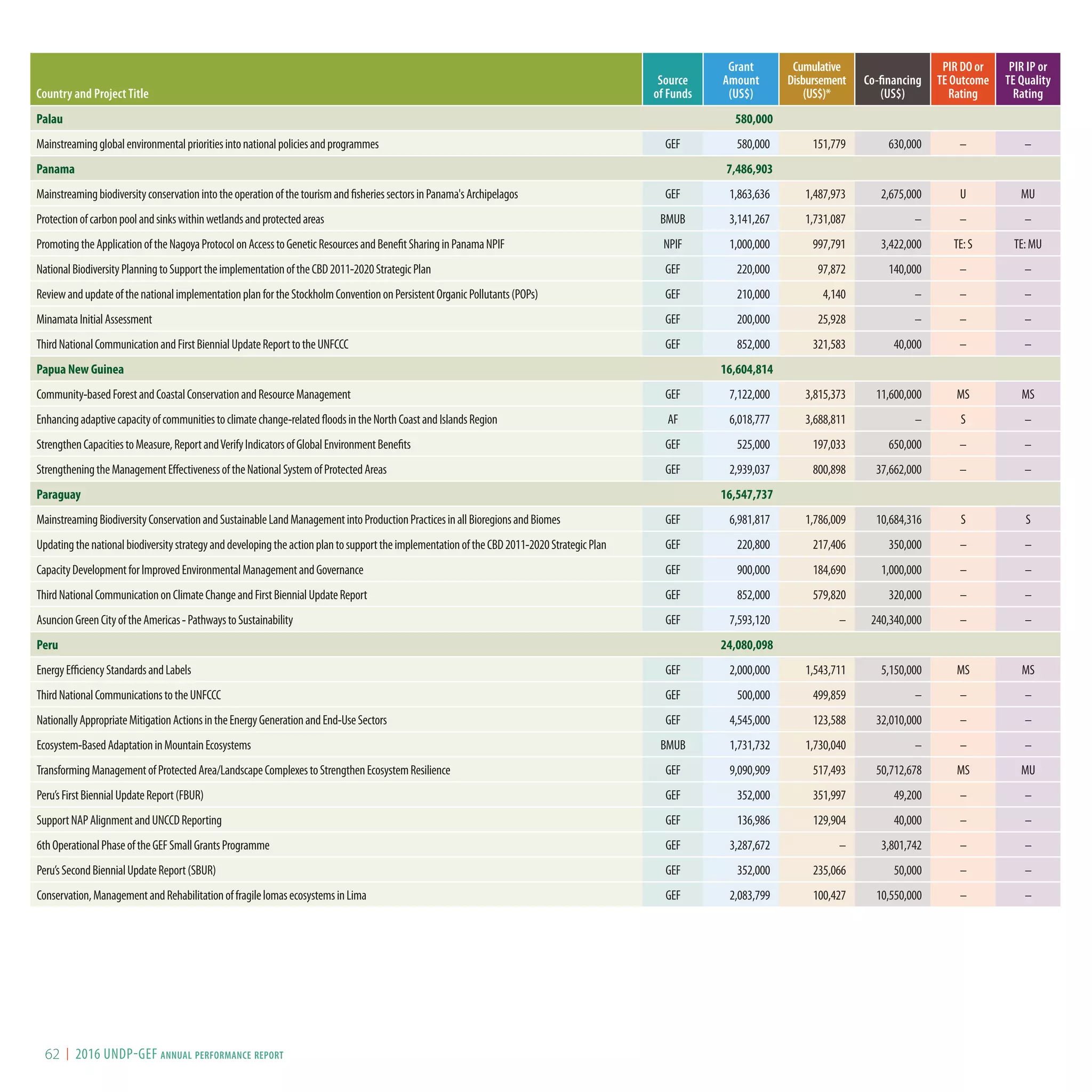
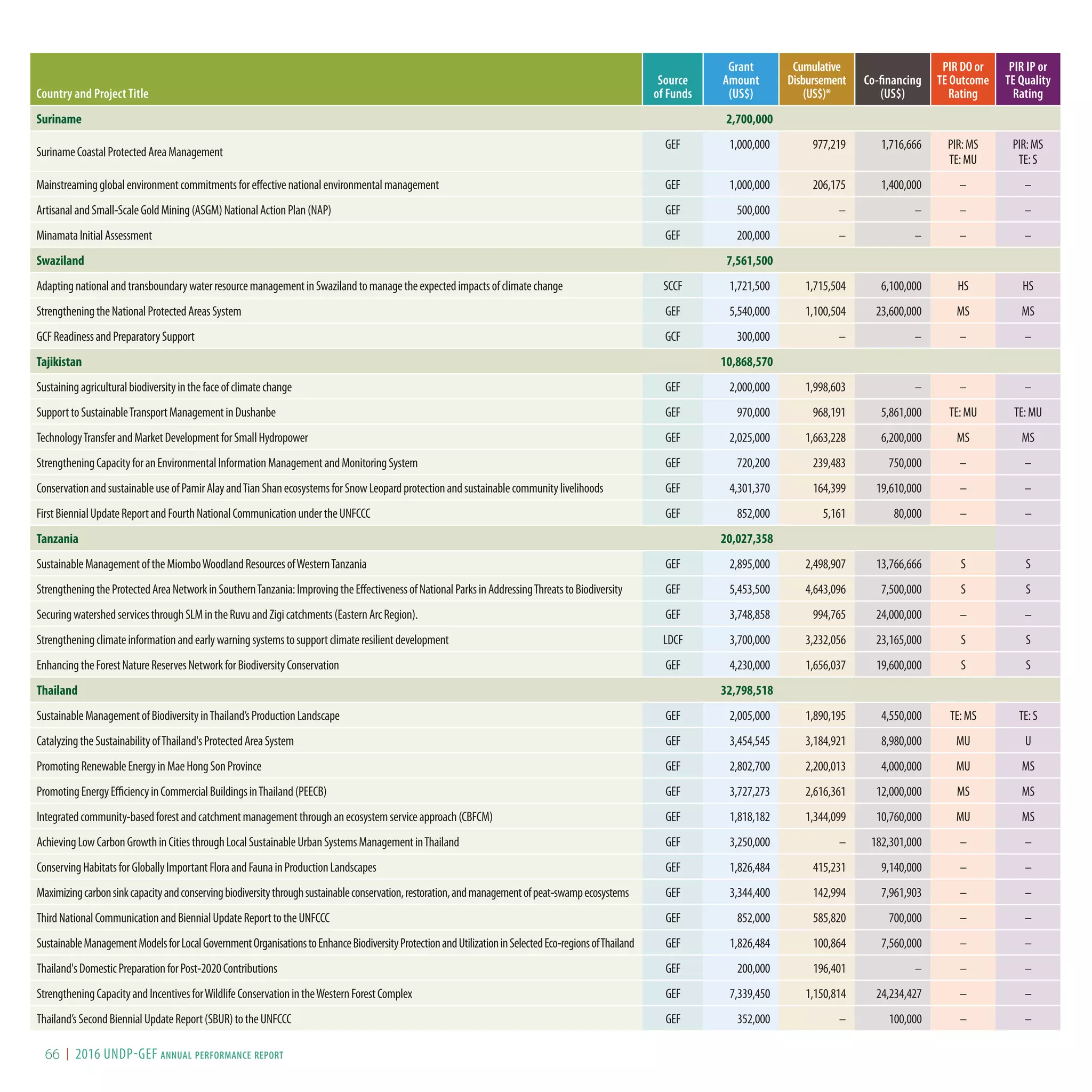
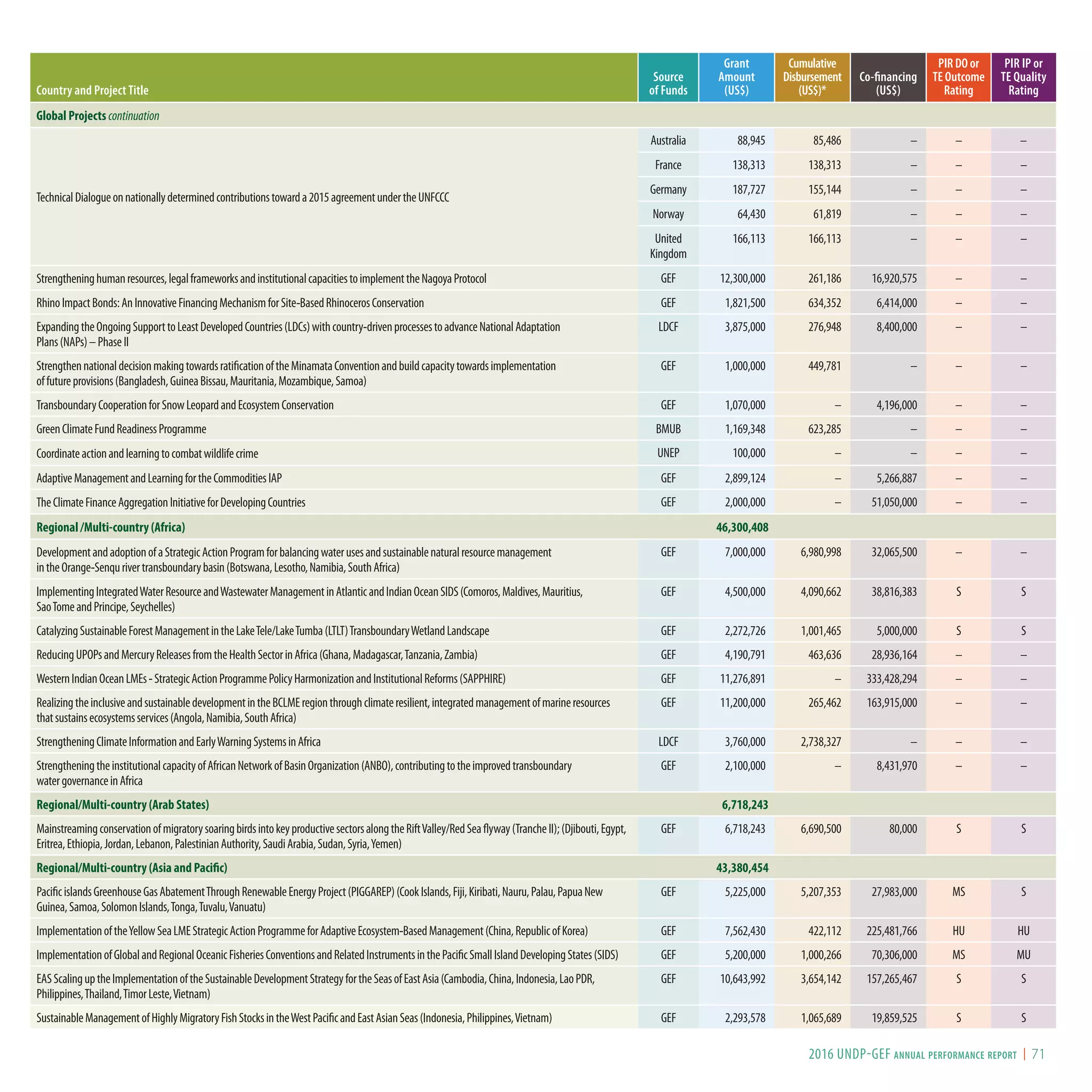
The 810 active projects within the scope of this report, listed in Annex 2,
represent a total grant investment of US$3.1 billion. Combined with an
additional US$14.1 billion in co-financing, this represents US$17.2 billion
invested in the environment and sustainable development priorities of
143 countries. Of the 810 projects, 344 submitted annual project reports
to the relevant vertical fund, 62 a mid-term review (MTR) and 55 a terminal
evaluation (TE) report.
UNDP and the Green
Climate Fund
Since 2015, UNDP has mobilized
a total of $348 million in GCF resources
for 11 approved projects for Armenia,
Ecuador, Malawi, Maldives, Mauritius,
Pakistan, Samoa, Sri Lanka, Tuvalu,
Uganda and Viet Nam. The 11 projects
already approved will advance
sustainable development by increasing
resilience to climate change among
4.5 million direct and 65.7 million
indirect beneficiaries, while avoiding
22.5 million tons of CO2
-equivalent
emissions. To date, UNDP-supported
GCF readiness grants have been
approved for eight countries to
build government capacity to access
climate finance.
66986 55
PROJECTS
RECENTLY
APPROVED
PROJECTS
UNDER
IMPLEMENTATION
PROJECTS
COMPLETED
TERMINAL
EVALUATION
US$543 million US$2.4 billion US$188 million
I 2016 UNDP-GEF annual performance report6
OURWORK IN
143COUNTRIES
77
strengthening
the management of
protected areas
92
scaling up
climate
resilient
livelihoods
and risk management
56
adopting
sustainable tourism
practices
69
adopting sustainable
agriculture and
livestock practices
63
adopting sustainable
forestry practices
43
developing
and strengthening
EarlyWarning Systems
49
adopting
sustainable
fisheries practices
64
with improved
access to clean and
affordable energy
65reducing
CO2
emissions
through renewable
energy programmes
41
reducing
CO2
emissions by improving
energy efficiency
10
implementing
sustainable and
alternative
transportation
practices
91
adopted integrated
water resource
management
practices
15
adopting sustainable
practices in extractive
industries
17
reducing POPs
and mercury
releases through
sound management
Supporting Sustainable Practices Across the Globe
2016 UNDP-GEF annual performance report I 7
Photo by UNDP Cambodia.
DEMONSTRATING IMPACT
8 I 2016 UNDP-GEF annual performance report
This section provides regional snapshots of progress
made toward realizing environment and development
benefits from projects financed by environmental vertical
funds and supported by UNDP. Only a small selection
of the total cohort of 810 projects could be included
in this short annual report. The results depicted in the
infographics throughout the report are actual results
reported by projects under implementation. Projects that
made particularly notable contributions toward gender
equality are presented in the Gender in Action section of
this report, and the achievements of the GEF Small Grants
Programme are described in the section that follows
thereafter.
implement INDCs. Through this work, UNDP has reached
over 1,000 policymakers from over 130 countries. Through
a Global Support Programme, UNDP and UN Environment
are supporting over 20 ‘non-Annex I countries’—developing
countries that are particularly vulnerable to the effects of
climate change—to prepare quality National Communications
(NCs) and Biennial Update Reports (BURs). In 2016, the Global
Support Programme launched the Gender Responsive National
Communications Toolkit3
to strengthen the capacity of national
government staff and assist them in integrating gender equality
into the development of NCs. UNDP also directly supports
45 countries to prepare and implement their National
Biodiversity Strategies and Action Plans (NBSAPs) and national
reports to the CBD. In partnership with the CBD Secretariat,
UN Environment and others, UNDP supports 128 small
island, middle income, and developing countries through the
NBSAP Forum (http://nbsapforum.net), an online knowledge
management and technical support facility. Furthermore, UNDP
assists countries with aligning their National Action Programs
to the 10 Year Strategy of the UNCCD and piloting the Land
Degradation Neutrality (LDN) target setting.
The Rio Conventions and UNDP
The three Rio Conventions have mobilized the world to address
the interrelated challenges of climate change, biodiversity
loss, and desertification and land degradation. UNDP supports
countries with meeting their reporting requirements under
the United Nations Framework Convention on Climate
Change (UNFCCC); the Convention on Biological Diversity
(CBD); and the UN Convention to Combat Desertification
(UNCCD). As the Parties to the UNFCCC established a process
whereby countries prepare National Adaptation Plans (NAPs),
UNDP, together with UN Environment, supported 16 least
developed countries in 2016—Angola, Bangladesh, Burkina
Faso, Cambodia, Comoros, Djibouti, Guinea, Liberia, Lesotho,
Madagascar, Malawi, Mauritania, Niger, The Gambia, Senegal
and Tanzania—to advance their NAP process. With financing
from the GEF, EU, and Government of Germany, UNDP
supported over 40 countries in developing their Intended
Nationally Determined Contributions (INDCs), the backbone
of future action on climate change, for the UNFCCC. Since
2014, UNDP has organized 17 regional and global forums
in partnership with the UNFCCC Secretariat and others to
exchange lessons learned and build capacity to prepare and
3
	 Availableat:www.undp.org/content/undp/en/home/librarypage/womens-empowerment/gender-responsive-national-communications.html
In Colombia, threatened turtles get a new chance at life thanks to UNDP work to improve coastal management protection.
Photo by UNDP Colombia.
2016 UNDP-GEF annual performance report I 9
27.6MILLION PEOPLE
BENEFITTING FROM
CLIMATE RESILIENT
LIVELIHOODS AND RISK
MANAGEMENT
74%PROJECTS
MAINSTREAMING GENDER
AND ADVANCING GENDER EQUALITY
458 MILLION HA
OF TERRESTRIAL AND MARINE
ECOSYSTEMS UNDER IMPROVED
MANAGEMENT AND/OR PROTECTION
223.9 MILLION PEOPLE
BENEFITTING FROM IMPROVED ECOSYSTEM
SERVICES THAT SUSTAIN AND PROTECT
THEIR LIVELIHOODS
37%PROJECTS
WORKING WITH INDIGENOUS
COMMUNITIES
Global Results: Benefiting People and Planet
10 I 2016 UNDP-GEF annual performance report
1.7MILLION PEOPLE
BENEFITTING FROM REDUCING POPs
AND MERCURY RELEASES
26.8MILLION PEOPLE
HAVE IMPROVED ACCESS TO CLIMATE
INFORMATION INCLUDING FROM
EARLY WARNING SYSTEMS
5.9 MILLION PEOPLE
BENEFITTING FROM SUSTAINABLE ENERGY SOLUTIONS
AND/OR IMPROVED ENERGY EFFICIENCY
1.4 BILLION PEOPLE
BENEFITTING FROM INTEGRATED WATER
RESOURCES MANAGEMENT MEASURES IN
27TRANSBOUNDARY WATER SYSTEMS
557MILLION TONNES
OF CO2 EMISSIONS AVOIDED
15,758TONNES
OF POPs HAVE BEEN
SAFELY DISPOSED
INTEGRATED WATER
RESOURCES MANAGEMENT
MEASURES UNDERWAY IN
13LARGE MARINE ECOSYSTEMS,
9 TRANSBOUNDARY RIVER BASINS,
2LAKES AND 3AQUIFERS
1,894KM
OF COASTLINE PROTECTED VIA CLIMATE
CHANGE ADAPTATION MEASURES
112016 UNDP-GEF annual performance report I
Africa
According to the 2016AfricaHumanDevelopmentReport, over
the past two decades Africa has had one of the fastest rates of
improvement in human development, but also has the lowest
average levels of human development compared to other regions
in the world.The development challenges faced by countries in this
region, as in other regions, are exacerbated by ongoing conflicts,
the changing climate, and legacies of environmental degradation.
The Sustainable Development Goals (SDGs) offer a hopeful frame
work for tackling these interconnected challenges.
This chapter highlights a range of innovative interventions in Africa
that are improving water management and climate information
systems; securing equitable land tenure systems; advancing energy
efficiency; and combatting the illegal trade of wildlife. By approaching
the challenges of poverty and inequality from a variety of entry points,
these interventions speak to the shared needs of the people and
the planet.
NUMBER
OF PROJECTS
198
TOTAL GRANT AMOUNT
$781MILLION
NUMBER
OF COUNTRIES
46
20 developing
and strengthening
EarlyWarning
Systems
23reducing CO2
emissions through
renewable energy
programmes
84%
37%projects
working with
indigenous
communities
projects
mainstreaming
gender
21 countries
adopting
sustainable
forestry practices
17 countries
adopting
sustainable
tourism practices
29 countries
adopting
integrated water resources
management practices
22 countries
with access
to clean and
affordable energy
26 countries adopting
sustainable
agriculture and
livestock practices
38 scaling up
climate resilient
livelihoods and
risk management
74 million ha of
terrestrial and marine
ecosystems under improved
management and/or
protection
I 2016 UNDP-GEF annual performance report12
In Zimbabwe, master farmer Boaz Chimombe recently experienced
the challenges of climate change firsthand when his district received
less than half the expected rainfall during the peak growing season.
At the height of the dry spell in mid-February 2016, he was worried:
“Given good rains I was expecting a yield of 15 tons on my plot alone,
but now with these unforgiving weather conditions I will be lucky to
harvest 0.5 tons of grain.”Joining UNDP’s climate-smart farming efforts,
Boaz now practices conservation farming – planting drought-tolerant
sorghum and using legume cover crops to retain soil moisture. When
the drought ended in March, these resilient crops brought food to his
table and additional income to his pockets; he harvested 1.2 tons
of sorghum per hectare, more than double his past yields of 0.5 tons/ha.
“I am now sitting pretty, I now have enough food to feed my family and
also sell to others. People used to laugh at my field as an early adopter
of climate smart farming practices. Look at me now, all my hard work
and application of knowledge from the project trainings have paid off.”
Now a champion for these practices, Boaz is helping UNDP to scale up
this important work by showing fellow farmers in his district that climate
change adaptation is possible even in the most difficult conditions. His
household is one of the 10,100 directly targeted with this support. At the
district level, localized weather forecast products have been developed
in collaboration with the Meteorological Services Department and with
input from farmers, extension workers and innovators from two local
universities; these products will increase knowledge and understanding
of climate variability and change-induced risks throughout the country.
Similar efforts by UNDP to strengthen—and improve systems for—
climate information are underway in 15 countries in Africa. In Ethiopia,
the country’s first weather index-based crop insurance mechanism paid
out more than US$100,000 to 1,403 farmers who suffered crop failures
in 2015/2016 due to El Niño. In Benin, climate information is being
generated by a new local automated weather station connected to
the national meteorology department in Cotonou; farmers now receive
details on the local weather, such as the expected onset of the rains,
which is helping to maximize their crop yields and avoid losses. In
São Tomé and Príncipe, the country’s first hydrological network—with
a complete communication system that connects the country’s fire
brigades, data management center, meteorological and hydrological
services, and coastal guards—has been created to benefit vulnerable
communities. As a result, national coverage of climate, weather, and
hydrological information has increased from less than 20 percent
to 60 percent, making the prevention of and improved response to
climate-related events now possible.
In the coastal town of Tarrafal in Cabo Verde, a multi-country effort for
improving water management in small island developing States (SIDS)
is tackling water availability from a different angle: farmers on the
outskirts of town now use treated wastewater from the town’s newly
upgraded treatment plant for irrigation. At the same time, these famers
are growing salt-tolerant plants to form a living barrier along the coast,
reducing salt water intrusion and improving the quality of their soil. The
By adopting improved planting, cultivation and processing techniques farmers in the Democratic Republic of Congo’s Kwilu Province are adapting to the impacts of climate change. Photo by Clotilde Goeman/UNDP.
2016 UNDP-GEF annual performance report I 13
other countries targeted by this intervention are Comoros, São Tomé
and Príncipe, Seychelles, Maldives and Mauritius. In Mauritius, UNDP
has helped to establish a water quality monitoring programme that
enables policy-makers to enact vital solutions for the 11,000 people who
depend on the threatened Northern Aquifer. In Comoros, a watershed
management plan was developed and adopted, and a monitoring plan
is also operational, which has helped to provide information on water
quality that is valuable for policy makers and farmers alike.
In Eritrea, an initiative to pilot the implementation of Eritrea’s 1994
land reform policy has resulted in farmers increasing investments in
sustainable land management. This change is transforming the land, as
people construct terraces, build check dams, and plant trees, thereby
reducing soil erosion, improving water retention capacity, and water
quality, all of which is already leading to increased productivity. In
Burkina Faso, 34 villages established new land tenure structures in
partnership with territorial communities and in line with the national
law on land tenure security, which are reducing conflicts among farmers
and other land users, and supporting the sustainable management and
protection of their lands. Similar work is underway in at least 12 other
countries around the world.
In Senegal, UNDP and partners are delivering multiple development
benefits from an innovative approach. Typha, an invasive aquatic
plant that has proliferated along the Senegal River, is threatening
internationally recognized wetlands in the country while also blocking
irrigation canals, making fishing difficult, invading rice plots, and
increasing health problems that result from stagnant water. By using
typha as insulation that improves the energy efficiency of both rural and
urban buildings, this innovative approach helps to conserve biodiversity
and mitigate climate change simultaneously. These benefits are achieved
through the knowledge transfer and co-production between CRATerre,
a French research laboratory that specializes in construction, and local
Senegalese artisans. The lessons learned in this work are expected to
inform the development of similar efforts in other countries in the region,
such as in Mauritania where a new initiative, inspired by the work in
Senegal, was recently approved.
In 2000, Ghana became the first country in sub-Saharan Africa to develop
an energy efficiency standards and labels program, initially targeting room
air conditioners and lighting systems. Building on the success of those past
interventions, UNDP has most recently supported the Energy Commission
of Ghana with new legislation that established minimum energy
performance standards for refrigerating appliances and an appliance
Packaged DDT contaminated soil is loaded into shipment containers at Pamplemousses District, Mauritius. Photo by HildaVan DerVeen/UNDP.
I 2016 UNDP-GEF annual performance report14
labeling regime. These pieces of legislation were designed to ensure that
only appliances that meet minimum energy efficiency standards enter
the Ghanaian market, effectively banning the import of inefficient used
refrigerators. Refrigerating appliances in Ghana consumed an average of
1,140 kWh/year before the standards and labels program; following the
introduction of standards and labelling under the UNDP support, new
refrigerators sold in Ghana now consume only 385 kWh/year. Though there
is still more work ahead, the enabling framework is now in place to sustain
and scale up these significant results. A total of 12 countries in Africa and
29 countries in other regions are also improving energy efficiency.
Dramatic achievements of another kind were secured in Kibira and
Ruvubu National Parks in Burundi, where dozens of poachers handed
over their trapping and hunting equipment, and transformed themselves
into environmental protectors. Previously dependent on the illegal
trade of wildlife for their livelihoods, these people now defend and
rehabilitate the animals and lands they once degraded, serving on
committees—comprised of local residents, including the Batwa
indigenous peoples—in charge of protecting the parks. Similar successes
in combatting poaching have been secured in Ethiopia, where capacity
building of law enforcement agents on the surveillance of live wildlife and
wildlife products directly led to the increased seizure of illegally extracted
elephant ivory and destruction of 6.1 tons in 2015. At the national level,
the country has reshaped and enhanced its legal framework for wildlife
conservation and established new protected areas in valuable sites where
agricultural investments were previously planned. The boundaries of
these new protected areas were demarcated in close consultation and
agreement with the surrounding communities. Those communities are
now involved in the surveillance and sustainable use of protected areas,
with authority to fine violators. The value of these ecosystems for the
local communities’welfare is recognized as intrinsic to the Ethiopian
development model, with protected areas serving as both a refuge for
wildlife and a source of livelihood. Thus, the agreements reached between
managers of the protected areas and the local communities help to
ensure that these valuable ecosystems will continue to provide important
supportive services into the future. These achievements will be scaled
up through a new initiative focused on enhancing the management
and enforcement of Ethiopia’s protected areas estate. Through a US$131
million GEF-financed program on the illegal wildlife trade that includes this
new project in Ethiopia, UNDP and partners are supporting 19 countries
through a variety of interventions.
In SãoTomé, training local communities in climate risk reduction. Photo by UNDP SãoTomé.
2016 UNDP-GEF annual performance report I 15
Arab States
Countries in the Arab States continue to face a period of political
transition, humanitarian crises, paired with numerous development
challenges. Many environmental challenges are intensifying with
climate change, and while the region is struggling to cope with
current climatic conditions, the longer-term impacts associated
with climate change will pose additional stress and new challenges.
This chapter highlights a variety of approaches currently underway
through the region that are advancing the achievement of numerous
SDGs, including those related to poverty, economic growth,
and climate change.
NUMBER
OF PROJECTS
53
TOTAL GRANT AMOUNT
$199MILLION
NUMBER
OF COUNTRIES
11
3 developing
and strengthening
EarlyWarning
Systems
8reducing CO2
emissions through
renewable energy
programmes
63%
37%projects
working with
indigenous
communities
projects
mainstreaming
gender
3 countries
adopting
sustainable
fisheries practices
6 scaling up
climate resilient
livelihoods and
risk management
9 countries
with access
to clean and
affordable energy
6 countries adopting
sustainable
agriculture and
livestock practices
109 million ha of
terrestrial and marine
ecosystems under improved
management and/or
protection
5 countries
adopting
sustainable
tourism practices
4 countries
adopting
integrated water resources
management practices
I 2016 UNDP-GEF annual performance report16
Globally, Morocco ranks among the largest exporters of medicinal
and aromatic plants (MAPs), with a value of nearly US$25 million of
cultivated MAPs and US$37 million of MAPs collected in the wild.
Beyond international trade, MAPs are a panacea for traditional Moroccan
medicine and are consequently in great demand in local markets. MAPs
play a key role in the lifestyle of local sedentary and nomadic populations
in remote regions of Morocco such as the Atlas Mountains and Sahara
Desert, as an integral part of traditional medicine. MAPs are used to treat
health problems related to the harsh environment (snake and scorpion
bites, sunstroke and dehydration), and to care for camels.
Because of both the cultural and economic value of MAPs, they contribute
to improving the living standards of disadvantaged people in Morocco,
particularly in arid and semi-arid areas. Efforts across pilot sites covering
45,000 hectares have resulted in the organic certification of 15 MAP
products—including dried leaves and essential oils of seven species
such as rosemary, thyme, sage and lavender—in line with international
standards. The average price of rosemary, for example, increased by 93
percent, 83 percent and 82 percent respectively for the Ofok, Kadam Al
Atlas, and Lamrija MAPs production cooperatives.
Medicinal and aromatic plants contribute to improving the living standards of disadvantaged people
in Morocco. Photo by UNDP Morocco.
South-South Cooperation
UNDP has a significant role to play as knowledge broker,
partnership facilitator, and capacity development supporter
when developing countries work together to find solutions to
common challenges. South-South collaboration and learning
between countries was reported in 61 percent of GEF-financed
projects under implementation in 2016, both within and across
regions. For example, professionals from 10 African countries—
Benin, Burkina Faso, Ethiopia, the Gambia, Liberia, Malawi,
Sierra Leone, São Tomé and Príncipe, Tanzania and Uganda—
gathered in Zambia to learn and share experiences with the
application of cutting-edge technology, communications,
public-private partnerships, and meteorology to support
climate information programmes. A GEF-financed initiative
in India organized an international conference for sharing
experiences, learning and best practices from implementing
energy efficiency projects in the building sector amongst
participants from Armenia, Belarus, India, Malaysia, Morocco,
Namibia, Romania, Russia, Thailand and Vietnam. Experts in
the management of protected areas in Colombia are working
with counterparts from Uruguay to implement a Tourist Plan
for the Uruguayan National Park Esteros de Farrapos (Western
Littoral). Representatives from Tonga visited Fiji to learn about
the governance system of locally managed marine areas
and how to successfully engage communities, the private
sector, and NGOs in resource management; they then applied
that learning to advance the integrated management of the
Fanga’uta Lagoon Catchment in Tonga. Personnel from Algerian
Cultural Parks visited Jordan to learn about biodiversity
conservation and management of protected areas, and then
shared their learning with Cultural Parks staff and key partners
throughout Algeria. Ukrainian representatives of an initiative
that focuses on the development of bioenergy technologies
visited Moldova to review and analyze results from a Moldovan
biomass project and to replicate those strategies in Ukraine.
2016 UNDP-GEF annual performance report I 17
Working with existing professional organizations at both regional
and national levels, UNDP and partners helped to create regional
associations of cooperatives, which then established the National
Federation of Cooperatives of Aromatic and Medicinal Plants. These
new entities fill a gap in the sector by giving producers a voice, creating
knowledge-sharing mechanisms for best practices, and enabling strong
partnerships, both public and private. The High Commission on Water
and Forests and Fight against Desertification (HCEFLCD) developed
and enacted a series of MAP-specific sustainable collection guides as
well as an Action Plan for the Conservation, Sustainable Management and
Valorization of Wild MAPs that builds on the successes of this intervention
and sustains them in the ten-year plan of HCEFLCD for the 2015-2024
period. Overall, through the establishment of cooperatives and organic
certification, MAP collectors have increased their income and seen
improvements in their lives, including improved housing conditions
and better diets.
Another 13 countries in Arab States and other regions are building
capacity at different levels for the sustainable use of MAPs, including
South Africa and Afghanistan.
Morocco is also working with UNDP to strengthen the protection and
sustainable use of genetic resources and its associated traditional
knowledge through the establishment of a national framework on
Access and Benefit-sharing (ABS) that will be compatible with the
Nagoya Protocol under the Convention on Biological Diversity. A similar
initiative recently began in Algeria, where a national policy on ABS will
also be developed. This work will activate the potential of the countries’
genetic resources and traditional knowledge for generating economic
benefits in the form of business, employment, technology transfer, and
capacity development. Across all regions, 13 countries are working on
ABS, including Bhutan, Colombia and Fiji, and a global ABS initiative
supporting another 24 countries—including Egypt, Jordan and Sudan—
has recently been launched.
Tourism in Jordan has been based mainly on the country’s rich
cultural and archeological heritage—including the famous rock-cut
architecture and water conduit system of Petra—and has been a major
pillar of the national economy, accounting for 14 percent of GDP in
2010. There remains, however, great potential for further development
of nature-based tourism in the country. Seizing on this opportunity,
the Government is working with UNDP to catalyze more responsible
ecotourism to yield multiple development benefits. Targeting popular
but environmentally sensitive sites, more than 200,000 hectares are now
covered by new biodiversity-friendly land use plans, including in and
around the UNESCO World Heritage Sites Wadi Rum Protected Area and
Petra. At the policy level, the Ministry of Tourism and Antiquities has
recently established a Green Tourism Unit, which has already developed
its governance system and began several initiatives, including a
“Tourism and Biodiversity”Information Management System, a strategic
environmental assessment for the tourism sector in Jordan, and an
eco-labeling and certification system that will target tourism service
providers. Work is also underway to embed biodiversity conservation
and environmental protection into the National Tourism Strategy for
2016-2020.
A new initiative will soon start in Egypt, also focusing on the synergies
between biodiversity conservation and tourism. Pressures from tourism
will be mitigated and reduced across approximately one million hectares
of land and sea, including 232,000 hectares of ecologically sensitive
areas inside existing and planned protected areas that are threatened by
In Petra, a site of historical and archeological significance, more responsible ecotourism practices are
yielding multiple development benefits. Photo by UNDP Jordan.
I 2016 UNDP-GEF annual performance report18
current tourism development pressures. At the same time, a national-
level policy mainstreaming committee responsible for overseeing
policy and planning coherence between tourism development and
environmental/biodiversity management will be established. More
than 50 countries around the world are likewise catalyzing benefits
through sustainable tourism.
In Lebanon, UNDP is assisting the Lebanese Standards Institution in
approving and adopting international quality standards related to solar
photovoltaic (PV) equipment, which would enable Customs and the
Industrial Research Institute to regulate the import of such equipment
in line with those standards. Parallel efforts to identify, mitigate, and
eliminate the risks that affect the competitiveness of renewable energy
are underway in collaboration with partners including the Ministry
of Environment and the EU-funded UNDP-supported CEDRO Project.
This work will pave the way for making the cost of electricity from
solar and wind energy competitive with fossil fuel-based energy.
Similar efforts are underway in Tunisia, where UNDP is supporting
the Government in transforming its electricity mix to include 30 percent
from renewable sources by 2030, resulting in large-scale greenhouse
gas (GHG) emissions reductions. The Tunisia Solar Plan, which will
be the foundation for this transformation, is expected to be finalized
and operationalized in 2017.
Globally, another 63 countries are advancing the adoption
of renewable energy.
In Jordan, UNDP is supporting environmentally friendly livelihood opportunities. Photo by UNDP Jordan.
2016 UNDP-GEF annual performance report I 19
Asia and the Pacific
There are over 4.5 billion people in the region of Asia and the Pacific,
making it home to approximately 60 percent of the global population.
Seven of the world’s 10 most populous countries are in this region,
as well as some of the smallest island nations. Rapid economic
growth, increasing populations, and urbanization are among the
challenges contributing to environmental degradation and natural
resource depletion.These challenges and others call for a diverse
set of initiatives to promote environmental sustainability and foster
sustainable development. Countries are engaging in a wide range
of efforts so that the region’s development gains are not lost and
prospects for future growth continue.
This chapter presents an assortment of stories from more than
15 countries in the region, which are building their resilience to
extreme climatic events; strengthening their protected areas systems;
reducing emissions through energy efficiency; bolstering communities
against the risks of major flooding; and sustainably managing their
valuable fisheries.
NUMBER
OF PROJECTS
214
TOTAL GRANT AMOUNT
$971MILLION
NUMBER
OF COUNTRIES
35
14 developing
and strengthening
EarlyWarning
Systems
11reducing CO2
emissions through
renewable energy
programmes
80%
48%projects
working with
indigenous
communities
projects
mainstreaming
gender
18 countries
adopting
sustainable
fisheries practices
14 countries
adopting
sustainable
tourism practices
27 scaling up
climate resilient
livelihoods and
risk management
5 countries
reducing POPs and
mercury releases
through sound management
16 countries adopting
sustainable
agriculture and
livestock practices
23 countries
adopting
integrated water resources
management practices
74 million ha of
terrestrial and marine
ecosystems under improved
management and/or
protection
I 2016 UNDP-GEF annual performance report20
The Small Island Development States (SIDS) in the Pacific are particularly
vulnerable to climate change effects—including increased frequency
and severity of storms, sea level rise, salinity in cultivated areas, and
coastline erosion—as much of their populations and infrastructure are
situated along coastal zones. By strengthening resilience to extreme
climatic events, these island nations are helping to preserve livelihoods.
In Tuvalu, institutions and communities are improving how they plan,
respond and adapt to climate change-related damage. Water retention
capacity was increased by approximately 1,700 cubic meters through
the construction and repair of community cisterns. This translates
to an additional 8.5 days of expanded water supply for the entire
nation. At the national level, climate change considerations were
factored into the National Climate Change Policy as well as National
Development Strategy Plan. Similar work is underway in the Maldives
where communities are being supported to shift from relying on limited
amounts of private rainwater supplies and expensive desalinated water
to a functional communal management system that will address climate
change-induced water shortages. Devastating El Niño events during
2015-2016 in the Solomon Islands resulted in a prolonged drought,
with several communities experiencing severe water stress. To address
this acute need, communal rainwater harvesting tanks were installed,
and hand dug wells and a piped water system were rehabilitated and
constructed. These infrastructure improvements complement long-term
measures to enhance communities’resilience. Now climate change has
been integrated into subnational water sector development strategies
in the targeted provinces.
Protected areas (PA) provide a range of social, environmental, and
economic benefits to communities residing in and around them.
Through the effective management and expansion of PAs, biodiversity
and traditional knowledge can be conserved, and local livelihoods
strengthened. The PA system of Malaysia maintains the supply and purity
of fresh water for millions of Malaysians and Singaporeans, mitigates
climate change through the carbon sequestered by its extensive forests,
and safeguards the country’s unique and globally significant biodiversity,
including populations of the critically endangered Malayan tiger. In
the past year, communities living near three targeted PAs have been
actively involved in discussions on the management of those sites;
these communities, which include the indigenous Orang Asli, depend
on those PAs for their livelihoods, and thus their active participation is
vital for effective PA management. Similarly, the Philippines has taken
steps to expand its national PA system to recognize new conservation
Smallholder farmers in Cambodia, including women, introduce new varieties of rice and diversify
crops to enhance resilience. Photo by UNDP Cambodia.
Ridge to Reef
Recognizing the critical value of coral reefs to many
national economies, new Ridge to Reef (R2R) programs are
working to improve the integration of water, land, forest,
and coastal management to build sustainable futures for
island communities in the Pacific. The Fanga’uta Lagoon and
Catchment area in Tonga is home to more than half of the
national population, with many communities relying on the
lagoon for their food and income. With close engagement
of community groups and other partners, thus far 20 percent
of the lagoon area has been demarcated for community-based
management. At the same time, communities are now
managing new mangrove nurseries and replanting and
restoring these important ecosystems. An R2R approach
is also being taken in five districts in Nauru, directly targeting
30 percent of the country’s population and a third of its
coastline. Efforts are underway to build stronger policy
frameworks and systems for marine and inland natural resource
management, which will benefit the entire national population.
Similar ridge to reef work will soon start in 14 Pacific Island
countries under a new regional intervention.
2016 UNDP-GEF annual performance report I 21
areas such as Indigenous and Community Conserved Areas (ICCAs)
and Local Conservation Areas. With support from UNDP, engagement
with indigenous peoples went beyond achieving land coverage in the
national PA system; it also resulted in strengthened relations with these
groups, who are key to management of natural resources in the country.
In Mongolia, community-based organizations comprised of herder
households are actively participating in the management of Locally
Protected Areas, while at the national level efforts are underway to, for the
first time, secure legal recognition for community-conserved areas as part
of the national PA system. Afghanistan, Myanmar and 13 other countries
in the region are also working towards more effective management of
their protected areas.
The region’s two most populous countries, China and India, are
implementing measures to reduce GHG emissions through the promotion
of energy efficient technology and building materials. In China, over
14,000 rural energy efficient buildings have been constructed and a
national design standard for energy efficient buildings was developed
and publicized. Ten local governments have incorporated rural energy
efficient building applications and brick production into their local
development planning and action plans. Online information systems
and multi-media packages were developed to promote the widespread
use of energy efficient bricks, reaching over 15 million people. Similarly,
in India, manufacturers now have the technical know-how to set up
machinery for resource-efficient bricks; nine of these manufacturers
reduced their emissions over five years by 12,294 tons. Bangladesh has
taken steps to promote widespread adoption of energy efficient kilns in
the brick making industry. Brick making is one of the largest sources of
GHG emissions in the country, estimated to be on the order of 6.4 million
tons of CO2
annually. In Viet Nam, non-fired brick production is being
promoted as an energy saving measure. These energy efficient initiatives
reduce energy consumption, local pollution, and GHG emissions, and
helps boost economic growth and advance environmental sustainability;
in total, eight countries in the Asia-Pacific region—and 41 around the
world—are working with UNDP to promote energy efficiency.
The Government of Viet Nam is also working with UNDP and two other
countries in the region—Indonesia and the Philippines—to sustainably
manage tuna resources which are threatened by resource depletion
and environmental degradation. Oceanic fish stocks, particularly tuna,
provide the resource base for livelihoods, food security, and economic
development opportunities for all three countries. Through the
establishment and expansion of data collection programmes and more
accurate estimates of species-specific catches, the risk of unsustainable
tuna stocks is decreased. The sustainability of tuna fisheries is also
being addressed in the Pacific SIDS: Cook Islands, Kiribati, Marshall
Islands, Micronesia, Nauru, Niue, Palau, Papua New Guinea, Samoa,
Solomon Islands, Tonga, Tuvalu and Vanuatu. In recent years, the
economic contribution of tuna fisheries to SIDS economies has increased
significantly, as reported in the annual Economic Indicators Report of the
Pacific Islands Forum Fisheries Agency (FFA) and Pacific Community.
Interventions aim to ensure that maximum economic and social benefits
accrue to SIDS from the sustainable utilization and management of
Western and Central Pacific Fisheries Convention (WCPFC) tuna fisheries.
A significant achievement during the past year was the substantive
contribution of representatives from SIDS to WCPFC meetings and
processes, including various scientific committees and working groups.
This work has contributed to increased awareness and higher levels of
engagement among WCPFC stakeholders of the technical capacity and
regional solidarity of SIDS.
Climate resilient practices strengthen the resilience of farming communities in Mindanao, Philippines.
Photo by UNDP Philippines.
I 2016 UNDP-GEF annual performance report22
Glacial melt and extreme precipitation events due to climate change
can cause ice or sediment bodies that contain glacial lakes to breach,
resulting in dangerous glacial lake outburst floods (GLOFs). Building
on the experience and lessons learned from various initiatives, notably
a successful UNDP-supported GLOF project in Bhutan, Nepal and
Pakistan are taking action to reduce vulnerabilities to GLOFs. In Nepal,
communities living downstream from the glacial Imja Lake are managing
community-based Flood Early Warning Systems, which have been
installed at three strategic locations to link upstream and downstream
communities by sharing real time flood-related information. The
reduction of water levels in Imja Lake using controlled draining will
reduce the risk of a GLOF event in Nepal. GLOFs are also a serious risk in
the Himalayan Karakorum and Hindu Kush Mountain ranges in northern
Pakistan, which have the world’s largest glaciers (outside polar regions).
Communities have been working with UNDP to develop infrastructure,
including weather stations, rain gauges, sensors and observatories, Early
Warning Systems, check dams, flood protection walls, bridges, and access
routes. A newly approved GCF-financed initiative in Pakistan will scale
up this work in vulnerable areas by building additional infrastructure,
establishing more weather monitoring stations, and supporting the
development of provincial climate change adaptation action plans
to address GLOF risks from a sectoral perspective, focusing primarily
on agriculture, livestock, and water.
Reducing the risk of glacial lake outburst floods in Nepal by promoting community-based risk reduction approaches. Photo by Kamal Raj Sigdel/UNDP Nepal.
2016 UNDP-GEF annual performance report I 23
Europe and Central Asia
Despite relatively equal distributions of income, broad access
to social services, and small gender disparities across Eastern Europe,
Turkey and Central Asia, many parts of the region are facing growing
threats to their human development accomplishments. According
to the region’s 2016HumanDevelopmentReport, unsustainable
use of natural resources is a major risk factor in rolling back progress.
For example, 97 percent of agricultural land inTajikistan is at least
somewhat eroded, while Uzbekistan is withdrawing 101 percent
of its fresh water.Vulnerable households in low- and middle-income
countries are particularly hard hit by unsustainable resource
management and face significant food and energy security challenges.
This chapter focuses on a range of interventions in the diverse
countries across Eastern Europe and Central Asia that are improving
flood and water management; securing coastal and marine
ecosystems; bringing clean and affordable energy to remote
villages; and reducing the prevalence of hazardous chemicals.
The environmental benefits of these interventions in turn deliver
and enhance development benefits, contributing significantly
to the SDGs.
NUMBER
OF PROJECTS
122
TOTAL GRANT AMOUNT
$348MILLION
NUMBER
OF COUNTRIES
21
4 developing
and strengthening
EarlyWarning
Systems
12reducing CO2
emissions through
renewable energy
programmes
59%
4implementing
sustainable and
alternative
transportation
practices
projects
mainstreaming
gender
7 countries
adopting
sustainable
forestry practices
6 countries
adopting
sustainable
tourism practices
10 scaling up
climate resilient
livelihoods and
risk management
9 countries
with access
to clean and
affordable energy
14 countries
reducing CO2
emissions by
improving energy efficiency
10 countries
adopting
integrated water resources
management practices
38 million ha of
terrestrial and marine
ecosystems under improved
management and/or
protection
I 2016 UNDP-GEF annual performance report24
In Georgia, floods and flash flood events are common occurrence and
could contribute to more than a 20 percent loss in the country’s annual
GDP. The Rioni River Basin is considered the country’s most vulnerable
to extreme climatic events.“Rioni is our constant threat. The river is
widening every year, getting closer to the houses. In some of the places
there are hardly two or three meters left between the river channel and
backyards,”said Natela Kharebava, a Sajavakho resident. With financing
from the Adaptation Fund (AF), UNDP and partners have protected and
stabilized the Rioni riverbanks from erosion by planting trees, established
an early warning system, and installed 35 new weather-monitoring
stations across the six municipalities that make up the Basin. Estimates
show that more than 200,000 lives will be saved by these measures over
the next 50 years. In addition, an innovative flood insurance scheme has
been developed for the entire Basin: not only does this scheme protect
vulnerable community members from the financial shocks of flooding
events, it steers development away from high-risk areas, and has the
potential to be implemented nationally. This work has transformed
the way that the country approaches flood and flash flood management.
Similar efforts are underway in Bosnia and Herzegovina, which has
experienced triple the frequency of floods from its major rivers in the
last decade. In the past two years alone, disasters have affected 15 times
more people, causing economic losses 30 times higher than the previous
decade. The Government is working to build the resilience of highly
exposed rural poor communities. Through these efforts, and for the first
time in the country, an automated hydrometric monitoring network
is now operational in the Vrbas River Basin. This network serves as the
informational foundation of a new Flood Forecasting and Early Warning
system. Although the Basin covers only 12 percent of the country,
its new methodology for flood hazard and risk mapping will be scaled
up to reach the entire country. At the national level, amendments to the
Law on Waters have been developed and, once approved, will create
a basis for widespread adoption and scaling-up of adaptation-related
technologies. Similar efforts to adapt to flooding events are underway
in another 26 countries around the world, including Namibia and
Timor-Leste.
Like riverside communities, those living close to the coasts face several
threats from the changing climate. The rehabilitation and protection
of coastal ecosystems can play an important role in building the resilience
of communities and economies.
A new meteorological station near Kutaisi, Georgia will deliver essential climate data. Photo by Anka Gujabidze/UNDP.
2016 UNDP-GEF annual performance report I 25
In Albania, more than one third of the country’s Adriatic coast is
eroding at an alarming rate of one to two meters per year. With support
from UNDP, the Government is better protecting the country’s first
marine protected area, the Karaburun-Sazan National Marine Park,
and two other sites are in the process of being designated. At the
national level, the Government recently approved the new Strategic
Plan on Marine and Coastal Protected Areas, which assists coordinated
decision-making for ecosystem-based spatial management. In Croatia,
all 19 Croatian national protected areas—eight national parks and 11
nature parks—which cover approximately 12 percent of the land and
two percent of the country’s coastal sea area are being targeted through
various interventions. The coastal region of Azerbaijan is its most
intensely used and densely populated, and is under severe pressure
due to the current construction boom. To combat these threats to its
valuable biodiversity, the Government is working to secure and improve
the boundaries and conservation of existing protected areas—including
its largest protected areas on and around the coast of the Caspian
Sea—with an emphasis on expanding protected area coverage and
harmonizing conservation and sustainable tourism efforts with local
communities. With UNDP support, a total of 11 countries in the region
(50 percent) and 92 countries globally are currently improving the
management of their protected areas, covering more than eight
million hectares in the region alone.
Throughout the region, 14 countries are also working with UNDP
to mitigate the impacts of climate change through renewable
energy, energy efficiency, and energy access interventions, which
are vital for achieving economic growth, social progress, and
environmental sustainability.
The Sorvo village in the Vahdat district of Tajikistan has long
struggled with access to clean, affordable, and reliable energy.
In a remote location with no access to the central grid, the people
of Sorvo have, for more than 20 years, relied on homemade micro
hydropower plants that they built with tractor wheels, old car spare
parts and water pumps. These plants provide unstable frequency and
voltage, meaning that they could not power electronics, and could not
be used to power the village’s one school. With support from UNDP,
70 households and the school are now connected to a new 30-kW
capacity small hydropower plant, which is operated and maintained
by three people from the village with technical backgrounds. Fayoz,
one of those operators, is proud of Sorvo’s new technology:“For years,
we have relied on electricity from the self-built micro hydropower
plants... Our children had to do their homework in poorly lighted
conditions and even use candles or kerosene lamps… We are thankful
that with the new hydropower plant we will avoid these problems
now, as the quality of electricity is much better… children can study
in properly lighted rooms at school and at home.”Sorvo is one of many
remote villages targeted to receive this sustained support; another
five such plants have been commissioned, with seven more
planned in the next year. At the national level, a new policy entitled
“National Program for Development of Renewable Energy Sources
and Construction of Small-scale Hydropower Plants”for the period
2016-2020 has been adopted, which will stimulate investments
in the renewable energy.
An affordable microcredit program is advancing sustainable alternative livelihoods, including beekeeping.
Photo by UNDP Kazakhstan.
Photo by ...
I 2016 UNDP-GEF annual performance report26
In Ghetlova, Moldova, UNDP works with farmers to strengthen natural resource management. Photo by UNDP Moldova. 272016 UNDP-GEF annual performance report I
Latin America and the Caribbean
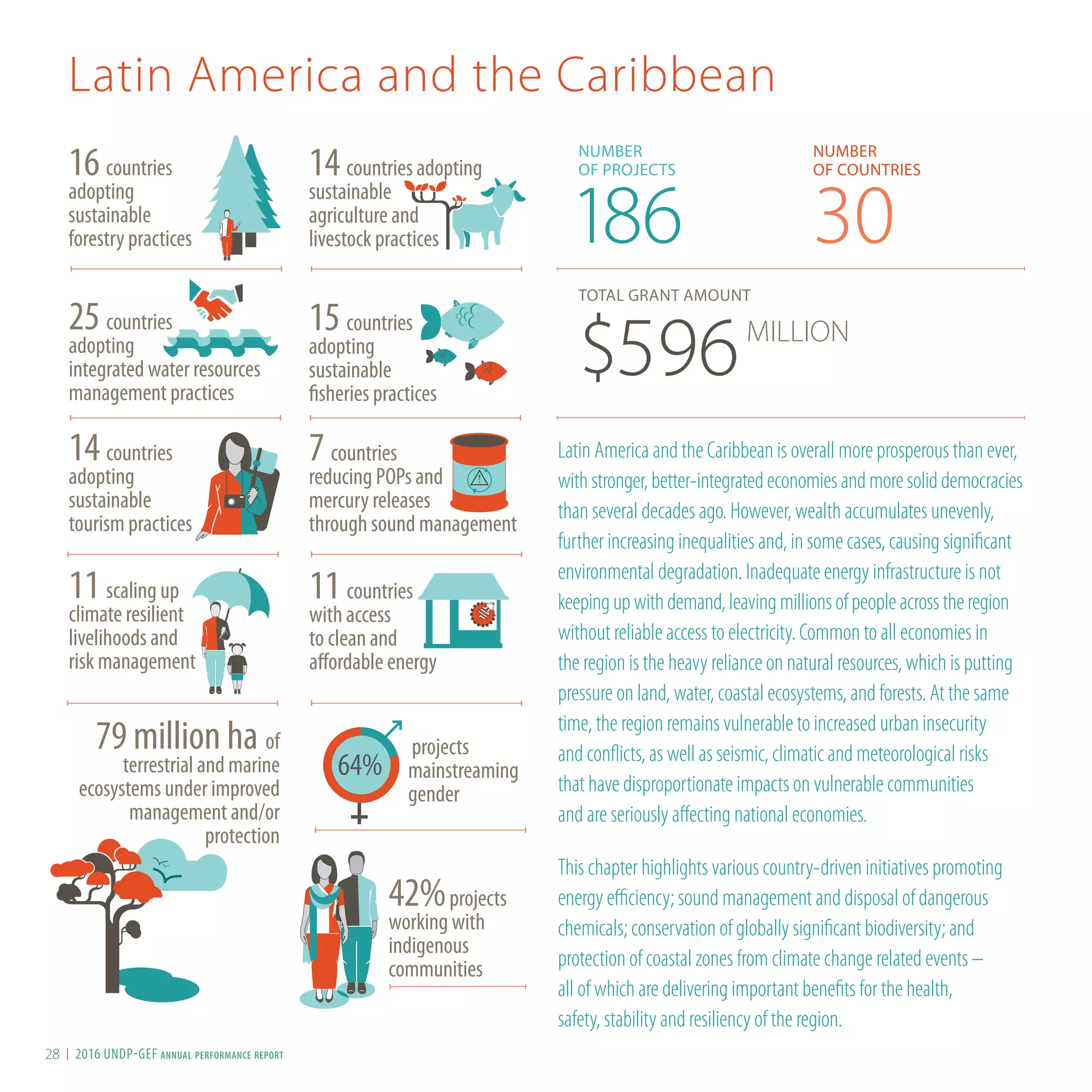
Latin America and the Caribbean is overall more prosperous than ever,
withstronger,better-integratedeconomiesandmoresoliddemocracies
than several decades ago. However, wealth accumulates unevenly,
further increasing inequalities and, in some cases, causing significant
environmental degradation. Inadequate energy infrastructure is not
keepingupwithdemand,leavingmillionsofpeopleacrosstheregion
without reliable access to electricity. Common to all economies in
the region is the heavy reliance on natural resources, which is putting
pressure on land, water, coastal ecosystems, and forests. At the same
time, the region remains vulnerable to increased urban insecurity
and conflicts, as well as seismic, climatic and meteorological risks
that have disproportionate impacts on vulnerable communities
and are seriously affecting national economies.
This chapter highlights various country-driven initiatives promoting
energy efficiency; sound management and disposal of dangerous
chemicals; conservation of globally significant biodiversity; and
protection of coastal zones from climate change related events –
all of which are delivering important benefits for the health,
safety, stability and resiliency of the region.
NUMBER
OF PROJECTS
186
TOTAL GRANT AMOUNT
$596MILLION
NUMBER
OF COUNTRIES
30
79 million ha of
terrestrial and marine
ecosystems under improved
management and/or
protection
64%
42%projects
working with
indigenous
communities
projects
mainstreaming
gender
15 countries
adopting
sustainable
fisheries practices
11 scaling up
climate resilient
livelihoods and
risk management
7 countries
reducing POPs and
mercury releases
through sound management
14 countries adopting
sustainable
agriculture and
livestock practices
25 countries
adopting
integrated water resources
management practices
16 countries
adopting
sustainable
forestry practices
11 countries
with access
to clean and
affordable energy
14 countries
adopting
sustainable
tourism practices
I 2016 UNDP-GEF annual performance report28
More than 80 percent of Brazil’s population lives in urban areas,
and energy consumption from buildings accounts for half of total
electricity consumption in the country. To move Brazil towards a more
sustainable energy consumption pathway, the Government is taking
steps to improve energy efficiency in public and private buildings.
Different models of energy efficiency have been tested in public
buildings in Rio de Janeiro, hospitals in Recife, and the headquarters
of the National Electricity Regulation Agency in Brasilia. The Brazilian
Labeling Program for Buildings has completed two rounds of a training
programme with engineering professionals and building managers
from around the country. In Colombia, a recently approved regulatory
framework requires using labels rating energy consumption performance
on high-demand equipment. This allows consumers to consider energy
consumption when purchasing appliances and promotes a market
transformation that gives a competitive advantage to energy
efficient appliances.
Polychlorinated biphenyls (PCBs)—classified as persistent organic
pollutants (POPs)—have been widely used as a component of cooling
oil in electrical equipment such as transformers and capacitors, however
they are considered by the International Agency for Research on Cancer
as among the most carcinogenic compounds. In Ecuador, the Ministry
of Environment is promoting the environmentally sound handling,
storage, and disposal of chemicals and hazardous wastes, including
the management of PCB stocks in the public electrical system. All
electric companies in the country now have PCB management plans,
and in January 2016 a ministerial agreement to regulate all phases of
PCB management was published, helping to improve the health and
safety of workers. The devastating 2016 earthquake provided additional
impetus to raise community awareness to the dangers of PCBs and the
necessity of sound chemicals management. Costa Rica is also promoting
safe management and elimination of PCBs through several initiatives,
including an approved national regulation for the identification and
UNDP is working with farmers to combat food insecurity in Haiti. Photo by M. Arago/UNDP Haiti
2016 UNDP-GEF annual performance report I 29
environmentally responsible elimination of PCBs that will significantly
reduce negative impacts on human health and the environment.
Similar activities are being carried out in Colombia, where public
and private laboratories across the country are being trained on
sampling and analysis of PCBs and other POPs in water, soil, air, oils,
blood, breast milk and food.
In Argentina, a set of community-based payment schemes for
environmental services (PES) was set up in four sites to conserve
ecosystems and the services they provide. The Misiones province, located
in the San Ramón River Watershed, covers an area of approximately 6,000
hectares, interspersed with remnants of an endangered ecosystem: the
Atlantic Forest. Local farmers, authorities and staff from the municipal
and provincial governments, and members of the San Ramón Watershed
Committee were involved in the development of a General Management
Plan for the entire watershed, an area where unsustainable agricultural
practices were leading to the degradation of soils and water, and the
associated loss of ecosystem services. The management plan serves as
a guide for designing individual farmer’s plans to increase the provision
of water-related ecosystem services while at the same time boosting
agricultural production. Similar work is underway in Guatemala.
A new legislative bill was approved and serves as an economic incentive
for sustainable forest management promoting the establishment,
recovery, restoration, management, production, and protection
of forests. Activities are underway with local communities to ensure
the sustainable management of about 9,700 ha of humid forest with
the support of the Foundation for Eco-development and Conservation,
the National Forest Institute, and by promoting reforestation with
native species, natural regeneration, and the establishment of biological
corridors and agroforestry systems. Local communities are involved in
forest conservation and water management initiatives and have signed
conservation agreements to protect over 13,000 ha of forest.
In the Caribbean, vulnerability and exposure to natural hazards has
resulted in huge costs in terms of the loss of human lives, productive
assets, infrastructure and natural resources. Coastal communities in
Haiti are vulnerable to higher frequency of droughts and floods, which
lead to increased beach erosion, salinization of fresh water aquifers
UNDP and the IMO have been assisting developing countries with reducing the risk of transfer of harmful aquatic organisms in ships’ballast water. Photo by UNDP-GEF-IMO GloBallast Partnership.
I 2016 UNDP-GEF annual performance report30
and estuaries, coastal erosion, and increased coral reef bleaching.
As these climate-related impacts affect food security, coastal farmers
are being supported to develop individualized farming plans based
on: an analysis of family needs; the vulnerabilities, problems, and
opportunities presented at each farm; and the vision of what the farmer
wants to achieve. These plans include planting new types of vegetables
to diversify crops, building stalls for livestock to keep them healthy
and protect crops, making compost from farm waste, introducing new
planting techniques that prevent erosion and use water more efficiently,
and establishing tree and plant nurseries. Watershed management
committees have been set up in the southern region of the country
to support ongoing work, including reforestation to help local
communities to better adapt to climate change impacts. At the national
level, the Ministry of Environment and the Ministry of Agriculture
have allocated specific budget lines for climate change management
in institutional budgets and plans, and the Ministry of Environment’s
Climate Change Department developed highly strategic policy
instruments, such as the country´s Intended Nationally Determined
Contributions (INDC) and the National Climate Change Policy, with
support from UNDP. Similar efforts are underway in Cuba, where the
coastal areas of the Artemisa and Mayabeque Provinces are particularly
vulnerable to climate change-related coastal erosion, flooding, and
saltwater intrusion. In these areas, mangrove forests are being restored,
and courses on the ecosystem services have been integrated into
university and school curricula.
Transforming the Global
Shipping Industry through
the GloBallast Partnership
Since 2007, UNDP and the International Maritime Organization
(IMO) have been assisting developing countries with reducing
the risk of transfer of harmful aquatic organisms in ships’ballast
water via the expansion of government and port management
capacities; strengthening of legal, policy and institutional
reforms at the national level; development of mechanisms
to improve sustainability; and regional coordination and
cooperation. The partnership has helped spur global efforts to
develop technological solutions to ballast water treatment and
management, and to enhance knowledge management and
information exchange to support marine biosecurity initiatives.
All 15 Lead Partner Countries—Argentina, Bahamas, Chile,
Colombia, Croatia, Egypt, Ghana, Jamaica, Jordan, Nigeria,
Panama, Trinidad and Tobago, Turkey, Venezuela
and Yemen—have drafted a National Ballast Water
Management Strategy, with 12 countries having officially
adopted their Strategy and the remaining three on track to
do so. Seven of these countries have ratified the International
Convention for the Control and Management of Ships’Ballast
Water and Sediments (BWM), which will enter into force in
September 2017, a significant catalytic impact of GloBallast.
With support from the GloBallast Partnership through initiatives
such as the Global Industry Alliance (GIA), a major new ballast
water treatment industry valued at over $40 billion has
emerged; to date, over 60 technologies have been approved for
global deployment across more than 40,000 ships that are now
mandated to treat their ballast water under the Convention.
With this continued progress and significantly enhanced global,
regional and national capacities, the GloBallast Partnership
is positioned to leave a remarkable legacy.
Crab larvae such as these have in several cases become invasive by traveling across the ocean in ship
ballast water. Photo by Roger Steene, UNDP-GEF-IMO GloBallast Partnership.
2016 UNDP-GEF annual performance report I 31
Photo by Arben Llapashtica/UNDP Kosovo.
GENDER IN ACTION
I 2016 UNDP-GEF annual performance report32
Gender equality is recognized not only as a fundamental human
right but also as a strategy to achieving sustainable human development.
The promotion of gender equality and the empowerment of women is
central to the mandate of UNDP and intrinsic to its development approach.
The gender results in this section were reported by 325 projects
that submitted a GEF project implementation report in 2016. These
results cover work carried out in 2015 and 2016, and may not include
all gender responsive interventions underway in this portfolio.
Performance on key gender mainstreaming indicators is included
in the corporate scorecard.
Three overlapping areas of impact emerged from this year’s portfolio:
supporting women’s economic empowerment, closing gender gaps
in natural resource management, and building gender responsive
national policies. These areas show progress in addressing gender
inequality while at the same time delivering and enhancing
environmental benefits.
Supporting Women’s Economic Empowerment
Women’s economic empowerment is recognized as a key factor
in reducing poverty, boosting economies, and improving the
health, safety, and resiliency of communities and ecosystems.
The stakes are high: closing the global gender gap in labor-force
participation could deliver an estimated US$12 trillion to $28 trillion
of additional GDP by 2025.
In 2016, 93 countries worked with UNDP to increase women’s economic
empowerment and generate environmental benefits through several
inter-linked approaches: access to alternative livelihoods opportunities
that do not degrade the environment; support for increased land tenure
and land rights for women; boosting women’s self-help groups and
collectives; and, assisting female farmers.
Closing Gender Gaps in Natural Resource Management
Closing gender gaps in natural resource management is vital to
advancing gender equality and tackling major environment and
development challenges including land degradation, water scarcity,
biodiversity loss, and food security. Activities that women commonly
carry out—such as water collection, gathering fuel wood, and subsistence
farming—are closely linked to the environment, therefore interventions
that tackle environmental challenges must also consider gendered
divisions of labor and gendered livelihood patterns. For example, in the
southern region of Mozambique where severe drought has threatened
food security and made daily water collection even more difficult,
In Colombia, women are key partners in making local communities more resilient to climate shocks. Photo by UNDP Colombia.
2016 UNDP-GEF annual performance report I 33
women have been the primary beneficiaries of microfinancing
services, which provide opportunities for alternative sustainable
livelihoods such as mussel cultivation and egg and chicken production.
These women are now the main suppliers to local tourism companies
that had previously relied on other markets for goods. With this
income, women have purchased their own land, enrolled themselves
in secondary school, started small businesses, and reinvested
in savings and loans groups. In addition, with new time-saving
measures, such as water-supplied greenhouses for community
gardening and boreholes, women no longer need to spend time
collecting water and traveling to farm—in some cases as far as
40 km, nearly the length of a marathon—and now instead participate
in and serve as leaders of water management committees. The
women-led water management committees in turn have prioritized
women’s land-use rights. Overall, this work is advancing women’s
economic empowerment while also making communities more
resilient to climate risks.
Building Gender Responsive National Policies
Supporting national governments to build policies to sustain
environment impacts is a key area of UNDP-GEF work. There
was significant progress in 2016 to integrate gender considerations
into national policies and planning processes, building on local-level
interventions that succeeded because women’s priorities and
decision-making informed the processes. For instance, in Haiti,
UNDP is assisting the Government in the development of a gender
responsive National Climate Change Policy that is based upon
knowledge gained from local-level support to women’s decision-
making and priorities in areas such as farming, water collection,
and food security.
These country-driven interventions demonstrate that promoting
gender equality is vital to achieving and sustaining global
environmental benefits.
In Nepal, UNDP is increasing women’s economic empowerment, a crucial driver of sustainable development. Photo by UNDP Nepal.
I 2016 UNDP-GEF annual performance report34
Since 2009 when Band-e Amir was officially declared
a national park, eight more women have been hired
as park staff. Not only are these women earning a decent
wage, but they are challenging traditional gender roles and
serving as the front-line faces of conservation and eco-friendly
tourism in the Park, which saw over 150,000 tourists in 2016.
The decision to hire the women was made through local
community councils, which are managed by board members,
30 percent of whom are women. In addition, over one third
of the Park’s 14 village committee members, which make
collective decisions on park management, are women.
In 2016, UNDP supported female park rangers working
to sustainably manage and protect natural resources in
eight countries: Afghanistan, Algeria, Angola, Croatia,
Guinea-Bissau, Seychelles, St. Kitts & Nevis and Uruguay.
Many of these countries have never before had female
park rangers.
In Afghanistan, where less than 16 percent of women work formally
outside the home, four women—Kubra, Nikhbakht, Sediqa and
Fatima—are transforming gender relations while also promoting
conservation.These ground-breakers are Afghanistan’s first female
park rangers, hired to protect the natural resources of the stunningly
beautiful Band-e Amir National Park, famous for its mineral-rich
sapphire blue lakes. Once a popular tourist destination, decades
of war and political unrest left the area unstable and the Park’s
natural resources in peril.
UNDP, in partnership with the Government of Afghanistan,
the GEF, and the Wildlife Conservation Society, is working
to sustainably manage protected areas, promote wildlife
conservation, and protect natural resources across the country.
Chosen by the community, and supported by UNDP, the park rangers are role models for other women
in Band-e-Amir and across the country as a whole. Photo by UNDP Afghanistan.
On a typical day, female park rangers collect data on endangered animals and protect the park
from poachers, overgrazing and the excesses of tourism. Photo by UNDP Afghanistan.
2016 UNDP-GEF annual performance report I 35
WOMEN’S
ECONOMIC EMPOWERMENT
GENDER RESPONSIVE
NATIONAL POLICIES
Work in 2016
Linked women’s self-help
groups and cooperatives
with microfinancing
services and access to
markets.
Ensured women’s
participation as
stakeholders and
decision-makers in
mixed-gender cooperatives
and collective producer
groups.
Empowered women as
trainers and facilitators
to share information on
topics including harmful
chemicals, energy efficient
technologies, water
resource management,
and other areas.
75 million women are
involved in self-helpgroups
in India alone
Cooperativesallowmembers
tosharerisks,poolresources,
accumulatesavingand
providecredit, especially
important in places where
women have low levels of
land ownership and lack
collateral to secure loans and
engage in other income-
generating opportunities
73 PROJECTS
IN 71COUNTRIES
SUPPORTING ALTERNATIVE
LIVELIHOODS
Increasing thehouseholdincome
controlled by women tends to
increase spending on children’s
education and health
In developing countries, 75% of
women’s employmentisinformal
andunprotected
Globally, women do 75% of
unpaidcareanddomesticwork
Key facts
Supported alternative
livelihood initiatives for
women that do not degrade
the environment, including
environmentally friendly
income-generating
opportunities such as
mushroom farming,
ecotourism sector work,
apiculture, renewable
energy entrepreneurship.
Boosted women’s productive
role in key value chains,
for instance Argan, shea
and charcoal, while at the
same time supporting
sustainable natural resource
management and low-carbon
energy strategies.
Provided time-saving,
environmentally-friendly
equipment, such as
multifunctional platforms and
solar-powered water tanks.
Work in 2016
Utilized findings from
gender responsive and
community- led
interventions to inform
decision-making at the
policy and planning levels
to address the structural
drivers of gender inequality.
Strengthened the capacity
of national governments
and assisted them in
integrating gender equality
into the development of
National Communications
and Biennial Reports to the
UNFCCC and National
Biodiversity Strategies and
Action Plans.
Supported women’s
decision-making and
participation in national
policy and planning
processes.
Policies, processes, and
institutions have different
impacts on women and men;
genderneutralandgender
blindpoliciescanexacerbate
inequalities, worsen
environmental degradation
and increase vulnerabilities to
climate shocks
Key facts
Work in 2016
Key facts
IMPACT
AREAS
41 PROJECTS
IN 39COUNTRIES
REINFORCING
SOLIDARITY NETWORKS
AND COLLECTIVE GROUPS
21 PROJECTS
IN 21COUNTRIES
SUPPORTING NATIONAL
POLICIES AND STRATEGIES
Gender Equality & Empowering Women
PHOTO CREDITS FROM LEFT TO RIGHT: UNDP Guatemala; UNDP Morocco; UNDP Lao PDR; UNDP Mali; UNDP Kosovo.I 2016 UNDP-GEF annual performance report36
CLOSING GENDER GAPS IN
NATURAL RESOURCE MANAGEMENT
In Morocco, where traditional patriarchal control
over land has meant that women are largely
excluded from the valuable Argan oil value chain
and are not represented in Argan tree rights holders
associations, UNDP is supporting an ecosystem
services scheme to circumvent women’s lack of land
rights by working with women’s cooperatives to
engage in sustainable Argan oil production.
In rural areas of Brazil, partnering with women’s
cooperatives is a key strategy in shifting away from
unsustainable agricultural practices to an approach
that conserves biodiversity. UNDP is working
women’s cooperatives in Maranhão and Alto São
Francisco to make fruit, seed and palm processing
more efficient, leading to higher income for the
women and more sustainable use of natural
resources.
In Uganda, UNDP is working with the National
Environment Management Authority and the
Uganda Wildlife Authority to help women earn
more money for shea butter tree nut production
by helping them form cooperative groups. The
groups learn more efficient production processes
and are linked directly with a private processing
company. The shea butter trees are being used more
sustainably – key to helping converse and sustain
the country’s threatened savanna woodland – and
the women are earning over double the price than
when they were working as individual sellers.
In Ukraine, UNDP has worked to integrate gender
considerations into the country’s draft Sustainable
Development Strategy, a key national framework
document which will guide all national policies,
strategies and planning in line with SDGs.
In Timor Leste, UNDP is working with the
government to ensure women’s priorities and
needs are included in national climate change
and climate risk management plans building
on local-level interventions to make community
water supplies more resilient to shocks.
IN FOCUS
Supported women’s
control of and access
to land and other natural
resources, including as
decision-makers in local
land and water
management committees
and natural resource
planning.
Integrated gender
considerations into
management plans
for sustainable land
management, integrated
water resources
management and
climate risk management.
Ensured women’s
decision-making and
participation in land-use
and water-use
committees.
In developing countries,
womenmakeuponly
10to20%oflandholders
Women’s lackofsecure
rightsoverlandtranslates
into lower productivity and
less investment in
sustainable resource use,
perpetrating land
degradation, food insecurity,
malnutrition and poverty
Ensured women’s
leadership roles in
Farmer Fields Schools,
an interactive approach
to sharing innovative and
relevant farming practices.
Empowered women
farmers to adopt farming
practices that can protect
soil fertility, diversify
livelihoods and strengthen
market linkages.
Supported gender
responsive access to
weather and climate
information, including
forecasting stations,
mobile phones and other
early warning systems.
Closing the gendergapin
agriculturalcould lift up to
150 million people out
of hunger
Women tend to have
smallerplots than men
and receive only about 5%
of agricultural
education services
Work in 2016
Key facts
Work in 2016
Key facts
16 PROJECTS
IN 15COUNTRIES
IMPROVING LAND
RIGHTS
31PROJECTS
IN 27COUNTRIES
EMPOWERING
FEMALE FARMERS
are key to achieving environmental benefits and sustainable development
2016 UNDP-GEF annual performance report I 37
GEF SMALL GRANTS PROGRAMME
peoples to conserve biodiversity, mitigate and adapt to climate change,
sustainably manage land, conserve marine and coastal areas, and
sustainably manage chemicals and waste.
A key feature of SGP-supported projects is their demonstrated replication
and upscaling impact, including via influencing policy. SGP country programs
reported that 146 projects completed during the reporting year were
already replicated or had been scaled-up, while 80 such projects reported
influencing policy changes. In Benin, for example, with the support of SGP,
Synergie Paysanne and the Pro-Environment Platform were instrumental in
strengthening the environmental protection aspects of Law No. 2013-01,
which now ensures better regulation of access to land by citizens, prior
confirmation of land rights before any transaction, and limits placed on
the acquisition of vast fields of unexploited land by affluent people.
These community driven projects were recognized nationally and
internationally, winning 55 national and international awards in the last
year alone. The results of this support to poor and vulnerable communities
and local CSOs were mentioned in local media—television, radio, print,
digital and social media—over 1,300 times.
In the year under review, the GEF Small Grants Programme (SGP)
committed an additional US$17.6 million for 525 new projects
that support communities and civil society organizations to take
action against environmental degradation and promote sustainable
development, bringing the value of the active portfolio to $123.9 million.
Active in 125 countries, the Programme is a world-renowned vehicle
for supporting indigenous peoples, women, youth, and marginalized
SGP PORTFOLIO
JULY 2015–JUNE 2016
SGP RESULTS ACHIEVED
JULY 2015–JUNE 2016
$123.9MILLION
IN GRANT FUNDING OF ACTIVE PROJECTS
525NEW
PROJECTS
1,142COMPLETED
PROJECTS
3,490ACTIVE
PROJECTS
BIODIVERSITY
LAND
DEGRADATION CLIMATE CHANGE
INTERNATIONAL
WATERS CHEMICALS
8.41m
HECTARES OF PAs SUPPORTED
1,803
SIGNIFICANT SPECIES CONSERVED
653
BIODIVERSITY-BASED PRODUCTS
SUSTAINABLY PRODUCED
645
PROTECTED AREAS AND
INDIGENOUS AND COMMUNITY
CONSERVED AREAS POSITIVELY
INFLUENCED
900k
HECTARES OF LAND BROUGHT
UNDER IMPROVED LAND
MANAGEMENT PRACTICES
500k
COMMUNITY MEMBERS
DEMONSTRATING SUSTAINABLE
LAND AND FOREST
MANAGEMENT PRACTICES
323PROJECTS
46%OF PROJECTS FOCUS ON LOW
CARBON TECHNOLOGY AND
RENEWABLE ENERGY
26%OF PROJECTS FOCUS ON ENERGY
EFFICIENCY SOLUTIONS
25%OF PROJECTS FOCUS ON
CONSERVATION AND ENHANCEMENT
OF CARBON STOCKS
15
INTERNATIONAL WATER
BODIES WHERE LOCAL
EFFORTS ARE SUPPORTED
40
TONS OF LAND-BASED
POLLUTION REDUCED
32k
HECTARES OF MARINE
AND COASTAL AREAS
WERE BROUGHT UNDER
SUSTAINABLE MANAGEMENT
3,458
TONS OF SOLID WASTE AVOIDED
FROM OPEN BURNING WASTE
37
TONS OF PESTICIDES
PROPERLY DISPOSED
I 2016 UNDP-GEF annual performance report38
Photo by UNDP Croatia.
ANNEX 1: Corporate Scorecard
392016 UNDP-GEF annual performance report I
Project cycle effectiveness
Projects submitted to vertical
funds by UNDP
This graph shows the total value
(in US$ millions) of projects submitted
to the GEF and the GCF for approval each
calendar year since 2012. This represents
a total of 682 projects covering
143 countries.
First disbursement
of full-sized projects
This graph shows the cumulative
number of projects that had their
first disbursement of GEF funds
within one, two, and three years after
endorsement. The graph shows that
UNDP performs slightly better than the
GEF overall, with 97% of projects making
first disbursement within two years.
This analysis is based on 224 full-sized
UNDP-supported projects endorsed
between FY2011 and FY2015 (GEF
Agencies’total is 559 full-sized projects).
0
200
400
600
800
1,000
1,200
20162015201420132012
TOTALVALUEINUS$MILLIONS
GEF FAMILY OF FUNDS GCF FUNDS
WITHIN
THREE
YEARS
WITHIN
TWO
YEARS
WITHIN
ONE
YEAR
UNDP GEF AGENCIES
0%
20%
40%
60%
80%
100%
PERCENTAGEOFPROJECTS
66%
86% 88%
This Corporate Scorecard highlights
progress made by the UNDP portfolio
of vertical fund projects (primarily
GEF, but also AF and GCF) in project
cycle effectiveness, results driven
implementation and gender
mainstreaming.Where appropriate,
UNDP’s performance is compared
to that of the overall GEF portfolio,
as reported in the GEF Corporate
Scorecard (October 2016), which
reports the performance of all
18 GEF Agencies.
I 2016 UNDP-GEF annual performance report40
Results-driven implementation Gender mainstreaming
Progress towards Project
Development Objectives
Gender in project design
This graph shows the percentage of
projects rated in the satisfactory range
for annual performance in terms of
cumulative progress toward achieving
project development objectives (DO),
since 2012. The target is 75% rated in
the satisfactory range. The graph shows
that UNDP performance is in line with
that of the GEF overall. This analysis is
based on UNDP’s annual PIR cohorts,
which contained an average of 320
projects per year from 2012 to 2016.
See Annex 2 for further details.
Outcome ratings
at project closure
This graph shows the percentage of
closed projects rated in the satisfactory
range for their outcomes, as assessed
by independent Terminal Evaluations
and validated by the UNDP IEO. The graph
compares UNDP performance against
that of all GEF Agencies; UNDP was under
performing in 2012 but since 2013 has
performed better than the GEF overall.
The project outcome ratings are not yet
available for 2016. See Annex 2.
This graph shows the percentage of
projects endorsed in GEF-6 (approved
1 July 2014 ‐ 30 June 2016) that have
conducted a gender analysis and
that have integrated gender into their
results framework. While the numbers
of projects in both cohorts is small, UNDP
performance is generally in line with that
of the GEF overall. This analysis is based
on six UNDP-supported projects and
29 projects from GEF Agencies.
A larger dataset is expected in the future.
20162015201420132012
PERCENTAGEOFPROJECTS
UNDP GEF AGENCIES
TOTAL NUMBER
OF PROJECTS 325298292329355
0%
20%
40%
60%
80%
100%
86%
90%
89%
87%
92%
PROJECTS WITH
GENDER RESPONSIVE
RESULTS FRAMEWORK
PROJECTS THAT
HAVE CONDUCTED
A GENDER ANALYSIS
PERCENTAGEOFPROJECTS
UNDP GEF AGENCIES
0%
20%
40%
60%
80%
100%
86%
79%
2015201420132012
PERCENTAGEOFPROJECTS
UNDP GEF AGENCIES
0%
20%
40%
60%
80%
100%
69565068
TOTAL NUMBER
OF PROJECTS
87%
79%
79%
75%
2016 UNDP-GEF annual performance report I 41
Photo by UNDP Cuba.
ANNEX 2: Projects Active in 2016
The following list of 810 projects have received financing from the GEF family of
funds (GEF, LDCF, NPIF, SCCF), the Green Climate Fund (GCF), the Adaptation Fund
(AF), and cost-sharing sources of funds. Of these, 86 have been recently approved
and have yet to begin implementation; 344 have been under implementation for
more than one year and submitted an annual progress report; and 55 submitted
a terminal evaluation and are expected to close shortly.
I 2016 UNDP-GEF annual performance report42
How to read the table in this annex:
•	 Grant Amount: Includes both the project preparation grant (PPG)
and the project grant in US$.
•	 Disbursement: Cumulative disbursement as of 31 December 2016
in US$.
•	 GEF Development Objective (DO) rating: Projects that completed
a GEF Project Implementation Report (PIR) in 2016 provided a rating
on cumulative progress made toward achieving their objective.
•	 Terminal Evaluation (TE) outcome rating: When a project completes
implementation, independent evaluators rate the achievement
of project outcomes. These ratings are validated by the UNDP
Independent Evaluation Office (IEO). If the ratings are changed
by the UNDP IEO this rating is provided. Ratings are provided
in the same column as the DO ratings.
•	 GEF Implementation Progress (IP) rating: Projects that completed
a GEF PIR in 2016 provided a rating on annual implementation
progress on delivering outputs.
•	 AF Project Performance Report (PPR): AF-financed projects are rated
annually on their progress towards achieving outcomes. Ratings are
provided only for projects that completed an AF PPR in 2016 and are
provided in the same column as the GEF DO rating.
•	 Terminal Evaluation (TE) quality rating: The UNDP Independent
Evaluation Office (IEO) rates the quality of each TE report. This rating
is not linked to the performance of the project. Ratings are available
only for projects that submitted a TE report in 2016 and are provided
in the same column as the GEF IP ratings.
All ratings are on a six-point scale ranging from Highly Satisfactory (HS)
to Highly Unsatisfactory (HU).
Total Portfolio Under Implementation By Region, Number of Countries and Number of Projects
US$3.1
BILLION
IN GRANTS
143
COUNTRIES
SUPPORTED
810
PROJECTS
UNDERWAY
GRANT
AMOUNT
(MILLION US$)
NUMBER
OF PROJECTS
NUMBER
OF COUNTRIES
AFRICA
$781
46 11 35 21 30
198 53 214 122 37186
ASIA AND
THE PACIFIC
$971
LATIN
AMERICA AND
THE CARIBBEAN
$596
ARAB
STATES
$199
EUROPE
AND CENTRAL
ASIA
$348
GLOBAL
$240
2016 UNDP-GEF annual performance report I 43
Projects Active in 2016
HS: Highly Satisfactory; S: Satisfactory; MS: Moderately Satisfactory; MU: Moderately Unsatisfactory; U: Unsatisfactory; HU: Highly Unsatisfactory
Country and Project Title
Source
of Funds
Grant
Amount
(US$)
Cumulative
Disbursement
(US$)*
Co-financing
(US$)
PIR DO or
TE Outcome
Rating
PIR IP or
TE Quality
Rating
Afghanistan 15,681,819
Establishingintegratedmodelsforprotectedareasandtheirco-management GEF 6,581,819 3,423,835 53,300,000 S S
StrengtheningtheresilienceofrurallivelihoodoptionsforAfghancommunitiesinPanjshir,Balkh,UruzganandHeratProvincestomanageclimate
change-induceddisasterrisks
LDCF 9,100,000 2,346,249 103,000,000 S S
Albania 4,150,000
Improvingcoverageandmanagementeffectivenessofmarineandcoastalprotectedareas GEF 1,000,000 978,157 1,927,500 HS S
ThirdNationalCommunicationstotheUNFCCC GEF 500,000 496,920 – – –
EstablishingAlbania’sEnvironmentalInformationManagementandMonitoringSystemalignedwiththeglobalenvironmentalreporting GEF 1,000,000 208,340 5,429,700 – –
Enhancingfinancialsustainabilityoftheprotectedareasystem GEF 1,450,000 – 7,020,000 – –
MinamataInitialAssessment GEF 200,000 11,399 – – –
Algeria 7,607,142
ConservationofgloballysignificantbiodiversityandsustainableuseofecosystemservicesinAlgeria’sCulturalParks-Phase2 GEF 5,387,142 2,606,101 10,022,858 S S
NationalBiodiversityPlanningtoSupporttheimplementationoftheCBD2011-2020StrategicPlan GEF 220,000 206,188 321,600 – –
Developinganationalstrategyandlegalandinstitutionalframeworkonaccesstogeneticresourcesandrelatedbenefitsharingandtraditional
knowledgeinlinewiththeCBDanditsNagoyaProtocol
GEF 2,000,000 91,778 5,284,320 – –
Angola 21,970,000
ExpansionandStrengtheningofAngola’sProtectedAreasystem GEF 5,900,000 254,129 16,426,607 – –
NationalBiodiversityProject:AngolaIonaConservationProject GEF 2,000,000 924,352 6,000,000 MS MS
Promotingclimate-resilientdevelopmentandenhancedadaptivecapacitytowithstanddisasterrisksinAngolan’sCuvelaiRiverBasin LDCF 8,350,000 288,666 46,473,004 – –
UNEP-UNDP:AddressingUrgentCoastalAdaptationNeedsandCapacityGaps LDCF 1,000,000 – 11,520,000 – –
PromotionofSustainableCharcoalinAngolathroughaValueChainApproach GEF 4,720,000 – 13,164,095 – –
Argentina 20,361,574
EnvironmentallySoundManagementandDestructionofPCBs GEF 3,500,000 3,152,617 5,000,000 MS MS
Establishmentofincentivesfortheconservationofecosystemservicesofglobalsignificance GEF 2,012,876 1,457,322 8,959,024 MS MU
Strengtheningfisheriesgovernancetoprotectfreshwaterandwetlandbiodiversity GEF 2,355,000 2,355,000 4,843,000 TE: HS TE: MS
Mainstreamingsustainableuseofbiodiversityinproductionpracticesofsmallproducerstoprotectthebiodiversityofhighvalueconservationforests
intheAtlanticForest,YungasandChaco
GEF 4,770,000 968,015 23,687,400 S MS
SustainablelandusemanagementinthedrylandsofNorth-westArgentina GEF 3,609,091 599,783 20,805,854 MS MS
PromotingtheapplicationoftheNagoyaProtocolonABS NPIF 958,904 44,260 3,000,186 – –
Sustainablebusinessmodelsforbiogasproductionfromorganicmunicipalsolidwaste GEF 2,854,849 – 12,665,000 – –
ArgentineRepublicFirstBiennialUpdateReport GEF 300,854 196,461 – – –
*	CumulativeDisbursementasof31December2016.
I 2016 UNDP-GEF annual performance report44
Country and Project Title
Source
of Funds
Grant
Amount
(US$)
Cumulative
Disbursement
(US$)*
Co-financing
(US$)
PIR DO or
TE Outcome
Rating
PIR IP or
TE Quality
Rating
Armenia 35,042,553
ImprovingEnergyEfficiencyinBuildings GEF 1,090,450 1,090,201 2,350,000
PIR: S
TE: S
PIR: S
TE: S
CatalyzingFinancialSustainabilityofArmenia’sProtectedAreasSystem GEF 1,000,000 975,921 4,535,000 S S
MainstreamingSustainableLandandForestManagementinDryMountainLandscapesofNortheasternArmenia GEF 3,068,493 205,839 2,075,892 – –
GreenUrbanLighting GEF 1,650,000 1,238,200 8,495,000 S S
EliminationofObsoletePesticideStockpilesandaddressingPOPsContaminatedSiteswithinaSoundChemicalsManagementFramework GEF 4,840,000 264,465 19,284,384 S S
ClimaEast:Promotionofbiodiversityconservationandclimatechangemitigationthroughrehabilitationofmountainrangelandandforestecosystems EC 1,389,610 1,041,462 – – –
Generateglobalenvironmentalbenefitsthroughenvironmentaleducationandraisingawarenessofstakeholders GEF 800,000 93,338 723,735 – –
Armenia'sFirstBiennialUpdateReport2014totheUNFCCC GEF 352,000 351,639 66,000 – –
De-RiskingandScaling-upInvestmentinEnergyEfficientBuildingRetrofits GCF 20,000,000 – 9,820,000 – –
DevelopmentofArmenia’sFourthNationalCommunicationtotheUNFCCCandSecondBiennialReport GEF 852,000 7,076 580,000 – –
Azerbaijan 4,150,000
SCCFIntegratingclimatechangerisksintowaterandfloodmanagementbyvulnerablemountainouscommunitiesintheGreaterCaucasusregion SCCF 2,800,000 2,590,329 7,260,000 S S
IncreasingrepresentationofeffectivelymanagedmarineecosystemsinProtectedAreasystems GEF 1,363,636 829,564 6,491,069 MS S
SustainableLandAndForestManagementInTheGreaterCaucasusLandscape
EC 1,389,610 1,262,123 – – –
GEF 5,780,000 3,579,311 11,400,000 MS MS
NationalBiodiversityPlanningtoSupporttheimplementationoftheCBD2011-2020StrategicPlan GEF 210,000 210,000 276,000
NationallyAppropriateMitigationActions(NAMAs)forlow-carbonend-usesectors GEF 3,670,000 1,085,554 31,900,000 MS MS
Nationallydeterminedcontributionstothe2015AgreementundertheUNFCCC GEF 150,000 150,000 – – –
Conservationandsustainableuseofgloballyimportantagrobiodiversity GEF 4,310,502 – 20,700,000 – –
StrengthennationaldecisionmakingtowardsratificationoftheMinamataConventionandbuildcapacitytowardsimplementationoffutureprovisions GEF 200,000 69,699 – – –
DevelopmentofAzerbaijan’sFourthNationalCommunicationtotheUNFCCCandSecondBiennialReporting GEF 852,000 – 575,000 – –
Bangladesh 19,683,787
ImprovingKilnEfficiencyfortheBrickIndustry GEF 3,348,000 3,265,388 200,000 MS MS
Community-basedAdaptationtoClimateChangethroughCoastalAfforestation LDCF 3,400,000 3,011,421 6,080,000 – –
DevelopmentofSustainableGrid-ConnectedWindElectricityGeneration GEF 4,227,272 580,288 49,600,000 MS MS
ExpandingthePASystemtoIncorporateImportantAquaticEcosystems GEF 1,716,894 72,970 8,450,000 HU HU
IntegratingCommunity-basedAdaptationintoAfforestationandReforestationProgrammes LDCF 5,700,000 107,983 47,000,000 MU MU
NationalCapacityDevelopmentforimplementingRioConventionsthroughEnvironmentalGovernance GEF 685,000 22,519 772,700 – –
ThirdNationalCommunicationtotheUNFCCC GEF 456,621 409,970 – – –
Barbados 2,246,484
SecondNationalCommunicationtotheUNFCCC GEF 420,000 419,903 – – –
PromotingSolarPhotovoltaicSystemsinPublicBuildingsforCleanEnergyAccess,IncreasedClimateResilienceandDisasterRiskManagement GEF 1,826,484 178,466 30,900,000 – –
2016 UNDP-GEF annual performance report I 45
Country and Project Title
Source
of Funds
Grant
Amount
(US$)
Cumulative
Disbursement
(US$)*
Co-financing
(US$)
PIR DO or
TE Outcome
Rating
PIR IP or
TE Quality
Rating
Belarus 19,960,916
ImprovingEnergyEfficiencyinNewResidentialBuildings GEF 4,560,000 2,908,799 13,700,000 S S
Landscapeapproachtomanagementofpeatlandsaimingatmultipleecologicalbenefits GEF 2,775,900 2,489,625 10,484,400 S S
RemovingBarrierstoWindPowerDevelopment GEF 3,125,000 643,115 40,900,000 MS MS
BelarusGreenCities:SupportingGreenUrbanDevelopmentinSmallandMediumSizedCities GEF 3,171,000 152,446 12,435,420 – –
ClimaEast:ConservationandsustainablemanagementofpeatlandsinBelarustominimizecarbonemissionsandhelpecosystemstoadapt
toclimatechange,whilecontributingtotheoverallmitigationandadaptationeffort
EC 1,945,455 1,580,720 – – –
Conservation-orientedmanagementofforestsandwetlandstoachievemultiplebenefits GEF 4,383,561 – 14,230,000 – –
Belize 3,921,000
StrengtheningNationalCapacitiesfortheConsolidation,OperationalizationandSustainabilityofBelize’sProtectedAreasSystem GEF 975,000 974,174 1,031,000 TE: MS TE: HS
NationalBiodiversityPlanningtoSupporttheimplementationoftheCBD2011-2020StrategicPlan GEF 220,000 217,522 102,000 – –
Capacity-buildingforthestrategicplanningandmanagementofnaturalresources GEF 784,000 333,177 643,000 – –
BelizeChemicalsandWasteManagementProgramme GEF 1,090,000 730,111 6,366,151 – –
FourthNationalCommunicationandFirstBiennialUpdateReporttotheUNFCCC GEF 852,000 – 215,500 – –
Benin 7,607,142
IncorporationofSacredForestsintotheProtectedAreasSystemofBenin GEF 950,000 945,887 4,070,000 HS S
IntegratedAdaptationProgrammetoCombattheadverseEffectsofClimateChangeonAgriculturalProductionandFoodSecurity LDCF 3,490,000 3,453,384 7,510,000 TE: S TE: U
StrengtheningtheresilienceoftheenergysectorinBenintotheimpactsofclimatechange LDCF 8,200,000 427,691 30,000,000 – –
Strengtheningclimateinformationandearlywarningsystemstosupportclimateresilientdevelopment LDCF 4,100,000 3,465,660 14,511,549 MS MS
Promotionofsustainablebiomassbasedelectricitygeneration GEF 3,972,602 – 14,300,000 – –
GreenClimateFundReadinessProgramme BMUB 931,255 303,650 – – –
Bhutan 14,414,200
PromotingSustainableRuralBiomassEnergy GEF 1,778,000 1,777,457 2,360,000 HS S
Addressingtheriskofclimate-induceddisastersthroughenhancednationalandlocalcapacityforeffectiveactions LDCF 11,591,200 6,773,706 54,539,829 S S
ImplementingtheNagoyaProtocolonAccesstoGeneticResourcesandBenefitSharing NPIF 1,045,000 659,922 3,003,668 S S
Bolivia 16,612,502
BiodiversityConservationthroughSustainableForestManagementbylocalcommunities GEF 5,600,000 2,323,026 10,885,000 MS MS
ThirdNationalCommunicationstotheUNFCCC GEF 500,000 450,761 – – –
FifthOperationalPhaseoftheGEFSmallGrantsProgramme GEF 4,166,667 4,155,351 4,500,000 – –
SustainablemanagementofforestecosystemsinAmazoniabyindigenousandlocalcommunitiestogeneratemultipleenvironmental
andsocialbenefits
GEF 6,345,835 – 26,393,386 – –
Bosnia  Herzegovina 5,850,000
TechnologytransferforclimateresilientfloodmanagementinVrbasRiverBasin SCCF 5,150,000 1,560,475 77,260,000 S S
ThirdNationalCommunication(TNC) GEF 500,000 483,991 131,000 – –
StrengthenBosniaandHerzegovinadecisionmakingtowardsbecomingaPartytotheMinamataConventionandbuildcapacitytowards
implementationoffutureprovisions.
GEF 200,000 48,828 – – –
I 2016 UNDP-GEF annual performance report46
Country and Project Title
Source
of Funds
Grant
Amount
(US$)
Cumulative
Disbursement
(US$)*
Co-financing
(US$)
PIR DO or
TE Outcome
Rating
PIR IP or
TE Quality
Rating
Botswana 9,568,024
ImprovedManagementEffectivenessoftheChobe-Kwando-LinyantiMatrixofProtectedAreas GEF 1,909,092 1,149,736 6,994,239 S S
MainstreamingSLMinrangelandareasofNgamilanddistrictproductivelandscapesforimprovedlivelihoods GEF 3,181,800 1,078,435 28,599,000 MU MU
Promotingproductionandutilizationofbiomethanefromagro-wasteinSouth-EasternBotswana GEF 2,732,300 – 16,684,000 – –
Botswana'sThirdNationalCommunication(TNC)totheUNFCCCandFirstBiennialUpdateReport(FBUR) GEF 952,000 144,051 103,000 – –
UsingSLMtoimprovetheintegrityoftheMakgadikgadiecosystemandtosecurethelivelihoodsofrangelanddependentcommunities GEF 792,832 415,775 6,795,000 S S
Brazil 75,039,354
EnvironmentalStrategyforElectrolyticHydrogenasaMassTransitFuelforBrazil GEF 12,274,000 11,940,325 – – –
Sustainablelandusemanagementinthesemi-aridregionofNorth-eastBrazil(Sergipe) GEF 3,900,078 1,093,424 17,333,016 S S
EffectiveConservationandSustainableUseofMangroveEcosystems(SNUC) GEF 5,330,000 4,480,153 15,345,692 S S
SugarcaneRenewableElectricity(SUCRE) GEF 8,000,000 1,467,842 62,800,000 S S
CatalyzingthecontributionofIndigenousLandstotheconservationofBrazil’sforestecosystems GEF 6,100,000 5,902,518 31,700,000 S S
MarketTransformationforEnergyEfficiency(EE)inBuildings GEF 3,305,000 1,552,728 122,774,000 S S
EstablishmentofPCBManagementandDisposalProgram GEF 4,862,000 2,333,799 11,553,000 MS S
ThirdNationalCommunicationtotheUNFCCC GEF 5,720,000 5,352,142 6,500,000 S S
5thOperationalPhaseoftheGEFSmallGrantsProgram GEF 5,000,000 3,843,251 5,050,000 HS S
MainstreamingBiodiversityConservationandSustainableUseintoNTFPandAFSproductionpracticesinMultiple-UseForestLandscapes
ofHighConservationValue
GEF 5,570,776 604,983 27,800,000 MS S
Productionofsustainable,renewablebiomass-basedcharcoalfortheironandsteelindustry GEF 7,200,000 241,392 36,800,000 S MS
NationalBiodiversityPlanningtoSupporttheimplementationoftheCBD2011-2020StrategicPlan GEF 249,000 145,670 367,290 – –
FourthNationalCommunicationandBiennialUpdateReportstotheUnitedNationsFrameworkConventiononClimateChange(UNFCCC) GEF 7,528,500 37,763 22,885,500 – –
Burkina Faso 19,804,680
NationalsubprogramforCoordinationandInstitutionalDevelopmentonSustainableLandManagement GEF 1,000,000 977,987 1,500,000 – –
CPP:MouhounRegionSub-ProgramforSustainableLandManagement GEF 2,502,450 1,945,859 9,248,351 S S
SustainableLandManagementsubprogramforCentre-Westregion GEF 2,219,594 1,738,278 8,877,377 S S
PromotionofJatrophaCurcasasaresourceofBioenergy GEF 1,363,636 176,341 4,455,000 MS S
ProtectedAreaBufferZoneManagement GEF 909,000 329,992 3,090,000 MS MS
ReducingvulnerabilityofnaturalresourcedependentlivelihoodsintwolandscapesatriskoftheeffectsofclimatechangeinBurkinaFaso:
BouclesduMouhounForestCorridorandMared’OursiWetlandsBasin
LDCF 7,120,000 1,523,282 30,552,541 S S
GeneratingGlobalEnvironmentalBenefitsfromImprovedLocalPlanningandDecision-makingSystems GEF 990,000 540,978 2,015,610 MU MS
StrengtheningclimateinformationandearlywarningsystemsinWesternandCentralAfricaforclimateresilientdevelopmentandadaptationto
climatechange
LDCF 3,700,000 2,315,954 61,090,525 S S
Burundi 9,694,090
ImprovingeffectivenessofProtectedAreastoconservebiodiversity GEF 909,090 897,685 2,375,571 S S
Communitydisasterriskmanagement LDCF 8,785,000 327,611 27,000,000 – –
2016 UNDP-GEF annual performance report I 47
Country and Project Title
Source
of Funds
Grant
Amount
(US$)
Cumulative
Disbursement
(US$)*
Co-financing
(US$)
PIR DO or
TE Outcome
Rating
PIR IP or
TE Quality
Rating
Cambodia 16,499,763
PromotingClimate-ResilientWaterManagementandAgriculturalPracticesinRuralCambodia Canada 2,242,426 2,195,259 1,950,000 – –
Strengtheningsustainableforestmanagementandthedevelopmentofbio-energymarketstopromoteenvironmentalsustainability,reducerural
povertyandCO2
emissions
GEF 2,363,635 2,361,178 6,300,000 TE: S TE: MS
ReducingthevulnerabilityofCambodianrurallivelihoodsthroughenhancedsub-nationalclimatechangeplanningandexecutionofpriorityactions LDCF 4,717,500 174,216 15,860,000 – –
Generating,AccessingandUsingInformationandKnowledgeRelatedtotheThreeRioConventions GEF 1,015,000 235,009 1,300,000 – –
StrengtheningclimateinformationandearlywarningsystemsinCambodiatosupportclimateresilientdevelopmentandadaptationtoclimatechange LDCF 5,060,285 278,051 21,884,540 U U
CollaborativeManagementofWatershedandEcosystemServiceProtectionandRehabilitationintheCardamomMountains,UpperPrekThnotRiverBasin GEF 1,100,917 – – – –
Cameroon 940,000
AbottomupapproachtoABS:communitylevelcapacitydevelopmentforsuccessfulengagementinABSvaluechainsinCameroon
(Echinopsgiganteus)andNamibia(CommiphoraWildii)
NPIF 440,000 30,445 550,000 – –
GEF 500,000 – 550,000 – –
CapeVerde 11,387,763
Buildingadaptivecapacityandresiliencetoclimatechangeinthewatersector Canada 1,980,000 1,896,586 13,570,000 – –
ConsolidationofCapeVerde’sProtectedAreasSystem GEF 3,200,000 3,199,234 14,395,000 TE: MS TE: MU
Mainstreamingbiodiversityconservationintothetourismsectorinsynergywithafurtherstrengthenedprotectedareassystem GEF 3,716,763 261,933 10,047,191 – –
ThirdNationalCommunicationstotheUNFCCC GEF 500,000 332,912 – – –
RemovingBarrierstoEnergy-EfficiencyintheCapeVerdeanBuiltEnvironmentandforAppliances GEF 1,991,000 269,210 10,036,998 – –
Central African Republic 300,000
GCFReadinessandPreparatorySupport GCF 300,000 – – – –
Chad 1,661,360
ConservationandsustainableuseofbiodiversityintheMoyen-Chari GEF 1,661,360 1,630,656 1,665,000 TE: MS TE: S
Chile 13,474,796
BuildingaComprehensiveNationalProtectedAreasSystemforChile:afinancialandoperationalframework GEF 5,312,000 5,307,561 21,950,000
PIR: S
TE: S
PIR: S
TE: MU
StrengtheningNationalFrameworksforI.A.S.Governance:PilotingInJuanFernandezArchipelago GEF 4,200,000 3,496,183 6,900,000 S S
ThirdNationalCommunicationstotheUNFCCC GEF 500,000 424,786 – – –
Supportingcivilsocietyandcommunityinitiativestogenerateglobalenvironmentalbenefitsusinggrantsandmicroloans
intheMediterraneanecoregion
GEF 3,462,796 839,917 17,119,772 MU MU
China 107,496,581
PriorityInstitutionalStrengtheningandCapacityDevelopmenttoImplementtheChinaBiodiversityPartnershipandFrameworkforAction GEF 4,858,182 4,857,684 15,100,000 TE: MS TE: S
EnablingChinatoPrepareItsSecondNationalCommunicationtotheUNFCCC GEF 5,350,000 5,269,669 700,000 TE: S TE: S
MarketTransformationofEnergy-EfficientBricksandRuralBuildings(MTEBRB) GEF 7,138,900 7,052,589 28,196,000 S S
PromotingEnergyEfficientRoomAirConditioners(PEERAC) GEF 6,363,600 6,036,570 20,094,500 S S
StrengtheningtheeffectivenessoftheprotectedareasysteminQinghaiProvince,China,inconservinggloballyimportantbiodiversity GEF 5,454,545 4,935,326 10,750,000 S S
CBPF-MSL:StrengtheningtheManagementEffectivenessoftheSub-SystemofWetlandProtectedAreasforConservationofGlobally
SignificantBiodiversity.
GEF 2,724,771 1,603,414 16,800,000 S S
CBPF-MSL:StrengtheningthemanagementeffectivenessoftheprotectedarealandscapeinAltaiMountainsandWetlands GEF 3,614,679 1,563,690 22,000,000 MS MS
I 2016 UNDP-GEF annual performance report48
Country and Project Title
Source
of Funds
Grant
Amount
(US$)
Cumulative
Disbursement
(US$)*
Co-financing
(US$)
PIR DO or
TE Outcome
Rating
PIR IP or
TE Quality
Rating
China Continuation
CBPF-MSL:StrengtheningthemanagementeffectivenessofthewetlandprotectedareasysteminHainanforconservationofglobally
significantbiodiversity
GEF 2,752,294 1,583,788 18,000,000 S S
PaymentforWatershedServicesintheChishuiRiverBasinfortheConservationofGloballySignificantBiodiversity GEF 2,009,133 789,379 16,000,000 MS MS
CBPF-MSL:StrengtheningthemanagementeffectivenessofthewetlandprotectedareasysteminHubeiProvince GEF 2,752,294 1,660,282 18,158,634 S S
CBPF-MSL:StrengtheningthemanagementeffectivenessoftheprotectedareanetworkintheDaxing’anlingLandscape GEF 3,669,725 1,987,056 24,500,000 S S
CBPF-MSL:StrengtheningthemanagementeffectivenessofthewetlandprotectedareasysteminAnhuiProvince GEF 2,752,294 1,470,797 18,147,255 S S
EnablingChinatoPrepareItsThirdNationalCommunication(3NC)totheUNFCCC GEF 7,280,000 3,824,463 900,000 S S
ReductionofPOPsandPTSreleasebyenvironmentallysoundmanagementthroughoutthelifecycleofelectricalandelectronicequipment
andassociatedwastes
GEF 11,870,000 4,558,456 47,000,000 HS S
EnablingSolidStateLightingMarketTransformationPromotionofLightEmittingDiode(LED)Lighting GEF 6,392,694 148,616 26,250,000 – –
PromotingEnergyEfficientElectricMotorsinChineseIndustries GEF 3,650,000 0 17,700,000 – –
GreeningtheLogisticsIndustryinZhejiangProvince GEF 3,013,700 0 12,130,000 – –
DevelopingandImplementingtheNationalFrameworkonAccessandBenefitSharingofGeneticResourcesandAssociatedTraditionalKnowledge GEF 4,566,210 170,197 22,936,000 – –
AcceleratingtheDevelopmentandCommercializationofFuelCellVehicles GEF 8,383,560 569,947 53,500,000 – –
UPOPsReductionthroughBAT/BEPandPPP-basedIndustryChainManagementinSecondaryCopperProductionSector GEF 12,900,000 338,559 52,450,000 – –
Colombia 50,655,456
EnergyEfficientStandardsandLabels GEF 2,985,000 2,330,686 7,500,000 S S
MainstreamingtraditionalknowledgeassociatedwithagrobiodiversityinColombianagroecosystems GEF 2,800,000 2,756,562 5,030,000 TE: S TE: MS
DesigningandImplementingaNationalSub-SystemofMarineProtectedAreas(SMPA) GEF 5,000,000 4,947,202 5,456,864 HS S
Institutionalandpolicystrengtheningtoincreasebiodiversityconservationonproductionlands(PL) GEF 997,454 996,763 3,000,000 TE: MS TE: MU
DevelopingnationalcapacityforenvironmentallysoundmanagementanddisposalofPCBs GEF 3,500,000 2,189,656 16,205,093 S S
ThirdNationalCommunicationstotheUNFCCC GEF 2,000,000 1,468,738 1,682,000 S MS
Conservationandsustainableuseofbiodiversityindryecosystemstoguaranteetheflowofecosystemservicesandtomitigatetheprocesses
ofdeforestationanddesertification
GEF 8,887,819 4,766,699 13,721,385 HS HS
ReducingriskandvulnerabilitytoclimatechangeintheregionofLaDepresiónMomposina AF 7,850,974 3,199,950 – S –
NationalBiodiversityPlanningtoSupporttheimplementationoftheCBD2011-2020StrategicPlan GEF 445,000 438,869 181,998 – –
ConservationofbiodiversityinlandscapesimpactedbyminingintheChocóBiogeographicRegion GEF 6,000,000 2,591,736 40,237,393 S S
ThedevelopmentandproductionofnaturaldyesintheChocóRegionofColombiaforthefood,cosmeticsandpersonalcareindustriesunder
theprovisionsoftheNagoyaProtocol
NPIF 1,000,091 991,382 2,017,102 S S
NAMAPilotImplementationofTechnologyTransferProjectsintheIndustrialSectoroftheCundinamarca-BogotáRegion GEF 1,826,484 152,385 12,127,460 – –
Comoros 16,626,738
AdaptingwaterresourcemanagementintheComorostoexpectedclimatechange
GEF 250,000 132,802 – – –
GEF 5,950,000 – 32,195,018 – –
Enhancingadaptivecapacityandresiliencetoclimatechangeintheagriculturesector LDCF 9,090,890 6,479,668 38,309,621 MS MS
DevelopmentofanationalnetworkofterrestrialandmarineprotectedareasrepresentativeoftheComoros’uniquenaturalheritageand
co-managedwithlocalvillagecommunities
GEF 4,345,440 844,540 21,630,314 MS MS
2016 UNDP-GEF annual performance report I 49
Country and Project Title
Source
of Funds
Grant
Amount
(US$)
Cumulative
Disbursement
(US$)*
Co-financing
(US$)
PIR DO or
TE Outcome
Rating
PIR IP or
TE Quality
Rating
Congo DR 13,867,669
Promotionofminimicro-hydropowerplants GEF 3,287,669 – 14,150,000 – –
ResilienceofMuanda’scommunitiesfromcoastalerosion LDCF 5,455,000 444,159 11,500,000 – –
Buildingtheresilienceandabilitytoadaptofwomenandchildrentochangingclimate LDCF 4,825,000 1,860,358 15,500,000 S S
GCFReadinessandPreparatorySupport GCF 300,000 – – – –
Congo-Brazzaville 940,000
SmallHydropower-basedMini-gridsforRuralElectrificationinCongo-Brazzaville GEF 2,009,133 – 10,250,000 – –
Cook Islands 10,556,335
StrengtheningtheResilienceofourIslandsandourCommunitiestoClimateChange(SRIC-CC) AF 4,960,000 3,685,655 – S –
Conservingbiodiversityandenhancingecosystemfunctionsthrougha“RidgetoReef”approach GEF 4,417,431 510,309 9,950,000 – –
StrengtheningtheImplementationoftheNagoyaProtocolonAccesstoGeneticResourcesandBenefitSharing NPIF 958,904 237,430 1,499,535 – –
NationalBiodiversityPlanningtoSupporttheimplementationoftheCBD2011-2020StrategicPlan GEF 220,000 95,728 270,000 – –
Costa Rica 25,980,163
OvercomingBarrierstoSustainabilityofCostaRica’sProtectedAreasSystem GEF 4,703,000 4,686,459 20,309,783 TE:S TE:MU
IntegratedPCBManagement GEF 2,000,000 817,930 8,709,274 S S
ConsolidatingCostaRica'sMarineProtectedAreas(MPAs) GEF 1,292,027 1,273,072 17,862,676 S S
FifthOperationalPhaseoftheGEFSmallGrantsProgramme GEF 4,398,148 4,398,148 4,625,000 – –
Promoting the application of the Nagoya Protocol through the development of nature-based products, benefit-sharing and biodiversity
conservation in Costa Rica
NPIF 1,004,566 443,131 4,619,309 MU HU
Conservation,sustainableuseofbiodiversity,andmaintenanceofecosystemservicesofinternationallyimportantprotectedwetlands GEF 3,817,973 1,887,000 17,188,318 S S
CapacityBuildingforMainstreamingMEAObjectivesintoInter-ministerialStructuresandMechanisms GEF 1,000,000 616,915 1,000,000 S S
StrengtheningCapacitiesofRuralAqueductAssociations''(ASADAS)AdaptationtoClimateChangeinNorthernCostaRica SCCF 5,150,000 1,066,003 26,658,949 – –
MinamataInitialAssessment GEF 200,000 198,610 – – –
6th
OperationalPhaseoftheGEFSmallGrantsProgramme GEF 2,414,449 574,337 5,117,840 – –
Cote d’Ivoire 1,175,000
StrengthenedEnvironmentalManagementInformationSystemforCoastalDevelopmenttomeetRioConventionObjectives GEF 575,000 541,787 700,000 S S
Nationallydeterminedcontributionstothe2015AgreementundertheUNFCCC GEF 600,000 595,665 – – –
Croatia 5,081,818
StrengtheningtheInstitutionalandFinancialSustainabilityoftheNationalProtectedAreaSystem GEF 5,081,818 3,666,031 18,011,116 S S
Cuba 5,081,818
MainstreamingandSustainingBiodiversityConservationinthreeProductiveSectorsoftheSabanaCamagüeyEcosystem GEF 4,319,498 4,319,498 207,420 TE:S TE:MS
Coordination,MonitoringandEvaluationofCubaCountryPilotPartnershiponSustainableLandManagement(CPPProject5) GEF 800,000 700,408 2,826,929 S S
Enhancingtheprevention,control,andmanagementofInvasiveAlienSpeciesinvulnerableecosystems GEF 5,090,909 5,014,465 10,000,000 HS HS
Alandscapeapproachtotheconservationofthreatenedmountainecosystems GEF 7,581,819 1,573,045 58,336,630 S S
NationalBiodiversityPlanningforSupportinImplementingtheCBDStrategicPlan2011-2020 GEF 220,000 179,270 245,600 – –
CleanEnergyTechnologiesfortheRuralAreasinCuba(CleanEnerg-Cuba) GEF 2,787,524 102,546 19,949,107 – –
Reductionofvulnerabilitytocoastalfloodingthroughecosystem-basedadaptationinthesouthofArtemisaandMayabequeprovinces AF 5,592,000 1,453,451 – S
ReviewandupdateofthenationalimplementationplanfortheStockholmConventiononPersistentOrganicPollutants(POPs) GEF 250,000 – – – –
I 2016 UNDP-GEF annual performance report50
Country and Project Title
Source
of Funds
Grant
Amount
(US$)
Cumulative
Disbursement
(US$)*
Co-financing
(US$)
PIR DO or
TE Outcome
Rating
PIR IP or
TE Quality
Rating
Djibouti 10,773,052
EstablishingEffectivelyManagedMarineProtectedAreas GEF 1,000,000 995,219 1,170,000 TE:MS TE:MU
Developingagro-pastoralshadegardensasanadaptationstrategyforpoorruralcommunities  AF 4,293,600 2,914,525 – MS –
Supportingruralcommunityadaptationtoclimatechangeinmountainregions LDCF 5,479,452 1,895,489 28,630,000 MS MS
Dominica 3,615,982
LowCarbonDevelopmentPath:Promotingenergyefficientlightingandsolarphotovoltaictechnologiesinstreets,outdoorareasandpublicbuildings
inislandcommunitiesnationwide
GEF 1,826,484 103,898 8,940,000 – –
SupportingSustainableEcosystemsbyStrengtheningtheEffectivenessofDominica’sProtectedAreasSystem GEF 1,789,498 118,358 7,700,000 – –
Dominican Republic 6,749,930
Re-engineeringtheNationalProtectedAreaSysteminordertoachievefinancialsustainability GEF 3,334,000 3,301,865 8,128,000 TE:S TE:MS
ThirdNationalCommunicationstotheUNFCCC GEF 500,000 426,043 – – –
ConservingBiodiversityinCoastalAreasThreatenedbyRapidTourismandPhysicalInfrastructureDevelopment GEF 2,915,930 372,220 16,034,799 – –
Ecuador 66,375,228
SustainableFinancingofEcuador’sNationalSystemofProtectedAreas(SNAP)andassociatedprivateandcommunity-managedPAsubsystems GEF 6,500,000 6,453,877 9,000,000 HS HS
FifthOperationalPhaseoftheGEFSmallGrantsProgramme GEF 4,398,145 4,389,971 4,800,000 – –
IntegratedandEnvironmentallySoundPCBsmanagement GEF 2,050,000 1,408,100 9,393,949 S S
NationalBiodiversityPlanningtoSupporttheimplementationoftheCBD2011-2020StrategicPlan GEF 251,442 248,626 443,558
AdvancinglandscapeapproachesinEcuador'sNationalProtectedAreaSystemtoimproveconservationofgloballyendangeredwildlife GEF 4,545,455 2,122,529 19,765,000 S S
SecuringenergyefficiencyintheEcuadorianresidentialandpublicsectors(SECURE) GEF 1,826,484 1,088,790 25,800,000 S MS
ThirdNationalCommunication(3NC)andFirstBiennialUpdateReport(BUR) GEF 852,000 826,257 – – –
ConservationofEcuadorianAmphibianDiversityandSustainableUseofitsGeneticResources GEF 2,818,232 790,048 14,216,124 – –
SupporttoEcuadorforthedevelopmentofNationalActionProgramsalignedtotheUNCCD10YearStrategyandReportingProcessunderUNCCD GEF 136,986 136,986 181,100 – –
SixthOperationalPhaseoftheGEFSmallGrantsProgramme GEF 1,826,484 409,152 4,133,990 – –
PrimingFinancialandLand-UsePlanningInstrumentstoReduceEmissionsfromDeforestation GCF 41,170,000 – 42,834,463 – –
Egypt 33,358,579
BioenergyforSustainableRuralDevelopment GEF 3,000,000 1,872,637 2,160,000 S HS
SustainableTransport GEF 7,175,000 4,715,281 70,000 S S
Strengtheningprotectedareafinancingandmanagementsystems GEF 3,674,000 1,629,630 13,800,000 MS MS
AdaptationtoClimateChangeintheNileDeltathroughIntegratedCoastalZoneManagement SCCF 4,100,000 1,662,697 12,838,060 S S
ImprovingtheEnergyEfficiencyofLightingandBuildingAppliances GEF 4,550,000 2,239,836 13,200,000 S S
ThirdNationalCommunicationstotheUNFCCC GEF 500,000 486,962 – – –
ProtecthumanhealthandtheenvironmentfromunintentionalreleasesofPOPsoriginatingfromincinerationandopenburningofhealth
care-andelectronic-waste
GEF 4,240,000 202,974 16,781,000 – –
NationalBiodiversityPlanningtoSupporttheimplementationoftheCBD2011-2020StrategicPlan GEF 220,000 215,716 310,000 – –
Egypt'sFirstBiennialUpdateReport GEF 352,000 58,545 30,000 – –
6th
OperationalPhaseoftheGEFSmallGrantsProgramme GEF 2,913,241 – 4,073,461 – –
MainstreamingtheconservationandsustainableuseofbiodiversityintotourismdevelopmentandoperationsinthreatenedecosystemsinEgypt GEF 2,634,338 – 10,648,000 – –
2016 UNDP-GEF annual performance report I 51
Country and Project Title
Source
of Funds
Grant
Amount
(US$)
Cumulative
Disbursement
(US$)*
Co-financing
(US$)
PIR DO or
TE Outcome
Rating
PIR IP or
TE Quality
Rating
El Salvador 6,560,401
MainstreamingBiodiversityManagementintoFisheriesandTourismActivitiescarriedoutinCoastal/MarineEcosystems GEF 2,454,545 2,424,430 5,923,000 – –
ThirdNationalCommunication(TNC)andBiennialUpdateReporttotheUNFCCC GEF 852,000 129,442 178,900 – –
Conservation,sustainableuseofbiodiversity,andmaintenanceofecosystemservicesinprotectedwetlandsofinternationalimportance GEF 2,283,106 95,331 8,914,666 – –
GreenClimateFundReadinessProgramme BMUB 970,750 227,904 – – –
Equatorial Guinea 5,471,150
StrengtheningEquatorialGuineaProtectedAreasSystem GEF 1,818,182 1,280,584 4,500,000 HS HS
SustainableEnergyforAll:PromotingsmallscalehydropowerinBiokoandothercleanenergysolutionsforremoteislands GEF 3,652,968 130,424 40,000,000 – –
Eritrea 23,008,000
SLMinHighlandsCatchmentManagement GEF 1,820,000 1,776,735 4,680,000 S S
ClimateChangeAdaptationProgrammeinwaterandagricultureinAnsebaRegion AF 6,010,000 2,579,053 – S –
MainstreamingclimateriskconsiderationsinfoodsecurityandIWRMinTsilimaPlain LDCF 9,150,000 – 27,500,000 – –
IntegratedSemenawiandDebubawiBahri-Buri-Irrori-HawakilProtectedAreaSystemforConservationofBiodiversityandMitigationofLandDegradation GEF 6,028,000 1,313,059 10,450,000 U U
Ethiopia Ethiopia
SustainableDevelopmentoftheProtectedAreaSystem GEF 9,317,821 8,263,511 200,000 TE:MS TE:MS
MainstreamingAgrobiodiversityConservationintotheFarmingSystems GEF 4,013,600 3,950,726 5,150,000 – –
SecondNationalCommunicationtotheUNFCCC GEF 500,000 496,214 750,000 – –
Promotingautonomousadaptationatthecommunitylevel LDCF 5,409,385 5,332,478 24,721,020 HS HS
MainstreamingIncentivesforBiodiversityConservationintheClimateResilientGreenEconomyStrategy(CRGE).
GEF 3,406,392 678,436 16,000,000 – –
Strengtheningclimateinformationandearlywarningsystemstosupportclimateresilientdevelopment LDCF 4,600,000 3,836,932 33,336,410 MS MS
PromotingSustainableRuralEnergyTechnologies(RETs)forHouseholdandProductiveUses GEF 4,191,781 1,792,424 69,045,899 – –
EthiopianUrbanNAMA:CreatingOpportunitiesforMunicipalitiestoProduceandOperationaliseSolidwasteTransformation(COMPOST) GEF 6,767,123 – 47,112,888 – –
Fiji 11,020,548
FijiRenewableEnergyPowerProject(FREPP) GEF 1,000,000 692,650 1,500,000 MU MU
CapacitybuildingformainstreamingMEAobjectivesintointer-ministerialstructuresandmechanisms GEF 636,364 57,473 1,175,000 – –
NationalBiodiversityPlanningtoSupporttheimplementationoftheCBD2011-2020StrategicPlan GEF 220,000 203,495 220,000 – –
Discoveringnature-basedproductsandbuildingcapacitiesfortheapplicationoftheNagoyaProtocolonAccesstoGeneticResourcesandBenefitSharing NPIF 1,000,000 198,509 2,712,778 MU U
Implementinga“RidgetoReef”approachtoPreserveEcosystemServices,SequesterCarbon,ImproveClimateResilienceandSustainLivelihoods GEF 7,637,614 262,012 11,337,437 – –
GreenClimateFundReadinessProgramme BMUB 526,570 284,666 – – –
Gabon 1,389,090
SustainableManagementoftheMbeRiverForestedWatershedthroughtheDevelopmentofaPaymentsforEcosystemServices(PES)Mechanism GEF 909,090 685,219 3,000,000 MS S
ThirdNationalCommunicationtotheUnitedNationsFrameworkConventiononClimateChange GEF 480,000 221,400 – – –
Gambia 13,141,810
EnhancingResilienceofVulnerableCoastalAreasandCommunitiestoClimateChange LDCF 9,050,000 5,710,826 39,560,000 S S
GambiaProtectedAreasNetworkandCommunityLivelihoodProject GEF 1,354,310 389,024 4,690,909 – –
StrengtheningclimateservicesandearlywarningsystemsinWesternandCentralAfricaforclimateresilientdevelopmentandadaptationtoclimate
change–2nd
Phase
LDCF 2,737,500 1,142,854 29,210,000 – –
I 2016 UNDP-GEF annual performance report52
Country and Project Title
Source
of Funds
Grant
Amount
(US$)
Cumulative
Disbursement
(US$)*
Co-financing
(US$)
PIR DO or
TE Outcome
Rating
PIR IP or
TE Quality
Rating
Georgia 13,210,246
EnsuringsufficiencyandpredictabilityofrevenuesfortheGeorgia’sprotectedareassystem GEF 1,000,000 982,042 4,635,000 S S
PromotionofBiomassProductionandUtilization GEF 1,000,000 944,708 955,000 MS MS
DevelopingClimateResilientFloodandFlashFloodManagementPracticestoProtectVulnerableCommunities AF 4,900,000 4,833,389 – S
ExpansionandImprovedManagementEffectivenessoftheAcharaRegion’sProtectedAreas GEF 1,363,636 814,243 13,715,142 S S
Harmonizationofinformationmanagementforimprovedknowledgeandmonitoringoftheglobalenvironment GEF 1,250,000 575,122 1,314,000 – –
GreenCities:IntegratedSustainableTransportintheCityofBatumiandtheAjaraRegion GEF 903,000 240,085 10,664,000 – –
ClimaEast:SustainablemanagementofpasturesinGeorgiatodemonstrateclimatechangemitigationandadaptationbenefitsanddividends
forlocalcommunities
EC 1,389,610 1,343,146 – – –
FirstBiennialUpdateReport GEF 352,000 351,489 64,000 – –
Strengthen national decision making towards ratification of the Minamata Convention and build capacity towards implementation
of future provisions
GEF 200,000 96,538 – – –
DevelopmentofGeorgia’sFourthNationalCommunicationandSecondBiennialUpdateReporttotheUNFCCC GEF 852,000 – 303,800 – –
Ghana 11,205,379
PromotingofApplianceEnergyEfficiencyandTransformationoftheRefrigeratingAppliancesMarket GEF 1,772,727 1,744,886 3,950,000 TE:S TE:S
IncreasedresiliencetoclimatechangeinnorthernGhanathroughthemanagementofwaterresourcesanddiversificationoflivelihoods AF 8,293,972 282,618 – – –
GreenClimateFundReadinessProgramme BMUB 938,680 520,881 – – –
DevelopmentofMinamataConventionInitialAssessment(MIA) GEF 200,000 – – – –
Grenada 6,649,718
SecondNationalCommunicationtotheUNFCCC GEF 420,000 356,056 – – –
PilotProgrammeonIntegratedAdaptationStrategies BMUB 3,098,052 2,338,304 – – –
Implementinga“RidgetoReef”approachtoprotectingbiodiversityandecosystemfunctionswithinandaroundprotectedareas GEF 3,131,666 982,937 11,336,822 S MS
Guatemala 16,539,187
PromotingecotourismtostrengthenthefinancialsustainabilityoftheGuatemalanProtectedAreasSystem(SIGAP) GEF 1,363,637 1,138,534 7,156,500 S S
Climatechangeresilientproductivelandscapesandsocio-economicnetworksadvanced AF 5,000,000 1,015,291 – S –
SustainableForestManagementandMultipleGlobalEnvironmentalBenefits GEF 4,509,091 1,685,602 1,518,035 S MS
Conservationandsustainableuseofbiodiversityincoastalandmarineprotectedareas(MPAs) GEF 5,445,454 1,647,417 16,190,535 S MS
NationalBiodiversityPlanningtoSupporttheimplementationoftheCBD2011-2020StrategicPlan GEF 221,005 218,539 293,050 – –
Guinea 18,644,070
IncreasedResilienceandAdaptationtoAdverseImpactsofClimateChangeinGuinea’sVulnerableCoastalZones LDCF 3,070,000 2,987,873 5,150,000 HS HS
StrengtheningfarmerscommunitieslivelihoodsresilienceagainstclimatechangesintheGuineanPrefecturesofGaoual,KoundaraandMali LDCF 3,816,364 2,799,057 58,640,000 HS HS
DevelopingamarketforBiogasResourceDevelopmentandUtilization GEF 2,707,706 331,926 11,000,000 – –
StrengtheningdecentralizedmanagementoftheenvironmenttomeetRioConventionobjectives GEF 550,000 258,778 625,000 – –
Ecosystem-BasedAdaptationtargetingvulnerablecommunitiesoftheUpperGuineaRegion LDCF 8,200,000 265,574 27,600,000 – –
GCFReadinessandPreparatorySupport GCF 300,000 – – – –
2016 UNDP-GEF annual performance report I 53
Country and Project Title
Source
of Funds
Grant
Amount
(US$)
Cumulative
Disbursement
(US$)*
Co-financing
(US$)
PIR DO or
TE Outcome
Rating
PIR IP or
TE Quality
Rating
Guinea-Bissau 7,454,429
SupportfortheConsolidationofaProtectedAreaSysteminGuinea-Bissau’sForestBelt GEF 950,000 946,235 3,450,000 MS MS
StrengtheningresilienceandadaptivecapacitytoclimatechangeinGuinea-Bissau’sagrarianandwatersectors LDCF 4,130,000 4,061,402 12,710,000 S S
Strengtheningthefinancialandoperationalframeworkofthenationalprotectedareasystem GEF 2,374,429 149,989 16,685,248 – –
Guyana 2,240,639
SupporttheAlignmentoftheNationalActionPlan(NAP)forLandDegradationwiththeUNCCD’s10-YearStrategy GEF 136,986 136,138 90,000 – –
StrengtheningtechnicalcapacitiestomainstreamandmonitorRioConventionimplementationthroughpolicycoordination GEF 1,100,000 35,306 1,276,100 – –
EnhancingBiodiversityProtectionthroughStrengthenedMonitoring,EnforcementandUptakeofEnvironmentalRegulationsinGuyana'sGoldMiningSector GEF 803,653 347,246 3,538,617 – –
MinamataInitialAssessment GEF 200,000 198,609 – – –
Haiti 19,587,341
SmallScaleHydropowerdevelopment GEF 975,000 773,701 3,660,000 U MU
Strengtheningadaptivecapacitiestoaddressclimatechangethreatsonsustainabledevelopmentstrategiesforcoastalcommunities
Canada 2,970,000 2,954,316 – – –
LDCF 3,600,000 3,405,565 8,280,000 S S
Establishingafinanciallysustainablenationalprotectedareassystem GEF 2,727,273 2,494,794 5,850,000 MU MU
IncreasingresilienceofecosystemsandvulnerablecommunitiestoCCandanthropicthreatsthrougharidgetoreefapproachtoBDconservationand
watershedmanagement
GEFLDCF 9,315,068 698,421 42,500,000 – –
Honduras 20,650,748
ConservationofbiodiversityintheindigenousproductivelandscapesoftheMoskitia GEF 2,159,300 2,109,256 5,740,000 TE:S TE:S
Mainstreamingbiodiversityconservationintothemanagementofpine-oakforests GEF 829,091 828,954 3,295,000 TE:MS TE:MS
StrengtheningNationalManagementCapacitiesandreductionreleasesofPOPs GEF 2,750,000 2,747,238 6,650,000 TE:S TE:MS
AddressingClimateChangeRisksonWaterResourcesinHonduras:IncreasedSystemicResilienceandReducedVulnerabilityoftheUrbanPoor AF 5,180,000 4,634,843 – S –
Deliveringmultipleglobalenvironmentalbenefitsthroughsustainablemanagementofproductionlandscapes GEF 3,145,455 1,056,741 17,556,909 S MS
Strengtheningthesub-systemofcoastalandmarineprotectedareas GEF 3,136,364 1,329,624 10,915,000 S MU
HondurasThirdNationalCommunication(3NC)andFirstBiennialUpdateReport(FBUR) GEF 852,000 323,793 195,000 – –
EnvironmentalSoundManagementofMercuryandMercuryContainingProductsandtheirWastesinArtisanalSmall-scaleGoldMiningandHealthcare GEF 1,370,000 368,241 6,219,854 MS MS
EnergyEfficientImprovementintheHonduranHotelIndustry GEF 1,228,538 – 8,730,000 – –
India 79,934,671
RemovalofBarrierstoBiomassPowerGenerationinIndia,PhaseI GEF 5,650,000 4,069,829 33,500,000 – –
MainstreamingtheconservationandsustainableuseofmedicinalplantsinthreeIndianstates GEF 5,280,000 5,274,664 25,000 – –
SustainableUrbanTransportProgram GEF 4,275,000 3,765,097 331,000,000 S S
EnergyEfficiencyImprovementsintheIndianBrickIndustry GEF 696,448 658,716 1,999,000 MU MU
IntegratedLandandEcosystemManagementtoCombatLandDegradationandDeforestationinMadhyaPradesh GEF 6,103,000 6,102,150 95,523,750 TE:MS TE:MS
EnergyEfficiencyImprovementsinCommercialBuildings GEF 5,290,000 3,878,840 11,910,000 MU MS
ImprovingEnergyEfficiencyintheIndianRailwaysSystem GEF 5,300,000 4,997,320 29,850,000 MU MU
SustainableLandManagementinShiftingCultivationAreasofNagalandforEcologicalandLivelihoodSecurity GEF 3,600,000 3,600,000 20,000,000 TE:MS TE:MS
MainstreamingCoastalandMarineBiodiversityConservationintoProductionSectorsintheSindhudurg(Malvan)Coast,MaharashtraState GEF 3,438,294 2,961,622 10,200,000 S S
MainstreamingCoastalandMarineBiodiversityintoProductionSectorsintheGodavariRiverEstuary,AndhraPradesh GEF 6,123,636 4,512,911 17,700,000 S S
I 2016 UNDP-GEF annual performance report54
Country and Project Title
Source
of Funds
Grant
Amount
(US$)
Cumulative
Disbursement
(US$)*
Co-financing
(US$)
PIR DO or
TE Outcome
Rating
PIR IP or
TE Quality
Rating
India Continuation
MarketDevelopmentandPromotionofSolarConcentratorsBasedProcessHeatApplication GEF 4,500,000 3,557,070 19,350,000 S S
FifthOperationalPhaseoftheGEFSmallGrantsProgramme GEF 5,000,000 3,843,126 6,000,000 S S
PreparationofThirdNationalCommunication(3NC)totheUNFCCCandstrengtheninginstitutionalandanalyticalcapacitiesonclimatechange GEF 9,010,604 2,091,633 26,240,000 U U
ScaleUpofAccesstoCleanEnergyforRuralProductiveandDomesticUses GEF 4,109,589 257,745 19,033,767 – –
MarketTransformationandRemovalofBarriersforEffectiveImplementationoftheStateLevelClimateChangeActionPlans GEF 3,894,500 660,101 25,000,000 – –
DevelopinganeffectivemultipleusemanagementframeworkforconservingbiodiversityinthemountainlandscapesoftheHighRanges,
WesternGhats
GEF 6,363,600 956,521 30,000,000 HU U
GCFReadinessandPreparatorySupport GCF 300,000 – – – –
ImprovedMercuryManagement GEF 1,000,000 – – – –
Indonesia 49,196,200
StrengtheningCommunityBasedForestandWatershedManagement GEF 7,095,000 7,083,640 41,000,000 – –
WindHybridPowerGeneration(WHyPGen)MarketDevelopmentInitiatives GEF 2,256,200 2,254,442 9,999,000 MS MS
EnhancingtheProtectedAreaSysteminSulawesi(E-PASS)forBiodiversityConservation GEF 6,365,000 1,310,873 43,700,000 S MS
StrategicPlanningandActiontoStrengthenClimateResilienceofRuralCommunitiesinNusaTenggaraTimorProvince(SPARC) SCCF 5,090,000 4,002,882 54,800,000 S S
MarketTransformationthroughDesignandImplementationofAppropriateMitigationActionsinEnergySector GEF 8,200,000 – 60,100,000 – –
NationalBiodiversityPlanningtoSupporttheImplementationoftheCBD2011-2020StrategicPlan GEF 450,000 441,574 991,000 – –
ThirdNationalCommunicationtotheUnitedNationsFrameworkConventiononClimateChange GEF 4,570,000 3,500,243 21,022,040 S S
ReducingReleasesofPBDEsandUPOPsoriginatingfromunsoundwastemanagementandrecyclingpracticesandthemanufacturingofplastics GEF 4,090,000 656,922 18,731,594 – –
CapacityDevelopmentforImplementingRioConventionsthroughEnhancingIncentiveMechanismforSustainableWatershed/LandManagement GEF 1,980,000 94,852 5,600,000 – –
TransformingeffectivenessofbiodiversityconservationinprioritySumatranlandscapes GEF 9,100,000 424,727 53,450,000 – –
Iran 15,016,000
ConservationofBiodiversityintheCentralZagrosLandscapeConservationZone GEF 3,996,000 3,866,700 128,000 S S
InstitutionalStrengtheningandCoherenceforIntegratedNaturalResourcesManagement GEF 4,420,000 3,855,497 14,600,000 HS S
PolicyReformsandMarketTransformationoftheEnergyEfficientBuildings GEF 4,100,000 112,914 35,550,000 – –
Buildingamultiple-useforestManagementtoconservebiodiversityintheCaspianforestslandscape GEF 2,000,000 1,319,220 5,175,000 S MS
ThirdNationalCommunicationtotheUNFCCC GEF 500,000 461,296 – – –
Iraq 2,457,273
CatalysingtheUseofSolarPhotovoltaicEnergy GEF 2,307,273 1,287,383 32,965,200 S S
Nationallydeterminedcontributionstothe2015AgreementundertheUNFCCC GEF 150,000 137,667 – – –
Jamaica 5,317,572
StrengtheningtheoperationalandfinancialsustainabilityofthenationalProtectedAreaSystem GEF 2,890,585 1,931,065 7,489,500 S S
DeploymentofRenewableEnergyandImprovementofEnergyEfficiencyinthePublicSector GEF 1,354,987 95,146 10,748,754 – –
ThirdNationalCommunication(TNC)andBiennialUpdateReporttotheUNFCCC GEF 852,000 443,494 200,000 – –
NationalBiodiversityPlanningtoSupporttheimplementationoftheCBD2011-2020StrategicPlan GEF 220,000 143,163 30,000 – –
2016 UNDP-GEF annual performance report I 55
Country and Project Title
Source
of Funds
Grant
Amount
(US$)
Cumulative
Disbursement
(US$)*
Co-financing
(US$)
PIR DO or
TE Outcome
Rating
PIR IP or
TE Quality
Rating
Jordan 4,398,000
Mainstreamingbiodiversityconservationintourismsectordevelopment GEF 2,800,000 1,552,769 8,710,000 S S
MainstreamingRioConventionProvisionsintoNationalSectoralPolicies GEF 1,046,000 298,988 1,132,485 – –
Jordan'sFirstBiennialUpdateReport GEF 352,000 164,960 98,000 – –
StrengthennationaldecisionmakingtowardsratificationoftheMinamataConventionandbuildcapacitytowardsimplementationoffutureprovisions GEF 200,000 21,194 – – –
Kazakhstan 30,627,364
SustainableTransportInTheCityOfAlmaty GEF 5,022,364 3,795,034 29,350,000 MS MS
EnergyEfficientDesignandConstructionofResidentialBuildings GEF 4,668,500 4,662,314 13,250,000 TE:S TE:S
Promotionofenergyefficientlighting GEF 3,470,000 3,084,401 28,622,338 S S
NIPupdate,integrationofPOPsintoNationalplanningandpromotingsoundhealthcarewastemanagement GEF 3,525,000 2,526,976 35,012,758 S S
NationallyAppropriateMitigationActionsforLow-carbonUrbanDevelopment GEF 6,080,000 909,072 65,389,094 S MS
ImprovingsustainabilityofPAsystemindesertecosystemsthroughpromotionofbiodiversity-compatiblelivelihoodsinandaroundPAs GEF 4,484,500 3,312,367 3,735,474 S S
Improvementofthedecision-makingprocessinKazakhstanthroughintroductionofmechanismsofeconomicassessmentoffulfillingnational
obligationsunderglobalenvironmentalagreements
GEF 525,000 266,117 650,000 – –
Supportingsustainablelandmanagementinsteppeandsemi-aridzonesthroughintegratedterritorialplanningandagro-environmentalincentives GEF 2,000,000 492,238 9,499,459 MS MS
DevelopmentofKazakhstan’sNationalcommunicationtotheUNFCCCandBiennialReport GEF 852,000 408,717 856,768 – –
Kenya 24,891,833
UsingFarmerFieldSchoolsApproachestoOvercomeLandDegradationinAgropastoralAreas
GEF 3,380,734 3,380,710 8,660,000 HS HS
FAO 400,000 395,138 – – –
DevelopmentandImplementationofaStandardsandLabellingProgramme GEF 2,350,000 2,127,009 150,000 – –
StrengtheningtheProtectedAreaNetworkoftheEasternMontaneForestHotspot GEF 4,650,000 4,619,328 1,550,000 TE:MS TE:MS
EnhancingWildlifeConservationintheProductiveSouthernKenyaRangelandsthroughalandscapeapproach GEF 4,090,909 454,031 24,820,000 MS MS
FifthOperationalPhaseoftheGEFSmallGrantsProgramme GEF 5,000,000 4,836,042 5,500,000 – –
SoundChemicalsManagementandUPOPsReductioninKenya GEF 4,665,000 167,762 21,008,803 – –
GreenClimateFundReadinessProgramme BMUB 355,190 3,138 – – –
Kiribati 5,090,210
Enhancingnationalfoodsecurityinthecontextofglobalclimatechange LDCF 4,566,210 168,498 8,390,000 – –
Integratingglobalenvironmentalprioritiesintonationalpoliciesandprogrammes GEF 524,000 205,500 530,000 – –
Kosovo†
1,000,000
EnablingtransboundarycooperationandintegratedwaterresourcesmanagementintheWhiteDrinandtheextendedDrinBasin GEF 1,000,000 95,242 7,853,373 – –
Kyrgyzstan 8,609,588
SmallHydroPowerDevelopment GEF 1,000,000 857,772 22,180,000 TE:U TE:S
ImprovingthecoverageandmanagementeffectivenessofPAsintheCentralTianShanMountains GEF 1,000,000 761,335 4,966,666 S S
ProtecthumanhealthandtheenvironmentfromunintentionalreleasesofPOPsandmercuryfromtheunsounddisposalofhealthcarewaste GEF 1,500,000 677,659 7,032,109 S S
Strengtheningofinstitutionalandlegalcapacitiestoenableimprovementofthenationalmonitoringsystemandmanagementofenvironmentalinformation GEF 1,000,000 211,127 1,210,000 – –
ConservationofgloballyimportantbiodiversityandassociationlandandforestresourcesofWesternTianShanForestMountainEcosystemsand
supporttosustainablelivelihoods
GEF 4,109,588 – 24,419,183 – –
†
	 ReferencestoKosovoshallbeunderstoodtobeinthecontextofSecurityCouncilResolution1244(1999)
I 2016 UNDP-GEF annual performance report56
Country and Project Title
Source
of Funds
Grant
Amount
(US$)
Cumulative
Disbursement
(US$)*
Co-financing
(US$)
PIR DO or
TE Outcome
Rating
PIR IP or
TE Quality
Rating
Lao PDR 22,911,817
MainstreamingbiodiversityinLaoPDR’sagriculturalandlandmanagementpolicies,plansandprogrammes GEF 2,354,545 2,316,262 4,900,000 S S
ImprovingtheResilienceoftheAgricultureSectorinLaoPDRtoClimateChangeImpacts LDCF 4,545,450 4,489,941 4,445,450 TE:MS TE:MS
EffectiveGovernanceforsmall-scaleruralinfrastructureanddisasterpreparednessinachangingclimate LDCF 4,820,000 4,077,909 25,927,478 S S
SustainableForestandLandManagementintheDryDipterocarpForestEcosystemofSouthernLaoPDR GEF 11,009,174 312,367 78,993,100 – –
LaoPDRIntendedNationalContributions GEF 182,648 47,767 51,551 – –
Lebanon 5,639,671
ThirdNationalCommunicationstotheUNFCCC GEF 500,000 498,392 – – –
SustainableLandManagementintheQarounWatershed GEF 3,287,671 131,177 18,050,000 – –
SmallDecentralizedRenewableEnergyPowerGeneration GEF 1,500,000 402,208 11,616,000 S S
SecondBiennialUpdateReport GEF 352,000 19,535 50,000 – –
Lesotho 11,998,172
ReducingvulnerabilityfromclimatechangeintheFoothills,LowlandsandthelowerSenquRiverBasin LDCF 8,398,172 569,475 27,600,000 MS MS
DevelopmentofCornerstonePublicPoliciesandInstitutionalCapacitiestoaccelerateSustainableEnergyforAll(SE4A)Progress GEF 3,600,000 89,911 19,267,837 – –
Liberia 11,926,400
CoastalDefenseSystem LDCF 3,000,000 2,923,153 2,900,000 S S
EnhancingResiliencetoClimateChangebyMainstreamingAdaptionConcernsintoAgriculturalSectorDevelopment LDCF 2,456,400 2,456,094 6,125,000 MS MS
StrengtheningLiberia’scapabilitytoprovideclimateinformationandservicestoenhanceclimateresilientdevelopmentandadaptation
toclimatechange
LDCF 6,170,000 1,687,646 11,859,700 MS MS
GCFReadinessandPreparatorySupport GCF 300,000 – – – –
Macedonia 352,000
SecondBiennialUpdateReportonClimateChange GEF 352,000 133,307 73,900 – –
Madagascar 17,656,849
NetworkofManagedResourceProtectedAreas GEF 6,150,000 5,407,618 9,075,000 S S
EnhancingtheadaptationcapacitiesandresiliencetoclimatechangeinruralcommunitiesinAnalamanga,Atsinanana,Androy,Anosy,and
AtsimoAndrefana
LDCF 6,027,397 144,847 61,361,670 – –
ALandscapeApproachtoconservingandmanagingthreatenedBiodiversityinMadagascarwithafocusontheAtsimo-AndrefanaSpinyandDry
ForestLandscape
GEF 5,479,452 – 43,812,820 – –
Malawi 30,061,140
SIP:PrivatePublicSectorPartnershiponCapacityBuildingforSLMintheShireRiverBasin-partofSIP GEF 2,172,940 2,172,483 5,200,000 TE:MS TE:MS
ClimateproofinglocaldevelopmentgainsinruralandurbanareasofMachingaandMangochiDistricts LDCF 5,468,200 1,660,743 36,000,000 S S
Implementingurgentadaptationprioritiesthroughstrengtheneddecentralizedandnationaldevelopmentplans LDCF 4,600,000 994,191 6,561,341 MU MU
Strengtheningclimateinformationandearlywarningsystemstosupportclimateresilientdevelopment LDCF 3,700,000 3,216,840 11,294,907 S S
Increasingaccesstocleanandaffordabledecentralizedenergyservicesinselectedvulnerableareas GEF 1,825,000 455,334 22,785,000 MS MS
SavingLivesandProtectingAgriculturebasedLivelihoodsinMalawi:ScalingUptheUseofModernizedClimateInformationandEarly
WarningSystems
GCF 12,295,000 – 3,970,000 – –
2016 UNDP-GEF annual performance report I 57
Country and Project Title
Source
of Funds
Grant
Amount
(US$)
Cumulative
Disbursement
(US$)*
Co-financing
(US$)
PIR DO or
TE Outcome
Rating
PIR IP or
TE Quality
Rating
Malaysia 29,484,000
BuildingsSectorEnergyEfficiencyProject(BSEEP) GEF 5,000,000 3,735,817 21,466,000 MS MS
EnhancingtheeffectivenessandfinancialsustainabilityofProtectedAreas GEF 5,600,000 2,079,515 9,800,000 S S
BiodiversityConservationinMultiple-UseForestLandscapesinSabah GEF 4,500,000 2,462,647 8,800,000 S S
ImprovingConnectivityintheCentralForestSpine(CFS)Landscape GEF 10,960,000 938,267 36,500,000 MS MS
ThirdNationalCommunicationstotheUNFCCCandBiennialUpdateReporting(BUR) GEF 852,000 509,518 804,000 – –
DevelopingandImplementingaNationalAccessandBenefitSharingFramework GEF 1,970,000 845,908 5,833,000 MS MU
SecondBiennialUpdateReportonClimateChange GEF 352,000 – 326,400 – –
MinamataConventionInitialAssessment GEF 250,000 – 250,000 – –
Maldives 38,116,802
IntegratingClimateChangeRisksintoResilientIslandPlanning LDCF 4,545,000 4,539,390 4,210,000 TE:MU TE:MS
IncreasingClimateChangeResilienceofMaldivesthroughAdaptationintheTourismSector LDCF 1,650,438 1,650,438 1,650,438 MS MS
IncreasingclimateresiliencethroughanIntegratedWaterResourceManagementProgrammeinHA.Ihavandhoo,ADh.MahibadhooandGDh.
GadhdhooIsland
AF 8,285,000 8,169,870 8,211,700 MS
SupportingvulnerablecommunitiesinMaldivestomanageclimatechange-inducedwatershortages GCF 23,636,364 – 4,593,000 – –
Mali 40,133,635
ExpansionandstrengtheningofMali’sprotectedareasystem GEF 1,832,500 1,669,806 10,650,000 S S
PromotionofAgrofueluse GEF 1,000,000 995,382 4,455,000 MS MS
EnhancingAdaptiveCapacityandResiliencetoClimateChangeinMali’sAgricultureSector
LDCF 2,440,000 2,400,158 6,865,000 S S
Canada 2,145,000 2,121,800 0 – –
SIP:FosteringAgriculturalProductivity GEF 1,900,000 288,684 5,420,000 MS MS
ProgrammeSupportforClimateChangeAdaptationinthevulnerableregionsof MoptiandTimbuktu AF 7,864,838 728,504 10,000,000 – –
PromotingsustainableelectricitygenerationinMalianruralareasthroughhybridtechnologies GEF 1,223,744 – 21,012,393 – –
StrengtheningtheresilienceofWomenproducergroup’sandvulnerablecommunities
BMUB 5,492,553 329,867 – – –
LDCF 5,560,000 1,324,960 16,500,000 S S
ThirdNationalCommunicationstotheUNFCCC GEF 500,000 429,117 77,149 – –
FloodhazardandclimateriskmanagementtosecurelivesandassetsinMali LDCF 9,075,000 138,079 27,000,000 – –
GeneratingglobalEnvironmentBenefitsthroughimprovedenvironmentalinformation,planninganddecisionmakingsystems. GEF 1,100,000 – 3,150,000 – –
Marshall Islands 1,395,000
SecondNationalCommunicationtotheUNFCCC GEF 420,000 412,932 – – –
ActionfortheDevelopmentofMarshallIslandsRenewableEnergies(ADMIRE) GEF 975,000 945,754 1,650,000 – –
Mauritania 2,288,142
PartnershiptoMainstreamBiodiversityintoOilandGasSectorDevelopment GEF 950,000 882,771 3,450,000 MS MS
PromotingSustainableMini-gridsinMauritanianprovincesthroughhybridtechnologies GEF 1,338,142 – 7,700,000 – –
I 2016 UNDP-GEF annual performance report58
Country and Project Title
Source
of Funds
Grant
Amount
(US$)
Cumulative
Disbursement
(US$)*
Co-financing
(US$)
PIR DO or
TE Outcome
Rating
PIR IP or
TE Quality
Rating
Mauritius 48,064,100
ExpandingCoverageandStrengtheningManagementEffectivenessoftheTerrestrialProtectedAreaNetwork GEF 4,150,000 2,861,467 6,000,000 S S
RemovalofBarrierstoSolarPVPowerGenerationinMauritius,RodriguesandtheOuterIslands GEF 2,085,000 2,067,232 11,058,000 S S
ClimateChangeAdaptationProgrammeintheCoastalZone AF 8,404,830 2,113,140 – MS
MainstreamingbiodiversityintothemanagementofthecoastalzoneintheRepublicofMauritius GEF 4,794,521 130,000 20,400,000 – –
NationalBiodiversityPlanningtoSupporttheimplementationoftheCBD2011-2020StrategicPlan GEF 220,000 147,022 142,000 – –
StrengthennationaldecisionmakingtowardsratificationoftheMinamataConventionandbuildcapacitytowardsimplementationoffutureprovisions. GEF 199,749 70,155 125,000 – –
Acceleratingthetransformationalshifttoalow-carboneconomy GCF 28,210,000 – 163,180,000 – –
Mexico 49,579,539
EnvironmentallySoundManagementandDestructionofPCBs GEF 4,800,000 4,791,625 14,000,000 TE:HS TE:MS
Transformingmanagementofbiodiversityrichcommunityproductionforeststhroughbuildingnationalcapacitiesformarketbasedinstruments GEF 7,000,000 6,768,169 17,371,500 S S
FifthOperationalPhaseoftheGEFSmallGrantsProgramme GEF 4,662,755 4,632,965 5,900,000 – –
Strengtheningmanagementeffectivenessandresilienceofprotectedareastoprotectbiodiversityunderconditionsofclimatechange GEF 10,272,727 3,237,353 76,971,960 MS MS
ManagementofPOPscontainingwaste GEF 5,820,000 297,117 23,100,000 – –
EnhancingNationalCapacitiestomanageInvasiveAlienSpecies(IAS)byimplementingtheNationalStrategyonIAS GEF 5,454,545 1,549,965 26,050,760 – –
SixthnationalCommunicationtotheUNFCCC GEF 3,636,364 675,363 4,000,000 – –
StrengtheningManagementofthePASystemtoBetterConserveEndangeredSpeciesandtheirHabitats GEF 5,625,043 635,336 31,850,000 – –
StrengtheningofNationalCapacitiesfortheimplementationofthe“NagoyaProtocolonAccesstoGeneticresourcesandtheFairandEquitable
SharingofBenefitsArisingFromtheirUtilizationtotheConventiononBiologicalDiversity.
GEF 2,308,105 – 8,938,579 – –
Micronesia 5,691,815
Implementinganintegrated“RidgetoReef”approachtoenhanceecosystemservices,toconservegloballyimportantbiodiversityand
tosustainlocallivelihoods
GEF 4,839,815 236,026 10,793,311 – –
ThirdNationalCommunicationsandFirstBiennialUpdateReport GEF 852,000 – 100,000 – –
Moldova 3,594,821
StrengtheningEnvironmentalFiscalReformForNationalAndGlobalEnvironmentManagement GEF 535,450 535,252 475,000 TE:MS TE:MS
MoldovaGreenCities:PromotingLowCarbonGrowthintheCityofChisinau GEF 1,360,000 1,208,903 7,615,000 MS MS
ClimaEast:SustainablemanagementofpasturesandcommunityforestsinMoldova’sfirstNationalParkOrhei EC 694,805 664,481 – – –
MainstreamingBiodiversityConservationintoMoldova’sTerritorialPlanningPoliciesandLand-UsePractices GEF 1,004,566 640,126 4,850,000 S S
Mongolia 10,536,116
StrengtheningoftheProtectedAreaNetworkingsystem(SPAN) GEF 1,363,630 1,363,629 4,800,000 – –
NetworkofManagedResourceProtectedAreas GEF 1,363,636 1,047,546 3,700,000 MS S
EcosystemBasedAdaptationApproachtoMaintainingWaterSecurityinCriticalWaterCatchments AF 5,069,124 4,440,778 5,500,000 S –
SLMOffsetinWesternMongolia GEF 1,369,863 360,767 5,280,000 MS MU
NationallyAppropriateMitigationActionsintheConstructionSector GEF 1,369,863 – 6,900,000 – –
2016 UNDP-GEF annual performance report I 59
Country and Project Title
Source
of Funds
Grant
Amount
(US$)
Cumulative
Disbursement
(US$)*
Co-financing
(US$)
PIR DO or
TE Outcome
Rating
PIR IP or
TE Quality
Rating
Montenegro 8,369,700
Capacitybuildingforenvironmentalpolicyinstitutionsforintegrationofglobalenvironmentcommitmentsintheinvestmentanddevelopment
decisions/projects
GEF 527,700 527,691 23,000 TE:MS TE:S
TowardsCarbonNeutralTourism GEF 3,190,000 1,062,041 121,907,362 S S
ComprehensiveEnvironmentallySoundManagementofPCBs GEF 3,600,000 – 19,803,691 – –
MinamataInitialAssessment GEF 200,000 70,782 20,000 – –
DevelopmentofMontenegro’sThirdNationalCommunicationtotheUNFCCC GEF 500,000 53,171 80,000 – –
DevelopmentofMontenegro’sSecondBiennialUpdateReport(SBUR)totheUNFCCC GEF 352,000 5,060 52,000 – –
Morocco 13,036,075
MainstreamingGlobalEnvironmentalAspectsintheplanningandmonitoringprocessesoftheNationalHumanDevelopmentInitiative(NHDI) GEF 460,000 442,469 560,000 – –
MainstreamingbiodiversityintovaluechainsforMediterraneanmedicinalandaromaticplants GEF 1,000,000 993,575 1,225,000 TE:S TE:MS
ThirdNationalCommunicationstotheUNFCCC GEF 500,000 489,128 – – –
Developinganationalframeworkonaccesstoandbenefit-sharingofgeneticresourcesandtraditionalknowledgeasastrategytocontribute
totheconservationandsustainableuseofbiodiversity
GEF 812,785 29,358 1,250,000 – –
Acirculareconomyapproachtoagro-biodiversityconservationintheSouss-MassaDrâaRegionofMorocco GEF 2,727,272 924,484 7,500,000 MS MS
MainstreamingclimatechangeintheNationalLogisticsStrategyandRoll-OutofIntegratedLogisticsPlatforms GEF 2,374,429 211,700 121,282,532 – –
Promotingthedevelopmentofphotovoltaicpumpingsystemsforirrigation GEF 2,739,726 – 25,800,000 – –
StrengthenthenationaldecisionmakingmechanismtoratifytheMinamataconventionandstrengthennationalcapacitiesfortheimplementation
ofitsfutureprovisions
GEF 200,000 – – – –
SecondBiennialUpdatedReportandFourthNationalCommunicationundertheUNFCCC GEF 852,000 – 100,000 – –
RenewableEnergyfortheCityofMarrakech’sBusRapidTransitSystem GEF 1,369,863 401,162 56,173,683 – –
Mozambique 9,524,000
SustainableFinancingoftheProtectedAreaSystem GEF 5,000,000 4,708,763 14,900,000 S S
Adaptationinthecoastalzones LDCF 4,524,000 3,761,436 8,866,000 MS MS
Myanmar 13,417,279
AddressingClimateChangeRisksOnWaterResourcesAndFoodSecurityInTheDryZoneOfMyanmar AF 7,289,425 2,033,263 – MU –
StrengtheningSustainabilityofProtectedAreaManagement GEF 6,127,854 1,276,255 17,896,300 MS MS
Namibia 21,186,000
SIP:Improvingpolicyandpracticeintegrationthroughcivilsocietycapacitybuilding GEF 1,820,000 1,805,828 2,400,000 – –
ProtectedLandscapeConservationAreasInitiative(NAM-PLACE) GEF 4,600,000 4,543,658 10,000,000 S S
ConcentratingSolarPowerTechnologyTransferforElectricityGenerationinNamibia(NAMCSPTT) GEF 1,768,000 1,648,467 870,000 MS S
StrengtheningtheCapacityoftheProtectedAreaSystemtoAddressNewManagementChallenges GEF 4,100,000 3,136,711 14,500,000 S S
SustainableManagementofNamibia’sForestedLands GEF 4,546,000 2,558,543 20,000,000 S S
ScalingupcommunityresiliencetoclimatevariabilityandclimatechangeinNorthernNamibia,withaspecialfocusonwomenandchildren
FAO 300,000 267,502 – – –
SCCF 3,200,000 1,703,718 20,017,263 MU MU
Namibia'sSecondBiennialUpdateReport GEF 352,000 320,286 50,000 – –
Namibia’sFourthNationalCommunicationtotheUNFCCC GEF 500,000 – 80,000 – –
I 2016 UNDP-GEF annual performance report60
Country and Project Title
Source
of Funds
Grant
Amount
(US$)
Cumulative
Disbursement
(US$)*
Co-financing
(US$)
PIR DO or
TE Outcome
Rating
PIR IP or
TE Quality
Rating
Nauru 2,729,358
Implementinga“RidgetoReef”approachtoprotectingbiodiversityandecosystemfunctions(R2RNauru) GEF 2,729,358 692,409 2,128,000 MU MU
Nepal 11,845,733
RenewableEnergyforRuralLivelihood(RERL) GEF 3,063,000 2,270,615 32,312,500 MS S
CommunityBasedFloodandGlacialLakeOutburstRiskReduction LDCF 6,363,500 5,807,329 20,352,510 S S
Ecosystem-BasedAdaptationinMountainEcosystems BMUB 1,731,733 1,730,553 – – –
GreenClimateFundReadinessProgramme BMUB 687,500 78,763 – – –
Nicaragua 15,041,012
PromotionofEnvironmentallySustainableTransportinMetropolitanManagua GEF 3,198,500 2,102,341 5,000 – –
ReductionofrisksandvulnerabilityfromfloodsanddroughtsintheEsteroRealwatershed AF 5,070,000 3,624,472 – S –
Strengtheningtheresilienceofmultiple-useprotectedareastodelivermultipleglobalenvironmentalbenefits GEF 6,272,512 386,994 19,191,718 – –
ThirdNationalCommunicationstotheUNFCCC GEF 500,000 226,778 44,000 – –
Niger 12,965,364
OasisMicro-BasinSandInvasionControlintheGouréandManéRegions GEF 2,370,000 2,369,054 10,100,000 TE:S TE:MS
ImplementingNAPApriorityinterventionstobuildresilienceandadaptivecapacityoftheagriculturesectortoclimatechange Canada 2,640,000 2,639,792 14,450,000
SPWA-IntegratingtheSustainableManagementofFaunalCorridorsintoNiger'sProtectedAreaSystem GEF 1,837,182 1,823,680 4,815,000 S S
IntegrationofGreenhouseGasemissionreductionsinNiger'sRuralEnergyServiceAccessprogram GEF 1,818,182 1,781,923 2,000,000 S S
ThirdNationalCommunicationstotheUNFCCC GEF 500,000 492,463 – – –
ScalingupCommunity-BasedAdaptation(CBA) LDCF 3,800,000 1,379,899 14,126,000 MS MS
Nigeria 19,299,000
SPWA-NigerDeltaBiodiversityProject GEF 3,757,000 2,090,293 6,150,000 MS MS
LessburntforacleanEarth:Minimizationofdioxinemissionfromopenburningsources GEF 4,280,000 4,279,242 11,150,000 – –
De-riskingRenewableEnergyNAMAfortheNigerianPowerSector GEF 4,530,000 111,862 213,550,000 – –
SustainableFuelwoodManagement GEF 4,530,000 – 15,900,000 – –
PreparationofThirdNationalCommunication(TNC)totheUNFCCCandCapacityStrengtheningonClimateChange GEF 1,850,000 188,367 15,868,882 – –
Nigeria'sFirstBiennialUpdateReport GEF 352,000 92,511 482,250 – –
Niue 4,334,862
ApplicationofRidgetoReefConceptforbiodiversityconservation,andfortheenhancementofecosystemserviceandculturalheritageinNiue GEF 4,334,862 299,046 11,068,600 – –
Pakistan 64,694,960
PakistanSustainableTransportProject GEF 4,950,000 4,834,731 35,000,000 MS S
MountainsandMarkets:BiodiversityandBusinessinNorthernPakistan GEF 1,818,182 1,294,368 6,185,000 S MS
5thOperationalPhaseoftheGEFSmallGrantsProgramme GEF 2,777,778 2,772,954 3,565,000 – –
SustainableLandManagementProgrammetoCombatDesertification GEF 3,791,000 661,626 16,630,000 MS MS
ComprehensivereductionandeliminationofPersistentOrganicPollutants GEF 5,225,000 374,624 20,060,000 S S
SustainableforestmanagementtosecuremultiplebenefitsinPakistan'shighconservationvalueforests GEF 8,538,000 107,316 9,011,800 – –
NAPAlignmentandStrengtheningNationalReportingProcesses GEF 135,000 115,044 230,000 – –
Scaling-upGlacialLakeOutburstFlood(GLOF)riskreductioninNorthernPakistan GCF 37,460,000 – 500,000 – –
2016 UNDP-GEF annual performance report I 61
Country and Project Title
Source
of Funds
Grant
Amount
(US$)
Cumulative
Disbursement
(US$)*
Co-financing
(US$)
PIR DO or
TE Outcome
Rating
PIR IP or
TE Quality
Rating
Palau 580,000
Mainstreamingglobalenvironmentalprioritiesintonationalpoliciesandprogrammes GEF 580,000 151,779 630,000 – –
Panama 7,486,903
MainstreamingbiodiversityconservationintotheoperationofthetourismandfisheriessectorsinPanama'sArchipelagos GEF 1,863,636 1,487,973 2,675,000 U MU
Protectionofcarbonpoolandsinkswithinwetlandsandprotectedareas BMUB 3,141,267 1,731,087 – – –
PromotingtheApplicationoftheNagoyaProtocolonAccesstoGeneticResourcesandBenefitSharinginPanamaNPIF NPIF 1,000,000 997,791 3,422,000 TE:S TE:MU
NationalBiodiversityPlanningtoSupporttheimplementationoftheCBD2011-2020StrategicPlan GEF 220,000 97,872 140,000 – –
ReviewandupdateofthenationalimplementationplanfortheStockholmConventiononPersistentOrganicPollutants(POPs) GEF 210,000 4,140 – – –
MinamataInitialAssessment GEF 200,000 25,928 – – –
ThirdNationalCommunicationandFirstBiennialUpdateReporttotheUNFCCC GEF 852,000 321,583 40,000 – –
Papua New Guinea 16,604,814
Community-basedForestandCoastalConservationandResourceManagement GEF 7,122,000 3,815,373 11,600,000 MS MS
Enhancingadaptivecapacityofcommunitiestoclimatechange-relatedfloodsintheNorthCoastandIslandsRegion AF 6,018,777 3,688,811 – S –
StrengthenCapacitiestoMeasure,ReportandVerifyIndicatorsofGlobalEnvironmentBenefits GEF 525,000 197,033 650,000 – –
StrengtheningtheManagementEffectivenessoftheNationalSystemofProtectedAreas GEF 2,939,037 800,898 37,662,000 – –
Paraguay 16,547,737
MainstreamingBiodiversityConservationandSustainableLandManagementintoProductionPracticesinallBioregionsandBiomes GEF 6,981,817 1,786,009 10,684,316 S S
UpdatingthenationalbiodiversitystrategyanddevelopingtheactionplantosupporttheimplementationoftheCBD2011-2020StrategicPlan GEF 220,800 217,406 350,000 – –
CapacityDevelopmentforImprovedEnvironmentalManagementandGovernance GEF 900,000 184,690 1,000,000 – –
ThirdNationalCommunicationonClimateChangeandFirstBiennialUpdateReport GEF 852,000 579,820 320,000 – –
AsuncionGreenCityoftheAmericas-PathwaystoSustainability GEF 7,593,120 – 240,340,000 – –
Peru 24,080,098
EnergyEfficiencyStandardsandLabels GEF 2,000,000 1,543,711 5,150,000 MS MS
ThirdNationalCommunicationstotheUNFCCC GEF 500,000 499,859 – – –
NationallyAppropriateMitigationActionsintheEnergyGenerationandEnd-UseSectors GEF 4,545,000 123,588 32,010,000 – –
Ecosystem-BasedAdaptationinMountainEcosystems BMUB 1,731,732 1,730,040 – – –
TransformingManagementofProtectedArea/LandscapeComplexestoStrengthenEcosystemResilience GEF 9,090,909 517,493 50,712,678 MS MU
Peru’sFirstBiennialUpdateReport(FBUR) GEF 352,000 351,997 49,200 – –
SupportNAPAlignmentandUNCCDReporting GEF 136,986 129,904 40,000 – –
6thOperationalPhaseoftheGEFSmallGrantsProgramme GEF 3,287,672 – 3,801,742 – –
Peru’sSecondBiennialUpdateReport(SBUR) GEF 352,000 235,066 50,000 – –
Conservation,ManagementandRehabilitationoffragilelomasecosystemsinLima GEF 2,083,799 100,427 10,550,000 – –
I 2016 UNDP-GEF annual performance report62
Country and Project Title
Source
of Funds
Grant
Amount
(US$)
Cumulative
Disbursement
(US$)*
Co-financing
(US$)
PIR DO or
TE Outcome
Rating
PIR IP or
TE Quality
Rating
Philippines 34,559,423
PartnershipsforBiodiversityConservation:MainstreaminginLocalAgriculturalLandscapes
GEF 4,593,200 4,413,780 9,100,000 S S
FAO 300,000 289,909 – – –
Expandinganddiversifyingthenationalsystemofterrestrialprotectedareas GEF 3,500,000 3,472,199 7,536,094 TE:S TE:MS
Community-basedcoastalmarineconservation GEF 8,160,600 2,988,749 25,833,490 MS MS
5thOperationalPhaseoftheGEFSmallGrantsProgramme GEF 4,583,333 2,338,896 5,102,907 S S
NationalBiodiversityPlanningtoSupporttheimplementationoftheCBD2011-2020StrategicPlan GEF 220,000 217,653 506,200 – –
ScalingupRiskTransferMechanismsforClimateVulnerableFarmingCommunitiesinSouthernPhilippines SCCF 1,100,000 694,368 16,250,000 S S
DevelopmentforRenewableEnergyApplicationsMainstreamingandMarketSustainability(DREAMS)Project GEF 5,300,000 95,289 38,302,222 – –
PromotionofLowCarbonUrbanTransportSystems GEF 2,739,726 – 15,840,000 – –
AddressingLandDegradationandDroughtthroughtheImplementationofSustainableLandManagement GEF 900,900 127,844 5,803,154 – –
StrengtheningNationalSystemstoImproveGovernanceandManagementofIndigenousPeoplesandLocalCommunitiesConservedAreasandTerritories GEF 1,826,484 164,065 5,025,239 – –
GreenClimateFundReadinessProgramme BMUB 1,335,180 23,274 – – –
Romania 3,072,840
ImprovingEnergyEfficiencyinLow-IncomeHouseholdsandCommunities GEF 3,072,840 3,009,080 40,270,000 PIR:MS
TE:MS
PIR:MS
TE:S
Russian Federation 48,538,895
StrengtheningProtectedAreaSystemoftheKomiRepublictoConserveVirginForestBiodiversityinthePechoraRiverHeadwatersRegion
EC 3,474,026 2,956,535 – – –
GEF 4,500,000 4,498,800 15,903,460 – –
StandardsandLabelsforPromotingEnergyEfficiency GEF 7,935,000 7,517,475 32,000,000 MS S
BuildingenergyefficiencyintheNorthWestofRussia GEF 5,980,000 5,115,413 23,200,000 S S
TransformingtheMarketforEfficientLighting GEF 7,160,000 6,359,444 20,500,000 HU S
Improvingthecoverageandmanagementefficiencyofprotectedareasinthesteppebiome
EC 1,111,688 869,148 – – –
GEF 5,454,545 5,453,121 12,420,000 S S
MainstreamingbiodiversityconservationintoRussia’senergysectorpoliciesandoperations GEF 7,373,636 5,615,587 33,700,000 S S
ReducingGHGEmissionsfromRoadTransportinRussia’sMedium-sizedCities GEF 5,550,000 3,801,159 35,200,000 S S
Rwanda 936,700
ManagementofPCBsstockpilesandequipmentcontainingPCBs GEF 936,700 787,792 1,050,000 S S
Samoa 90,186,913
IntegratingClimateChangeRisksintotheAgricultureandHealthSectors LDCF 2,050,000 2,005,467 2,100,000 – –
IntegrationofClimateChangeRiskandResilienceintoForestryManagement(ICCRIFS) LDCF 2,450,000 2,450,000 2,400,000 TE:S TE:MS
StrengtheningMulti-SectoralManagementOfCriticalLandscapes(SMSMCL) GEF 4,872,727 1,847,543 24,217,000 S S
EnhancingtheResilienceofTourism-reliantCommunitiestoClimateChangeRisks LDCF 2,000,000 853,795 17,288,500 S S
EnhancingresilienceofcoastalcommunitiesofSamoatoclimatechange AF 8,048,250 5,360,176 – MS –
CapacityforImplementingRioConventions GEF 525,000 319,775 500,000 – –
Economy-wideintegrationofCCAdaptationandDRM/DRRtoreduceclimatevulnerabilityofcommunities LDCF 12,522,936 1,331,455 90,000,000 MS MS
IntegratedFloodManagementtoEnhanceClimateResilienceoftheVaisiganoCatchment GCF 57,718,000 – 8,000,000 – –
2016 UNDP-GEF annual performance report I 63
Country and Project Title
Source
of Funds
Grant
Amount
(US$)
Cumulative
Disbursement
(US$)*
Co-financing
(US$)
PIR DO or
TE Outcome
Rating
PIR IP or
TE Quality
Rating
SaoTome and Principe 13,149,544
Promotionofenvironmentallysustainableandclimate-resilientgrid-basedhydroelectricelectricitythroughanintegratedapproachinSaoTome
andPrincipe
GEF 5,374,544 428,455 10,890,000 – –
EnhancingcapacitiesofruralcommunitiesinthedistrictstopursueclimateresilientlivelihoodoptionsintheSaoTomeandPrincipedistrictsofCaué,
Me-Zochi,Principe,Lemba,Cantagalo,andLobata(CMPLCL)
LDCF 4,075,000 1,776,483 16,276,281 S S
Strengtheningclimateinformationandearlywarningsystemstosupportclimateresilientdevelopment LDCF 3,700,000 3,023,828 40,295,000 S S
Senegal 10,350,000
SPWA-ParticipatoryBiodiversityConservationandLowCarbonDevelopmentinPilotEcovillages GEF 3,000,000 2,760,245 13,176,900 S S
TechnologyTransfer:Typha-basedThermalInsulationMaterialProduction GEF 2,100,000 1,352,884 2,000,000 S S
NationalGreenhouseGasReductionProgramthroughenergyefficiencyinthebuiltenvironment GEF 1,000,000 776,378 3,000,000 S S
StrengtheninglandecosystemmanagementunderconditionsofclimatechangeintheNiayesandCasamanceregions LDCF 4,250,000 473,934 14,000,000 – –
Serbia 9,745,000
Ensuringfinancialsustainabilityoftheprotectedareasystem GEF 1,000,000 999,991 2,970,000 TE:S TE:MU
ReducingBarrierstoAcceleratetheDevelopmentofBiomassMarkets GEF 2,925,000 1,692,405 27,630,000 HS HS
RemovingBarrierstoPromoteandSupportEnergyManagementSystemsinMunicipalities(EMIS)throughoutSerbia GEF 2,400,000 296,126 19,600,000 – –
NationalBiodiversityPlanningtoSupporttheimplementationoftheCBD2011-2020StrategicPlanintheRepublic GEF 220,000 220,000 50,000 – –
CapacityDevelopmentforImprovedImplementationofMultilateralEnvironmentalAgreements(MEAs) GEF 1,000,000 – 969,075 – –
ClimateSmartUrbanDevelopmentChallenge GEF 2,000,000 – 10,000,000 – –
MinamataInitialAssessment GEF 200,000 45,810 97,220 – –
Seychelles 20,000,091
MainstreamingBiodiversityManagementintoProductionSectorActivities GEF 3,900,000 3,898,893 76,428 TE:MS TE:S
StrengtheningSeychelles’ProtectedAreaSystemthroughNGOManagementmodalities GEF 2,154,545 2,153,425 2,590,000 TE:S TE:S
TechnologyTransferforGrid-ConnectedRooftopPhotovoltaicSystems GEF 1,227,000 1,223,207 4,885,000 S S
ExpansionandStrengtheningoftheProtectedAreaSubsystemoftheOuterIslandsofSeychellesanditsIntegrationintothebroaderlandandseascape GEF 1,872,546 980,960 8,483,841 MS MS
Seychelles’ProtectedAreasFinanceProject GEF 2,876,900 491,142 15,013,654 – –
EcosystemBasedAdaptationtoClimateChange AF 5,950,000 1,375,752 – MU –
Promotionandup-scalingofclimate-resilient,resourceefficienttechnologiesinaTropicalIslandContext GEF 1,820,000 818,623 8,775,000 MS MS
StrengthennationaldecisionmakingtowardsratificationofMinamataConventionandbuildcapacitytowardsimplementationoffutureprovisions GEF 199,100 191,191 25,000 – –
Sierra Leone 8,528,182
Buildingadaptivecapacitytocatalyzeactivepublicandprivatesectorparticipationtomanagetheexposureandsensitivityofwatersupplyservices
toclimatechange
LDCF 3,010,000 913,892 10,150,000 MS MS
EnergyEfficientProductionandUtilizationofCharcoalthroughInnovativeTechnologiesandPrivateSectorInvolvement GEF 1,818,182 556,765 9,000,000 MS MS
Strengtheningclimateinformationandearlywarningsystemstosupportclimateresilientdevelopment LDCF 3,700,000 2,634,851 20,347,310 MU MU
Solomon Islands 12,975,000
EnhancingresilienceofcommunitiesinSolomonIslandstotheadverseeffectsofclimatechangeinagricultureandfoodsecurity AF 5,100,000 3,023,572 – S –
SolomonIslandsWaterSectorAdaptationProject(SIWSAP) LDCF 7,000,000 2,503,129 43,622,462 S S
Integratingglobalenvironmentcommitmentsininvestmentanddevelopmentdecision-making GEF 875,000 296,571 400,000 – –
I 2016 UNDP-GEF annual performance report64
Country and Project Title
Source
of Funds
Grant
Amount
(US$)
Cumulative
Disbursement
(US$)*
Co-financing
(US$)
PIR DO or
TE Outcome
Rating
PIR IP or
TE Quality
Rating
Somalia 8,400,000
EnhancingClimateResilienceoftheVulnerableCommunitiesandEcosystems LDCF 8,200,000 3,752,026 64,820,000 S S
NationalCapacitySelf-Assessment(NCSA)forGlobalEnvironmentalManagement GEF 200,000 147,335 70,000 – –
South Africa 41,895,840
NationalGrasslandsBiodiversityProgramme GEF 8,650,000 8,588,181 37,261,763 – –
MarketTransformationthroughEnergyEfficiencyStandardsLabelingofAppliances GEF 4,470,000 1,524,775 13,500,000 MS MS
ReducingDisasterRisksfromWildfireHazardsAssociatedwithClimateChange SCCF 3,636,360 3,575,178 31,800,000 HS HS
MainstreamingBiodiversityintoLandUseRegulationandManagementattheMunicipalScale GEF 8,277,730 998,421 50,653,616 MS S
NationalBiodiversityPlanningtoSupporttheimplementationoftheCBD2011-2020StrategicPlan GEF 220,000 187,682 356,000 – –
ImprovingManagementEffectivenessoftheProtectedAreaNetwork GEF 8,650,000 478,560 49,359,113 MS MS
SouthAfricaWindEnergyProject(SAWEP)–PhaseII GEF 3,654,250 94,488 35,667,936 – –
SecuringmultipleecosystemsbenefitthroughSLMintheproductivebutdegradedlandscapesofSouthAfrica GEF 4,337,500 – 40,521,790 – –
South Sudan 3,920,000
LaunchingProtectedAreaNetworkManagementandBuildingCapacityinPost-ConflictSouthernSudan GEF 3,920,000 3,656,868 4,500,000 S S
Sri Lanka 53,013,247
Strengtheningcapacitytocontroltheintroductionandspreadofalieninvasivespecies GEF 1,930,000 1,638,377 2,000,000 S S
PromotingSustainableBiomassEnergyProductionandModernBio-EnergyTechnologies GEF 1,120,250 646,752 6,460,000 MU MU
NationalBiodiversityPlanningtoSupporttheimplementationoftheCBD2011-2020StrategicPlan GEF 200,000 178,217 271,000 – –
StrengtheningtheResilienceofPostConflictRecoveryandDevelopmenttoClimateChangeRisks SCCF 3,181,818 2,724,215 57,095,000 S S
Ensuringglobalenvironmentalconcernsandbestpracticesmainstreamedinthepost-conflictrapiddevelopmentprocessofSriLankathrough
improvedinformationmanagement
GEF 823,000 158,579 1,391,500 – –
EnhancingBiodiversityConservationandSustenanceofEcosystemservicesinEnvironmentallySensitiveAreas GEF 2,726,690 329,597 16,650,000 – –
PreparationofSriLanka'sThirdNationalCommunicationstotheUNFCCC GEF 500,000 9,424 187,000 – –
AppropriateMitigationActionsintheEnergyGenerationandEnd-UseSectors GEF 1,890,411 384,006 25,880,000 MS MS
SixthOperationalPhaseoftheGEFSmallGrantsProgramme GEF 2,557,078 – 3,300,000 – –
StrengtheningtheResilienceofSmallholderFarmersintheDryZonetoClimateVariabilityandExtremeEvents GCF 38,084,000 – 14,000,000 – –
St Kitts  Nevis 3,856,355
SecondNationalCommunicationtotheUNFCCC GEF 420,000 419,241 – – –
ConservingBiodiversityandreducinghabitatdegradationinProtectedAreas GEF 3,436,355 405,502 14,199,101 MS MS
StVincent  Grenadines 1,826,484
Promotingaccesstocleanenergyservices GEF 1,826,484 567,268 89,625,000 MS MS
Sudan 21,234,117
ImplementingNAPAPriorityInterventionstobuildresilienceintheAgricultureandWatersectorstotheadverseimpactsofclimatechange
Canada 3,080,000 2,821,426 3,000,000 – –
LDCF 3,400,000 3,394,697 3,000,000 – –
Climateriskfinanceforsustainableandclimateresilientrainfedfarmingandpastoralsystems LDCF 5,800,000 1,777,461 18,800,000 MS MS
PromotingUtility-ScalePowerGenerationfromWindEnergy GEF 3,636,364 630,561 213,950,000 U MU
PromotingtheuseofelectricwaterpumpsforirrigationinSudan GEF 4,465,753 408,589 20,150,000 – –
ThirdNationalCommunication(TNC)andFirstBiennialUpdateReport(BUR) GEF 852,000 15,407 500,000 – –
2016 UNDP-GEF annual performance report I 65
Country and Project Title
Source
of Funds
Grant
Amount
(US$)
Cumulative
Disbursement
(US$)*
Co-financing
(US$)
PIR DO or
TE Outcome
Rating
PIR IP or
TE Quality
Rating
Suriname 2,700,000
SurinameCoastalProtectedAreaManagement
GEF 1,000,000 977,219 1,716,666 PIR:MS
TE:MU
PIR:MS
TE:S
Mainstreamingglobalenvironmentcommitmentsforeffectivenationalenvironmentalmanagement GEF 1,000,000 206,175 1,400,000 – –
ArtisanalandSmall-ScaleGoldMining(ASGM)NationalActionPlan(NAP) GEF 500,000 – – – –
MinamataInitialAssessment GEF 200,000 – – – –
Swaziland 7,561,500
AdaptingnationalandtransboundarywaterresourcemanagementinSwazilandtomanagetheexpectedimpactsofclimatechange SCCF 1,721,500 1,715,504 6,100,000 HS HS
StrengtheningtheNationalProtectedAreasSystem GEF 5,540,000 1,100,504 23,600,000 MS MS
GCFReadinessandPreparatorySupport GCF 300,000 – – – –
Tajikistan 10,868,570
Sustainingagriculturalbiodiversityinthefaceofclimatechange GEF 2,000,000 1,998,603 – – –
SupporttoSustainableTransportManagementinDushanbe GEF 970,000 968,191 5,861,000 TE:MU TE:MU
TechnologyTransferandMarketDevelopmentforSmallHydropower GEF 2,025,000 1,663,228 6,200,000 MS MS
StrengtheningCapacityforanEnvironmentalInformationManagementandMonitoringSystem GEF 720,200 239,483 750,000 – –
ConservationandsustainableuseofPamirAlayandTianShanecosystemsforSnowLeopardprotectionandsustainablecommunitylivelihoods GEF 4,301,370 164,399 19,610,000 – –
FirstBiennialUpdateReportandFourthNationalCommunicationundertheUNFCCC GEF 852,000 5,161 80,000 – –
Tanzania 20,027,358
SustainableManagementoftheMiomboWoodlandResourcesofWesternTanzania GEF 2,895,000 2,498,907 13,766,666 S S
StrengtheningtheProtectedAreaNetworkinSouthernTanzania:ImprovingtheEffectivenessofNationalParksinAddressingThreatstoBiodiversity GEF 5,453,500 4,643,096 7,500,000 S S
SecuringwatershedservicesthroughSLMintheRuvuandZigicatchments(EasternArcRegion). GEF 3,748,858 994,765 24,000,000 – –
Strengtheningclimateinformationandearlywarningsystemstosupportclimateresilientdevelopment LDCF 3,700,000 3,232,056 23,165,000 S S
EnhancingtheForestNatureReservesNetworkforBiodiversityConservation GEF 4,230,000 1,656,037 19,600,000 S S
Thailand 32,798,518
SustainableManagementofBiodiversityinThailand’sProductionLandscape GEF 2,005,000 1,890,195 4,550,000 TE:MS TE:S
CatalyzingtheSustainabilityofThailand'sProtectedAreaSystem GEF 3,454,545 3,184,921 8,980,000 MU U
PromotingRenewableEnergyinMaeHongSonProvince GEF 2,802,700 2,200,013 4,000,000 MU MS
PromotingEnergyEfficiencyinCommercialBuildingsinThailand(PEECB) GEF 3,727,273 2,616,361 12,000,000 MS MS
Integratedcommunity-basedforestandcatchmentmanagementthroughanecosystemserviceapproach(CBFCM) GEF 1,818,182 1,344,099 10,760,000 MU MS
AchievingLowCarbonGrowthinCitiesthroughLocalSustainableUrbanSystemsManagementinThailand GEF 3,250,000 – 182,301,000 – –
ConservingHabitatsforGloballyImportantFloraandFaunainProductionLandscapes GEF 1,826,484 415,231 9,140,000 – –
Maximizingcarbonsinkcapacityandconservingbiodiversitythroughsustainableconservation,restoration,andmanagementofpeat-swampecosystems GEF 3,344,400 142,994 7,961,903 – –
ThirdNationalCommunicationandBiennialUpdateReporttotheUNFCCC GEF 852,000 585,820 700,000 – –
SustainableManagementModelsforLocalGovernmentOrganisationstoEnhanceBiodiversityProtectionandUtilizationinSelectedEco-regionsofThailand GEF 1,826,484 100,864 7,560,000 – –
Thailand'sDomesticPreparationforPost-2020Contributions GEF 200,000 196,401 – – –
StrengtheningCapacityandIncentivesforWildlifeConservationintheWesternForestComplex GEF 7,339,450 1,150,814 24,234,427 – –
Thailand’sSecondBiennialUpdateReport(SBUR)totheUNFCCC GEF 352,000 – 100,000 – –
I 2016 UNDP-GEF annual performance report66
Country and Project Title
Source
of Funds
Grant
Amount
(US$)
Cumulative
Disbursement
(US$)*
Co-financing
(US$)
PIR DO or
TE Outcome
Rating
PIR IP or
TE Quality
Rating
Timor Leste 20,338,000
PromotingSustainableBio-energyProductionfromBiomass GEF 1,798,000 380,649 6,650,000 S MS
StrengtheningtheResilienceofSmallScaleRuralInfrastructureandLocalGovernmentSystemstoClimaticVariabilityandRisk LDCF 4,720,000 3,619,252 52,265,399 S S
StrengtheningCommunityResiliencetoClimateInducedNaturalDisastersinRuralTimorLester LDCF 5,370,000 1,767,872 37,366,780 MS MS
SecondCommunicationtotheUNFCCC GEF 1,000,000 392,431 190,000 – –
BuildingshorelineresilienceofTimorLestetoprotectlocalcommunitiesandtheirlivelihoods LDCF 7,150,000 425,115 55,052,180 – –
GCFReadinessandPreparatorySupport GCF 300,000 – – – –
Togo 2,919,727
SPWA-RationalisingandstrengtheningtheconservationroleofTogo’snationalSystemofProtectedAreas(PA)System GEF 1,272,727 746,900 3,000,000 MS MU
StrengtheningNationalandDecentralizedManagementforGlobalEnvironmentalBenefits GEF 795,000 614,455 950,000 S MS
ThirdNationalCommunicationstotheUNFCCC GEF 500,000 498,245 – – –
Togo'sFirstBiennialUpdateReport(FBUR) GEF 352,000 84,763 60,000 – –
Tonga 2,256,880
ThirdNationalCommunicationstotheUNFCCC GEF 500,000 402,177 – – –
IntegratedEnvironmentalManagementoftheFanga'utaLagoonCatchment GEF 1,756,880 1,258,048 2,775,000 S S
Trinidad Tobago 1,683,300
InitialassistancetoenableTrinidadandTobagotofulfillitsobligationsundertheStockholmConventiononPOPs GEF 425,500 420,795 400,000 – –
CapacityDevelopmentforMultilateralAgreements GEF 1,257,800 – 1,200,000 – –
Tunisia 10,379,786
Addressingclimatechangevulnerabilitiesandrisksinvulnerablecoastalareas SCCF 5,600,000 665,527 73,930,000 MS MS
ThirdNationalCommunicationstotheUNFCCC GEF 500,000 142,214 – – –
NationalBiodiversityPlanningtoSupporttheimplementationoftheCBD2011-2020StrategicPlan GEF 220,000 172,487 100,400 – –
NAMASupportfortheTunisianSolarPlan GEF 3,652,968 473,098 65,382,640 MS MS
Tunisia'sFirstBiennialUpdateReport GEF 406,818 373,088 184,000 – –
Turkey 31,129,398
PromotingEnergyEfficiencyinBuildings GEF 2,720,000 2,134,226 18,700,000 S S
Markettransformationofenergyefficientappliances GEF 2,710,000 2,709,496 2,247,000 TE:S TE:MS
ImprovingEnergyEfficiencyinIndustry GEF 3,278,998 1,874,737 12,403,400 MS MS
IntegratedapproachtomanagementofhighconservationvalueforestsintheMediterranean GEF 7,245,000 4,029,329 21,180,000 S S
POPsLegacyEliminationandPOPsReleaseReductionProject(JointUNDP-UNIDO) GEF 7,093,400 1,557,786 84,664,583 S S
SupportforthePreparationofTurkey'sFirstBiennialReport(FBR)totheUNCCC GEF 352,000 311,036 60,000 – –
PromotingEnergy-EfficientMotorsinSmallandMediumSizedEnterprises(SMEs) GEF 3,850,000 – 28,340,000 – –
SustainableEnergyFinancingMechanismforSolarPVinForestVillages GEF 3,880,000 131,206 52,500,000 – –
2016 UNDP-GEF annual performance report I 67
Country and Project Title
Source
of Funds
Grant
Amount
(US$)
Cumulative
Disbursement
(US$)*
Co-financing
(US$)
PIR DO or
TE Outcome
Rating
PIR IP or
TE Quality
Rating
Turkmenistan 15,052,627
ImprovingEnergyEfficiencyintheResidentialBuildingsSector GEF 2,601,280 2,321,765 15,500,000 MS MS
Addressingclimatechangerisksonwaterresourcesforfarmingsystemsatnationalandcommunitylevel AF 2,700,000 2,485,833 – S –
NationalBiodiversityPlanningtoSupporttheimplementationoftheCBD2011-2020StrategicPlan GEF 220,000 216,984 220,000 – –
EnergyEfficiencyandRenewableEnergyforSustainableWaterManagement GEF 6,335,000 940,034 72,000,000 S MS
Supportingclimate-resilientlivelihoodsinagriculturalcommunitiesindrought-proneareas SCCF 3,196,347 256,676 20,830,000 – –
Tuvalu 48,027,844
SecondNationalCommunicationtotheUNFCCC GEF 420,000 414,943 – – –
IncreasingResilienceofCoastalAreasandCommunitySettlementstoClimateChange LDCF 3,360,000 3,349,746 3,080,000 U U
Effectiveandresponsiveisland-levelgovernancetosecureanddiversifyclimateresilientmarine-basedcoastallivelihoodsandenhanceclimatehazard
responsecapacity
LDCF 4,325,000 2,846,958 19,601,596 S S
Implementinga‘RidgetoReef’approachtoprotectbiodiversityandecosystemfunctions(R2RTuvalu) GEF 3,912,844 539,050 15,680,591 – –
TuvaluCoastalAdaptationProject(TCAP) GCF 36,010,000 – 2,860,000 – –
Uganda 40,234,602
EnablingEnvironmentforSLMtoovercomelanddegradationintheUgandacattlecorridorDistricts GEF 1,830,730 1,693,329 5,470,000 TE:MS TE:MS
AddressingbarrierstotheadoptionofimprovedcharcoalproductiontechnologiesandSustainableLandManagementpracticesthroughanintegratedapproach GEF 3,580,000 1,833,843 14,662,108 MS S
ConservationandSustainableUseoftheThreatenedSavannaWoodlandintheKidepoCriticalLandscapeinNorthEasternUganda GEF 3,181,819 1,393,233 10,684,700 MS MS
IntegratedLandscapeManagementforImprovedLivelihoodsandEcosystemResilienceinMountElgon GEF 1,670,320 67,631 8,831,384 – –
Ecosystem-BasedAdaptationinMountainEcosystems BMUB 1,731,733 1,729,699 – – –
Strengtheningclimateinformationandearlywarningsystemstosupportclimateresilientdevelopment LDCF 4,100,000 3,286,556 26,270,000 S S
BuildingResilientCommunities,WetlandEcosystemsandAssociatedCatchments GCF 24,140,000 – 20,122,000 – –
Ukraine 20,386,299
DevelopmentandCommercializationofBioenergyTechnologiesintheMunicipalSector GEF 4,790,000 2,584,020 30,057,500 MS MS
RemovingBarrierstoincreaseinvestmentinEnergy-EfficiencyinPublicBuildingsinUkraine GEF 5,570,000 – 56,673,195 – –
TransformingtheMarketforEfficientLighting GEF 6,600,000 6,370,165 18,500,000 MS MS
IntegratingRioConventionprovisionsintoUkraine’snationalenvironmentalpolicyframework GEF 925,000 709,438 1,030,000 S S
ClimaEast:ConservationandsustainableuseofPeatlands EC 2,501,299 2,252,405 – – –
Uruguay 7,338,000
FirstNationalCommunicationstotheUNFCCC GEF 500,000 – – – –
FourthNationalCommunicationstotheUNFCCC GEF 500,000 500,000 – – –
UpdatingthenationalbiodiversitystrategyanddevelopingtheactionplantosupporttheimplementationoftheCBD2011-2020StrategicPlan GEF 220,800 220,798 224,800 – –
StrengtheningtheeffectivenessoftheNationalProtectedAreaSystembyincludingalandscapeapproachtomanagement GEF 1,720,000 1,057,768 8,873,161 S S
EnvironmentalSoundLife-CycleManagementofMercuryContainingProductsandtheirWastes GEF 1,272,800 385,041 2,947,760 S S
Uruguay'sFirstBiennialUpdateReport(FBUR) GEF 320,000 320,000 60,000 – –
ImprovedConventionCoordinationforSustainableGrowth(ECCOSUR) GEF 1,952,400 – 1,863,030 – –
Uruguay’sSecondBiennialUpdateReport(BUR2) GEF 352,000 80,413 – – –
InstitutionalStrengtheningforthepreparationoftheFifthNationalCommunicationtotheUNFCCC GEF 500,000 – 150,000 – –
I 2016 UNDP-GEF annual performance report68
Country and Project Title
Source
of Funds
Grant
Amount
(US$)
Cumulative
Disbursement
(US$)*
Co-financing
(US$)
PIR DO or
TE Outcome
Rating
PIR IP or
TE Quality
Rating
Uzbekistan 22,196,799
MainstreamingbiodiversityintoUzbekistan’soil-and-gassectorpoliciesandoperations GEF 1,000,000 958,831 2,180,000 TE:MS TE:MS
Reducingpressuresonnaturalresourcesfromcompetinglanduseinnon-irrigatedaridmountain,semi-desertanddesertlandscapes GEF 2,363,600 1,054,193 9,880,000 MS MS
Developingclimateresilienceoffarmingcommunitiesinthedroughtproneparts AF 4,990,878 700,657 200,000 MS –
MarketTransformationforSustainableRuralHousing GEF 6,100,000 – 130,000,000 – –
SustainableNaturalResourceandForestManagementinKeyMountainousAreasImportantforGloballySignificantBiodiversity GEF 6,369,863 – 25,300,000 – –
GreenClimateFundReadinessProgramme BMUB 1,372,458 80,369 – – –
Vanuatu 10,132,000
SecondNationalCommunicationtotheUNFCCC GEF 420,000 419,391 – – –
AdaptationtoClimateChangeintheCoastalZone LDCF 8,280,000 1,885,782 30,897,253 MS MS
Mainstreamingglobalenvironmentalprioritiesintonationalpoliciesandprogrammes GEF 580,000 30,830 2,652,947 – –
ThirdNationalCommunicationsandFirstBiennialUpdateReport GEF 852,000 – 40,000 – –
Venezuela 7,545,455
Strengtheningthemarineandcoastalprotectedareassystem GEF 7,545,455 4,144,184 16,000,000 MU MU
Vietnam 56,858,615
BuildingcapacitytoeliminatePOPspesticidesstockpiles GEF 4,307,580 4,307,580 6,540,109 TE:S TE:MS
PromotingClimateResilientInfrastructureinNorthernMountainProvincesofVietnam SCCF 1,450,000 1,117,990 175,675,000 MS MS
RemovingbarriershinderingPAmanagementeffectiveness GEF 3,636,360 3,634,822 15,150,000 – –
ConservationofcriticalwetlandPAsandlinkedlandscapes GEF 3,280,287 994,142 14,891,600 S MS
PromotionofNon-firedBrick(NFB)ProductionandUtilization GEF 2,895,000 729,910 36,080,000 HS S
DevelopingNationalBiodiversityStrategyandActionPlanandMainstreamingBiodiversityConservationintoProvincialPlanning GEF 909,091 909,045 4,550,000 TE:S TE:MS
UpdatingVietNam'sNationalImplementationPlanfortheStockholmConventiononPersistentOrganicPollutants GEF 225,000 212,315 155,000 – –
CapacityforimplementingRioConventions GEF 1,000,000 290,260 1,604,646 – –
VietnamPOPSandSoundHarmfulChemicalsManagementProject GEF 2,650,000 144,496 11,050,000 – –
LocalDevelopmentandPromotionofLEDTechnologiesforAdvancedGeneralLighting GEF 1,607,306 401,181 6,629,394 S MS
EnergyEfficiencyImprovementinCommercialandHigh-RiseResidentialBuildings GEF 3,297,991 154,363 21,498,550 – –
CapacityBuildingfortheRatificationandImplementationoftheNagoyaProtocolonAccessandBenefitSharing GEF 2,077,000 – 7,690,000 – –
ImprovingtheResilienceofVulnerableCoastalCommunitiestoClimateChangeRelatedImpacts GCF 29,523,000 – 11,007,000 – –
Yemen 1,927,000
StrengtheningSocotra'sPolicyandRegulatoryFrameworkforMainstreamingBiodiversity GEF 975,000 863,738 1,000,000 MU MU
ThirdNationalCommunicationandFirstBiennialUpdateReporttotheUNFCCC GEF 852,000 437,969 40,000 – –
Nationallydeterminedcontributionstothe2015AgreementundertheUNFCCC GEF 100,000 95,209 – – –
Zambia 21,184,068
StrengtheningManagementEffectivenessandGeneratingMultipleEnvironmentalBenefitswithinandaroundProtectedAreasinZambia
FlemishGovt. 200,204 150,821 – – –
GEF 13,298,864 2,758,283 46,786,777 MS MS
Promotingclimateresilientcommunity-basedregenerationofindigenousforestsinZambia’sCentralProvince LDCF 3,985,000 961,285 29,030,090 – –
StrengtheningclimateinformationandearlywarningsystemsinZambiatosupportclimateresilientdevelopment LDCF 3,700,000 2,519,268 12,563,907 S S
2016 UNDP-GEF annual performance report I 69
Country and Project Title
Source
of Funds
Grant
Amount
(US$)
Cumulative
Disbursement
(US$)*
Co-financing
(US$)
PIR DO or
TE Outcome
Rating
PIR IP or
TE Quality
Rating
Global Projects 160,137,067
DemonstratingandPromotingBestTechniquesandPracticesforReducingHealthCareWastetoAvoidEnvironmentalReleasesofDioxins
andMercury
GEF 11,026,403 6,370,679 6,350,507 – –
BuildingPartnershipstoAssistDevelopingCountriestoReducetheTransferofHarmfulAquaticOrganismsinShip'sBallastWater
(GloBallastPartnerships)
GEF 6,387,840 5,904,515 16,143,599 HS HS
SupportingEarlyActionontheCBDProgrammeofWorkonProtectedAreas GEF 9,465,000 9,452,814 4,036,000 – –
UNDPEcosystem-BasedAdaptationinMountainEcosystems
Switzerland 189,950 188,516 130,000 – –
BMUB 1,324,361 1,285,207 – – –
MainstreamingGroundwaterConsiderationsintotheIntegratedManagementoftheNileRiverBasin GEF 1,000,000 838,596 4,822,300 S S
BIOFIN:BuildingTransformativePolicyandFinancingFrameworkstoincreaseInvestmentinBiodiversityManagement
FlemishGovt. 129,068 3,368 – – –
Switzerland 600,871 392,209 – – –
SupporttoGEFEligibleCBDPartiesforcarryingout2010BiodiversityTargetsNationalAssessments-PhasesIandII GEF 1,865,000 1,826,147 735,450 – –
BIOFIN:BuildingTransformativePolicyandFinancingFrameworkstoincreaseInvestmentinBiodiversityManagement
Germany 22,172,065 6,386,416 – – –
Norway 701,899 115,792 – – –
WorldHeritageLocalEcologicalEntrepreneurshipProgramme UN
Foundation
584,463 579,814 – – –
StrengtheningGlobalGovernanceofLargeMarineEcosystemsandTheirCoaststhroughenhancedsharingandapplicationofLME/ICM/MPA
knowledgeandinformationtools.
GEF 2,575,000 206,397 13,799,726 – –
USDOC 100,000 55,762 – – –
GlobalSustainableSupplyChainsforMarineCommodities GEF 5,650,000 261,404 34,550,000 – –
DowntoEarth:TerritorialApproachtoClimateChange(TACC) Brittany 229,420 229,420 – – –
SharedWatersPartnership USDOS 2,022,834 1,947,648 300,000 – –
CommunityDevelopmentandKnowledgeManagementfortheSatoyamaInitiativeProject(COMDEKS1) UNEP 8,000,000 7,342,481 – – –
GlobalSupportProgrammeforPreparationofNationalCommunicationsandBiennialUpdateReportsfornonAnnexIPartiesundertheUNFCCC GEF 3,575,000 549,014 1,800,000 S S
Globalindigenouspeoples’andcommunityconservedareasandterritories(ICCA)SupportInitiative Germany 16,304,348 2,228,528 – – –
TransformingtheGlobalMaritimeTransportIndustrytowardsaLowCarbonFuturethroughImprovedEnergyEfficiency GEF 2,000,000 568,970 8,805,600 HS HS
Canada-UNDPClimateChangeAdaptationFacility Canada 1,166,763 968,895 – – –
UNEP-UNDP:AssistingLeastDevelopedCountries(LDCs)withcountry-drivenprocessestoadvanceNationalAdaptationPlans(NAPS)
Germany 19,171,620 2,829,764 – – –
LDCF 999,000 998,927 – TE:S TE:MS
Transformingtheglobalaviationsector:EmissionsReductionsfromInternationalAviation GEF 2,000,000 175,060 13,050,000 HS HS
SupporttoGEFEligibleCountriesforachievingAichiBiodiversityTarget17throughagloballyguidedNBSAPsupdateprocess
FlemishGovt. 204,796 165,058 2,000,000 – –
GEF 850,000 558,223 – – –
Scaled-upCarbonFinanceForSustainableDevelopment Australia 2,606,882 2,440,389 – – –
BuildingcapacityforLDCsfromAfricaandtheCaribbeantoparticipateeffectivelyinintergovernmentalclimatechangeprocesses LDCF 2,075,000 1,720,932 19,671,396 S S
Parks,People,Planet:Protectedareasassolutionstoglobalchallenges GEF 1,826,484 1,797,833 4,500,000 S S
GEFInternationalWaters:LearningExchangeAndResourcesNetwork(IW:LEARN) GEF 4,127,500 706,837 12,269,312 – –
Assistingnon-LDCdevelopingcountrieswithcountry-drivenprocessestoadvanceNationalAdaptationPlans(NAPs) SCCF 2,325,000 1,003,185 44,600,000 S S
I 2016 UNDP-GEF annual performance report70
Country and Project Title
Source
of Funds
Grant
Amount
(US$)
Cumulative
Disbursement
(US$)*
Co-financing
(US$)
PIR DO or
TE Outcome
Rating
PIR IP or
TE Quality
Rating
Global Projects continuation
TechnicalDialogueonnationallydeterminedcontributionstowarda2015agreementundertheUNFCCC
Australia 88,945 85,486 – – –
France 138,313 138,313 – – –
Germany 187,727 155,144 – – –
Norway 64,430 61,819 – – –
United
Kingdom
166,113 166,113 – – –
Strengtheninghumanresources,legalframeworksandinstitutionalcapacitiestoimplementtheNagoyaProtocol GEF 12,300,000 261,186 16,920,575 – –
RhinoImpactBonds:AnInnovativeFinancingMechanismforSite-BasedRhinocerosConservation GEF 1,821,500 634,352 6,414,000 – –
ExpandingtheOngoingSupporttoLeastDevelopedCountries(LDCs)withcountry-drivenprocessestoadvanceNationalAdaptation
Plans(NAPs)–PhaseII
LDCF 3,875,000 276,948 8,400,000 – –
StrengthennationaldecisionmakingtowardsratificationoftheMinamataConventionandbuildcapacitytowardsimplementation
offutureprovisions(Bangladesh,GuineaBissau,Mauritania,Mozambique,Samoa)
GEF 1,000,000 449,781 – – –
TransboundaryCooperationforSnowLeopardandEcosystemConservation GEF 1,070,000 – 4,196,000 – –
GreenClimateFundReadinessProgramme BMUB 1,169,348 623,285 – – –
Coordinateactionandlearningtocombatwildlifecrime UNEP 100,000 – – – –
AdaptiveManagementandLearningfortheCommoditiesIAP GEF 2,899,124 – 5,266,887 – –
TheClimateFinanceAggregationInitiativeforDevelopingCountries GEF 2,000,000 – 51,050,000 – –
Regional /Multi-country (Africa) 46,300,408
DevelopmentandadoptionofaStrategicActionProgramforbalancingwaterusesandsustainablenaturalresourcemanagement
intheOrange-Senqurivertransboundarybasin(Botswana,Lesotho,Namibia,SouthAfrica)
GEF 7,000,000 6,980,998 32,065,500 – –
ImplementingIntegratedWaterResourceandWastewaterManagementinAtlanticandIndianOceanSIDS(Comoros,Maldives,Mauritius,
SaoTomeandPrincipe,Seychelles)
GEF 4,500,000 4,090,662 38,816,383 S S
CatalyzingSustainableForestManagementintheLakeTele/LakeTumba(LTLT)TransboundaryWetlandLandscape GEF 2,272,726 1,001,465 5,000,000 S S
ReducingUPOPsandMercuryReleasesfromtheHealthSectorinAfrica(Ghana,Madagascar,Tanzania,Zambia) GEF 4,190,791 463,636 28,936,164 – –
WesternIndianOceanLMEs-StrategicActionProgrammePolicyHarmonizationandInstitutionalReforms(SAPPHIRE) GEF 11,276,891 – 333,428,294 – –
RealizingtheinclusiveandsustainabledevelopmentintheBCLMEregionthroughclimateresilient,integratedmanagementofmarineresources
thatsustainsecosystemsservices(Angola,Namibia,SouthAfrica)
GEF 11,200,000 265,462 163,915,000 – –
StrengtheningClimateInformationandEarlyWarningSystemsinAfrica LDCF 3,760,000 2,738,327 – – –
StrengtheningtheinstitutionalcapacityofAfricanNetworkofBasinOrganization(ANBO),contributingtotheimprovedtransboundary
watergovernanceinAfrica
GEF 2,100,000 – 8,431,970 – –
Regional/Multi-country (Arab States) 6,718,243
MainstreamingconservationofmigratorysoaringbirdsintokeyproductivesectorsalongtheRiftValley/RedSeaflyway(TrancheII);(Djibouti,Egypt,
Eritrea,Ethiopia,Jordan,Lebanon,PalestinianAuthority,SaudiArabia,Sudan,Syria,Yemen)
GEF 6,718,243 6,690,500 80,000 S S
Regional/Multi-country (Asia and Pacific) 43,380,454
PacificislandsGreenhouseGasAbatementThroughRenewableEnergyProject(PIGGAREP)(CookIslands,Fiji,Kiribati,Nauru,Palau,PapuaNew
Guinea,Samoa,SolomonIslands,Tonga,Tuvalu,Vanuatu)
GEF 5,225,000 5,207,353 27,983,000 MS S
ImplementationoftheYellowSeaLMEStrategicActionProgrammeforAdaptiveEcosystem-BasedManagement(China,RepublicofKorea) GEF 7,562,430 422,112 225,481,766 HU HU
ImplementationofGlobalandRegionalOceanicFisheriesConventionsandRelatedInstrumentsinthePacificSmallIslandDevelopingStates(SIDS) GEF 5,200,000 1,000,266 70,306,000 MS MU
EASScalinguptheImplementationoftheSustainableDevelopmentStrategyfortheSeasofEastAsia(Cambodia,China,Indonesia,LaoPDR,
Philippines,Thailand,TimorLeste,Vietnam)
GEF 10,643,992 3,654,142 157,265,467 S S
SustainableManagementofHighlyMigratoryFishStocksintheWestPacificandEastAsianSeas(Indonesia,Philippines,Vietnam) GEF 2,293,578 1,065,689 19,859,525 S S
2016 UNDP-GEF annual performance report I 71
Country and Project Title
Source
of Funds
Grant
Amount
(US$)
Cumulative
Disbursement
(US$)*
Co-financing
(US$)
PIR DO or
TE Outcome
Rating
PIR IP or
TE Quality
Rating
Regional/Multi-country (Asia and Pacific) continuation 43,380,454
EnhancingcapacitytodevelopandmanageglobalenvironmentalprojectsinthePacific(CookIslands,Fiji,Micronesia,Kiribati,MarshalIslands,
Nauru,Niue,PapuaNewGuinea,Palau,SolomonIslands,Tonga,Tuvalu,Vanuatu,Samoa)
GEF 1,000,000 785,779 1,914,502 – –
RidgetoReef:TestingtheIntegrationofWater,Land,ForestCoastalManagementtoPreserveEcosystemServices,StoreCarbon,ImproveClimate
ResilienceandSustainLivelihoodsinPacificIslandCountries
GEF 10,617,454 1,499,212 87,708,160 – –
ReducingEnvironmentalandHealthRiskstoVulnerableCommunitiesfromLeadContaminationfromLeadPaintandRecyclingofUsedLeadAcid
Batteries(Indonesia,Philippines)
GEF 838,000 229,811 2,471,000 MS MS
Regional/Multi-Project (Europe and CIS) 30,322,501
ProtectionandSustainableUseoftheDinaricKarstTransboundaryAquiferSystem(DIKTAS)(Albania,Bosnia,Croatia,Montenegro,SlovakRepublic) GEF 2,360,000 2,347,727 3,050,000 TE:MS TE:MS
AcceleratedHCFCPhaseOut(Belarus,Tajikistan,Ukraine,Uzbekistan) GEF 9,250,000 5,940,777 12,300,000 S S
IntegratednaturalresourcemanagementintheBaikalBasintransboundaryecosystem(Mongolia,RussianFederation) GEF 3,958,000 3,906,939 10,810,000 TE:S TE:S
EnablingtransboundarycooperationandintegratedwaterresourcesmanagementintheextendedDrinRiverBasin GEF 4,500,000 649,256 221,829,721 – –
StrengtheningEnvironmentalGovernancebyBuildingtheCapacityOfNon-GovernmentalOrganizations(NGOs) EC 3,725,049 3,449,452 – – –
EnablingtransboundarycooperationandintegratedwaterresourcesmanagementintheChuandTalasRiverBasins(Kyrgyzstan,Kazakhstan) GEF 1,050,000 467,858 6,173,970 S MS
AdvancingIWRMacrosstheKuraArasriverbasinthroughimplementationofthetransboundaryagreedactionsandnationalplans(Georgia,
Armenia,Azerbaijan)
GEF 5,479,452 126,477 187,070,000 – –
Regional/Multi-country (Latin America and Caribbean) 69,152,117
DemonstrationofInnovativeApproachestotheRehabilitationofHeavilyContaminatedBaysintheWiderCaribbean(Cuba,Jamaica) GEF 4,038,600 3,920,090 15,999,000 MS MS
Regional:AcceleratingrenewableenergyinvestmentsthroughCABEIinCentralAmerica GEF 6,920,000 6,919,735 82,670,000 TE:HS TE:MS
ReducingconflictingwaterusesintheArtiboniteRiverbasinthroughdevelopmentandadoptionofamulti-focalareaStrategicActionProgramme
(DominicanRepublic,Haiti)
GEF 3,080,000 3,079,294 7,180,000 – –
CentralAmericanMarketsforBiodiversity(CAMBio):Mainstreamingbiodiversityconservationandsustainableusewithinmicro-,small,and
medium-sizedenterprisedevelopmentandfinancing(Belize,CostaRica,ElSalvador,Guatemala,Honduras,Nicaragua,Panama)
GEF 10,225,000 10,176,361 17,320,000 TE:MS TE:MS
UNEP-UNDP:SustainableForestManagementintheTransboundaryGranChacoAmericanoEcosystem(Argentina,Bolivia,Paraguay) GEF 3,659,292 3,483,248 18,370,852 – –
Reducingandpreventingland-basedpollutionintheRiodelaPlata/MaritimeFrontthroughimplementationoftheFrePlataStrategicAction
Programme(Argentina,Uruguay)
GEF 150,000 1,101,646 – – –
TowardsEcosystemBasedManagementoftheHumboldtCurrentLargeMarineEcosystem(Chile,Peru)
GEF 7,000,000 6,807,309 – – –
USDOC 70,000 68,665 – TE:S TE:MS
IntegratedWaterResourcesManagementintheTiticaca-Desaguadero-Poopo-SalardeCoipasa(TDPS)System(Bolivia,Peru) GEF 6,713,750 149,985 40,729,400 – –
IntegratedWaterResourcesManagementinthePuyango-Tumbes,Catamayo-ChiraandZarumillaTransboundaryAquifersandRiverBasins(Ecuador,Peru) GEF 4,110,000 323,605 20,483,600 – –
CaribSIDSIWRM/ICM-InnovativeSolutionsComponent(AntiguaandBarbuda,Barbados,Cuba,DominicanRepublic,Grenada,Jamaica,SaintKitts
andNevis,SaintLucia,SaintVincentandtheGrenadines,TrinidadandTobago)
GEF 1,500,000 369,537 87,239,763 – –
CLME+:CatalysingImplementationoftheStrategicActionProgrammefortheSustainableManagementofsharedLivingMarineResources
intheCaribbeanandNorthBrazilShelfLargeMarineEcosystems
USDOC 120,000 68,665 – – –
GEF 12,950,000 3,027,529 134,153,695 S MS
TheTenIslandChallenge:DeriskingtheTransitionoftheCaribbeanfromFossilFuelstoRenewables GEF 1,826,484 427,747 304,550,000 – –
CoastalFisheriesInitiative(Ecuador,Peru) GEF 6,788,991 – 65,562,889 – –
Small Grants Programme 193,488,782
GEFSmallGrantsProgramme–6th
OperationalPhase(TrancheI) GEF 67,307,692 – 70,000,000 – –
GEFSmallGrantsProgramme–5th
OperationalPhase-ImplementingtheprogramusingSTARresources(STARI) GEF 40,828,365 – 40,890,000 – –
GEFSmallGrantsProgramme–5th
OperationalPhase-ImplementingtheprogramusingSTARresources(STARII) GEF 72,851,267 – 75,766,000 – –
Global–5th
OperationPhaseofGEFSmallGrantsProgramme Australia 6,331,483 3,461,793 223,537,056 – –
Global–SmallGrantsProgrammeOperationalPhaseIV Australia 6,169,975 3,084,442 5,172,701 – –
I 2016 UNDP-GEF annual performance report72
RAISING AWARENESS AROUND THE WORLD
A Selection of Project-level Communication Campaigns
‫حولك‬ ‫لمن‬ ‫قدوة‬ ‫كن‬
‫البيئة‬ ‫حماي��ة‬ ‫في‬ ‫معنا‬ ‫وش��ارك‬
‫اله����واء‬ ‫ن��وعي������ة‬ ‫وتحس�ي������ن‬
Réseau National des Aires Protégées des Comores
PROTEGEONS NOS TORTUES
1
Parks of
Croatia
GUIDETO NATIONAL PARKS AND NATURE PARKS
INTHE REPUBLIC OF CROATIA
CROATIA TICKETS 
Malayan Sun Bear
2016 UNDP-GEF annual performance report I 73
United Nations Development Programme
304 East 45th
Street, 9th
Floor
NewYork, NY 10017 USA
For more information: www.undp.org
Copyright 2017, UNDP

2016 UNDP-GEF Annual Performance Report

  • 1.
  • 2.
    UNDP partners withpeople at all levels of society to help build nations that can withstand crisis, and drive and sustain the kind of growth that improves the quality of life for everyone. On the ground in nearly 170 countries and territories, we offer global perspective and local insight to help empower lives and build resilient nations. www.undp.org May 2017 © United Nations Development Programme 304 East 45th Street, 9th Floor NewYork, NY 10017 USA www.undp.org All rights reserved. This publication or parts of it may not be reproduced, stored by means of any system or transmitted, in any form or by any medium, whether electronic, mechanical, photocopied, recorded or of any other type, without the prior permission of the United Nations Development Programme. This publication is digitally printed using eco-friendly practices including sustainably manufactured paper, carbon-neutral presses and environmentally-friendly ink. AUTHORS: Margarita Arguelles, Nancy Bennet, Ciara Daniels, Jessie Mee, Estefania Samper. ART DIRECTION & DESIGN: Camilo J. Salomón (www.cjsalomon.com) INFOGRAPHICS: Ipsita Sarkar ([email protected]) PRINTER: Influence Graphics. COVER PHOTO: Farmers learn more sustainable practices, reversing degradation and improving economic wellbeing in Strumica River Basin, the former Yugoslav Republic of Macedonia. Photo by Ljubo Stefanov/UNDP. The Global Environment Facility (GEF), established on the eve of the 1992 Rio Earth Summit, is a catalyst for action on the environment — and much more. Through its strategic investments, the GEF works with partners to tackle the planet’s biggest environmental issues.
  • 3.
    Foreword 2 UNDP and GlobalEnvironmental Vertical Funds 4 Demonstrating Impact 8 Africa 12 Arab States 16 Asia and the Pacific 20 Europe and Central Asia 24 Latin America and the Caribbean 28 Gender in Action 32 GEF Small Grants Programme 38 Annex 1: Corporate Scorecard 39 Annex 2: Projects Active in 2016 42 Contents Photo by UNDP Sudan. 12016 UNDP-GEF annual performance report I
  • 4.
    Year 2016 wasa year of celebration! UNDP celebrated its 50th year as a leader in international development, while also marking the 25th year of our outstanding partnership with the Global Environment Facility (GEF). As one of the founding members of the GEF, we are especially proud to celebrate the achievements of this great partnership. The partnership has enabled countries to deliver high quality results for our people and our planet. As outlined in this ninth annual performance report—and in several anniversary publications— the investments made over the past 25 years have helped to transform markets, empower and strengthen the resilience of vulnerable communities, and build the capacity of countries to safeguard their natural capital as the foundation of sustainable development. The GEF continues to play a critical role in providing financing to developing countries to achieve global environmental benefits that reduce or reverse the pressures on planetary boundaries. In 2016, the new UNDP partnership with the Green Climate Fund (GCF) began to flourish. Eleven countries were successful in accessing US$348 million of GCF grant financing, with the support of UNDP, to undertake innovative approaches focused on scaling up climate change adaptation measures—contributing to food and water security, improved coastal zone management, and reduced vulnerability of communities—and mitigation measures through reducing emissions from deforestation and forest degradation, and generating accessible, sustainable, and affordable energy. This was a wonderful first chapter of what will be an exciting, strategic and results-driven partnership with the GCF. Addressing poverty and persistent inequalities when several planetary boundaries have already been transgressed is a daunting task. The good news is the world has never been so aligned around a vision as it is now. The Sustainable Development Goals (SDGs) are not just aspirational, but transformational; if fully implemented they will change the trajectory of development for all countries and peoples. The consonance of the SDGs and the Paris Agreement signals a new era of commitment and political will. The 2030 Agenda is notable for the extent to which it reflects a widespread acknowledgement by UN Member States that the health of the planet—from climate, to oceans, water, land, biodiversity and forests—is essential for sustainable development. Our work demonstrates that investments in the environment contribute to the achievement of SDGs 13, 14, and 15 and accelerate the achievement of the other SDGs including those aimed at eradicating poverty and hunger, and building strong institutions, peace, and stability. UNDP’s partnerships with the GEF, the GCF, and other vertical funds and partners demonstrate our shared commitment to advance the 2030 Agenda and support countries in turning the vision of long-term prosperity, human development, and environmental well-being into reality. This ninth annual performance report of the UNDP Global Environmental Finance Unit provides a snapshot of progress made in delivering impact in 143 countries through 810 projects representing a total investment of $3.1 billion. We also include—for the first time—a corporate scorecard that tracks the efficiency and effectiveness of the portfolio of GEF-financed projects, demonstrating our commitment to deliver value for money to those who support us in our mission. I continue to be inspired by every one of the magnificent people who have contributed so much on our shared journey to deliver high quality results for people and the planet. Thank you! Adriana Dinu Executive Coordinator UNDP Global Environmental Finance Unit Sustainable Development Cluster Bureau for Policy and Programme Support UNDP Foreword ADRIANA DINU I 2016 UNDP-GEF annual performance report2
  • 5.
    Alignment of ourwork with the Sustainable Development Goals Relative circle sizes indicate the percentage of active GEF-financed projects that contribute to each SDG shown OVERARCHING OBJECTIVES OUR PLANET’S LIFE SUPPORT SYSTEMS DEVELOPMENT IMPACTS AND SUSTAINING TRANSFORMATIONAL CHANGE 32016 UNDP-GEF annual performance report I
  • 6.
    Thoddoo Island, Maldives.Photo by UNDP. UNDP AND GLOBAL ENVIRONMENTAL VERTICAL FUNDS I 2016 UNDP-GEF annual performance report4
  • 7.
    UNDP partners withenvironmental vertical funds to support countries in accessing, combining and sequencing various sources of environmental finance and financial instruments for high-impact environmental benefits that advance sustainable development. UNDP was one of the founding implementing agencies of the Global Environment Facility (GEF), and in 2016 celebrated 25 years of partnership with the GEF. Since 1992, UNDP has mobilized a total of US$6.6 billion in GEF resources, assisting 150 developing countries in addressing the key drivers of environmental degradation which undermine sustainable development. With a current market share of 39 percent, UNDP is the largest of the 18 GEF Agencies. The Green Climate Fund (GCF) is the newest vertical fund partner of UNDP. UNDP was the first UN agency to be accredited to the GCF and in 2016 became the first international Accredited Entity with approved projects to sign an Accreditation Master Agreement with the GCF. UNDP is one of only three international entities to have signed a Framework Readiness and Preparation Support Grant Agreement with GCF, governing UNDP’s engagement as a delivery partner for climate readiness. These environmental vertical funds require all Accredited Agencies (also called entities) to provide fund-specific services, and provide a fee to the accredited agency for the delivery of these services. In the case of the GEF managed funds, services are defined by the GEF Council and include corporate services such as portfolio-level financial and results reporting, and project cycle management services, such as project design, monitoring and evaluation. Similar services are required by the GCF and the Adaptation Fund. UNDP Global Environmental Finance (UNDP-GEF) Unit For managing the relationship with the environmental vertical funds, the Global Environmental Finance Unit in the Sustainable Development Cluster of the Bureau for Policy and Programme Support works with countries to access environmental finance for sustainable development. The Unit provides GEF programming and implementation support services to countries in five thematic areas: sustainable management of biodiversity and ecosystems; sustainable, affordable, and accessible energy services; scaling up climate change adaptation and mitigation; sustainable management of chemicals and waste; and improved water and ocean governance. The Unit also provides GCF programming and implementation support services covering sustainable, affordable and accessible energy; and scaling up climate change mitigation and adaptation. This work represents a major conduit of finance for implementing the four environmental outputs in the UNDP Strategic Plan. 1 Cost-sharingisadditionalfundingreceivedforalreadyapprovedGEF-fundedprojectsfromtheGovernmentsofAustralia,Austria,Brittany,Canada,Denmark,Flanders,Norway,SwitzerlandandtheUnitedStates,aswellastheEuropeanCommission. Total Resources Mobilized since 1992 (IN MILLION US$) GEFTrust LDCF GCF Cost Sharing1 Adaptation Fund SCCF NPIF TOTAL 5,417 539 350 156 135 82 7 $6.6 BILLION LDCF is the Least Developed Countries Fund; GCF is the Green Climate Fund; SCCF is the Special Climate Change Fund; NPIF is the Nagoya Protocol Implementation Fund. 2016 UNDP-GEF annual performance report I 5
  • 8.
    Managing for Results Projectsfinanced by environmental vertical funds are required to follow the specific policies and procedures of each vertical fund in addition to UNDP policies and procedures. The UNDP-GEF Directorate closely monitors compliance with the vertical fund requirements to ensure that UNDP delivers high quality services to each vertical fund thereby maintaining UNDP’s reputation as a reliable, effective, and efficient partner. The Corporate Scorecard in Annex 1 highlights progress made by the UNDP portfolio of active GEF-financed projects against key project cycle milestones. Where appropriate, UNDP’s performance is compared to the overall GEF average, which combines the performance of all 18 GEF Agencies. Projects Covered in this Report The 810 active projects within the scope of this report, listed in Annex 2, represent a total grant investment of US$3.1 billion. Combined with an additional US$14.1 billion in co-financing, this represents US$17.2 billion invested in the environment and sustainable development priorities of 143 countries. Of the 810 projects, 344 submitted annual project reports to the relevant vertical fund, 62 a mid-term review (MTR) and 55 a terminal evaluation (TE) report. UNDP and the Green Climate Fund Since 2015, UNDP has mobilized a total of $348 million in GCF resources for 11 approved projects for Armenia, Ecuador, Malawi, Maldives, Mauritius, Pakistan, Samoa, Sri Lanka, Tuvalu, Uganda and Viet Nam. The 11 projects already approved will advance sustainable development by increasing resilience to climate change among 4.5 million direct and 65.7 million indirect beneficiaries, while avoiding 22.5 million tons of CO2 -equivalent emissions. To date, UNDP-supported GCF readiness grants have been approved for eight countries to build government capacity to access climate finance. 66986 55 PROJECTS RECENTLY APPROVED PROJECTS UNDER IMPLEMENTATION PROJECTS COMPLETED TERMINAL EVALUATION US$543 million US$2.4 billion US$188 million I 2016 UNDP-GEF annual performance report6
  • 9.
    OURWORK IN 143COUNTRIES 77 strengthening the managementof protected areas 92 scaling up climate resilient livelihoods and risk management 56 adopting sustainable tourism practices 69 adopting sustainable agriculture and livestock practices 63 adopting sustainable forestry practices 43 developing and strengthening EarlyWarning Systems 49 adopting sustainable fisheries practices 64 with improved access to clean and affordable energy 65reducing CO2 emissions through renewable energy programmes 41 reducing CO2 emissions by improving energy efficiency 10 implementing sustainable and alternative transportation practices 91 adopted integrated water resource management practices 15 adopting sustainable practices in extractive industries 17 reducing POPs and mercury releases through sound management Supporting Sustainable Practices Across the Globe 2016 UNDP-GEF annual performance report I 7
  • 10.
    Photo by UNDPCambodia. DEMONSTRATING IMPACT 8 I 2016 UNDP-GEF annual performance report
  • 11.
    This section providesregional snapshots of progress made toward realizing environment and development benefits from projects financed by environmental vertical funds and supported by UNDP. Only a small selection of the total cohort of 810 projects could be included in this short annual report. The results depicted in the infographics throughout the report are actual results reported by projects under implementation. Projects that made particularly notable contributions toward gender equality are presented in the Gender in Action section of this report, and the achievements of the GEF Small Grants Programme are described in the section that follows thereafter. implement INDCs. Through this work, UNDP has reached over 1,000 policymakers from over 130 countries. Through a Global Support Programme, UNDP and UN Environment are supporting over 20 ‘non-Annex I countries’—developing countries that are particularly vulnerable to the effects of climate change—to prepare quality National Communications (NCs) and Biennial Update Reports (BURs). In 2016, the Global Support Programme launched the Gender Responsive National Communications Toolkit3 to strengthen the capacity of national government staff and assist them in integrating gender equality into the development of NCs. UNDP also directly supports 45 countries to prepare and implement their National Biodiversity Strategies and Action Plans (NBSAPs) and national reports to the CBD. In partnership with the CBD Secretariat, UN Environment and others, UNDP supports 128 small island, middle income, and developing countries through the NBSAP Forum (http://nbsapforum.net), an online knowledge management and technical support facility. Furthermore, UNDP assists countries with aligning their National Action Programs to the 10 Year Strategy of the UNCCD and piloting the Land Degradation Neutrality (LDN) target setting. The Rio Conventions and UNDP The three Rio Conventions have mobilized the world to address the interrelated challenges of climate change, biodiversity loss, and desertification and land degradation. UNDP supports countries with meeting their reporting requirements under the United Nations Framework Convention on Climate Change (UNFCCC); the Convention on Biological Diversity (CBD); and the UN Convention to Combat Desertification (UNCCD). As the Parties to the UNFCCC established a process whereby countries prepare National Adaptation Plans (NAPs), UNDP, together with UN Environment, supported 16 least developed countries in 2016—Angola, Bangladesh, Burkina Faso, Cambodia, Comoros, Djibouti, Guinea, Liberia, Lesotho, Madagascar, Malawi, Mauritania, Niger, The Gambia, Senegal and Tanzania—to advance their NAP process. With financing from the GEF, EU, and Government of Germany, UNDP supported over 40 countries in developing their Intended Nationally Determined Contributions (INDCs), the backbone of future action on climate change, for the UNFCCC. Since 2014, UNDP has organized 17 regional and global forums in partnership with the UNFCCC Secretariat and others to exchange lessons learned and build capacity to prepare and 3 Availableat:www.undp.org/content/undp/en/home/librarypage/womens-empowerment/gender-responsive-national-communications.html In Colombia, threatened turtles get a new chance at life thanks to UNDP work to improve coastal management protection. Photo by UNDP Colombia. 2016 UNDP-GEF annual performance report I 9
  • 12.
    27.6MILLION PEOPLE BENEFITTING FROM CLIMATERESILIENT LIVELIHOODS AND RISK MANAGEMENT 74%PROJECTS MAINSTREAMING GENDER AND ADVANCING GENDER EQUALITY 458 MILLION HA OF TERRESTRIAL AND MARINE ECOSYSTEMS UNDER IMPROVED MANAGEMENT AND/OR PROTECTION 223.9 MILLION PEOPLE BENEFITTING FROM IMPROVED ECOSYSTEM SERVICES THAT SUSTAIN AND PROTECT THEIR LIVELIHOODS 37%PROJECTS WORKING WITH INDIGENOUS COMMUNITIES Global Results: Benefiting People and Planet 10 I 2016 UNDP-GEF annual performance report
  • 13.
    1.7MILLION PEOPLE BENEFITTING FROMREDUCING POPs AND MERCURY RELEASES 26.8MILLION PEOPLE HAVE IMPROVED ACCESS TO CLIMATE INFORMATION INCLUDING FROM EARLY WARNING SYSTEMS 5.9 MILLION PEOPLE BENEFITTING FROM SUSTAINABLE ENERGY SOLUTIONS AND/OR IMPROVED ENERGY EFFICIENCY 1.4 BILLION PEOPLE BENEFITTING FROM INTEGRATED WATER RESOURCES MANAGEMENT MEASURES IN 27TRANSBOUNDARY WATER SYSTEMS 557MILLION TONNES OF CO2 EMISSIONS AVOIDED 15,758TONNES OF POPs HAVE BEEN SAFELY DISPOSED INTEGRATED WATER RESOURCES MANAGEMENT MEASURES UNDERWAY IN 13LARGE MARINE ECOSYSTEMS, 9 TRANSBOUNDARY RIVER BASINS, 2LAKES AND 3AQUIFERS 1,894KM OF COASTLINE PROTECTED VIA CLIMATE CHANGE ADAPTATION MEASURES 112016 UNDP-GEF annual performance report I
  • 14.
    Africa According to the2016AfricaHumanDevelopmentReport, over the past two decades Africa has had one of the fastest rates of improvement in human development, but also has the lowest average levels of human development compared to other regions in the world.The development challenges faced by countries in this region, as in other regions, are exacerbated by ongoing conflicts, the changing climate, and legacies of environmental degradation. The Sustainable Development Goals (SDGs) offer a hopeful frame work for tackling these interconnected challenges. This chapter highlights a range of innovative interventions in Africa that are improving water management and climate information systems; securing equitable land tenure systems; advancing energy efficiency; and combatting the illegal trade of wildlife. By approaching the challenges of poverty and inequality from a variety of entry points, these interventions speak to the shared needs of the people and the planet. NUMBER OF PROJECTS 198 TOTAL GRANT AMOUNT $781MILLION NUMBER OF COUNTRIES 46 20 developing and strengthening EarlyWarning Systems 23reducing CO2 emissions through renewable energy programmes 84% 37%projects working with indigenous communities projects mainstreaming gender 21 countries adopting sustainable forestry practices 17 countries adopting sustainable tourism practices 29 countries adopting integrated water resources management practices 22 countries with access to clean and affordable energy 26 countries adopting sustainable agriculture and livestock practices 38 scaling up climate resilient livelihoods and risk management 74 million ha of terrestrial and marine ecosystems under improved management and/or protection I 2016 UNDP-GEF annual performance report12
  • 15.
    In Zimbabwe, masterfarmer Boaz Chimombe recently experienced the challenges of climate change firsthand when his district received less than half the expected rainfall during the peak growing season. At the height of the dry spell in mid-February 2016, he was worried: “Given good rains I was expecting a yield of 15 tons on my plot alone, but now with these unforgiving weather conditions I will be lucky to harvest 0.5 tons of grain.”Joining UNDP’s climate-smart farming efforts, Boaz now practices conservation farming – planting drought-tolerant sorghum and using legume cover crops to retain soil moisture. When the drought ended in March, these resilient crops brought food to his table and additional income to his pockets; he harvested 1.2 tons of sorghum per hectare, more than double his past yields of 0.5 tons/ha. “I am now sitting pretty, I now have enough food to feed my family and also sell to others. People used to laugh at my field as an early adopter of climate smart farming practices. Look at me now, all my hard work and application of knowledge from the project trainings have paid off.” Now a champion for these practices, Boaz is helping UNDP to scale up this important work by showing fellow farmers in his district that climate change adaptation is possible even in the most difficult conditions. His household is one of the 10,100 directly targeted with this support. At the district level, localized weather forecast products have been developed in collaboration with the Meteorological Services Department and with input from farmers, extension workers and innovators from two local universities; these products will increase knowledge and understanding of climate variability and change-induced risks throughout the country. Similar efforts by UNDP to strengthen—and improve systems for— climate information are underway in 15 countries in Africa. In Ethiopia, the country’s first weather index-based crop insurance mechanism paid out more than US$100,000 to 1,403 farmers who suffered crop failures in 2015/2016 due to El Niño. In Benin, climate information is being generated by a new local automated weather station connected to the national meteorology department in Cotonou; farmers now receive details on the local weather, such as the expected onset of the rains, which is helping to maximize their crop yields and avoid losses. In São Tomé and Príncipe, the country’s first hydrological network—with a complete communication system that connects the country’s fire brigades, data management center, meteorological and hydrological services, and coastal guards—has been created to benefit vulnerable communities. As a result, national coverage of climate, weather, and hydrological information has increased from less than 20 percent to 60 percent, making the prevention of and improved response to climate-related events now possible. In the coastal town of Tarrafal in Cabo Verde, a multi-country effort for improving water management in small island developing States (SIDS) is tackling water availability from a different angle: farmers on the outskirts of town now use treated wastewater from the town’s newly upgraded treatment plant for irrigation. At the same time, these famers are growing salt-tolerant plants to form a living barrier along the coast, reducing salt water intrusion and improving the quality of their soil. The By adopting improved planting, cultivation and processing techniques farmers in the Democratic Republic of Congo’s Kwilu Province are adapting to the impacts of climate change. Photo by Clotilde Goeman/UNDP. 2016 UNDP-GEF annual performance report I 13
  • 16.
    other countries targetedby this intervention are Comoros, São Tomé and Príncipe, Seychelles, Maldives and Mauritius. In Mauritius, UNDP has helped to establish a water quality monitoring programme that enables policy-makers to enact vital solutions for the 11,000 people who depend on the threatened Northern Aquifer. In Comoros, a watershed management plan was developed and adopted, and a monitoring plan is also operational, which has helped to provide information on water quality that is valuable for policy makers and farmers alike. In Eritrea, an initiative to pilot the implementation of Eritrea’s 1994 land reform policy has resulted in farmers increasing investments in sustainable land management. This change is transforming the land, as people construct terraces, build check dams, and plant trees, thereby reducing soil erosion, improving water retention capacity, and water quality, all of which is already leading to increased productivity. In Burkina Faso, 34 villages established new land tenure structures in partnership with territorial communities and in line with the national law on land tenure security, which are reducing conflicts among farmers and other land users, and supporting the sustainable management and protection of their lands. Similar work is underway in at least 12 other countries around the world. In Senegal, UNDP and partners are delivering multiple development benefits from an innovative approach. Typha, an invasive aquatic plant that has proliferated along the Senegal River, is threatening internationally recognized wetlands in the country while also blocking irrigation canals, making fishing difficult, invading rice plots, and increasing health problems that result from stagnant water. By using typha as insulation that improves the energy efficiency of both rural and urban buildings, this innovative approach helps to conserve biodiversity and mitigate climate change simultaneously. These benefits are achieved through the knowledge transfer and co-production between CRATerre, a French research laboratory that specializes in construction, and local Senegalese artisans. The lessons learned in this work are expected to inform the development of similar efforts in other countries in the region, such as in Mauritania where a new initiative, inspired by the work in Senegal, was recently approved. In 2000, Ghana became the first country in sub-Saharan Africa to develop an energy efficiency standards and labels program, initially targeting room air conditioners and lighting systems. Building on the success of those past interventions, UNDP has most recently supported the Energy Commission of Ghana with new legislation that established minimum energy performance standards for refrigerating appliances and an appliance Packaged DDT contaminated soil is loaded into shipment containers at Pamplemousses District, Mauritius. Photo by HildaVan DerVeen/UNDP. I 2016 UNDP-GEF annual performance report14
  • 17.
    labeling regime. Thesepieces of legislation were designed to ensure that only appliances that meet minimum energy efficiency standards enter the Ghanaian market, effectively banning the import of inefficient used refrigerators. Refrigerating appliances in Ghana consumed an average of 1,140 kWh/year before the standards and labels program; following the introduction of standards and labelling under the UNDP support, new refrigerators sold in Ghana now consume only 385 kWh/year. Though there is still more work ahead, the enabling framework is now in place to sustain and scale up these significant results. A total of 12 countries in Africa and 29 countries in other regions are also improving energy efficiency. Dramatic achievements of another kind were secured in Kibira and Ruvubu National Parks in Burundi, where dozens of poachers handed over their trapping and hunting equipment, and transformed themselves into environmental protectors. Previously dependent on the illegal trade of wildlife for their livelihoods, these people now defend and rehabilitate the animals and lands they once degraded, serving on committees—comprised of local residents, including the Batwa indigenous peoples—in charge of protecting the parks. Similar successes in combatting poaching have been secured in Ethiopia, where capacity building of law enforcement agents on the surveillance of live wildlife and wildlife products directly led to the increased seizure of illegally extracted elephant ivory and destruction of 6.1 tons in 2015. At the national level, the country has reshaped and enhanced its legal framework for wildlife conservation and established new protected areas in valuable sites where agricultural investments were previously planned. The boundaries of these new protected areas were demarcated in close consultation and agreement with the surrounding communities. Those communities are now involved in the surveillance and sustainable use of protected areas, with authority to fine violators. The value of these ecosystems for the local communities’welfare is recognized as intrinsic to the Ethiopian development model, with protected areas serving as both a refuge for wildlife and a source of livelihood. Thus, the agreements reached between managers of the protected areas and the local communities help to ensure that these valuable ecosystems will continue to provide important supportive services into the future. These achievements will be scaled up through a new initiative focused on enhancing the management and enforcement of Ethiopia’s protected areas estate. Through a US$131 million GEF-financed program on the illegal wildlife trade that includes this new project in Ethiopia, UNDP and partners are supporting 19 countries through a variety of interventions. In SãoTomé, training local communities in climate risk reduction. Photo by UNDP SãoTomé. 2016 UNDP-GEF annual performance report I 15
  • 18.
    Arab States Countries inthe Arab States continue to face a period of political transition, humanitarian crises, paired with numerous development challenges. Many environmental challenges are intensifying with climate change, and while the region is struggling to cope with current climatic conditions, the longer-term impacts associated with climate change will pose additional stress and new challenges. This chapter highlights a variety of approaches currently underway through the region that are advancing the achievement of numerous SDGs, including those related to poverty, economic growth, and climate change. NUMBER OF PROJECTS 53 TOTAL GRANT AMOUNT $199MILLION NUMBER OF COUNTRIES 11 3 developing and strengthening EarlyWarning Systems 8reducing CO2 emissions through renewable energy programmes 63% 37%projects working with indigenous communities projects mainstreaming gender 3 countries adopting sustainable fisheries practices 6 scaling up climate resilient livelihoods and risk management 9 countries with access to clean and affordable energy 6 countries adopting sustainable agriculture and livestock practices 109 million ha of terrestrial and marine ecosystems under improved management and/or protection 5 countries adopting sustainable tourism practices 4 countries adopting integrated water resources management practices I 2016 UNDP-GEF annual performance report16
  • 19.
    Globally, Morocco ranksamong the largest exporters of medicinal and aromatic plants (MAPs), with a value of nearly US$25 million of cultivated MAPs and US$37 million of MAPs collected in the wild. Beyond international trade, MAPs are a panacea for traditional Moroccan medicine and are consequently in great demand in local markets. MAPs play a key role in the lifestyle of local sedentary and nomadic populations in remote regions of Morocco such as the Atlas Mountains and Sahara Desert, as an integral part of traditional medicine. MAPs are used to treat health problems related to the harsh environment (snake and scorpion bites, sunstroke and dehydration), and to care for camels. Because of both the cultural and economic value of MAPs, they contribute to improving the living standards of disadvantaged people in Morocco, particularly in arid and semi-arid areas. Efforts across pilot sites covering 45,000 hectares have resulted in the organic certification of 15 MAP products—including dried leaves and essential oils of seven species such as rosemary, thyme, sage and lavender—in line with international standards. The average price of rosemary, for example, increased by 93 percent, 83 percent and 82 percent respectively for the Ofok, Kadam Al Atlas, and Lamrija MAPs production cooperatives. Medicinal and aromatic plants contribute to improving the living standards of disadvantaged people in Morocco. Photo by UNDP Morocco. South-South Cooperation UNDP has a significant role to play as knowledge broker, partnership facilitator, and capacity development supporter when developing countries work together to find solutions to common challenges. South-South collaboration and learning between countries was reported in 61 percent of GEF-financed projects under implementation in 2016, both within and across regions. For example, professionals from 10 African countries— Benin, Burkina Faso, Ethiopia, the Gambia, Liberia, Malawi, Sierra Leone, São Tomé and Príncipe, Tanzania and Uganda— gathered in Zambia to learn and share experiences with the application of cutting-edge technology, communications, public-private partnerships, and meteorology to support climate information programmes. A GEF-financed initiative in India organized an international conference for sharing experiences, learning and best practices from implementing energy efficiency projects in the building sector amongst participants from Armenia, Belarus, India, Malaysia, Morocco, Namibia, Romania, Russia, Thailand and Vietnam. Experts in the management of protected areas in Colombia are working with counterparts from Uruguay to implement a Tourist Plan for the Uruguayan National Park Esteros de Farrapos (Western Littoral). Representatives from Tonga visited Fiji to learn about the governance system of locally managed marine areas and how to successfully engage communities, the private sector, and NGOs in resource management; they then applied that learning to advance the integrated management of the Fanga’uta Lagoon Catchment in Tonga. Personnel from Algerian Cultural Parks visited Jordan to learn about biodiversity conservation and management of protected areas, and then shared their learning with Cultural Parks staff and key partners throughout Algeria. Ukrainian representatives of an initiative that focuses on the development of bioenergy technologies visited Moldova to review and analyze results from a Moldovan biomass project and to replicate those strategies in Ukraine. 2016 UNDP-GEF annual performance report I 17
  • 20.
    Working with existingprofessional organizations at both regional and national levels, UNDP and partners helped to create regional associations of cooperatives, which then established the National Federation of Cooperatives of Aromatic and Medicinal Plants. These new entities fill a gap in the sector by giving producers a voice, creating knowledge-sharing mechanisms for best practices, and enabling strong partnerships, both public and private. The High Commission on Water and Forests and Fight against Desertification (HCEFLCD) developed and enacted a series of MAP-specific sustainable collection guides as well as an Action Plan for the Conservation, Sustainable Management and Valorization of Wild MAPs that builds on the successes of this intervention and sustains them in the ten-year plan of HCEFLCD for the 2015-2024 period. Overall, through the establishment of cooperatives and organic certification, MAP collectors have increased their income and seen improvements in their lives, including improved housing conditions and better diets. Another 13 countries in Arab States and other regions are building capacity at different levels for the sustainable use of MAPs, including South Africa and Afghanistan. Morocco is also working with UNDP to strengthen the protection and sustainable use of genetic resources and its associated traditional knowledge through the establishment of a national framework on Access and Benefit-sharing (ABS) that will be compatible with the Nagoya Protocol under the Convention on Biological Diversity. A similar initiative recently began in Algeria, where a national policy on ABS will also be developed. This work will activate the potential of the countries’ genetic resources and traditional knowledge for generating economic benefits in the form of business, employment, technology transfer, and capacity development. Across all regions, 13 countries are working on ABS, including Bhutan, Colombia and Fiji, and a global ABS initiative supporting another 24 countries—including Egypt, Jordan and Sudan— has recently been launched. Tourism in Jordan has been based mainly on the country’s rich cultural and archeological heritage—including the famous rock-cut architecture and water conduit system of Petra—and has been a major pillar of the national economy, accounting for 14 percent of GDP in 2010. There remains, however, great potential for further development of nature-based tourism in the country. Seizing on this opportunity, the Government is working with UNDP to catalyze more responsible ecotourism to yield multiple development benefits. Targeting popular but environmentally sensitive sites, more than 200,000 hectares are now covered by new biodiversity-friendly land use plans, including in and around the UNESCO World Heritage Sites Wadi Rum Protected Area and Petra. At the policy level, the Ministry of Tourism and Antiquities has recently established a Green Tourism Unit, which has already developed its governance system and began several initiatives, including a “Tourism and Biodiversity”Information Management System, a strategic environmental assessment for the tourism sector in Jordan, and an eco-labeling and certification system that will target tourism service providers. Work is also underway to embed biodiversity conservation and environmental protection into the National Tourism Strategy for 2016-2020. A new initiative will soon start in Egypt, also focusing on the synergies between biodiversity conservation and tourism. Pressures from tourism will be mitigated and reduced across approximately one million hectares of land and sea, including 232,000 hectares of ecologically sensitive areas inside existing and planned protected areas that are threatened by In Petra, a site of historical and archeological significance, more responsible ecotourism practices are yielding multiple development benefits. Photo by UNDP Jordan. I 2016 UNDP-GEF annual performance report18
  • 21.
    current tourism developmentpressures. At the same time, a national- level policy mainstreaming committee responsible for overseeing policy and planning coherence between tourism development and environmental/biodiversity management will be established. More than 50 countries around the world are likewise catalyzing benefits through sustainable tourism. In Lebanon, UNDP is assisting the Lebanese Standards Institution in approving and adopting international quality standards related to solar photovoltaic (PV) equipment, which would enable Customs and the Industrial Research Institute to regulate the import of such equipment in line with those standards. Parallel efforts to identify, mitigate, and eliminate the risks that affect the competitiveness of renewable energy are underway in collaboration with partners including the Ministry of Environment and the EU-funded UNDP-supported CEDRO Project. This work will pave the way for making the cost of electricity from solar and wind energy competitive with fossil fuel-based energy. Similar efforts are underway in Tunisia, where UNDP is supporting the Government in transforming its electricity mix to include 30 percent from renewable sources by 2030, resulting in large-scale greenhouse gas (GHG) emissions reductions. The Tunisia Solar Plan, which will be the foundation for this transformation, is expected to be finalized and operationalized in 2017. Globally, another 63 countries are advancing the adoption of renewable energy. In Jordan, UNDP is supporting environmentally friendly livelihood opportunities. Photo by UNDP Jordan. 2016 UNDP-GEF annual performance report I 19
  • 22.
    Asia and thePacific There are over 4.5 billion people in the region of Asia and the Pacific, making it home to approximately 60 percent of the global population. Seven of the world’s 10 most populous countries are in this region, as well as some of the smallest island nations. Rapid economic growth, increasing populations, and urbanization are among the challenges contributing to environmental degradation and natural resource depletion.These challenges and others call for a diverse set of initiatives to promote environmental sustainability and foster sustainable development. Countries are engaging in a wide range of efforts so that the region’s development gains are not lost and prospects for future growth continue. This chapter presents an assortment of stories from more than 15 countries in the region, which are building their resilience to extreme climatic events; strengthening their protected areas systems; reducing emissions through energy efficiency; bolstering communities against the risks of major flooding; and sustainably managing their valuable fisheries. NUMBER OF PROJECTS 214 TOTAL GRANT AMOUNT $971MILLION NUMBER OF COUNTRIES 35 14 developing and strengthening EarlyWarning Systems 11reducing CO2 emissions through renewable energy programmes 80% 48%projects working with indigenous communities projects mainstreaming gender 18 countries adopting sustainable fisheries practices 14 countries adopting sustainable tourism practices 27 scaling up climate resilient livelihoods and risk management 5 countries reducing POPs and mercury releases through sound management 16 countries adopting sustainable agriculture and livestock practices 23 countries adopting integrated water resources management practices 74 million ha of terrestrial and marine ecosystems under improved management and/or protection I 2016 UNDP-GEF annual performance report20
  • 23.
    The Small IslandDevelopment States (SIDS) in the Pacific are particularly vulnerable to climate change effects—including increased frequency and severity of storms, sea level rise, salinity in cultivated areas, and coastline erosion—as much of their populations and infrastructure are situated along coastal zones. By strengthening resilience to extreme climatic events, these island nations are helping to preserve livelihoods. In Tuvalu, institutions and communities are improving how they plan, respond and adapt to climate change-related damage. Water retention capacity was increased by approximately 1,700 cubic meters through the construction and repair of community cisterns. This translates to an additional 8.5 days of expanded water supply for the entire nation. At the national level, climate change considerations were factored into the National Climate Change Policy as well as National Development Strategy Plan. Similar work is underway in the Maldives where communities are being supported to shift from relying on limited amounts of private rainwater supplies and expensive desalinated water to a functional communal management system that will address climate change-induced water shortages. Devastating El Niño events during 2015-2016 in the Solomon Islands resulted in a prolonged drought, with several communities experiencing severe water stress. To address this acute need, communal rainwater harvesting tanks were installed, and hand dug wells and a piped water system were rehabilitated and constructed. These infrastructure improvements complement long-term measures to enhance communities’resilience. Now climate change has been integrated into subnational water sector development strategies in the targeted provinces. Protected areas (PA) provide a range of social, environmental, and economic benefits to communities residing in and around them. Through the effective management and expansion of PAs, biodiversity and traditional knowledge can be conserved, and local livelihoods strengthened. The PA system of Malaysia maintains the supply and purity of fresh water for millions of Malaysians and Singaporeans, mitigates climate change through the carbon sequestered by its extensive forests, and safeguards the country’s unique and globally significant biodiversity, including populations of the critically endangered Malayan tiger. In the past year, communities living near three targeted PAs have been actively involved in discussions on the management of those sites; these communities, which include the indigenous Orang Asli, depend on those PAs for their livelihoods, and thus their active participation is vital for effective PA management. Similarly, the Philippines has taken steps to expand its national PA system to recognize new conservation Smallholder farmers in Cambodia, including women, introduce new varieties of rice and diversify crops to enhance resilience. Photo by UNDP Cambodia. Ridge to Reef Recognizing the critical value of coral reefs to many national economies, new Ridge to Reef (R2R) programs are working to improve the integration of water, land, forest, and coastal management to build sustainable futures for island communities in the Pacific. The Fanga’uta Lagoon and Catchment area in Tonga is home to more than half of the national population, with many communities relying on the lagoon for their food and income. With close engagement of community groups and other partners, thus far 20 percent of the lagoon area has been demarcated for community-based management. At the same time, communities are now managing new mangrove nurseries and replanting and restoring these important ecosystems. An R2R approach is also being taken in five districts in Nauru, directly targeting 30 percent of the country’s population and a third of its coastline. Efforts are underway to build stronger policy frameworks and systems for marine and inland natural resource management, which will benefit the entire national population. Similar ridge to reef work will soon start in 14 Pacific Island countries under a new regional intervention. 2016 UNDP-GEF annual performance report I 21
  • 24.
    areas such asIndigenous and Community Conserved Areas (ICCAs) and Local Conservation Areas. With support from UNDP, engagement with indigenous peoples went beyond achieving land coverage in the national PA system; it also resulted in strengthened relations with these groups, who are key to management of natural resources in the country. In Mongolia, community-based organizations comprised of herder households are actively participating in the management of Locally Protected Areas, while at the national level efforts are underway to, for the first time, secure legal recognition for community-conserved areas as part of the national PA system. Afghanistan, Myanmar and 13 other countries in the region are also working towards more effective management of their protected areas. The region’s two most populous countries, China and India, are implementing measures to reduce GHG emissions through the promotion of energy efficient technology and building materials. In China, over 14,000 rural energy efficient buildings have been constructed and a national design standard for energy efficient buildings was developed and publicized. Ten local governments have incorporated rural energy efficient building applications and brick production into their local development planning and action plans. Online information systems and multi-media packages were developed to promote the widespread use of energy efficient bricks, reaching over 15 million people. Similarly, in India, manufacturers now have the technical know-how to set up machinery for resource-efficient bricks; nine of these manufacturers reduced their emissions over five years by 12,294 tons. Bangladesh has taken steps to promote widespread adoption of energy efficient kilns in the brick making industry. Brick making is one of the largest sources of GHG emissions in the country, estimated to be on the order of 6.4 million tons of CO2 annually. In Viet Nam, non-fired brick production is being promoted as an energy saving measure. These energy efficient initiatives reduce energy consumption, local pollution, and GHG emissions, and helps boost economic growth and advance environmental sustainability; in total, eight countries in the Asia-Pacific region—and 41 around the world—are working with UNDP to promote energy efficiency. The Government of Viet Nam is also working with UNDP and two other countries in the region—Indonesia and the Philippines—to sustainably manage tuna resources which are threatened by resource depletion and environmental degradation. Oceanic fish stocks, particularly tuna, provide the resource base for livelihoods, food security, and economic development opportunities for all three countries. Through the establishment and expansion of data collection programmes and more accurate estimates of species-specific catches, the risk of unsustainable tuna stocks is decreased. The sustainability of tuna fisheries is also being addressed in the Pacific SIDS: Cook Islands, Kiribati, Marshall Islands, Micronesia, Nauru, Niue, Palau, Papua New Guinea, Samoa, Solomon Islands, Tonga, Tuvalu and Vanuatu. In recent years, the economic contribution of tuna fisheries to SIDS economies has increased significantly, as reported in the annual Economic Indicators Report of the Pacific Islands Forum Fisheries Agency (FFA) and Pacific Community. Interventions aim to ensure that maximum economic and social benefits accrue to SIDS from the sustainable utilization and management of Western and Central Pacific Fisheries Convention (WCPFC) tuna fisheries. A significant achievement during the past year was the substantive contribution of representatives from SIDS to WCPFC meetings and processes, including various scientific committees and working groups. This work has contributed to increased awareness and higher levels of engagement among WCPFC stakeholders of the technical capacity and regional solidarity of SIDS. Climate resilient practices strengthen the resilience of farming communities in Mindanao, Philippines. Photo by UNDP Philippines. I 2016 UNDP-GEF annual performance report22
  • 25.
    Glacial melt andextreme precipitation events due to climate change can cause ice or sediment bodies that contain glacial lakes to breach, resulting in dangerous glacial lake outburst floods (GLOFs). Building on the experience and lessons learned from various initiatives, notably a successful UNDP-supported GLOF project in Bhutan, Nepal and Pakistan are taking action to reduce vulnerabilities to GLOFs. In Nepal, communities living downstream from the glacial Imja Lake are managing community-based Flood Early Warning Systems, which have been installed at three strategic locations to link upstream and downstream communities by sharing real time flood-related information. The reduction of water levels in Imja Lake using controlled draining will reduce the risk of a GLOF event in Nepal. GLOFs are also a serious risk in the Himalayan Karakorum and Hindu Kush Mountain ranges in northern Pakistan, which have the world’s largest glaciers (outside polar regions). Communities have been working with UNDP to develop infrastructure, including weather stations, rain gauges, sensors and observatories, Early Warning Systems, check dams, flood protection walls, bridges, and access routes. A newly approved GCF-financed initiative in Pakistan will scale up this work in vulnerable areas by building additional infrastructure, establishing more weather monitoring stations, and supporting the development of provincial climate change adaptation action plans to address GLOF risks from a sectoral perspective, focusing primarily on agriculture, livestock, and water. Reducing the risk of glacial lake outburst floods in Nepal by promoting community-based risk reduction approaches. Photo by Kamal Raj Sigdel/UNDP Nepal. 2016 UNDP-GEF annual performance report I 23
  • 26.
    Europe and CentralAsia Despite relatively equal distributions of income, broad access to social services, and small gender disparities across Eastern Europe, Turkey and Central Asia, many parts of the region are facing growing threats to their human development accomplishments. According to the region’s 2016HumanDevelopmentReport, unsustainable use of natural resources is a major risk factor in rolling back progress. For example, 97 percent of agricultural land inTajikistan is at least somewhat eroded, while Uzbekistan is withdrawing 101 percent of its fresh water.Vulnerable households in low- and middle-income countries are particularly hard hit by unsustainable resource management and face significant food and energy security challenges. This chapter focuses on a range of interventions in the diverse countries across Eastern Europe and Central Asia that are improving flood and water management; securing coastal and marine ecosystems; bringing clean and affordable energy to remote villages; and reducing the prevalence of hazardous chemicals. The environmental benefits of these interventions in turn deliver and enhance development benefits, contributing significantly to the SDGs. NUMBER OF PROJECTS 122 TOTAL GRANT AMOUNT $348MILLION NUMBER OF COUNTRIES 21 4 developing and strengthening EarlyWarning Systems 12reducing CO2 emissions through renewable energy programmes 59% 4implementing sustainable and alternative transportation practices projects mainstreaming gender 7 countries adopting sustainable forestry practices 6 countries adopting sustainable tourism practices 10 scaling up climate resilient livelihoods and risk management 9 countries with access to clean and affordable energy 14 countries reducing CO2 emissions by improving energy efficiency 10 countries adopting integrated water resources management practices 38 million ha of terrestrial and marine ecosystems under improved management and/or protection I 2016 UNDP-GEF annual performance report24
  • 27.
    In Georgia, floodsand flash flood events are common occurrence and could contribute to more than a 20 percent loss in the country’s annual GDP. The Rioni River Basin is considered the country’s most vulnerable to extreme climatic events.“Rioni is our constant threat. The river is widening every year, getting closer to the houses. In some of the places there are hardly two or three meters left between the river channel and backyards,”said Natela Kharebava, a Sajavakho resident. With financing from the Adaptation Fund (AF), UNDP and partners have protected and stabilized the Rioni riverbanks from erosion by planting trees, established an early warning system, and installed 35 new weather-monitoring stations across the six municipalities that make up the Basin. Estimates show that more than 200,000 lives will be saved by these measures over the next 50 years. In addition, an innovative flood insurance scheme has been developed for the entire Basin: not only does this scheme protect vulnerable community members from the financial shocks of flooding events, it steers development away from high-risk areas, and has the potential to be implemented nationally. This work has transformed the way that the country approaches flood and flash flood management. Similar efforts are underway in Bosnia and Herzegovina, which has experienced triple the frequency of floods from its major rivers in the last decade. In the past two years alone, disasters have affected 15 times more people, causing economic losses 30 times higher than the previous decade. The Government is working to build the resilience of highly exposed rural poor communities. Through these efforts, and for the first time in the country, an automated hydrometric monitoring network is now operational in the Vrbas River Basin. This network serves as the informational foundation of a new Flood Forecasting and Early Warning system. Although the Basin covers only 12 percent of the country, its new methodology for flood hazard and risk mapping will be scaled up to reach the entire country. At the national level, amendments to the Law on Waters have been developed and, once approved, will create a basis for widespread adoption and scaling-up of adaptation-related technologies. Similar efforts to adapt to flooding events are underway in another 26 countries around the world, including Namibia and Timor-Leste. Like riverside communities, those living close to the coasts face several threats from the changing climate. The rehabilitation and protection of coastal ecosystems can play an important role in building the resilience of communities and economies. A new meteorological station near Kutaisi, Georgia will deliver essential climate data. Photo by Anka Gujabidze/UNDP. 2016 UNDP-GEF annual performance report I 25
  • 28.
    In Albania, morethan one third of the country’s Adriatic coast is eroding at an alarming rate of one to two meters per year. With support from UNDP, the Government is better protecting the country’s first marine protected area, the Karaburun-Sazan National Marine Park, and two other sites are in the process of being designated. At the national level, the Government recently approved the new Strategic Plan on Marine and Coastal Protected Areas, which assists coordinated decision-making for ecosystem-based spatial management. In Croatia, all 19 Croatian national protected areas—eight national parks and 11 nature parks—which cover approximately 12 percent of the land and two percent of the country’s coastal sea area are being targeted through various interventions. The coastal region of Azerbaijan is its most intensely used and densely populated, and is under severe pressure due to the current construction boom. To combat these threats to its valuable biodiversity, the Government is working to secure and improve the boundaries and conservation of existing protected areas—including its largest protected areas on and around the coast of the Caspian Sea—with an emphasis on expanding protected area coverage and harmonizing conservation and sustainable tourism efforts with local communities. With UNDP support, a total of 11 countries in the region (50 percent) and 92 countries globally are currently improving the management of their protected areas, covering more than eight million hectares in the region alone. Throughout the region, 14 countries are also working with UNDP to mitigate the impacts of climate change through renewable energy, energy efficiency, and energy access interventions, which are vital for achieving economic growth, social progress, and environmental sustainability. The Sorvo village in the Vahdat district of Tajikistan has long struggled with access to clean, affordable, and reliable energy. In a remote location with no access to the central grid, the people of Sorvo have, for more than 20 years, relied on homemade micro hydropower plants that they built with tractor wheels, old car spare parts and water pumps. These plants provide unstable frequency and voltage, meaning that they could not power electronics, and could not be used to power the village’s one school. With support from UNDP, 70 households and the school are now connected to a new 30-kW capacity small hydropower plant, which is operated and maintained by three people from the village with technical backgrounds. Fayoz, one of those operators, is proud of Sorvo’s new technology:“For years, we have relied on electricity from the self-built micro hydropower plants... Our children had to do their homework in poorly lighted conditions and even use candles or kerosene lamps… We are thankful that with the new hydropower plant we will avoid these problems now, as the quality of electricity is much better… children can study in properly lighted rooms at school and at home.”Sorvo is one of many remote villages targeted to receive this sustained support; another five such plants have been commissioned, with seven more planned in the next year. At the national level, a new policy entitled “National Program for Development of Renewable Energy Sources and Construction of Small-scale Hydropower Plants”for the period 2016-2020 has been adopted, which will stimulate investments in the renewable energy. An affordable microcredit program is advancing sustainable alternative livelihoods, including beekeeping. Photo by UNDP Kazakhstan. Photo by ... I 2016 UNDP-GEF annual performance report26
  • 29.
    In Ghetlova, Moldova,UNDP works with farmers to strengthen natural resource management. Photo by UNDP Moldova. 272016 UNDP-GEF annual performance report I
  • 30.
    Latin America andthe Caribbean Latin America and the Caribbean is overall more prosperous than ever, withstronger,better-integratedeconomiesandmoresoliddemocracies than several decades ago. However, wealth accumulates unevenly, further increasing inequalities and, in some cases, causing significant environmental degradation. Inadequate energy infrastructure is not keepingupwithdemand,leavingmillionsofpeopleacrosstheregion without reliable access to electricity. Common to all economies in the region is the heavy reliance on natural resources, which is putting pressure on land, water, coastal ecosystems, and forests. At the same time, the region remains vulnerable to increased urban insecurity and conflicts, as well as seismic, climatic and meteorological risks that have disproportionate impacts on vulnerable communities and are seriously affecting national economies. This chapter highlights various country-driven initiatives promoting energy efficiency; sound management and disposal of dangerous chemicals; conservation of globally significant biodiversity; and protection of coastal zones from climate change related events – all of which are delivering important benefits for the health, safety, stability and resiliency of the region. NUMBER OF PROJECTS 186 TOTAL GRANT AMOUNT $596MILLION NUMBER OF COUNTRIES 30 79 million ha of terrestrial and marine ecosystems under improved management and/or protection 64% 42%projects working with indigenous communities projects mainstreaming gender 15 countries adopting sustainable fisheries practices 11 scaling up climate resilient livelihoods and risk management 7 countries reducing POPs and mercury releases through sound management 14 countries adopting sustainable agriculture and livestock practices 25 countries adopting integrated water resources management practices 16 countries adopting sustainable forestry practices 11 countries with access to clean and affordable energy 14 countries adopting sustainable tourism practices I 2016 UNDP-GEF annual performance report28
  • 31.
    More than 80percent of Brazil’s population lives in urban areas, and energy consumption from buildings accounts for half of total electricity consumption in the country. To move Brazil towards a more sustainable energy consumption pathway, the Government is taking steps to improve energy efficiency in public and private buildings. Different models of energy efficiency have been tested in public buildings in Rio de Janeiro, hospitals in Recife, and the headquarters of the National Electricity Regulation Agency in Brasilia. The Brazilian Labeling Program for Buildings has completed two rounds of a training programme with engineering professionals and building managers from around the country. In Colombia, a recently approved regulatory framework requires using labels rating energy consumption performance on high-demand equipment. This allows consumers to consider energy consumption when purchasing appliances and promotes a market transformation that gives a competitive advantage to energy efficient appliances. Polychlorinated biphenyls (PCBs)—classified as persistent organic pollutants (POPs)—have been widely used as a component of cooling oil in electrical equipment such as transformers and capacitors, however they are considered by the International Agency for Research on Cancer as among the most carcinogenic compounds. In Ecuador, the Ministry of Environment is promoting the environmentally sound handling, storage, and disposal of chemicals and hazardous wastes, including the management of PCB stocks in the public electrical system. All electric companies in the country now have PCB management plans, and in January 2016 a ministerial agreement to regulate all phases of PCB management was published, helping to improve the health and safety of workers. The devastating 2016 earthquake provided additional impetus to raise community awareness to the dangers of PCBs and the necessity of sound chemicals management. Costa Rica is also promoting safe management and elimination of PCBs through several initiatives, including an approved national regulation for the identification and UNDP is working with farmers to combat food insecurity in Haiti. Photo by M. Arago/UNDP Haiti 2016 UNDP-GEF annual performance report I 29
  • 32.
    environmentally responsible eliminationof PCBs that will significantly reduce negative impacts on human health and the environment. Similar activities are being carried out in Colombia, where public and private laboratories across the country are being trained on sampling and analysis of PCBs and other POPs in water, soil, air, oils, blood, breast milk and food. In Argentina, a set of community-based payment schemes for environmental services (PES) was set up in four sites to conserve ecosystems and the services they provide. The Misiones province, located in the San Ramón River Watershed, covers an area of approximately 6,000 hectares, interspersed with remnants of an endangered ecosystem: the Atlantic Forest. Local farmers, authorities and staff from the municipal and provincial governments, and members of the San Ramón Watershed Committee were involved in the development of a General Management Plan for the entire watershed, an area where unsustainable agricultural practices were leading to the degradation of soils and water, and the associated loss of ecosystem services. The management plan serves as a guide for designing individual farmer’s plans to increase the provision of water-related ecosystem services while at the same time boosting agricultural production. Similar work is underway in Guatemala. A new legislative bill was approved and serves as an economic incentive for sustainable forest management promoting the establishment, recovery, restoration, management, production, and protection of forests. Activities are underway with local communities to ensure the sustainable management of about 9,700 ha of humid forest with the support of the Foundation for Eco-development and Conservation, the National Forest Institute, and by promoting reforestation with native species, natural regeneration, and the establishment of biological corridors and agroforestry systems. Local communities are involved in forest conservation and water management initiatives and have signed conservation agreements to protect over 13,000 ha of forest. In the Caribbean, vulnerability and exposure to natural hazards has resulted in huge costs in terms of the loss of human lives, productive assets, infrastructure and natural resources. Coastal communities in Haiti are vulnerable to higher frequency of droughts and floods, which lead to increased beach erosion, salinization of fresh water aquifers UNDP and the IMO have been assisting developing countries with reducing the risk of transfer of harmful aquatic organisms in ships’ballast water. Photo by UNDP-GEF-IMO GloBallast Partnership. I 2016 UNDP-GEF annual performance report30
  • 33.
    and estuaries, coastalerosion, and increased coral reef bleaching. As these climate-related impacts affect food security, coastal farmers are being supported to develop individualized farming plans based on: an analysis of family needs; the vulnerabilities, problems, and opportunities presented at each farm; and the vision of what the farmer wants to achieve. These plans include planting new types of vegetables to diversify crops, building stalls for livestock to keep them healthy and protect crops, making compost from farm waste, introducing new planting techniques that prevent erosion and use water more efficiently, and establishing tree and plant nurseries. Watershed management committees have been set up in the southern region of the country to support ongoing work, including reforestation to help local communities to better adapt to climate change impacts. At the national level, the Ministry of Environment and the Ministry of Agriculture have allocated specific budget lines for climate change management in institutional budgets and plans, and the Ministry of Environment’s Climate Change Department developed highly strategic policy instruments, such as the country´s Intended Nationally Determined Contributions (INDC) and the National Climate Change Policy, with support from UNDP. Similar efforts are underway in Cuba, where the coastal areas of the Artemisa and Mayabeque Provinces are particularly vulnerable to climate change-related coastal erosion, flooding, and saltwater intrusion. In these areas, mangrove forests are being restored, and courses on the ecosystem services have been integrated into university and school curricula. Transforming the Global Shipping Industry through the GloBallast Partnership Since 2007, UNDP and the International Maritime Organization (IMO) have been assisting developing countries with reducing the risk of transfer of harmful aquatic organisms in ships’ballast water via the expansion of government and port management capacities; strengthening of legal, policy and institutional reforms at the national level; development of mechanisms to improve sustainability; and regional coordination and cooperation. The partnership has helped spur global efforts to develop technological solutions to ballast water treatment and management, and to enhance knowledge management and information exchange to support marine biosecurity initiatives. All 15 Lead Partner Countries—Argentina, Bahamas, Chile, Colombia, Croatia, Egypt, Ghana, Jamaica, Jordan, Nigeria, Panama, Trinidad and Tobago, Turkey, Venezuela and Yemen—have drafted a National Ballast Water Management Strategy, with 12 countries having officially adopted their Strategy and the remaining three on track to do so. Seven of these countries have ratified the International Convention for the Control and Management of Ships’Ballast Water and Sediments (BWM), which will enter into force in September 2017, a significant catalytic impact of GloBallast. With support from the GloBallast Partnership through initiatives such as the Global Industry Alliance (GIA), a major new ballast water treatment industry valued at over $40 billion has emerged; to date, over 60 technologies have been approved for global deployment across more than 40,000 ships that are now mandated to treat their ballast water under the Convention. With this continued progress and significantly enhanced global, regional and national capacities, the GloBallast Partnership is positioned to leave a remarkable legacy. Crab larvae such as these have in several cases become invasive by traveling across the ocean in ship ballast water. Photo by Roger Steene, UNDP-GEF-IMO GloBallast Partnership. 2016 UNDP-GEF annual performance report I 31
  • 34.
    Photo by ArbenLlapashtica/UNDP Kosovo. GENDER IN ACTION I 2016 UNDP-GEF annual performance report32
  • 35.
    Gender equality isrecognized not only as a fundamental human right but also as a strategy to achieving sustainable human development. The promotion of gender equality and the empowerment of women is central to the mandate of UNDP and intrinsic to its development approach. The gender results in this section were reported by 325 projects that submitted a GEF project implementation report in 2016. These results cover work carried out in 2015 and 2016, and may not include all gender responsive interventions underway in this portfolio. Performance on key gender mainstreaming indicators is included in the corporate scorecard. Three overlapping areas of impact emerged from this year’s portfolio: supporting women’s economic empowerment, closing gender gaps in natural resource management, and building gender responsive national policies. These areas show progress in addressing gender inequality while at the same time delivering and enhancing environmental benefits. Supporting Women’s Economic Empowerment Women’s economic empowerment is recognized as a key factor in reducing poverty, boosting economies, and improving the health, safety, and resiliency of communities and ecosystems. The stakes are high: closing the global gender gap in labor-force participation could deliver an estimated US$12 trillion to $28 trillion of additional GDP by 2025. In 2016, 93 countries worked with UNDP to increase women’s economic empowerment and generate environmental benefits through several inter-linked approaches: access to alternative livelihoods opportunities that do not degrade the environment; support for increased land tenure and land rights for women; boosting women’s self-help groups and collectives; and, assisting female farmers. Closing Gender Gaps in Natural Resource Management Closing gender gaps in natural resource management is vital to advancing gender equality and tackling major environment and development challenges including land degradation, water scarcity, biodiversity loss, and food security. Activities that women commonly carry out—such as water collection, gathering fuel wood, and subsistence farming—are closely linked to the environment, therefore interventions that tackle environmental challenges must also consider gendered divisions of labor and gendered livelihood patterns. For example, in the southern region of Mozambique where severe drought has threatened food security and made daily water collection even more difficult, In Colombia, women are key partners in making local communities more resilient to climate shocks. Photo by UNDP Colombia. 2016 UNDP-GEF annual performance report I 33
  • 36.
    women have beenthe primary beneficiaries of microfinancing services, which provide opportunities for alternative sustainable livelihoods such as mussel cultivation and egg and chicken production. These women are now the main suppliers to local tourism companies that had previously relied on other markets for goods. With this income, women have purchased their own land, enrolled themselves in secondary school, started small businesses, and reinvested in savings and loans groups. In addition, with new time-saving measures, such as water-supplied greenhouses for community gardening and boreholes, women no longer need to spend time collecting water and traveling to farm—in some cases as far as 40 km, nearly the length of a marathon—and now instead participate in and serve as leaders of water management committees. The women-led water management committees in turn have prioritized women’s land-use rights. Overall, this work is advancing women’s economic empowerment while also making communities more resilient to climate risks. Building Gender Responsive National Policies Supporting national governments to build policies to sustain environment impacts is a key area of UNDP-GEF work. There was significant progress in 2016 to integrate gender considerations into national policies and planning processes, building on local-level interventions that succeeded because women’s priorities and decision-making informed the processes. For instance, in Haiti, UNDP is assisting the Government in the development of a gender responsive National Climate Change Policy that is based upon knowledge gained from local-level support to women’s decision- making and priorities in areas such as farming, water collection, and food security. These country-driven interventions demonstrate that promoting gender equality is vital to achieving and sustaining global environmental benefits. In Nepal, UNDP is increasing women’s economic empowerment, a crucial driver of sustainable development. Photo by UNDP Nepal. I 2016 UNDP-GEF annual performance report34
  • 37.
    Since 2009 whenBand-e Amir was officially declared a national park, eight more women have been hired as park staff. Not only are these women earning a decent wage, but they are challenging traditional gender roles and serving as the front-line faces of conservation and eco-friendly tourism in the Park, which saw over 150,000 tourists in 2016. The decision to hire the women was made through local community councils, which are managed by board members, 30 percent of whom are women. In addition, over one third of the Park’s 14 village committee members, which make collective decisions on park management, are women. In 2016, UNDP supported female park rangers working to sustainably manage and protect natural resources in eight countries: Afghanistan, Algeria, Angola, Croatia, Guinea-Bissau, Seychelles, St. Kitts & Nevis and Uruguay. Many of these countries have never before had female park rangers. In Afghanistan, where less than 16 percent of women work formally outside the home, four women—Kubra, Nikhbakht, Sediqa and Fatima—are transforming gender relations while also promoting conservation.These ground-breakers are Afghanistan’s first female park rangers, hired to protect the natural resources of the stunningly beautiful Band-e Amir National Park, famous for its mineral-rich sapphire blue lakes. Once a popular tourist destination, decades of war and political unrest left the area unstable and the Park’s natural resources in peril. UNDP, in partnership with the Government of Afghanistan, the GEF, and the Wildlife Conservation Society, is working to sustainably manage protected areas, promote wildlife conservation, and protect natural resources across the country. Chosen by the community, and supported by UNDP, the park rangers are role models for other women in Band-e-Amir and across the country as a whole. Photo by UNDP Afghanistan. On a typical day, female park rangers collect data on endangered animals and protect the park from poachers, overgrazing and the excesses of tourism. Photo by UNDP Afghanistan. 2016 UNDP-GEF annual performance report I 35
  • 38.
    WOMEN’S ECONOMIC EMPOWERMENT GENDER RESPONSIVE NATIONALPOLICIES Work in 2016 Linked women’s self-help groups and cooperatives with microfinancing services and access to markets. Ensured women’s participation as stakeholders and decision-makers in mixed-gender cooperatives and collective producer groups. Empowered women as trainers and facilitators to share information on topics including harmful chemicals, energy efficient technologies, water resource management, and other areas. 75 million women are involved in self-helpgroups in India alone Cooperativesallowmembers tosharerisks,poolresources, accumulatesavingand providecredit, especially important in places where women have low levels of land ownership and lack collateral to secure loans and engage in other income- generating opportunities 73 PROJECTS IN 71COUNTRIES SUPPORTING ALTERNATIVE LIVELIHOODS Increasing thehouseholdincome controlled by women tends to increase spending on children’s education and health In developing countries, 75% of women’s employmentisinformal andunprotected Globally, women do 75% of unpaidcareanddomesticwork Key facts Supported alternative livelihood initiatives for women that do not degrade the environment, including environmentally friendly income-generating opportunities such as mushroom farming, ecotourism sector work, apiculture, renewable energy entrepreneurship. Boosted women’s productive role in key value chains, for instance Argan, shea and charcoal, while at the same time supporting sustainable natural resource management and low-carbon energy strategies. Provided time-saving, environmentally-friendly equipment, such as multifunctional platforms and solar-powered water tanks. Work in 2016 Utilized findings from gender responsive and community- led interventions to inform decision-making at the policy and planning levels to address the structural drivers of gender inequality. Strengthened the capacity of national governments and assisted them in integrating gender equality into the development of National Communications and Biennial Reports to the UNFCCC and National Biodiversity Strategies and Action Plans. Supported women’s decision-making and participation in national policy and planning processes. Policies, processes, and institutions have different impacts on women and men; genderneutralandgender blindpoliciescanexacerbate inequalities, worsen environmental degradation and increase vulnerabilities to climate shocks Key facts Work in 2016 Key facts IMPACT AREAS 41 PROJECTS IN 39COUNTRIES REINFORCING SOLIDARITY NETWORKS AND COLLECTIVE GROUPS 21 PROJECTS IN 21COUNTRIES SUPPORTING NATIONAL POLICIES AND STRATEGIES Gender Equality & Empowering Women PHOTO CREDITS FROM LEFT TO RIGHT: UNDP Guatemala; UNDP Morocco; UNDP Lao PDR; UNDP Mali; UNDP Kosovo.I 2016 UNDP-GEF annual performance report36
  • 39.
    CLOSING GENDER GAPSIN NATURAL RESOURCE MANAGEMENT In Morocco, where traditional patriarchal control over land has meant that women are largely excluded from the valuable Argan oil value chain and are not represented in Argan tree rights holders associations, UNDP is supporting an ecosystem services scheme to circumvent women’s lack of land rights by working with women’s cooperatives to engage in sustainable Argan oil production. In rural areas of Brazil, partnering with women’s cooperatives is a key strategy in shifting away from unsustainable agricultural practices to an approach that conserves biodiversity. UNDP is working women’s cooperatives in Maranhão and Alto São Francisco to make fruit, seed and palm processing more efficient, leading to higher income for the women and more sustainable use of natural resources. In Uganda, UNDP is working with the National Environment Management Authority and the Uganda Wildlife Authority to help women earn more money for shea butter tree nut production by helping them form cooperative groups. The groups learn more efficient production processes and are linked directly with a private processing company. The shea butter trees are being used more sustainably – key to helping converse and sustain the country’s threatened savanna woodland – and the women are earning over double the price than when they were working as individual sellers. In Ukraine, UNDP has worked to integrate gender considerations into the country’s draft Sustainable Development Strategy, a key national framework document which will guide all national policies, strategies and planning in line with SDGs. In Timor Leste, UNDP is working with the government to ensure women’s priorities and needs are included in national climate change and climate risk management plans building on local-level interventions to make community water supplies more resilient to shocks. IN FOCUS Supported women’s control of and access to land and other natural resources, including as decision-makers in local land and water management committees and natural resource planning. Integrated gender considerations into management plans for sustainable land management, integrated water resources management and climate risk management. Ensured women’s decision-making and participation in land-use and water-use committees. In developing countries, womenmakeuponly 10to20%oflandholders Women’s lackofsecure rightsoverlandtranslates into lower productivity and less investment in sustainable resource use, perpetrating land degradation, food insecurity, malnutrition and poverty Ensured women’s leadership roles in Farmer Fields Schools, an interactive approach to sharing innovative and relevant farming practices. Empowered women farmers to adopt farming practices that can protect soil fertility, diversify livelihoods and strengthen market linkages. Supported gender responsive access to weather and climate information, including forecasting stations, mobile phones and other early warning systems. Closing the gendergapin agriculturalcould lift up to 150 million people out of hunger Women tend to have smallerplots than men and receive only about 5% of agricultural education services Work in 2016 Key facts Work in 2016 Key facts 16 PROJECTS IN 15COUNTRIES IMPROVING LAND RIGHTS 31PROJECTS IN 27COUNTRIES EMPOWERING FEMALE FARMERS are key to achieving environmental benefits and sustainable development 2016 UNDP-GEF annual performance report I 37
  • 40.
    GEF SMALL GRANTSPROGRAMME peoples to conserve biodiversity, mitigate and adapt to climate change, sustainably manage land, conserve marine and coastal areas, and sustainably manage chemicals and waste. A key feature of SGP-supported projects is their demonstrated replication and upscaling impact, including via influencing policy. SGP country programs reported that 146 projects completed during the reporting year were already replicated or had been scaled-up, while 80 such projects reported influencing policy changes. In Benin, for example, with the support of SGP, Synergie Paysanne and the Pro-Environment Platform were instrumental in strengthening the environmental protection aspects of Law No. 2013-01, which now ensures better regulation of access to land by citizens, prior confirmation of land rights before any transaction, and limits placed on the acquisition of vast fields of unexploited land by affluent people. These community driven projects were recognized nationally and internationally, winning 55 national and international awards in the last year alone. The results of this support to poor and vulnerable communities and local CSOs were mentioned in local media—television, radio, print, digital and social media—over 1,300 times. In the year under review, the GEF Small Grants Programme (SGP) committed an additional US$17.6 million for 525 new projects that support communities and civil society organizations to take action against environmental degradation and promote sustainable development, bringing the value of the active portfolio to $123.9 million. Active in 125 countries, the Programme is a world-renowned vehicle for supporting indigenous peoples, women, youth, and marginalized SGP PORTFOLIO JULY 2015–JUNE 2016 SGP RESULTS ACHIEVED JULY 2015–JUNE 2016 $123.9MILLION IN GRANT FUNDING OF ACTIVE PROJECTS 525NEW PROJECTS 1,142COMPLETED PROJECTS 3,490ACTIVE PROJECTS BIODIVERSITY LAND DEGRADATION CLIMATE CHANGE INTERNATIONAL WATERS CHEMICALS 8.41m HECTARES OF PAs SUPPORTED 1,803 SIGNIFICANT SPECIES CONSERVED 653 BIODIVERSITY-BASED PRODUCTS SUSTAINABLY PRODUCED 645 PROTECTED AREAS AND INDIGENOUS AND COMMUNITY CONSERVED AREAS POSITIVELY INFLUENCED 900k HECTARES OF LAND BROUGHT UNDER IMPROVED LAND MANAGEMENT PRACTICES 500k COMMUNITY MEMBERS DEMONSTRATING SUSTAINABLE LAND AND FOREST MANAGEMENT PRACTICES 323PROJECTS 46%OF PROJECTS FOCUS ON LOW CARBON TECHNOLOGY AND RENEWABLE ENERGY 26%OF PROJECTS FOCUS ON ENERGY EFFICIENCY SOLUTIONS 25%OF PROJECTS FOCUS ON CONSERVATION AND ENHANCEMENT OF CARBON STOCKS 15 INTERNATIONAL WATER BODIES WHERE LOCAL EFFORTS ARE SUPPORTED 40 TONS OF LAND-BASED POLLUTION REDUCED 32k HECTARES OF MARINE AND COASTAL AREAS WERE BROUGHT UNDER SUSTAINABLE MANAGEMENT 3,458 TONS OF SOLID WASTE AVOIDED FROM OPEN BURNING WASTE 37 TONS OF PESTICIDES PROPERLY DISPOSED I 2016 UNDP-GEF annual performance report38
  • 41.
    Photo by UNDPCroatia. ANNEX 1: Corporate Scorecard 392016 UNDP-GEF annual performance report I
  • 42.
    Project cycle effectiveness Projectssubmitted to vertical funds by UNDP This graph shows the total value (in US$ millions) of projects submitted to the GEF and the GCF for approval each calendar year since 2012. This represents a total of 682 projects covering 143 countries. First disbursement of full-sized projects This graph shows the cumulative number of projects that had their first disbursement of GEF funds within one, two, and three years after endorsement. The graph shows that UNDP performs slightly better than the GEF overall, with 97% of projects making first disbursement within two years. This analysis is based on 224 full-sized UNDP-supported projects endorsed between FY2011 and FY2015 (GEF Agencies’total is 559 full-sized projects). 0 200 400 600 800 1,000 1,200 20162015201420132012 TOTALVALUEINUS$MILLIONS GEF FAMILY OF FUNDS GCF FUNDS WITHIN THREE YEARS WITHIN TWO YEARS WITHIN ONE YEAR UNDP GEF AGENCIES 0% 20% 40% 60% 80% 100% PERCENTAGEOFPROJECTS 66% 86% 88% This Corporate Scorecard highlights progress made by the UNDP portfolio of vertical fund projects (primarily GEF, but also AF and GCF) in project cycle effectiveness, results driven implementation and gender mainstreaming.Where appropriate, UNDP’s performance is compared to that of the overall GEF portfolio, as reported in the GEF Corporate Scorecard (October 2016), which reports the performance of all 18 GEF Agencies. I 2016 UNDP-GEF annual performance report40
  • 43.
    Results-driven implementation Gendermainstreaming Progress towards Project Development Objectives Gender in project design This graph shows the percentage of projects rated in the satisfactory range for annual performance in terms of cumulative progress toward achieving project development objectives (DO), since 2012. The target is 75% rated in the satisfactory range. The graph shows that UNDP performance is in line with that of the GEF overall. This analysis is based on UNDP’s annual PIR cohorts, which contained an average of 320 projects per year from 2012 to 2016. See Annex 2 for further details. Outcome ratings at project closure This graph shows the percentage of closed projects rated in the satisfactory range for their outcomes, as assessed by independent Terminal Evaluations and validated by the UNDP IEO. The graph compares UNDP performance against that of all GEF Agencies; UNDP was under performing in 2012 but since 2013 has performed better than the GEF overall. The project outcome ratings are not yet available for 2016. See Annex 2. This graph shows the percentage of projects endorsed in GEF-6 (approved 1 July 2014 ‐ 30 June 2016) that have conducted a gender analysis and that have integrated gender into their results framework. While the numbers of projects in both cohorts is small, UNDP performance is generally in line with that of the GEF overall. This analysis is based on six UNDP-supported projects and 29 projects from GEF Agencies. A larger dataset is expected in the future. 20162015201420132012 PERCENTAGEOFPROJECTS UNDP GEF AGENCIES TOTAL NUMBER OF PROJECTS 325298292329355 0% 20% 40% 60% 80% 100% 86% 90% 89% 87% 92% PROJECTS WITH GENDER RESPONSIVE RESULTS FRAMEWORK PROJECTS THAT HAVE CONDUCTED A GENDER ANALYSIS PERCENTAGEOFPROJECTS UNDP GEF AGENCIES 0% 20% 40% 60% 80% 100% 86% 79% 2015201420132012 PERCENTAGEOFPROJECTS UNDP GEF AGENCIES 0% 20% 40% 60% 80% 100% 69565068 TOTAL NUMBER OF PROJECTS 87% 79% 79% 75% 2016 UNDP-GEF annual performance report I 41
  • 44.
    Photo by UNDPCuba. ANNEX 2: Projects Active in 2016 The following list of 810 projects have received financing from the GEF family of funds (GEF, LDCF, NPIF, SCCF), the Green Climate Fund (GCF), the Adaptation Fund (AF), and cost-sharing sources of funds. Of these, 86 have been recently approved and have yet to begin implementation; 344 have been under implementation for more than one year and submitted an annual progress report; and 55 submitted a terminal evaluation and are expected to close shortly. I 2016 UNDP-GEF annual performance report42
  • 45.
    How to readthe table in this annex: • Grant Amount: Includes both the project preparation grant (PPG) and the project grant in US$. • Disbursement: Cumulative disbursement as of 31 December 2016 in US$. • GEF Development Objective (DO) rating: Projects that completed a GEF Project Implementation Report (PIR) in 2016 provided a rating on cumulative progress made toward achieving their objective. • Terminal Evaluation (TE) outcome rating: When a project completes implementation, independent evaluators rate the achievement of project outcomes. These ratings are validated by the UNDP Independent Evaluation Office (IEO). If the ratings are changed by the UNDP IEO this rating is provided. Ratings are provided in the same column as the DO ratings. • GEF Implementation Progress (IP) rating: Projects that completed a GEF PIR in 2016 provided a rating on annual implementation progress on delivering outputs. • AF Project Performance Report (PPR): AF-financed projects are rated annually on their progress towards achieving outcomes. Ratings are provided only for projects that completed an AF PPR in 2016 and are provided in the same column as the GEF DO rating. • Terminal Evaluation (TE) quality rating: The UNDP Independent Evaluation Office (IEO) rates the quality of each TE report. This rating is not linked to the performance of the project. Ratings are available only for projects that submitted a TE report in 2016 and are provided in the same column as the GEF IP ratings. All ratings are on a six-point scale ranging from Highly Satisfactory (HS) to Highly Unsatisfactory (HU). Total Portfolio Under Implementation By Region, Number of Countries and Number of Projects US$3.1 BILLION IN GRANTS 143 COUNTRIES SUPPORTED 810 PROJECTS UNDERWAY GRANT AMOUNT (MILLION US$) NUMBER OF PROJECTS NUMBER OF COUNTRIES AFRICA $781 46 11 35 21 30 198 53 214 122 37186 ASIA AND THE PACIFIC $971 LATIN AMERICA AND THE CARIBBEAN $596 ARAB STATES $199 EUROPE AND CENTRAL ASIA $348 GLOBAL $240 2016 UNDP-GEF annual performance report I 43
  • 46.
    Projects Active in2016 HS: Highly Satisfactory; S: Satisfactory; MS: Moderately Satisfactory; MU: Moderately Unsatisfactory; U: Unsatisfactory; HU: Highly Unsatisfactory Country and Project Title Source of Funds Grant Amount (US$) Cumulative Disbursement (US$)* Co-financing (US$) PIR DO or TE Outcome Rating PIR IP or TE Quality Rating Afghanistan 15,681,819 Establishingintegratedmodelsforprotectedareasandtheirco-management GEF 6,581,819 3,423,835 53,300,000 S S StrengtheningtheresilienceofrurallivelihoodoptionsforAfghancommunitiesinPanjshir,Balkh,UruzganandHeratProvincestomanageclimate change-induceddisasterrisks LDCF 9,100,000 2,346,249 103,000,000 S S Albania 4,150,000 Improvingcoverageandmanagementeffectivenessofmarineandcoastalprotectedareas GEF 1,000,000 978,157 1,927,500 HS S ThirdNationalCommunicationstotheUNFCCC GEF 500,000 496,920 – – – EstablishingAlbania’sEnvironmentalInformationManagementandMonitoringSystemalignedwiththeglobalenvironmentalreporting GEF 1,000,000 208,340 5,429,700 – – Enhancingfinancialsustainabilityoftheprotectedareasystem GEF 1,450,000 – 7,020,000 – – MinamataInitialAssessment GEF 200,000 11,399 – – – Algeria 7,607,142 ConservationofgloballysignificantbiodiversityandsustainableuseofecosystemservicesinAlgeria’sCulturalParks-Phase2 GEF 5,387,142 2,606,101 10,022,858 S S NationalBiodiversityPlanningtoSupporttheimplementationoftheCBD2011-2020StrategicPlan GEF 220,000 206,188 321,600 – – Developinganationalstrategyandlegalandinstitutionalframeworkonaccesstogeneticresourcesandrelatedbenefitsharingandtraditional knowledgeinlinewiththeCBDanditsNagoyaProtocol GEF 2,000,000 91,778 5,284,320 – – Angola 21,970,000 ExpansionandStrengtheningofAngola’sProtectedAreasystem GEF 5,900,000 254,129 16,426,607 – – NationalBiodiversityProject:AngolaIonaConservationProject GEF 2,000,000 924,352 6,000,000 MS MS Promotingclimate-resilientdevelopmentandenhancedadaptivecapacitytowithstanddisasterrisksinAngolan’sCuvelaiRiverBasin LDCF 8,350,000 288,666 46,473,004 – – UNEP-UNDP:AddressingUrgentCoastalAdaptationNeedsandCapacityGaps LDCF 1,000,000 – 11,520,000 – – PromotionofSustainableCharcoalinAngolathroughaValueChainApproach GEF 4,720,000 – 13,164,095 – – Argentina 20,361,574 EnvironmentallySoundManagementandDestructionofPCBs GEF 3,500,000 3,152,617 5,000,000 MS MS Establishmentofincentivesfortheconservationofecosystemservicesofglobalsignificance GEF 2,012,876 1,457,322 8,959,024 MS MU Strengtheningfisheriesgovernancetoprotectfreshwaterandwetlandbiodiversity GEF 2,355,000 2,355,000 4,843,000 TE: HS TE: MS Mainstreamingsustainableuseofbiodiversityinproductionpracticesofsmallproducerstoprotectthebiodiversityofhighvalueconservationforests intheAtlanticForest,YungasandChaco GEF 4,770,000 968,015 23,687,400 S MS SustainablelandusemanagementinthedrylandsofNorth-westArgentina GEF 3,609,091 599,783 20,805,854 MS MS PromotingtheapplicationoftheNagoyaProtocolonABS NPIF 958,904 44,260 3,000,186 – – Sustainablebusinessmodelsforbiogasproductionfromorganicmunicipalsolidwaste GEF 2,854,849 – 12,665,000 – – ArgentineRepublicFirstBiennialUpdateReport GEF 300,854 196,461 – – – * CumulativeDisbursementasof31December2016. I 2016 UNDP-GEF annual performance report44
  • 47.
    Country and ProjectTitle Source of Funds Grant Amount (US$) Cumulative Disbursement (US$)* Co-financing (US$) PIR DO or TE Outcome Rating PIR IP or TE Quality Rating Armenia 35,042,553 ImprovingEnergyEfficiencyinBuildings GEF 1,090,450 1,090,201 2,350,000 PIR: S TE: S PIR: S TE: S CatalyzingFinancialSustainabilityofArmenia’sProtectedAreasSystem GEF 1,000,000 975,921 4,535,000 S S MainstreamingSustainableLandandForestManagementinDryMountainLandscapesofNortheasternArmenia GEF 3,068,493 205,839 2,075,892 – – GreenUrbanLighting GEF 1,650,000 1,238,200 8,495,000 S S EliminationofObsoletePesticideStockpilesandaddressingPOPsContaminatedSiteswithinaSoundChemicalsManagementFramework GEF 4,840,000 264,465 19,284,384 S S ClimaEast:Promotionofbiodiversityconservationandclimatechangemitigationthroughrehabilitationofmountainrangelandandforestecosystems EC 1,389,610 1,041,462 – – – Generateglobalenvironmentalbenefitsthroughenvironmentaleducationandraisingawarenessofstakeholders GEF 800,000 93,338 723,735 – – Armenia'sFirstBiennialUpdateReport2014totheUNFCCC GEF 352,000 351,639 66,000 – – De-RiskingandScaling-upInvestmentinEnergyEfficientBuildingRetrofits GCF 20,000,000 – 9,820,000 – – DevelopmentofArmenia’sFourthNationalCommunicationtotheUNFCCCandSecondBiennialReport GEF 852,000 7,076 580,000 – – Azerbaijan 4,150,000 SCCFIntegratingclimatechangerisksintowaterandfloodmanagementbyvulnerablemountainouscommunitiesintheGreaterCaucasusregion SCCF 2,800,000 2,590,329 7,260,000 S S IncreasingrepresentationofeffectivelymanagedmarineecosystemsinProtectedAreasystems GEF 1,363,636 829,564 6,491,069 MS S SustainableLandAndForestManagementInTheGreaterCaucasusLandscape EC 1,389,610 1,262,123 – – – GEF 5,780,000 3,579,311 11,400,000 MS MS NationalBiodiversityPlanningtoSupporttheimplementationoftheCBD2011-2020StrategicPlan GEF 210,000 210,000 276,000 NationallyAppropriateMitigationActions(NAMAs)forlow-carbonend-usesectors GEF 3,670,000 1,085,554 31,900,000 MS MS Nationallydeterminedcontributionstothe2015AgreementundertheUNFCCC GEF 150,000 150,000 – – – Conservationandsustainableuseofgloballyimportantagrobiodiversity GEF 4,310,502 – 20,700,000 – – StrengthennationaldecisionmakingtowardsratificationoftheMinamataConventionandbuildcapacitytowardsimplementationoffutureprovisions GEF 200,000 69,699 – – – DevelopmentofAzerbaijan’sFourthNationalCommunicationtotheUNFCCCandSecondBiennialReporting GEF 852,000 – 575,000 – – Bangladesh 19,683,787 ImprovingKilnEfficiencyfortheBrickIndustry GEF 3,348,000 3,265,388 200,000 MS MS Community-basedAdaptationtoClimateChangethroughCoastalAfforestation LDCF 3,400,000 3,011,421 6,080,000 – – DevelopmentofSustainableGrid-ConnectedWindElectricityGeneration GEF 4,227,272 580,288 49,600,000 MS MS ExpandingthePASystemtoIncorporateImportantAquaticEcosystems GEF 1,716,894 72,970 8,450,000 HU HU IntegratingCommunity-basedAdaptationintoAfforestationandReforestationProgrammes LDCF 5,700,000 107,983 47,000,000 MU MU NationalCapacityDevelopmentforimplementingRioConventionsthroughEnvironmentalGovernance GEF 685,000 22,519 772,700 – – ThirdNationalCommunicationtotheUNFCCC GEF 456,621 409,970 – – – Barbados 2,246,484 SecondNationalCommunicationtotheUNFCCC GEF 420,000 419,903 – – – PromotingSolarPhotovoltaicSystemsinPublicBuildingsforCleanEnergyAccess,IncreasedClimateResilienceandDisasterRiskManagement GEF 1,826,484 178,466 30,900,000 – – 2016 UNDP-GEF annual performance report I 45
  • 48.
    Country and ProjectTitle Source of Funds Grant Amount (US$) Cumulative Disbursement (US$)* Co-financing (US$) PIR DO or TE Outcome Rating PIR IP or TE Quality Rating Belarus 19,960,916 ImprovingEnergyEfficiencyinNewResidentialBuildings GEF 4,560,000 2,908,799 13,700,000 S S Landscapeapproachtomanagementofpeatlandsaimingatmultipleecologicalbenefits GEF 2,775,900 2,489,625 10,484,400 S S RemovingBarrierstoWindPowerDevelopment GEF 3,125,000 643,115 40,900,000 MS MS BelarusGreenCities:SupportingGreenUrbanDevelopmentinSmallandMediumSizedCities GEF 3,171,000 152,446 12,435,420 – – ClimaEast:ConservationandsustainablemanagementofpeatlandsinBelarustominimizecarbonemissionsandhelpecosystemstoadapt toclimatechange,whilecontributingtotheoverallmitigationandadaptationeffort EC 1,945,455 1,580,720 – – – Conservation-orientedmanagementofforestsandwetlandstoachievemultiplebenefits GEF 4,383,561 – 14,230,000 – – Belize 3,921,000 StrengtheningNationalCapacitiesfortheConsolidation,OperationalizationandSustainabilityofBelize’sProtectedAreasSystem GEF 975,000 974,174 1,031,000 TE: MS TE: HS NationalBiodiversityPlanningtoSupporttheimplementationoftheCBD2011-2020StrategicPlan GEF 220,000 217,522 102,000 – – Capacity-buildingforthestrategicplanningandmanagementofnaturalresources GEF 784,000 333,177 643,000 – – BelizeChemicalsandWasteManagementProgramme GEF 1,090,000 730,111 6,366,151 – – FourthNationalCommunicationandFirstBiennialUpdateReporttotheUNFCCC GEF 852,000 – 215,500 – – Benin 7,607,142 IncorporationofSacredForestsintotheProtectedAreasSystemofBenin GEF 950,000 945,887 4,070,000 HS S IntegratedAdaptationProgrammetoCombattheadverseEffectsofClimateChangeonAgriculturalProductionandFoodSecurity LDCF 3,490,000 3,453,384 7,510,000 TE: S TE: U StrengtheningtheresilienceoftheenergysectorinBenintotheimpactsofclimatechange LDCF 8,200,000 427,691 30,000,000 – – Strengtheningclimateinformationandearlywarningsystemstosupportclimateresilientdevelopment LDCF 4,100,000 3,465,660 14,511,549 MS MS Promotionofsustainablebiomassbasedelectricitygeneration GEF 3,972,602 – 14,300,000 – – GreenClimateFundReadinessProgramme BMUB 931,255 303,650 – – – Bhutan 14,414,200 PromotingSustainableRuralBiomassEnergy GEF 1,778,000 1,777,457 2,360,000 HS S Addressingtheriskofclimate-induceddisastersthroughenhancednationalandlocalcapacityforeffectiveactions LDCF 11,591,200 6,773,706 54,539,829 S S ImplementingtheNagoyaProtocolonAccesstoGeneticResourcesandBenefitSharing NPIF 1,045,000 659,922 3,003,668 S S Bolivia 16,612,502 BiodiversityConservationthroughSustainableForestManagementbylocalcommunities GEF 5,600,000 2,323,026 10,885,000 MS MS ThirdNationalCommunicationstotheUNFCCC GEF 500,000 450,761 – – – FifthOperationalPhaseoftheGEFSmallGrantsProgramme GEF 4,166,667 4,155,351 4,500,000 – – SustainablemanagementofforestecosystemsinAmazoniabyindigenousandlocalcommunitiestogeneratemultipleenvironmental andsocialbenefits GEF 6,345,835 – 26,393,386 – – Bosnia Herzegovina 5,850,000 TechnologytransferforclimateresilientfloodmanagementinVrbasRiverBasin SCCF 5,150,000 1,560,475 77,260,000 S S ThirdNationalCommunication(TNC) GEF 500,000 483,991 131,000 – – StrengthenBosniaandHerzegovinadecisionmakingtowardsbecomingaPartytotheMinamataConventionandbuildcapacitytowards implementationoffutureprovisions. GEF 200,000 48,828 – – – I 2016 UNDP-GEF annual performance report46
  • 49.
    Country and ProjectTitle Source of Funds Grant Amount (US$) Cumulative Disbursement (US$)* Co-financing (US$) PIR DO or TE Outcome Rating PIR IP or TE Quality Rating Botswana 9,568,024 ImprovedManagementEffectivenessoftheChobe-Kwando-LinyantiMatrixofProtectedAreas GEF 1,909,092 1,149,736 6,994,239 S S MainstreamingSLMinrangelandareasofNgamilanddistrictproductivelandscapesforimprovedlivelihoods GEF 3,181,800 1,078,435 28,599,000 MU MU Promotingproductionandutilizationofbiomethanefromagro-wasteinSouth-EasternBotswana GEF 2,732,300 – 16,684,000 – – Botswana'sThirdNationalCommunication(TNC)totheUNFCCCandFirstBiennialUpdateReport(FBUR) GEF 952,000 144,051 103,000 – – UsingSLMtoimprovetheintegrityoftheMakgadikgadiecosystemandtosecurethelivelihoodsofrangelanddependentcommunities GEF 792,832 415,775 6,795,000 S S Brazil 75,039,354 EnvironmentalStrategyforElectrolyticHydrogenasaMassTransitFuelforBrazil GEF 12,274,000 11,940,325 – – – Sustainablelandusemanagementinthesemi-aridregionofNorth-eastBrazil(Sergipe) GEF 3,900,078 1,093,424 17,333,016 S S EffectiveConservationandSustainableUseofMangroveEcosystems(SNUC) GEF 5,330,000 4,480,153 15,345,692 S S SugarcaneRenewableElectricity(SUCRE) GEF 8,000,000 1,467,842 62,800,000 S S CatalyzingthecontributionofIndigenousLandstotheconservationofBrazil’sforestecosystems GEF 6,100,000 5,902,518 31,700,000 S S MarketTransformationforEnergyEfficiency(EE)inBuildings GEF 3,305,000 1,552,728 122,774,000 S S EstablishmentofPCBManagementandDisposalProgram GEF 4,862,000 2,333,799 11,553,000 MS S ThirdNationalCommunicationtotheUNFCCC GEF 5,720,000 5,352,142 6,500,000 S S 5thOperationalPhaseoftheGEFSmallGrantsProgram GEF 5,000,000 3,843,251 5,050,000 HS S MainstreamingBiodiversityConservationandSustainableUseintoNTFPandAFSproductionpracticesinMultiple-UseForestLandscapes ofHighConservationValue GEF 5,570,776 604,983 27,800,000 MS S Productionofsustainable,renewablebiomass-basedcharcoalfortheironandsteelindustry GEF 7,200,000 241,392 36,800,000 S MS NationalBiodiversityPlanningtoSupporttheimplementationoftheCBD2011-2020StrategicPlan GEF 249,000 145,670 367,290 – – FourthNationalCommunicationandBiennialUpdateReportstotheUnitedNationsFrameworkConventiononClimateChange(UNFCCC) GEF 7,528,500 37,763 22,885,500 – – Burkina Faso 19,804,680 NationalsubprogramforCoordinationandInstitutionalDevelopmentonSustainableLandManagement GEF 1,000,000 977,987 1,500,000 – – CPP:MouhounRegionSub-ProgramforSustainableLandManagement GEF 2,502,450 1,945,859 9,248,351 S S SustainableLandManagementsubprogramforCentre-Westregion GEF 2,219,594 1,738,278 8,877,377 S S PromotionofJatrophaCurcasasaresourceofBioenergy GEF 1,363,636 176,341 4,455,000 MS S ProtectedAreaBufferZoneManagement GEF 909,000 329,992 3,090,000 MS MS ReducingvulnerabilityofnaturalresourcedependentlivelihoodsintwolandscapesatriskoftheeffectsofclimatechangeinBurkinaFaso: BouclesduMouhounForestCorridorandMared’OursiWetlandsBasin LDCF 7,120,000 1,523,282 30,552,541 S S GeneratingGlobalEnvironmentalBenefitsfromImprovedLocalPlanningandDecision-makingSystems GEF 990,000 540,978 2,015,610 MU MS StrengtheningclimateinformationandearlywarningsystemsinWesternandCentralAfricaforclimateresilientdevelopmentandadaptationto climatechange LDCF 3,700,000 2,315,954 61,090,525 S S Burundi 9,694,090 ImprovingeffectivenessofProtectedAreastoconservebiodiversity GEF 909,090 897,685 2,375,571 S S Communitydisasterriskmanagement LDCF 8,785,000 327,611 27,000,000 – – 2016 UNDP-GEF annual performance report I 47
  • 50.
    Country and ProjectTitle Source of Funds Grant Amount (US$) Cumulative Disbursement (US$)* Co-financing (US$) PIR DO or TE Outcome Rating PIR IP or TE Quality Rating Cambodia 16,499,763 PromotingClimate-ResilientWaterManagementandAgriculturalPracticesinRuralCambodia Canada 2,242,426 2,195,259 1,950,000 – – Strengtheningsustainableforestmanagementandthedevelopmentofbio-energymarketstopromoteenvironmentalsustainability,reducerural povertyandCO2 emissions GEF 2,363,635 2,361,178 6,300,000 TE: S TE: MS ReducingthevulnerabilityofCambodianrurallivelihoodsthroughenhancedsub-nationalclimatechangeplanningandexecutionofpriorityactions LDCF 4,717,500 174,216 15,860,000 – – Generating,AccessingandUsingInformationandKnowledgeRelatedtotheThreeRioConventions GEF 1,015,000 235,009 1,300,000 – – StrengtheningclimateinformationandearlywarningsystemsinCambodiatosupportclimateresilientdevelopmentandadaptationtoclimatechange LDCF 5,060,285 278,051 21,884,540 U U CollaborativeManagementofWatershedandEcosystemServiceProtectionandRehabilitationintheCardamomMountains,UpperPrekThnotRiverBasin GEF 1,100,917 – – – – Cameroon 940,000 AbottomupapproachtoABS:communitylevelcapacitydevelopmentforsuccessfulengagementinABSvaluechainsinCameroon (Echinopsgiganteus)andNamibia(CommiphoraWildii) NPIF 440,000 30,445 550,000 – – GEF 500,000 – 550,000 – – CapeVerde 11,387,763 Buildingadaptivecapacityandresiliencetoclimatechangeinthewatersector Canada 1,980,000 1,896,586 13,570,000 – – ConsolidationofCapeVerde’sProtectedAreasSystem GEF 3,200,000 3,199,234 14,395,000 TE: MS TE: MU Mainstreamingbiodiversityconservationintothetourismsectorinsynergywithafurtherstrengthenedprotectedareassystem GEF 3,716,763 261,933 10,047,191 – – ThirdNationalCommunicationstotheUNFCCC GEF 500,000 332,912 – – – RemovingBarrierstoEnergy-EfficiencyintheCapeVerdeanBuiltEnvironmentandforAppliances GEF 1,991,000 269,210 10,036,998 – – Central African Republic 300,000 GCFReadinessandPreparatorySupport GCF 300,000 – – – – Chad 1,661,360 ConservationandsustainableuseofbiodiversityintheMoyen-Chari GEF 1,661,360 1,630,656 1,665,000 TE: MS TE: S Chile 13,474,796 BuildingaComprehensiveNationalProtectedAreasSystemforChile:afinancialandoperationalframework GEF 5,312,000 5,307,561 21,950,000 PIR: S TE: S PIR: S TE: MU StrengtheningNationalFrameworksforI.A.S.Governance:PilotingInJuanFernandezArchipelago GEF 4,200,000 3,496,183 6,900,000 S S ThirdNationalCommunicationstotheUNFCCC GEF 500,000 424,786 – – – Supportingcivilsocietyandcommunityinitiativestogenerateglobalenvironmentalbenefitsusinggrantsandmicroloans intheMediterraneanecoregion GEF 3,462,796 839,917 17,119,772 MU MU China 107,496,581 PriorityInstitutionalStrengtheningandCapacityDevelopmenttoImplementtheChinaBiodiversityPartnershipandFrameworkforAction GEF 4,858,182 4,857,684 15,100,000 TE: MS TE: S EnablingChinatoPrepareItsSecondNationalCommunicationtotheUNFCCC GEF 5,350,000 5,269,669 700,000 TE: S TE: S MarketTransformationofEnergy-EfficientBricksandRuralBuildings(MTEBRB) GEF 7,138,900 7,052,589 28,196,000 S S PromotingEnergyEfficientRoomAirConditioners(PEERAC) GEF 6,363,600 6,036,570 20,094,500 S S StrengtheningtheeffectivenessoftheprotectedareasysteminQinghaiProvince,China,inconservinggloballyimportantbiodiversity GEF 5,454,545 4,935,326 10,750,000 S S CBPF-MSL:StrengtheningtheManagementEffectivenessoftheSub-SystemofWetlandProtectedAreasforConservationofGlobally SignificantBiodiversity. GEF 2,724,771 1,603,414 16,800,000 S S CBPF-MSL:StrengtheningthemanagementeffectivenessoftheprotectedarealandscapeinAltaiMountainsandWetlands GEF 3,614,679 1,563,690 22,000,000 MS MS I 2016 UNDP-GEF annual performance report48
  • 51.
    Country and ProjectTitle Source of Funds Grant Amount (US$) Cumulative Disbursement (US$)* Co-financing (US$) PIR DO or TE Outcome Rating PIR IP or TE Quality Rating China Continuation CBPF-MSL:StrengtheningthemanagementeffectivenessofthewetlandprotectedareasysteminHainanforconservationofglobally significantbiodiversity GEF 2,752,294 1,583,788 18,000,000 S S PaymentforWatershedServicesintheChishuiRiverBasinfortheConservationofGloballySignificantBiodiversity GEF 2,009,133 789,379 16,000,000 MS MS CBPF-MSL:StrengtheningthemanagementeffectivenessofthewetlandprotectedareasysteminHubeiProvince GEF 2,752,294 1,660,282 18,158,634 S S CBPF-MSL:StrengtheningthemanagementeffectivenessoftheprotectedareanetworkintheDaxing’anlingLandscape GEF 3,669,725 1,987,056 24,500,000 S S CBPF-MSL:StrengtheningthemanagementeffectivenessofthewetlandprotectedareasysteminAnhuiProvince GEF 2,752,294 1,470,797 18,147,255 S S EnablingChinatoPrepareItsThirdNationalCommunication(3NC)totheUNFCCC GEF 7,280,000 3,824,463 900,000 S S ReductionofPOPsandPTSreleasebyenvironmentallysoundmanagementthroughoutthelifecycleofelectricalandelectronicequipment andassociatedwastes GEF 11,870,000 4,558,456 47,000,000 HS S EnablingSolidStateLightingMarketTransformationPromotionofLightEmittingDiode(LED)Lighting GEF 6,392,694 148,616 26,250,000 – – PromotingEnergyEfficientElectricMotorsinChineseIndustries GEF 3,650,000 0 17,700,000 – – GreeningtheLogisticsIndustryinZhejiangProvince GEF 3,013,700 0 12,130,000 – – DevelopingandImplementingtheNationalFrameworkonAccessandBenefitSharingofGeneticResourcesandAssociatedTraditionalKnowledge GEF 4,566,210 170,197 22,936,000 – – AcceleratingtheDevelopmentandCommercializationofFuelCellVehicles GEF 8,383,560 569,947 53,500,000 – – UPOPsReductionthroughBAT/BEPandPPP-basedIndustryChainManagementinSecondaryCopperProductionSector GEF 12,900,000 338,559 52,450,000 – – Colombia 50,655,456 EnergyEfficientStandardsandLabels GEF 2,985,000 2,330,686 7,500,000 S S MainstreamingtraditionalknowledgeassociatedwithagrobiodiversityinColombianagroecosystems GEF 2,800,000 2,756,562 5,030,000 TE: S TE: MS DesigningandImplementingaNationalSub-SystemofMarineProtectedAreas(SMPA) GEF 5,000,000 4,947,202 5,456,864 HS S Institutionalandpolicystrengtheningtoincreasebiodiversityconservationonproductionlands(PL) GEF 997,454 996,763 3,000,000 TE: MS TE: MU DevelopingnationalcapacityforenvironmentallysoundmanagementanddisposalofPCBs GEF 3,500,000 2,189,656 16,205,093 S S ThirdNationalCommunicationstotheUNFCCC GEF 2,000,000 1,468,738 1,682,000 S MS Conservationandsustainableuseofbiodiversityindryecosystemstoguaranteetheflowofecosystemservicesandtomitigatetheprocesses ofdeforestationanddesertification GEF 8,887,819 4,766,699 13,721,385 HS HS ReducingriskandvulnerabilitytoclimatechangeintheregionofLaDepresiónMomposina AF 7,850,974 3,199,950 – S – NationalBiodiversityPlanningtoSupporttheimplementationoftheCBD2011-2020StrategicPlan GEF 445,000 438,869 181,998 – – ConservationofbiodiversityinlandscapesimpactedbyminingintheChocóBiogeographicRegion GEF 6,000,000 2,591,736 40,237,393 S S ThedevelopmentandproductionofnaturaldyesintheChocóRegionofColombiaforthefood,cosmeticsandpersonalcareindustriesunder theprovisionsoftheNagoyaProtocol NPIF 1,000,091 991,382 2,017,102 S S NAMAPilotImplementationofTechnologyTransferProjectsintheIndustrialSectoroftheCundinamarca-BogotáRegion GEF 1,826,484 152,385 12,127,460 – – Comoros 16,626,738 AdaptingwaterresourcemanagementintheComorostoexpectedclimatechange GEF 250,000 132,802 – – – GEF 5,950,000 – 32,195,018 – – Enhancingadaptivecapacityandresiliencetoclimatechangeintheagriculturesector LDCF 9,090,890 6,479,668 38,309,621 MS MS DevelopmentofanationalnetworkofterrestrialandmarineprotectedareasrepresentativeoftheComoros’uniquenaturalheritageand co-managedwithlocalvillagecommunities GEF 4,345,440 844,540 21,630,314 MS MS 2016 UNDP-GEF annual performance report I 49
  • 52.
    Country and ProjectTitle Source of Funds Grant Amount (US$) Cumulative Disbursement (US$)* Co-financing (US$) PIR DO or TE Outcome Rating PIR IP or TE Quality Rating Congo DR 13,867,669 Promotionofminimicro-hydropowerplants GEF 3,287,669 – 14,150,000 – – ResilienceofMuanda’scommunitiesfromcoastalerosion LDCF 5,455,000 444,159 11,500,000 – – Buildingtheresilienceandabilitytoadaptofwomenandchildrentochangingclimate LDCF 4,825,000 1,860,358 15,500,000 S S GCFReadinessandPreparatorySupport GCF 300,000 – – – – Congo-Brazzaville 940,000 SmallHydropower-basedMini-gridsforRuralElectrificationinCongo-Brazzaville GEF 2,009,133 – 10,250,000 – – Cook Islands 10,556,335 StrengtheningtheResilienceofourIslandsandourCommunitiestoClimateChange(SRIC-CC) AF 4,960,000 3,685,655 – S – Conservingbiodiversityandenhancingecosystemfunctionsthrougha“RidgetoReef”approach GEF 4,417,431 510,309 9,950,000 – – StrengtheningtheImplementationoftheNagoyaProtocolonAccesstoGeneticResourcesandBenefitSharing NPIF 958,904 237,430 1,499,535 – – NationalBiodiversityPlanningtoSupporttheimplementationoftheCBD2011-2020StrategicPlan GEF 220,000 95,728 270,000 – – Costa Rica 25,980,163 OvercomingBarrierstoSustainabilityofCostaRica’sProtectedAreasSystem GEF 4,703,000 4,686,459 20,309,783 TE:S TE:MU IntegratedPCBManagement GEF 2,000,000 817,930 8,709,274 S S ConsolidatingCostaRica'sMarineProtectedAreas(MPAs) GEF 1,292,027 1,273,072 17,862,676 S S FifthOperationalPhaseoftheGEFSmallGrantsProgramme GEF 4,398,148 4,398,148 4,625,000 – – Promoting the application of the Nagoya Protocol through the development of nature-based products, benefit-sharing and biodiversity conservation in Costa Rica NPIF 1,004,566 443,131 4,619,309 MU HU Conservation,sustainableuseofbiodiversity,andmaintenanceofecosystemservicesofinternationallyimportantprotectedwetlands GEF 3,817,973 1,887,000 17,188,318 S S CapacityBuildingforMainstreamingMEAObjectivesintoInter-ministerialStructuresandMechanisms GEF 1,000,000 616,915 1,000,000 S S StrengtheningCapacitiesofRuralAqueductAssociations''(ASADAS)AdaptationtoClimateChangeinNorthernCostaRica SCCF 5,150,000 1,066,003 26,658,949 – – MinamataInitialAssessment GEF 200,000 198,610 – – – 6th OperationalPhaseoftheGEFSmallGrantsProgramme GEF 2,414,449 574,337 5,117,840 – – Cote d’Ivoire 1,175,000 StrengthenedEnvironmentalManagementInformationSystemforCoastalDevelopmenttomeetRioConventionObjectives GEF 575,000 541,787 700,000 S S Nationallydeterminedcontributionstothe2015AgreementundertheUNFCCC GEF 600,000 595,665 – – – Croatia 5,081,818 StrengtheningtheInstitutionalandFinancialSustainabilityoftheNationalProtectedAreaSystem GEF 5,081,818 3,666,031 18,011,116 S S Cuba 5,081,818 MainstreamingandSustainingBiodiversityConservationinthreeProductiveSectorsoftheSabanaCamagüeyEcosystem GEF 4,319,498 4,319,498 207,420 TE:S TE:MS Coordination,MonitoringandEvaluationofCubaCountryPilotPartnershiponSustainableLandManagement(CPPProject5) GEF 800,000 700,408 2,826,929 S S Enhancingtheprevention,control,andmanagementofInvasiveAlienSpeciesinvulnerableecosystems GEF 5,090,909 5,014,465 10,000,000 HS HS Alandscapeapproachtotheconservationofthreatenedmountainecosystems GEF 7,581,819 1,573,045 58,336,630 S S NationalBiodiversityPlanningforSupportinImplementingtheCBDStrategicPlan2011-2020 GEF 220,000 179,270 245,600 – – CleanEnergyTechnologiesfortheRuralAreasinCuba(CleanEnerg-Cuba) GEF 2,787,524 102,546 19,949,107 – – Reductionofvulnerabilitytocoastalfloodingthroughecosystem-basedadaptationinthesouthofArtemisaandMayabequeprovinces AF 5,592,000 1,453,451 – S ReviewandupdateofthenationalimplementationplanfortheStockholmConventiononPersistentOrganicPollutants(POPs) GEF 250,000 – – – – I 2016 UNDP-GEF annual performance report50
  • 53.
    Country and ProjectTitle Source of Funds Grant Amount (US$) Cumulative Disbursement (US$)* Co-financing (US$) PIR DO or TE Outcome Rating PIR IP or TE Quality Rating Djibouti 10,773,052 EstablishingEffectivelyManagedMarineProtectedAreas GEF 1,000,000 995,219 1,170,000 TE:MS TE:MU Developingagro-pastoralshadegardensasanadaptationstrategyforpoorruralcommunities  AF 4,293,600 2,914,525 – MS – Supportingruralcommunityadaptationtoclimatechangeinmountainregions LDCF 5,479,452 1,895,489 28,630,000 MS MS Dominica 3,615,982 LowCarbonDevelopmentPath:Promotingenergyefficientlightingandsolarphotovoltaictechnologiesinstreets,outdoorareasandpublicbuildings inislandcommunitiesnationwide GEF 1,826,484 103,898 8,940,000 – – SupportingSustainableEcosystemsbyStrengtheningtheEffectivenessofDominica’sProtectedAreasSystem GEF 1,789,498 118,358 7,700,000 – – Dominican Republic 6,749,930 Re-engineeringtheNationalProtectedAreaSysteminordertoachievefinancialsustainability GEF 3,334,000 3,301,865 8,128,000 TE:S TE:MS ThirdNationalCommunicationstotheUNFCCC GEF 500,000 426,043 – – – ConservingBiodiversityinCoastalAreasThreatenedbyRapidTourismandPhysicalInfrastructureDevelopment GEF 2,915,930 372,220 16,034,799 – – Ecuador 66,375,228 SustainableFinancingofEcuador’sNationalSystemofProtectedAreas(SNAP)andassociatedprivateandcommunity-managedPAsubsystems GEF 6,500,000 6,453,877 9,000,000 HS HS FifthOperationalPhaseoftheGEFSmallGrantsProgramme GEF 4,398,145 4,389,971 4,800,000 – – IntegratedandEnvironmentallySoundPCBsmanagement GEF 2,050,000 1,408,100 9,393,949 S S NationalBiodiversityPlanningtoSupporttheimplementationoftheCBD2011-2020StrategicPlan GEF 251,442 248,626 443,558 AdvancinglandscapeapproachesinEcuador'sNationalProtectedAreaSystemtoimproveconservationofgloballyendangeredwildlife GEF 4,545,455 2,122,529 19,765,000 S S SecuringenergyefficiencyintheEcuadorianresidentialandpublicsectors(SECURE) GEF 1,826,484 1,088,790 25,800,000 S MS ThirdNationalCommunication(3NC)andFirstBiennialUpdateReport(BUR) GEF 852,000 826,257 – – – ConservationofEcuadorianAmphibianDiversityandSustainableUseofitsGeneticResources GEF 2,818,232 790,048 14,216,124 – – SupporttoEcuadorforthedevelopmentofNationalActionProgramsalignedtotheUNCCD10YearStrategyandReportingProcessunderUNCCD GEF 136,986 136,986 181,100 – – SixthOperationalPhaseoftheGEFSmallGrantsProgramme GEF 1,826,484 409,152 4,133,990 – – PrimingFinancialandLand-UsePlanningInstrumentstoReduceEmissionsfromDeforestation GCF 41,170,000 – 42,834,463 – – Egypt 33,358,579 BioenergyforSustainableRuralDevelopment GEF 3,000,000 1,872,637 2,160,000 S HS SustainableTransport GEF 7,175,000 4,715,281 70,000 S S Strengtheningprotectedareafinancingandmanagementsystems GEF 3,674,000 1,629,630 13,800,000 MS MS AdaptationtoClimateChangeintheNileDeltathroughIntegratedCoastalZoneManagement SCCF 4,100,000 1,662,697 12,838,060 S S ImprovingtheEnergyEfficiencyofLightingandBuildingAppliances GEF 4,550,000 2,239,836 13,200,000 S S ThirdNationalCommunicationstotheUNFCCC GEF 500,000 486,962 – – – ProtecthumanhealthandtheenvironmentfromunintentionalreleasesofPOPsoriginatingfromincinerationandopenburningofhealth care-andelectronic-waste GEF 4,240,000 202,974 16,781,000 – – NationalBiodiversityPlanningtoSupporttheimplementationoftheCBD2011-2020StrategicPlan GEF 220,000 215,716 310,000 – – Egypt'sFirstBiennialUpdateReport GEF 352,000 58,545 30,000 – – 6th OperationalPhaseoftheGEFSmallGrantsProgramme GEF 2,913,241 – 4,073,461 – – MainstreamingtheconservationandsustainableuseofbiodiversityintotourismdevelopmentandoperationsinthreatenedecosystemsinEgypt GEF 2,634,338 – 10,648,000 – – 2016 UNDP-GEF annual performance report I 51
  • 54.
    Country and ProjectTitle Source of Funds Grant Amount (US$) Cumulative Disbursement (US$)* Co-financing (US$) PIR DO or TE Outcome Rating PIR IP or TE Quality Rating El Salvador 6,560,401 MainstreamingBiodiversityManagementintoFisheriesandTourismActivitiescarriedoutinCoastal/MarineEcosystems GEF 2,454,545 2,424,430 5,923,000 – – ThirdNationalCommunication(TNC)andBiennialUpdateReporttotheUNFCCC GEF 852,000 129,442 178,900 – – Conservation,sustainableuseofbiodiversity,andmaintenanceofecosystemservicesinprotectedwetlandsofinternationalimportance GEF 2,283,106 95,331 8,914,666 – – GreenClimateFundReadinessProgramme BMUB 970,750 227,904 – – – Equatorial Guinea 5,471,150 StrengtheningEquatorialGuineaProtectedAreasSystem GEF 1,818,182 1,280,584 4,500,000 HS HS SustainableEnergyforAll:PromotingsmallscalehydropowerinBiokoandothercleanenergysolutionsforremoteislands GEF 3,652,968 130,424 40,000,000 – – Eritrea 23,008,000 SLMinHighlandsCatchmentManagement GEF 1,820,000 1,776,735 4,680,000 S S ClimateChangeAdaptationProgrammeinwaterandagricultureinAnsebaRegion AF 6,010,000 2,579,053 – S – MainstreamingclimateriskconsiderationsinfoodsecurityandIWRMinTsilimaPlain LDCF 9,150,000 – 27,500,000 – – IntegratedSemenawiandDebubawiBahri-Buri-Irrori-HawakilProtectedAreaSystemforConservationofBiodiversityandMitigationofLandDegradation GEF 6,028,000 1,313,059 10,450,000 U U Ethiopia Ethiopia SustainableDevelopmentoftheProtectedAreaSystem GEF 9,317,821 8,263,511 200,000 TE:MS TE:MS MainstreamingAgrobiodiversityConservationintotheFarmingSystems GEF 4,013,600 3,950,726 5,150,000 – – SecondNationalCommunicationtotheUNFCCC GEF 500,000 496,214 750,000 – – Promotingautonomousadaptationatthecommunitylevel LDCF 5,409,385 5,332,478 24,721,020 HS HS MainstreamingIncentivesforBiodiversityConservationintheClimateResilientGreenEconomyStrategy(CRGE). GEF 3,406,392 678,436 16,000,000 – – Strengtheningclimateinformationandearlywarningsystemstosupportclimateresilientdevelopment LDCF 4,600,000 3,836,932 33,336,410 MS MS PromotingSustainableRuralEnergyTechnologies(RETs)forHouseholdandProductiveUses GEF 4,191,781 1,792,424 69,045,899 – – EthiopianUrbanNAMA:CreatingOpportunitiesforMunicipalitiestoProduceandOperationaliseSolidwasteTransformation(COMPOST) GEF 6,767,123 – 47,112,888 – – Fiji 11,020,548 FijiRenewableEnergyPowerProject(FREPP) GEF 1,000,000 692,650 1,500,000 MU MU CapacitybuildingformainstreamingMEAobjectivesintointer-ministerialstructuresandmechanisms GEF 636,364 57,473 1,175,000 – – NationalBiodiversityPlanningtoSupporttheimplementationoftheCBD2011-2020StrategicPlan GEF 220,000 203,495 220,000 – – Discoveringnature-basedproductsandbuildingcapacitiesfortheapplicationoftheNagoyaProtocolonAccesstoGeneticResourcesandBenefitSharing NPIF 1,000,000 198,509 2,712,778 MU U Implementinga“RidgetoReef”approachtoPreserveEcosystemServices,SequesterCarbon,ImproveClimateResilienceandSustainLivelihoods GEF 7,637,614 262,012 11,337,437 – – GreenClimateFundReadinessProgramme BMUB 526,570 284,666 – – – Gabon 1,389,090 SustainableManagementoftheMbeRiverForestedWatershedthroughtheDevelopmentofaPaymentsforEcosystemServices(PES)Mechanism GEF 909,090 685,219 3,000,000 MS S ThirdNationalCommunicationtotheUnitedNationsFrameworkConventiononClimateChange GEF 480,000 221,400 – – – Gambia 13,141,810 EnhancingResilienceofVulnerableCoastalAreasandCommunitiestoClimateChange LDCF 9,050,000 5,710,826 39,560,000 S S GambiaProtectedAreasNetworkandCommunityLivelihoodProject GEF 1,354,310 389,024 4,690,909 – – StrengtheningclimateservicesandearlywarningsystemsinWesternandCentralAfricaforclimateresilientdevelopmentandadaptationtoclimate change–2nd Phase LDCF 2,737,500 1,142,854 29,210,000 – – I 2016 UNDP-GEF annual performance report52
  • 55.
    Country and ProjectTitle Source of Funds Grant Amount (US$) Cumulative Disbursement (US$)* Co-financing (US$) PIR DO or TE Outcome Rating PIR IP or TE Quality Rating Georgia 13,210,246 EnsuringsufficiencyandpredictabilityofrevenuesfortheGeorgia’sprotectedareassystem GEF 1,000,000 982,042 4,635,000 S S PromotionofBiomassProductionandUtilization GEF 1,000,000 944,708 955,000 MS MS DevelopingClimateResilientFloodandFlashFloodManagementPracticestoProtectVulnerableCommunities AF 4,900,000 4,833,389 – S ExpansionandImprovedManagementEffectivenessoftheAcharaRegion’sProtectedAreas GEF 1,363,636 814,243 13,715,142 S S Harmonizationofinformationmanagementforimprovedknowledgeandmonitoringoftheglobalenvironment GEF 1,250,000 575,122 1,314,000 – – GreenCities:IntegratedSustainableTransportintheCityofBatumiandtheAjaraRegion GEF 903,000 240,085 10,664,000 – – ClimaEast:SustainablemanagementofpasturesinGeorgiatodemonstrateclimatechangemitigationandadaptationbenefitsanddividends forlocalcommunities EC 1,389,610 1,343,146 – – – FirstBiennialUpdateReport GEF 352,000 351,489 64,000 – – Strengthen national decision making towards ratification of the Minamata Convention and build capacity towards implementation of future provisions GEF 200,000 96,538 – – – DevelopmentofGeorgia’sFourthNationalCommunicationandSecondBiennialUpdateReporttotheUNFCCC GEF 852,000 – 303,800 – – Ghana 11,205,379 PromotingofApplianceEnergyEfficiencyandTransformationoftheRefrigeratingAppliancesMarket GEF 1,772,727 1,744,886 3,950,000 TE:S TE:S IncreasedresiliencetoclimatechangeinnorthernGhanathroughthemanagementofwaterresourcesanddiversificationoflivelihoods AF 8,293,972 282,618 – – – GreenClimateFundReadinessProgramme BMUB 938,680 520,881 – – – DevelopmentofMinamataConventionInitialAssessment(MIA) GEF 200,000 – – – – Grenada 6,649,718 SecondNationalCommunicationtotheUNFCCC GEF 420,000 356,056 – – – PilotProgrammeonIntegratedAdaptationStrategies BMUB 3,098,052 2,338,304 – – – Implementinga“RidgetoReef”approachtoprotectingbiodiversityandecosystemfunctionswithinandaroundprotectedareas GEF 3,131,666 982,937 11,336,822 S MS Guatemala 16,539,187 PromotingecotourismtostrengthenthefinancialsustainabilityoftheGuatemalanProtectedAreasSystem(SIGAP) GEF 1,363,637 1,138,534 7,156,500 S S Climatechangeresilientproductivelandscapesandsocio-economicnetworksadvanced AF 5,000,000 1,015,291 – S – SustainableForestManagementandMultipleGlobalEnvironmentalBenefits GEF 4,509,091 1,685,602 1,518,035 S MS Conservationandsustainableuseofbiodiversityincoastalandmarineprotectedareas(MPAs) GEF 5,445,454 1,647,417 16,190,535 S MS NationalBiodiversityPlanningtoSupporttheimplementationoftheCBD2011-2020StrategicPlan GEF 221,005 218,539 293,050 – – Guinea 18,644,070 IncreasedResilienceandAdaptationtoAdverseImpactsofClimateChangeinGuinea’sVulnerableCoastalZones LDCF 3,070,000 2,987,873 5,150,000 HS HS StrengtheningfarmerscommunitieslivelihoodsresilienceagainstclimatechangesintheGuineanPrefecturesofGaoual,KoundaraandMali LDCF 3,816,364 2,799,057 58,640,000 HS HS DevelopingamarketforBiogasResourceDevelopmentandUtilization GEF 2,707,706 331,926 11,000,000 – – StrengtheningdecentralizedmanagementoftheenvironmenttomeetRioConventionobjectives GEF 550,000 258,778 625,000 – – Ecosystem-BasedAdaptationtargetingvulnerablecommunitiesoftheUpperGuineaRegion LDCF 8,200,000 265,574 27,600,000 – – GCFReadinessandPreparatorySupport GCF 300,000 – – – – 2016 UNDP-GEF annual performance report I 53
  • 56.
    Country and ProjectTitle Source of Funds Grant Amount (US$) Cumulative Disbursement (US$)* Co-financing (US$) PIR DO or TE Outcome Rating PIR IP or TE Quality Rating Guinea-Bissau 7,454,429 SupportfortheConsolidationofaProtectedAreaSysteminGuinea-Bissau’sForestBelt GEF 950,000 946,235 3,450,000 MS MS StrengtheningresilienceandadaptivecapacitytoclimatechangeinGuinea-Bissau’sagrarianandwatersectors LDCF 4,130,000 4,061,402 12,710,000 S S Strengtheningthefinancialandoperationalframeworkofthenationalprotectedareasystem GEF 2,374,429 149,989 16,685,248 – – Guyana 2,240,639 SupporttheAlignmentoftheNationalActionPlan(NAP)forLandDegradationwiththeUNCCD’s10-YearStrategy GEF 136,986 136,138 90,000 – – StrengtheningtechnicalcapacitiestomainstreamandmonitorRioConventionimplementationthroughpolicycoordination GEF 1,100,000 35,306 1,276,100 – – EnhancingBiodiversityProtectionthroughStrengthenedMonitoring,EnforcementandUptakeofEnvironmentalRegulationsinGuyana'sGoldMiningSector GEF 803,653 347,246 3,538,617 – – MinamataInitialAssessment GEF 200,000 198,609 – – – Haiti 19,587,341 SmallScaleHydropowerdevelopment GEF 975,000 773,701 3,660,000 U MU Strengtheningadaptivecapacitiestoaddressclimatechangethreatsonsustainabledevelopmentstrategiesforcoastalcommunities Canada 2,970,000 2,954,316 – – – LDCF 3,600,000 3,405,565 8,280,000 S S Establishingafinanciallysustainablenationalprotectedareassystem GEF 2,727,273 2,494,794 5,850,000 MU MU IncreasingresilienceofecosystemsandvulnerablecommunitiestoCCandanthropicthreatsthrougharidgetoreefapproachtoBDconservationand watershedmanagement GEFLDCF 9,315,068 698,421 42,500,000 – – Honduras 20,650,748 ConservationofbiodiversityintheindigenousproductivelandscapesoftheMoskitia GEF 2,159,300 2,109,256 5,740,000 TE:S TE:S Mainstreamingbiodiversityconservationintothemanagementofpine-oakforests GEF 829,091 828,954 3,295,000 TE:MS TE:MS StrengtheningNationalManagementCapacitiesandreductionreleasesofPOPs GEF 2,750,000 2,747,238 6,650,000 TE:S TE:MS AddressingClimateChangeRisksonWaterResourcesinHonduras:IncreasedSystemicResilienceandReducedVulnerabilityoftheUrbanPoor AF 5,180,000 4,634,843 – S – Deliveringmultipleglobalenvironmentalbenefitsthroughsustainablemanagementofproductionlandscapes GEF 3,145,455 1,056,741 17,556,909 S MS Strengtheningthesub-systemofcoastalandmarineprotectedareas GEF 3,136,364 1,329,624 10,915,000 S MU HondurasThirdNationalCommunication(3NC)andFirstBiennialUpdateReport(FBUR) GEF 852,000 323,793 195,000 – – EnvironmentalSoundManagementofMercuryandMercuryContainingProductsandtheirWastesinArtisanalSmall-scaleGoldMiningandHealthcare GEF 1,370,000 368,241 6,219,854 MS MS EnergyEfficientImprovementintheHonduranHotelIndustry GEF 1,228,538 – 8,730,000 – – India 79,934,671 RemovalofBarrierstoBiomassPowerGenerationinIndia,PhaseI GEF 5,650,000 4,069,829 33,500,000 – – MainstreamingtheconservationandsustainableuseofmedicinalplantsinthreeIndianstates GEF 5,280,000 5,274,664 25,000 – – SustainableUrbanTransportProgram GEF 4,275,000 3,765,097 331,000,000 S S EnergyEfficiencyImprovementsintheIndianBrickIndustry GEF 696,448 658,716 1,999,000 MU MU IntegratedLandandEcosystemManagementtoCombatLandDegradationandDeforestationinMadhyaPradesh GEF 6,103,000 6,102,150 95,523,750 TE:MS TE:MS EnergyEfficiencyImprovementsinCommercialBuildings GEF 5,290,000 3,878,840 11,910,000 MU MS ImprovingEnergyEfficiencyintheIndianRailwaysSystem GEF 5,300,000 4,997,320 29,850,000 MU MU SustainableLandManagementinShiftingCultivationAreasofNagalandforEcologicalandLivelihoodSecurity GEF 3,600,000 3,600,000 20,000,000 TE:MS TE:MS MainstreamingCoastalandMarineBiodiversityConservationintoProductionSectorsintheSindhudurg(Malvan)Coast,MaharashtraState GEF 3,438,294 2,961,622 10,200,000 S S MainstreamingCoastalandMarineBiodiversityintoProductionSectorsintheGodavariRiverEstuary,AndhraPradesh GEF 6,123,636 4,512,911 17,700,000 S S I 2016 UNDP-GEF annual performance report54
  • 57.
    Country and ProjectTitle Source of Funds Grant Amount (US$) Cumulative Disbursement (US$)* Co-financing (US$) PIR DO or TE Outcome Rating PIR IP or TE Quality Rating India Continuation MarketDevelopmentandPromotionofSolarConcentratorsBasedProcessHeatApplication GEF 4,500,000 3,557,070 19,350,000 S S FifthOperationalPhaseoftheGEFSmallGrantsProgramme GEF 5,000,000 3,843,126 6,000,000 S S PreparationofThirdNationalCommunication(3NC)totheUNFCCCandstrengtheninginstitutionalandanalyticalcapacitiesonclimatechange GEF 9,010,604 2,091,633 26,240,000 U U ScaleUpofAccesstoCleanEnergyforRuralProductiveandDomesticUses GEF 4,109,589 257,745 19,033,767 – – MarketTransformationandRemovalofBarriersforEffectiveImplementationoftheStateLevelClimateChangeActionPlans GEF 3,894,500 660,101 25,000,000 – – DevelopinganeffectivemultipleusemanagementframeworkforconservingbiodiversityinthemountainlandscapesoftheHighRanges, WesternGhats GEF 6,363,600 956,521 30,000,000 HU U GCFReadinessandPreparatorySupport GCF 300,000 – – – – ImprovedMercuryManagement GEF 1,000,000 – – – – Indonesia 49,196,200 StrengtheningCommunityBasedForestandWatershedManagement GEF 7,095,000 7,083,640 41,000,000 – – WindHybridPowerGeneration(WHyPGen)MarketDevelopmentInitiatives GEF 2,256,200 2,254,442 9,999,000 MS MS EnhancingtheProtectedAreaSysteminSulawesi(E-PASS)forBiodiversityConservation GEF 6,365,000 1,310,873 43,700,000 S MS StrategicPlanningandActiontoStrengthenClimateResilienceofRuralCommunitiesinNusaTenggaraTimorProvince(SPARC) SCCF 5,090,000 4,002,882 54,800,000 S S MarketTransformationthroughDesignandImplementationofAppropriateMitigationActionsinEnergySector GEF 8,200,000 – 60,100,000 – – NationalBiodiversityPlanningtoSupporttheImplementationoftheCBD2011-2020StrategicPlan GEF 450,000 441,574 991,000 – – ThirdNationalCommunicationtotheUnitedNationsFrameworkConventiononClimateChange GEF 4,570,000 3,500,243 21,022,040 S S ReducingReleasesofPBDEsandUPOPsoriginatingfromunsoundwastemanagementandrecyclingpracticesandthemanufacturingofplastics GEF 4,090,000 656,922 18,731,594 – – CapacityDevelopmentforImplementingRioConventionsthroughEnhancingIncentiveMechanismforSustainableWatershed/LandManagement GEF 1,980,000 94,852 5,600,000 – – TransformingeffectivenessofbiodiversityconservationinprioritySumatranlandscapes GEF 9,100,000 424,727 53,450,000 – – Iran 15,016,000 ConservationofBiodiversityintheCentralZagrosLandscapeConservationZone GEF 3,996,000 3,866,700 128,000 S S InstitutionalStrengtheningandCoherenceforIntegratedNaturalResourcesManagement GEF 4,420,000 3,855,497 14,600,000 HS S PolicyReformsandMarketTransformationoftheEnergyEfficientBuildings GEF 4,100,000 112,914 35,550,000 – – Buildingamultiple-useforestManagementtoconservebiodiversityintheCaspianforestslandscape GEF 2,000,000 1,319,220 5,175,000 S MS ThirdNationalCommunicationtotheUNFCCC GEF 500,000 461,296 – – – Iraq 2,457,273 CatalysingtheUseofSolarPhotovoltaicEnergy GEF 2,307,273 1,287,383 32,965,200 S S Nationallydeterminedcontributionstothe2015AgreementundertheUNFCCC GEF 150,000 137,667 – – – Jamaica 5,317,572 StrengtheningtheoperationalandfinancialsustainabilityofthenationalProtectedAreaSystem GEF 2,890,585 1,931,065 7,489,500 S S DeploymentofRenewableEnergyandImprovementofEnergyEfficiencyinthePublicSector GEF 1,354,987 95,146 10,748,754 – – ThirdNationalCommunication(TNC)andBiennialUpdateReporttotheUNFCCC GEF 852,000 443,494 200,000 – – NationalBiodiversityPlanningtoSupporttheimplementationoftheCBD2011-2020StrategicPlan GEF 220,000 143,163 30,000 – – 2016 UNDP-GEF annual performance report I 55
  • 58.
    Country and ProjectTitle Source of Funds Grant Amount (US$) Cumulative Disbursement (US$)* Co-financing (US$) PIR DO or TE Outcome Rating PIR IP or TE Quality Rating Jordan 4,398,000 Mainstreamingbiodiversityconservationintourismsectordevelopment GEF 2,800,000 1,552,769 8,710,000 S S MainstreamingRioConventionProvisionsintoNationalSectoralPolicies GEF 1,046,000 298,988 1,132,485 – – Jordan'sFirstBiennialUpdateReport GEF 352,000 164,960 98,000 – – StrengthennationaldecisionmakingtowardsratificationoftheMinamataConventionandbuildcapacitytowardsimplementationoffutureprovisions GEF 200,000 21,194 – – – Kazakhstan 30,627,364 SustainableTransportInTheCityOfAlmaty GEF 5,022,364 3,795,034 29,350,000 MS MS EnergyEfficientDesignandConstructionofResidentialBuildings GEF 4,668,500 4,662,314 13,250,000 TE:S TE:S Promotionofenergyefficientlighting GEF 3,470,000 3,084,401 28,622,338 S S NIPupdate,integrationofPOPsintoNationalplanningandpromotingsoundhealthcarewastemanagement GEF 3,525,000 2,526,976 35,012,758 S S NationallyAppropriateMitigationActionsforLow-carbonUrbanDevelopment GEF 6,080,000 909,072 65,389,094 S MS ImprovingsustainabilityofPAsystemindesertecosystemsthroughpromotionofbiodiversity-compatiblelivelihoodsinandaroundPAs GEF 4,484,500 3,312,367 3,735,474 S S Improvementofthedecision-makingprocessinKazakhstanthroughintroductionofmechanismsofeconomicassessmentoffulfillingnational obligationsunderglobalenvironmentalagreements GEF 525,000 266,117 650,000 – – Supportingsustainablelandmanagementinsteppeandsemi-aridzonesthroughintegratedterritorialplanningandagro-environmentalincentives GEF 2,000,000 492,238 9,499,459 MS MS DevelopmentofKazakhstan’sNationalcommunicationtotheUNFCCCandBiennialReport GEF 852,000 408,717 856,768 – – Kenya 24,891,833 UsingFarmerFieldSchoolsApproachestoOvercomeLandDegradationinAgropastoralAreas GEF 3,380,734 3,380,710 8,660,000 HS HS FAO 400,000 395,138 – – – DevelopmentandImplementationofaStandardsandLabellingProgramme GEF 2,350,000 2,127,009 150,000 – – StrengtheningtheProtectedAreaNetworkoftheEasternMontaneForestHotspot GEF 4,650,000 4,619,328 1,550,000 TE:MS TE:MS EnhancingWildlifeConservationintheProductiveSouthernKenyaRangelandsthroughalandscapeapproach GEF 4,090,909 454,031 24,820,000 MS MS FifthOperationalPhaseoftheGEFSmallGrantsProgramme GEF 5,000,000 4,836,042 5,500,000 – – SoundChemicalsManagementandUPOPsReductioninKenya GEF 4,665,000 167,762 21,008,803 – – GreenClimateFundReadinessProgramme BMUB 355,190 3,138 – – – Kiribati 5,090,210 Enhancingnationalfoodsecurityinthecontextofglobalclimatechange LDCF 4,566,210 168,498 8,390,000 – – Integratingglobalenvironmentalprioritiesintonationalpoliciesandprogrammes GEF 524,000 205,500 530,000 – – Kosovo† 1,000,000 EnablingtransboundarycooperationandintegratedwaterresourcesmanagementintheWhiteDrinandtheextendedDrinBasin GEF 1,000,000 95,242 7,853,373 – – Kyrgyzstan 8,609,588 SmallHydroPowerDevelopment GEF 1,000,000 857,772 22,180,000 TE:U TE:S ImprovingthecoverageandmanagementeffectivenessofPAsintheCentralTianShanMountains GEF 1,000,000 761,335 4,966,666 S S ProtecthumanhealthandtheenvironmentfromunintentionalreleasesofPOPsandmercuryfromtheunsounddisposalofhealthcarewaste GEF 1,500,000 677,659 7,032,109 S S Strengtheningofinstitutionalandlegalcapacitiestoenableimprovementofthenationalmonitoringsystemandmanagementofenvironmentalinformation GEF 1,000,000 211,127 1,210,000 – – ConservationofgloballyimportantbiodiversityandassociationlandandforestresourcesofWesternTianShanForestMountainEcosystemsand supporttosustainablelivelihoods GEF 4,109,588 – 24,419,183 – – † ReferencestoKosovoshallbeunderstoodtobeinthecontextofSecurityCouncilResolution1244(1999) I 2016 UNDP-GEF annual performance report56
  • 59.
    Country and ProjectTitle Source of Funds Grant Amount (US$) Cumulative Disbursement (US$)* Co-financing (US$) PIR DO or TE Outcome Rating PIR IP or TE Quality Rating Lao PDR 22,911,817 MainstreamingbiodiversityinLaoPDR’sagriculturalandlandmanagementpolicies,plansandprogrammes GEF 2,354,545 2,316,262 4,900,000 S S ImprovingtheResilienceoftheAgricultureSectorinLaoPDRtoClimateChangeImpacts LDCF 4,545,450 4,489,941 4,445,450 TE:MS TE:MS EffectiveGovernanceforsmall-scaleruralinfrastructureanddisasterpreparednessinachangingclimate LDCF 4,820,000 4,077,909 25,927,478 S S SustainableForestandLandManagementintheDryDipterocarpForestEcosystemofSouthernLaoPDR GEF 11,009,174 312,367 78,993,100 – – LaoPDRIntendedNationalContributions GEF 182,648 47,767 51,551 – – Lebanon 5,639,671 ThirdNationalCommunicationstotheUNFCCC GEF 500,000 498,392 – – – SustainableLandManagementintheQarounWatershed GEF 3,287,671 131,177 18,050,000 – – SmallDecentralizedRenewableEnergyPowerGeneration GEF 1,500,000 402,208 11,616,000 S S SecondBiennialUpdateReport GEF 352,000 19,535 50,000 – – Lesotho 11,998,172 ReducingvulnerabilityfromclimatechangeintheFoothills,LowlandsandthelowerSenquRiverBasin LDCF 8,398,172 569,475 27,600,000 MS MS DevelopmentofCornerstonePublicPoliciesandInstitutionalCapacitiestoaccelerateSustainableEnergyforAll(SE4A)Progress GEF 3,600,000 89,911 19,267,837 – – Liberia 11,926,400 CoastalDefenseSystem LDCF 3,000,000 2,923,153 2,900,000 S S EnhancingResiliencetoClimateChangebyMainstreamingAdaptionConcernsintoAgriculturalSectorDevelopment LDCF 2,456,400 2,456,094 6,125,000 MS MS StrengtheningLiberia’scapabilitytoprovideclimateinformationandservicestoenhanceclimateresilientdevelopmentandadaptation toclimatechange LDCF 6,170,000 1,687,646 11,859,700 MS MS GCFReadinessandPreparatorySupport GCF 300,000 – – – – Macedonia 352,000 SecondBiennialUpdateReportonClimateChange GEF 352,000 133,307 73,900 – – Madagascar 17,656,849 NetworkofManagedResourceProtectedAreas GEF 6,150,000 5,407,618 9,075,000 S S EnhancingtheadaptationcapacitiesandresiliencetoclimatechangeinruralcommunitiesinAnalamanga,Atsinanana,Androy,Anosy,and AtsimoAndrefana LDCF 6,027,397 144,847 61,361,670 – – ALandscapeApproachtoconservingandmanagingthreatenedBiodiversityinMadagascarwithafocusontheAtsimo-AndrefanaSpinyandDry ForestLandscape GEF 5,479,452 – 43,812,820 – – Malawi 30,061,140 SIP:PrivatePublicSectorPartnershiponCapacityBuildingforSLMintheShireRiverBasin-partofSIP GEF 2,172,940 2,172,483 5,200,000 TE:MS TE:MS ClimateproofinglocaldevelopmentgainsinruralandurbanareasofMachingaandMangochiDistricts LDCF 5,468,200 1,660,743 36,000,000 S S Implementingurgentadaptationprioritiesthroughstrengtheneddecentralizedandnationaldevelopmentplans LDCF 4,600,000 994,191 6,561,341 MU MU Strengtheningclimateinformationandearlywarningsystemstosupportclimateresilientdevelopment LDCF 3,700,000 3,216,840 11,294,907 S S Increasingaccesstocleanandaffordabledecentralizedenergyservicesinselectedvulnerableareas GEF 1,825,000 455,334 22,785,000 MS MS SavingLivesandProtectingAgriculturebasedLivelihoodsinMalawi:ScalingUptheUseofModernizedClimateInformationandEarly WarningSystems GCF 12,295,000 – 3,970,000 – – 2016 UNDP-GEF annual performance report I 57
  • 60.
    Country and ProjectTitle Source of Funds Grant Amount (US$) Cumulative Disbursement (US$)* Co-financing (US$) PIR DO or TE Outcome Rating PIR IP or TE Quality Rating Malaysia 29,484,000 BuildingsSectorEnergyEfficiencyProject(BSEEP) GEF 5,000,000 3,735,817 21,466,000 MS MS EnhancingtheeffectivenessandfinancialsustainabilityofProtectedAreas GEF 5,600,000 2,079,515 9,800,000 S S BiodiversityConservationinMultiple-UseForestLandscapesinSabah GEF 4,500,000 2,462,647 8,800,000 S S ImprovingConnectivityintheCentralForestSpine(CFS)Landscape GEF 10,960,000 938,267 36,500,000 MS MS ThirdNationalCommunicationstotheUNFCCCandBiennialUpdateReporting(BUR) GEF 852,000 509,518 804,000 – – DevelopingandImplementingaNationalAccessandBenefitSharingFramework GEF 1,970,000 845,908 5,833,000 MS MU SecondBiennialUpdateReportonClimateChange GEF 352,000 – 326,400 – – MinamataConventionInitialAssessment GEF 250,000 – 250,000 – – Maldives 38,116,802 IntegratingClimateChangeRisksintoResilientIslandPlanning LDCF 4,545,000 4,539,390 4,210,000 TE:MU TE:MS IncreasingClimateChangeResilienceofMaldivesthroughAdaptationintheTourismSector LDCF 1,650,438 1,650,438 1,650,438 MS MS IncreasingclimateresiliencethroughanIntegratedWaterResourceManagementProgrammeinHA.Ihavandhoo,ADh.MahibadhooandGDh. GadhdhooIsland AF 8,285,000 8,169,870 8,211,700 MS SupportingvulnerablecommunitiesinMaldivestomanageclimatechange-inducedwatershortages GCF 23,636,364 – 4,593,000 – – Mali 40,133,635 ExpansionandstrengtheningofMali’sprotectedareasystem GEF 1,832,500 1,669,806 10,650,000 S S PromotionofAgrofueluse GEF 1,000,000 995,382 4,455,000 MS MS EnhancingAdaptiveCapacityandResiliencetoClimateChangeinMali’sAgricultureSector LDCF 2,440,000 2,400,158 6,865,000 S S Canada 2,145,000 2,121,800 0 – – SIP:FosteringAgriculturalProductivity GEF 1,900,000 288,684 5,420,000 MS MS ProgrammeSupportforClimateChangeAdaptationinthevulnerableregionsof MoptiandTimbuktu AF 7,864,838 728,504 10,000,000 – – PromotingsustainableelectricitygenerationinMalianruralareasthroughhybridtechnologies GEF 1,223,744 – 21,012,393 – – StrengtheningtheresilienceofWomenproducergroup’sandvulnerablecommunities BMUB 5,492,553 329,867 – – – LDCF 5,560,000 1,324,960 16,500,000 S S ThirdNationalCommunicationstotheUNFCCC GEF 500,000 429,117 77,149 – – FloodhazardandclimateriskmanagementtosecurelivesandassetsinMali LDCF 9,075,000 138,079 27,000,000 – – GeneratingglobalEnvironmentBenefitsthroughimprovedenvironmentalinformation,planninganddecisionmakingsystems. GEF 1,100,000 – 3,150,000 – – Marshall Islands 1,395,000 SecondNationalCommunicationtotheUNFCCC GEF 420,000 412,932 – – – ActionfortheDevelopmentofMarshallIslandsRenewableEnergies(ADMIRE) GEF 975,000 945,754 1,650,000 – – Mauritania 2,288,142 PartnershiptoMainstreamBiodiversityintoOilandGasSectorDevelopment GEF 950,000 882,771 3,450,000 MS MS PromotingSustainableMini-gridsinMauritanianprovincesthroughhybridtechnologies GEF 1,338,142 – 7,700,000 – – I 2016 UNDP-GEF annual performance report58
  • 61.
    Country and ProjectTitle Source of Funds Grant Amount (US$) Cumulative Disbursement (US$)* Co-financing (US$) PIR DO or TE Outcome Rating PIR IP or TE Quality Rating Mauritius 48,064,100 ExpandingCoverageandStrengtheningManagementEffectivenessoftheTerrestrialProtectedAreaNetwork GEF 4,150,000 2,861,467 6,000,000 S S RemovalofBarrierstoSolarPVPowerGenerationinMauritius,RodriguesandtheOuterIslands GEF 2,085,000 2,067,232 11,058,000 S S ClimateChangeAdaptationProgrammeintheCoastalZone AF 8,404,830 2,113,140 – MS MainstreamingbiodiversityintothemanagementofthecoastalzoneintheRepublicofMauritius GEF 4,794,521 130,000 20,400,000 – – NationalBiodiversityPlanningtoSupporttheimplementationoftheCBD2011-2020StrategicPlan GEF 220,000 147,022 142,000 – – StrengthennationaldecisionmakingtowardsratificationoftheMinamataConventionandbuildcapacitytowardsimplementationoffutureprovisions. GEF 199,749 70,155 125,000 – – Acceleratingthetransformationalshifttoalow-carboneconomy GCF 28,210,000 – 163,180,000 – – Mexico 49,579,539 EnvironmentallySoundManagementandDestructionofPCBs GEF 4,800,000 4,791,625 14,000,000 TE:HS TE:MS Transformingmanagementofbiodiversityrichcommunityproductionforeststhroughbuildingnationalcapacitiesformarketbasedinstruments GEF 7,000,000 6,768,169 17,371,500 S S FifthOperationalPhaseoftheGEFSmallGrantsProgramme GEF 4,662,755 4,632,965 5,900,000 – – Strengtheningmanagementeffectivenessandresilienceofprotectedareastoprotectbiodiversityunderconditionsofclimatechange GEF 10,272,727 3,237,353 76,971,960 MS MS ManagementofPOPscontainingwaste GEF 5,820,000 297,117 23,100,000 – – EnhancingNationalCapacitiestomanageInvasiveAlienSpecies(IAS)byimplementingtheNationalStrategyonIAS GEF 5,454,545 1,549,965 26,050,760 – – SixthnationalCommunicationtotheUNFCCC GEF 3,636,364 675,363 4,000,000 – – StrengtheningManagementofthePASystemtoBetterConserveEndangeredSpeciesandtheirHabitats GEF 5,625,043 635,336 31,850,000 – – StrengtheningofNationalCapacitiesfortheimplementationofthe“NagoyaProtocolonAccesstoGeneticresourcesandtheFairandEquitable SharingofBenefitsArisingFromtheirUtilizationtotheConventiononBiologicalDiversity. GEF 2,308,105 – 8,938,579 – – Micronesia 5,691,815 Implementinganintegrated“RidgetoReef”approachtoenhanceecosystemservices,toconservegloballyimportantbiodiversityand tosustainlocallivelihoods GEF 4,839,815 236,026 10,793,311 – – ThirdNationalCommunicationsandFirstBiennialUpdateReport GEF 852,000 – 100,000 – – Moldova 3,594,821 StrengtheningEnvironmentalFiscalReformForNationalAndGlobalEnvironmentManagement GEF 535,450 535,252 475,000 TE:MS TE:MS MoldovaGreenCities:PromotingLowCarbonGrowthintheCityofChisinau GEF 1,360,000 1,208,903 7,615,000 MS MS ClimaEast:SustainablemanagementofpasturesandcommunityforestsinMoldova’sfirstNationalParkOrhei EC 694,805 664,481 – – – MainstreamingBiodiversityConservationintoMoldova’sTerritorialPlanningPoliciesandLand-UsePractices GEF 1,004,566 640,126 4,850,000 S S Mongolia 10,536,116 StrengtheningoftheProtectedAreaNetworkingsystem(SPAN) GEF 1,363,630 1,363,629 4,800,000 – – NetworkofManagedResourceProtectedAreas GEF 1,363,636 1,047,546 3,700,000 MS S EcosystemBasedAdaptationApproachtoMaintainingWaterSecurityinCriticalWaterCatchments AF 5,069,124 4,440,778 5,500,000 S – SLMOffsetinWesternMongolia GEF 1,369,863 360,767 5,280,000 MS MU NationallyAppropriateMitigationActionsintheConstructionSector GEF 1,369,863 – 6,900,000 – – 2016 UNDP-GEF annual performance report I 59
  • 62.
    Country and ProjectTitle Source of Funds Grant Amount (US$) Cumulative Disbursement (US$)* Co-financing (US$) PIR DO or TE Outcome Rating PIR IP or TE Quality Rating Montenegro 8,369,700 Capacitybuildingforenvironmentalpolicyinstitutionsforintegrationofglobalenvironmentcommitmentsintheinvestmentanddevelopment decisions/projects GEF 527,700 527,691 23,000 TE:MS TE:S TowardsCarbonNeutralTourism GEF 3,190,000 1,062,041 121,907,362 S S ComprehensiveEnvironmentallySoundManagementofPCBs GEF 3,600,000 – 19,803,691 – – MinamataInitialAssessment GEF 200,000 70,782 20,000 – – DevelopmentofMontenegro’sThirdNationalCommunicationtotheUNFCCC GEF 500,000 53,171 80,000 – – DevelopmentofMontenegro’sSecondBiennialUpdateReport(SBUR)totheUNFCCC GEF 352,000 5,060 52,000 – – Morocco 13,036,075 MainstreamingGlobalEnvironmentalAspectsintheplanningandmonitoringprocessesoftheNationalHumanDevelopmentInitiative(NHDI) GEF 460,000 442,469 560,000 – – MainstreamingbiodiversityintovaluechainsforMediterraneanmedicinalandaromaticplants GEF 1,000,000 993,575 1,225,000 TE:S TE:MS ThirdNationalCommunicationstotheUNFCCC GEF 500,000 489,128 – – – Developinganationalframeworkonaccesstoandbenefit-sharingofgeneticresourcesandtraditionalknowledgeasastrategytocontribute totheconservationandsustainableuseofbiodiversity GEF 812,785 29,358 1,250,000 – – Acirculareconomyapproachtoagro-biodiversityconservationintheSouss-MassaDrâaRegionofMorocco GEF 2,727,272 924,484 7,500,000 MS MS MainstreamingclimatechangeintheNationalLogisticsStrategyandRoll-OutofIntegratedLogisticsPlatforms GEF 2,374,429 211,700 121,282,532 – – Promotingthedevelopmentofphotovoltaicpumpingsystemsforirrigation GEF 2,739,726 – 25,800,000 – – StrengthenthenationaldecisionmakingmechanismtoratifytheMinamataconventionandstrengthennationalcapacitiesfortheimplementation ofitsfutureprovisions GEF 200,000 – – – – SecondBiennialUpdatedReportandFourthNationalCommunicationundertheUNFCCC GEF 852,000 – 100,000 – – RenewableEnergyfortheCityofMarrakech’sBusRapidTransitSystem GEF 1,369,863 401,162 56,173,683 – – Mozambique 9,524,000 SustainableFinancingoftheProtectedAreaSystem GEF 5,000,000 4,708,763 14,900,000 S S Adaptationinthecoastalzones LDCF 4,524,000 3,761,436 8,866,000 MS MS Myanmar 13,417,279 AddressingClimateChangeRisksOnWaterResourcesAndFoodSecurityInTheDryZoneOfMyanmar AF 7,289,425 2,033,263 – MU – StrengtheningSustainabilityofProtectedAreaManagement GEF 6,127,854 1,276,255 17,896,300 MS MS Namibia 21,186,000 SIP:Improvingpolicyandpracticeintegrationthroughcivilsocietycapacitybuilding GEF 1,820,000 1,805,828 2,400,000 – – ProtectedLandscapeConservationAreasInitiative(NAM-PLACE) GEF 4,600,000 4,543,658 10,000,000 S S ConcentratingSolarPowerTechnologyTransferforElectricityGenerationinNamibia(NAMCSPTT) GEF 1,768,000 1,648,467 870,000 MS S StrengtheningtheCapacityoftheProtectedAreaSystemtoAddressNewManagementChallenges GEF 4,100,000 3,136,711 14,500,000 S S SustainableManagementofNamibia’sForestedLands GEF 4,546,000 2,558,543 20,000,000 S S ScalingupcommunityresiliencetoclimatevariabilityandclimatechangeinNorthernNamibia,withaspecialfocusonwomenandchildren FAO 300,000 267,502 – – – SCCF 3,200,000 1,703,718 20,017,263 MU MU Namibia'sSecondBiennialUpdateReport GEF 352,000 320,286 50,000 – – Namibia’sFourthNationalCommunicationtotheUNFCCC GEF 500,000 – 80,000 – – I 2016 UNDP-GEF annual performance report60
  • 63.
    Country and ProjectTitle Source of Funds Grant Amount (US$) Cumulative Disbursement (US$)* Co-financing (US$) PIR DO or TE Outcome Rating PIR IP or TE Quality Rating Nauru 2,729,358 Implementinga“RidgetoReef”approachtoprotectingbiodiversityandecosystemfunctions(R2RNauru) GEF 2,729,358 692,409 2,128,000 MU MU Nepal 11,845,733 RenewableEnergyforRuralLivelihood(RERL) GEF 3,063,000 2,270,615 32,312,500 MS S CommunityBasedFloodandGlacialLakeOutburstRiskReduction LDCF 6,363,500 5,807,329 20,352,510 S S Ecosystem-BasedAdaptationinMountainEcosystems BMUB 1,731,733 1,730,553 – – – GreenClimateFundReadinessProgramme BMUB 687,500 78,763 – – – Nicaragua 15,041,012 PromotionofEnvironmentallySustainableTransportinMetropolitanManagua GEF 3,198,500 2,102,341 5,000 – – ReductionofrisksandvulnerabilityfromfloodsanddroughtsintheEsteroRealwatershed AF 5,070,000 3,624,472 – S – Strengtheningtheresilienceofmultiple-useprotectedareastodelivermultipleglobalenvironmentalbenefits GEF 6,272,512 386,994 19,191,718 – – ThirdNationalCommunicationstotheUNFCCC GEF 500,000 226,778 44,000 – – Niger 12,965,364 OasisMicro-BasinSandInvasionControlintheGouréandManéRegions GEF 2,370,000 2,369,054 10,100,000 TE:S TE:MS ImplementingNAPApriorityinterventionstobuildresilienceandadaptivecapacityoftheagriculturesectortoclimatechange Canada 2,640,000 2,639,792 14,450,000 SPWA-IntegratingtheSustainableManagementofFaunalCorridorsintoNiger'sProtectedAreaSystem GEF 1,837,182 1,823,680 4,815,000 S S IntegrationofGreenhouseGasemissionreductionsinNiger'sRuralEnergyServiceAccessprogram GEF 1,818,182 1,781,923 2,000,000 S S ThirdNationalCommunicationstotheUNFCCC GEF 500,000 492,463 – – – ScalingupCommunity-BasedAdaptation(CBA) LDCF 3,800,000 1,379,899 14,126,000 MS MS Nigeria 19,299,000 SPWA-NigerDeltaBiodiversityProject GEF 3,757,000 2,090,293 6,150,000 MS MS LessburntforacleanEarth:Minimizationofdioxinemissionfromopenburningsources GEF 4,280,000 4,279,242 11,150,000 – – De-riskingRenewableEnergyNAMAfortheNigerianPowerSector GEF 4,530,000 111,862 213,550,000 – – SustainableFuelwoodManagement GEF 4,530,000 – 15,900,000 – – PreparationofThirdNationalCommunication(TNC)totheUNFCCCandCapacityStrengtheningonClimateChange GEF 1,850,000 188,367 15,868,882 – – Nigeria'sFirstBiennialUpdateReport GEF 352,000 92,511 482,250 – – Niue 4,334,862 ApplicationofRidgetoReefConceptforbiodiversityconservation,andfortheenhancementofecosystemserviceandculturalheritageinNiue GEF 4,334,862 299,046 11,068,600 – – Pakistan 64,694,960 PakistanSustainableTransportProject GEF 4,950,000 4,834,731 35,000,000 MS S MountainsandMarkets:BiodiversityandBusinessinNorthernPakistan GEF 1,818,182 1,294,368 6,185,000 S MS 5thOperationalPhaseoftheGEFSmallGrantsProgramme GEF 2,777,778 2,772,954 3,565,000 – – SustainableLandManagementProgrammetoCombatDesertification GEF 3,791,000 661,626 16,630,000 MS MS ComprehensivereductionandeliminationofPersistentOrganicPollutants GEF 5,225,000 374,624 20,060,000 S S SustainableforestmanagementtosecuremultiplebenefitsinPakistan'shighconservationvalueforests GEF 8,538,000 107,316 9,011,800 – – NAPAlignmentandStrengtheningNationalReportingProcesses GEF 135,000 115,044 230,000 – – Scaling-upGlacialLakeOutburstFlood(GLOF)riskreductioninNorthernPakistan GCF 37,460,000 – 500,000 – – 2016 UNDP-GEF annual performance report I 61
  • 64.
    Country and ProjectTitle Source of Funds Grant Amount (US$) Cumulative Disbursement (US$)* Co-financing (US$) PIR DO or TE Outcome Rating PIR IP or TE Quality Rating Palau 580,000 Mainstreamingglobalenvironmentalprioritiesintonationalpoliciesandprogrammes GEF 580,000 151,779 630,000 – – Panama 7,486,903 MainstreamingbiodiversityconservationintotheoperationofthetourismandfisheriessectorsinPanama'sArchipelagos GEF 1,863,636 1,487,973 2,675,000 U MU Protectionofcarbonpoolandsinkswithinwetlandsandprotectedareas BMUB 3,141,267 1,731,087 – – – PromotingtheApplicationoftheNagoyaProtocolonAccesstoGeneticResourcesandBenefitSharinginPanamaNPIF NPIF 1,000,000 997,791 3,422,000 TE:S TE:MU NationalBiodiversityPlanningtoSupporttheimplementationoftheCBD2011-2020StrategicPlan GEF 220,000 97,872 140,000 – – ReviewandupdateofthenationalimplementationplanfortheStockholmConventiononPersistentOrganicPollutants(POPs) GEF 210,000 4,140 – – – MinamataInitialAssessment GEF 200,000 25,928 – – – ThirdNationalCommunicationandFirstBiennialUpdateReporttotheUNFCCC GEF 852,000 321,583 40,000 – – Papua New Guinea 16,604,814 Community-basedForestandCoastalConservationandResourceManagement GEF 7,122,000 3,815,373 11,600,000 MS MS Enhancingadaptivecapacityofcommunitiestoclimatechange-relatedfloodsintheNorthCoastandIslandsRegion AF 6,018,777 3,688,811 – S – StrengthenCapacitiestoMeasure,ReportandVerifyIndicatorsofGlobalEnvironmentBenefits GEF 525,000 197,033 650,000 – – StrengtheningtheManagementEffectivenessoftheNationalSystemofProtectedAreas GEF 2,939,037 800,898 37,662,000 – – Paraguay 16,547,737 MainstreamingBiodiversityConservationandSustainableLandManagementintoProductionPracticesinallBioregionsandBiomes GEF 6,981,817 1,786,009 10,684,316 S S UpdatingthenationalbiodiversitystrategyanddevelopingtheactionplantosupporttheimplementationoftheCBD2011-2020StrategicPlan GEF 220,800 217,406 350,000 – – CapacityDevelopmentforImprovedEnvironmentalManagementandGovernance GEF 900,000 184,690 1,000,000 – – ThirdNationalCommunicationonClimateChangeandFirstBiennialUpdateReport GEF 852,000 579,820 320,000 – – AsuncionGreenCityoftheAmericas-PathwaystoSustainability GEF 7,593,120 – 240,340,000 – – Peru 24,080,098 EnergyEfficiencyStandardsandLabels GEF 2,000,000 1,543,711 5,150,000 MS MS ThirdNationalCommunicationstotheUNFCCC GEF 500,000 499,859 – – – NationallyAppropriateMitigationActionsintheEnergyGenerationandEnd-UseSectors GEF 4,545,000 123,588 32,010,000 – – Ecosystem-BasedAdaptationinMountainEcosystems BMUB 1,731,732 1,730,040 – – – TransformingManagementofProtectedArea/LandscapeComplexestoStrengthenEcosystemResilience GEF 9,090,909 517,493 50,712,678 MS MU Peru’sFirstBiennialUpdateReport(FBUR) GEF 352,000 351,997 49,200 – – SupportNAPAlignmentandUNCCDReporting GEF 136,986 129,904 40,000 – – 6thOperationalPhaseoftheGEFSmallGrantsProgramme GEF 3,287,672 – 3,801,742 – – Peru’sSecondBiennialUpdateReport(SBUR) GEF 352,000 235,066 50,000 – – Conservation,ManagementandRehabilitationoffragilelomasecosystemsinLima GEF 2,083,799 100,427 10,550,000 – – I 2016 UNDP-GEF annual performance report62
  • 65.
    Country and ProjectTitle Source of Funds Grant Amount (US$) Cumulative Disbursement (US$)* Co-financing (US$) PIR DO or TE Outcome Rating PIR IP or TE Quality Rating Philippines 34,559,423 PartnershipsforBiodiversityConservation:MainstreaminginLocalAgriculturalLandscapes GEF 4,593,200 4,413,780 9,100,000 S S FAO 300,000 289,909 – – – Expandinganddiversifyingthenationalsystemofterrestrialprotectedareas GEF 3,500,000 3,472,199 7,536,094 TE:S TE:MS Community-basedcoastalmarineconservation GEF 8,160,600 2,988,749 25,833,490 MS MS 5thOperationalPhaseoftheGEFSmallGrantsProgramme GEF 4,583,333 2,338,896 5,102,907 S S NationalBiodiversityPlanningtoSupporttheimplementationoftheCBD2011-2020StrategicPlan GEF 220,000 217,653 506,200 – – ScalingupRiskTransferMechanismsforClimateVulnerableFarmingCommunitiesinSouthernPhilippines SCCF 1,100,000 694,368 16,250,000 S S DevelopmentforRenewableEnergyApplicationsMainstreamingandMarketSustainability(DREAMS)Project GEF 5,300,000 95,289 38,302,222 – – PromotionofLowCarbonUrbanTransportSystems GEF 2,739,726 – 15,840,000 – – AddressingLandDegradationandDroughtthroughtheImplementationofSustainableLandManagement GEF 900,900 127,844 5,803,154 – – StrengtheningNationalSystemstoImproveGovernanceandManagementofIndigenousPeoplesandLocalCommunitiesConservedAreasandTerritories GEF 1,826,484 164,065 5,025,239 – – GreenClimateFundReadinessProgramme BMUB 1,335,180 23,274 – – – Romania 3,072,840 ImprovingEnergyEfficiencyinLow-IncomeHouseholdsandCommunities GEF 3,072,840 3,009,080 40,270,000 PIR:MS TE:MS PIR:MS TE:S Russian Federation 48,538,895 StrengtheningProtectedAreaSystemoftheKomiRepublictoConserveVirginForestBiodiversityinthePechoraRiverHeadwatersRegion EC 3,474,026 2,956,535 – – – GEF 4,500,000 4,498,800 15,903,460 – – StandardsandLabelsforPromotingEnergyEfficiency GEF 7,935,000 7,517,475 32,000,000 MS S BuildingenergyefficiencyintheNorthWestofRussia GEF 5,980,000 5,115,413 23,200,000 S S TransformingtheMarketforEfficientLighting GEF 7,160,000 6,359,444 20,500,000 HU S Improvingthecoverageandmanagementefficiencyofprotectedareasinthesteppebiome EC 1,111,688 869,148 – – – GEF 5,454,545 5,453,121 12,420,000 S S MainstreamingbiodiversityconservationintoRussia’senergysectorpoliciesandoperations GEF 7,373,636 5,615,587 33,700,000 S S ReducingGHGEmissionsfromRoadTransportinRussia’sMedium-sizedCities GEF 5,550,000 3,801,159 35,200,000 S S Rwanda 936,700 ManagementofPCBsstockpilesandequipmentcontainingPCBs GEF 936,700 787,792 1,050,000 S S Samoa 90,186,913 IntegratingClimateChangeRisksintotheAgricultureandHealthSectors LDCF 2,050,000 2,005,467 2,100,000 – – IntegrationofClimateChangeRiskandResilienceintoForestryManagement(ICCRIFS) LDCF 2,450,000 2,450,000 2,400,000 TE:S TE:MS StrengtheningMulti-SectoralManagementOfCriticalLandscapes(SMSMCL) GEF 4,872,727 1,847,543 24,217,000 S S EnhancingtheResilienceofTourism-reliantCommunitiestoClimateChangeRisks LDCF 2,000,000 853,795 17,288,500 S S EnhancingresilienceofcoastalcommunitiesofSamoatoclimatechange AF 8,048,250 5,360,176 – MS – CapacityforImplementingRioConventions GEF 525,000 319,775 500,000 – – Economy-wideintegrationofCCAdaptationandDRM/DRRtoreduceclimatevulnerabilityofcommunities LDCF 12,522,936 1,331,455 90,000,000 MS MS IntegratedFloodManagementtoEnhanceClimateResilienceoftheVaisiganoCatchment GCF 57,718,000 – 8,000,000 – – 2016 UNDP-GEF annual performance report I 63
  • 66.
    Country and ProjectTitle Source of Funds Grant Amount (US$) Cumulative Disbursement (US$)* Co-financing (US$) PIR DO or TE Outcome Rating PIR IP or TE Quality Rating SaoTome and Principe 13,149,544 Promotionofenvironmentallysustainableandclimate-resilientgrid-basedhydroelectricelectricitythroughanintegratedapproachinSaoTome andPrincipe GEF 5,374,544 428,455 10,890,000 – – EnhancingcapacitiesofruralcommunitiesinthedistrictstopursueclimateresilientlivelihoodoptionsintheSaoTomeandPrincipedistrictsofCaué, Me-Zochi,Principe,Lemba,Cantagalo,andLobata(CMPLCL) LDCF 4,075,000 1,776,483 16,276,281 S S Strengtheningclimateinformationandearlywarningsystemstosupportclimateresilientdevelopment LDCF 3,700,000 3,023,828 40,295,000 S S Senegal 10,350,000 SPWA-ParticipatoryBiodiversityConservationandLowCarbonDevelopmentinPilotEcovillages GEF 3,000,000 2,760,245 13,176,900 S S TechnologyTransfer:Typha-basedThermalInsulationMaterialProduction GEF 2,100,000 1,352,884 2,000,000 S S NationalGreenhouseGasReductionProgramthroughenergyefficiencyinthebuiltenvironment GEF 1,000,000 776,378 3,000,000 S S StrengtheninglandecosystemmanagementunderconditionsofclimatechangeintheNiayesandCasamanceregions LDCF 4,250,000 473,934 14,000,000 – – Serbia 9,745,000 Ensuringfinancialsustainabilityoftheprotectedareasystem GEF 1,000,000 999,991 2,970,000 TE:S TE:MU ReducingBarrierstoAcceleratetheDevelopmentofBiomassMarkets GEF 2,925,000 1,692,405 27,630,000 HS HS RemovingBarrierstoPromoteandSupportEnergyManagementSystemsinMunicipalities(EMIS)throughoutSerbia GEF 2,400,000 296,126 19,600,000 – – NationalBiodiversityPlanningtoSupporttheimplementationoftheCBD2011-2020StrategicPlanintheRepublic GEF 220,000 220,000 50,000 – – CapacityDevelopmentforImprovedImplementationofMultilateralEnvironmentalAgreements(MEAs) GEF 1,000,000 – 969,075 – – ClimateSmartUrbanDevelopmentChallenge GEF 2,000,000 – 10,000,000 – – MinamataInitialAssessment GEF 200,000 45,810 97,220 – – Seychelles 20,000,091 MainstreamingBiodiversityManagementintoProductionSectorActivities GEF 3,900,000 3,898,893 76,428 TE:MS TE:S StrengtheningSeychelles’ProtectedAreaSystemthroughNGOManagementmodalities GEF 2,154,545 2,153,425 2,590,000 TE:S TE:S TechnologyTransferforGrid-ConnectedRooftopPhotovoltaicSystems GEF 1,227,000 1,223,207 4,885,000 S S ExpansionandStrengtheningoftheProtectedAreaSubsystemoftheOuterIslandsofSeychellesanditsIntegrationintothebroaderlandandseascape GEF 1,872,546 980,960 8,483,841 MS MS Seychelles’ProtectedAreasFinanceProject GEF 2,876,900 491,142 15,013,654 – – EcosystemBasedAdaptationtoClimateChange AF 5,950,000 1,375,752 – MU – Promotionandup-scalingofclimate-resilient,resourceefficienttechnologiesinaTropicalIslandContext GEF 1,820,000 818,623 8,775,000 MS MS StrengthennationaldecisionmakingtowardsratificationofMinamataConventionandbuildcapacitytowardsimplementationoffutureprovisions GEF 199,100 191,191 25,000 – – Sierra Leone 8,528,182 Buildingadaptivecapacitytocatalyzeactivepublicandprivatesectorparticipationtomanagetheexposureandsensitivityofwatersupplyservices toclimatechange LDCF 3,010,000 913,892 10,150,000 MS MS EnergyEfficientProductionandUtilizationofCharcoalthroughInnovativeTechnologiesandPrivateSectorInvolvement GEF 1,818,182 556,765 9,000,000 MS MS Strengtheningclimateinformationandearlywarningsystemstosupportclimateresilientdevelopment LDCF 3,700,000 2,634,851 20,347,310 MU MU Solomon Islands 12,975,000 EnhancingresilienceofcommunitiesinSolomonIslandstotheadverseeffectsofclimatechangeinagricultureandfoodsecurity AF 5,100,000 3,023,572 – S – SolomonIslandsWaterSectorAdaptationProject(SIWSAP) LDCF 7,000,000 2,503,129 43,622,462 S S Integratingglobalenvironmentcommitmentsininvestmentanddevelopmentdecision-making GEF 875,000 296,571 400,000 – – I 2016 UNDP-GEF annual performance report64
  • 67.
    Country and ProjectTitle Source of Funds Grant Amount (US$) Cumulative Disbursement (US$)* Co-financing (US$) PIR DO or TE Outcome Rating PIR IP or TE Quality Rating Somalia 8,400,000 EnhancingClimateResilienceoftheVulnerableCommunitiesandEcosystems LDCF 8,200,000 3,752,026 64,820,000 S S NationalCapacitySelf-Assessment(NCSA)forGlobalEnvironmentalManagement GEF 200,000 147,335 70,000 – – South Africa 41,895,840 NationalGrasslandsBiodiversityProgramme GEF 8,650,000 8,588,181 37,261,763 – – MarketTransformationthroughEnergyEfficiencyStandardsLabelingofAppliances GEF 4,470,000 1,524,775 13,500,000 MS MS ReducingDisasterRisksfromWildfireHazardsAssociatedwithClimateChange SCCF 3,636,360 3,575,178 31,800,000 HS HS MainstreamingBiodiversityintoLandUseRegulationandManagementattheMunicipalScale GEF 8,277,730 998,421 50,653,616 MS S NationalBiodiversityPlanningtoSupporttheimplementationoftheCBD2011-2020StrategicPlan GEF 220,000 187,682 356,000 – – ImprovingManagementEffectivenessoftheProtectedAreaNetwork GEF 8,650,000 478,560 49,359,113 MS MS SouthAfricaWindEnergyProject(SAWEP)–PhaseII GEF 3,654,250 94,488 35,667,936 – – SecuringmultipleecosystemsbenefitthroughSLMintheproductivebutdegradedlandscapesofSouthAfrica GEF 4,337,500 – 40,521,790 – – South Sudan 3,920,000 LaunchingProtectedAreaNetworkManagementandBuildingCapacityinPost-ConflictSouthernSudan GEF 3,920,000 3,656,868 4,500,000 S S Sri Lanka 53,013,247 Strengtheningcapacitytocontroltheintroductionandspreadofalieninvasivespecies GEF 1,930,000 1,638,377 2,000,000 S S PromotingSustainableBiomassEnergyProductionandModernBio-EnergyTechnologies GEF 1,120,250 646,752 6,460,000 MU MU NationalBiodiversityPlanningtoSupporttheimplementationoftheCBD2011-2020StrategicPlan GEF 200,000 178,217 271,000 – – StrengtheningtheResilienceofPostConflictRecoveryandDevelopmenttoClimateChangeRisks SCCF 3,181,818 2,724,215 57,095,000 S S Ensuringglobalenvironmentalconcernsandbestpracticesmainstreamedinthepost-conflictrapiddevelopmentprocessofSriLankathrough improvedinformationmanagement GEF 823,000 158,579 1,391,500 – – EnhancingBiodiversityConservationandSustenanceofEcosystemservicesinEnvironmentallySensitiveAreas GEF 2,726,690 329,597 16,650,000 – – PreparationofSriLanka'sThirdNationalCommunicationstotheUNFCCC GEF 500,000 9,424 187,000 – – AppropriateMitigationActionsintheEnergyGenerationandEnd-UseSectors GEF 1,890,411 384,006 25,880,000 MS MS SixthOperationalPhaseoftheGEFSmallGrantsProgramme GEF 2,557,078 – 3,300,000 – – StrengtheningtheResilienceofSmallholderFarmersintheDryZonetoClimateVariabilityandExtremeEvents GCF 38,084,000 – 14,000,000 – – St Kitts Nevis 3,856,355 SecondNationalCommunicationtotheUNFCCC GEF 420,000 419,241 – – – ConservingBiodiversityandreducinghabitatdegradationinProtectedAreas GEF 3,436,355 405,502 14,199,101 MS MS StVincent Grenadines 1,826,484 Promotingaccesstocleanenergyservices GEF 1,826,484 567,268 89,625,000 MS MS Sudan 21,234,117 ImplementingNAPAPriorityInterventionstobuildresilienceintheAgricultureandWatersectorstotheadverseimpactsofclimatechange Canada 3,080,000 2,821,426 3,000,000 – – LDCF 3,400,000 3,394,697 3,000,000 – – Climateriskfinanceforsustainableandclimateresilientrainfedfarmingandpastoralsystems LDCF 5,800,000 1,777,461 18,800,000 MS MS PromotingUtility-ScalePowerGenerationfromWindEnergy GEF 3,636,364 630,561 213,950,000 U MU PromotingtheuseofelectricwaterpumpsforirrigationinSudan GEF 4,465,753 408,589 20,150,000 – – ThirdNationalCommunication(TNC)andFirstBiennialUpdateReport(BUR) GEF 852,000 15,407 500,000 – – 2016 UNDP-GEF annual performance report I 65
  • 68.
    Country and ProjectTitle Source of Funds Grant Amount (US$) Cumulative Disbursement (US$)* Co-financing (US$) PIR DO or TE Outcome Rating PIR IP or TE Quality Rating Suriname 2,700,000 SurinameCoastalProtectedAreaManagement GEF 1,000,000 977,219 1,716,666 PIR:MS TE:MU PIR:MS TE:S Mainstreamingglobalenvironmentcommitmentsforeffectivenationalenvironmentalmanagement GEF 1,000,000 206,175 1,400,000 – – ArtisanalandSmall-ScaleGoldMining(ASGM)NationalActionPlan(NAP) GEF 500,000 – – – – MinamataInitialAssessment GEF 200,000 – – – – Swaziland 7,561,500 AdaptingnationalandtransboundarywaterresourcemanagementinSwazilandtomanagetheexpectedimpactsofclimatechange SCCF 1,721,500 1,715,504 6,100,000 HS HS StrengtheningtheNationalProtectedAreasSystem GEF 5,540,000 1,100,504 23,600,000 MS MS GCFReadinessandPreparatorySupport GCF 300,000 – – – – Tajikistan 10,868,570 Sustainingagriculturalbiodiversityinthefaceofclimatechange GEF 2,000,000 1,998,603 – – – SupporttoSustainableTransportManagementinDushanbe GEF 970,000 968,191 5,861,000 TE:MU TE:MU TechnologyTransferandMarketDevelopmentforSmallHydropower GEF 2,025,000 1,663,228 6,200,000 MS MS StrengtheningCapacityforanEnvironmentalInformationManagementandMonitoringSystem GEF 720,200 239,483 750,000 – – ConservationandsustainableuseofPamirAlayandTianShanecosystemsforSnowLeopardprotectionandsustainablecommunitylivelihoods GEF 4,301,370 164,399 19,610,000 – – FirstBiennialUpdateReportandFourthNationalCommunicationundertheUNFCCC GEF 852,000 5,161 80,000 – – Tanzania 20,027,358 SustainableManagementoftheMiomboWoodlandResourcesofWesternTanzania GEF 2,895,000 2,498,907 13,766,666 S S StrengtheningtheProtectedAreaNetworkinSouthernTanzania:ImprovingtheEffectivenessofNationalParksinAddressingThreatstoBiodiversity GEF 5,453,500 4,643,096 7,500,000 S S SecuringwatershedservicesthroughSLMintheRuvuandZigicatchments(EasternArcRegion). GEF 3,748,858 994,765 24,000,000 – – Strengtheningclimateinformationandearlywarningsystemstosupportclimateresilientdevelopment LDCF 3,700,000 3,232,056 23,165,000 S S EnhancingtheForestNatureReservesNetworkforBiodiversityConservation GEF 4,230,000 1,656,037 19,600,000 S S Thailand 32,798,518 SustainableManagementofBiodiversityinThailand’sProductionLandscape GEF 2,005,000 1,890,195 4,550,000 TE:MS TE:S CatalyzingtheSustainabilityofThailand'sProtectedAreaSystem GEF 3,454,545 3,184,921 8,980,000 MU U PromotingRenewableEnergyinMaeHongSonProvince GEF 2,802,700 2,200,013 4,000,000 MU MS PromotingEnergyEfficiencyinCommercialBuildingsinThailand(PEECB) GEF 3,727,273 2,616,361 12,000,000 MS MS Integratedcommunity-basedforestandcatchmentmanagementthroughanecosystemserviceapproach(CBFCM) GEF 1,818,182 1,344,099 10,760,000 MU MS AchievingLowCarbonGrowthinCitiesthroughLocalSustainableUrbanSystemsManagementinThailand GEF 3,250,000 – 182,301,000 – – ConservingHabitatsforGloballyImportantFloraandFaunainProductionLandscapes GEF 1,826,484 415,231 9,140,000 – – Maximizingcarbonsinkcapacityandconservingbiodiversitythroughsustainableconservation,restoration,andmanagementofpeat-swampecosystems GEF 3,344,400 142,994 7,961,903 – – ThirdNationalCommunicationandBiennialUpdateReporttotheUNFCCC GEF 852,000 585,820 700,000 – – SustainableManagementModelsforLocalGovernmentOrganisationstoEnhanceBiodiversityProtectionandUtilizationinSelectedEco-regionsofThailand GEF 1,826,484 100,864 7,560,000 – – Thailand'sDomesticPreparationforPost-2020Contributions GEF 200,000 196,401 – – – StrengtheningCapacityandIncentivesforWildlifeConservationintheWesternForestComplex GEF 7,339,450 1,150,814 24,234,427 – – Thailand’sSecondBiennialUpdateReport(SBUR)totheUNFCCC GEF 352,000 – 100,000 – – I 2016 UNDP-GEF annual performance report66
  • 69.
    Country and ProjectTitle Source of Funds Grant Amount (US$) Cumulative Disbursement (US$)* Co-financing (US$) PIR DO or TE Outcome Rating PIR IP or TE Quality Rating Timor Leste 20,338,000 PromotingSustainableBio-energyProductionfromBiomass GEF 1,798,000 380,649 6,650,000 S MS StrengtheningtheResilienceofSmallScaleRuralInfrastructureandLocalGovernmentSystemstoClimaticVariabilityandRisk LDCF 4,720,000 3,619,252 52,265,399 S S StrengtheningCommunityResiliencetoClimateInducedNaturalDisastersinRuralTimorLester LDCF 5,370,000 1,767,872 37,366,780 MS MS SecondCommunicationtotheUNFCCC GEF 1,000,000 392,431 190,000 – – BuildingshorelineresilienceofTimorLestetoprotectlocalcommunitiesandtheirlivelihoods LDCF 7,150,000 425,115 55,052,180 – – GCFReadinessandPreparatorySupport GCF 300,000 – – – – Togo 2,919,727 SPWA-RationalisingandstrengtheningtheconservationroleofTogo’snationalSystemofProtectedAreas(PA)System GEF 1,272,727 746,900 3,000,000 MS MU StrengtheningNationalandDecentralizedManagementforGlobalEnvironmentalBenefits GEF 795,000 614,455 950,000 S MS ThirdNationalCommunicationstotheUNFCCC GEF 500,000 498,245 – – – Togo'sFirstBiennialUpdateReport(FBUR) GEF 352,000 84,763 60,000 – – Tonga 2,256,880 ThirdNationalCommunicationstotheUNFCCC GEF 500,000 402,177 – – – IntegratedEnvironmentalManagementoftheFanga'utaLagoonCatchment GEF 1,756,880 1,258,048 2,775,000 S S Trinidad Tobago 1,683,300 InitialassistancetoenableTrinidadandTobagotofulfillitsobligationsundertheStockholmConventiononPOPs GEF 425,500 420,795 400,000 – – CapacityDevelopmentforMultilateralAgreements GEF 1,257,800 – 1,200,000 – – Tunisia 10,379,786 Addressingclimatechangevulnerabilitiesandrisksinvulnerablecoastalareas SCCF 5,600,000 665,527 73,930,000 MS MS ThirdNationalCommunicationstotheUNFCCC GEF 500,000 142,214 – – – NationalBiodiversityPlanningtoSupporttheimplementationoftheCBD2011-2020StrategicPlan GEF 220,000 172,487 100,400 – – NAMASupportfortheTunisianSolarPlan GEF 3,652,968 473,098 65,382,640 MS MS Tunisia'sFirstBiennialUpdateReport GEF 406,818 373,088 184,000 – – Turkey 31,129,398 PromotingEnergyEfficiencyinBuildings GEF 2,720,000 2,134,226 18,700,000 S S Markettransformationofenergyefficientappliances GEF 2,710,000 2,709,496 2,247,000 TE:S TE:MS ImprovingEnergyEfficiencyinIndustry GEF 3,278,998 1,874,737 12,403,400 MS MS IntegratedapproachtomanagementofhighconservationvalueforestsintheMediterranean GEF 7,245,000 4,029,329 21,180,000 S S POPsLegacyEliminationandPOPsReleaseReductionProject(JointUNDP-UNIDO) GEF 7,093,400 1,557,786 84,664,583 S S SupportforthePreparationofTurkey'sFirstBiennialReport(FBR)totheUNCCC GEF 352,000 311,036 60,000 – – PromotingEnergy-EfficientMotorsinSmallandMediumSizedEnterprises(SMEs) GEF 3,850,000 – 28,340,000 – – SustainableEnergyFinancingMechanismforSolarPVinForestVillages GEF 3,880,000 131,206 52,500,000 – – 2016 UNDP-GEF annual performance report I 67
  • 70.
    Country and ProjectTitle Source of Funds Grant Amount (US$) Cumulative Disbursement (US$)* Co-financing (US$) PIR DO or TE Outcome Rating PIR IP or TE Quality Rating Turkmenistan 15,052,627 ImprovingEnergyEfficiencyintheResidentialBuildingsSector GEF 2,601,280 2,321,765 15,500,000 MS MS Addressingclimatechangerisksonwaterresourcesforfarmingsystemsatnationalandcommunitylevel AF 2,700,000 2,485,833 – S – NationalBiodiversityPlanningtoSupporttheimplementationoftheCBD2011-2020StrategicPlan GEF 220,000 216,984 220,000 – – EnergyEfficiencyandRenewableEnergyforSustainableWaterManagement GEF 6,335,000 940,034 72,000,000 S MS Supportingclimate-resilientlivelihoodsinagriculturalcommunitiesindrought-proneareas SCCF 3,196,347 256,676 20,830,000 – – Tuvalu 48,027,844 SecondNationalCommunicationtotheUNFCCC GEF 420,000 414,943 – – – IncreasingResilienceofCoastalAreasandCommunitySettlementstoClimateChange LDCF 3,360,000 3,349,746 3,080,000 U U Effectiveandresponsiveisland-levelgovernancetosecureanddiversifyclimateresilientmarine-basedcoastallivelihoodsandenhanceclimatehazard responsecapacity LDCF 4,325,000 2,846,958 19,601,596 S S Implementinga‘RidgetoReef’approachtoprotectbiodiversityandecosystemfunctions(R2RTuvalu) GEF 3,912,844 539,050 15,680,591 – – TuvaluCoastalAdaptationProject(TCAP) GCF 36,010,000 – 2,860,000 – – Uganda 40,234,602 EnablingEnvironmentforSLMtoovercomelanddegradationintheUgandacattlecorridorDistricts GEF 1,830,730 1,693,329 5,470,000 TE:MS TE:MS AddressingbarrierstotheadoptionofimprovedcharcoalproductiontechnologiesandSustainableLandManagementpracticesthroughanintegratedapproach GEF 3,580,000 1,833,843 14,662,108 MS S ConservationandSustainableUseoftheThreatenedSavannaWoodlandintheKidepoCriticalLandscapeinNorthEasternUganda GEF 3,181,819 1,393,233 10,684,700 MS MS IntegratedLandscapeManagementforImprovedLivelihoodsandEcosystemResilienceinMountElgon GEF 1,670,320 67,631 8,831,384 – – Ecosystem-BasedAdaptationinMountainEcosystems BMUB 1,731,733 1,729,699 – – – Strengtheningclimateinformationandearlywarningsystemstosupportclimateresilientdevelopment LDCF 4,100,000 3,286,556 26,270,000 S S BuildingResilientCommunities,WetlandEcosystemsandAssociatedCatchments GCF 24,140,000 – 20,122,000 – – Ukraine 20,386,299 DevelopmentandCommercializationofBioenergyTechnologiesintheMunicipalSector GEF 4,790,000 2,584,020 30,057,500 MS MS RemovingBarrierstoincreaseinvestmentinEnergy-EfficiencyinPublicBuildingsinUkraine GEF 5,570,000 – 56,673,195 – – TransformingtheMarketforEfficientLighting GEF 6,600,000 6,370,165 18,500,000 MS MS IntegratingRioConventionprovisionsintoUkraine’snationalenvironmentalpolicyframework GEF 925,000 709,438 1,030,000 S S ClimaEast:ConservationandsustainableuseofPeatlands EC 2,501,299 2,252,405 – – – Uruguay 7,338,000 FirstNationalCommunicationstotheUNFCCC GEF 500,000 – – – – FourthNationalCommunicationstotheUNFCCC GEF 500,000 500,000 – – – UpdatingthenationalbiodiversitystrategyanddevelopingtheactionplantosupporttheimplementationoftheCBD2011-2020StrategicPlan GEF 220,800 220,798 224,800 – – StrengtheningtheeffectivenessoftheNationalProtectedAreaSystembyincludingalandscapeapproachtomanagement GEF 1,720,000 1,057,768 8,873,161 S S EnvironmentalSoundLife-CycleManagementofMercuryContainingProductsandtheirWastes GEF 1,272,800 385,041 2,947,760 S S Uruguay'sFirstBiennialUpdateReport(FBUR) GEF 320,000 320,000 60,000 – – ImprovedConventionCoordinationforSustainableGrowth(ECCOSUR) GEF 1,952,400 – 1,863,030 – – Uruguay’sSecondBiennialUpdateReport(BUR2) GEF 352,000 80,413 – – – InstitutionalStrengtheningforthepreparationoftheFifthNationalCommunicationtotheUNFCCC GEF 500,000 – 150,000 – – I 2016 UNDP-GEF annual performance report68
  • 71.
    Country and ProjectTitle Source of Funds Grant Amount (US$) Cumulative Disbursement (US$)* Co-financing (US$) PIR DO or TE Outcome Rating PIR IP or TE Quality Rating Uzbekistan 22,196,799 MainstreamingbiodiversityintoUzbekistan’soil-and-gassectorpoliciesandoperations GEF 1,000,000 958,831 2,180,000 TE:MS TE:MS Reducingpressuresonnaturalresourcesfromcompetinglanduseinnon-irrigatedaridmountain,semi-desertanddesertlandscapes GEF 2,363,600 1,054,193 9,880,000 MS MS Developingclimateresilienceoffarmingcommunitiesinthedroughtproneparts AF 4,990,878 700,657 200,000 MS – MarketTransformationforSustainableRuralHousing GEF 6,100,000 – 130,000,000 – – SustainableNaturalResourceandForestManagementinKeyMountainousAreasImportantforGloballySignificantBiodiversity GEF 6,369,863 – 25,300,000 – – GreenClimateFundReadinessProgramme BMUB 1,372,458 80,369 – – – Vanuatu 10,132,000 SecondNationalCommunicationtotheUNFCCC GEF 420,000 419,391 – – – AdaptationtoClimateChangeintheCoastalZone LDCF 8,280,000 1,885,782 30,897,253 MS MS Mainstreamingglobalenvironmentalprioritiesintonationalpoliciesandprogrammes GEF 580,000 30,830 2,652,947 – – ThirdNationalCommunicationsandFirstBiennialUpdateReport GEF 852,000 – 40,000 – – Venezuela 7,545,455 Strengtheningthemarineandcoastalprotectedareassystem GEF 7,545,455 4,144,184 16,000,000 MU MU Vietnam 56,858,615 BuildingcapacitytoeliminatePOPspesticidesstockpiles GEF 4,307,580 4,307,580 6,540,109 TE:S TE:MS PromotingClimateResilientInfrastructureinNorthernMountainProvincesofVietnam SCCF 1,450,000 1,117,990 175,675,000 MS MS RemovingbarriershinderingPAmanagementeffectiveness GEF 3,636,360 3,634,822 15,150,000 – – ConservationofcriticalwetlandPAsandlinkedlandscapes GEF 3,280,287 994,142 14,891,600 S MS PromotionofNon-firedBrick(NFB)ProductionandUtilization GEF 2,895,000 729,910 36,080,000 HS S DevelopingNationalBiodiversityStrategyandActionPlanandMainstreamingBiodiversityConservationintoProvincialPlanning GEF 909,091 909,045 4,550,000 TE:S TE:MS UpdatingVietNam'sNationalImplementationPlanfortheStockholmConventiononPersistentOrganicPollutants GEF 225,000 212,315 155,000 – – CapacityforimplementingRioConventions GEF 1,000,000 290,260 1,604,646 – – VietnamPOPSandSoundHarmfulChemicalsManagementProject GEF 2,650,000 144,496 11,050,000 – – LocalDevelopmentandPromotionofLEDTechnologiesforAdvancedGeneralLighting GEF 1,607,306 401,181 6,629,394 S MS EnergyEfficiencyImprovementinCommercialandHigh-RiseResidentialBuildings GEF 3,297,991 154,363 21,498,550 – – CapacityBuildingfortheRatificationandImplementationoftheNagoyaProtocolonAccessandBenefitSharing GEF 2,077,000 – 7,690,000 – – ImprovingtheResilienceofVulnerableCoastalCommunitiestoClimateChangeRelatedImpacts GCF 29,523,000 – 11,007,000 – – Yemen 1,927,000 StrengtheningSocotra'sPolicyandRegulatoryFrameworkforMainstreamingBiodiversity GEF 975,000 863,738 1,000,000 MU MU ThirdNationalCommunicationandFirstBiennialUpdateReporttotheUNFCCC GEF 852,000 437,969 40,000 – – Nationallydeterminedcontributionstothe2015AgreementundertheUNFCCC GEF 100,000 95,209 – – – Zambia 21,184,068 StrengtheningManagementEffectivenessandGeneratingMultipleEnvironmentalBenefitswithinandaroundProtectedAreasinZambia FlemishGovt. 200,204 150,821 – – – GEF 13,298,864 2,758,283 46,786,777 MS MS Promotingclimateresilientcommunity-basedregenerationofindigenousforestsinZambia’sCentralProvince LDCF 3,985,000 961,285 29,030,090 – – StrengtheningclimateinformationandearlywarningsystemsinZambiatosupportclimateresilientdevelopment LDCF 3,700,000 2,519,268 12,563,907 S S 2016 UNDP-GEF annual performance report I 69
  • 72.
    Country and ProjectTitle Source of Funds Grant Amount (US$) Cumulative Disbursement (US$)* Co-financing (US$) PIR DO or TE Outcome Rating PIR IP or TE Quality Rating Global Projects 160,137,067 DemonstratingandPromotingBestTechniquesandPracticesforReducingHealthCareWastetoAvoidEnvironmentalReleasesofDioxins andMercury GEF 11,026,403 6,370,679 6,350,507 – – BuildingPartnershipstoAssistDevelopingCountriestoReducetheTransferofHarmfulAquaticOrganismsinShip'sBallastWater (GloBallastPartnerships) GEF 6,387,840 5,904,515 16,143,599 HS HS SupportingEarlyActionontheCBDProgrammeofWorkonProtectedAreas GEF 9,465,000 9,452,814 4,036,000 – – UNDPEcosystem-BasedAdaptationinMountainEcosystems Switzerland 189,950 188,516 130,000 – – BMUB 1,324,361 1,285,207 – – – MainstreamingGroundwaterConsiderationsintotheIntegratedManagementoftheNileRiverBasin GEF 1,000,000 838,596 4,822,300 S S BIOFIN:BuildingTransformativePolicyandFinancingFrameworkstoincreaseInvestmentinBiodiversityManagement FlemishGovt. 129,068 3,368 – – – Switzerland 600,871 392,209 – – – SupporttoGEFEligibleCBDPartiesforcarryingout2010BiodiversityTargetsNationalAssessments-PhasesIandII GEF 1,865,000 1,826,147 735,450 – – BIOFIN:BuildingTransformativePolicyandFinancingFrameworkstoincreaseInvestmentinBiodiversityManagement Germany 22,172,065 6,386,416 – – – Norway 701,899 115,792 – – – WorldHeritageLocalEcologicalEntrepreneurshipProgramme UN Foundation 584,463 579,814 – – – StrengtheningGlobalGovernanceofLargeMarineEcosystemsandTheirCoaststhroughenhancedsharingandapplicationofLME/ICM/MPA knowledgeandinformationtools. GEF 2,575,000 206,397 13,799,726 – – USDOC 100,000 55,762 – – – GlobalSustainableSupplyChainsforMarineCommodities GEF 5,650,000 261,404 34,550,000 – – DowntoEarth:TerritorialApproachtoClimateChange(TACC) Brittany 229,420 229,420 – – – SharedWatersPartnership USDOS 2,022,834 1,947,648 300,000 – – CommunityDevelopmentandKnowledgeManagementfortheSatoyamaInitiativeProject(COMDEKS1) UNEP 8,000,000 7,342,481 – – – GlobalSupportProgrammeforPreparationofNationalCommunicationsandBiennialUpdateReportsfornonAnnexIPartiesundertheUNFCCC GEF 3,575,000 549,014 1,800,000 S S Globalindigenouspeoples’andcommunityconservedareasandterritories(ICCA)SupportInitiative Germany 16,304,348 2,228,528 – – – TransformingtheGlobalMaritimeTransportIndustrytowardsaLowCarbonFuturethroughImprovedEnergyEfficiency GEF 2,000,000 568,970 8,805,600 HS HS Canada-UNDPClimateChangeAdaptationFacility Canada 1,166,763 968,895 – – – UNEP-UNDP:AssistingLeastDevelopedCountries(LDCs)withcountry-drivenprocessestoadvanceNationalAdaptationPlans(NAPS) Germany 19,171,620 2,829,764 – – – LDCF 999,000 998,927 – TE:S TE:MS Transformingtheglobalaviationsector:EmissionsReductionsfromInternationalAviation GEF 2,000,000 175,060 13,050,000 HS HS SupporttoGEFEligibleCountriesforachievingAichiBiodiversityTarget17throughagloballyguidedNBSAPsupdateprocess FlemishGovt. 204,796 165,058 2,000,000 – – GEF 850,000 558,223 – – – Scaled-upCarbonFinanceForSustainableDevelopment Australia 2,606,882 2,440,389 – – – BuildingcapacityforLDCsfromAfricaandtheCaribbeantoparticipateeffectivelyinintergovernmentalclimatechangeprocesses LDCF 2,075,000 1,720,932 19,671,396 S S Parks,People,Planet:Protectedareasassolutionstoglobalchallenges GEF 1,826,484 1,797,833 4,500,000 S S GEFInternationalWaters:LearningExchangeAndResourcesNetwork(IW:LEARN) GEF 4,127,500 706,837 12,269,312 – – Assistingnon-LDCdevelopingcountrieswithcountry-drivenprocessestoadvanceNationalAdaptationPlans(NAPs) SCCF 2,325,000 1,003,185 44,600,000 S S I 2016 UNDP-GEF annual performance report70
  • 73.
    Country and ProjectTitle Source of Funds Grant Amount (US$) Cumulative Disbursement (US$)* Co-financing (US$) PIR DO or TE Outcome Rating PIR IP or TE Quality Rating Global Projects continuation TechnicalDialogueonnationallydeterminedcontributionstowarda2015agreementundertheUNFCCC Australia 88,945 85,486 – – – France 138,313 138,313 – – – Germany 187,727 155,144 – – – Norway 64,430 61,819 – – – United Kingdom 166,113 166,113 – – – Strengtheninghumanresources,legalframeworksandinstitutionalcapacitiestoimplementtheNagoyaProtocol GEF 12,300,000 261,186 16,920,575 – – RhinoImpactBonds:AnInnovativeFinancingMechanismforSite-BasedRhinocerosConservation GEF 1,821,500 634,352 6,414,000 – – ExpandingtheOngoingSupporttoLeastDevelopedCountries(LDCs)withcountry-drivenprocessestoadvanceNationalAdaptation Plans(NAPs)–PhaseII LDCF 3,875,000 276,948 8,400,000 – – StrengthennationaldecisionmakingtowardsratificationoftheMinamataConventionandbuildcapacitytowardsimplementation offutureprovisions(Bangladesh,GuineaBissau,Mauritania,Mozambique,Samoa) GEF 1,000,000 449,781 – – – TransboundaryCooperationforSnowLeopardandEcosystemConservation GEF 1,070,000 – 4,196,000 – – GreenClimateFundReadinessProgramme BMUB 1,169,348 623,285 – – – Coordinateactionandlearningtocombatwildlifecrime UNEP 100,000 – – – – AdaptiveManagementandLearningfortheCommoditiesIAP GEF 2,899,124 – 5,266,887 – – TheClimateFinanceAggregationInitiativeforDevelopingCountries GEF 2,000,000 – 51,050,000 – – Regional /Multi-country (Africa) 46,300,408 DevelopmentandadoptionofaStrategicActionProgramforbalancingwaterusesandsustainablenaturalresourcemanagement intheOrange-Senqurivertransboundarybasin(Botswana,Lesotho,Namibia,SouthAfrica) GEF 7,000,000 6,980,998 32,065,500 – – ImplementingIntegratedWaterResourceandWastewaterManagementinAtlanticandIndianOceanSIDS(Comoros,Maldives,Mauritius, SaoTomeandPrincipe,Seychelles) GEF 4,500,000 4,090,662 38,816,383 S S CatalyzingSustainableForestManagementintheLakeTele/LakeTumba(LTLT)TransboundaryWetlandLandscape GEF 2,272,726 1,001,465 5,000,000 S S ReducingUPOPsandMercuryReleasesfromtheHealthSectorinAfrica(Ghana,Madagascar,Tanzania,Zambia) GEF 4,190,791 463,636 28,936,164 – – WesternIndianOceanLMEs-StrategicActionProgrammePolicyHarmonizationandInstitutionalReforms(SAPPHIRE) GEF 11,276,891 – 333,428,294 – – RealizingtheinclusiveandsustainabledevelopmentintheBCLMEregionthroughclimateresilient,integratedmanagementofmarineresources thatsustainsecosystemsservices(Angola,Namibia,SouthAfrica) GEF 11,200,000 265,462 163,915,000 – – StrengtheningClimateInformationandEarlyWarningSystemsinAfrica LDCF 3,760,000 2,738,327 – – – StrengtheningtheinstitutionalcapacityofAfricanNetworkofBasinOrganization(ANBO),contributingtotheimprovedtransboundary watergovernanceinAfrica GEF 2,100,000 – 8,431,970 – – Regional/Multi-country (Arab States) 6,718,243 MainstreamingconservationofmigratorysoaringbirdsintokeyproductivesectorsalongtheRiftValley/RedSeaflyway(TrancheII);(Djibouti,Egypt, Eritrea,Ethiopia,Jordan,Lebanon,PalestinianAuthority,SaudiArabia,Sudan,Syria,Yemen) GEF 6,718,243 6,690,500 80,000 S S Regional/Multi-country (Asia and Pacific) 43,380,454 PacificislandsGreenhouseGasAbatementThroughRenewableEnergyProject(PIGGAREP)(CookIslands,Fiji,Kiribati,Nauru,Palau,PapuaNew Guinea,Samoa,SolomonIslands,Tonga,Tuvalu,Vanuatu) GEF 5,225,000 5,207,353 27,983,000 MS S ImplementationoftheYellowSeaLMEStrategicActionProgrammeforAdaptiveEcosystem-BasedManagement(China,RepublicofKorea) GEF 7,562,430 422,112 225,481,766 HU HU ImplementationofGlobalandRegionalOceanicFisheriesConventionsandRelatedInstrumentsinthePacificSmallIslandDevelopingStates(SIDS) GEF 5,200,000 1,000,266 70,306,000 MS MU EASScalinguptheImplementationoftheSustainableDevelopmentStrategyfortheSeasofEastAsia(Cambodia,China,Indonesia,LaoPDR, Philippines,Thailand,TimorLeste,Vietnam) GEF 10,643,992 3,654,142 157,265,467 S S SustainableManagementofHighlyMigratoryFishStocksintheWestPacificandEastAsianSeas(Indonesia,Philippines,Vietnam) GEF 2,293,578 1,065,689 19,859,525 S S 2016 UNDP-GEF annual performance report I 71
  • 74.
    Country and ProjectTitle Source of Funds Grant Amount (US$) Cumulative Disbursement (US$)* Co-financing (US$) PIR DO or TE Outcome Rating PIR IP or TE Quality Rating Regional/Multi-country (Asia and Pacific) continuation 43,380,454 EnhancingcapacitytodevelopandmanageglobalenvironmentalprojectsinthePacific(CookIslands,Fiji,Micronesia,Kiribati,MarshalIslands, Nauru,Niue,PapuaNewGuinea,Palau,SolomonIslands,Tonga,Tuvalu,Vanuatu,Samoa) GEF 1,000,000 785,779 1,914,502 – – RidgetoReef:TestingtheIntegrationofWater,Land,ForestCoastalManagementtoPreserveEcosystemServices,StoreCarbon,ImproveClimate ResilienceandSustainLivelihoodsinPacificIslandCountries GEF 10,617,454 1,499,212 87,708,160 – – ReducingEnvironmentalandHealthRiskstoVulnerableCommunitiesfromLeadContaminationfromLeadPaintandRecyclingofUsedLeadAcid Batteries(Indonesia,Philippines) GEF 838,000 229,811 2,471,000 MS MS Regional/Multi-Project (Europe and CIS) 30,322,501 ProtectionandSustainableUseoftheDinaricKarstTransboundaryAquiferSystem(DIKTAS)(Albania,Bosnia,Croatia,Montenegro,SlovakRepublic) GEF 2,360,000 2,347,727 3,050,000 TE:MS TE:MS AcceleratedHCFCPhaseOut(Belarus,Tajikistan,Ukraine,Uzbekistan) GEF 9,250,000 5,940,777 12,300,000 S S IntegratednaturalresourcemanagementintheBaikalBasintransboundaryecosystem(Mongolia,RussianFederation) GEF 3,958,000 3,906,939 10,810,000 TE:S TE:S EnablingtransboundarycooperationandintegratedwaterresourcesmanagementintheextendedDrinRiverBasin GEF 4,500,000 649,256 221,829,721 – – StrengtheningEnvironmentalGovernancebyBuildingtheCapacityOfNon-GovernmentalOrganizations(NGOs) EC 3,725,049 3,449,452 – – – EnablingtransboundarycooperationandintegratedwaterresourcesmanagementintheChuandTalasRiverBasins(Kyrgyzstan,Kazakhstan) GEF 1,050,000 467,858 6,173,970 S MS AdvancingIWRMacrosstheKuraArasriverbasinthroughimplementationofthetransboundaryagreedactionsandnationalplans(Georgia, Armenia,Azerbaijan) GEF 5,479,452 126,477 187,070,000 – – Regional/Multi-country (Latin America and Caribbean) 69,152,117 DemonstrationofInnovativeApproachestotheRehabilitationofHeavilyContaminatedBaysintheWiderCaribbean(Cuba,Jamaica) GEF 4,038,600 3,920,090 15,999,000 MS MS Regional:AcceleratingrenewableenergyinvestmentsthroughCABEIinCentralAmerica GEF 6,920,000 6,919,735 82,670,000 TE:HS TE:MS ReducingconflictingwaterusesintheArtiboniteRiverbasinthroughdevelopmentandadoptionofamulti-focalareaStrategicActionProgramme (DominicanRepublic,Haiti) GEF 3,080,000 3,079,294 7,180,000 – – CentralAmericanMarketsforBiodiversity(CAMBio):Mainstreamingbiodiversityconservationandsustainableusewithinmicro-,small,and medium-sizedenterprisedevelopmentandfinancing(Belize,CostaRica,ElSalvador,Guatemala,Honduras,Nicaragua,Panama) GEF 10,225,000 10,176,361 17,320,000 TE:MS TE:MS UNEP-UNDP:SustainableForestManagementintheTransboundaryGranChacoAmericanoEcosystem(Argentina,Bolivia,Paraguay) GEF 3,659,292 3,483,248 18,370,852 – – Reducingandpreventingland-basedpollutionintheRiodelaPlata/MaritimeFrontthroughimplementationoftheFrePlataStrategicAction Programme(Argentina,Uruguay) GEF 150,000 1,101,646 – – – TowardsEcosystemBasedManagementoftheHumboldtCurrentLargeMarineEcosystem(Chile,Peru) GEF 7,000,000 6,807,309 – – – USDOC 70,000 68,665 – TE:S TE:MS IntegratedWaterResourcesManagementintheTiticaca-Desaguadero-Poopo-SalardeCoipasa(TDPS)System(Bolivia,Peru) GEF 6,713,750 149,985 40,729,400 – – IntegratedWaterResourcesManagementinthePuyango-Tumbes,Catamayo-ChiraandZarumillaTransboundaryAquifersandRiverBasins(Ecuador,Peru) GEF 4,110,000 323,605 20,483,600 – – CaribSIDSIWRM/ICM-InnovativeSolutionsComponent(AntiguaandBarbuda,Barbados,Cuba,DominicanRepublic,Grenada,Jamaica,SaintKitts andNevis,SaintLucia,SaintVincentandtheGrenadines,TrinidadandTobago) GEF 1,500,000 369,537 87,239,763 – – CLME+:CatalysingImplementationoftheStrategicActionProgrammefortheSustainableManagementofsharedLivingMarineResources intheCaribbeanandNorthBrazilShelfLargeMarineEcosystems USDOC 120,000 68,665 – – – GEF 12,950,000 3,027,529 134,153,695 S MS TheTenIslandChallenge:DeriskingtheTransitionoftheCaribbeanfromFossilFuelstoRenewables GEF 1,826,484 427,747 304,550,000 – – CoastalFisheriesInitiative(Ecuador,Peru) GEF 6,788,991 – 65,562,889 – – Small Grants Programme 193,488,782 GEFSmallGrantsProgramme–6th OperationalPhase(TrancheI) GEF 67,307,692 – 70,000,000 – – GEFSmallGrantsProgramme–5th OperationalPhase-ImplementingtheprogramusingSTARresources(STARI) GEF 40,828,365 – 40,890,000 – – GEFSmallGrantsProgramme–5th OperationalPhase-ImplementingtheprogramusingSTARresources(STARII) GEF 72,851,267 – 75,766,000 – – Global–5th OperationPhaseofGEFSmallGrantsProgramme Australia 6,331,483 3,461,793 223,537,056 – – Global–SmallGrantsProgrammeOperationalPhaseIV Australia 6,169,975 3,084,442 5,172,701 – – I 2016 UNDP-GEF annual performance report72
  • 75.
    RAISING AWARENESS AROUNDTHE WORLD A Selection of Project-level Communication Campaigns ‫حولك‬ ‫لمن‬ ‫قدوة‬ ‫كن‬ ‫البيئة‬ ‫حماي��ة‬ ‫في‬ ‫معنا‬ ‫وش��ارك‬ ‫اله����واء‬ ‫ن��وعي������ة‬ ‫وتحس�ي������ن‬ Réseau National des Aires Protégées des Comores PROTEGEONS NOS TORTUES 1 Parks of Croatia GUIDETO NATIONAL PARKS AND NATURE PARKS INTHE REPUBLIC OF CROATIA CROATIA TICKETS Malayan Sun Bear 2016 UNDP-GEF annual performance report I 73
  • 76.
    United Nations DevelopmentProgramme 304 East 45th Street, 9th Floor NewYork, NY 10017 USA For more information: www.undp.org Copyright 2017, UNDP